




Abstract
Mechanical properties are substantiated, that are the most vulnerable to maintenance material deterioration of under prolonged operating time, accompanied by intense damage. The opposite behavior of relative elongation and contraction indicates the intensity of scattered damage of the operated metal. Reducing the percentage reduction indicates operational metal embrittlement, as a result of strain hardening, which can serve as confirmation of the increase in hardness and microhardness. Fractographic analysis of failure mechanisms of steel 17G1S cut in the length and breadth of the pipe is implemented.
Introduction
The main gas pipelines are the objects of the long-term operation, during which they are subjected to a complex effect of the medium and force factors.1,2 It is known that cyclic loading causes complex processes of defect accumulation within the structure of the crystalline materials at the micro-, meso-, and macrolevels.3,4
These processes change the corrosive and mechanical characteristics of materials essentially. The exhaustion of plasticity reserves in structural steels and alloys is usually connected with the lowering of their operational characteristics. 5 This process can influence the existing technological norms of the pumping pressure; however, the stress level within the pipe wall is, as a rule, much lower than the conventional yield stress. That is why, a more precise definition of the effect of the long-term operation will allow taking into account the damage level of the pipe material and ensuring safe operation of the main gas pipelines.6,7 The results of the investigations into the degraded materials of gas pipeline systems testify to the fact that the processes of fatigue degradation are combined with the intensive hydrogenation of the pipe material and activate the damage accumulation kinetics. 8 The initial structure is changed, and a subsequent self-organization of the material takes place with the disintegration of grain boundaries, which aids in the material “plasticization.” 9 This phenomenon is caused by the opening and changing of the shape of the dissipated structural damage of the metal. 10 This experimentally established fact proves that the mechanical properties of the material within the stress concentration zone may vary within a broad range. Moreover, a change in the mechanical properties has a direct effect on the steel failure kinetics. 11
The purpose of this work is to perform an in-depth investigation of the regularities in the degradation of the main gas pipeline steel, taking into account the structural non-uniformity of materials.
Research technique
A section of the main gas pipeline “Kyiv—West of Ukraine-1” (KWU-1) was investigated after 40 years of operation under ground. The gas pipeline has a diameter of 1020 mm, wall thickness of 10 mm, and a rubber-bituminous insulation. The failure of insulation caused the formation of the corrosive damage on the external surface of pipes in the form of spots, pits, and cavities of different size and depth, due to the interaction between the pipe metal and the medium. Lack of insulation on the analyzed section of the main gas pipeline “KWU-1” from steel 17G1S according to TU 1-150-67 caused the formation of multiple corrosive damage on the external surface. 12 Table 1 shows the chemical compositions of the tested steel 17G1S.
Chemical composition of pipeline steel of 17G1S steel.

A fragment was cut from the pipe during repair (Figure 1) in order to evaluate the metal damage. The static tests were performed on the STM-100 servo-hydraulic machine, and the impact toughness of the pipeline material was tested on the MK-30A impact testing machine. Charpy impact specimen with notch depth of 2.0 mm and notch root radius of 0.25 mm was used. The tensile tests were done at room temperature at a strain rate ε = 10−6 s−1 using smooth cylindrical specimens (with a gauge diameter of 5 mm and a gauge length of 25 mm). Test specimens were cut in the radial and axial directions (Figure 1).
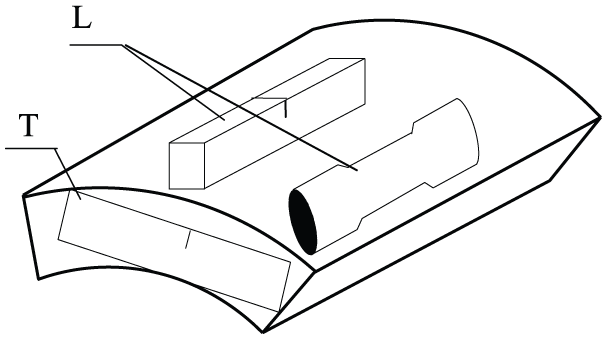
Scheme of cutting test specimens from a fragment of the pipeline.
Pitting damage
The main defects of the main gas pipeline include damage and pipe deformation, failure of the insulating coating, which appears at different stages of operation. 11 However, the analysis of the test results and the internal pipe diagnostics testify to the fact that the percentage of the corrosive defects on the internal surface is less than 10% of the corrosive defects on the external surface, which include ∼30% (corrosive pits and pitting) and ∼70% (stress corrosion cracks). 13
These two types of damages decrease the pipe thickness, which under certain circumstances may cause the formation of cracks and rupture of pipes. Based on the analysis of inspection of the pipeline corrosive status and the results of technical diagnostics, it is shown that the presence of corrosive pits (Figure 2) is the main reason for the hydrogenation of the pipe wall, which activates the processes of the structural damage of the material, thus decreasing its crack growth resistance. 14

Corrosive pits found on the external surface of the gas pipeline after 40 years of operation (a) zoom factor is 150 and(b) zoom factor is 250.
It should be noted that corrosion occurs on both the inner and the outer surface of the pipeline. Currently, during construction of new main pipelines, steel pipes with pre-insulation are used. However, the manufacture of these pipes began just not more than 20 years ago. Pipelines previously constructed (including studied in this article) were isolated in the field. The applied asphalt insulation was applied for more than 40 years ago, although experience shows that a satisfactory period of use for these types of coatings is not more than 15 years. The film insulation coating applied in the field conditions after such a long life does not fit for purpose to isolate the pipe from groundwater and condensate.
That is why we assume that the hydrogenation took place and influenced on the degradation properties of the investigated steel 17G1S.
Mechanical properties of the service-exposed pipeline metal
It is found that the service-exposed steel is characterized by significant differences between the strength properties in various directions; however, they are higher than those in the initial material (Table 2). Obviously, the exhaustion of plasticity (hardening) of the gas pipeline material takes place during its operation. In addition, an increase in the relative elongation of the material cut along the pipe axis takes place, which is preconditioned by the opening of multiple defects in the damaged material. 1 The material cut in the transverse direction, on the contrary, is characterized by a decreased relative elongation, which is caused by the material embrittlement and quasi-brittle shear mechanism of failure in the vicinity of structural defects.
Characteristics of steel 17G1S of gas pipeline KWU-1 in the initial state and after 40 years of operation.

The fractographic analysis of the cylindrical surfaces of fractured specimens has revealed a significant amount of defects. The strain accumulated in these areas was added to the general registered strain and was reflected in the strain of the working surface. Obviously, these “artifacts” cause an ambiguous hydrogenation effect on the values of plasticity and strength. 7 So, parameter φ, which is determined as a result of the fractured specimen analysis, should be considered most informative and objective in determining the hydrogen embrittlement of materials of gas and oil pipelines.1,7
In the initial state, the microhardness of steel 17G1S was 1200 MPa. For the degraded pipe, the value of microhardness Hµ at a distance from the internal pipe surface increases monotonously from 1150 MPa and attains “saturation” at 1700 MPa. The main reasons for that include the incompleteness of atom connections on the surface (surface energy) and lack of conditions for restraining (limiting) strains during plastic yielding, which are located favorably in respect to the loading direction and microvolumes of material. 15 In other words, the fixation of dislocations takes place in microvolumes of the material under the stress corrosion effect. The hardness of the service-exposed material is higher as compared to that in the initial state. The information about the variation of hardness is given in Table 3.
Hardness of steel 17G1S in the initial state and after 40 years of operation.

A significant decrease in the impact toughness (KCV) from 2.0 MJ/m2 in the initial state to 0.85–1.05 MJ/m2 was found, which is more pronounced for the metal cut from the pipe in the transverse direction. The energetic parameters of the dynamic failure of steel 17G1S are generalized in Table 4.
Energy efficiency of impact fracture of steel 17G1S in the initial state and after 40 years of operation.

A decrease in the impact fracture energy of the service-exposed material is caused by the formation of microcracks due to lamination and multiple damage of the material. An increase in the relative elongation of the main gas pipeline material (along the pipe) after operation from 23.5%–26.0% to 44.0% is found, as well as a decrease in the relative necking from 59% to 46%. The results obtained are generalized in Figure 3, and the value of degradation was determined, as an example, 10 from the following formula

where φ0 is the relative necking of the material in the initial state and φdeg is the relative necking of the material after the operation.

Degradation of the mechanical characteristics of steel 17G1S after 40 years of operation for the (a) longitudinal and (b) transverse directions of cutting.
The generalized values (in relative units) of the pipe material degradation, which are determined based on the results of different test types and evaluation parameters, are presented in Figure 3.
One of the main reasons for steel failure after a long-term operation is the non-uniform distribution of strains in the material. Moreover, the initiation of failure is caused by the localized instability of the deformation process caused by the presence of the structural defect at the micro- or mesolevel. 16
The process of plastic deformation of steel 17G1S takes place gradually at several scale levels. Each level is characterized by its particular structural and deformation defects. For the microlevel these are dislocations, for the mesolevel grain conglomerates and pore clusters, and the macrolevel considers the specimen as the solid medium. The structural self-organization of the material of a certain scale level, which takes place during plastic deformation, ceases on condition of the ultimate defect concentration. This condition can be considered as the bifurcation point and moment of the system transition to a higher level. 17
Plastic deformation is accompanied and ends by failure. 18 The process of microfailure occurs in the elementary material volumes, as a rule, in the vicinity of structural defects, inclusions, and so on. Failure at the mesolevel is the coalescence of microdefects with the formation of a defect, which is larger in size than the structural element of the material (grain). The coalescence of several mesodefects transfers the process to the macrolevel.
The main regularities in deformation and failure of specimens from steel 17G1S cut in different directions are considered.
Static failure
Longitudinal cutting
The specimen fracture surface testifies to the active plastic yielding of the material during deformation, during which the ductile separation with a multiple dimple formation took place (Figure 4(a)–(c)). The static deformation of the material results in a banded corrugated mesostructure of the surface layer. The plastic deformation bands are oriented in the force application direction.

Fracture surface of specimens from the service-exposed steel 17G1S cut in the (a–c) longitudinal and (d–f) transverse directions after 40 years of operation.
Transverse cutting
The specimen fracture surface testifies to a significant non-uniformity of the material, which causes the deformational and grain boundary hardening, as well as the increased sensitivity to strain localization, and proneness to the brittle spalling of the structural components. 19 However, the “orderliness” of the banded structure, which is capable of impeding deformation processes on grain boundaries, causes quite a high strength of such a material, although a decreased plasticity, as evidenced by the neck shape (Figure 4(d)–(f)).
The experiments performed on smooth specimens and specimens with the preliminarily delineated cracks have proved that the service-exposed steels show a high sensitivity to the hydrogen cracking both at the stage of crack nucleation and at the stage of crack propagation. 20
Impact failure
It is known that the velocity of deformation has an effect on the “injection” of energy into the material, hardening of its matrix, and the accompanying processes of the material opening as a whole. 21 The performed fractographic investigations of the specimens cut from the pipe in the transverse direction allow stating that the new pipe fails in the ductile manner by the dimple separation mechanism, which testifies to a high energy efficiency of the process (Figure 5).

Fracture surfaces of specimens cut from the service-exposed steel 17G1S in the transverse direction (a) for a new pipe and (b) for a pipe after 40 years of operation.
Failure of the service-exposed pipe takes place with the formation of dissipative structures in the form of the voluminously connected localized bands of “channels.” Special attention should be paid to the geometrical distortions of channels detected on the surface, in the form of extractions with individual transverse laminations. This allows concluding that dissipative structures have quite a high level of structural and mechanical damage, which determines the non-uniformity of their dynamic failure, which is higher than static loading.
This experimentally established fact proves that the mechanical properties of materials within the stress concentration zone after impact loading of various intensities can change within a broad range.
Damage of the grain boundaries and grain conglomerates takes place during operation; moreover, the distance between the structural elements increases. However, if in case of the longitudinal direction these processes take place on grain boundaries, in case of the specimens cut in the transverse direction these boundaries are the boundaries between grain conglomerates (bands of rolling). So, a common feature for the two cases investigated is the formation of the structural and hierarchical non-uniformity; however, this process takes place at different scale levels.
Discussion
The results obtained are important for understanding failure mechanisms of the pipeline system materials. Especially interesting is an increase in the material non-uniformity, that is, a change in the condition of the structurally non-uniform medium at different structural level. A change in the condition of the structural levels of materials takes place during deformation of steel 17G1S. It is known from literature that evolution of such a system is a typical synergetic process, which can be described using the principles of non-equilibrium thermodynamics. 17
Let us note certain peculiarities of the mechanical behavior of the service-exposed and non-exposed steel, which are obtained from the comparative analysis of their properties and failure mechanisms.
First, the synchronic character of variation of hardness and strength: hardness increases, which testifies to the deformation hardening of material during operation.
Second, the opposite character of variation of the relative elongation and relative necking, which, according to a number of works,1,5,11 testifies to the intensive scattered damage of the service-exposed material. A decrease in the relative necking indicates the in-service embrittlement of metal, including deformation hardening, which in turn is confirmed by the test methods of hardness and microhardness. At the same time, an increase in the relative elongation is connected with the opening of multiple defects, that is, it does not depict the material ability to deform plastically. This necessitates a critical attitude to relative elongation as the indicator of the plasticity of the service-exposed material if multiple damage is implied. Changes found in the mechanical behavior of the material subjected to a long-term operation can be explained by the fact that metal degradation is depicted not only in the deformation hardening but also in softening and increased opening of multiple defects.
Third, the material strength increases in both directions of cutting, and relative elongation increases only in case of cutting along the pipe. However, such a contradiction can be eliminated if an increase in hardness is caused by dislocation processes, and the processes of “plasticization,” which are subordinated to the “matrix+crack” system, by multiple damage of metal both before investigations (in-service damage) and during loading before the ultimate strength is attained. Thus, the ultimate strength is determined by the deformational abilities of the matrix before the appearance of the neck (exhaustion of the ability to a uniform plastic deformation) and relative elongation by the intensive variation of shapes of pores and microdefects. 22
Conclusion
Degradation of the material properties of the service-exposed main gas pipeline is investigated. A series of investigations performed allowed detecting changes in the mechanical properties of the steel. Long-term operation of the main gas pipelines decreases brittle-fracture resistance revealed by the drop of impact strength and reduction in relative necking.
Exploitation embrittlement of the metal, that is, the decrease in the brittle-fracture resistance along with the increase in metal hardness. The plasticity parameters of the metal changes in accordance with the opposite trend. In-service degradation of the pipeline causes relative narrowing and relative elongation of the pipeline material.
The revealed mechanical behaviors of steels after long-term operation can be explained under the assumption that the degradation of the metal manifests itself not only in the deformation aging but also in the intense development of damaging (defectiveness) on the micro- and submicrolevels, which was confirmed by fractographic analysis.
Footnotes
Academic Editor: Jianqiao Ye
Declaration of conflicting interests
The author(s) declared no potential conflicts of interest with respect to the research, authorship, and/or publication of this article.
Funding
The author(s) received no financial support for the research, authorship, and/or publication of this article.