



Abstract
Bubble–bubble interactions play important roles in the dynamic behaviours of multiple bubbles or bubble clouds in a vortical flow field. Based on the Rayleigh–Plesset equation and the modified Maxey–Riley equation of a single bubble, bubble–bubble interaction terms are derived and introduced for multiple bubbles. Thus, both the Rayleigh–Plesset and modified Maxey–Riley equations are improved by considering bubble–bubble interactions and then applied for the multiple bubbles entrainment into a stationary Gaussian vortex. Runge–Kutta fourth-order scheme is adopted to solve the coupled dynamic and kinematic equations and the convergence study has been conducted. Numerical result has also been compared and validated with the published experimental data. On this basis, the oscillation, trajectory and effects of different parameters of double-bubble and multi-bubble entrainment into Gaussian vortex have been studied and the results have been compared with those of the cases without bubble–bubble interactions. It indicates that bubble–bubble interactions influence the amplitudes and periods of bubble oscillations severely, but have small effects on bubble trajectories.
Introduction
Cavitation and gas bubbles entrainment into a vortical flow field is always of great importance, because of its either useful applications or undesirable effects, in chemical engineering, 1 hydraulic engineering, 2 marine and ocean engineering3,4 and so on. One famous example in marine and ocean engineering field is propeller cavitation. 5 It involves the kinematics and dynamics of multiple cavitation bubbles emerged at the finite hydrofoils. The vortex is generated from the interaction between the rotating propeller and the flow. The bubble nuclei translate and rotate along the vortex as well as oscillate and interact with each other. When the pressure at the bubble position induced by the vortex is lower than the local saturated vapour pressure, the bubble nucleus will grow explosively there. This process is usually called ‘cavitation inception’. Many studies5,6 indicate that the vortex cavitation bubble clouds mentioned above are one of the main reasons for the white wake after the stern of a high-speed ship.
To reveal this complex phenomenon, researchers have made great efforts in experimental, analytical and numerical simulations. Main studies in the last century can be found in the review paper ‘Cavitation in vortical flows’ by Arndt. 7 From the viewpoint of numerical modelling, work on cavitation and gas bubble entrainment into a vortical flow field can be broadly divided into two categories. In the first category, a small bubble nucleus is released and will be captured in the vortical flow field. Because just one single bubble is considered, it is relatively easy to track its motion and deformation induced by the vortex flow. Different methods were adopted to study the entrainment of the single bubble depending on whether the bubble was spherical or not. Hsiao and Pauley 6 studied the cavitation inception in a tip vortex flow through the spherical Rayleigh–Plesset (RP) bubble dynamics equation coupled with the bubble motion equation. The tip vortex flow was obtained from a Reynolds-averaged Navier–Stokes (RANS) solver. On this basis, Hsiao et al. 8 improved the spherical bubble dynamic model using the average pressure over the bubble surface to replace the pressure at the bubble centre. However, the bubble–vortex, vortex–vortex interaction and the non-spherical deformation of the bubble had not been considered in these researches. Hsiao and Chahine 9 applied spherical and non-spherical bubble dynamic models to study the cavitation inception, deformation and the scaling of the bubble in a vortex flow. The spherical and non-spherical models were both modified, where the spherical model accounted for the slip velocity between the bubble and the background flow, while the non-spherical model was embedded in an unsteady RANS code. Hsiao and Chahine 10 further extended this model to study the cavitation inception in a ducted propulsor and the vortex–vortex interaction was considered using Navier–Stokes (NS) computations. The work by Hsiao and Chahine et al. provided much insight on the single cavitation bubble captured by the vortex. Oweis et al. 11 applied direct numerical simulations and point-particle tracking method to study capture and inception of bubbles near a line vortex under non-cavitating and cavitating conditions. Numerical results were compared and validated with their experimental data from Oweis et al. 12 Choi et al. 13 applied both axisymmetric and three-dimensional numerical models to examine the non-spherical growth, oscillation and collapse of a vortex cavitation bubble from a spherical nucleus. The numerical models, named as ‘DF_UNCLE’, were based on finite volume formulation to solve the NS equations including full bubble–vortex interaction. Numerical results were compared with the experimental study of Choi and Ceccio 14 who recorded the deformation of individual cavitation vortex bubble produced by a laser-initiated nuclei passing through a region of pressure reduction and recovery. Ni et al. 15 and Zhang and Ni 16 used one-way coupled particle tracking method and the boundary element method to simulate the entire process of the motion of a bubble in a Gaussian line vortex field, including its release, capture, inception, deformation and splitting.
In the second category of the problem, multiple bubbles or bubble clouds are initially released in the vortical flow. The growth of the bubble number raises some challenging problems which a single bubble has not encountered. The most distinguishing one is the bubble will be influenced by the neighbouring bubbles, namely bubble–bubble interactions (BBI), which is short for BBI in this article. However, most previous researchers studied the multiple bubbles entrainment into vortex flow using the same method as the single bubble and just increased the number of equations directly. For example, Hsiao and Chahine 17 simulated the acoustic pressure generated by cavitation inception in a tip vortex flow in water containing a realistic bubble nuclei size distribution through the spherical bubble dynamics model directly. Hsiao et al. 5 considered the effect of gas diffusion across the bubble wall on the entrainment and dynamics of bubble nuclei population in the flow field of a propeller. Park et al. 18 distributed multi-bubbles with prescribed size and position initially and studied the multi-bubble motions in a vortex flow of a hydrofoil by spherical RP model. It was found that cavitation inception of smaller nuclei is more sensitive to the change of cavitation number. Some other researchers focused on the bubble–vortex interactions rather than BBI. Finn et al. 19 developed a discrete element model to simulate the bubble entrainment and interactions with two-dimensional vortical flows. It was found that the existence of the bubble resulted in the distortion of the vortex. Cihonski et al.20,21 further extended the study to three-dimensional simulation of travelling vortex ring together with a few micro-bubbles using a volumetric coupling approach. However, in their model, they ignored bubble oscillations and just took bubbles as spheres with gas density.
On the other hand, BBI have been extensively studied in various flow fields, such as in infinite flow field,22,23 near the walls,24–26 in homogeneous bubbly flows, 27 in a sound field28–31 and under given pressure waves. 32 It is found that the coupling of bubbles may lead to a variety of phenomena that a single bubble can never exhibit, such as attraction and repulsion of pulsating bubbles,24,28,33,34 phase delays 35 and even coalescence.36,37 However, most previous studies on BBI in these flow fields focused on the oscillations of bubbles at their static balance positions, which denote the positions of stationary bubbles when the inner pressure equals to the fluid pressure outside, instead of the translations of bubbles, so the effect of BBI on the motion equations of moving bubbles has been seldom considered.
It seems that there has been little work which considers the BBI during multiple moving bubbles. On the other hand, inspired by the previous studies in other flow fields, BBI are expected to affect multiple bubbles entrainment into a vortical flow field, which is still not understood and needs to be studied further. These form the prime motivation of the present work and give its distinctive focus. Here, we adopt a stationary Gaussian vortex and distribute prescribed numbers of very small bubble nuclei inside it. RP equation and modified Maxey–Riley (MR) equation are both improved and solved simultaneously to obtain the oscillations and motions of bubbles. The numerical model is validated against the published experimental data. Influences of different parameters such as bubble radii and number are further considered.
The main motivation or contribution of this article from a modelling standpoint is the incorporation of additional terms in the RP equation and kinematic equation of bubble motion to account for BBI. It shows that the amplitude and period of bubble oscillation have been changed significantly relative to the un-modified equations. As a result, the vortex cavitation inception and motion of multi-bubble nuclei may be predicted more accurately by the model developed here, which would lead to a better way to control the propeller cavitation and improve the effectiveness of the propeller of high-speed vessels.
Mathematical formulation
Dynamic and kinematic models of multiple bubbles
Dynamic model
To study the dynamics of multiple bubbles, we first consider the oscillation of a spherical bubble in an infinite free flow field. It is assumed that the fluid is incompressible with constant density

where

It should be noticed that the last term on the right-hand side of equation (1) becomes zero in equation (2). As discussed by Yang and Yeh, 39 the viscous term in Newton liquid to a spherical bubble is zero and the contribution of viscosity just comes from the boundary layer of the bubble, as shown in equation (4).
Integrating equation (2) from the bubble radius R to the infinity

where
Taking the surface tension and the viscous stress at the bubble surface into account, one can link the bubble inner pressure

where
Substituting equation (4) into equation (3) and considering the relative translational slip velocity between the bubble velocity

where
Equation (5) can be used to study the oscillation of a single bubble in a carrying flow. However, when multiple bubbles are involved, BBI should be incorporated on the basis of equation (5). It is assumed any bubble is so small that the asphericity of bubble surface can be ignored. On the other hand, the bubble size is assumed to be much smaller than the distance between bubbles and the existence of a bubble will not change the sphericity of another one. By integrating equation (2), one can obtain the pressure wave emitted by a pulsating bubble j as 42

where
It is further assumed that bubble sizes and oscillation periods are much smaller than the length and time scale of the ambient flow, respectively. Thus, the presence and oscillation of the bubbles will not change the distribution of the ambient flow, which is also named as ‘one-way coupling’ Lagrangian point-particle model. 21 The pressures induced by the neighbouring bubbles can be linearly added 22 to the vortex flow pressure and thus the oscillation equation of bubble i can be obtained by
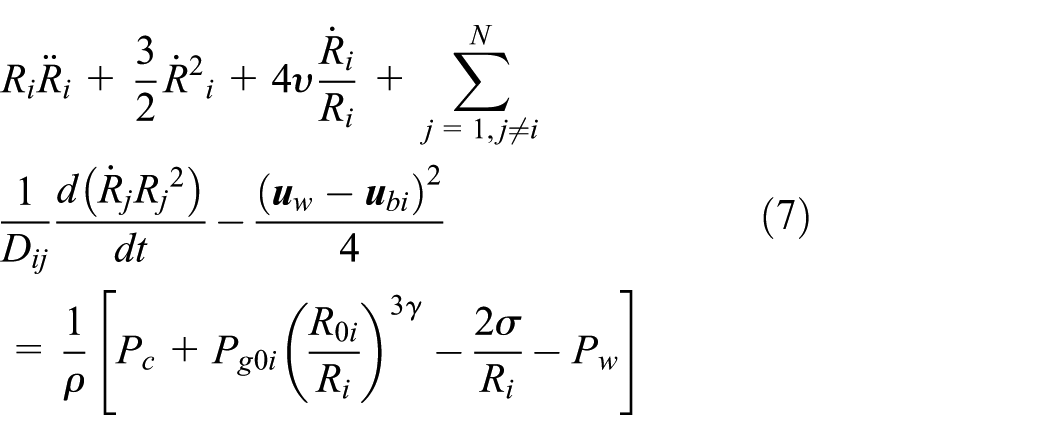
where
Kinematic model
Based on the MR equation 44 of a small rigid sphere in a non-uniform flow, the motion equation of a small spherical bubble in an incompressible liquid in the Lagrangian reference frame can be written as

where
When multiple bubbles are considered, it is expected that the neighbouring bubbles will induce additional forces besides the forces above. The induced force

where

where
Substituting equation (10) into equation (8) and considering gas density
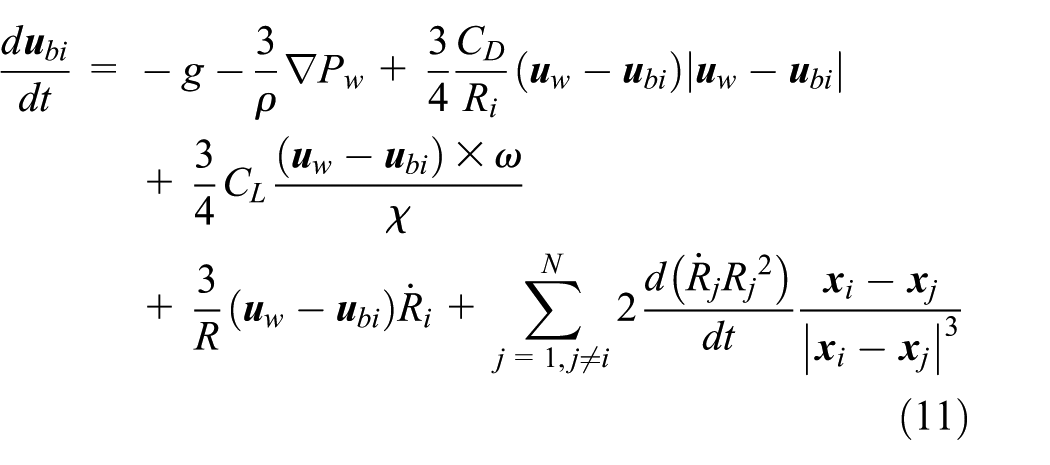
Equation (11) can be adopted to calculate the translation of multiple bubbles in a given vortex flow. The Runge–Kutta fourth-order scheme is applied to solve equations (7) and (11) simultaneously. It should be noticed that although the induced velocity of bubble j may disturb the motion of bubble i also, this disturbance is
Gaussian vortex model
According to the hydrofoil theory, a finite aspect ratio hydrofoil generates a free vortex along the tip. Various free vortex models can be adopted corresponding to different kinds of foil shape, such as Gaussian vortex (also known as Lamb–Oseen vortex), Rankine vortex and Scully vortex. Gaussian vortex is adopted in this article.
Combining the Gaussian vortex flow and the incoming free-stream flow, one can obtain the velocity and pressure of the undisturbed carrying flow as


where


It can be calculated that the maximum tangential velocity emerges at local core radius
Numerical results and discussions
Convergence study and comparison
Convergence study with time step
The present model is first verified through convergence study with time step. The parameters of the Gaussian vortex are same as those in Oweis et al.,
12
that is,

Schematic of the problem.
The fixed time step

Radius oscillation of bubble 1 at different time steps.
Comparison with experimental data
The numerical model is further validated by comparison with experimental data. The experimental data on bubble rotating and captured by a vortex are rare, especially for multi-bubbles. Here, we adopted the photographic experimental data
11
of an initially static bubble releasing and moving in a line Gaussian vortex. The experimental parameters are
Figure 3 provides the comparison between numerical results and experimental data, where the circles come from the outlines of the bubble recorded in the photos by Oweis et al. 11 It can be seen that the position and volume of the numerical bubble agree with those of experiment in general. Because the numerical model is based on the spherical bubble theory, it can be understood that bubble shapes disagree. Besides, the capture time in experiment is 2.8 ms while the numerical one is 2.6 ms, which are close too. For more discussions, refer to Ni et al. 15 The agreement validates the single-bubble model in the Gaussian vortex flow and the coupling effects of multi-bubbles will be studied on this basis.

The comparison of bubble entrainment between experimental data (circles, from Oweis et al. 11 ) and numerical simulation (spheres).
Two-bubble case study
Based on the convergence study and validation with experimental data, the cases of double bubbles and multiple bubbles will be studied in this and next sections. Hereafter, the initial bubble radius ranged from
Comparison between cases with and without BBI
The trajectory and oscillation of two bubbles are simulated in this section and the results are compared with those without BBI. The parameters are same with those in section ‘Convergence study with time step’.
Figures 4 and 5 show the radius oscillations of bubbles 1 and 2 in the cases with and without BBI, respectively. It is interesting to notice that the amplitude of bubble 1 is depressed while that of bubble 2 is intensified, compared to those without BBI. The average amplitude of bubble 1 is depressed by up to 49.0% while that of bubble 2 is intensified by up to 25.5%. As the bubble radii oscillate periodically, the amplitudes of them also show cyclical fluctuations. On the other hand, the oscillation periods of bubbles 1 and 2 increase by 0.6% and 2.2%, respectively, relative to the case without BBI. So BBI influence both the oscillation amplitude and period of bubbles distinctly. The changes are different from those of two static bubbles oscillating in a uniform pressure field, where two bubble oscillations are the same. 32 Thus, we predict the pressure background or the bubble position affects the oscillation also. Actually, we have done a series of study by changing the initial relative positions of the two bubbles and found that the initial radial positions r affects the oscillation amplitude predominantly. The pressure varies with r, which induces the oscillation amplitude at a smaller r intensified but the one at a larger r depressed. However, it can be seen in Figures 4 and 5 that the bubble capture time and balance radius are almost same with those without BBI. It denotes that BBI may have little influence on the bubble trajectories, which will be validated in Figure 6.

Radius oscillations of bubble 1 in cases with and without BBI: (a) within a long time and (b) within a short time.

Radius oscillations of bubble 2 in cases with and without BBI: (a) within a long time and (b) within a short time.

Trajectories of bubble 1 in the cases with and without BBI.
Figure 6 shows the comparison of trajectories of bubble 1 in the cases with and without BBI. It can be seen that bubble trajectory with BBI almost coincides with that of the bubble without BBI. This is because the BBI term
Figure 7 shows trajectories and distance of two bubbles with BBI, where bubble positions corresponding to the largest distance in Figure 7(b) are marked in Figure 7(a). It can be seen that either bubble presents a kind of ‘reduced spiral’ motion. The largest distance happens when the two bubbles move to the two ends of the circumference relatively in their trajectories. When they approach to the vortex core or when they are captured, the two bubbles will move along the axis of the Gaussian vortex at carrying liquid velocity, so the distance between them remains constant as shown in Figure 7(b).

Motion of bubbles with BBI: (a) trajectories of bubbles and (b) distance of bubbles.
Here, we will further investigate the influence of different parameters on BBI of double bubbles in a Gaussian vortex field, such as bubble radii and initial distance between two bubbles.
Initial radii of bubbles
The initial radii of the bubbles are important factors that influence bubble oscillations, as Li et al.
32
showed in their work where the oscillation of double bubbles is driven by pressure fluctuation. As mentioned in section ‘Comparison with experimental data’, the initial radial position r affects bubble oscillations predominantly. In order to eliminate the influence of r, only z-coordinates of two bubbles are different here. The initial coordinates of the two bubbles are
Figure 8 shows the oscillation of bubble 1 at different ratios between the initial radii of the bubbles, where just a short time span is provided for a clearer view. It can be seen that initial radii ratio will influence the oscillation amplitude and period of the bubbles. For the oscillation period, it is observed that the period in the case of

Oscillations of bubble 1 at different ratios of initial radii: (a) radius and (b) radius amplitude.
Initial distance between bubbles
The initial distance
Figure 9 shows the oscillation of the radius of bubble 1 with BBI at different

Oscillations of bubble 1 at different initial distances between two bubbles: (a) radius and (b) radius amplitude.
Multi-bubble case study
Based on the double-bubble case considered in previous sections, multi-bubble cases with different bubble numbers or distributions will be analysed in this section, which is more general in realistic situation.
Bubble number
Under different numbers of bubbles in the vortex field, bubble oscillations will change greatly. Different numbers of bubbles with same radii
Figure 10 shows radius oscillation of bubble 1 in multi-bubble case at different bubble numbers. It is observed that oscillation period of bubble 1 will increase by 1.6% and 3.8%, respectively, as bubble number rises from 2 to 3 and 5. Besides, the average amplitude of bubble 1 will also rise by up to 12.5% and by up to 16.5% correspondingly, respectively. It can be further seen in Figure 10(b) that as bubble number increases, the cyclical fluctuation of the oscillation amplitude will become more intense, with larger amplitude and smaller period.

Oscillations of bubble 1 at different bubble numbers: (a) radius and (b) radius amplitude.
Bubble distribution
Three kinds of distribution of five bubbles with same radii
Figure 11 shows the trajectories of these five bubbles at three kinds of distributions. It can be seen that all bubbles present kinds of ‘reduced spiral’ motion as mentioned in section ‘Comparison between cases with and without BBI’. As for the Figure 11(a), the bubble closer to the vortex core will be captured earlier. When bubble 1 and bubble 2 both approach to the vortex core, the distance between them becomes very small and the mathematical model does not work anymore. Thus, the calculation terminates then. Similar situation also happens for the case of distribution along the circle, where the calculation terminates when the distance between either two bubbles is smaller than a critical value, as shown in Figure 11(c).

Bubble trajectories at three kinds of distributions: (a) r axis distribution, (b) z axis distribution and (c) circle distribution.
Conclusion
The dynamic behaviours of multiple bubbles entrainment into a vortical flow field have been investigated by solving the coupled improved RP and MR equations where BBI terms are introduced. On the basis of convergence study and comparison with experimental data, series of numerical simulation have been conducted. The results have also been compared with those without BBI. Some conclusions have been drawn as follows:
The oscillations of the bubbles are affected by BBI greatly, but the trajectories of the bubbles are hardly influenced.
When the bubbles have same initial radii, BBI is able to increase amplitude of the bubble with a smaller radial position by up to 25.5% while reduce that of the other one by up to 49.0% relative to the case without BBI over the parameter space studied. Meanwhile, it extends both the oscillation periods of the two bubbles by up to 2.2%.
When the bubbles have same radial positions, BBI is able to intensify the amplitude of the bigger bubble and depress that of the smaller bubble. In terms of the oscillation period, when the radii of two bubbles equal, the oscillation period reaches longest.
Both amplitudes and periods of the bubbles will rise with the increase of bubble number.
Footnotes
Academic Editor: Moran Wang
Declaration of conflicting interests
The author(s) declared no potential conflicts of interest with respect to the research, authorship, and/or publication of this article.
Funding
The author(s) disclosed receipt of the following financial support for the research, authorship, and/or publication of this article: This work is supported by Lloyd’s Register Foundation through the joint centre involving University College London, Shanghai Jiaotong University and Harbin Engineering University, the National Natural Science Foundation of China (Nos 11302056, 11302057, 11472088 and 51579054) and the International Postdoctoral Exchange Fellowship Program (No. 20140068), to which the authors are most grateful. Lloyd’s Register Foundation helps to protect life and property by supporting engineering-related education, public engagement and the application of research.