



Abstract
Pallet pooling is a basis for the operation of a city joint distribution system. Pallet allocation is a key problem for the success of a pallet pool. This article considers a multi-station, multi-period, and multi-type pallet allocation problem over a pallet pool in a city joint distribution system. First of all, we develop a deterministic model to optimally allocate pallets when managers have perfect knowledge of the information that will be available. By case studies, we show that this model can help managers to make scientific decisions. The influence of transportation capacity on decisions is shown by numerical simulation. And we propose managers should use both demand forecasting and leasing and renting tactics to minimization allocation cost. Then, we propose a multi-scenario model to optimally allocate pallets when some uncertain parameters cannot be estimated through historical data. The application of this multi-scenario model is also illustrated.
Introduction
At present, the project of city joint distribution system (CJDS) was proposed by the Ministry of Commerce of PRC and the Ministry of Finance of PRC. This project has received extensive attention from various circles of society. CJDS is designed to guarantee that all goods are distributed to their destination through a joint distribution center. It is a good solution to the problem of “last kilometer,” but is a complex system. In a CJDS, the logistics system is more efficient because all the goods are loaded on pallets when transported. As pallets are viewed as not only equipment but also assets, how can the manager fully reap their use benefits and receive a measurable return of investment becomes a challenging issue. Although there are three kinds of pallet management methods (transfer of ownership, pallet exchange, and pallet pooling), pallet pooling has increasingly gained its popularity. 1 However, there is still no recent study on establishing a pallet pool in a CJDS.
Pallet pools have been studied since 1960s. Murray 2 introduced a pallet pool which enables officers at every Swedish railway station to complete document and invoice work for sending freight container to Great Britain or United States. Auguston, 3 McKerrow, 4 and Witt 5 each stated pool participants could reap a variety of benefits from pallet pooling. Lacefield 6 suggested a company should create a cross-functional team to make the decision on whether to rent or own pallets. Brindley7,8 introduced that the economic feasibility study by Penn State confirms profit potential for new, industry cooperative block pool in the United States. Brindley 9 analyzed what was happening in pallet pool industry and how it can influence this industry. Brindley 10 found that Loscam had taken a dominant position in Asia and Loscam executives offered insight on the Asian pallet market, particularly the huge growth potential in China. There are also some other literature on pallet pools.
It is very important to allocate pallets efficiently. Brindley 11 pointed out that pallet logistics had become one of the most crucial aspects in the pallet business, and repositioning pallets could make or break a pallet pool. Almost all the big pallet rental companies, like Commonwealth Handling and Equipment Pool (CHEP) Intelligent Global Pooling Systems (iGPS), and PECO (PECO pallet) are struggling to figure out how can they put the right number of pallets in the right place at the right time. Mosqueda 12 said the trip cost is the real number to watch, not the issue fee. The trip cost includes all of the pricing elements combined together to equal your real cost to use the rental pallet. In most cases, your US$5.00 issue fee will turn into a US$7–US$10 per pallet, depending on how well you work the program.
However, as to our best knowledge, there is very few literature on pallet allocation problem yet except Ren and Zhang,13–15 let alone literatures on the problem in a CJDS. The purpose of this article is to study pallet allocation over a pallet pool in a CJDS. To address this problem, we developed a deterministic optimization model and a multi-scenario optimization model.
The remainder of the article is organized as follows: Section “Problem descriptions” presents the pallet pool we addressed and described its main components and characteristics. Section “Deterministic model” is dedicated to the development of the deterministic model for this problem. The multi-scenario model is presented in Section “Multi-scenario model.” Conclusions are drawn in section “Conclusion.”
Problem descriptions
In a CJDS, a pallet services supplier will build some service stations to provide good services for customers. The most important service is to provide the right numbers of right pallets when customers need them. The pallet service supplier also purchase or lease pallets from outside pools to meet the demands if necessary. The supplier also has to make sure that there are enough pallets to meet demands at each station by moving pallets among all stations. This basic allocation process is shown in Figure 1.
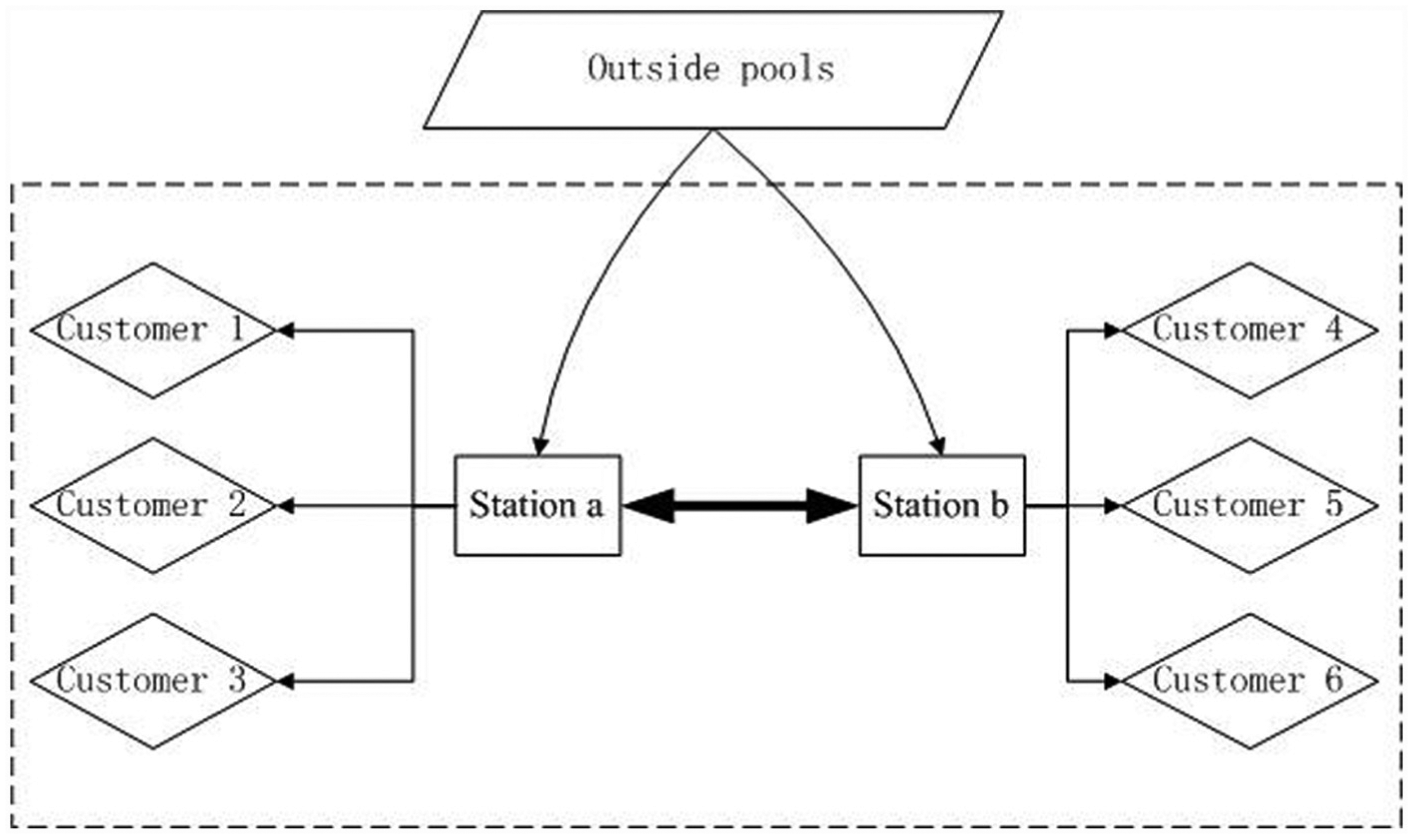
Basic pallet allocation process in a CJDS.
Those decisions need to be carefully made under a great deal of information, including the demand of all customers, the stock of each service station, and the transportation capacity. If all the information could be known accurately, which is an idealized situation, managers can therefore make perfect decisions by using the deterministic model we presented in the next section.
However, managers always have to make decisions in uncertain circumstances. The uncertain circumstances mean historical data are inappropriate for estimating uncertain parameters. For instance, the demand is hard to estimate because our market is uncertain. In order to ensure an effective allocation scheme for different possible realizations of uncertain parameters, we have to generate a set of scenarios, and a multi-scenario model is needed.
Deterministic model
Assumptions
There are several irreplaceable types of pallets.
All demands should be satisfied. If there are not enough pallets, the pallet service supplier will purchase or lease pallets from outside pools. There is no limit to purchase or lease number.
Supply of each kind of pallet at each station has been estimated.
Demand of each kind of pallet of each customer has been estimated.
Unitary cost of transportation, storage, and purchasing and leasing has been estimated.
Weight of each type of pallet occupying transportation capacity has been estimated.
Transport time and transportation capacity between two nodes have been estimated.
Formulation
This subsection presents the modeling of the problem of a deterministic formulation. The model minimizes the total allocation cost and subject to the constraints of demand, supply, transportation capacity, and so on. This formulation is to be used in a rolling-horizon fashion. It determines decisions to be implemented “immediately” and assess its impacts on the system evolution. Then, in the “next” period, new information becomes available and the model must be run again to make new decisions. 16
To describe the system, we introduce the following notations for the deterministic model.
Index
I is the set of stations of a pallet service supplier. T represents the set of time period.
Decision variables
Deterministic parameters
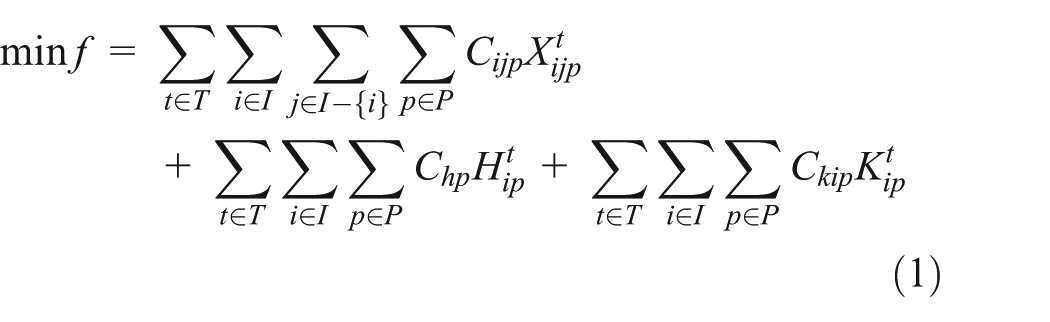
The objective function set (1) minimizes the total cost of allocation pallets over a pallet pool in a CJDS. The total cost includes pallet delivery cost, purchasing or leasing cost of pallets from outside pools, loading and unloading cost, and holding cost at pallet service stations
The constraint set (2) ensures that all demands of each kind of pallet should be fulfilled

The constraint set (3) guarantees that the number of pallets moved from a pallet service supplier’s station to all customers do not exceed the sum of its supply capacity. The supply capacity is derived from the amount of stock at the last period plus the new supply quantity at this period and the number of pallets purchased or leased from outside pools, and the inflow of pallets from other stations, then minus outflow of pallets to other stations and the stock at this period

The constraint set (4) imposes an upper transportation capacity bound on the number of pallets that can be moved between two locations

The constraint set (5) indicates that all decision variables are non-negative integer values

Experimental results
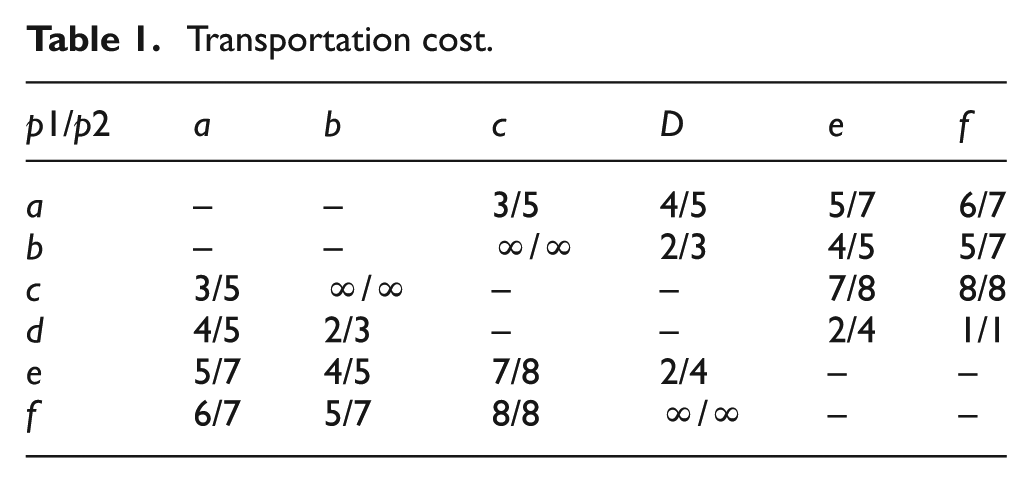
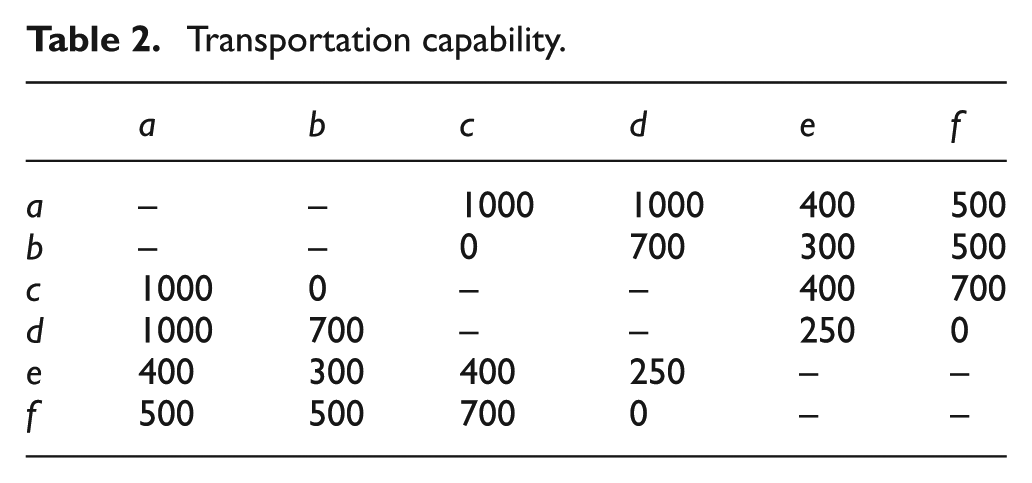
To illustrate the interest of this model, we simulated the behavior of a pallet pool in a CJDS. In this system, there are six pallet service supplier’s stations
Transportation cost.
Transportation capability.
Supplies and demands.

Transportation time.
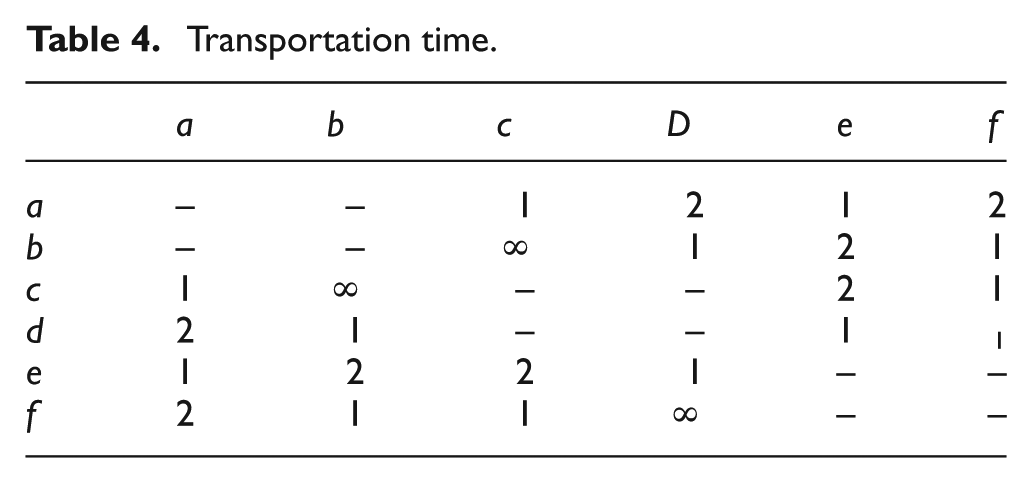
We run the model with MATLAB. An optimal allocation scheme is shown in Figure 2.

Optimal scheme of the deterministic model.
The total cost is 24,620. All demands are satisfied and no station need to purchase or lease pallet from outside pools. According to the results, we found that all the requirements of this case are satisfied, which therefore means the validity of that deterministic model is proved.
Transportation capacity does not increase or decrease easily which lead to an awkward situation when customer demand changes. We should pay more attention to this parameter in a CJDS. As we can see from Figure 2, despite a low unitary transportation cost between d and f, pallets do not move from d to f. The reason is the transportation capacity between them is empty. If we set this capacity to be 700, total cost will be reduced to 14,341. The optimal allocation scheme is showed in Figure 3.

Optimal scheme of the deterministic model with a larger transportation capacity.
In this experiment, managers could reduce total cost by improving transportation capacity, but that decision may not be a good one in the long run for managers have to pay more cost for extra capacity. What is worse is the number of pallets moving from d to f reduces after we enlarged transportation capacity, managers would receive a measurable lose on that investment. In this article, we proposed a more scientific method to make the transportation capacity between two stations be reasonable.
We suggest managers estimate demands through historical data when making decision on transportation capacity. When the actual demand is greater than the expected one, managers can meet those extra demands easily by leasing capacity from other companies. On the contrary, managers could lease out surplus capacity to other companies.
Multi-scenario model
Assumptions
In previous sections, we assumed the supply, demand, and transportation capacity to be perfectly estimated. We now relax these assumptions.
Historical data are inappropriate for estimating parameters like customer demands, transportation capacity, and new supplies to pallet service stations.
Pallet service supplier may exceed or fail to fulfill the customer’s uncertain requests. Pallet service supplier has to pay punishment cost when it happens. Punishment cost of failing to satisfy requests is higher than exceeding them, for inadequate supply will cause customer losing.
Formulation
We will model the problem as a multi-scenario formulation. In order to propose the model, we have to use the method of scenario planning.16,17 The model minimizes the expected total allocation cost and subject to the constraints of demand, supply, transportation capacity, congruity, and so on. This formulation is also to be used in a rolling-horizon fashion.
The objective function set (6) minimizes the expected total cost of allocation pallets over a pallet pool in a CJDS. The total cost includes pallet delivery cost, purchasing or leasing cost of pallets from outside pools, loading and unloading cost, punishment cost of failing to satisfy requests or exceeding them, and holding cost at pallet service supplier’s stations. S implies the set of scenarios.

The constraint set (7) shows that

The constraint set (8) shows the unitary punishment cost. If

The constraint set (9) guarantees that the number of pallets moved from a pallet service supplier’s station to all customers do not exceed the sum of its supply capacity

The constraint set (10) imposes an upper transportation capacity bound on number of pallets that can be moved between two locations

The constraint sets (11), (12), and (13) are congruity constraints which means the decision variables to be implemented are identical in each scenario



The constraint set (14) indicates that all decision variables are non-negative integer values

Experimental results
This multi-scenario model will be studied by a case presented in subsection “Experimental results” after we modify some information in advance. We assume the demand of customers at e at time t4 and the transportation capacity from d to e at time t4 are uncertain. The unitary punishment cost of exceeding the requests of
In this section, we will analyze three significant scenarios as follows:
S1 assumes that (1) the requests for
S2 assumes that all the other uncertain parameters are equal to the expected ones.
S3 assumes that (1) the requests for
We assumed w1 = 0.2, w2 = 0.4, and w3 = 0.4. An optimal allocation scheme is shown in Figure 4.
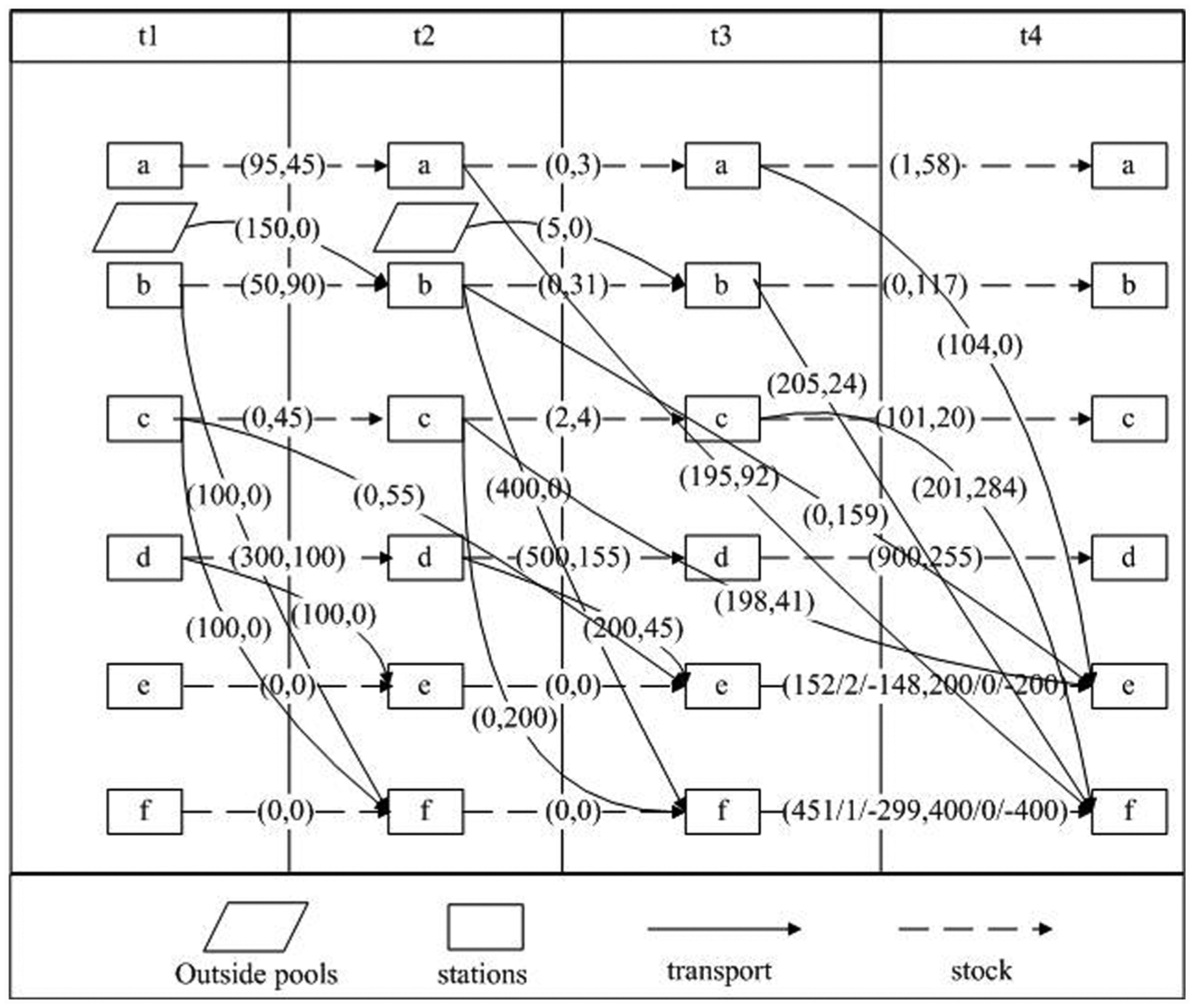
Optimal scheme of the multi-scenario model.
Our experimental result shows that the total expected cost is 34852.2. In this case, we have higher expected cost than the one in subsection “Experimental results” because of uncertain demand at time t4. If we set w1 = 0, w2 = 1, and w3 = 0, which means that only scenario 2 will happen, the expected cost in this case is the same as the case we studied in subsection “Experimental results.” In fact, only if we set the transportation capacity will always be the expected value, the result is as we analyzed above. Otherwise, the constraint set (10) would make the result be changed because the capacity in scenario 1 and scenario 2 is not enough.
According to the result, we found that all the requirements of this case are satisfied, so the validity of this multi-scenario model is proved.
Conclusion
The living cost in each city of China is so high, one of reasons for which is that its logistics cost in Chinese cities is too high. This problem is named as “last kilometer.” The project of CJDS is proposed to solve the problem. In a CJDS, pallets will be widely used and accordingly how to effectively allocate these pallets become an aporia.
In this article, we presented a deterministic model and a multi-scenario model for pallet allocation over a pallet pool in a CJDS. The problem is a multi-station, multi-period, and multi-type pallet allocation problem. The applications of the two models were illustrated. As far as we know, there is still no literature on the problem addressed in this article yet. So these are two basic models that can help the managers of a pallet pool in a CJDS to make scientific decisions.
The managers should estimate how much information will be available. If they get perfect knowledge of the information, they should use the deterministic model to make decisions. If they have not enough information to estimate uncertain parameters, they should use the multi-scenario model to make decisions. We suggest that they create a team to decide how to generate scenarios and assign weights to these scenarios. Furthermore, we suggest managers should develop an intelligent algorithm to rapidly solve the two models when the problem size is large. Otherwise, they can just use CPLEX, LINGO, or other optimization software to solve the two models.
Footnotes
Acknowledgements
The authors would like to thank Dr Massimo Di Francesco at University of Cagliari and Dr Judd Michael at Penn State University for their help in the research.
Academic Editor: Geert Wets
Declaration of Conflicting Interests
The author(s) declared no potential conflicts of interest with respect to the research, authorship, and/or publication of this article.
Funding
The author(s) disclosed receipt of the following financial support for the research, authorship, and/or publication of this article: This research was supported by the Research Foundation for Advanced Talents of Inner Mongolia University (2200-5145103) and the National Natural Science Foundation of China (71502087).