




Abstract
Pallets are widely used around the world. Pallet pooling, as a useful management method of pallets, has become more and more popular. It is very important to allocate pallets over a pallet pool efficiently. However, there is very little literature on the pallet allocation problem as to our knowledge. This article addresses a pallet allocation problem where some uncertain parameters can be estimated through historical data, while some others cannot be. To address this problem, with the method of stochastic chance constrained programming and scenario planning, we propose an optimization model in which sustainable factors and customer priority factors are taken into account. The sustainable factors are used to measure the sustainable development costs of pallets. The customer priority factors are used to measure the customers’ rating. It is proved by experimental tests that the model can help pallet pool managers make more effective pallet allocation schemes against uncertainty. It is also suggested by the results that we should pay attention to sustainable factors and customer priority factors when making decisions.
Introduction
Pallets move the world. 1 In the United States, an estimated 4 billion pallets are in daily service. Nationwide, on an annual basis, an estimated 441 million new pallets are manufactured and 357 million pallets are repaired or rebuilt from discarded pallets. 2 As pallets are viewed as assets, their management becomes essential to fully reap their benefits and to receive a measurable return on investment. Historically, pallets have been managed by one of three methods (transfer of ownership, pallet exchange, and pallet pooling), and pallet pooling has increasingly become popular over the last two decades. 3
Pallet pools have been studied for a long time. Auguston, 4 McKerrow 5 and Witt 6 stated pool participants could reap a variety of benefits from pallet pooling. Lacefield 7 suggested a company should create a cross-functional team to make the decision on whether to rent or own pallets. Ray et al. 8 found that rental pallet systems were, on average, more costly to the customers through the supply chain than purchased pallet systems, by at least US$1.00 per pallet trip. Brindley 9 introduced that the economic feasibility study by Penn State confirmed profit potential for new, industry cooperative block pool in the United States. Brindley 10 analyzed the effect of Costco’s suggestion which was that iGPS (Intelligent Global Pooling Systems), PECO (PECO pallet), and CHEP (Commonwealth Handling and Equipment Pool) block pallets in North America should be regarded as the primary options for Costco’s suppliers. Brindley 11 analyzed what was happening in pallet pool industry and how it could influence this industry. Brindley 12 found that LOSCAM had taken a dominant position in Asia and LOSCAM executives offered insight on the Asian pallet market, particularly the huge growth potential in China.
It is very important to allocate pallets efficiently. Brindley 13 pointed out that pallet logistics had become one of the most crucial aspects of being in the pallet business, and repositioning pallets could make or break a pallet pool. Almost all the big pallet rental companies, like CHEP, iGPS, and PECO, were struggling to figure out how to put the right number of pallets in the right place at the right time. Mosqueda 14 said the trip cost was the real number to watch not the issue fee, and the trip cost included all of the pricing elements combined together to equal your real cost to use the rental pallet. In most cases, your US$5.00 issue fee would turn into a US$7–US$10 pallet, depending on how well you work the program.
However, there is very little literature on the pallet allocation problem to our knowledge. Ren and Zhang15,16 presented an integer programming model and a stochastic programming model for a modified pallet pool. Ren and Zhang 17 developed a two-stage stochastic chance constrained programming model that regarded the minimization allocation cost as the target. Ren et al. 18 proposed a multi-scenario model for multi-type pallet allocation over a pallet pool considering the uncertain future without adequate historical data. Their deterministic model assumed perfect knowledge of the information that will be available and may yield low-quality allocation plans. The stochastic optimization models required a good knowledge of uncertain parameter distributions to be adopted successfully. The scenario optimization model aimed to allocate pallets when historical data were inappropriate for estimating uncertain parameters. 19 However, we disappointedly found that there is no paper that addresses a pallet allocation problem where some uncertain parameters can be estimated through historical data, while some others cannot be.
In fact, managers of pallet pools always could have a good knowledge of distributions of its own stock capacity, supply capacity, and loading and unloading capacity. As to the distributions of customers’ stock capacity, supply capacity, loading and unloading capacity, and transportation capacity, they are correspondingly difficult to obtain when needed. To address this problem, we developed an optimization model for multi-type pallet allocation over a pallet pool with the method of stochastic chance constrained programming and scenario planning.
The remainder of the article is organized as follows: section “Problem descriptions” presents the pallet pool, and we address and describe its main components and characteristics. Section “Modeling” is dedicated to the development of the mathematical formulation of this problem. We tested our optimization model in section “Experimental results.” Conclusions are drawn in section “Conclusion.”
Problem descriptions
Typical pallet pools include, but are not limited to, the following:
Third-party owned pool. Pallets are owned by a third-party that manages all aspects of the pallet pool. 3
Cooperative pool. The pallet pool is managed by an organization with a lot of members who own and exchange pallets. An example of third-party-owned pool companies is CPC (The Canadian Pallet Council).
Third-party managed pool. The pallets are owned by the user, but all aspects of the pallet pool are managed by a third party. 3
Private pool. The manufacturer owns the pallets and manages all aspects of the pallet pool. 3
We will develop a model suit for the four kinds of pallet pool because they have some basic common features as follows. A pallet pool always consists of several pallet service suppliers and some pallet service demanders. As for a third-party owned pool, the service station of the pallet rental company is a pallet service supplier and its customers are demanders. As for a cooperative pool, a member who provides recycling, leasing, repairing, or other services is a supplier and a member who requires services is a demander. As for a third-party managed pool, a third-party management company is a supplier and the companies who own the pool are demanders. As for a private pool, a pallet management department is a supplier and those departments using pallets are demanders.
A pallet service demander could be a demand customer or supply customer. A demand customer requires that one or several types of pallets be delivered at its site, while a supply customer has one or several types of pallets that need to be taken away. A pallet service supplier has many depots to provide pallet services for pallet service demanders. The most important job of a pallet service supplier is to satisfy the demand customers’ requests and take away the pallets from supply customers. In order to allocate pallets more efficiently, a pallet service supplier move pallets not only from their own pallet service depots to demand customers (distribution) but also from supply customers to demand customers (reposition). If there are surplus pallets at a supply customer after reposition, its pallet service supplier is supposed to recover them (recovery). A pallet service supplier can also purchase pallets from outside pools to satisfy demand customers’ requests if necessary. The basic allocation process consists of four stages (purchase, distribution, reposition, and recovery), which is shown in Figure 1.

Basic allocation process of a pallet pool.
As sustainable development is concerned, the costs of purchasing new pallets are completely different from reusing old ones. So we put sustainable factors into consideration in our model. The sustainable factors are used to measure the sustainable development costs of pallets which are refer to costs of resource consumption and environmental pollution.
From the perspective of customer strategy, in order to maximize the economic benefit of the pallet pool, managers have to adopt different strategies to meet different customers’ demand. So in the model that will be proposed, customer priority factors will be considered. The customer priority factors are used to measure the customers’ rating.
Modeling
To describe the system, it is important to introduce the following notations for the multi-type pallet allocation model.
There are several pallet service suppliers, supply customers, and demand customers in a pallet pool.
The multi-type pallet allocation plan is scheduled in a certain period of time, and the managers of the pool have to make some decisions.
The unitary cost of transportation, storage, loading and unloading, and purchasing have been estimated.
The pallet service supplier has to pay punishment cost if it fails to recover all the pallets from a supply customer. The higher the customer priority, the more the punishment cost.
A pallet service supplier has to pay punishment cost if it fails to satisfy the requests of a demand customer or exceeds them. The punishment cost of failing to satisfy requests is higher than the cost of exceeding them for inadequate supply, which will lead to losing customers. The positive correlation between punishment cost and customer priority is assumed in the model.
The sustainable development cost of using a new pallet is higher than reusing an old one. The sustainable development costs of pallets which are made from different materials are not the same.
We assume that part of the supply, storage capacity, and loading and unloading capacity of pallet service supplier’s depots are deterministic and the other parts are stochastic. The deterministic one is resulting from perfect information which is received prior to the beginning of the planning horizon. The stochastic one is corresponding to the forecast but uncertain future, and the distribution of the stochastic supply, storage capacity, and loading and unloading capacity of pallet service supplier’s depots can be estimated.
The historical data are inappropriate for estimating some parameters including requests of demand customers, available pallets that have to be taken away from supply customers, pallet damage ratio for each supply customer, loading and unloading capacity of all customers, and transportation capacity.
The weight of each type of pallet occupying transportation capacity, storage capacity, and loading and unloading capacity have been estimated.
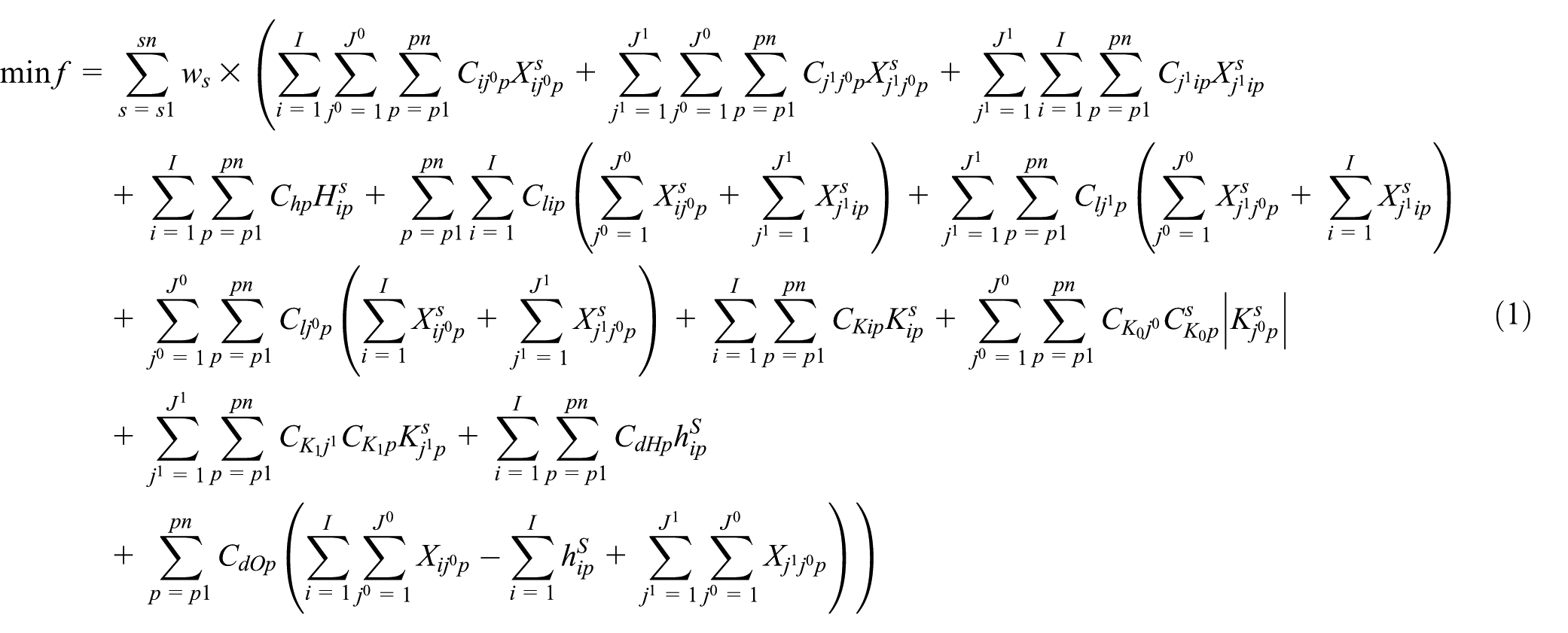
The objective function set (1) minimizes the expected total cost of allocation pallets over a pallet pool. The total cost includes pallet delivery cost (distribution, reposition, and recovery) between locations, holding cost at pallet service supplier’s depots, purchasing cost of pallets from outside pools, loading and unloading cost, punishment cost of failing to satisfy requests or exceeding them, punishment cost of failing to recover pallets from supply customers, and sustainable development cost of using new pallets and old ones. The numbers of old pallets are the number of old pallets to be moved from pallet service suppliers to demand customers plus the number of pallets to be moved from supply customers to demand customers. And the number of old pallets to be moved from pallet service suppliers to demand customers is the number of all pallets to be moved from pallet service suppliers to demand customers minus the new pallets purchased from outside pools
The constraint set (2) ensures that the number of pallets moved from a pallet service supplier’s depot to all demand customers do not exceed the sum of its supply capacity and the number of pallets purchased from outside pools. The constraint set (3) guarantees that the number of pallets moved from a pallet service supplier’s depot is more than the number of pallets purchased from outside pools


The constraint set (4) makes sure that the number of pallets moved from a supply customer to demand customers does not exceed the available pallets that are in good condition at this supply customer. The number of available pallets that are in good condition is derived from the number of pallets that ought to be taken away from a supply customer by the intact proportion (1 − damage percentage) of pallets at this supply customer

The constraint set (5) shows the available stock of pallets at a pallet service supplier’s depot. The pallet stock is derived from the number of supply capacity (or initial inventory) at a pallet service supplier’s depot plus the number of pallets purchased from outside pools and inflow of pallets from supply customers, then minus outflow of pallets to demand customers. According to constraint (6), pallets stored at a pallet service supplier’s depot are not supposed to over storage capacity


The constraint set (7) shows the number of pallets which has not been recovered. It is derived from the number of pallets that have to be taken away from a supply customer minus the outflow of pallets to demand customers and to pallet service supplier’s depots. The constraint set (8) ensures the number of pallets which has not been recovered is non-negative


The constraint set (9) shows the number of pallets exceeding or failing to satisfy the requests of a demand customer. It is derived from the inflow of pallets from pallet service’s depots and supply customers minus the requests of this customer. The constraint set (10) shows the unitary punishment cost. If the inflow of pallets from pallet service supplier’s depots and supply customers is more than the requests of a demand customer, the unitary punishment cost will be the cost of exceeding the requests. Otherwise, it will be the cost of failing to satisfy the requests


The constraint sets (11), (12), and (13) impose an upper transportation capacity on the number of the pallets that can be moved between two locations



The constraint sets (14), (15), and (16) impose a loading and unloading capacity on the number of pallets loaded or unloaded at a pallet service supplier’s depot, a supply customer, and a demand customer, respectively


The constraint sets (17), (18), (19), and (20) are congruity constraints




The constraint set (21) indicates that all decision variables are non-negative integer values

This model is suit for each of those four kinds of pallet pools. As long as managers could assign a role for each member in a pool, they could use this model to make better decisions.
Experimental results
We simulated the behavior of a pallet pool. In this system, there are two pallet service supplier’s depots
The purchasing cost of a
Unitary transportation cost.
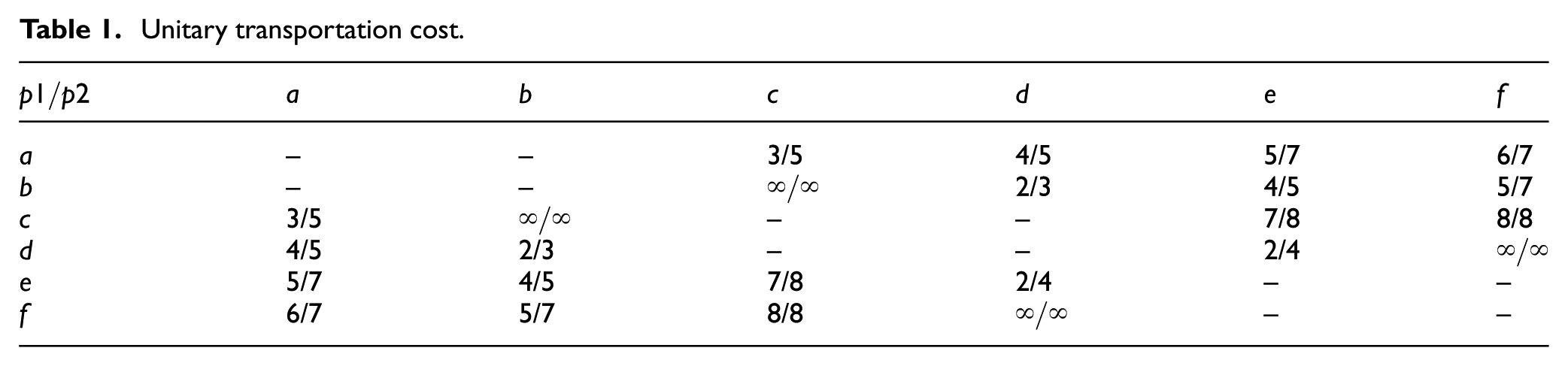
Transportation capability.
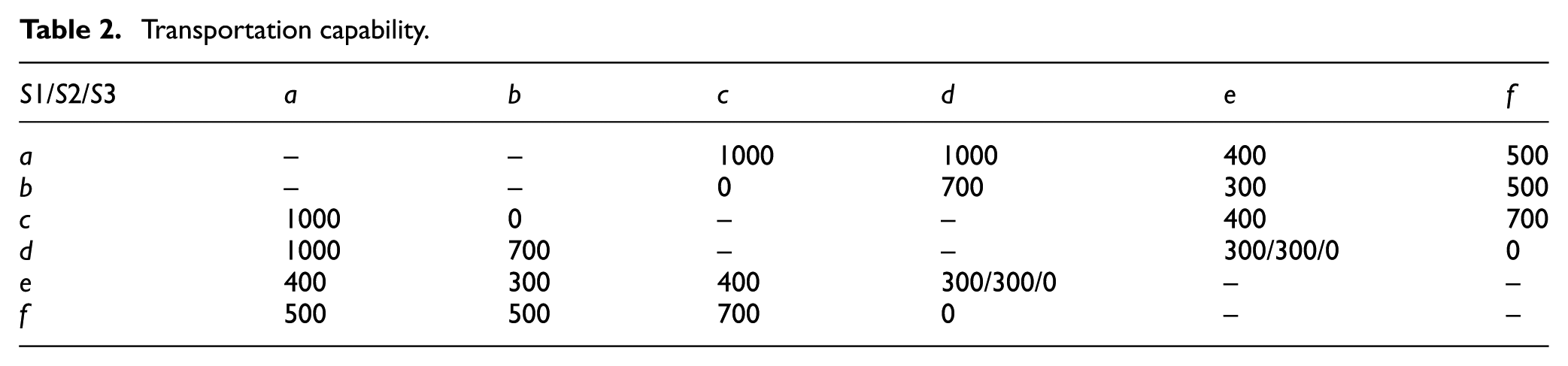
Supplies and demands.
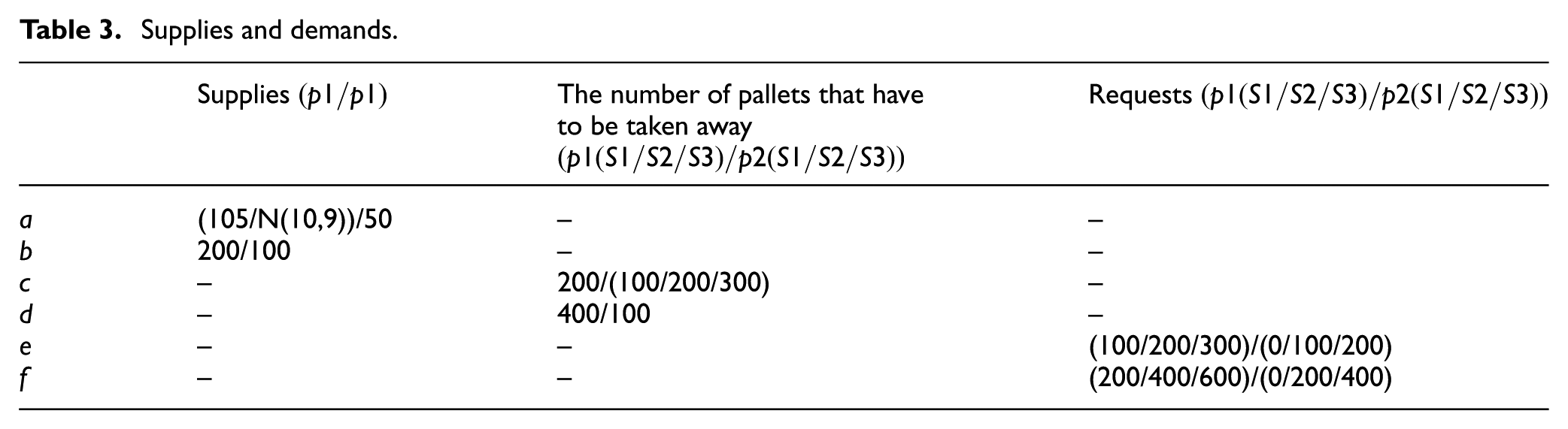
Other parameters.

We will analyze three significant scenarios as follow. S1 assumes that (1) the number of
Case 1
We assumed
Optimum scheme for case 1.

Case 2
We assumed
Optimum scheme for case 2.

As analyzed in Table 7 (D.F. (demand fulfillment) and R.F. (recovery fulfillment)), our model can help managers of a pallet pool make an effective multi-type pallet allocation scheme against uncertainty.
1. The important effects of sustainable factors on decision making
Analysis.

D.F.: demand fulfillment; R.F.: recovery fulfillment.
We assumed
2. The important effects of customer priority factors on decision making
Optimal scheme.


The important effects of sustainable factors on decision making.
Let
Optimal scheme.


The important effects of customer priority factors on decision making.
Conclusion
In this article, we present a model that can provide an optimal pallet allocation scheme over a pallet pool when some uncertain parameters can be estimated through historical data, while some others cannot be. The objective of this model is to minimize the expected total pallet allocation cost. This model’s constraints include supply capacity, transportation capacity, loading and unloading capacity, and so on. Additionally, sustainable factors and customer priority factors are studied in this article. It is apparently shown by our experimental tests that our work is of great help for the pallet pool managers make right decision under uncertain environment. We also found that sustainable factors and customer priority factors are quite important in decision making: (1) managers should use less high sustainable factor pallets and (2) managers should preferentially fulfill the demands of those customers with high priority.
Footnotes
Acknowledgements
The authors would like to thank Dr Massimo Di Francesco at University of Cagliari and Dr Ming-Miin Yu at National Taiwan Ocean University for their help on the research. The authors are grateful to the anonymous referee for a careful checking of the details and for helpful comments that improved this article.
Academic Editor: Rahmi Guclu
Declaration of conflicting interests
The author(s) declared no potential conflicts of interest with respect to the research, authorship, and/or publication of this article.
Funding
The author(s) disclosed receipt of the following financial support for the research, authorship, and/or publication of this article: The paper was supported by the National Natural Science Foundation of China (71502087), the Research Foundation for Postdoctor of Inner Mongolia University, and the Research foundation of China Society of Logistics (2016CSLKT3-015).