




Abstract
The aim of this article is to introduce a modified analytical approach to obtain quick and accurate solution of wave-like fractional physical models. This modified analytical approach is an innovative adjustment in Laplace transform algorithm and homotopy analysis method for fractional partial differential equations. The proposed technique solves the problems using Adomian’s polynomials. The homotopy analysis transform method utilizes a simple and powerful method to adjust and control the convergence region of the infinite series solution using an auxiliary parameter. The numerical solutions obtained by this modified proposed method indicate that the approach is easy to implement, highly accurate, and computationally very attractive. A good agreement between the obtained solutions and some well-known results has been obtained.
Keywords
Introduction
Fractional differential equations have drawn the interest of many researchers1–4 due to their important applications in science and engineering. Fractional derivatives provide an excellent instrument for the description of memory and hereditary properties of various materials and processes.
Our concern in this work is to consider the numerical solution of the time-fractional wave equations. Wave-like model can describe many physical problems in different fields of science and engineering. These physical problems describe some nonlinear phenomena such as earthquake stresses 5 and non-homogeneous elastic waves in soils. 6 Recently, there has been a growing interest for obtaining the explicit solutions to heat-like and wave-like models by analytic techniques. The different types of heat-like and wave-like physical models in physics have been solved by Wazwaz and Gorguis, 7 Shou and He, 8 and Özis and Agırseven. 9
In this article, the homotopy analysis transform method (HATM) basically illustrates how the Laplace transform can be used to approximate analytical solutions of the wave-like fractional models by manipulating the homotopy analysis method (HAM). The proposed method is coupling of the HAM and Laplace transform. The main advantage of this proposed method is its capability of combining two powerful methods for obtaining rapid convergent series for fractional partial differential equations. HAM was first proposed and applied by Liao10–13 based on homotopy, a fundamental concept in topology and differential geometry. The HAM has been successfully applied by many researchers for solving linear and nonlinear partial differential equations.14–22 In recent years, many researchers have paid attention to obtaining solutions to linear and nonlinear differential and integral equations using various methods by combining the Laplace transform method. Among these, we may mention the following: Laplace decomposition methods23,24 and homotopy perturbation transform method.25–28 Recently, Khan et al. 29 have applied to obtain the solutions of the Blasius flow equation on a semi-infinite domain by coupling homotopy analysis with the Laplace transform method.
The main aim of this article presents approximate analytical solutions of wave-like physical models with time-fractional derivative
Definition 1
The Laplace transform

Definition 2
The Laplace transform

Basic idea of HATM
To illustrate the basic idea of the HATM for the fractional partial differential equation, we consider the following fractional partial differential equation as

where

Now, using the differentiation property of the Laplace transform, we have

We define the nonlinear operator

where

where

Thus, as

where

If the auxiliary linear operator

which must be one of the solutions of original nonlinear equations.
Define the vectors

Differentiating equation (7)

Operating the inverse Laplace transform on both sides, we get

where

and

In this way, it is easy to obtain

when

In this way, it is easily to obtain

where
The nonlinear term

where

Combining equations (17) and (20), we get

From equation (21), we calculate the various
In order to select the optimal value of auxiliary parameter

with

Numerical experiments
In this section, two examples on time-fractional wave equations are solved to demonstrate the performance and efficiency of the HATM.
Example 1
We consider the one-dimensional wave-like equation with variable coefficients7–9 as

subject to the Neumann boundary conditions

and the initial conditions

We choose linear operator as

with property
We now define a nonlinear operator as

Thus, we obtain the mth-order deformation equation

Operating the inverse Laplace transform on both sides in equation (29), we get

where

Now the solution of mth-order deformation equations

Using the initial approximation




Proceeding in this manner, the rest of the components

However, mostly, the results given by the Laplace decomposition method and homotopy perturbation transform method converge to the corresponding numerical solutions in a rather small region. But, different from those two methods, the HATM provides us with a simple way to adjust and control the convergence region of solution series by choosing a proper value for the auxiliary parameter

where

When we choose
Figure 1 shows the behavior of obtained solution

Plot of solutions at different values of
The convergence and rate of approximation for the HAM solution strongly depend on the value of auxiliary parameter
Figure 2 shows the
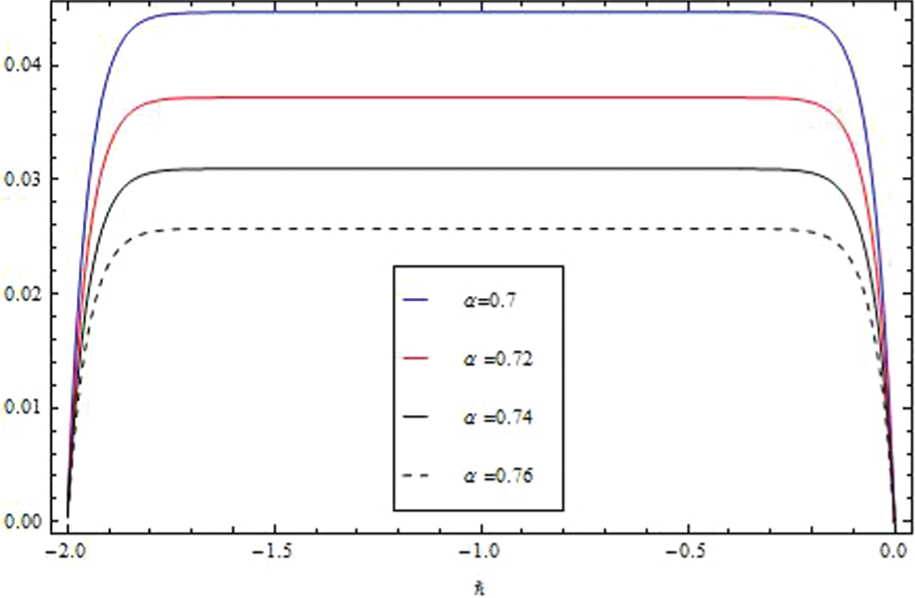
Plot of
Example 2
In this example, we consider the following two-dimensional wave-like equation with variable coefficients7–9 as

subject to the Neumann conditions

with initial condition

Applying the Laplace transform on both sides in equation (35) and after using the differentiation property of Laplace transform, we get

We choose the linear operator as

with property
We now define a nonlinear operator as

Using equation (7), with assumption

Obviously, when

Thus, we obtain the mth-order deformation equation

Operating the inverse Laplace transform on both sides in equation (43), we get

where

Now, the solution of mth-order deformation equations

Using the initial approximation



Proceeding in this manner, the rest of the components

For

where the functions

As
Figure 3 shows the behavior of the approximate solution

Plot of solutions at different values of α = 0.7, 0.8, 0.9, and 1 for Example 2.

Plot of
Concluding remarks
In this article, we carefully proposed a reliable modification of the HAM which introduces a promising tool for solving wave equations of fractional order. Different from all other analytic methods, it provides us with a simple way to adjust and control the convergence region of solution series by introducing an auxiliary parameter. This work illustrates the validity and great potential of the HATM for fractional differential equations. An excellent agreement is achieved. The solution is very rapidly convergent by utilizing the modified HAM by modification of Laplace operator. It may be concluded that the modified HATM methodology is very powerful and efficient in finding approximate solutions as well as analytical solutions of many fractional physical models.
Footnotes
Acknowledgements
The authors are very grateful to the referees for carefully reading the paper and for their comments and suggestions which have improved the paper. The second author is highly grateful to the Department of Mathematics, National Institute of Technology, Jamshedpur, India, for the provision of some excellent facilities and research environment. This work is also supported by the Natural Science Foundation of Heilongjiang Province, China (Grant No. QC2015069).
Academic Editor: Xiao-Jun Yang
Declaration of conflicting interests
The author(s) declared no potential conflicts of interest with respect to the research, authorship, and/or publication of this article.
Funding
The author(s) disclosed receipt of the following financial support for the research, authorship, and/or publication of this article: This work is also supported by the Natural Science Foundation of Heilongjiang Province, China (Grant No. QC2015069)