This article describes electrical series circuits RC and RL using the concept of derivative with two fractional orders and in Liouville–Caputo sense. The fractional equations consider derivatives in the range of . Numerical solutions are presented considering different source terms introduced in the fractional equation. This new approach considers electrical elements with two different properties. In addition, we prove that if , the fractional derivative with Mittag-Leffler kernel in Liouville–Caputo sense is recovered, and when , the Liouville–Caputo fractional derivative is recovered.
Fractional calculus (FC) allows to research the non-local response of multiple phenomena,1–6 particularly in electrical circuits, several authors studied the behavior of capacitors, coils, memristors, and meminductors.7–20 These elements involve irreversible dissipative effects (ohmic friction) and nonlinear effects due to the electric and magnetic fields.17,21,22 Rousan et al.23 suggested a fractional order differential equation to study an LC and RC circuit. Obeidat et al.24 studied the evolution of current in a simple source-wire circuit. Ertik et al.25 considered the RC electrical circuit and showed charging and discharging processes of different capacitors, and experimental results showed similar behaviors that obtained within the fractional calculus approach. In 2015, a new definition of fractional operator without singular kernel and regular is presented,26 the Caputo–Fabrizio fractional operator. Gómez-Aguilar et al.27 presented some electrical circuits in terms of Caputo–Fabrizio fractional operator; they obtained numerical simulations of these circuits by applying the numerical Laplace transform algorithm, and more works related to this fractional operator are given by Atangana and Alkahtani,28 Atangana and Nieto,29 Atangana and Alkahtani,30 Gómez-Aguilar et al.,31 and Alsaedi et al.32,33 Recently, Atangana and Baleanu proposed a new definition with non-local and nonsingular kernel based on the Mittag-Leffler function, this definition has all the benefits of the fractional derivatives of Liouville–Caputo and Caputo–Fabrizio types.34–38
The fractional operators mentioned above have been widely used. However, none of these fractional operators is capable of handling the concept of heterogeneity with great success. Using the Mittag-Leffler law, new derivatives with two fractional orders were developed by A Atangana39 in the paper; in this work, the author introduces fractional operators with two orders in Riemann and Liouville–Caputo sense; these operators allow to describe more complex problems with different layers and with different properties, for instance, in thermal science where the heat is flowing within a medium with two different properties.
The aim of this contribution is to present an alternative representation of the electrical series circuits RC and RL using the concept of derivative with two fractional orders and . The orders considered for the fractional equations are .
The article is organized as follows: second section presents the new definitions of fractional operators with bi-order and with Mittag-Leffler kernel, third section discusses the fractional electrical series circuits, and the fourth section presents the conclusions.
Basic concepts
In the following, we present the definition of fractional operators with bi-order39 in Liouville–Caputo sense
For this operator, the inverse Laplace transform is defined as follows
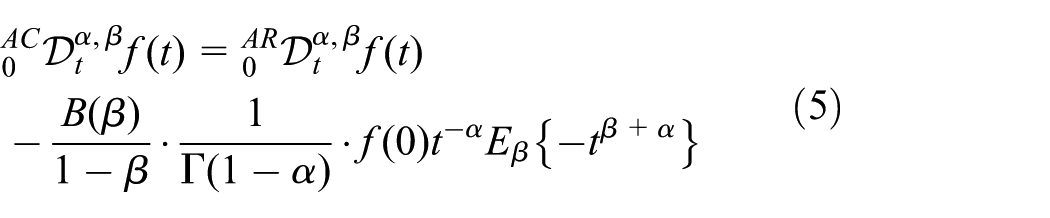
For the fractional operator with bi-order (equation (1)), when , the Atangana–Baleanu fractional derivative in Liouville–Caputo sense (ABC) is recovered. This operator is defined as follows34–38
where is an ABC fractional derivative with respect to , is a normalization function.
The Laplace transform of equation (6) is defined as follows34–38
For the fractional operator with bi-order (equation (1)), when , the Liouville–Caputo fractional derivative (C) is recovered. This operator is defined as follows
Electrical circuits
To keep the physical dimensionality of the fractional differential equation with bi-order (equation (1)), a parameter is introduced,40 this parameter has the dimension of seconds. In this case, we have
when , the expressions mentioned above are recovered in the classical case.
RC electrical circuit
Applying Kirchhoff’s laws, the equation of the RC electrical series circuit is given as follows
where C is the capacitance, R is the resistance, and the source voltage is .
Considering equation (1), the fractional equation with bi-order for this circuit is given as follows
where
τ is the fractional time constant with bi-order and is the classical time constant. Now, we obtain the numerical approximation of equation (12) considering different source terms.
First case
Unit step source, , , , equation (12) can be written as follows
The numerical approximation of equation (14) is given as follows
then
where is the Mittag-Leffler function.
If in equation (1), we recover ABC fractional derivative equation (6). Considering this operator, we have
where
τ is the fractional time constant and is the classical time constant. For the unit step source, , , , equation (17) can be written as follows
Applying the Laplace transform to equation (19), we have
The numerical approximation of equation (25) is given as follows
then
where is the Mittag-Leffler function.
Considering in equation (1), we recover ABC fractional derivative (equation (6)). Considering this operator, we have
where τ is given by equation (18). For the periodic source, , , , equation (39) can be written as follows
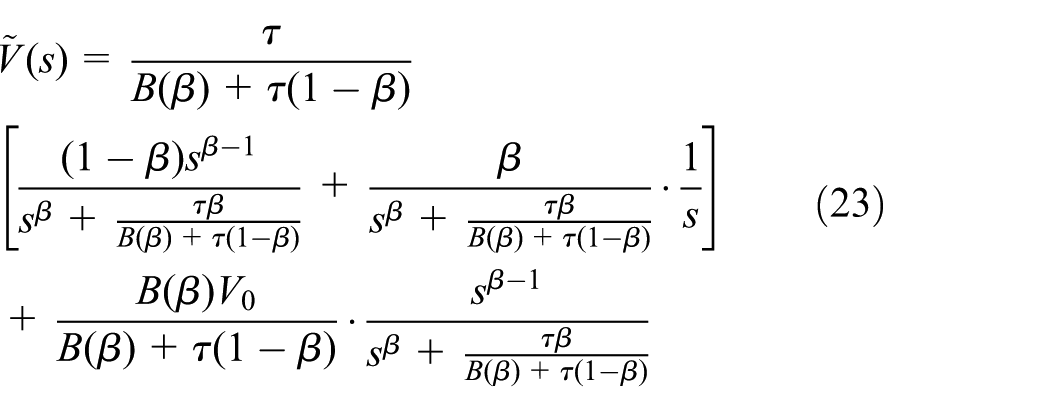
Applying the Laplace transform to equation (29), we have
where .
The expression for the voltage is as follows
Taking the inverse Laplace transform of equation (31), we obtain the following solution
RL electrical circuit
Applying Kirchhoff’s laws, the equation of the RL electrical series circuit is given as follows
where L is the inductance, R is the resistance, and the source voltage is E(t).
Considering equation (1), the fractional equation with bi-order for this circuit is given as follows
where
is the fractional time constant with bi-order, and is the classical time constant. Now, we obtain the numerical approximation of equation (34) considering different source terms.
First case
Unit step source, , , , equation (34) can be written as follows
The numerical approximation of equation (36) is given as follows
then
where is the Mittag-Leffler function.
Considering in equation (1), we recover ABC fractional derivative (equation (6)). Considering this operator we have
where
is the fractional time constant and is the classical time constant. Now, we obtain the numerical approximation of equation (39). For the unit step source, , , , equation (34) can be written as follows
Applying the Laplace transform to equation (41), we have
Applying the Laplace transform to equation (51), we have
where .
The expression for the current is as follows
Taking the inverse Laplace transform of (53), we obtain the following solution
Examples
Consider the electrical series circuit RC with , , and . Figure 1(a)–(d) shows numerical simulations for the voltage across the capacitor considering unit step source with bi-order operator, equation (16) and unit step source with ABC operator, equation (24) and periodic source with bi-order operator (27) and periodic source with ABC operator, equation (32), for different particular cases of and .
Numerical simulation for RC electrical series circuit: (a) fractional operator with bi-order, equation (16); (b) fractional operator of type ABC, equation (24); (c) fractional operator with bi-order, equation (27); and (d) fractional operator of type ABC, equation (32).
Consider the electrical series circuit RL with , , and . Figure 2(a)–(d) shows numerical simulations for the current across the inductor considering unit step source with bi-order operator, equation (38) and unit step source with ABC operator, equation (46) and periodic source with bi-order operator (49), and periodic source with ABC operator, equation (54), for different particular cases of and .
Numerical simulation for RL electrical series circuit: (a) fractional operator with bi-order, equation (38); (b) fractional operator of type ABC, equation (46); (c) fractional operator with bi-order, equation (49); and (d) fractional operator of type ABC, equation (54).
Conclusion
In this article, we describe electrical series circuits RC and RL using the concept of derivative with two fractional orders and in Liouville–Caputo sense. The definitions developed by Atangana are the extensions of Liouville–Caputo and Riemann–Liouville derivatives with Mittag-Leffler kernel. These fractional operators have been widely used; however, none of these fractional operators is capable of handling the concept of heterogeneity and structures with different scales with great success. In the literature, the fractional calculus is applied to various electrical circuit problems as a useful mathematical tool. In the electrical circuits, the experimental results do not comply with standard theoretical calculations; this is due to the effects of ohmic friction and temperature (dissipative effects related to resistance), and these losses are not taken into account in the standard approach. Since the temperature of these circuits increases with time, an unstable ohmic friction occurs during the process. This behavior is nonlinear and non-local in time (resistance value increasing nonlinearly with increasing temperature is not a constant parameter). In order to make a more realistic description, time-fractional derivative with bi-order can be used in the calculations; in this context, the results showed that there exists a close relationship between the temperature and fractional operator with bi-order. The case of corresponds to local behavior in time or classical case; in this case, is a constant parameter and dissipative effects are neglected, whereas the case corresponds to non-local behavior in time. In this alternative representation, considering fractional operators with bi-order is possible to describe more complex systems with different properties represented by and . These types of problems cannot be portrayed with existing derivatives with fractional order. Alternative methods of analysis involving novel integral transforms41–43 are goals of future works.
Footnotes
Acknowledgements
The authors would like to thank to Mayra Martínez for the interesting discussions. J.F.G.A. acknowledges the support provided by CONACyT: cátedras CONACyT para jóvenes investigadores 2014.
Academic Editor: Xiao-Jun Yang
Declaration of conflicting interests
The author(s) declared no potential conflicts of interest with respect to the research, authorship, and/or publication of this article.
Funding
The author(s) received no financial support for the research, authorship, and/or publication of this article.
References
1.
YangXJBaleanuDSrivastavaHM. Local fractional integral transforms and their applications. New York: Academic Press, 2015.
2.
SunHHaoXZhangY. Relaxation and diffusion models with non-singular kernels. Physica A2017; 468: 590–596.
YangXJ. Fractional derivatives of constant and variable orders applied to anomalous relaxation models in heat-transfer problems, 2016, https://arxiv.org/abs/1612.03202
5.
YangXJSrivastavaHMMachadoJT. A new fractional derivative without singular kernel. Therm Sci2016; 20: 753–756.
6.
YangXJZhangZZMachadoJT. On local fractional operators view of computational complexity. Therm Sci2016; 20: 755–767.
7.
KaczorekTRogowskiK. Positive fractional electrical circuits. In: KaczorekTRogowskiK (eds) Fractional linear systems and electrical circuits. Cham: Springer International Publishing, 2015, pp.49–80.
8.
BaoHParkJHCaoJ. Adaptive synchronization of fractional-order memristor-based neural networks with time delay. Nonlinear Dynam2015; 82: 1343–1354.
9.
YangQXuJCaoB. A simplified fractional order impedance model and parameter identification method for lithium-ion batteries. PLoS ONE2017; 12: e0172424.
10.
FoudaMEElwakilASRadwanAG. Power and energy analysis of fractional-order electrical energy storage devices. Energy2016; 111: 785–792.
11.
DancaMFTangWKChenG. Suppressing chaos in a simplest autonomous memristor-based circuit of fractional order by periodic impulses. Chaos Soliton Fract2016; 84: 31–40.
12.
TsirimokouGPsychalinosC. Ultra flow voltage fractional-order circuits using current mirrors. Int J Circ Theor App2016; 44: 109–126.
13.
TembulkarTDaradeSJadhavSR. Design of fractional order differentiator & integrator circuit using RC cross ladder network. Int J Emerg Eng Res Technol2014; 2: 127–135.
14.
SoltanARadwanAGSolimanAM. Fractional-order mutual inductance: analysis and design. Int J Circ Theor App2016; 44: 85–97.
15.
CaoJSytaALitakG. Regular and chaotic vibration in a piezoelectric energy harvester with fractional damping. Eur Phys J Plus2015; 130: 103.
16.
FreebornTJMaundyBElwakilAS. Fractional-order models of supercapacitors, batteries and fuel cells: a survey. Mater Renew Sustain Energ2015; 4: 9.
17.
ElwakilAS. Fractional-order circuits and systems: an emerging interdisciplinary research area. IEEE Circ Syst Mag2010; 10: 40–50.
18.
KumarS. A new analytical modelling for fractional telegraph equation via Laplace transform. Appl Math Model2014; 38: 3154–3163.
19.
YangXJMachadoJTCattaniC. On a fractal LC-electric circuit modeled by local fractional calculus. Commun Nonlinear Sci2017; 47: 200–206.
20.
Gómez AguilarJF. Behavior characteristics of a cap-resistor, memcapacitor, and a memristor from the response obtained of RC and RL electrical circuits described by fractional differential equations. Turk J Electr Eng Co2016; 24: 1421–1433.
21.
KimSKimS-JMin KimK. Physical electro-thermal model of resistive switching in bi-layered resistance-change memory. Sci Rep2013; 3: 1680.
22.
ChenJZengZJiangP. Global Mittag-Leffler stability and synchronization of memristor-based fractional-order neural networks. Neural Networks2014; 51: 1–8.
ObeidatAGharibehMAl-AliM. Evolution of a current in a resistor. Fract Calc Appl Anal2011; 14: 247–259.
25.
ErtikHÇalikAEŞirinH. Investigation of electrical RC circuit within the framework of fractional calculus. Rev Mex Fis2015; 61: 58–63.
26.
CaputoMFabricioM. A new definition of fractional derivative without singular kernel. Prog Fract Differ Appl2015; 1: 73–85.
27.
Gómez-AguilarJFCórdova-FragaTEscalante-MartínezJE. Electrical circuits described by a fractional derivative with regular Kernel. Rev Mex Fis2016; 62: 144–154.
28.
AtanganaAAlkahtaniBST. Analysis of the Keller–Segel model with a fractional derivative without singular kernel. Entropy2015; 17: 4439–4453.
29.
AtanganaANietoJJ. Numerical solution for the model of RLC circuit via the fractional derivative without singular kernel. Adv Mech Eng. Epub ahead of print 29October2015. DOI: 10.1177/1687814015613758.
30.
AtanganaAAlkahtaniBST. Extension of the resistance, inductance, capacitance electrical circuit to fractional derivative without singular kernel. Adv Mech Eng. Epub ahead of print 26June2015. DOI: 10.1177/1687814015591937.
31.
Gómez-AguilarJFYépez-MartínezHCalderón-RamónC. Modeling of a mass-spring-damper system by fractional derivatives with and without a singular kernel. Entropy2015; 17: 6289–6303.
AlsaediABaleanuDEtemadS. On coupled systems of time-fractional differential problems by using a new fractional derivative. J Funct Space2016; 2016: 4626940.
34.
AtanganaABaleanuD. New fractional derivatives with nonlocal and non-singular kernel: theory and application to heat transfer model. Therm Sci2016; 20: 763–769.
35.
Coronel-EscamillaAGómez-AguilarJFLópez-LópezMG. Triple pendulum model involving fractional derivatives with different kernels. Chaos Soliton Fract2016; 91: 248–261.
36.
Gómez-AguilarJF. Irving–Mullineux oscillator via fractional derivatives with Mittag-Leffler kernel. Chaos Soliton Fract2017; 95: 179–186.
37.
Gómez-AguilarJFEscobar-JiménezRFLópez-LópezMG. Atangana-Baleanu fractional derivative applied to electromagnetic waves in dielectric media. J Electromagnet Wave2016; 30: 1937–1952.
38.
AtanganaAKocaI. Chaos in a simple nonlinear system with Atangana–Baleanu derivatives with fractional order. Chaos Soliton Fract2016; 89: 447–454.
39.
AtanganaA. Derivative with two fractional orders: a new avenue of investigation toward revolution in fractional calculus. Eur Phys J Plus2016; 131: 373.