



Abstract
In order to better obtain information about customer requirement and develop products meeting customer requirement, it is necessary to systematically analyze and handle the customer requirement. This article uses the product service system of numerical control machine as research objective and studies the customer requirement modeling and mapping oriented toward configuration design. It introduces the conception of requirement unit, expounds the customer requirement decomposition rules, and establishes customer requirement model; it builds the house of quality using quality function deployment and confirms the weight of technical feature of product and service; it explores the relevance rules between data using rough set theory, establishes rule database, and solves the target value of technical feature of product. Using economical turning center series numerical control machine as an example, it verifies the rationality of proposed customer requirement model.
Keywords
Introduction
With the globalization of world economy development, manufacturing industry is facing huge challenges. Only the supply of products cannot adapt to the increasingly fierce market competition now, so the manufacturing enterprises have been forced to put its focus on providing overall solution of “product + service” instead of product development, and the product service system is the new-type manufacturing paradigm that rightly adapts to this strategic transition. As the key stage of development of product service system, configuration design is to configure the integrated solution of product service system that meets the customer requirement (CR), and the key point is to accurately understand the CR and develop products satisfying the customers.
CR refers to the requirement description of the customers about the product and service based on the function, performance, price, and others of product and service. When acquiring the CR, the customer does not know the function of product or service completely, and customers have different preferences. Therefore, the requirements about product and service are unclear, and it is needed to use scientific analytical methods to figure out the CR. In the meantime, this process is the premise and basis of configuration.
This article studies the CR modeling and mapping of numerical control machine. It introduces the conception of requirement unit (RU), discomposes the CR layer by layer, discomposes the unclear CR into specific RU, and finally establishes the parse tree model of RU, which can clearly describe the hierarchy and relevance between each RU. It also maps the CR using quality function deployment (QFD) to obtain the requirement weight in the configuration design of product and service. This article excavates rules of solution data in database using rough set theory so as to obtain the target value of the corresponding design requiremen and realize requirement mapping.
Literature review
Requirement modeling
Before the CR modeling, the CR should be analyzed first and then according to analysis results, the appropriate methods are used to build CR model. Junwu et al. 1 put forward that CR can be derived from the product design. Shan and Chen 2 analyzed CR by the gray system theory and obtained the design structure matrix. Violante and Vezzetti 3 developed the integrated product life cycle management (PLM) requirement management tool based on the user strategy and by the Kano method to manage the CR. Hauksdóttir et al. 4 proposed reusable CR rules. Li et al. 5 proposed the theory of CR rating and determined the ultimate priority by the minimum deviation method. Wang and Tseng6,7 led the requirement of customers which used the probability analysis, including potential CR and subjective preference requirement. They used a probabilistic approach to elicit customers’ latent and subjective preferences requirement and incorporated them into product design. Cao et al. 8 put forward that the preference of CR is different and the customer preference model is constructed to analyze CR. Li et al. 9 used three types of least squares modeling to obtain CR satisfaction and diverse customer preference requirement. Liu et al. 10 proposed a scenario-based systematic approach for requirements management in engineering design. Violante et al. 11 incorporated user-centered design principles into the customization process of requirement management tool.
Requirement mapping
After the customer RUs are proposed, designers need to map the customer RUs and obtain the technical features of products and services from technical perspective. In the mapping process, the requirement weight is obtained by the corresponding method, and finally, the target value of technical characteristics is obtained. Jin et al. 12 mapped CR by the QFD method. Liu et al. 13 developed the fuzzy nonlinear regression model to embed the CR compensation degree to quality function configuration and realized CR mapping. Wang and Chin 14 proposed linear goal programming method to evaluate the relative importance weights of CR. Chougule et al. 15 determined the importance of CR by the fuzzy logic algorithm. Wang 16 determined the standard weight in the fuzzy multi-criteria decision, combined with the fuzzy quality function deployment (FQFD) and relative preference relation. Zaim et al. 17 sorted the product technical characteristics which used hybrid analytic network process (ANP) and fuzzy logic. Li et al. 18 put forward modeling method based on rough set theory and determined some technical characteristic target of QFD. Fung et al. 19 determined the target value of some technical characteristics by the multi-objective genetic rule mining algorithm.
Modeling of CR
The method proposed in this article includes two main processes: CR modeling and CR mapping. For the CR modeling process, first the definition and description of RU are given so as to use in configuration design, then the CR decomposition is carried out according to four rules, and finally, the CR model with four layers is obtained in this article.
Definition of RU
CR has features such as uncertainty, dynamic nature, priority, and diversity. It is needed to confirm and refine the CR and map it as information of configuration design into the detailed technical parameters so as to apply it in design, manufacturing, service, and so on. In order to establish CR model, this article introduces the conception of “Requirement Unit.”
Definition 1
RU refers to the minimum unit that cannot be further subdivided during the decomposing of CR in the requirement model. To identify and invoke the information of RU in the configuration design system, the RU needs to be formalistically described as

where Id is the identification code of RU, consisting of numbers; Type 1 is the type of RU. For numerical control machine, product-related varieties are 0 and service-related varieties are 1; Type 2 is the type of requirement of RU. For numerical control machine, RU mainly includes five types, namely, work environment, function requirement, safety requirement, requirement of technologies, and service and others.
Signalment is the language describing information of requirement, used for representing the characteristic attributes of product and service, for example, “the maximum length of processing part is 500 mm” and “positional accuracy ≤ 0.005.” This kind of description includes the value of expectation of CR and can be directly reflected on the target value of technical feature.
Significance describes the importance of RU in the form of number, including four categories, namely, “must meet,”“important,”“relatively important,” and “not so important,” as 1, 2, 3, and 4, respectively.
CR decomposition
CR contains different RUs, and generally, there are unclear, abstract, and incomplete RUs, so we must analyze and handle the initial CR and decompose and transmit the vague and abstract initial CR into a series of explicit and detailed customer RUs. Decomposition of CR can be indicated as follows

where CR refers to customer requirement, which results in RU1, RU2, … RU n through decomposition.
Figure 1 shows the decomposition process of CR. To ensure the information integrity of CR, RU should fully express the original CR. The rules of decomposition are set by the designer, used for guiding the decomposition of CR. The rules of decomposition of CR are as follows:
Rule of semantic decomposition. The expression of CRs is generally descriptive words and contains the expectations of customer. Rule of semantic decomposition refers to decomposing these descriptive words into semantics so as to obtain minimum, complete, and independent information of CR. This rule is based on the fact that the descriptive words which express semantics can be decomposed. Applying this rule can fully exploit complete information of requirement. As an example shown in Figure 2, the requirement of safety of customer, that is, safe and reliable operation of the machine, can be decomposed into “safe operation” and “reliable operation,” two complete and independent RUs.
Rule of merging same requirements. After decomposing CR, there may be semantic overlaps of RU, and we need to merge them. The rule of merging same RUs refers to merging same requirement. As an example shown in Figure 2, the same RUs, “reliable operation,” are merged.
Rule of semantic consistency. Rule of semantic consistency refers to that the decomposed RUs should be consistent with the original CR in semantics and may not change the semantics of CR during decomposition.
Rule of semantic correspondence. Rule of semantic correspondence refers to that the decomposed RUs should correspond to the original CR and avoid information loss.

Decomposition process of CR.

Example of rule of semantic decomposition and rule of merging of same requirements.
Decomposing the CR based on the above four rules will make the RUs fully express CR and also ensure the avoidance of information overlap of requirement so as to decompose the vague and abstract CRs into clear and specific information of RUs.
Modeling of CRs
CRs consist of RUs, which have relevance and hierarchy. And we should consider these features during the modeling of CRs. CRs contain both the requirement description of product and that of service, based on which the CRs will be classified as “product-related varieties” and “service-related varieties.” Decompose CRs according to rules of decomposition of CRs until no further subdivision can be proceeded, and finally, a series of detailed RUs are obtained, as shown in Figure 3. The more the layers of the requirement model, the more complicated the model. To make the model simple, this article adopts the model with four layers.

CR model.
First layer. It is about the original requirements, representing the initial CRs. CRs have dynamic nature and different types of products corresponding to different CRs, such as “Economical Turning Center (ETC) numerical control machine” and “Horizontal Turning Center (HTC) numerical control machine.”
Second layer. It initially classifies CRs. According to the integrity thought of product service system, decompose CRs from the view of product and service to confirm the CRs about product and service.
Third layer. It refers to the type of RUs. It is used for the classification of each RU, numbering the type of requirement with number, and disposing numbers of all subrequirements in this layer.
Fourth layer. It indicates the final layer of RUs through decomposition. Merge the RUs according to the rule of merging same requirements and number the RUs.
Mapping of CRs based on rules
For the CR mapping process, which is the second process of the method proposed in this article, first the house of quality of CR mapping is given using QFD, then the weights of RUs and technical features are calculated, and finally, the target values of technical features are determined by rule mining algorithm based on rough set theory.
Mapping house of quality of CRs for configuration design
The customer RU is the target that the configuration design of product service system should finally reach, and it is the requirement about product and service that customers propose, but it cannot really guide the process of configuration of product and service. During configuration, the designer should map these RUs into technical features of product and service. This article obtains information needed during the configuration design of product or service using QFD, and the structure is shown in Figure 4. The main conception of the house of quality is presented as follows:

House of quality of CR mapping for configuration design.
Input end. It includes the customer RU and its absolute weight and relative weight, and it also adds the expectation value of CR to represent the CR about product or service. The expectation value corresponds to each RU and has mapping relation with the target value of technical features.
Technical feature. It refers to the item of technical feature that the designer sets in configuration design according to CR. It not only includes quantitative descriptions but also contains qualitative description. For example, in the sentence “the speed of main shaft is 4500 r/min,”“the speed of main shaft” is technical feature, while “4500 r/min” is quantitative description; in the sentence “installation services is optional,”“installation services” is technical feature, while “optional” is qualitative description.
Relevancy matrix. It indicates the relevance between customer RU and technical feature, including “strong relevancy,”“medium relevancy,”“weak relevancy,” and “no relevancy.” It is used for confirming the weight of technical feature, and the evaluation of relevancy is shown in Table 1.
Weight of technical feature and target value. The weight of technical feature is used to describe the degree of importance of technical feature, and it is obtained from the relevancy matrix and weight of RUs. The target value of technical feature indicates the expectation value of technical feature, corresponding with the technical feature.
Evaluation form of relevancy between customer requirement unit and technical feature.

Mapping process of CRs for configuration design
The mapping process of CRs for configuration design should at first confirm the weight of RUs and target value of CRs. Then, it may obtain the weight of technical feature and confirm the target value of technical feature for configuration design to realize the mapping from CRs to technical feature. This process is indicated in Figure 5.

Mapping process from CR to technical feature.
Establishment of standard weight matrix
This article adopts the standard weight matrix to confirm the weight of RU, and the main process is as follows:
Decomposition of CRs. Analyze and decompose the initial CRs and establish the CR model to obtain a series of RUs, each of which includes all information of CR. Finally, the vector quantity of expectation of RU is obtained

where RUs indicates the set of expectation value of RUs, and Sli presents the expectation value corresponding to the i customer RU, i = 1, 2, …, n.
2. Establishment of weight matrix. Conduct pairwise comparison on the RUs and establish weight matrix. Indicate the degree of relative importance between ith RU and jth RU with uij, including four degrees, namely, “equal importance,”“slight importance,”“significant importance,” and “much more importance.”Table 2 shows the evaluation of the relative importance between the RUs.
Evaluation of relative importance between the RUs.

RU: requirement unit.
Represent the vector quantity of RU with set U = {U1, U2, …, Un}, and the weight matrix of requirement, Uξ, is

where Uξ is the symmetric matrix. For the convenience of calculation, only the upper triangular matrix is adopted, that is

3. Establishment of standard weight matrix. Simplify formula (2) according to the rules below: (a)Since diagonal line is the comparison of itself, the degree of importance is the same, indicated by “1.” (b)If (b)Others may be indicated by “
Through adjustment of the weight matrix based on the above rules, the standard weight matrix can be obtained.
Calculation of weight of RU
Solve the standard weight matrix according to formula (3) and confirm the absolute weight of Ui

where
Confirm the relative weight of

where
Confirmation of weight of technical feature
CR and technical feature are mapped through the relevancy matrix, and the premise is that there is correspondence between them. The absolute weight of any technical feature,

where
Rule mining algorithm based on rough set theory
When using QFD, the confirmation of target value of technical feature is a key step. The target values of some technical features can be directly obtained from the expectation value of CR, while some cannot, and the information of requirement is vague. This article adopts rough set theory to confirm the target value of technical feature that cannot be directly mapped.
The rough set theory is carried out by operating the data in the existing database and exploits the rules of relevancy for guiding the new design. Reduction is a key content of rough set theory, which does not need any a priori knowledge and will measure the degree of uncertainty of knowledge using the relation of equivalence of dataset, which can avoid the error brought by the subjective assessment of knowledge.
Definition 2
Decision table
Definition 3
For any decision rule

where
The detailed description of the algorithm is as follows:
Step 1. Conduct attribute reduction on the decision table S to eliminate the obvious attributes and obtain the new decision table
Step 2. Calculate the discernibility matrix of each rule
Step 3. Check the first
Step 4. Select the attribute with the least importance in the non-core-value attributes and make its position in the discernibility matrix to be 1 to obtain the new matrix. Then, check it row by row. If no i making
Step 5. The decision rule after reduction is obtained.
Step 6. Merge the same rules and obtain the final decision rules.
Instance analysis
Take the ETC numerical control machine as an example to explain the modeling and mapping of CRs.
Modeling of CRs
The customized requirement is “ETC numerical control machine.” Decompose it layer by layer. First, decompose the CR from the view of product and service to obtain subrequirement and then continue decomposing these subrequirements to obtain RUs. Using the rule of merging same requirements, the CR model of ETC numerical control machine is established as shown in Figure 6. The formalized expression of RU is shown in Table 3.

Requirement model of ETC numerical control machine.
Formalized expression of RU of ETC numerical control machine.

RU: requirement unit; ETC: economical turning center.
Solution of weight of RU
Table 3 shows the importance of each RU. Compare the degree of importance of each RU and confirm the weight of each RU of the numerical control machine by standard weight matrix. The results are shown in Table 4.
Solution of weight of RU.

RU: requirement unit.
Confirmation of technical feature
Through analysis, the technical features that meet the CRs include the maximum machining diameter, maximum machining length, positional accuracy, repeated positioning accuracy, torque of main shaft, maximum speed of revolution of main shaft, power of main motor, rapid traverse speed, operating stroke of X-axis, through-hole of main shaft, numerical control system, locking of tail platform, nominal voltage, service life, automatic chip cleaner, intelligent control service, numerical control programming service, logistics service, installation services, fundamental maintenance service, service beyond warranty period, recycling service, and service of spare parts.
Confirmation of target value of technical feature
The CR attributes can be described by fuzzy variables “VI (very important),”“I (important),”“MI (medium important),” and “L (low).” Conduct attribute reduction on the CRs as shown in Table 3 to obtain the undecipherable CRs, easy operation (G), intelligent control (I), continuous working for long (J), security of operation (K), and good-looking appearance (N). According to the degree of importance in Table 4, I > K > G = J > N. The technical features of service are represented in this article as qualitative features, which will be measured based on “optional outfit,” and no parameterization is needed. So, the technical features requiring confirmation are those related to products. Table 5 shows the historical records of CR and product features.
Historical records of CRs and product features.

CR: customer requirement.
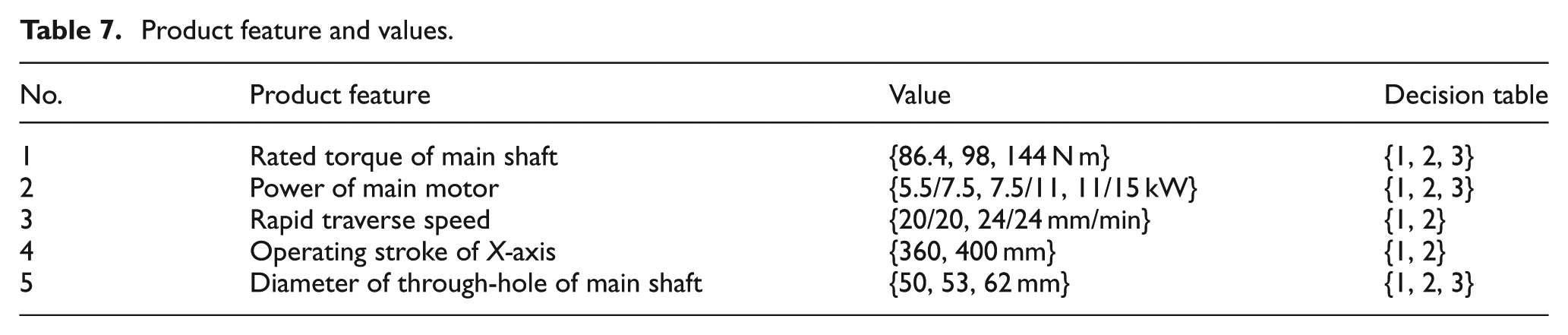
For the convenience of calculation, assignment needs to be done on the degree of importance of CRs, and the values are shown in Table 6. Number the set of target value of technical features of products as shown in Table 7. Finally establish a decision table as shown in Table 8, in which a, b, c, d, and e indicate condition attributes, corresponding to customer RU; m, n, o, p, and q are decision attributes, corresponding to technical features.
Values of degree of importance of CR.

CR: customer requirement.
Product feature and values.
Decision table of RUs.

RU: requirement unit.
Take the fourth rule as an example. For the fourth rule,

According to the degree of importance of CR in Table 4, I > K > G = J > N, and the character is b > d > a = c > e.
Select the attribute with the lowest importance degree in the non-core-value attributes as N and set this attribute as 1. Check whether

Repeat the steps above for each rule, and we can obtain the set of rules. Merge and organize the set of rules. The final rule database is shown in Table 9.
Rules after merging.

CR: customer requirement.
Assume the CR is {CR(a) = 1, CR(b) = 2, CR(c) = 1, CR(d) = 0, CR(e) = −1}. According to the rules in the rule database, the attribute values of some rules can be deduced. Through deduction, it is concluded that {m = 1&n = 3&o = 2&p = 1&q = 1}. The final result is {rated torque of main shaft = 86.4 N m, power of main motor = 11 kW, rapid traverse speed = 24/24 mm/min, operating stroke of X-axis = 360 mm, diameter of through-hole of main shaft = 50 mm}.
Conclusion
In order to better understand CR and develop satisfied product, it is necessary to systematically analyze and handle CR. This article introduced the conception of RU and established the model of CR by analyzing CR and based on the rules of decomposition of CR, which can clearly describe the hierarchy and relevancy between RUs. This article built the house of quality of mapping requirement and realized the mapping from CR to technical weight and target value, which provided conditions for the following configuration design. Finally, this article took the ETC series numerical control machine as an example to accomplish modeling and mapping of CR and verified the validity and practicability of the proposed CR model.
Footnotes
Academic Editor: Tian Han
Declaration of conflicting interests
The author(s) declared no potential conflicts of interest with respect to the research, authorship, and/or publication of this article.
Funding
This work is supported by the Fundamental Research Funds for the Central Universities (N140305001), the Natural Science Fund of Liaoning Province (2013020052), and the Research Funds of State “Twelve Five” Support Program (2012BAF12B08).