




Abstract
Customer requirement preference is an important part of customer satisfaction. In view of similar case retrieval technology for existing product level, in the process of solving similar cases, there is no consideration for customer requirement preference. This article proposes a similar case solution method considering customer requirement preference. First, we deal with the expression of customer requirements and transform them into operable parameter forms according to the mapping model. Second, the preference graph is used to analyze the customer’s requirement preference, to determine the preference weight, and to weigh the final weight of the requirement node with the initial weight determined by the fuzzy analytic hierarchy process. Finally, the similarity degree solving model of requirement node and product case attribute parameters is established. By integrating the weights of the above-mentioned nodes, the similarity of the product case is obtained, and a more satisfied case of the customer is obtained. Taking the automated guided vehicle car product as an example, the effectiveness of the proposed method is verified.
Keywords
Introduction
With the rise of personalized customized products, customers have more and more individualized requirements for products. But for the traditional design process, the product design process is complex and cumbersome and leads to a longer product development cycle. How to quickly and efficiently design the products of customers’ needs is the key to enhance the competitiveness of enterprises. Product case retrieval technology is an idea to solve this problem, by retrieving case base and using the designed historical case to Reasoning Design. 1 The product case retrieval method does not need the product knowledge domain model, only needs to carry on the variant design to the corresponding module based on the original product case to realize the customer’s requirement, and improves the product design efficiency. 2 Therefore, the acquisition of similar cases is the key to product case retrieval and has a great impact on the final product reasoning.
At present, many scholars have studied the similarity solving of cases. Wang et al. 3 proposed a new case retrieval method based on self-organizing mapping and fuzzy similarity priority ratio, which can reduce the retrieval scope and improve the retrieval efficiency. Benedek and Trousse 4 proposed two schema index models based on neural network in case-based reasoning (CBR) environment to obtain similar cases. Wang et al. 5 proposed a hybrid similarity measure and fuzzy set retrieval case to improve the accuracy of case retrieval and help designers achieve the goal of rapid design. Qin et al. 6 based on the computational similarity measure of ontology, designed the similarity between the target and the previous case and proposed a high-precision algorithm to establish similarity measure. Du and Bormann 7 proposed a novel similarity measure algorithm for solving the nonlinear and multilinear problems embedded in the problem and the difference between manual work. Biswas et al. 8 used neural network to solve the problem of weight allocation and then solved similar instances. You et al. 9 used the method of planar bending diagram for CBR to reuse previous designs to speed up stamping process planning and die design. Fan et al. 10 developed a new hybrid attribute similarity measure with five attribute values—clear symbol, clear number, interval number, fuzzy linguistic variables, and random variables—to solve similar case problems.
The above works mainly focus on the efficiency and accuracy of solving the similarity model between requirement attributes and product case attributes, but they cannot be analyzed from the requirement attributes weight, customer satisfaction, and so on. The acquisition of cases is essentially to obtain products that are most similar and satisfying to customer requirements. Therefore, in the process of obtaining cases, it is necessary and meaningful to consider customer satisfaction. Customer requirement preference (CRP) reflects the customer’s needs, interests, and hobbies for the product. Consideration of customer preference helps to improve customer satisfaction and deepen the interaction between enterprises and customers. 11 If the characteristics of customer’s requirement preference can be fully considered in the process of case solving, it is of great practical significance for enterprises to improve the accuracy of case search and improve customer satisfaction. On the basis of the above research, this article takes CRP into account. By introducing the preference graph (PG), 12 the fuzzy preferences of customers are analyzed, and the weight of customer preferences is determined. Weigh and adjust the initial weights to determine the final weight. The example is solved by solving the model, and a similar case is obtained.
Similar case solving model considering customer preference
Similarity case solving is the input of product design and knowledge reuse for CBR, which selects the most similar case with customer requirements through enterprise product case base. Based on the analysis of the subjectivity of product attribute weight and the lack of sufficient consideration of CRP, the final weight is established, and a similar solution model considering CRP is established as shown in Figure 1:
Step 1. Customer requirement representation is processed by mapping model to obtain operable customer requirement nodes and parameterized range space vector R = (R1, R2, R3, …, Rn).
Step 2. Construct PG to generate requirement node preference weight vector ω.
Step 3. The initial weight vector η of requirement node is obtained using fuzzy analytic hierarchy process (FAHP), and the final combination weight vector ω ad is generated by combining the initial weight vector with the preference weight vector ω.
Step 4. The similarity solution model is constructed, the product case base is input, and the extension correlation function is used to solve the similarity of different attribute node value range, and ω ad is substituted. The weighted sum method is used to solve the similarity.
Step 5. Output similarity of product cases.

A similar solution model considering CRP.
Customer requirements expression and mapping
Customer requirements can be obtained through a variety of ways, Q Yang et al. 13 used customer requirements acquisition system to guide and express requirements. In view of the incomplete knowledge of product expertise, this article establishes a customer demand template to guide the customer to express, so as to obtain customer demand information for the product. The expression of customer requirement template can be defined as follows

In this formula, CR
i
is the ith customer requirement expressed by customers; vi is the name of the requirement node; Typei is the type of the requirement node, including two types (optional and parametric); and
Through the customer requirement template, the parameterized mapping model is established, and the customer requirement is transformed from the description space to the parameterized space, so that they become the operational conditions of similar case matching. Luo and Guo 14 aimed at the fuzziness and irregularity of customer requirement information in product configuration, and the mapping model between customer requirement and configuration parameter table is used to realize the mapping from customer requirement to product parameter. To improve the operability of parameterization of product-level customization requirements, it is necessary to propose a customer expression mapping model (Figure 2). The mapping type can be divided into two forms:
When Typei = 1, the customer requirement node is set to an optional type and then the customer requirement node range Ri is an unrelated discrete state value, such as product appearance color, red, black, and blue. The mapping model can be converted according to the word character/number. For example, red is represented by A, that is, red-A mapping. For some structure of irrelevant requirements, it is also defined as option type. For example, the mouse has wireless and wired form.
When Typei = 2, the customer requirement node is set to a parametric type and then the value range Ri of the requirement node is usually a continuous interval. There are six common ways to express the requirement: exact value (=), about a certain value (≈), greater than a certain value (>), less than a certain value (<), between two values ([ ]), and fuzzy language value. 15

Customer requirement representation and mapping model.
If the customer has a better understanding of the product, you can choose the exact value of the expression, for the general user can choose the other five expressions. Exact values are used to describe customized requirements, such as volume, angle, and width of mechanical and electrical products. When parameterized mapping is performed, it can be directly transformed into the parameter space range of nodes. As for the expression of interval value, it can be transformed into an accurate interval expression according to the fuzzy requirement processing method. For fuzzy linguistic values, technicians can use their experience to map them to exact numerical or interval descriptions, such as {very poor, relatively poor, general, good, very good} for performance evaluation {0, 0.25, 0.5, 0.75, 1}, thus converting fuzzy linguistic values into numerical descriptions. Through the mapping model, the corresponding range of requirement nodes obtained from customer requirement template is transformed into the expression vector of parameterized space: R ={R1, R2, …, Ri, …, Rn}, where Ri is the parameterized spatial range corresponding to the node vi of customer requirements.
Calculation of attribute parameter weight considering customer preferences
Preference analysis of customer requirement node
Requirement preference refers to the degree of customer preference for product structure or attributes, and the analysis of customer preference is helpful to improve customer satisfaction and promote the development of enterprise products. The ultimate goal of acquiring similar product cases is to find the product that best meets customer requirements and satisfaction. Therefore, the analysis and consideration of customer requirements preference is very important to the acquisition of similar product cases. There are many ways to obtain customer preference, such as Kano model 16 and joint analysis method, 17 but these methods require customers to evaluate the product model. Because the customer’s subjective consciousness is too strong, it requires a lot of questionnaire survey, which is time-consuming and exhausting.
YE Nahm and H Ishikawa 18 proposed graph-based representation techniques to simulate incomplete or uncertain preference structures of humans, called PG. The main advantage of this representation technique is that customers do not need to establish preferences between each pair of possible requirement nodes vi, but customers can only express some of the preferences they knew at first. Since most customers do not understand the product expertise, they usually express preferences for some attributes of the product according to their own requirements. The PG diagram allows the customer to specify partial sorting of vi. Therefore, this article uses PG method to calculate the preference of customer requirement nodes, and this method is convenient for the expression of customers and can more truly obtain customer preference.
The n customer requirement nodes are determined through the customer requirement template to get the customer requirement node. Then, the system automatically generates statistical tables and feeds them back to the customers, compares their preferences to the nodes, checks them more interestingly, and skips the uncertainties directly. The technical personnel will form the customer feedback form into the PG through the relative preference relationship between nodes (as Figure 3).

PG acquisition of node attributes of customer requirements.
The adjacency matrix PG M constructed by PG is shown as follows

where pgij is the element of the adjacency matrix PG M . Its value represents the M-order dominance of requirement node i over requirement node j.
The dominance matrix D is the sum of the PG M of every adjacency matrix. That is

The sum of the elements of the Nth row of the dominance matrix D is defined as dN, which represents the preference value of the Nth requirement node directly or indirectly relative to other requirement nodes. If dN is 0, then the requirement node is suboptimal relative to other nodes. Because the customer proposed this customer requirement node, the customer care about this requirement node, preference value of 0, is obviously unreasonable. At this point, the definition adds 1 of the dN value to the corresponding calculation. Then, the calculation of customer requirement node preference RDP (the relative degree of preference) is as follows


Normalization of RDP is applied to get the weight vector ω of requirement node preference

where

For example, the PG is shown in Figure 4, and it shows that customers prefer the requirement node v2 to the requirement node v3 and v4. Compared with requirement node v5, customers prefer v3, v4. The adjacency matrix can be represented by


PG representation of customer requirement node.
It gets d1 = 2, d2 = 4, d3 = 1, d4 = 1, d5 = 0 from dominance matrix D. Then, we substitute it in formulas (3) and (4) to get the customer requirement node preference weight vector as ω = (0.231, 0.385, 0.154, 0.154, 0.077).
Initial weight determination of customer requirement node
The initial weight of customer requirement node reflects the importance of the node, and it mainly reflects the difficulty of implementation from the technical level. There are many methods to calculate the weight, such as AHP and ANP. Compared with these methods, the major advantages of FAHP are that it can be used for both qualitative and quantitative criteria. 19 Naghadehi et al. 20 apply the combination of FAHP and traditional AHP to the selection of underground mining methods, and FAHP is used to determine the weights of criteria for decision makers. The FAHP decision support tool is useful to determine the relative weight of factors for standard dominance and can be successfully used in decision-making problems relating to standardization. 21 FAHP combines the objectivity of AHP and fuzzy comprehensive evaluation and can better introduce expert opinions into the weight calculation process. 22 The initial weights are calculated by FAHP. The calculation process is as follows:
1. The priority relation matrix F = (vij)
n×n
is constructed from the fuzzy relation of the customer requirement node, and the matrix element vij represents the fuzzy scale, that is, the comparison of the importance degree between the requirement node i and j. Lan et al.
23
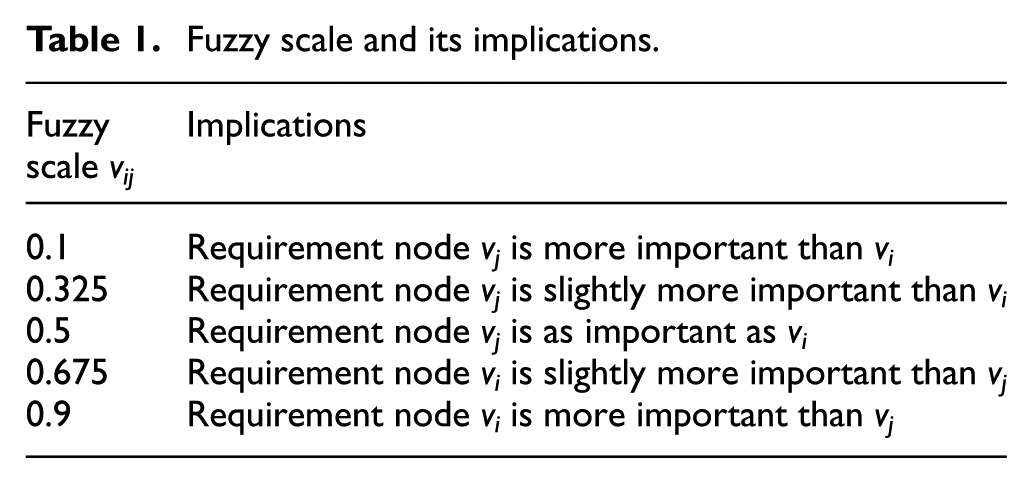
proposed a method to determine the fuzzy scale and weight of FAHP. Its value is by
2. The matrix elements of the priority relation matrix F = (vij) n×n is transformed into fuzzy consistent matrix A = (aij) n×n by the following formula

3. The calculation of the initial weight

Fuzzy scale and its implications.
The initial weight vector of the customer requirement node is
Adjustment of weights based on preference of customer requirement node
FAHP obtains the judgment matrix and solves the problem by comparing the importance and correlation of the requirement nodes between technicians and experts. However, the weight obtained above mainly considers the importance of customer requirement nodes and does not consider the satisfaction degree of customer requirement node preferences. PG method solves the problem of preference weight of customer requirement nodes by analyzing CRP. In order to obtain more effective node weights of customer requirements, we need to consider the impact of preference weights, that is, adjust the initial weights and preference weights. The final weight of requirement nodes can be obtained by establishing the influence intensity function. 24 The influence intensity factors are u and x, respectively. That is

And there are constraints as follows

Therefore, the final weight vector of the customer requirement node is

Similarity solving model for cases
The model establishes the relationship between customer requirements and product attribute parameters and compares the model with product attribute parameters mainly from the value range expression of requirement nodes. Aiming at the different attributes of demand nodes and the different parameter types of corresponding range, this article establishes different similarity calculation methods according to different range types based on the extension correlation function to improve the accuracy of similarity model calculation results.
Determining product case attribute parameter matrix E
Suppose that there are m product cases, and the product cases include the existing product cases, as well as the supplementary cases modified by the existing cases. n is the number of nodes required for customers, and the corresponding product case attribute parameter matrix is as follows

Normalizing each attribute parameter
When calculating the similarity, the feature attributes and dimensions of product cases of the same product family are different, and the values of corresponding attribute parameters are also very different. In order to eliminate the influence of different dimensions, the attribute parameters need to be normalized and converted into the values of the [0, 1] interval.
Suppose that an interval attribute parameter eki of product case is


For the exact value attribute parameter uki, when it is a benefit type feature (the bigger the value of attribute parameter, the better), we adopt

When it is a cost type feature (the smaller the attribute parameter value, the better), we adopt

The xki in the formula is the normalization value of the exact value attribute parameter.
After the above formula is processed, the normalized attribute parameter matrix is obtained as follows

where
Solving the similarity of cases
When Type = 1, the range
When Type = 2, the value range of customer requirement attribute node is in the form of parameter. Considering the reflexivity of attribute parameter similarity, Euclidean distance can be used to solve the problem as follows
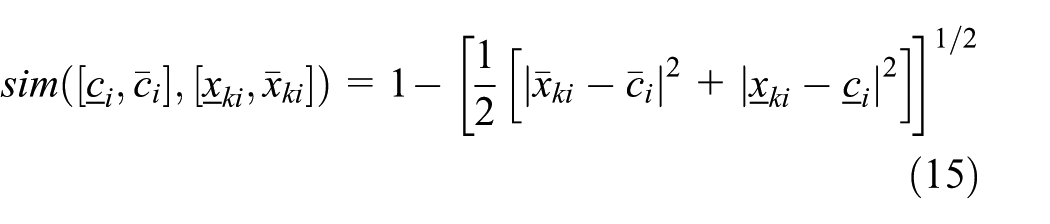
where
For product attribute parameters, the exact value similarity is solved as follows
Let

From the final weight vector, the weighted sum is used to solve the similarity value. The result is
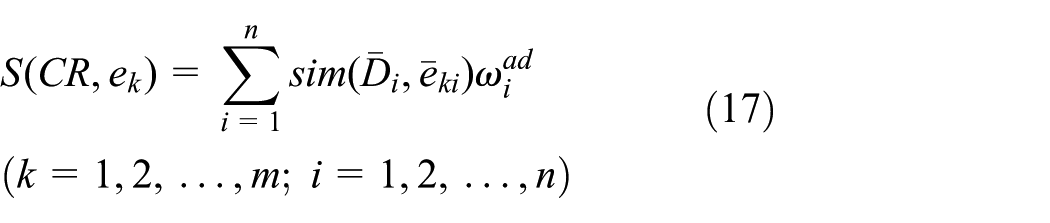
where
Case study
Automated guided vehicle (AGV) is equipped with electromagnetic or optical automatic guidance devices, which can travel along the prescribed guidance path, with safety protection and various load transfer functions of the transport vehicle, widely used in storage industry and manufacturing industry. Taking AGV car as an example (as shown in Figure 5), this article proves the validity and feasibility of the method for solving similar cases considering CRP.
1. Get customer requirements through customer requirement template, as shown in Table 2.

AGV car structure and its attribute description.
Customer requirements template.
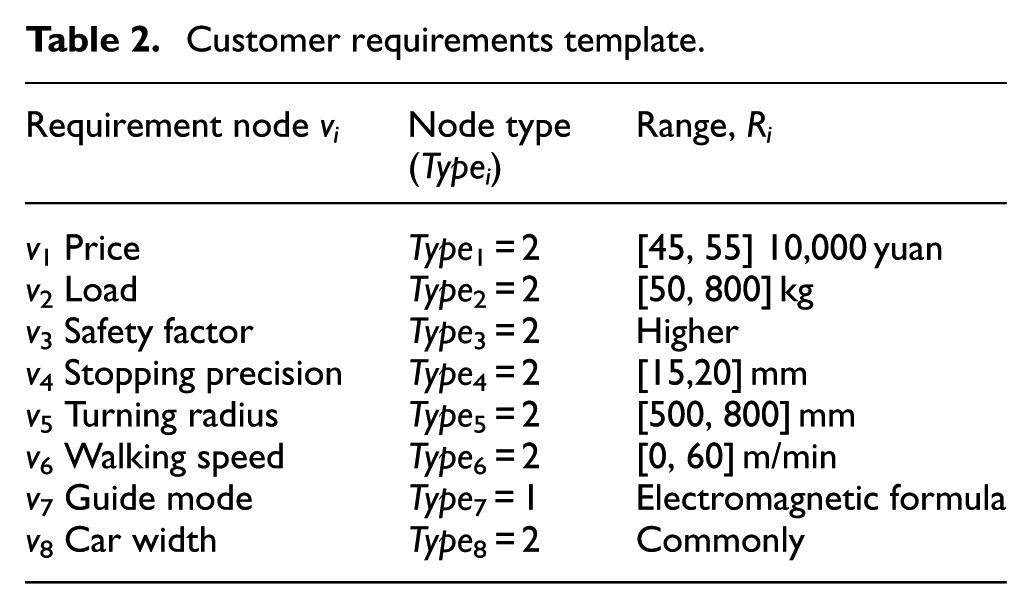
Technicians refer to section “Customer requirements expression and mapping” to analyze and deal with customer requirements. The range of the parametric node v3 and v8 is described by the language value. The safety factor of the node v3 is higher. According to the historical experience, technicians convert it into 0.8, and the range of the node v8 is general. It is more reasonable to convert it into 1.2 m to meet the customer’s requirements. For other node analysis, v7 is an option node. For the option customer requirement node, set the corresponding character corresponding to it. The node v7 has electromagnetic, magnetic stripe, and laser type, corresponding to letters A, B, and C, respectively. From the mapping model, the customer requirement node value vector is determined to be

2. By communicating with customers and obtaining customer preferences, we get the PG as shown in Figure 6.

PG of customer requirement node for AGV car.
The adjacency matrix of PG1 can be represented by


From this, we get dominance matrix D as follows
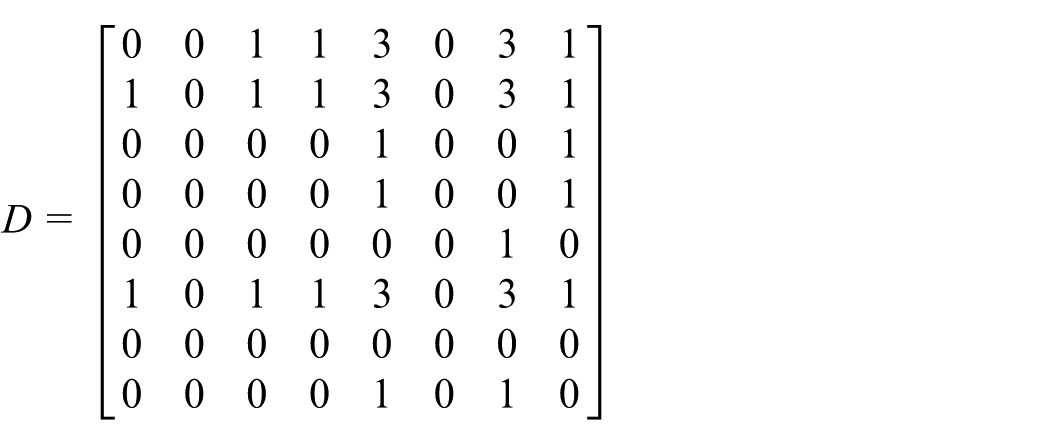
According to dominance matrix D, we get d1 = 9, d2 = 10, d3 = 2, d4 = 2, d5 = 1, d6 = 10, d7 = 0, and d8 = 2.
Substituting it in formula (3), we get: rap1 = 0.909, rap2 = 1, rap3 = 0.273, rap4 = 0.273, rap5 = 0.182, rap6 = 1, rap7 = 0.091, and rap8 = 0.273.
Therefore, RDP = (0.909, 1, 0.273, 0.273, 0.182, 1, 0.091, 0.273). Substituting formula (4) normalization calculation, we get the weight vector of CRP as follows

3. From the FAHP, we get the initial weight vector of customer requirement node as follows

From Han et al., 24 you can take u:x = 0.4:0.6, of course, technicians can, according to the actual situation of the product, as well as market feedback, set the value of u, x.
The final weight vector of customer requirement node is obtained by balancing the weight of customer requirement with formula (7)

Considering the change of customer demand node weight before and after customer demand preference, as shown in Figure 7, it is found that the demand node weight of customer preference has changed significantly.
4. Solving case similarity.

Changes in the weight of customer requirement nodes before and after customer preferences.
For some mechanical and electrical products with more common product cases, enterprises can first conduct case clustering analysis, roughly select products closer to customer requirements, speed up the search, and then conduct similar retrieval of product examples based on the theory of this article. Because of limited space, nine cases are used to solve this problem. Enterprise cases and corresponding property parameters are shown in Table 3.
Enterprise product case parameters.

From normalization process, the normalized attribute parameter matrix of cases is obtained as follows

The normalized attribute parameter vector of requirements is

The similarity of cases is obtained by formula (17)

When CRP is not considered, the initial weight vector η (i.e. ηi instead of

Comparing the similarity of product cases considering CRP with those without considering CRP, as shown in Figure 8, the highest similarity of product cases considering CRP is e8, followed by e2, e4, and e3. The highest similarity case without considering customer preference is e4, followed by e5, e8, and e2.

The comparison of product instance similarity values is based on considering and not considering customer preferences.
Therefore, by considering the CRP, the product that best meets the customer’s requirement is case e8. Compared with e2 and e4, case e8 is more in line with customer requirements in terms of cost, load, and speed attributes. From the results of similar case solving, we can see that the case with higher similarity obtained by considering preference solving is more inclined to the product case with better customer preference attributes than the case without considering preference solving, and it is more in line with the actual preference of customers, which proves the validity of the method. Technical personnel can analyze this case, and on this basis, according to the customer requirement similarity threshold set by the enterprise, it can effectively judge whether the enterprise needs to modify the design on this basis. At the same time, for some products solved, if the defect only has the attribute of weak customer preference, enterprises can communicate with customers and compensate through product service system, thus avoiding the complexity of modification.
Conclusion
CRP has an important impact on improving customer satisfaction and should be considered in the process of personalized customization. In this article, the traditional product similarity case solving process does not fully consider the characteristics of CRP, proposed and established a product case similarity calculation method considering CRP. The contributions and conclusions of this article are as follows:
A weighting method combining FAHP with CRP analysis is proposed, which reduces the subjectivity of customer requirement weights in FAHP and fully considers the satisfaction degree of CRP, thus making the similarity weights more reasonable.
The method model of solving product case similarity is constructed, and the weights considering CRP are used to make the case similarity more reasonable, more in line with the actual customer requirements and technical personnel to modify the case to meet the individual customization order.
Footnotes
Acknowledgements
The authors thank Dr. Chang Weijie for his great help during the revision of the article. And the authors are grateful for the reviewers’ helpful comments and suggestions.
Handling Editor: Shun-Peng Zhu
Declaration of conflicting interests
The author(s) declared no potential conflicts of interest with respect to the research, authorship, and/or publication of this article.
Funding
The author(s) disclosed receipt of the following financial support for the research, authorship, and/or publication of this article: This research was supported by the National Natural Science Foundation of China (NSFC, grant no. 5177516) and the China Scholarship Council (CSC, grant no. 201706695019).
