




Abstract
This article is concerned with the periodic flow induced by non-torsional oscillations of two porous disks rotating about distinct axes. While the porous disks are initially rotating with the same angular velocity about non-coincident axes, they start to execute non-torsional oscillations in their own planes and in the opposite directions. An analytical solution corresponding to the velocity field in the periodic state is obtained. The variations in the components of the horizontal force per unit area exerted by the fluid on the top and bottom disks with the time are investigated for the suction/injection velocity parameter, the Reynolds number, the ratio of the frequency of oscillation to the angular velocity of the disks, and the dimensionless velocity amplitudes of oscillation. It is shown that the horizontal force on the upper disk is not equal to that on the lower disk.
Introduction
Maxwell and Chartoff 1 claimed that it is possible to determine the material moduli of non-Newtonian fluids if an instrument called the orthogonal rheometer consisting of two parallel disks rotating with the same angular velocity about two different axes normal to the disks is used. Abbott and Walters 2 obtained an exact solution corresponding to the flow in this instrument for a Newtonian fluid. Rajagopal 3 showed that this motion is one with constant principal relative stretch history.
Unsteady flows of Newtonian fluids between the eccentric rotating disks have also received considerable attention. Erdoğan 4 studied the unsteady flow induced by the rotation about non-coincident axes while the disks are initially rotating with the same angular velocity about a common axis. Ersoy 5 investigated the unsteady flow due to a sudden pull with constant velocities of the disks rotating eccentrically at the same speed. Ersoy 6 examined the unsteady flow produced by the axes that are made coincident while the disks are initially rotating eccentrically. Mohyuddin 7 studied the unsteady flow due to a sudden pull with constant velocities of the porous disks in the presence of a magnetic field. Das et al. 8 examined the unsteady hydromagnetic flow between two disks rotating about non-coincident axes which are suddenly made coincident.
Time-dependent flows of Newtonian fluids caused by non-torsional oscillations of eccentric rotating disks have also attracted the attention of researchers. Erdoğan9,10 studied the non-symmetrical unsteady flows due to the non-torsional oscillations of the disks initially rotating about a common axis. In the first article, 9 he thought that the disks start to rotate eccentrically and the lower disk executes oscillations. In the second article, 10 he took into account that the disks start to rotate eccentrically and both the disks execute oscillations in the same direction. Ersoy 11 studied the symmetrical unsteady flow caused by their oscillations in their own planes and in the opposite directions while the disks are initially rotating eccentrically.
Unsteady flows due to the oscillation of a porous disk have also attracted the interest of many investigators. The reader may consult Kasiviswanathan and Rao, 12 Hayat et al.,13–16 Guria et al., 17 and Hayat et al.18,19 for more details.
In this article, the periodic flow due to the non-torsional oscillations in their own planes and in the opposite directions of the porous disks initially rotating at the same speed about distinct axes is studied. In order to obtain a general solution, the oscillating disk velocity has two components. An analytical solution of the velocity field corresponding to the flow is found. Since the study of the horizontal force applied by the fluid on the disks in an orthogonal rheometer is important, a special attention is given to analyze the shear stresses. The main idea in this article is to study the effect of porous disks. It is shown that the horizontal force on the upper disk is not the same as that on the lower disk in the case of porous disks whereas they are equal to each other for non-porous disks. Moreover, it should be emphasized that the main difference between x- and y-components of the horizontal force is due to the eccentricity defined along the y-axis. The influences of the parameters controlling the periodic flow on the shear stresses corresponding to the components of the horizontal force are examined with the help of the figures.
Basic equations and solution
Let us consider an incompressible Newtonian fluid between two porous disks located at

Flow geometry.
Therefore, the appropriate initial and boundary conditions for the velocity field are



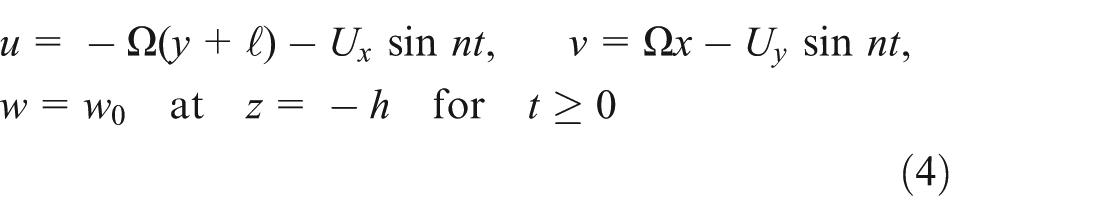
The functions

where

It is the result obtained in Ersoy
20
(for

Substituting equation (7) into the Navier–Stokes equations, one has
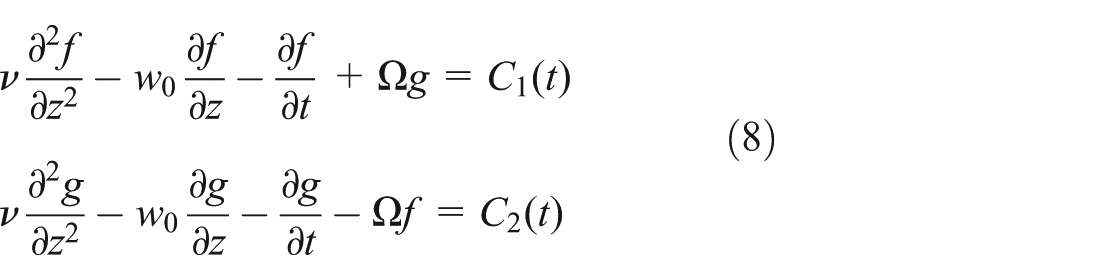
Introducing

For the periodic solution in the fluid, it is natural to assume a solution of the form

where


where a prime denotes differentiation with respect to
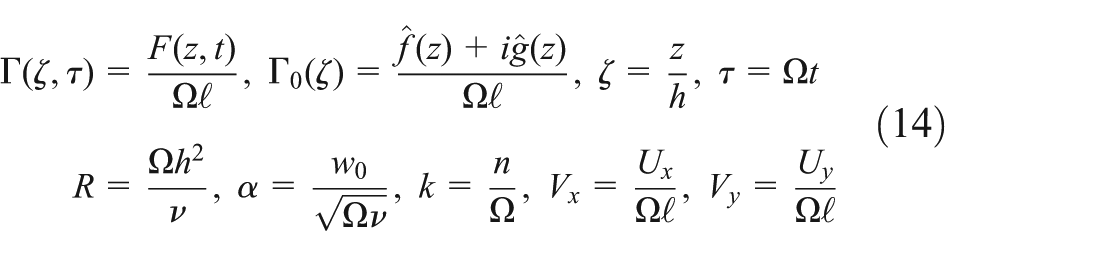
with the conditions

Thus, the solution is

where

Here,
The solution for

It is worth noting that the results obtained for large times by Ersoy
11
can be obtained as the special case of the present analysis by taking the suction/injection velocity parameter to be 0. The shear stress components
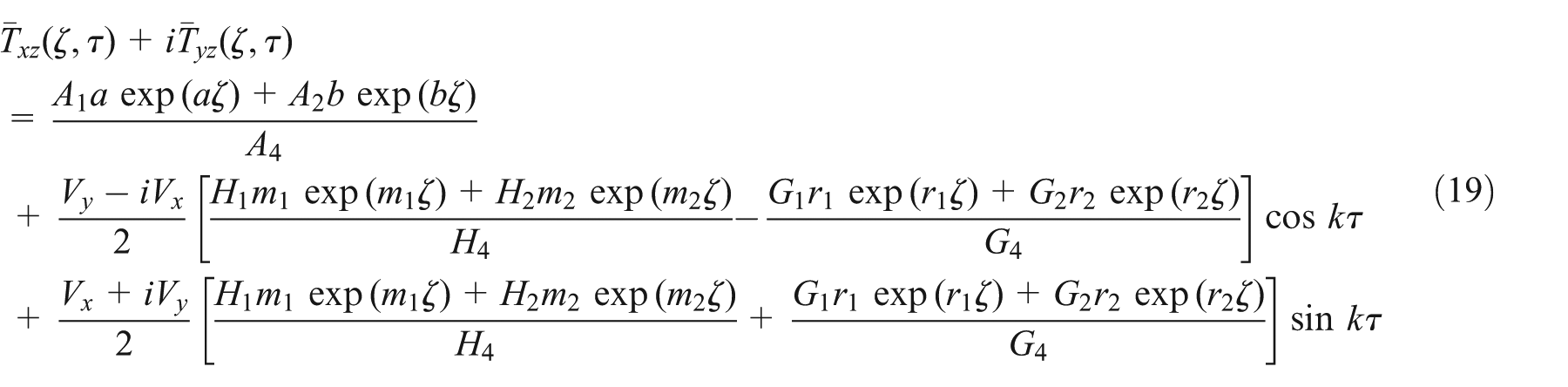
where

The solution corresponding to

The variations in
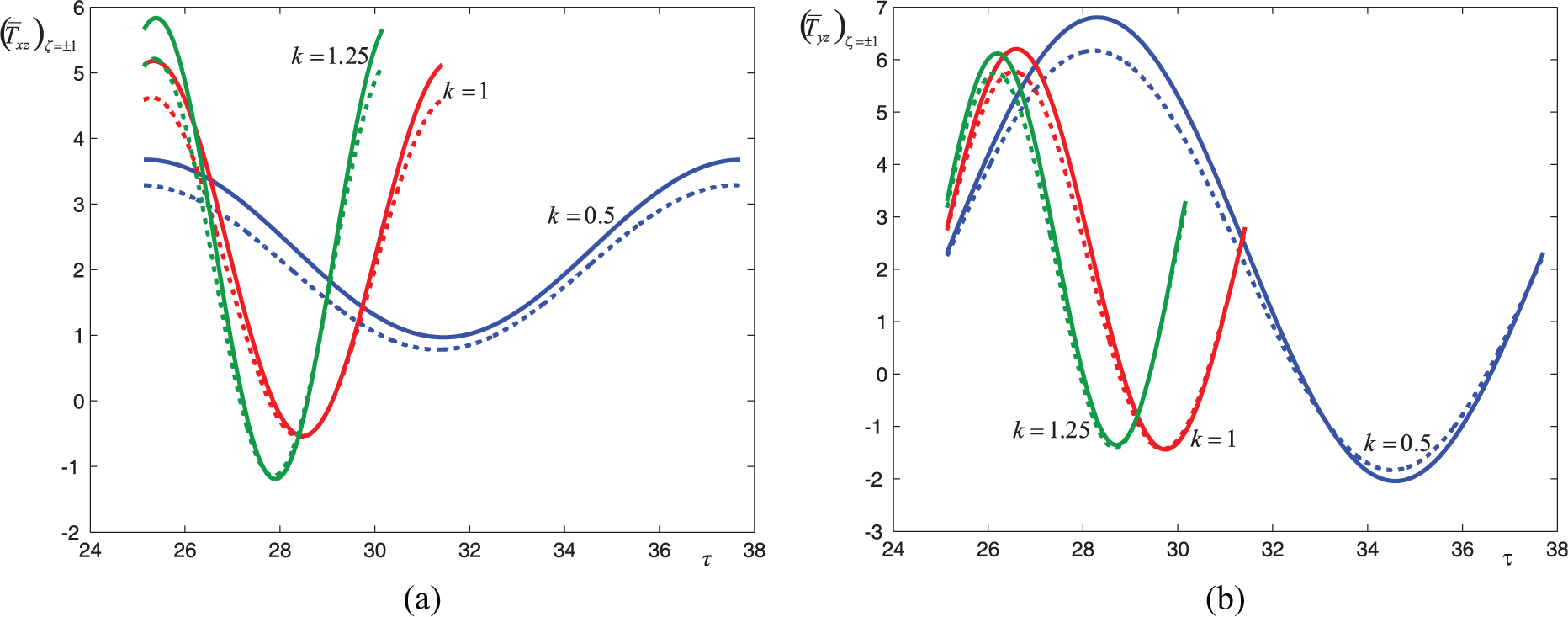
Variations in

Variations in
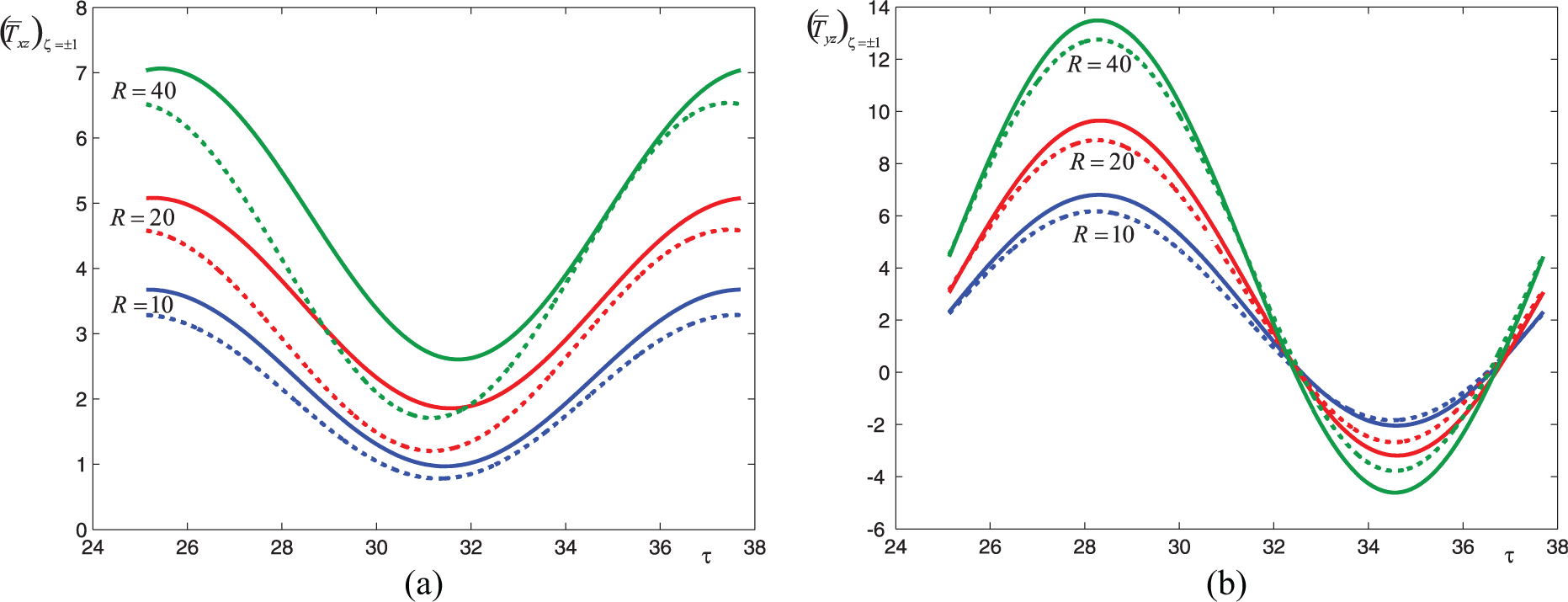
Variations in

Variations in

Variations in
Results and discussion
This article deals with the periodic flow due to non-torsional oscillations of eccentric rotating porous disks. The two porous disks are initially rotating with the same angular velocity about non-coincident axes. The direction of constant axial velocity is upward. Hence, the initial condition is taken as the solution corresponding to
When the disks are non-porous, the Poiseuille-type pressure gradient is 0. In other words, we have
Although the shear stresses
In this article, an exact solution corresponding to the velocity field is obtained. However, the attention is focused on the variations in the dimensionless shear stresses on the top and bottom disks with the time. The results are obtained by means of Figures 2–6.
Conclusion
Since the dimensionless shear stresses
The direction of the force exerted by the fluid is opposite to that exerted by the disk. Hence, it is sufficient to carry out the analysis of the magnitudes of the dimensionless horizontal force exerted by the fluid. The main conclusions are pointed out as follows:
The direction of the y-component of force changes more often in comparison with that of x-component in the periodic time interval since the eccentricity is defined along the y-axis. The changes in
In general, it is observed that
When
An increase in
When
The increase in
Footnotes
Appendix 1
Acknowledgements
The author would like to express his sincere thanks to the referees for their valuable comments and suggestions.
Academic Editor: Thirumalisai S Dhanasekaran
Declaration of conflicting interests
The author declared no potential conflicts of interest with respect to the research, authorship, and/or publication of this article.
Funding
The author received no financial support for the research, authorship, and/or publication of this article.