



Abstract
This work proposes and discusses a new wall boiling model for a 2-mm narrow rectangular channel with a copper heating surface at atmospheric pressure. The model includes a wall heat flux partitioning model and several sub-models that compute active nucleation site density, bubble departure diameter, and bubble departure frequency. This wall boiling model was developed based on our previous experimental work on narrow channel flow in order to account for the unique thermal-hydraulics that occur under these specific conditions. The model was implemented in CFX code to simulate the subcooled flow boiling in a narrow channel with a two-fluid model; we also considered the onset of nucleate boiling. The new model has been validated by the experimental data. Compared to the default model that had been developed in CFX code, the new model provides better predictions of the distribution of wall temperature in the 2-mm narrow channel.
Keywords
Introduction
An accurate prediction of the characteristics of subcooled flow boiling in narrow channels is important for the safe and reliable designs and operation of heat exchangers, especially those used in nuclear reactors. 1 In recent years, there have been experiments and numerical simulations used to investigate subcooled boiling flow. The computational fluid dynamics (CFD) simulation has attracted great interest due to the rapid development of numerical modeling capabilities and computer technology; simulation work has been reported for many practical boiling flow applications.2,3
Many numerical models have been developed over the years to improve simulation accuracy under various physical conditions, such as system pressure, working fluids, and the shapes and dimensions of flow channels. Tu and Yeoh 4 reported satisfactory results for the prediction of void fraction distributions under low-pressure conditions. They used a modified wall boiling model incorporated in CFX code to replace the high-pressure subcooled flow boiling model. Li et al. 5 accurately predicted the wall temperature distribution of the flow boiling of liquid nitrogen in a vertical tube using a set of corrections for bubble nucleation and bubble departure in CFX code. They found that the active site density has a dominant effect on predicting the temperature of the heating surface. Koncar and Krepper 6 studied the radial phase velocity distributions of refrigerant in a vertical annulus. They improved the simulation accuracy using a new two-phase wall law for flow boiling, which took into account the effect of nucleating bubbles near the wall on the liquid flow. Krepper et al. 7 coupled wall boiling and population balance models to consider both coalescence and breakup processes among bubbles in the fluid. They found this approach better described the bubble size and the gas volume fraction profile. Lifante et al. 8 proposed a new wall heat flux partitioning model that added vapor phase convection heat flux in addition to the phase change and liquid heat transfer in the original model. With these improvements, they were able to accurately predict the dry-out and critical heat flux (CHF). Ustinenko et al. 9 analyzed the two-phase coolant flow and heat transfer phenomena in a boiling water reactor (BWR) fuel bundle by developing the CFD-BWR model for use with STAR-CD, and good agreement between computed and measured results was obtained for a large number of test cases.
Even though the numerical simulation of subcooled flow boiling has proven to be effective in many cases, subcooled boiling flow in narrow channels (1–2 mm) is still a challenging topic for the simulation community due to the unique physics involved; for example, the heat transfer coefficient increases with a reduction in the gap size and active nucleation site density; bubble departure size and frequency are influenced by changing the gap size. 10 Many commercial CFD codes, such as CFX, use empirical models to predict these important physical parameters of boiling flow, such as active nucleation site density, bubble departure diameter, and bubble departure frequency. But the fundamental physics of subcooled boiling in a narrow channel was not fully captured by those models, which are only applicable to a very limited range of applications. In order to improve the simulation capability for the subcooled flow boiling in narrow channels, it is important to first thoroughly understand the flow and thermal characteristics through experiments. Recently, we conducted a series of experiments to investigate the characteristics of narrow channel subcooled flow boiling. Important boiling phenomena, such as bubble nucleation and the onset of nucleate boiling (ONB), were studied.
This article discusses a new wall boiling model that was developed based on the test data for the prediction of the narrow channel subcooled boiling flow. The new wall boiling model was implemented in CFX code. The new model and the default CFX models were used to simulate subcooled flow boiling in narrow channels. Both model predictions of temperature fields were compared with the experimental results to evaluate the accuracy of the numerical models. Through the comparison of nucleation parameters, such as the active nucleation density, bubble departure diameter, and bubble departure frequency, the two boiling models’ differences are discussed. An empirical ONB model has been proposed based on the experimental data and its impact on numerical results has been evaluated.
Subcooled flow boiling models
The two-fluid model and the wall boiling model are the two fundamental building blocks for the numerical simulation of subcooled flow boiling. A multidimensional Eulerian two-phase flow approach was used for the subcooled boiling flow simulation in this study.
Two-phase model
According to the experimental phenomena, the liquid and vapor bubble phases can be treated as the continuous-dispersed morphologies. The vapor bubble dispersed phase is characterized by a single diameter which is taken as its mean value in the whole region. The two-phase model consists of the conservation equations for mass, momentum, and energy of each phase, and the interaction terms that couple the interphase transfer of mass, momentum, and energy between liquid and vapor. The conservation equations and interphase transfer terms are discussed briefly in the following sections.
The conservation equations
Liquid is the dominant phase that is treated as continuous phase; the vapor bubbles are described as a dispersed phase and has been resolved to study the nucleate boiling and bubble flow. The ensemble-averaged conservation equations for liquid phase are as follows:
the continuity equation

the momentum equation

and the energy equation
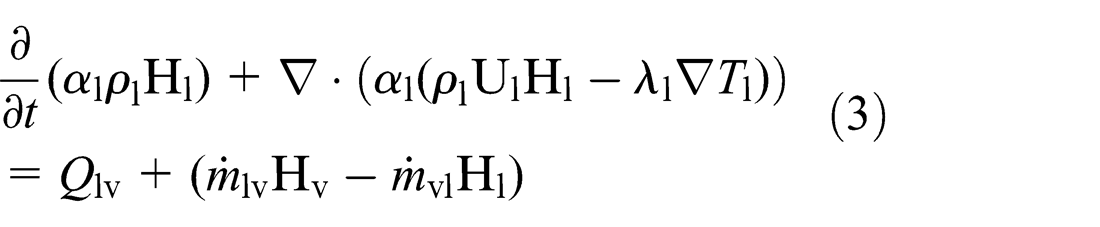
where the subscripts l and v indicate phase denotations (l = liquid, v = vapor). The variables
Interphase momentum transfer
In equation (2), the source term

In this article, the interphase drag force,
Interphase heat transfer
In subcooled flow boiling, bubbles generated on the heated wall slide along the wall, eventually departing from the wall and moving into the subcooled fluid, where they are subject to condensation. In this article, the vapor inside the bubble and the bubble interface were assumed to be at the saturation temperature. So, the rate of heat transfer per unit volume across phase boundaries

where

where

where
Interphase mass transfer
In subcooled flow boiling, the interphase mass transfer includes two parts: the generation of vapor bubbles on the heating wall and the condensation of vapor in the bulk liquid. Bubble generation will be discussed in the wall boiling model. The bubble condensation was modeled using the following equation

Wall boiling model
Wall boiling model is used to describe the generation of the vapor phase and the corresponding heat and mass transfer from the heating wall. It includes a wall heat flux partitioning model and a set of sub-models for bubble nucleation prediction.
Partitioning the wall heat flux
The most important building block of an empirical wall nucleation model is the algorithm about partition of the wall heat flux. There are several mechanisms involved in wall boiling that transfer heat from a hot solid surface to a fluid one. Kurul and Podowski 16 proposed a model that splits the total wall heat flux into three different modes of heat transfer

where
The heat partitioning model is called the Rensselaer Polytechnic Institute (RPI) model in CFX code. In this study, the main sub-model parameters of
The CFX wall boiling model
The essential parameters in bubble nucleation and departure models include the active nucleation site density
Egorov and Menter 18 used a pool boiling correlation to model the active nucleation site density

where
Tolubinsky and Kostanchuk 19 used the following correlation for the bubble departure diameter

where
Cole 20 proposed a bubble departure frequency model in 1960

Note that this correlation was taken from pool boiling, so it supposes the bubble departure’s dependence on gravity. The bubble departure frequency is simply estimated as the bubble rise velocity divided by the bubble departure diameter. To apply the model to flow boiling, the drag coefficient factor

The new wall boiling model based on experiments
The experimental facility and the experimental procedure have been introduced in detail in our previous post; 22 only a brief description of experiment and the flow phenomena has been summarized here to provide some background for the model development. A schematic of the experiment setup has been provided in Figure 1. Deionized water was used as a working fluid, which was degassed by continuous boiling that lasted several hours in the reservoir before the test. The reservoir was open to the atmosphere. A variable speed, pulseless gear pump (IDEX Micropump 67-GA-V21) drove the working fluid through the facility. The debris was cleared out by the filter and only the liquid passed into circulation. The heat exchanger and pre-heater worked together to control the inlet temperature of the test section. The mass flow rate was measured by the mass flow meter (DMF-1-3-A/DX). A high-speed camera was employed to visualize the bubble dynamics with a frame rate of 2000 frames per second (fps) and a maximum resolution of 1024 × 1024 pixels. Static images extracted from the recorded videos were analyzed to yield information of the active nucleation site density, bubble departure size, and departure frequency.
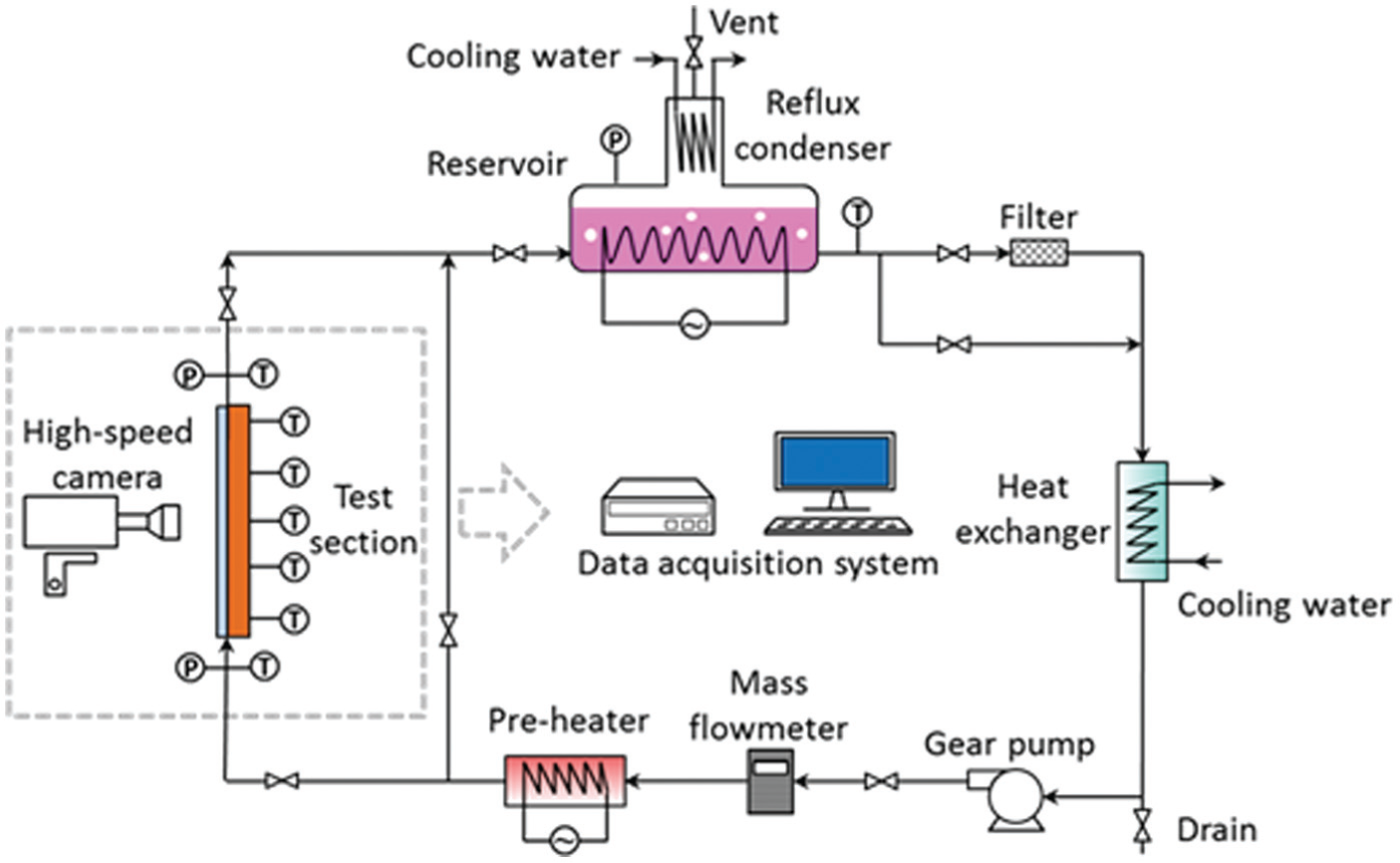
Schematic of the experimental apparatus.
Figure 2 shows the flow channel dimensions. The flow channel was 330 mm in length (L) and 28 mm × 2 mm in cross section (W × H). The heating surface material was red copper, 199 mm in length (L c), and 20 mm in width (W c). There were 65.5-mm-long flow development sections at points upstream and downstream of the heated section. On each side of the heated surface was a 4-mm-wide no-heating port.

Dimension of narrow channel.
The typical bubble flow was observed in the experiments, as shown as Figure 3. The bubble growth began at a nucleation site. After reaching their maximum diameters, the bubbles departed from the wall and then started to slide up the vertical wall. While bubbles were sliding up the vertical wall, they grew gradually due to the heat flux from the heating surface. After sliding upward for a certain distance, bubbles departed from the vertical wall toward the bulk fluid. Bubbles would be rapidly condensed if they moved out of the developing saturation boundary. In the subcooled region, there existed a small void fraction. The experimental bubble flow patterns show that the Eulerian two-phase flow approach and the interphase transfer models set up in section “Two-phase model” were suitable for describing this bubble flow phenomenon.
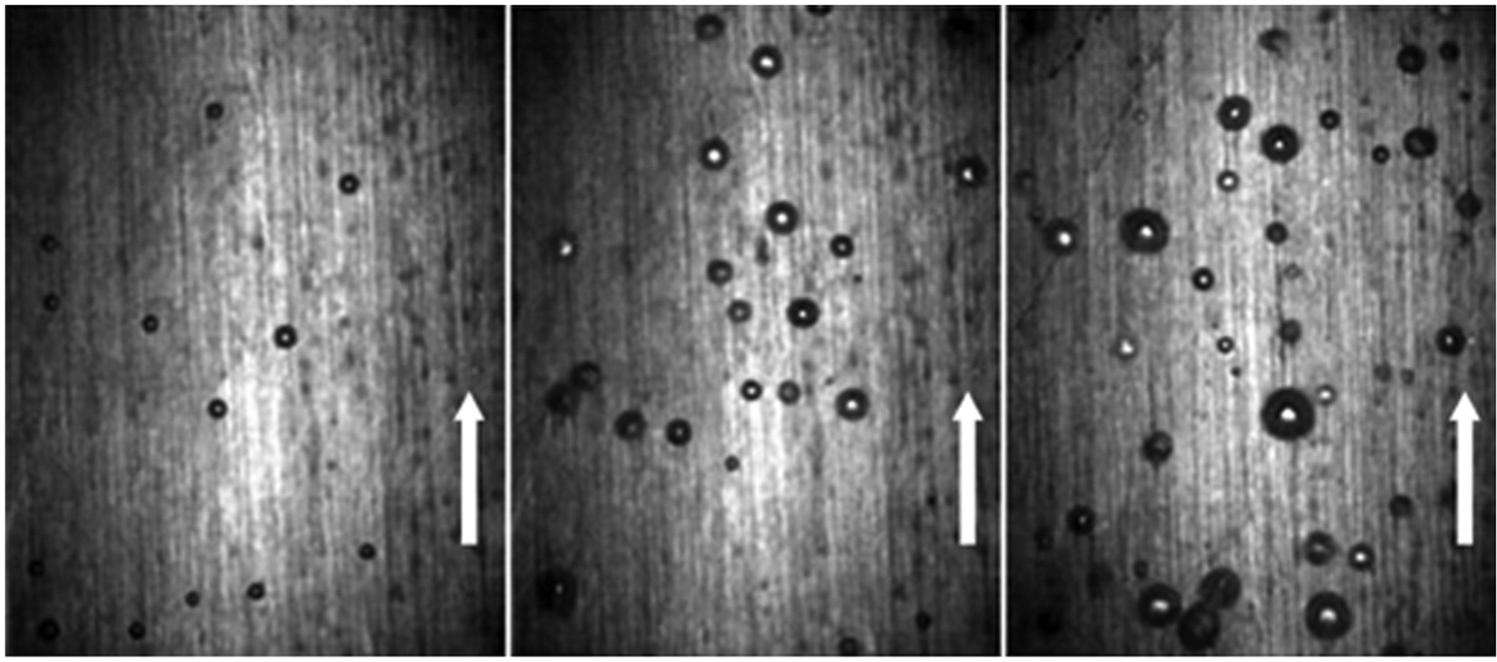
Typical flow pattern.
Some important experimental observations have been summarized here to support the new wall boiling model development in the 2-mm gap channel: 22
Active nucleation site density was independent of the liquid subcooling and inlet liquid mass flux and only relative to wall superheat.
Bubble departure diameter depended on inlet liquid mass flux, wall superheat, and liquid subcooling.
Bubble departure frequency was the reciprocal of the summation of bubble waiting time and bubble growth time. It was found that the bubble growth time is small, relative to bubble waiting time, so the bubble departure frequency was decided by the bubble waiting time. Under this condition, bubble departure frequency was only dependent on the wall superheat. It was found that the wall superheat was the most important influence factor and played a decisive role in the wall nucleation.
From the above observations, it was found that the sub-models for the wall boiling model in CFX code were not fully suitable for the narrow channel setup because some of the models were developed for pool boiling or high-pressure fluid. Based on our experimental data, new correlations for the active nucleation site density, bubble departure diameter, and bubble departure frequency for narrow channel at atmospheric pressure have been proposed 22



where
In experimental conditions, wall boiling starts when the wall temperature is sufficiently large to activate the wall nucleation sites. The activation temperature is typically a few degrees above the saturation temperature. However, in some numerical simulation tools, such as CFX, the nucleate boiling is initiated as soon as the wall temperature reaches the liquid saturation temperature, which causes an inaccurate prediction of the onset of the nucleate boiling. In order to improve the ONB prediction, an empirical model was derived from the experimental data

The correlation is valid in the following range of parameters:
To validate the proposed correlations, the predicted values were compared with the experimental data as shown in Figure 4, which shows satisfactory agreement.
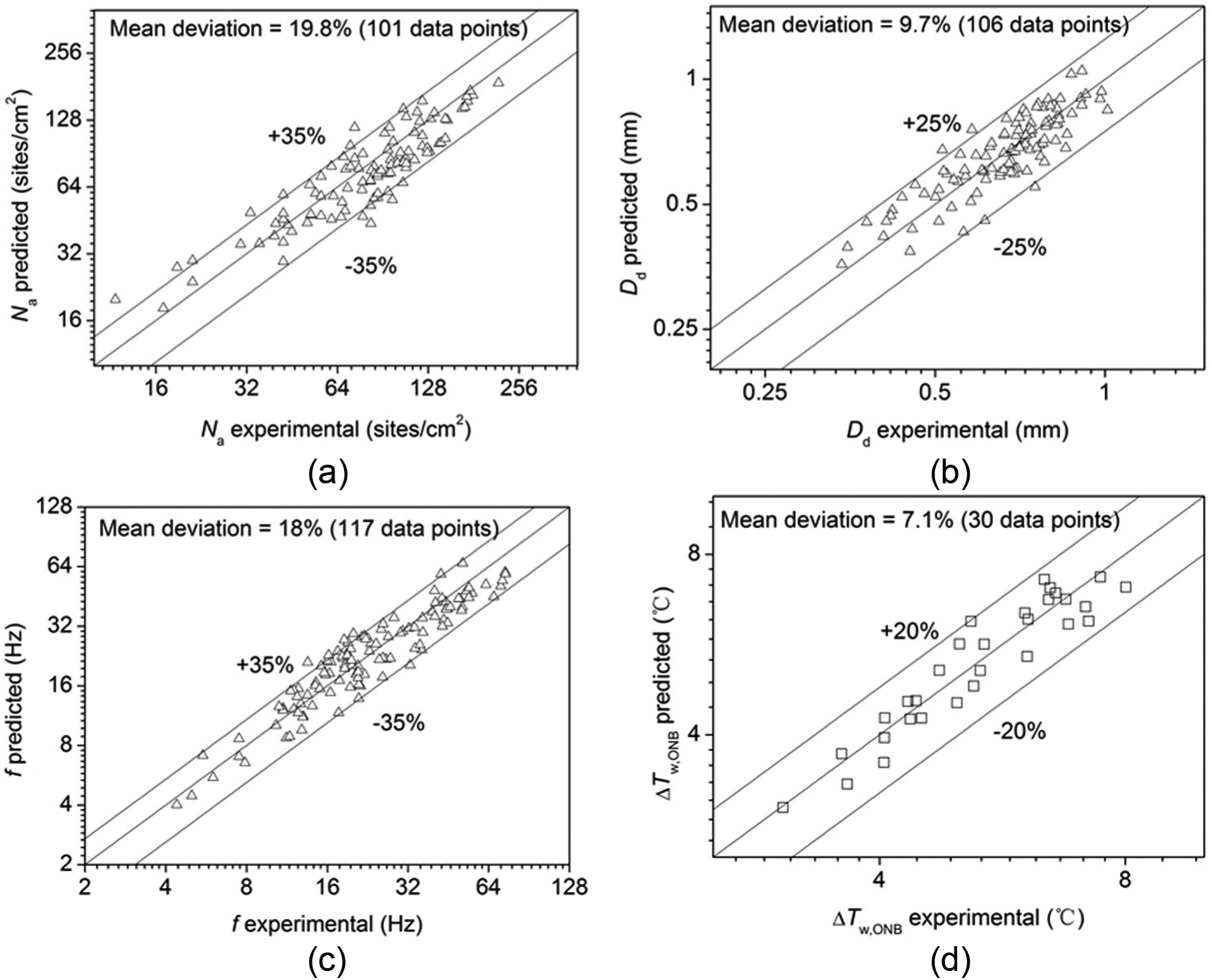
Comparison of predicted and experimental data: (a) N
a
, (b) D
d
, (c) f, and (d)
Numerical result and discussion
Numerical model setup
The computational domain is a three-dimensional narrow channel with the same dimensions and structure as the channel used in the experiment. The new boiling model discussed in previous sections was incorporated in the CFX code using user-defined subroutines. The saturation temperature, T
sat, and other physical property parameters of the water were specified as constants based on the system pressure. It is worth noting that the vapor was assumed to be saturated everywhere, and no part of the wall heat flux was applied to the superheating of the vapor phase. For the liquid phase, a no-slip boundary condition was applied for flow simulation; for the gas phase, a slip boundary condition was used. Because of the breakup and coalescence of bubbles, the vapor bubble diameters (

Grid arrangement.
Temperature results
This section discusses wall temperature distribution and the average wall temperatures. To validate against the experimental data, a group of experimental conditions with different inlet temperatures, mass flux, and wall heat flux were used as simulation boundary conditions. The conditions studied here are shown in Table 1. Cases 1–4 are four typical conditions with a wide range of experimental parameters and were used to validate the wall temperature distribution. Cases 5–8 are four groups of conditions and were used to validate the wall average temperature. The inlet temperature and velocity remained constant and the wall heat fluxes were variable for each group condition.
Simulation boundary conditions for model validation.

The wall temperature distributions predicted by the new and CFX models along the flow direction were compared with the experimental data for the three conditions provided in Figure 6, where “New model” and “CFX model” represent the numerical results of the new wall boiling model and the CFX default wall boiling model, respectively. Both numerical model results show that the temperature along the flow direction increased monotonically, but the experimental data showed a slight decrease near the flow outlet. This was caused by the outlet structure of the test section where a greater amount of copper material used during assembly brought more heat loss. The simulation models did not include the assembly structure of the inlet and outlet in the test section so the monotonically increasing trend in the simulation results was a reasonable distribution. From Figure 6, it is seen that the wall temperature distributions predicted using the new model agreed very well with the experimental data; on the other hand, the CFX model significantly under-predicted the wall temperature. The conclusion is that for narrow channels used in the experiment, the new boiling model significantly improved the accuracy of the wall temperature predictions.
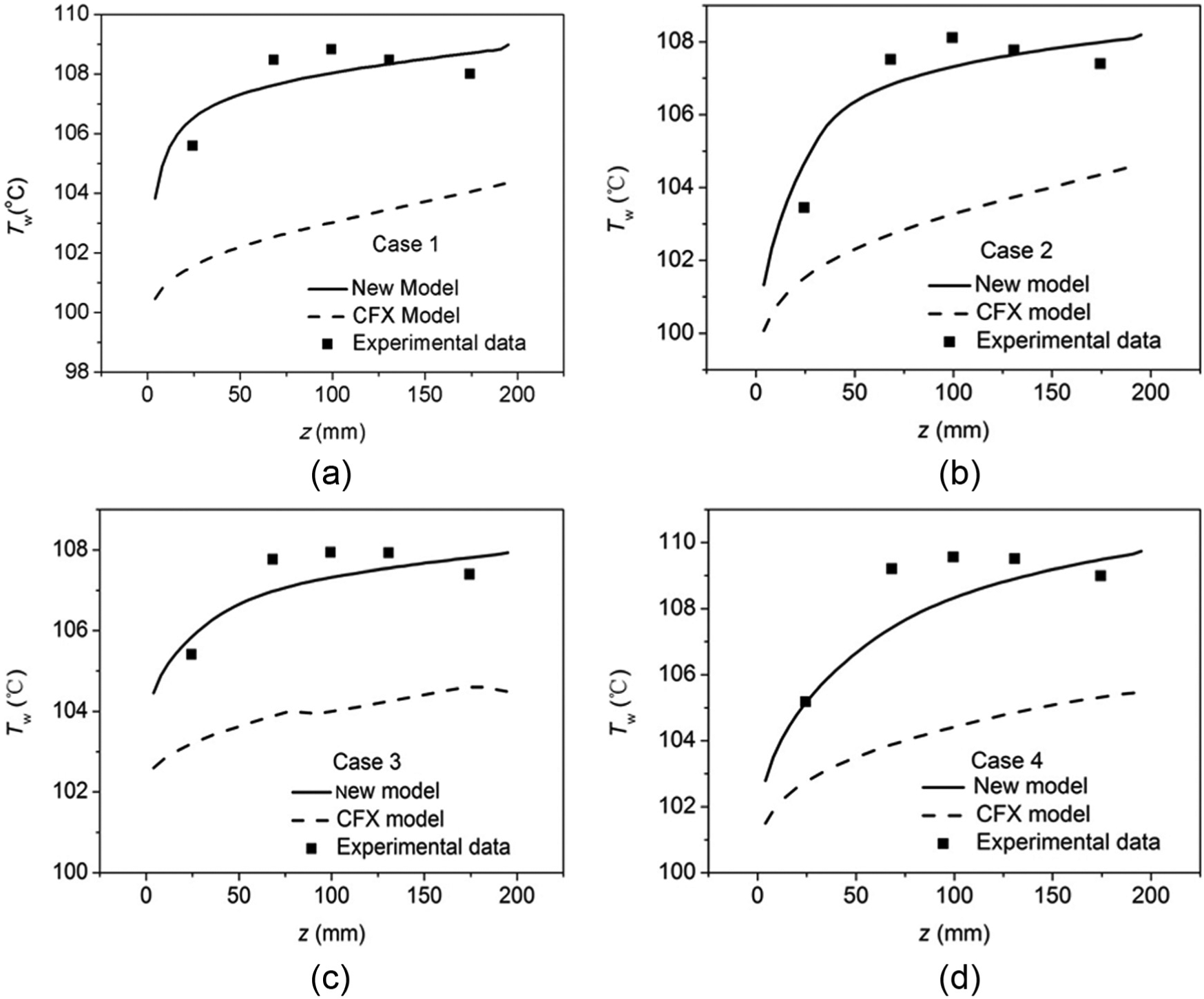
Comparison of predicted and experimental wall temperatures along flow direction: (a) Case 1, (b) Case 2, (c) Case 3, and (d) Case 4.
For the four groups of conditions from Case 5 to Case 8, the average wall temperatures predicted by the new and the CFX models as functions of the wall heat flux have been compared with the experimental data in Figure 7. The inlet temperature and velocity were kept constant for each case group. Figure 7 shows that the predictions from the new model have good agreement with the experimental data and accurately captured the temperature trend. The CFX model predictions, on the other hand, significantly under-predicted the wall temperature. More importantly, the model failed to capture the shape of the wall temperature curve as a function of the wall heat flux.

Comparison of predicted and experimental mean wall temperatures: (a) Case 5, (b) Case 6, (c) Case 7, and (d) Case 8.
Comparison of two wall boiling models
In order to directly compare the new and the CFX boiling models, the contrast analysis of the bubble characteristics was studied for numerical results of Case 1 by both boiling models.
The bubble characteristics, including the active nucleation density, bubble departure diameter, and bubble departure frequency along the flow direction, are shown in Figure 8(a)–(c). The new model predicts zero value for all the parameters before a certain location, and a steep rise after that location, which is the ONB predicted by the new model. The default CFX model did not capture the ONB. The effect of the ONB model will be discussed further in the following sections. From Figure 8(a), it can be seen that the active nucleation site density predicted by the new model is much higher than the CFX model. In nucleate boiling, the microstructure of the boiling surface and the thermal properties of the fluid have dominant effects on the active nucleation site density, and the wall temperature determines the range of available cavity size. 25 This means that higher wall temperatures generate greater active nucleation site densities. It also indicates that the material and processing methods of the boiling surface determine the magnitude of the results. The new model, which was developed based on the experimental data, took into consideration both the channel geometry and the properties of the channel surface; therefore, it predicts Na better than the CFX model that did not take into consideration the surface properties of the channel. In other words, the nucleation density is sensitive to the boiling surface material and treatment. It is hard to propose a general correlation for this parameter Na.

Comparison of two models: (a) N a , (b) D d , and (c) f.
The bubble departure diameters are compared in Figure 8(b). Because the wall superheat has a decisive influence on the bubble departure size, the difference in the bubble departure diameter predicted by two models is small. But the influence of gap size, liquid mass flux, and liquid subcooling are still evident. The bubble departure diameter curve along the flow direction of the new model is steeper than that of the CFX model. It illustrates that the bubbles on the boiling surface were constrained by the narrow channel structure and became larger while they departed the heating wall.
The bubble departure frequency is shown in Figure 8(c). Compared to the active nucleation site density, the bubble departure frequencies show opposite trends for two models’ results. The confined characteristic of the narrow channel significantly reduces the magnitude of bubble departure frequency; that trend increases along the flow direction. Since the CFX model did not take into account the influence of wall temperature and the narrow channel structure, it predicts that the bubble departure frequency decreases along the flow direction and with higher values. Because of the differences in the predictions of the bubble characteristics, the temperature distributions along the flow direction predicted by the two models are significantly different.
The impact of ONB model
To understand the impact of the ONB, the boiling curves predicted from the new and the CFX models are compared in Figure 9. The figure’s x-axis is the average temperature of the heating surface (

Boiling curves.
The predicted wall temperature distributions along the flow direction using these three models (the new model, the new model without the ONB correlation, and the CFX model) for Case 1 were compared with the experimental data in Figure 10. It is seen that the prediction of the new model agrees well with the experimental data, while the predictions of the CFX model and the new model without ONB are significantly below the experimental data. This result suggests that the prediction of the onset of nucleation boiling has a significant impact on the overall boiling prediction.
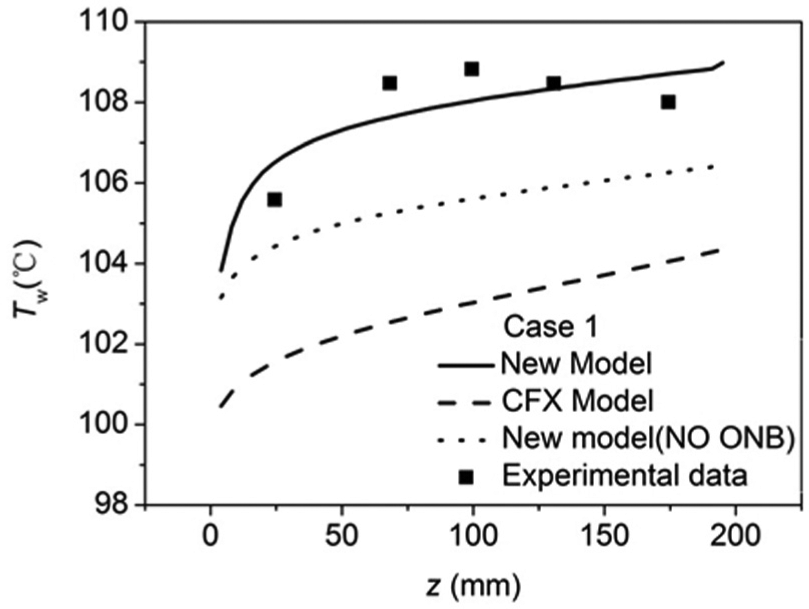
Influence of ONB model.
Conclusion
A new boiling model, including several sub-models and an empirical ONB model, was proposed based on the experimental data in this study. The new model was implemented in a two-fluid model in CFX through a user-defined subroutine. The experimental data were used to validate the models.
By comparing the experimental data and the numerical predictions, it was found that the predictions from the new model agree well with the experimental data. The CFX boiling model, on the other hand, under-predicted the heat transfer and mispredicted the trend of wall temperature distribution along the flow direction. The wall boiling model plays an important role on the simulation of heat transfer of subcooled flow boiling in narrow channel. The onset of nucleation boiling has an important impact on the overall subcooled boiling heat transfer. Without a proper ONB model, the heat transfer rate would be over-predicted. The study confirmed that it is necessary to use the special wall boiling model with the ONB model to achieve accurate wall temperature predictions in the narrow channel.
Footnotes
Appendix 1
Academic Editor: Hongwei Wu
Declaration of conflicting interests
The authors declare that there is no conflict of interest.
Funding
This work was supported by National Natural Science Foundation of China (Grant No. 51376022).