




Abstract
Management innovation is the method with which enterprises acquire competitive advantage over their competitors, especially in current fierce competitive industry environment. Simultaneous importance–performance analysis can be used to simultaneously analyze three concepts of management innovation factors including the importance, self-expression, and the performance of competitors, so that enterprises are able to understand the status of their management innovation capability. Decision-making trial-and-evaluation laboratory is the method for enterprises to process and calculate the level of influence and causality between the indicators and subsequently determine the weight of the indicators. This study developed the 14 management innovation–based assessment indicators to evaluate a management innovation capability. In the first stage, simultaneous importance–performance analysis is used to compare the management innovation capabilities of company A and its competitors. In the second stage, decision-making trial-and-evaluation laboratory is used to analyze the influence and causality between the indicators. Finally, the strategies of management innovation are rebuilt based on the simultaneous importance–performance analysis and decision-making trial-and-evaluation laboratory analysis, which has both theoretical and practical contributions.
Keywords
Introduction
In the 21st century, the management innovation becomes increasingly important because the situation changes frequently and rapidly. According to a survey report from McKinsey Co during 1995–1999, the high growth of productivity in America can be attributed to the management and technology innovations but not progress of information technology. Some scholars argue that management innovation is probably one of the most important and continuously competitive advantages of enterprises.1,2
Drucker 3 defined innovation as a “purposefully planned change.” A business that cannot innovate will wither. However, if a business cannot manage its current business operations and excel in its performance, it cannot accumulate risk capital for the future. Drucker indicated that traditional businesses must focus on continuous improvement, whereas transitional businesses must focus on adaptive improvement or adaptive innovation. At the transformational stage, businesses that become transformational businesses should focus on breakthrough innovations. Traditional, transitional, and transformational businesses should all embrace the concept of entrepreneurialism and employ the aforementioned strategies as approaches for responding to changes. In addition, businesses in the transitional and transformational stages should analyze and identify market opportunities, pay attention to unfulfilled customer needs, and focus particularly on innovations, all of which evidently differ from traditional businesses that focus merely on continuous improvement.
Given the intense market competition resulting from globalization, businesses must focus on strategies, continuously implement innovation and change, and use innovations to acquire competitive advantages. Businesses that do not innovate cannot develop new products, services, and business model; consequently, they can only produce the same old products through the same old methods. However, business innovation involves numerous complexities and problems in implementation. Innovation management is crucial, yet various risks and difficulties are inevitably involved. Effectively implementing innovation to achieve success is difficult.
As Burns 4 and Porter 5 mentioned for the research of competition, the action and reaction of competitors should be emphasized. Burns 4 proposed the method, simultaneous importance–performance analysis (SIPA), which is used to simply analyze the importance of factors of competition in three concepts of competition, the importance, the self-expression, and performance of competitors, and at the same time to discriminate eight levels of competition status. In SIPA, the basic hypothesis of the importance analysis is the independence without causal relations between the criteria. Thereby, it is necessary to distinguish the causal relationship among the criteria for the result of SIPA to prevent the incorrect strategy.
Decision-making trial-and-evaluation laboratory (DEMATEL) is built up by Gabus and Fontela 6 to distinguish the causalities between the criteria and the mutual influence in the complexity of system. The DEMATEL is characterized by its application of matrices to obtain the causalities and influential strength between factors. The level of influence and direction of the essential constituents are explained in direct-relationship diagrams, in which influential strength was numerically represented.6,7
Causal diagrams are used to structure complex questions, dividing all evaluation criteria into causes and effects, to identify core problems and corresponding solutions. In recent years, many scholars have noted the practicability of the DEMATEL and have widely used it to improve decision-making quality and performance.6,7
There are two shortcomings on the previous research of management innovation capability. First, most studies hypothesize that the indicators are independent of each other without causal relations. Second, some studies have shown that weights of evaluation indicators are same. To overcome these two limitations, in order to analyze the methodology for manufacturing enterprises to establish the management innovation capability and strengthen their competitive advantage, this study developed capability-based indicators composed by 3 dimensions and 14 factors to establish an assessment framework of management innovation. In addition, the SIPA and DEMATEL methods were used to establish the SIPA-DEMATEL model, which was then employed to obtain the comparison of management capabilities, the level of influence, and causality between the indicators and subsequently determine the weight of the indicators for the case company, A, and its competitors. Finally, the competitive advantage strategy to build up management innovation capability is proposed.
Literature review
Contents of management innovation
Management innovation is a derived theory of the innovation theory. Stata 8 was the first scholar to distinguish innovation from the management innovation, market innovation, and technology innovation, and he argued the issue that enterprises need to solve should include internal collaborative process, cost control of development, and individual management. Mol and Birkinshaw 9 claimed that management innovation was not treated as leading technology as competitive advantage of American enterprises was the main reason to develop behind.
Chang 10 and Mingjie 11 are scholars who devoted to the study of management innovation in China. Mingjie 11 defined the management innovation as either the creation of new process for management to achieve business objectives and responsibilities in the way of more effective resource integration paradigm for resources or a fine management for new specific resource integration and goal setting. He made the comprehensive and profound dissertation through the discussion of theory and practice, circumstance, and behavior of enterprises for the management innovation. Chang 10 claimed that management innovation is the kind of organization innovation which practiced on the operation and defined management innovation as implementation of new methods of management with the goal of the reduction in transaction costs. After which, more scholars devoted themselves to the research of theory and practice of management, and the mainstream is to propose the methods and principles of management innovation based on the case studies on concreted practice of enterprises.1,2,12
Evaluation of management innovation capability
The way scholars evaluate the capability of management innovation is mostly followed by the method of evaluation of technological innovation capability. Based on the literature review, the methods can be divided into perspectives such as (1) the strategy management perspective: Burgelman et al. 13 argued that the innovation capability is the comprehensive characters of enterprise to support technological innovation, including the resources and allocation; review and prospect on the development of technology and industry; and the capability to manage organizational structure, organizational culture, and strategies based on the composition factors of technological innovation; and (2) the entrepreneur perspective: Ireland et al. 14 claimed that management innovation capability is the capability of business executives to strategically manage the resources of enterprise for promotion of technology innovation development.
Many scholars in China focused on the research of management innovation capability from different perspectives in recent years. Wang 15 and Shao and Liu 16 distinguished management innovation capability from three parts which are investment capability, conversion capability, and production capability, based on general equilibrium theory, and proposed the evaluation index. Lin and Peng 17 argued that management innovation capability is built up by strategic capability, concept innovation capability, resource management capability, market management capability, and organizational management capability. Meuer 2 from the perspective of enterprise sustainable innovation capacity point of view defined that the capability of sustainable management innovation is the innovation integration of internal and external resources to achieve the goal of the enterprise, including strategy innovation capability, cultural innovation capability, knowledge innovation management, and information management capability. They also claimed that management innovation capability is an important embodiment of the core competence vitality of the enterprise. Thus, how to enhance the management innovation has become the inevitable criterion for the sustainable development of enterprises. Fu and Du 18 also proposed the evaluation system of management innovation capability built up by systematic mechanism, scientific method, and enterprise culture after the literature researched, interview of experts, and managers of enterprise.19,20
Based on previous literature review, this study adopted the comprehensive point of view according to innovation theory of Schumpeter and general equilibrium theory to compartmentalize management innovation capability into three elements, including the organization of management innovation, resources of innovation management, and investment of management innovation, and established 14 indicators. The evaluation system of management innovation capability for a manufacturing enterprise is proposed in this study, including the entrepreneurs’ innovation and forward-looking initiative, corporate values, organization system, training mechanism, supervision mechanism, the quality of staff, organization and coordination ability, comprehension of information management, coherence of the employees, desire of innovation, the atmosphere of learning, funding compensation system of R&D, and incentive system for innovation. The definition of 14 factors is as follows:19,20
The organization of management innovation
Entrepreneurs’ innovative and forward-looking initiative: the leader’s insight into the market and product and the firm execution of innovation idea reflect the entrepreneur’s style and leadership;
Corporate values: corporate values are the agreement of members in enterprise of specific event or behaviors which lead directions for the employees;
Organization system: including the organization regulations, procedures, standards, and so on;
Training system: including the goal of enterprise, organizational culture, employees’ job responsibilities, and the regulations;
Supervision mechanism: fairness, development, and humanity are the characteristics of supervision mechanism for management innovation;
The resources of management innovation
Quality of staff: the head count proportion of employees with a college degree or above could be the employee’s quality evaluation index;
Organizational coordination ability: including the ability to deal with the conflict in the process to achieve the goal;
Comprehension of information management: information management can not only make the operation of the enterprise transparent but also guide internal communication and coordination of the enterprise;
Cohesion of the employees: refer to the sense of belonging of employees to the enterprise which can be measured by employees’ aggregate idea and cooperation consciousness;
Employee’s desire for innovation: a reflection of innovation culture and innovation environment;
Learning atmosphere: it should include the training course, self-learning and enthusiasm of employees, and the learning environment provided by enterprise;
The investment of management innovation
R&D funding: the expenditures to improve the procedure, process, and research of new production product;
Compensation system: including employee salary, fixed allowance, social welfare, and the internal welfare of company;
Incentive to innovation: incentive mechanism to promote the innovation including the prize and award for technical innovation, new product development, technology renovation, and quality improvement.
Methodology
There are two shortcomings on the previous research of management innovation capability. First, most studies hypothesize that the indicators are independent of each other without causal relations. Second, some studies based on the hypothesis of same weights of evaluation indicators but the influence of the indicators are same. Therefore, the relationship and causal correlation between indicators cannot be identified, which limit the further research of management innovation capability indicators and decrease the effectiveness of guiding the enterprise to develop management innovation capability. In this study, 14 indicators of management innovation capability had been defined and claimed the causal correlation between the 14 indicators.
The methodology of this study is combined with SIPA and DEMATEL to form the SIPA-DEMATEL model. In the first step, the capability of management innovation for case company is compared to competitors by SIPA and then the causal correlations between indicators are measured by DEMATEL. Finally, the management innovation capability evaluation of the manufacturing enterprise is established, and the strategy of the management innovation for the case company is proposed.
SIPA
SIPA is the method which is able to simply analyze the importance of factors of competition in three concepts of competition, the importance of criteria, the self-expression, and expression of competitors, at the same time. 4 The analysis data of SIPA for comparison between case company and competitors are collected by questionnaires of relevant personnel to measure the attribute importance after indicators are defined with the “High” and “Low” properties. The performances of case company and competitors for each indicator are also scored by relevant personnel and distinguished as “Poor” and “Good.” The eight states of competitions had been defined, and the corresponding competitive strategy is able to build up, as shown in Table 1.
Simultaneous importance–performance diagnostic grid.

Four of the eight kinds of simultaneous results, “Neglected Opportunity,”“Competitive Disadvantage,”“Competitive Advantage,” and “False Advantage,” are most important because they are strongly correlated to management innovation of enterprise. It is necessary for enterprise to invest and allocate the resource for “Neglected Opportunity” to early grasp the opportunity, and the capability can be improved early. If enterprise is not able to neither immediately strengthen nor improve the “Competitive Disadvantage,” enterprise will continue losing the capability of management innovation. Continue sustaining “Competitive Advantage” in the long period will help enterprise to maintain the capability of management innovation. “False Advantage” does not help enterprise to keep or enhance capability of management innovation more; thus, the resource needs to be reduced and invested in other aspects.
The analysis by SIPA method considers the performance of both case company and competitors. The corresponding strategy could be formed by the results of comparison and analysis of SIPA, which help to direct and allocate the corporations’ resources investment. On the basis of study of Burns, 4 many subsequent applications of the researches of SIPA are proposed.21–26
DEMATEL
The DEMATEL method was developed by the Battelle Memorial Institute, Geneva. Gabus and Fontela 6 initially used this method to resolve complex global problems, such as racial issues, starvation, environmental protection, and resource problems. DEMATEL directly compares the correlation between attributes in complex systems and uses matrix operations to obtain the direct and indirect causal relationships and levels of influence among all attributes. DEMATEL can transform complex systems into causal relationships with definite structures.27–31
In recent years, DEMATEL has been widely applied to resolve numerous problems in various fields. Lee et al. 27 used DEMATEL to verify benefits of applying DEMATEL to the technology acceptance model. Wu and Lee 32 evaluate performance criteria of employment service outreach program personnel. Lee and Hsieh 25 utilized DEMATEL to analyze the causal relationships between service attributes for adjusting the importance of service attributes and to resolve core problems.
The DEMATEL method was implemented in this study using the following steps:
1. Step 1. The attribute characteristics and measurement scales were defined.
The expert opinion approach was used to establish the causal relationship between the attributes and the measurement scale for the level of influence. Several methodologies of scale of influence had been used to evaluate including 6 level scales, 33 4 level scales,34,35 and 11-point measurement scale.25,27 A 11-point measurement scale was used in this study because the wide range of options enabled the experts to effectively distinguish the level of influences among the attributes and complete the questionnaire.
2. Step 2. The direct-relation matrix X was established.
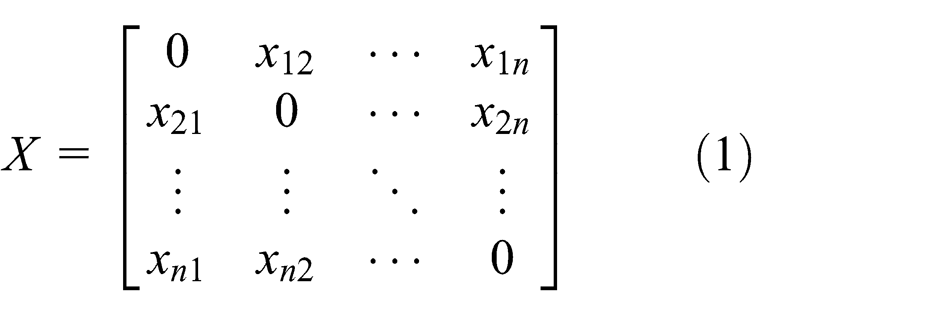
The initial direct-relation n-by-n matrix X, denoted as equation (1), was formulated based on pairwise comparisons generated in an expert survey. In matrix X, Xij is the degree to which the criterion i affects the criterion j
3. Step 3. The direct-relation matrix N was normalized.
Based on the direct-relation matrix X, the normalized direct-relation matrix N was generated using the following34,36

where
4. Step 4. The total-relation matrix T was calculated.
After generating the known N, the identity matrix I was used to acquire the direct–indirect matrix T, also called the total-relation matrix

5. Step 5. The influence and influential levels of the factors were calculated.
After determining T, the influence of certain attributes on other attributes was calculated to determine the degree to which the target attribute was influenced by other attributes. The term “Tij ” was used to define the characteristics of the attributes in T, where i, j = 1, 2, …, n. The term “Di ” was considered the sum of row i and represented the sum of the attributes influenced by i. The term “Rj ” represented the sum of column j (i.e. the sum of the attributes that influenced attribute i). The terms “Di ” and “Rj ” were acquired from T and included both direct and indirect influences. The sum of the rows and the sum of the columns were separately denoted as vector D and vector R in equations (4) and (5)


6. Step 6. The DEMATEL relations between the four dimensions.
The prominence was defined as (Dk+Rk ), k = i = j = 1, 2, …, n, and indicated the overall influence of and influential levels of a specific attribute (k). This value represented the core level of k in all problems. The varying degree of the influence of and influential levels of k was defined as (Dk − Rk ). This value indicated the causal level of k in all problems. If the value was positive, k was categorized as a cause. Conversely, if the value was negative, k was categorized as an effect. Increased (Dk +Rk ) values indicated an increased degree of influence on other attributes or an increased degree of being influenced by other attributes.
Integrated SIPA and DEMATEL methods
SIPA is the method which is used to simply analyze the importance of factors of competition in three concepts of competition, the importance of criteria, the self-expression, and expression of competitors, and at the same time to discriminate eight levels of competition status. However, the basic hypothesis of SIPA is the independence and without causal relations between the criteria. Thereby, it is necessary to distinguish the dependency and causal relationship among the criteria for the result of SIPA. The implementation of DEMATEL analysis in the second stage is applied to clarify the causal relationship and degree of influence between the 14 criteria of management innovation capability. The enterprise is possible to distinguish the major criteria to strengthen the management innovation capability and build up the effective strategies.
The integrated SIPA and DEMATEL methods proposed to analyze the competitive status of the management innovation capability and construct the enhancement strategy of manufacturing enterprises in this study by the following sequence to discuss the three aspects of questions: (1) analyze the performance differences of management innovation capability between case company and its competitors, (2) distinguish the causal relationship and mutual influence by DEMATEL, and (3) reform the strategy to strengthen the management innovation capability by integrated SIPA and DEMATEL methods.
Result and discussion
Company A, with more than 10,000 employees around America, Europe, Japan, and Southeast Asia, is well known as an integrated circuit (IC) foundry in China and ranked fifth of revenue in the world. With more than 15 years of experiences, company A serves customers throughout the world including the integrated device manufacturers and fabless design houses in IC industry.
According to the data of IHS iSuppli in 2013, the market value of global circuit foundry is about US$4.3 billion. The market share of company A was 4.6% and its competitors’ were 46% for company B, 10% for company C, and 9% for company D. The market share of these four companies is about 70% of global market. Although company A is ranked fourth in top 5, the gap is still large in both revenue and advanced technology. The technology gap compared to company D is about 1 year, but 2 years compared to company B. In recent years, the market share and the profitability of company A were stagnated, and behind the main rivals, even company A continued to increase the funding in research and the speed of capacity expansion. Top manager of company A realized the importance of management innovation capability is as well as that of the investment in the R&D in technology; therefore, company A needs urgent research to distinguish the competition status and construct the appropriate strategies to strengthen its capability of management innovation. Thereby, this study compared and discussed the performance of management innovation of company A and its competitions in industry, companies B, C, and D, and proposed the appropriate strategies for company A to strengthen the management innovation capability.
Design of questionnaire and data collection
The questionnaire is designed based on the management innovation capability evaluation model, which is composed of 14 criteria in three dimensions, and it is distributed from April to May in 2014. The topic of SIPA questionnaire is “SIPA Questionnaire of Management Innovation Capability for IC Foundry,” and the 14 criteria are (Q1) entrepreneurs’ innovative and forward-looking initiative, (Q2) corporate values, (Q3) organization system, (Q4) training system, (Q5) supervision mechanism, (Q6) quality of staff, (Q7) organizational coordination ability, (Q8) comprehension of information management, (Q9) cohesion of the employees, (Q10) employee’s desire for innovation, (Q11) learning atmosphere, (Q12) R&D funding, (Q13) compensation system, and (Q14) incentive to innovation. The scoring scale of this questionnaire follows the 9-point scale, where “1” indicates “extreme not meet the demands for the management innovation” and “9” indicates “perfectly meet the demands of the management innovation” to investigate the importance and performance of case company A and its competitors. The SIPA questionnaire is surveyed by the 65 experts of IC foundry and related supply chain including vice president of marketing, deputy general manager of purchase, vice president of technology development, and general manager who are familiar with the business, operation, and management status of company A and IC industry. The effective return rate of the 65 questionnaires is 60%, including 39 effective return and 26 invalid return.
The topic of DEMATEL questionnaire is “DEMATEL Questionnaire of Management Innovation Capability for IC Foundry” and is distributed during June–October in 2014. The survey of questionnaire is collecting the expertise understanding of 14 criteria of Management Innovation Capability for IC Foundry, by the 11-point scale of measurement following Lee et al. 27 and Lee and Hsieh. 25 The score “10” is the maximum score which perfectly indicates correlation, “0” is the minimum score which indicates extremely no correlation, and the score between 9 and 1 is the sequence score according to the importance. The DEMATEL questionnaire is adopted by expert investigation and the 14 IC-related experts including 2 general manager of IC foundry, 2 vice president of marketing, 5 vice president of purchase, and 5 vice manager of technology development. The direct visit and detailed explanation of the content of questionnaire is completed by the author; thereby, the effective return rate of this survey is 100% of 14 copies of questionnaire.
Results of the SIPA study
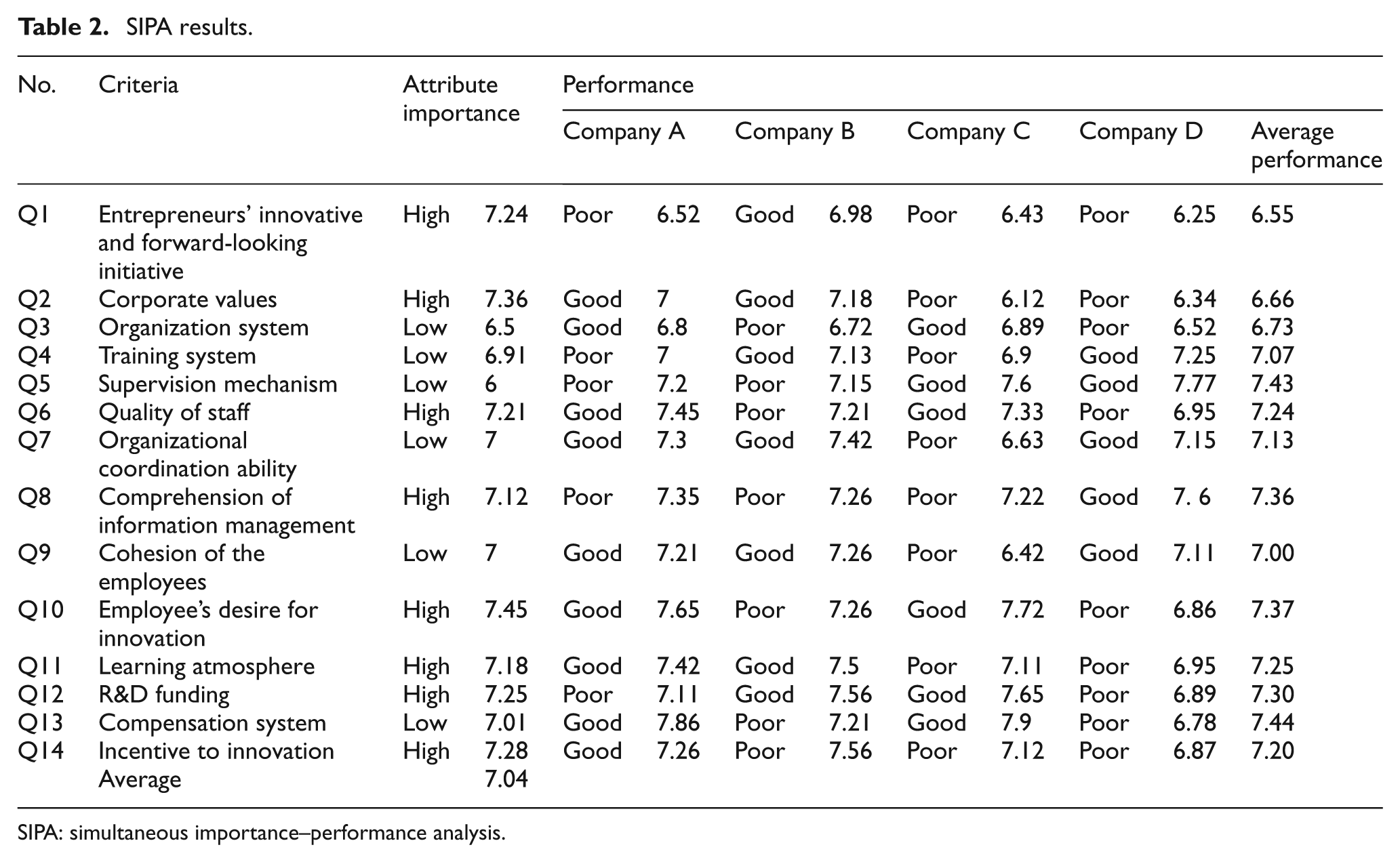
In this SIPA research, the average importance is a statistical average of the result of questionnaire which is 7.04 and used as the standard to judge the degree of importance as “High” or “Low.” The importance of the 14 criteria is listed in Table 4, as the sequence of importance degree from “High” to “Low” as (Q1) entrepreneurs’ innovative and forward-looking initiative (7.24), (Q2) corporate values (7.36), (Q6) quality of staff (7.21), (Q8) comprehension of information management (7.12), (Q10) employee’s desire for innovation (7.45), (Q11) learning atmosphere (7.18), (Q12) R&D funding (7.25), and (Q14) incentive to innovation (7.280). The above eight criteria are judged as “high” importance, and the other six criteria are judged as “low” importance.
In this study, the average performance of four companies is the standard to determine the performance of each criterion as “Good” or “Poor” (“Good” indicated the performance is higher than the standard, and “Poor” indicated the performance is worse than the standard). The five criteria of “poor” performance for company A are (Q1) entrepreneurs’ innovative and forward-looking initiative, (Q4) training system, (Q5) supervision mechanism, (Q8) comprehension of information management, and (Q12) R&D funding. There are seven criteria of “poor” performance for company B and company C each and eight criteria for company D. The details are listed in Table 2.
SIPA results.
SIPA: simultaneous importance–performance analysis.
In order to analyze the advantages and disadvantages of management innovation capability of company A compared with other three companies, B, C, and D, it is necessary to condense these three companies by the weight of market share to a competitor. Thus, the importance and performance of this competitor can be calculated according to the weight of market share of four companies, A, B, C, and D. Based on the data form IHS iSuppli in 2013, the market share is 4.6% for company A, 46% for B, 10% for C, and 9% for D; the SIPA method to analyze the management innovation capability can be compiled in Table 4 for strategy.
The result of SIPA shows that company A performs better than competitors and is defined as “competitive advantage” at (Q6) quality of staff and (Q10) employee’s desire for innovation. Company A needs to keep the strengths for strengthening management innovation capability. In other words, the “competitive disadvantage” of company A is defined as (Q1) entrepreneurs’ innovative and forward-looking initiative and (Q12) R&D funding but needs company A to focus on resources to improve these two criteria to reduce the disadvantage. (Q3) organization system is defined as a “false advantage.” The third-party felt low importance of this criterion, but the performance of company A at this criteria is better than the competitors. The more management innovation capability cannot be created; thereby, the resources should be considered to allocate to other criteria. There is a “neglected opportunity,” in which company A and competitors seem to ignore the opportunities; at (Q8) comprehension of information management, company A should invest resources to facilitate at this criterion to transcend its competitors (Table 3).
SIPA of company A and competitors.

SIPA: simultaneous importance–performance analysis.
DEMATEL calculation and results
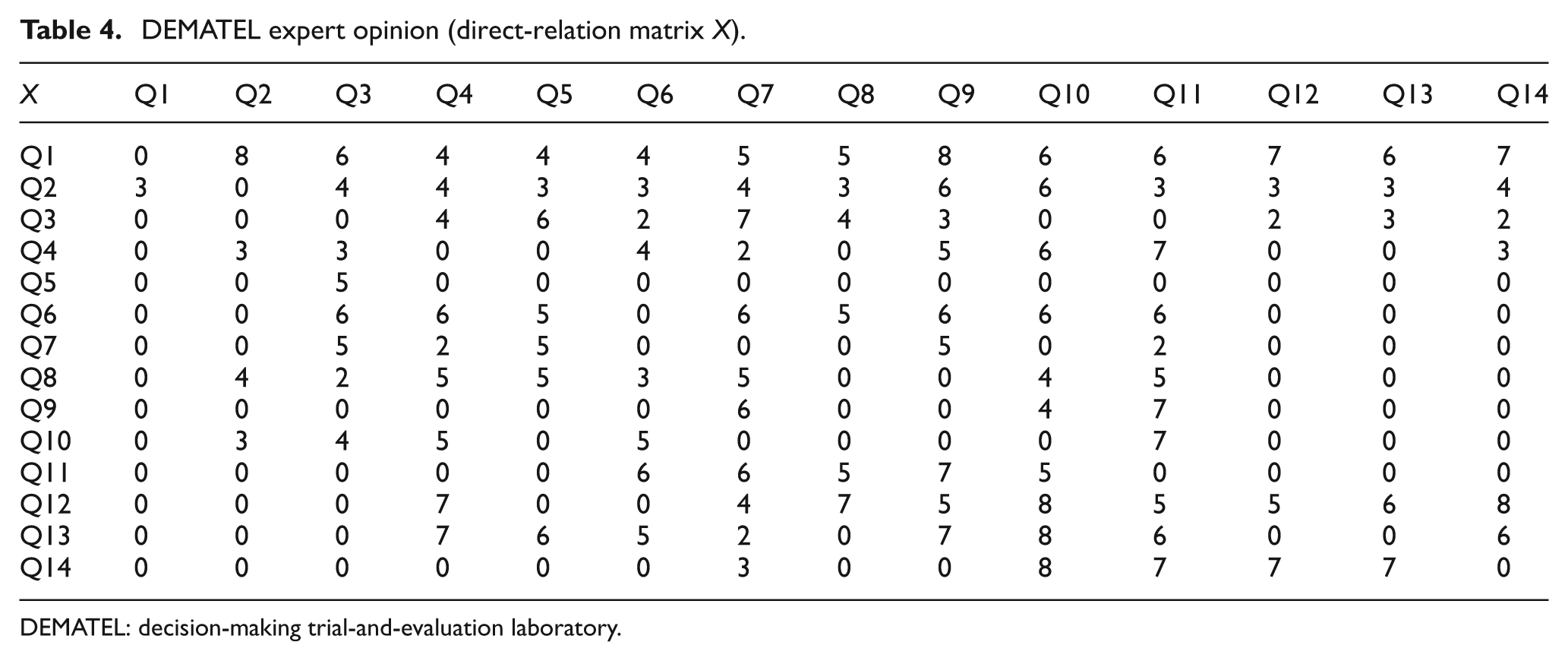
As the expert questionnaire method is applied, data for DEMATEL method are collected to analyze the mutual relation and influence degree of the 14 criteria. The data of expert opinion surveyed for the 14 criteria result in 182 mutual influences excluding the zero influence degree of the 14 diagonal properties. The average score of data from the 14 experts is accessed to the entire digital fractional as shown in Table 4.
DEMATEL expert opinion (direct-relation matrix X).
DEMATEL: decision-making trial-and-evaluation laboratory.
Take (Q7) organizational coordination ability for example, the degree of influence of (Q7) to (Q3) organization system is five, the degree of influence of (Q7) to (Q4) training system is two, the degree of influence of (Q7) to (Q5) supervision mechanism is five, the degree of influence of (Q7) to (Q9) cohesion of the employees is five, and the degree of influence of (Q7) to (Q11) learning atmosphere is two.
(Q7) is also influenced by (Q1) entrepreneurs’ innovative and forward-looking initiative and the degree of influence is five, the degree of influence of (Q2) corporate values to (Q7) is four, the degree of influence of (Q3) organization system to (Q7) is seven, the degree of influence of (Q4) training system to (Q7) is two, the degree of influence of (Q6) quality of staff to (Q7) is six, the degree of influence of (Q8) comprehension of information management to (Q7) is five, the degree of influence of (Q9) cohesion of the employees to (Q7) is six, the degree of influence of (Q11) learning atmosphere to (Q7) is six, the degree of influence of (Q12) R&D funding to (Q7) is four, the degree of influence of (Q13) compensation system to (Q7) is two, and the degree of influence of (Q14) incentive to innovation to (Q7) is three. A direct-relation matrix X (Table 4) is established according to the result of expert survey above.
Results of DEMATEL
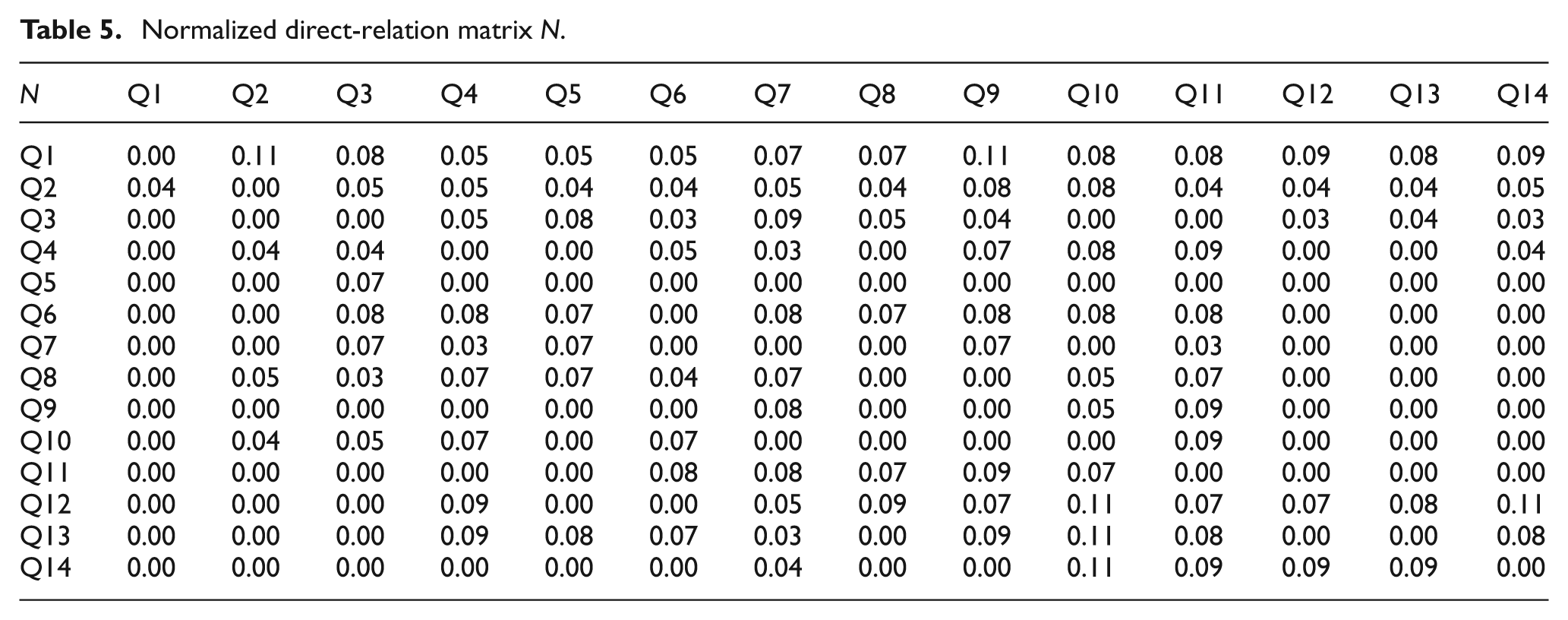
Calculation of normalized direct-relation matrix N. The calculation of normalized direct-relation matrix should reference on the maximum sum of column vector, following formula (2) by (Q1) as an example, the aggregation of the column is 0+3+0+... 0+0 = 3. The aggregation of influence of each column by similar method and the result is, respectively, 18, 35, 44, 34, 32, 50, 29, 52, 61, 61, 24, 25, and 30; thus, the λ is calculated by reciprocal of the maximum value, 61. By formula (3) operations, the normalized direct-relation matrix N is calculated by multiplying directly related matrix X by λ and half adjusted by the following second bit decimal point as shown in Table 5.
Calculating the total-relation matrix T. The total-relation matrix T can be obtained by following formula (4) and half adjusted by the following second bit decimal point as shown in Table 6.
Normalized direct-relation matrix N.
Total-relation matrix T.

For the purpose of simplifying the complicated relationship among the criteria, Tzeng et al., 36 Lee and Hsieh, 25 and Lee et al. 27 claimed the method to screen the influence which is below the certain degree as no causal relationship after discussed with the experts of original questionnaire. This study followed this method and defined 0.10 as the determining limit to judge the causal relationship, and the 44 values were kept for the total-relation matrix Tcut = 0.1 (Table 7).
Total-relation matrix Tc u t = 0.1.

From this table, (Q13) compensation system affects (Q4), (Q9), (Q10), and (Q11) and the coefficient of influence is 0.12, 0.13, 0.15, and 0.14, respectively. In addition, (Q13) compensation system is affected by (Q1) and (Q14), and the coefficient of influence is 0.11 and 0.1, respectively.
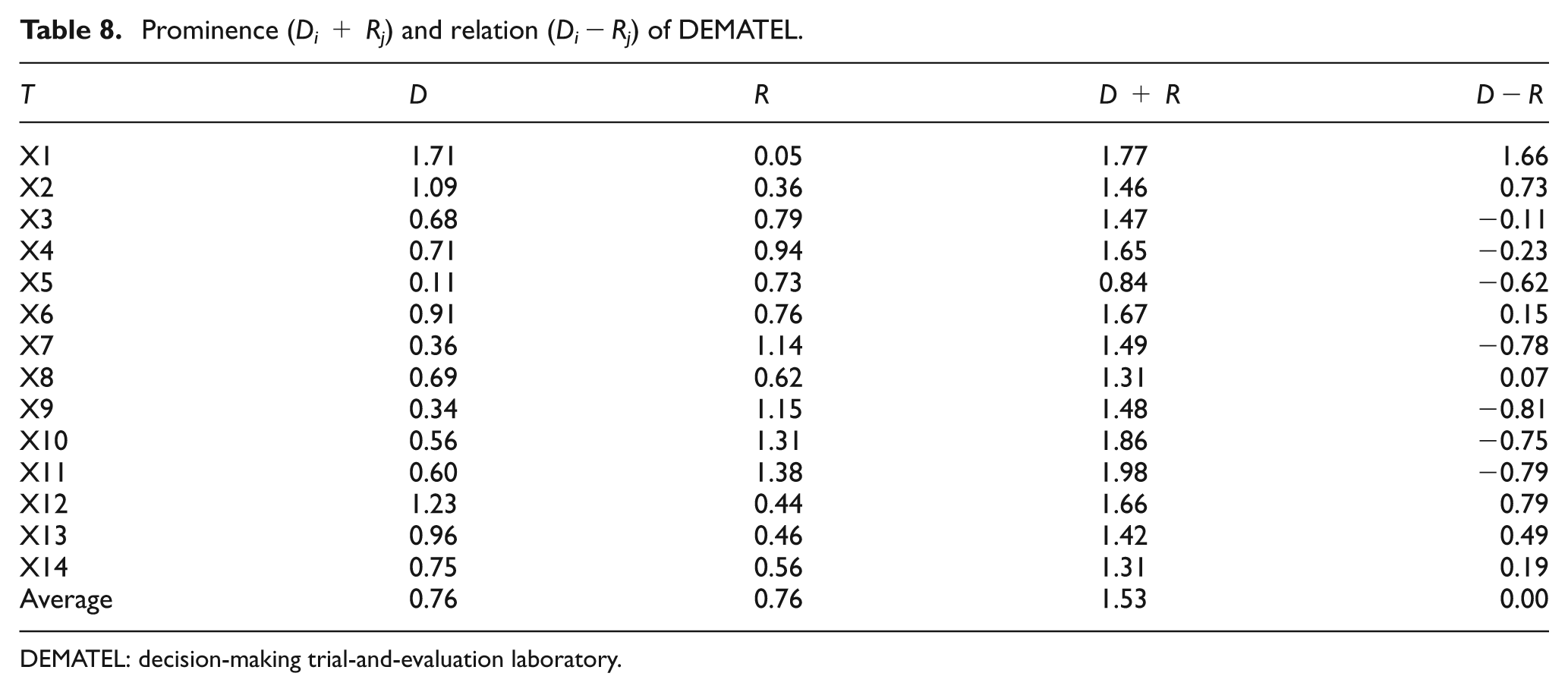
Then, prominence (Di+Rj ) and relation (Di − Rj ) can be calculated using the values of Di and Rj according to formula (5) and formula (6). For (Q2) corporate values, D 2 is the sum of influence coefficient of second column, which is D 2 = 0.04+0.02+0.09+...+0.06+0.06+0.07 = 1.09, and R 2 is the sum of influence coefficient of second column, which is R 2 = 0.12+0.02+0.01+...+0.02+0.01+0.01 = 0.36. Similarly, other Di and Rj values for each criterion and (Di+Rj ) and (Di − Rj ) can be obtained as shown in Table 9. In addition to the 14 criteria, the DEMATEL relations between the four dimensions can be shown in Figure 1.

DEMATEL relations between the four dimensions.
According to the analysis results in Table 8 and Figure 1, the causality and mutual influence of the 14 criteria of the management innovation capability is explained as follows:
High relation, high prominence: (Q1) entrepreneurs’ innovative and forward-looking initiative, (Q6) quality of staff, and (Q12) R&D funding were characterized as high-relation, high-prominence attributes. These attributes were considered cause attributes—the core items and driving factors influencing the other attributes;
High relation, low prominence: (Q2) corporate values, (Q8) comprehension of information management, (Q13) compensation system, and (Q14) incentive to innovation were considered high-relation, low-prominence attributes. These attributes influenced certain other attributes to a relatively minor degree;
Low relation, high prominence: (Q4) training system, (Q10) employee’s desire for innovation, and (Q11) learning atmosphere were considered low-relation, high-prominence attributes. These criteria were considered as effect attributes; in other words, attributes influenced by other attributes which could not be directly improved;
Low relation, low prominence: (Q3) organization system, (Q5) supervision mechanism, (Q7) organizational coordination ability, and (Q9) cohesion of the employees were considered low-relation, low-prominence attributes. These criteria were subtly influenced by other criteria, indicating that they were relatively independent.
Prominence (Di + Rj ) and relation (Di − Rj ) of DEMATEL.
DEMATEL: decision-making trial-and-evaluation laboratory.
Compiling these analyses of the influence level and causal relations of the 14 criteria indicated that (Q1) entrepreneurs’ innovative and forward-looking initiative, (Q6) quality of staff, and (Q12) R&D funding were core items and driving factors influencing other criteria. The improvement of these three criteria not only solves the core problem but also can help to improve the competitiveness of other criteria.
Discussion of the result of SIPA and DEMATEL
In order to help company A to strengthen the management innovation capability, it is necessary to verify the “competitive advantage,”“competitive disadvantage,”“false advantage,” and “neglected opportunity” of company A compared with the competitors. It will affect the strategy and resource allocation for the management innovation capacity of company A.
From the result of SIPA, (Q6) quality of staff and (Q10) employee’s desire for innovation are the “competitive advantage” of company A, and company A should continue keeping the strengths. Combined with the result of DEMATEL, (Q6) is characterized as a cause attributes (high-relation, high-prominence attributes) which is a driving factor influencing the other attributes and the company needs to keep the advantage for related criterion improvement. Contradistinguishing with the practice of company A, the previous effort to invest resource and to hire the professional expert of technology development and operation and fresh members from the best college seems to benefit in enhancement of management innovation capability. But (Q10) employee’s desire for innovation is considered as effect attributes (low relation, high prominence), which cannot be improved directly but need to find related cause attribute to improve.
In SIPA, (Q1) entrepreneurs’ innovative and forward-looking initiative and (Q12) R&D funding are competitive disadvantages which need company A focus to promote these two criteria. Combined with the analysis of DEMATEL, (Q1) entrepreneurs’ innovative and forward-looking initiative and (Q12) R&D funding are characterized as a cause attributes (high-relation, high-prominence attributes) which are the driving factors of problem solving. The results of DEMATEL analysis matched with the conclusion of SIPA. It is urgent for company A to focus company’s resources to solve the weakness in entrepreneurial innovation and forward-looking initiative and enhance the investment of R&D funding, otherwise company A will suffer irreversible competitive disadvantage. Company A, following the direction of innovation, increased the investment for technology development in recent years, even is insufficient, but is correct and need to maintain the direction.
In SIPA, (Q3) organization system is a “false advantage,” and even the performance is better than the competitors, but company A cannot gain more management innovation by opinions of related third party. The resource of company A which was invested in this aspect should be considered to transfer to other attributes. In the analysis of DEMATEL, (Q3) organization system is considered as relatively independent effect factor (low-relation, low-prominence attributes) which is influenced by other criteria with low coefficient, but it could not be directly improved. Referenced to practice of company A, although standardization and reorganization are implemented during the past few years, which purpose to improve efficiency of operation, there is no obvious enhancement of the management innovation capability.
(Q8) Comprehension of information management is the neglected opportunity from the analysis results of the SIPA, which ignored the potential opportunities for company A and competitors. It is a good chance for company A to grasp the opportunity and invest resources to facilitate for a leading opponent. In DEMATEL, (Q8) comprehension of information management is characterized as a cause attributes (low-relation, low-prominence attributes) but relatively independent, that is, not affected by other criteria. Company A could establish a long-term improvement scheme, which is based on financial and operating situation, and invest resource ahead of competition rival for this potential opportunity to strengthen the management innovation capability.
The strategy of company A to enhance the management innovation capability can be built up based on the integrated SIPA-DEMATEL analysis of management innovation capability which is summarized in Table 9.
Integrated SIPA-DEMATEL analysis of management innovation capability.

SIPA: simultaneous importance–performance analysis; DEMATEL: decision-making trial-and-evaluation laboratory.
Conclusion
Management innovation is the method which enterprises use to acquire competitive advantage to keep more profitable than their competitors, especially in current fierce competitive industry environment. Management innovation–based assessment indicators to evaluate a management innovation capability is established for a manufacturing enterprise of the 14 indicators in three dimensions had been proposed based on previous literature review, innovation theory of Schumpeter, and general equilibrium theory. In addition, SIPA is used to compare the management innovation capabilities of the company A and its competitors. Combined with DEMATEL for influence and causality between the indicators and subsequently determine the weight of the indicators, the strategies for enhancement of management innovation capability is built up.
According to the case study results, (Q6) quality of staff and (Q10) employee’s desire for innovation are “competitive advantage,” and it is necessary for company A continue to maintain the leading advantages, especially (Q6) quality of staff which is the factor that not only aid to maintain sustained management innovation but also enhance other criteria. (Q1) Entrepreneurs’ innovative and forward-looking initiative and (Q12) R&D funding are “competitive disadvantage,” and it is urgent for company A to focus company’s resources to solve the weakness in entrepreneurial innovation and forward-looking initiative and enhance the investment of R&D funding, otherwise company A will suffer irreversible competitive disadvantage. (Q8) Comprehension of information management is the neglected opportunity, which is ignored by company A and competitors. Company A could establish a long-term improvement scheme, which is based on the financial and operating situation, and invest resource ahead of competition rival for these potential opportunities to strengthen the management innovation capability.
The conclusion of this article proves to well match the practical applications of company A. Hence, this article contributes not only in theory to propose a new method to discuss the improvement of management innovation capability of the manufacturing enterprise but also in the practical experience in industry. Nevertheless, this study surveyed only company A and did not conduct a large-scale survey on other companies; moreover, the survey was limited to the IC manufacturing industry; consequently, this study has limited applicability to other industries. Future researchers should employ the method adopted in this study to research other industries to accumulate more industry experience.
Footnotes
Academic Editor: Jianbo Yu
Declaration of conflicting interests
The authors declare that there is no conflict of interest.
Funding
This research received no specific grant from any funding agency in the public, commercial, or not-for-profit sectors.