




Abstract
Manipulating nanowires with external magnetic fields has emerged as a powerful tool in various engineering applications, which prompts an urgent need to better understand the dynamics of nanowire rotation under different control conditions. In this article, the motion of ferromagnetic nickel (Ni) nanowires under a rotating magnetic field was investigated both theoretically and experimentally. The synchronous and asynchronous rotations were characterized in detail. Analytical models were developed for the major modes of motion by solving the governing equations of rotation. Particularly, a selection of theoretical formula for fluid viscous torque on nanowires of large aspect ratios was made based on the computational fluid dynamics simulation results. The comparisons of the theoretical prediction and the experimental data showed very good agreement. The effects of various system variables, such as the strength and rotating frequency of the magnetic field and the nanowire aspect ratio, were examined. Hence, the insights gained from this work can be applied to future exploration of magnetic manipulation of nanowires.
Keywords
Introduction
Manipulating rod-like nanoparticles, such as nanowires, with external magnetic fields has attracted extensive interests in a myriad of engineering applications in micro/nanofluidics and biomedical engineering.1–15 For instance, in a study of nanowire alignment in solidifying films where the fluid viscosity increased with time, it was found that a large portion of the nanowires cannot properly align due to the viscous force. Hence, by analyzing the relaxation time of a single nanowire under different viscosities, the total time required for the whole field to align can be extracted. 1 To measure the protein generation rate, proteins were adhered to the surface of nanowires. The nanowire’s geometry was modified by the protein coating and their rotation trajectories were changed. Thus, the average generation rate of protein can be determined from the measurement of the angle variety of single nanowire in different position. 3 In an application involving laser beam transmission, the beam transmission was accurately controlled with manipulating the movement of nanorods. 9 Other applications requiring specific nanowire motion include nanomotor, 12 drug delivery, 14 and nanosensors. 15 Therefore, a good understanding of the dynamics of nanowire motion is imperative to ensure the success and future advancement of these new technologies.
The study of magnetic rotation of small particles was initially conducted with a pair of bounded spherical particles or single ellipsoidal particle. Depending on the angular frequency of the magnetic field, either synchronous rotation, in which the lag angle between the magnetic field and the long axis of the ellipsoidal nanoparticle (or the centerline connecting the pair of spherical nanoparticles) remains constant, or asynchronous rotation, in which the lag angle exhibits periodic oscillation, can be observed.16,17 Analytical models have been successfully developed to account for the mechanisms of both modes of particle motion.18,19 However, new challenges arise when these models are extended to describe the magnetic rotation of nanowires, which are typically characterized by extremely large aspect ratios (defined as the ratio of nanowire length to its diameter). The anisotropic shape of the nanowires can no longer be approximated by ellipsoidal geometries, thereby rendering the existing theoretical models of the viscous torque inaccurate. 18 Some efforts have been taken to rectify this issue. For example, Edwards and Doi 20 treated the slim nanowire as a string of spheres in “shish-kebab” model and calculated the viscous torque as a summation of those experienced by the individual constituent spheres. Tirado and De La Torre 21 and Tirado et al. 22 followed a similar approach in considering the nanowire as a cluster of spheres, which refined the accuracy of solution. Keshoju et al. 6 modeled the nanowire as several segments of short cylinders and estimated the overall viscous torque as the accumulation of each of them. Despite the improvement by the new models, the applicability of these models is limited to a specific range of nanowire aspect ratios. Additionally, the available studies in the open literature focus on either theoretical analysis or experimental characterization of the nanowire motion in a magnetic field. Much essential information of the underlying rotation dynamics, especially that which is related to the experimental corroboration of theoretical models, is scattered or even missing. Therefore, it is the goals of this work to perform an in-depth analysis of the dynamics of magnetic field–driven nanowire rotation, to conduct comprehensive experimental measurements of the key parameters, and, eventually, to compare the theoretical predictions with the measured data.
In this article, the motion of ferromagnetic nickel (Ni) nanowires under a rotating magnetic field was investigated both theoretically and experimentally. The synchronous and asynchronous rotations were characterized in detail. Analytical models were developed for the major modes of motion by solving the governing equations of rotation. Particularly, a selection of fluid viscous torque was made according to computational fluid dynamics (CFD) simulations for nanowires of large aspect ratios. The comparisons of the theoretical prediction and the experimental data show very good agreement. The effects of various system variables, such as the strength and rotating frequency of the magnetic field and the nanowire aspect ratio, were examined. Hence, the insights gained from this work can be applied to future exploration of magnetic manipulation of nanowires.
Experimental apparatus and method
Ni nanowires were synthesized using electrochemical deposition in porous anodic aluminum oxide (AAO) templates. 23 The average nanowire radius r was 300 nm and the average length l was in the range of 10–50 μm, as determined by scanning electron microscopy (SEM). Dry nanowire powders were dispersed in ethylene glycol (EG) to formulate the sample solution, and the resulting volume fraction was less than 0.1 vol%. At this concentration, the nanowire can be deemed as freely rotating without interfering with its nearest neighbors. 24 The dilute solution was then pre-magnetized by a piece of Nd-Fe-B magnet with 1 T magnetic intensity and solicited for 30 min to ensure uniform dispersion. Prior to the magnetic rotation experiments, 1.5 mL sample solution was collected and transferred into a polystyrene container, which measures 20 mm in diameter and 5 mm in height. A single nanowire suspended at the middle height of the container was selected as the test wire for observation, although all the nanowires were experiencing similar rotation motion. The experiments were conducted at an ambient temperature of 15 °C, at which point the viscosity of the EG solution is 26 mPa s. The relative high viscosity helps to alleviate the precipitation of nanowires and improve the solution stability.
A pair of Helmholtz coils was mounted on a rotating disk driven by a brushed direct current (DC) motor to create the magnetic field with controlled angular frequency (as shown in Figure 1). The field strength can be varied from 0 to 20 Gs, and the rotating frequency of the field was between 1 and 3 Hz. Dynamics of nanowire rotation was visualized using a biological microscope (Eclipse Ti-U; Nikon). A 50× objective lens (M Plan APO; Mitutoyo) was used to achieve sufficient magnification and long working distance. A high-speed charge-coupled device (CCD) camera (X-MOTION; AOS Technology) was employed to record the real-time nanowire rotation with a frame rate of up to 1000 frames per second (fps) and a maximum resolution of 1280 × 600 pixels. Static images were extracted from the recorded videos and analyzed with an in-house MATLAB code to yield information of the location and phase angle of the nanowire at desired time instants.

Schematic of the experimental setup.
During each experiment, a stationary magnetic field was first established by actuating the Helmholtz coils. The initially randomly oriented nanowires quickly aligned along the direction of the field. Then, the DC motor was turned on to rotate the magnetic field at a specified frequency, and the high-speed camera started simultaneously to record the nanowire rotation. It was found that a frame rate of 63 fps and a resolution of 800 × 600 pixels were sufficient to yield an optimal image quality for subsequent analysis. In a series of experiments, the rotating frequency was varied and both synchronous and asynchronous motions of the single nanowire with respect to the magnetic field were observed.
Theoretical analysis
Magnetically driven rotation of a single nanowire is shown schematically in Figure 2. The external magnetic field with frequency ωH and strength H was applied in the horizontal plane (X–Y plane) at an instantaneous angle θH around the Z-axis (ωH = dθH /dt). The pre-magnetized nanowire tends to follow the rotating field with the long axis laying in the same plane and an instantaneous angle of θW . However, due to inertia and viscous drag from the surrounding medium, there is always a lag angle θL between the nanowire and the field directions, θL = θH − θW . The nanowire rotating frequency ωW (ωW = dθW /dt) also usually differs from ωH during the dynamic process.
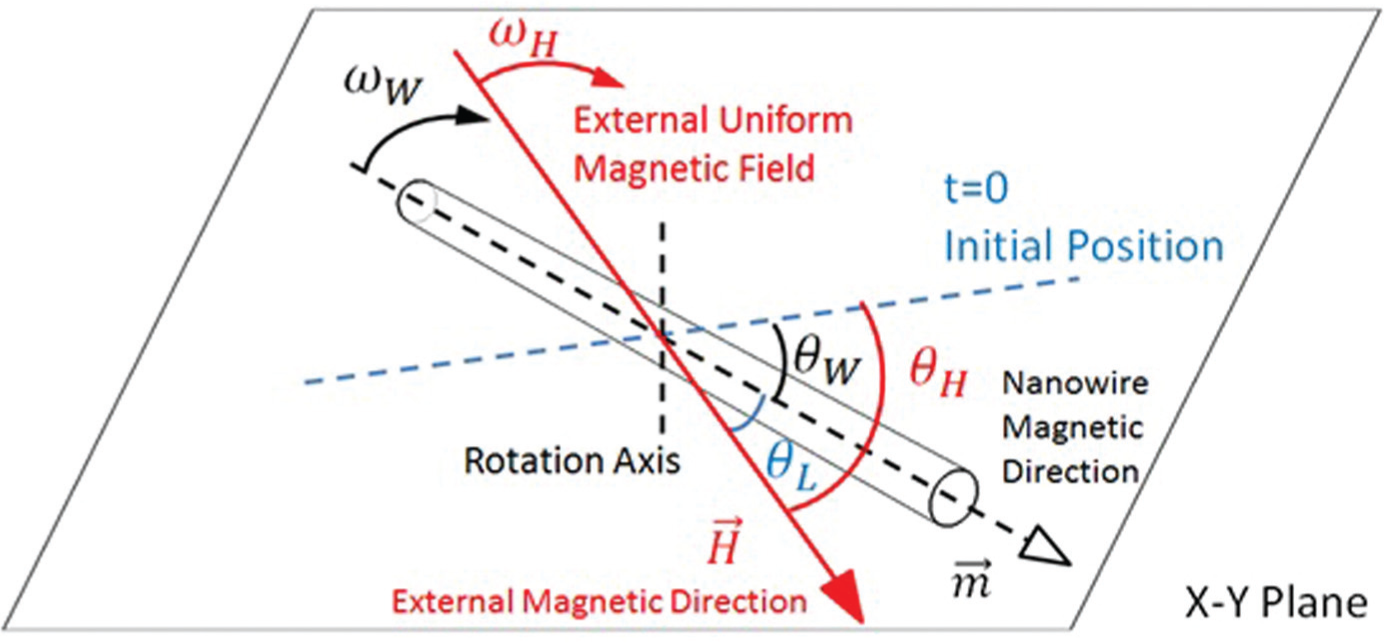
Schematic of a magnetically driven nanowire.
The nanowire rotation is governed by the magnetic torque, the fluid viscous torque, and the Brownian motion. The magnetic torque provides the driving force for the nanowire motion, whereas the viscous torque acts as the resisting mechanism. Due to the extreme small size of nanowire, the Brownian motion may have some effect on the rotation dynamics. All these factors will be discussed in this section.
Magnetic torque
The magnetic torque τm of the nanowire is given by 25

where
Fluid viscous torque
Due to its nanoscale size, the Reynolds number of the flow is far smaller than 1. So, the viscous force dominated the fluid field. Motion of the nanowire can be treated as the rotation of a long slender cylinder in Stokes flow. Consequently, the viscous torque τd can be calculated as

where γ is the fluid drag coefficient, μ is the viscosity of fluid, and C is a geometric constant related to the aspect ratio of the nanowire. A few hydrodynamic models for estimating the C value can be found in the literature (as summarized in Figure 4), where the cylinder was approximated as a series of spherical or ellipsoidal segments, each having a finite length. Knowing the drag force on the individual segments, the viscous torque can be obtained by summating the product of the drag force and the distance from the rotating axis over all the segments. To validate the analytical models, full-scale CFD models were developed using the multiple frames of reference (MFR) approach. 26 The numerical results for viscous torque on nanowires with various aspect ratios are plotted in Figure 3, where the analytical predictions are also included. It is seen that the Tirado model provides the best estimate over a wide range of nanowire aspect ratios (20 < p < 100)

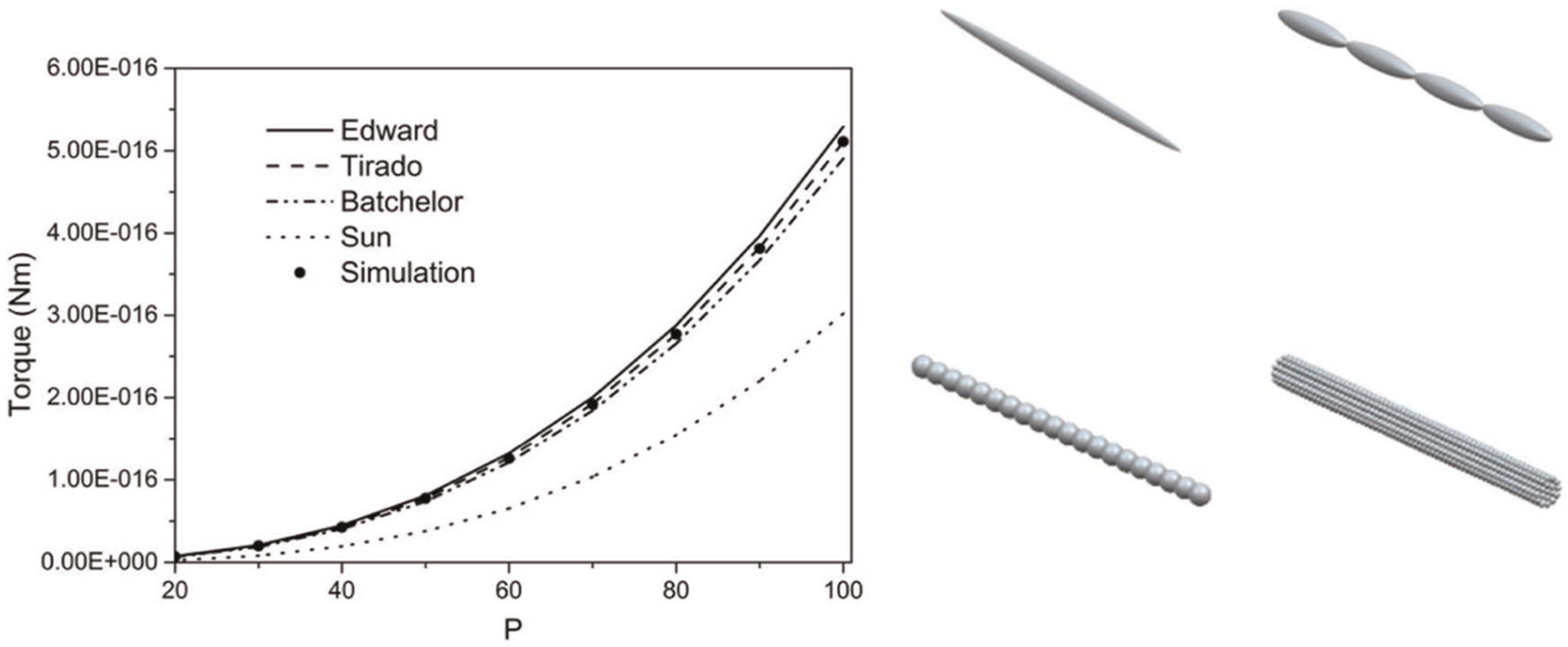
Comparison of fluid viscous torque models.
and, therefore, it was selected in this work to estimate the fluid viscous torque in equation (2).
Brownian motion
Nanowires suspended in a liquid are subject to the effects of Brownian motion. In particular, the rotational Brownian motion may compete with the magnetic and viscous torques to disorient the nanowire. For a given time interval Δt, the Brownian-induced rotation angle
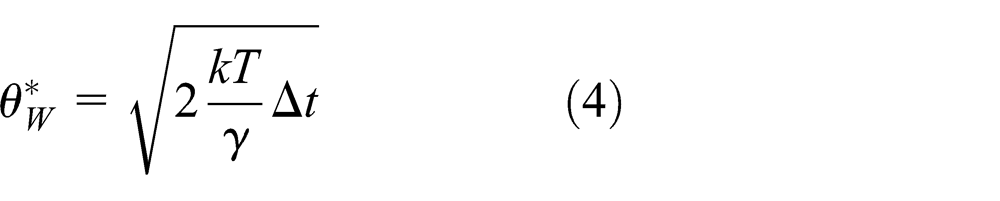
where k = 1.38 × 10⁻²³ J/K is the Boltzmann constant, T is the absolute temperature, and Δt = 1/63 s is the time interval between consecutive video frames. In the experiments, μ = 26 mPa s, l = 26.7 μm, r = 300 nm, T = 288 K, and the corresponding Brownian rotation speed
Governing equation
The equation of nanowire motion is obtained from Newton’s second law for rotation

where the moment of inertia is

A scaling analysis of equation (6) reveals that for nickel nanowires suspended in EG,

and

Note that essentially, equation (7) is equivalent to
Solutions
The solution to equation (7) can be obtained for different system conditions.
When a stationary magnetic field (ωH = 0) is applied abruptly, equation (7) reduces to

Depending on the initial lag angle θL ,0, three solutions are possible:
If θL ,0 = 0, θL = 0 (stable equilibrium).
If θL ,0 = π, θL = π (unstable equilibrium).
Otherwise

where
When the angular frequency of the magnetic field satisfies ωH ≤ ωC , a steady-state solution exists for equation (7)

In this case, the lag angle remains constant, that is, the motion is phase locked, and the nanowire rotates synchronously with the magnetic field. In particular, if ωH approaches the critical frequency ωC , the nanowire will be oriented perpendicularly to the magnetic field, that is, θL = π/2, at which point the driving torque reaches the maximum Msπr2 Hl, according to equation (1).
3. When the frequency of the magnetic field surpasses the threshold value, ωH > ωC , there is a periodic solution for equation (7)


where β is a constant determined by the initial condition, and if the nanowire aligns perfectly with the magnetic field at t = 0 s,
Results and discussion
Criterion for nanowire rotation trajectory
As shown in the previous section, the parameter

where the left-hand side (LHS) of the equation is associated with the magnetic driving torque, and the right-hand side (RHS) represents the viscous resistance torque. As the lag angle θL
increases, the magnetic torque also increases till θL
reaches 90°. Clearly, the maximum magnetic torque occurs when θL
= 90° (the exact form is

Physically, when

Theoretical prediction of synchronous versus asynchronous rotation of nanowire.
Nanowire alignment when a stationary field is rotated abruptly
When a stationary magnetic field is rotated abruptly by a certain angle, the nanowire will re-orient and align itself with the field. The relaxation of the lag angle can be described by equation (10) as a function of time, which represents by line in the plot. In Figure 5, the theoretical predictions are compared to the experimental data measured under various test conditions, where a good agreement is observed.
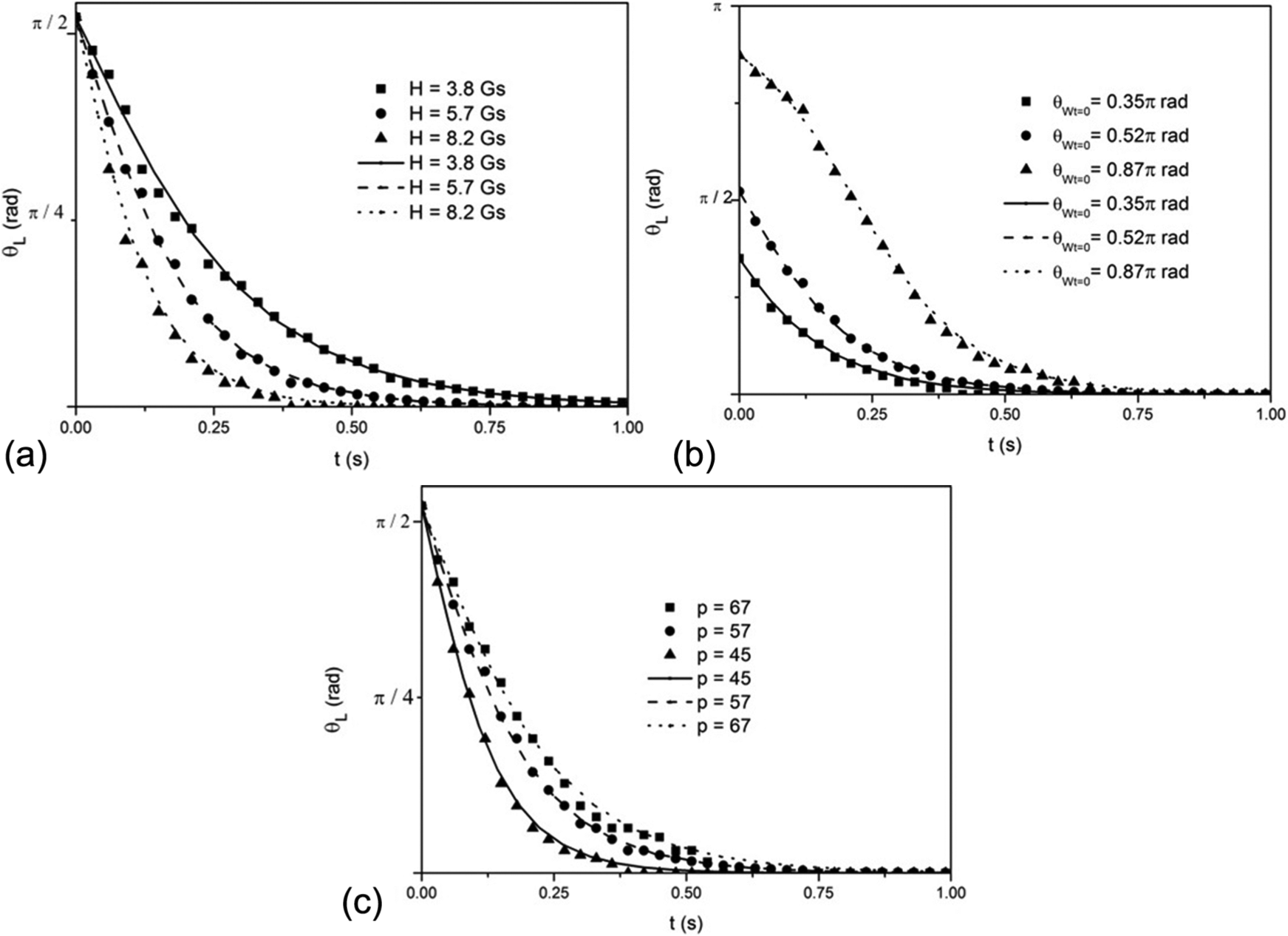
Lag angle versus t for various conditions of H, p, and initial angle: (a) Lag angle ∼H; (b) Lag angle ∼ Initial angle; (c) Lag angle ∼p.
Synchronous rotation
Figure 6(a) shows the instantaneous orientations of a nanowire in a magnetic field (H = 7.2 Gs) that rotates in the counterclockwise direction with a constant angular frequency ωH
= 13.5 rad/s. The dark arrow is the nanowire and the red arrow represents the direction of magnetic field. The nanowire under investigation is l = 26.7 μm and r = 0.3 μm. Thus, the geometric constant C can be estimated from equation (3) as C = 0.31, and the critical frequency is obtained from equation (8) as ωC
= 16.4 rad/s. Since ωH
/ωC
< 1, the nanowire falls in the synchronous rotation regime. Figure 6(b) illustrates the time evolution of θH
, θW
, and θL
, respectively. At t = 0, the magnetic field and the nanowire are aligned. Once the magnetic field starts spinning, θH
increases linearly. The nanowire begins to follow the field; however, the catching-up takes about 0.4 s before the wire can reach the same angular speed of the field. Afterward, θL
remains unchanged. It is noted that the slow startup is not caused by the inertia of the nanowire, which has been shown to be negligible in the discussion of equation (6). Rather, it is because the magnetic driving torque (see equation (1)), being proportional to

Synchronous rotation of nanowire: (a) images of synchronous rotation of nanowire; (b) angle of nanowire, magnetic, and lag angle; and (c) angular velocity of nanowire, magnetic, and lag angle.
The startup and steady-state processes can be better discerned from Figure 6(c) where the respective angular frequencies are plotted as a function of time. It is easy to note that the measured steady-state lag angle (θL
= 1 rad) is also predicted by equation (11) which yields
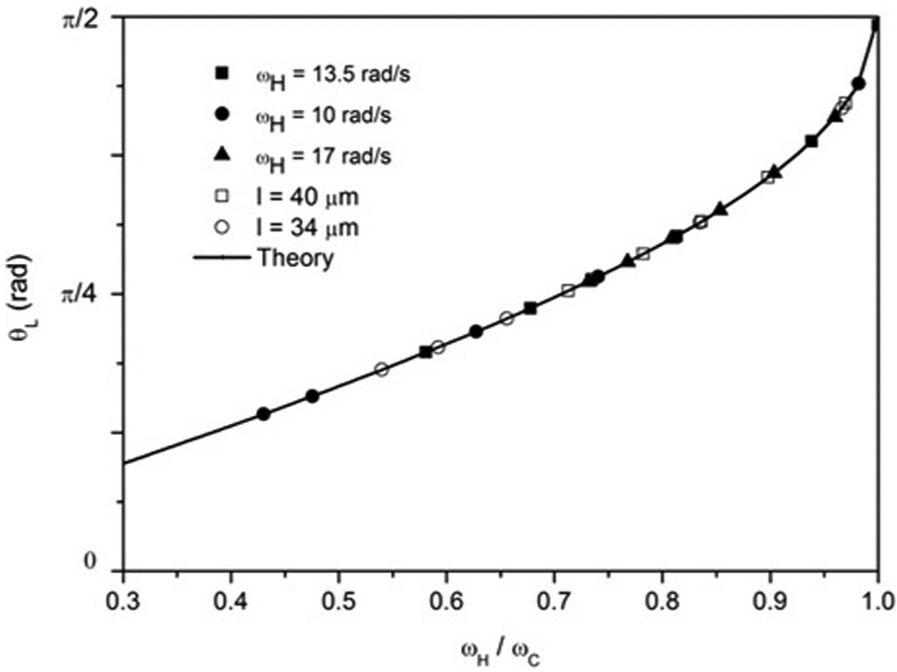
Asynchronous rotation
When ωH
/ωC
> 1, the nanowire will rotate asynchronously with the magnetic field. The mathematical origin of this oscillating behavior has been shown in equations (12) and (13). Physically, when the nanowire first starts moving, it tries to follow the magnetic field from behind, leading to the forward rotation. However, because the magnetic field spins too fast and the rotation period (tH
= 1/ωH
) is shorter than the time of nanowire in one period rotation cost, the lag angle θL
keeps increasing, that is,
Figure 8 shows the asynchronous rotation of a nanowire (l = 26.7 μm) over one period in a magnetic field (H = 3.9 Gs and ωH = 13.5 rad/s). The instantaneous orientations of the nanowire and the magnetic field are depicted in Figure 8(a), and the forth-and-back motion of the nanowire can be identified more clearly from Figure 8(b) and (c).
Forward motion: from t = 0–0.44 s, the nanowire is always going along the same direction as the magnetic field, as evidenced by the ascending θW in Figure 8(b). The trend of ωW is shown in Figure 8(c). As discussed above, ωC is the highest velocity the nanowire could reach. It first increases till it reaches the highest speed of 8.5 rad/s at t = 0.22 s, at which moment the magnetic field is perpendicular to the nanowire (θL = π/2) and 8.5 rad/s equals to ωC . Then, the angular speed will decrease as the magnetic torque passes the peak. At t = 0.44 s, ωW = 0 rad/s, and θL = π, the magnetic momentum of the nanowire and the magnetic field are aligned opposite, and the nanowire becomes static.
Backward motion: from t = 0.44–0.60 s, the nanowire is rotating backward, as shown by the descending θW
in Figure 8(b). Since the nanowire and the field are moving opposite to each other, the lag angle θL
increases sharply to 2π at t = 0.605 s. The rotation speed of the nanowire

Nanowire asynchronous rotation in one period: (a) images of asynchronous rotation of nanowire; (b) angle of nanowire, magnetic, and lag angle; and (c) angular velocity of nanowire, magnetic, and lag angle.
The polar representation of the rotation dynamics of a nanowire (l = 26.7 μm) under a myriad of magnetic fields is shown in Figure 9. In this figure, the theoretical value of θW is calculated for each frame (Δt = 1/63 s), and θL is accumulated over consecutive periods. It can be found that the theoretical results match well with the experimental data.
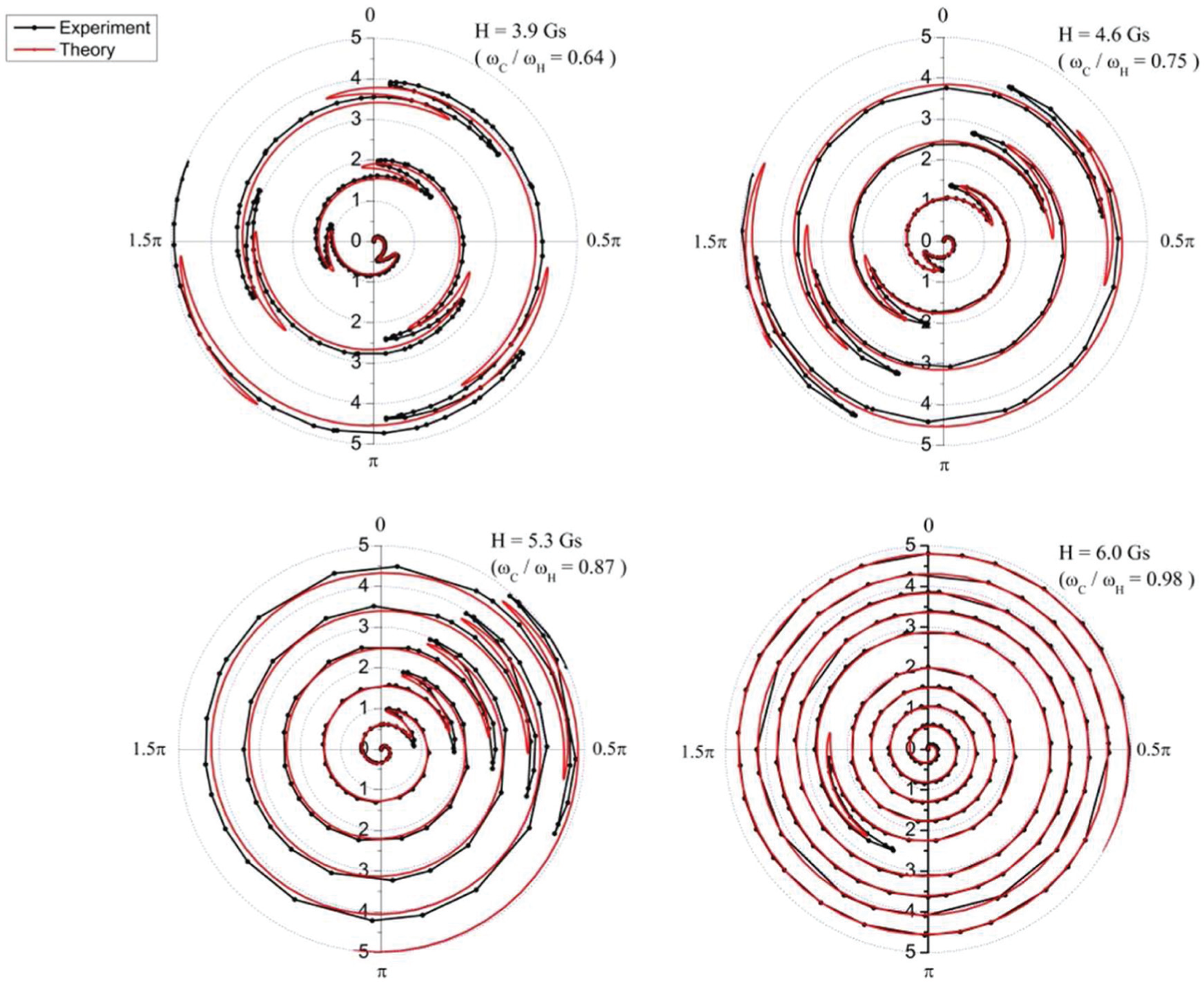
Nanowire asynchronous rotation under different H.
From the foregoing discussion, the forward motion of the nanowire starts at θL = 0 and ends at θL = π. Subsequently, the backward motion starts at θL = π and ends at θL = 2π. The respective duration of the two regimes is given as follows
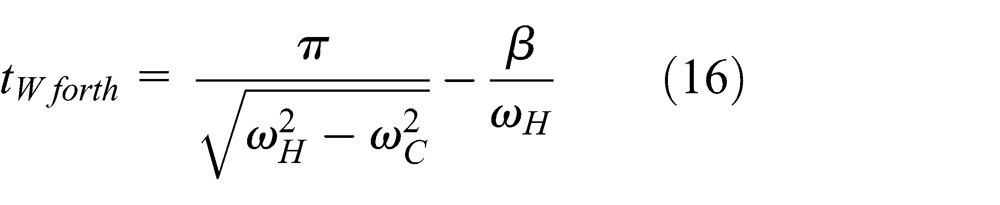
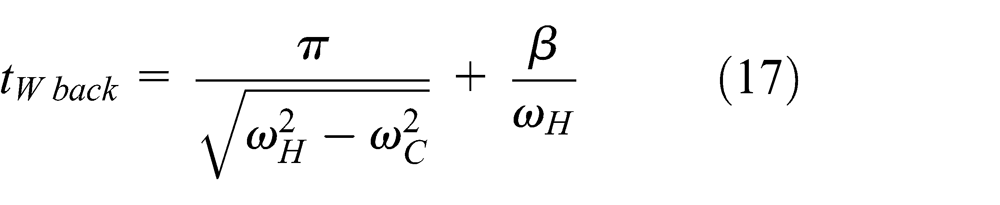
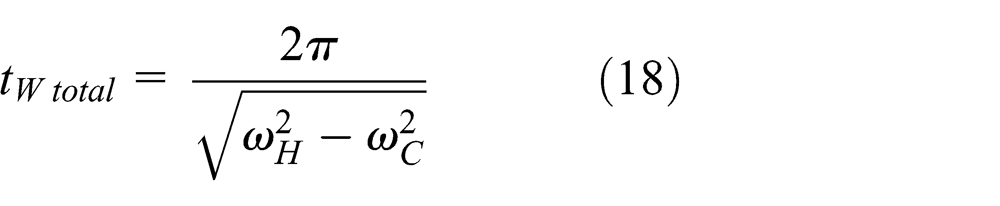
where
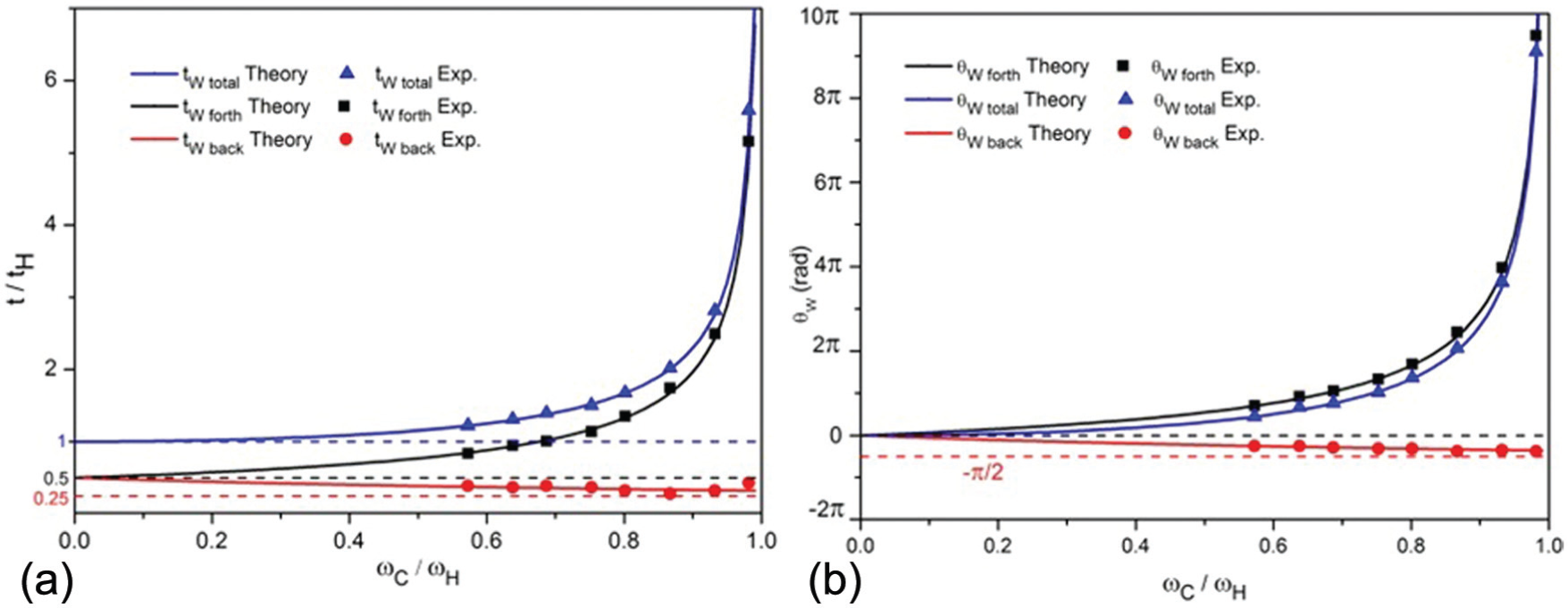
Time and angle of nanowire of forward and backward rotation in one period: (a) time of forward and backward regimes and (b) angle of forward and backward regimes.
With the angle relation θL = θH –θW , θW of the forward and backward motion can be derived from equations (12) and (13)
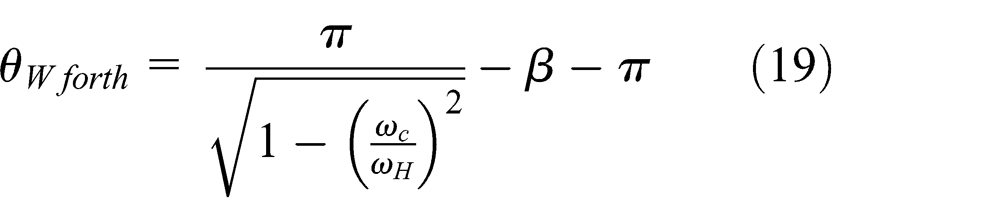


where
Conclusion
The dynamics of ferromagnetic nickel (Ni) nanowires rotating in a driving magnetic field was investigated. The major findings are summarized as follows.
The dynamics of nanowire rotation is governed primarily by the magnetic torque and the fluid viscous torque, whereas the Brownian motion and inertia have negligible impact.
There exists a critical rotation speed for the magnetic field, ωC . When ωH /ωC ≤ 1, the nanowire rotates in the synchronous mode, where the lag angle θL remains constant; otherwise, the nanowire rotates in the asynchronous mode, where θL fluctuates with time and the nanowire undergoes back-and-forth oscillation.
Analytical models were developed to describe the major modes of nanowire motion. The comparisons of the theoretical prediction and the experimental data show very good agreement.
Footnotes
Acknowledgements
We thank Dr Li Sun at the University of Houston for supplying the nanowire samples.
Academic Editor: Hyung Hee Cho
Declaration of conflicting interests
The authors declare that there is no conflict of interest.
Funding
This work was supported by National Natural Science Foundation of China (Grant No. 51376022).