




Abstract
Proper initial load is necessary to ensure the stability of the bolted connections. In order to apply appropriate torque, the relationship between tightening torque and initial load should be determined. In this study, a detailed three-dimensional finite element model of bolted joints was established with consideration of helix angle, pitch, thread type, tooth-type angle, and other details. The process of pre-tightening of bolted joints was simulated to validate the finite element model. The curves for the relationship between the torque and initial load obtained from finite element analysis agree well with those calculated from theoretical equations. Then, the influence of the friction coefficient, pitch, elastic modulus, assembly clearance, and strain-hardening exponent on the relationship was studied. The results show that the friction coefficient between nut and joint has great influence on the relationship between torque and initial load, that is, the larger the friction coefficient, the smaller the initial load of bolt at the same tightening torque. In contrast, the pitch, assembly clearance, Young’s modulus, and strain-hardening exponent have little influence on torque–initial load relation. The method used in this study provides a theoretical basis for accurately determining the tightening torque for bolted joints.
Bolted joints are widely used in mechanical structures as they are easy to be assembled and disassembled. Threaded joints must be tightened when installed so that the connected components are compressed while the bolt is stretched. The force acting on the bolt introduced by pre-tightening is named initial load. 1 The purpose of pre-tightening is to strengthen reliability and compactness of the connections. However, an excessive initial load will lead to yield and even fracture in the bolt; on the other hand, an insufficient initial load cannot provide the adequate clamping force which is required for maintaining the integrity of the joint and eventually causes structure loosening and failure. So, determining an appropriate initial load is quite important for bolted connections. It is hard to measure the initial load during the assembly process, so the common practice is using torque wrench to regulate the tightening torque. Thus, determining the relationship between the tightening torque and initial load is of remarkable significance in maintaining the reliability of the bolted joints.
Many factors can affect the relationship between torque and initial load. Lin and colleagues2,3 studied the influence of lubrication conditions, surface treatment, materials of joints and bolt, size, and other factors. Izumi et al. 4 used three-dimensional (3D) finite element method (FEM) to explore the mechanism of the tightening and loosening processes under shear loading. The experimental results were compared with theoretical results, and the relation between tightening torque and initial load under elastic range of tightening process and the load distribution of threads was evaluated by 3D FEM. Nassar and Zaki 5 conducted experiments to explore the effects of surface coating, tightening speed, and repetitive tightening on the relationship between torque and initial load. Croccolo and colleagues6–9 provided a useful experimental methodology to determine the friction coefficients in bolted joints and then to determine the relation between torque and initial load precisely. The assessment of the correct design methodology that allows selecting the appropriate screw to be used in high-duty bolted joints was conducted. The influence of tightening procedures and lubrication conditions on titanium screw joints for lightweight applications was completed. Failure analysis of bolted joints used in the front of motorbike suspensions to connect steering plates and legs and quantitative impact analysis of lubrication, forming process, surface treatment, and tightening times on the torque–tension relationship were completed during tightening. Hwang 10 conducted a numerical simulation using FEM to set the installation torque for a joint in vehicle design process based on torque–angle curves. A detailed 3D model of bolted joints was constructed. LS-DYNA was used to simulate the installation process of bolted joints by applying a torque gradually. Then, the relationship between torque and initial load was obtained and compared with experiment results. Wang et al. 11 made an experimental study of pre-tightening force for M16 galvanized bolts commonly used in transmission tower, and the effects of bolt strength grade, the presence or absence of washer, and the presence of lubrication on torque coefficient of bolted joints were analyzed. Furthermore, the control of torque coefficient and some key engineering problems about bolted connections were also discussed. Ganeshmurthy and Nassar 12 presented a precise method to establish bolt and nut models, taking into account the helix angle of threads. The 3D finite element analysis was conducted to simulate and evaluate different process control methods that are commonly used for automating the assembly of bolted joints in a mass production environment. The effects of friction coefficients and assembly clearance between bolt and joint on the torque coefficient of bolted joints were investigated.
Many researchers have studied the stress and strain distribution over bolt using simplified model; however, few people studied using 3D finite element model of bolted joints accounting for helix angle to analyze the relation between tightening torque and initial load and factors affecting the torque coefficient. In this study, 3D detailed models of bolted joints were established with consideration of the helix angle of mating threads. Pre-tightening process of bolted joints used in aircraft gas turbine engine was simulated using 3D FEM. Load distribution of bolted joint was presented, and the relationship of torque and initial load was drawn and compared with the theoretical results. The effects of friction coefficient, pitch, Young’s modulus, assembly clearance, and strain-hardening exponent on torque coefficient were discussed.
Theoretical relation between torque and initial load
For general nuts and bolts with rolled thread without lubrication, the short-form torque–initial load equation could be represented in equation (1) 13

where
In order to obtain the relation between torque and initial load precisely, a more accurate equation provided by Motosh 14 neglecting the helix angle of threads is as follows

where
The friction coefficient between nut and joint can be determined through mechanical experiment and calculated based on the following equation 15

The slope
As we can see from equation (3), the friction coefficient between nut and joint is a function of initial load, and Jiang et al. 15 found that it decreases when the initial load is continuously increasing. In this article, we assume that it remains constant during pre-tightening.
The expression of torque–tension relation given by the Mechanism and Machine Theory is 16

where
Since

The torque–initial load relation in elastic tightening region proposed by Yamamoto based on the balance between the friction force on the contact surface and tightening torque can be expressed in equation (6) 4

where
Finite element analysis
The 3D finite element model was used to simulate the tightening process of bolted joints. The relationship between the tightening torque and initial load and the factors affecting the torque coefficient were investigated in this article.
Finite element model
The 3D finite element model consists of an M12 × 1.75 bolt, nut, and a joint, which is a hollow cylinder as shown in Figure 1. The inner and outer diameters of the hollow cylinder are 13 and 30 mm, respectively. The detailed thread model with consideration of the helix angle, basic profile, and angle of the thread is constructed through rotating thread profile around the axis of bolt or nut using the commercial finite element package ABAQUS, 17 which is also used to perform finite element analysis for pre-tightening process of bolted joint structures.

Finite element model and mesh.
Mesh
The bolt and nut models are meshed using tetrahedral (C3D4) and hexahedral elements (C3D8R), respectively, and the joint model is meshed using hexahedral elements (C3D8R). In order to improve the accuracy and reduce time consumption of calculation, external threads of bolt and internal threads of nut are meshed with finer elements, whereas other regions and joint are meshed with coarse elements as shown in Figure 1. There are 39,617 elements in bolt, 24,866 elements in nut, and 26,028 elements in bolted joint model.
Material properties
The base material of bolt, nut, and joint is Nickel-based superalloy GH4169 18 and steel. The Young’s modulus for GH4169 and steel is 204 and 206 GPa, respectively; the density for GH4169 and steel is 8.24E-9 and 7.8E-9 ton/mm3, respectively; and the Poisson ratio for both materials is 0.3.
Contact conditions
Three contact interactions are established for all sliding surfaces in the finite element model, including the interfaces between the mating threads, nut face, and the upper surface of joint, bolt head surface, and the lower surface of joint. Bolt shank and bolt hole are not in contact with clearance fit. Surface-to-surface contact is set up using finite sliding formulation in ABAQUS. 17 Identical contact properties assigned for all contact interactions are assumed, which are hard contact and friction contact of normal and tangential behaviors, respectively. Friction coefficients between all contact surfaces are assumed to be the same. We define the friction coefficient as 0.15 using penalty method.
Boundary conditions and load
All nodes in the edges of the bottom surface of bolt head are fixed. Nodes of the outer surface of hollow cylinder are constrained in the radial direction but not along the bolt axis so that the joint can produce axial deformation during the process of pre-tightening.
A target-tightening torque is applied to nut by way of applying equal and opposite shear stress distributed evenly on two corresponding sides of the hex nut as shown in Figure 2. The value of torque is calculated by

Tightening torque applied by shear stress.
Results and discussion
Equivalent stress distributions over bolt and the cross section of bolted joint are obtained through finite element simulation when torque

Equivalent stress distribution at the end of tightening process as torque reaches 110 N m.

Relation curves of tightening torque–initial load.
As can be seen from Figure 3, the highest stress occurred at the root of the first engaged thread between the bolt and nut because of stress concentration, with maximum stress up to
Effect of friction
For bolted joints, the larger the friction coefficient, the greater the proportion of torque consumed to overcome the frictional resistance during the process of tightening, thus the smaller the initial load. Finite element simulations of pre-tightening process are conducted when friction coefficient is 0.1, 0.15, and 0.2 in order to analyze the effect of friction coefficient on torque–initial load relation. The torque–initial load curves corresponding to different friction coefficients are obtained and compared with the theoretical curves plotted through equations (2), (5), and (6), which are presented in Figure 5. It is observed that the torque–initial load curves corresponding to different friction coefficients based on finite element analysis are consistent with the theoretical results. On the other hand, Figure 5 also shows that friction coefficient has great influence on the relationship between torque and initial load, namely, the larger the friction coefficient, the smaller the initial load of bolt at the same tightening torque.
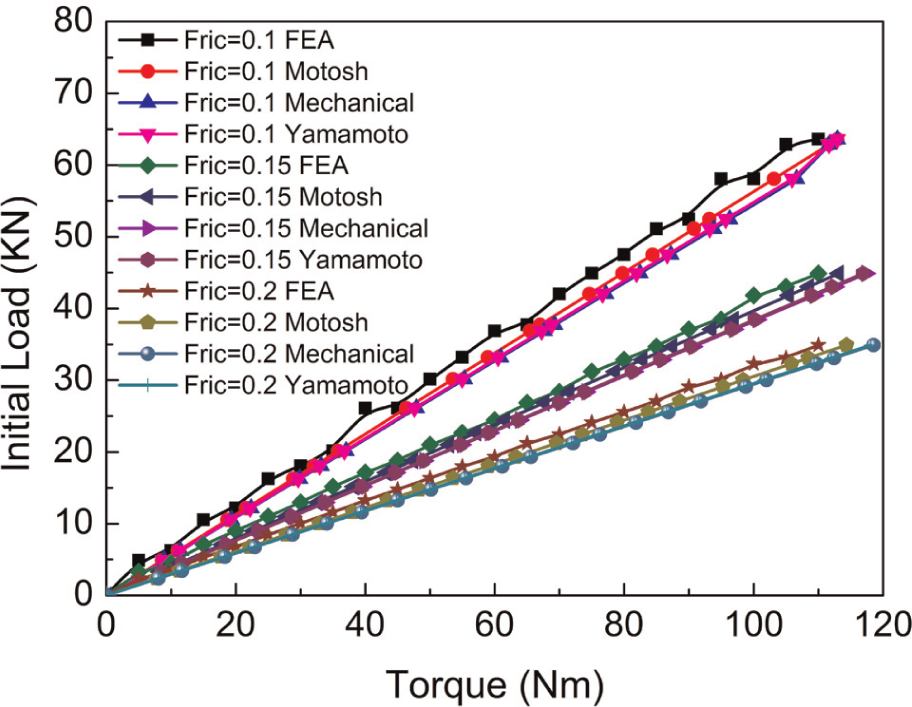
Effect of friction coefficient on torque–initial load relation when pitch is 1.75 mm and assembly clearance is 0.5 mm.
Effect of pitch
Pitch is one of the parameters in equations (2), (5), and (6). In order to analyze the influence of pitch on torque–initial load relation, coarse thread model for M12 bolt when pitch is 1.75 mm and fine thread models when pitch is 1.5 and 1.25 are established when other parameters are kept constant. The value of nut factor is 0.207, 0.210, and 0.204 calculated by equation (2) when the pitch of thread is 1.75, 1.5, and 1.25, respectively. The torque–initial load curves corresponding to different pitches are obtained and compared with the theoretical curves plotted through equations (2), (5), and (6), which are presented in Figure 6. It is observed that pitch almost has no influence on relation between torque and initial load, even if the results of finite element analysis are in accordance with theoretical results.
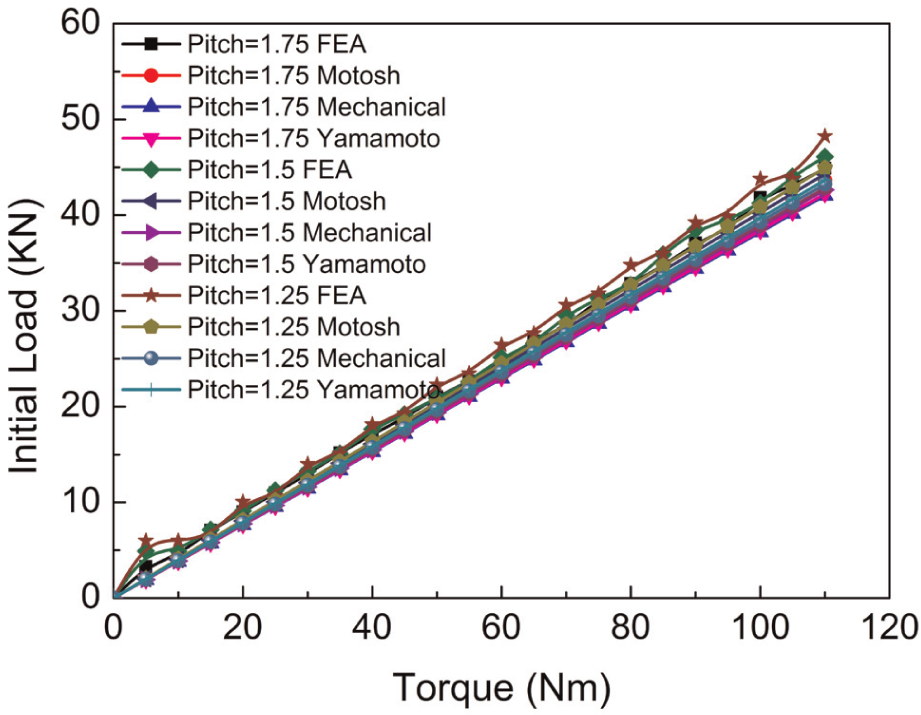
Effect of pitch on torque–initial load relation when friction coefficient is 0.15 and assembly clearance is 0.5 mm.
Effect of assembly clearance
Connection between the bolt and the bolt hole is clearance fit; the greater the assembly clearance, the greater the effective contact radius of the contact between the nut face and the upper surface of joint. In this article, the effect of assembly clearance is investigated by the torque–initial load curves shown in Figure 7 obtained through finite element analysis when assembly clearance is 0.5, 1, 2, 3, and 4 mm. Figure 7 reveals that the torque–initial load relationship is not significantly affected by assembly clearance for the same target torque of 110 N m.

Effect of assembly clearance on torque–initial load relation when friction coefficient is 0.15 and pitch is 1.75 mm.
Effect of Young’s moduli
When tightened at the same torque of 110 N m, the greater the elastic modulus of joint material, the less the deformation caused by compression.

where
The torque–initial load curves corresponding to different modulus ratios are shown in Figure 8 obtained through finite element analysis when the value of

Effect of elastic modulus on torque–initial load relation when friction coefficient is 0.15, pitch is 1.75 mm, and assembly clearance is 0.5 mm.
Effect of strain-hardening exponent
Stress at the root of thread, especially at the first engaged thread root, may exceed yield strength of bolt material due to stress concentration; therefore, plastic deformation starts from the first engaged thread in the process of tightening. Stress–strain relation curve is no longer linear when stress exceeds yield strength of material, where an appropriate model is needed to describe the elastoplastic behavior of material. In this study, we chose the power-hardening model, 19 which is the most widely used in describing the constitutive relations of material

where

where
Taking
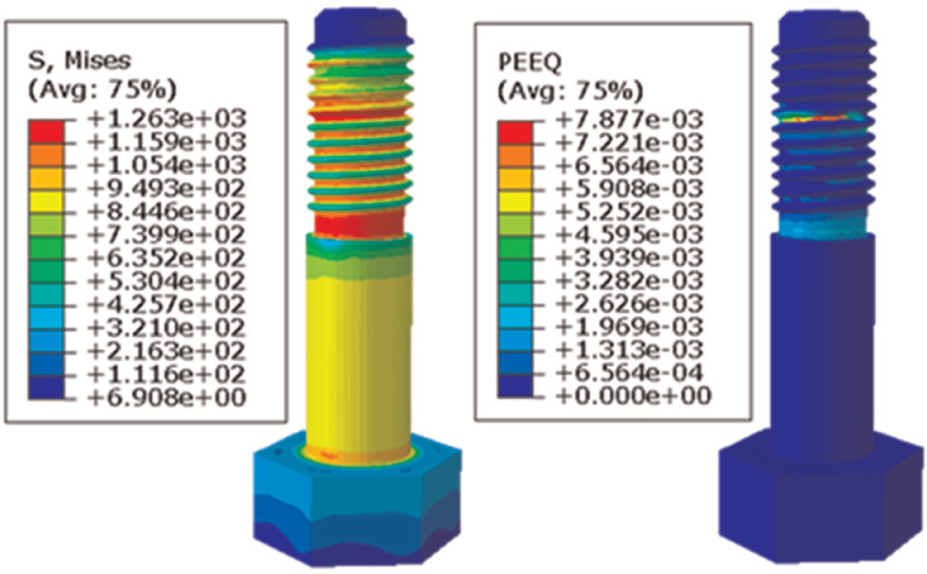
Equivalent stress and strain distribution contours at the end of pre-tightening process.
As can be seen from Figure 9, the maximum stress, whose value is
In order to analyze the influence of strain-hardening exponent on torque–initial load relation, the torque–initial load curves presented in Figure 10 are obtained when

Effect of strain-hardening exponent on torque–initial load relation.
Conclusion
A 3D finite element model of bolted structure of aircraft gas turbine engine is created with consideration of helix angle, pitch, thread type, tooth-type angle, and other details. Then, the pre-tightening process of bolted joint structures was investigated. The torque–initial load relationship was obtained, and the effects of friction coefficient, pitch, Young’s modulus, assembly clearance, and strain-hardening exponent were all investigated. Based on a comparison with theoretical relationships between torque and initial load, the following conclusions can be drawn:
Relation of tightening torque and initial load obtained from finite element analysis in this article agrees well with theoretical curves based on analytical equations derived by Motosh, Yamamoto, and given by the Mechanism and Machine Theory. It verifies the method used in this study and provides a theoretical basis for determining the tightening torque for bolted joint structures.
Friction coefficient has great influence on the relationship between torque and initial load. In contrast, pitch, assembly clearance, Young’s modulus, and strain-hardening exponent have little influence on torque–preload relation. On the other hand, plastic deformation of bolt will cause tightening torque–initial load straight line to become a curve at the top with the increase in torque after the bolt starts to yield. Therefore, plastic deformation of bolt should be avoided during the process of pre-tightening for bolted joint.
Footnotes
Academic Editor: Jia-Jang Wu
Declaration of conflicting interests
The authors declare that there is no conflict of interest.
Funding
This research received no specific grant from any funding agency in the public, commercial, or not-for-profit sectors.