



Abstract
With the TBM disc cutter box as the subject of investigation, this study addresses the intricate and labor-intensive nature of the assembly process in TBM disc cutter box welding assembly. In order to expedite the assembly of the cutter-head and disc cutter box, an alternative approach utilizing combined bolt connections is implemented in place of welding assembly. Therefore, this article proposes a TBM disc cutter combination bolt connection design method based on AHP. Initially, a hierarchical analysis model is constructed, taking into account the actual conditions of the TBM disc cutter box combined bolt connections. Subsequently, from the array of factors influencing bolted connection performance, five experimental variables were chosen, and an orthogonal experimental layout was devised to examine the stress dispersion in the TBM disc cutter box under conditions of bolted assembly, employing finite element analysis. By conducting extreme difference analysis, the study examined the effects of each experimental factor on the bolt connection performance, and determined the order of importance of each factor more objectively. Thus, the comprehensive weights of each factor were calculated, and the optimal solution of the bolt connection scheme was selected by synthesizing the effects of multiple factors.
Keywords
Introduction
Bolted connections, owing to their ease of disassembly, high load-bearing capacity, and adaptability, find widespread application in the assembly of full-face hard rock tunnel boring machine (TBM). Currently, the majority of TBM available in the market employ segmented cutter-heads, utilizing high-strength bolts for assembly. However, other key components on the cutter-head, such as the disc cutter box, are assembled through welding. While welding ensures the reliability of the cutter-head during operation, it consumes a significant amount of time and labor during equipment installation and maintenance. In practical engineering, the damage to cutting tools often accompanies structural wear and deformation of the disc cutter box. The use of bolted connections in assembling the disc cutter box and cutter-head is of great significance, as it enables the replacement of entire components when damage occurs. The proper installation of bolts plays a crucial role in addressing assembly, maintenance, and the efficient reuse of the disc cutter box.
Numerous scholars have dedicated extensive research efforts to the arrangement of bolted connections and the design of bolt assemblies. As illustrated in Table 1.
Current status of research on bolt connection and assembly design.

Currently, the predominant trend in evaluation methodologies lies in the realm of multi-attribute and multi-factor comprehensive assessment approaches. Numerous scholars have harnessed the AHP to construct assessment decision systems for product evaluation and optimization. As illustrated in Table 2.
Current status of research on establishing evaluation decision systems based on AHP method.

The performance of key components in TBM directly influences the quality and efficiency of tunnel excavation. Consequently, the design of TBM Disc Cutter Box has increasingly become a focal point of collaborative research between large-scale equipment designers and academic institutions. The current state of research is detailed in Table 3.
The evolutionary status of TBM disc cutter box design.
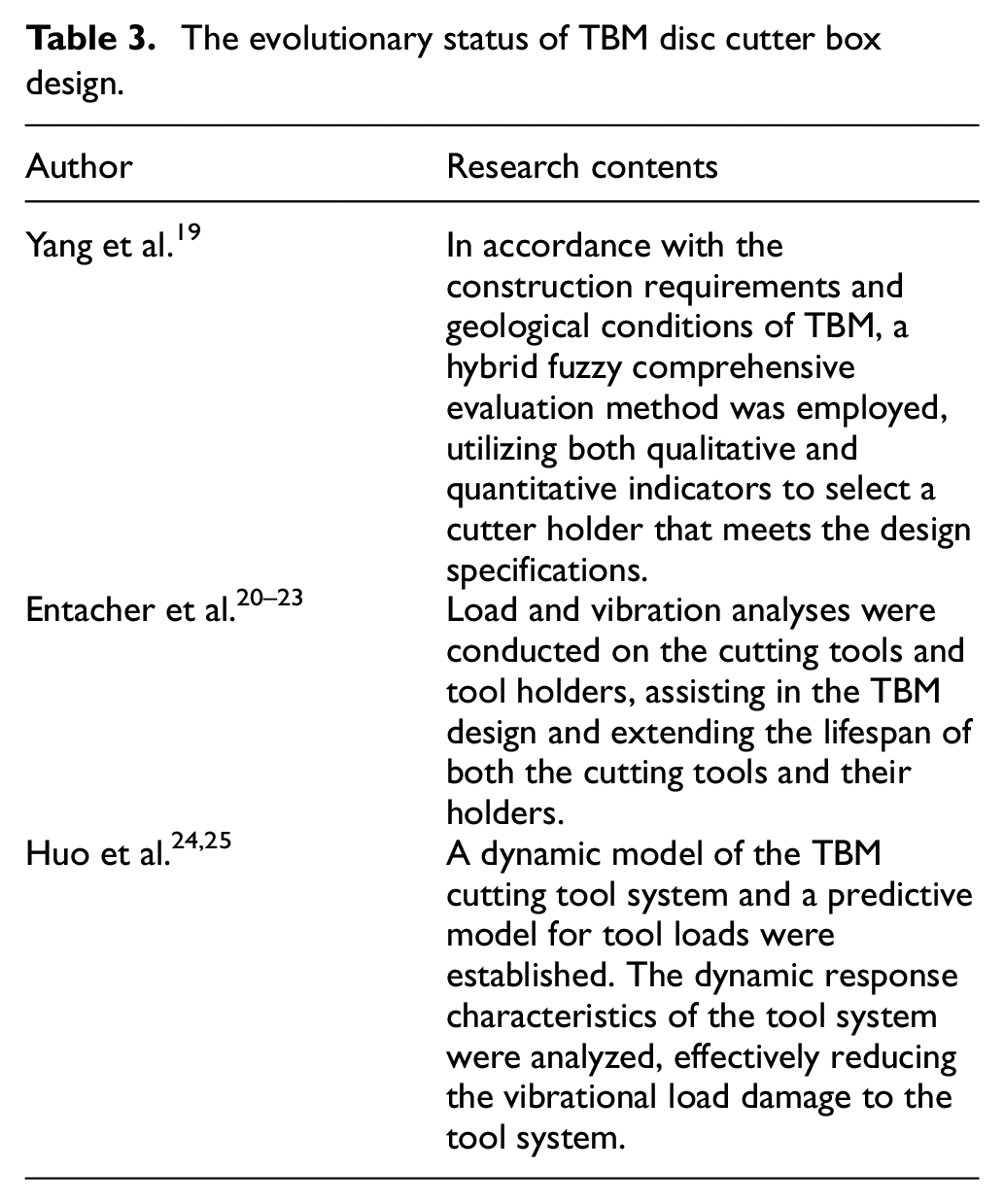
Presently, research on composite bolted connection configurations primarily emphasizes bolt arrangement and preload force, inadvertently overlooking other vital factors and their respective weights. Within the realm of bolt layout design, studies have elucidated the impact of various parameters on assembly performance. However, a comprehensive design and set of guidelines for TBM disc cutter box bolted connections remain absent, rendering it incapable of providing practical engineering guidance. Consequently, the selection of the optimal TBM disc cutter box bolted connection scheme necessitates an approach that, starting from assembly performance, comprehensively considers factors such as bolt arrangement, length, preload force, specifications, materials, and more. Establishing an evaluation system and conducting a holistic assessment of these schemes is imperative. In light of the above analysis, the AHP emerges as an effective solution to address multifactor decision-making challenges. Consequently, it finds widespread utility in the field of engineering for selecting optimal solutions.
In light of the foregoing, this study centers its attention on the bolt connections within TBM disc cutter box, aiming to expedite their assembly and facilitate routine maintenance by introducing alternative connection approaches. Employing the AHP, a hierarchical analysis model is established to guide the design of bolt connections in TBM cutter-head. Utilizing the sub-criteria factors embedded within the AHP framework, a diverse array of connection schemes is generated through orthogonal experiments. Furthermore, employing finite element analysis, simulations are conducted to assess the behavior of the tools and the stress distribution on the bolts. Subsequently, a range analysis is performed on the simulation results to discern the relative significance of each influencing factor on the performance of the bolt connections. Based on these findings, a judgment matrix is constructed to determine the respective weights of the factors involved. Finally, through a comprehensive analysis that accounts for the multifaceted impact of the various factors, an optimal solution is discerned, characterized by both economic viability and judicious arrangement.
This research has achieved innovation in the design of TBM disc cutter box bolt connections, proposing an AHP-based design methodology that optimizes the bolt connection configuration. While the study demonstrates the application of orthogonal experiments and finite element analysis, enhancing assembly efficiency and safety, it acknowledges the limitations of experimental conditions that do not encompass all factors potentially affecting bolt connection performance. Future work will include on-site validation of research findings, long-term performance testing, and interdisciplinary studies to refine the accuracy and practicality of the design method. Through these endeavors, the design of TBM disc cutter box can be further optimized, offering more precise guidance for engineering design, advancing industrial automation and technological progress, and contributing to the development of the mining and construction industries.The main content of this study is as follows:
Section 1 introduces the objectives of the research;
Section 2 design methodology for TBM cutter-head box bolt connections based on the AHP;
Section 3 creation of the mechanical model for TBM disc cutter box bolt connection;
Section 4 establishing an evaluation system based on AHP;
Section 5 selection of TBM disc cutter box bolt connection scheme based on AHP;
Section 6 concludes.
Research objectives
The TBM stands as an advanced apparatus for excavating rock tunnels, widely employed in sectors such as railways, water resources, and urban transit. Its merits encompass continuous excavation, rapid speed, high efficiency, and a commendable safety record, making it particularly suited for the construction of deep and lengthy tunnels. Presently, TBM disc cutter boxes are predominantly assembled through welding onto the cutter-head, a procedure characterized by its complexity and labor-intensive nature. The specific structure of the cutter box and the welding assembly process is illustrated in Figure 1.

Illustrates the detailed configuration and schematic representation of the welding assembly method employed for the disc cutter box.
Design methodology for TBM cutter-head box bolt connections based on the AHP
The AHP has gained extensive traction in the realm of industrial analysis and decision-making concerning multiple objectives and attributes. 26 Nonetheless, the subjective nature of determining weights for various factors within the hierarchical analysis framework lacks a solid scientific foundation. Consequently, this study integrates the finite element method with the range analysis method used in orthogonal experiments to calculate the weight values of each objective and attribute in relation to the comprehensive solution. Subsequently, through comprehensive computations, the study ascertains the comprehensive scores of each solution and consequently identifies the optimal course of action.
Designing the AHP model
To facilitate decision-making using the AHP, it is imperative to establish a comprehensive hierarchical model comprising the goal level, criterion level, sub-criterion level, and alternative level. The goal level represents the ultimate objective of attaining the optimal solution, while the criterion level entails the discernment of key factors essential for achieving the superior goal, encompassing rational arrangement, reliability, and economic viability. The primary objective of the innovative bolt connection design for the TBM’s disc cutter box is to replace the time-consuming welding assembly process, thereby enabling rapid assembly while preserving both the system’s reliability and a strategic layout. In this regard, it becomes indispensable to thoroughly contemplate the economic aspects associated with bolt assembly, thereby capturing the actual project costs.
The sub-criterion level, adhering to the fundamental principles of the AHP, necessitates the subdivision of the criterion level into finer constituents. In light of rational arrangement, the pivotal elements of bolt placement and bolt length are posited, while for ensuring reliability, the salient factors of maximum stress and bolt pre-tensioning are identified. Additionally, in the pursuit of cost-effectiveness, due consideration is given to the influential aspects of bolt specifications and bolt materials. Consequently, within the context of accorded to all hierarchical levels, encompassing the goal level, criterion level, and sub-criterion level, as eloquently illustrated in Figure 2.

Hierarchical analytical model for the bolt connection system in the novel disc cutter box.
Judgment matrix and weights
The construction of the judgment matrix is a crucial step in the AHP. However, this approach is significantly dependent on the decision-makers’ subjective assessments concerning the relative significance of criteria and alternatives, which may result in potential discrepancies in the outcomes due to individual variances. In light of this challenge, this study adopts a rigorous approach by integrating orthogonal experimental design with finite element analysis to facilitate a qualitative analysis. Specifically, the factors within the sub-criterion level are regarded as levels in the orthogonal experimental design, and the obtained strain and stress contour maps derived from the finite element analysis serve as valuable evaluation indicators. Moreover, the range analysis technique is utilized to determine the differential impact of each element on the bolt connection’s performance, thus offering essential direction for forming a definitive judgment matrix in the later phases. The outlined steps for the AHP-based design of the combined bolt connection in TBM disc cutter boxes are meticulously illustrated in Figure 3.

Depicts the design process of rapid assembly of TBM disc cutter box with combined bolt connection based on AHP.
The design process for rapid assembly of TBM disc cutter box with combined bolt connection based on AHP, as illustrated in Figure 3, is as follows:
Step 1: Create an analytic hierarchy model based on TBM disc cutter box bolt connection design.
Step 2: Based on the elements in the sub-criteria layer of the analytic hierarchy model, establish the orthogonal experimental factors and generate an orthogonal table with 16 combinations of TBM disc cutter box and bolt connection design.
Step 3: Build finite element analysis models for each design scheme and conduct static analysis.
Step 4: Analyze the influence of factors on bolt connection performance by combining the results of finite element analysis with orthogonal experimental factors, using range analysis, to provide decisive guidance for establishing the decision matrix.
Step 5: Establish the decision matrix and determine the weights of each factor.
Step 6: Perform comprehensive evaluation by considering multiple evaluation criteria to identify the optimal solution.
Creation of the mechanical model for TBM disc cutter box bolt connection
Force model of disc cutters in TBM excavation process
During the construction process of a TBM, the rotational speed and excavation velocity of the cutter-head are relatively low. Therefore, static analysis methods can be employed to analyze the forces acting on the cutter tools. The disc cutters on the cutter-head mainly experience vertical forces


Contact model between the disc cutter and rock.
The fundamental pressure in the crushing zone is defined as:


In the above equation,
Load calculation model for TBM disc cutter box bolts
According to the selected bolt material and bolt specifications, the pre-tension force for each bolt size can be calculated using the following formula. According to the regulations, the pre-tension stress generated in the threaded joint under the action of pre-tension force should be less than or equal to 80% of its material yield strength

When the contacting support surface is annular.

In the above equation,
Establishing an evaluation system based on AHP
The core of establishing an evaluation system using the AHP lies in the construction of the judgment matrix. Traditional methods rely on expert judgments to determine the weights of various attributes, which are subjective and may result in lower decision accuracy. Therefore, this study adopts the orthogonal experimental method combined with finite element analysis for qualitative analysis. Ultimately, the impact of each factor on the bolt connection performance is assessed using the range analysis method, providing crucial guidance for constructing the judgment matrix.
Orthogonal experimental method
For the complex relationship and interaction among multiple influencing factors in the TBM cutter-head bolt connection design method, the use of orthogonal experimental method 28 allows for parameter optimization. This method considers the interactions among various factors in the disc cutter box bolt connection scheme and their influence on bolt connection performance, yielding more precise results than single-factor analysis. In this study, orthogonal experimental design is employed to select and design parameters for the TBM disc cutter box bolt connection design method, while considering the degree of influence of each factor on the bolt connection performance through finite element analysis.
In experimental research, the experimental indicators serve as dependent variables that describe the characteristics of the experimental results. On the other hand, factors act as independent variables, representing the reasons behind the variations in the experimental indicators according to certain rules. In this study, the factors refer to the design parameters of the TBM disc cutter box bolt connection, while levels refer to the specific states of the factors, with several values chosen for each parameter.
Finite element analysis model
The design of the evaluation system based on the (AHP), following orthogonal experiments, necessitates subsequent static analysis to derive its experimental indicators. Given the lengthy duration and significant resource requirements of conducting practical static tests on TBM cutter-head bolted connections, and recognizing that high-precision calculations can be attained through the application of static finite element simulation methods, 29 this study utilizes simulation software to perform static mechanical analysis calculations when evaluating the bolted connections of the cutter box during the operational state. The application scenario is the connection between the cutter-head and the cutter box of the 19-inch single-disc cutter in the TBM cutter-head. Due to the substantial computational power required for simulating the entire cutter-head, a simplified model has been constructed, as depicted in Figure 5, utilizing a single cutter box.
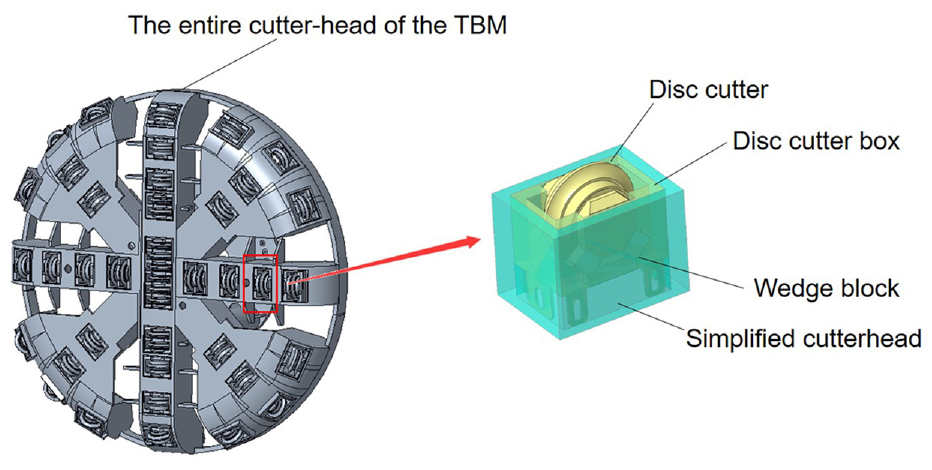
Simplified disc cutter box assembly model.
Constructing the judgment matrix for the evaluation system
The AHP constructs judgment matrices that determine the relative importance between any two elements at the current level concerning a particular element from the previous level. In this study, based on the results of orthogonal experiments, a range analysis was performed to quantify the impact of various factors on bolt assembly performance and the importance of sub-criterion layers on the criterion layer. During the construction of judgment matrices, values were assigned according to a scale of 1–9. 30 By integrating the importance levels of various factors and utilizing the proportional scale, a judgment matrix for the criterion layer and three judgment matrices for the sub-criterion layer were formulated. Calculation of these matrices provided the corresponding weights for each criterion. Furthermore, the consistency of the matrices was evaluated using their eigenvalues to assess their validity. Ultimately, these calculated weights were employed to perform comprehensive scoring, thus determining the optimal configuration for bolt assembly.
Selection of TBM disc cutter box bolt connection scheme based on AHP
Establishment of bolt assembly scheme based on orthogonal experimental design
In accordance with the analysis at the sub-criterion level within the AHP, numerous factors play a pivotal role in influencing the performance of TBM cutter-head bolted connections. Among these factors, bolt arrangement, bolt specifications (including model and length), bolt material, and bolt preload force are identified as pivotal determinants of bolted connection performance sensitivity. To attain the zenith of bolted connection performance, it is imperative to devise an optimal bolt configuration, one that harmoniously balances considerations of rational arrangement, reliability, cost-effectiveness, and a myriad of multifaceted factors. If each factor has four levels, a large number of experiments are required to cover all levels, while according to the orthogonal table
Analysis of the stress distribution in the model during the bolt assembly process
Based on the stress model of the disc cutter during TBM excavation as described in the previous text, the stress distribution of the 19-inch disc cutter used in this study is calculated. The simplified model of the rolling seat connected to the cutter-head primarily experiences compressive forces during the rock-breaking process. Granite is selected as the excavated rock material, and the relevant parameters of the disc cutter 26 and rock are shown in Table 4 below.
Parameters of the disc cutter stress model.
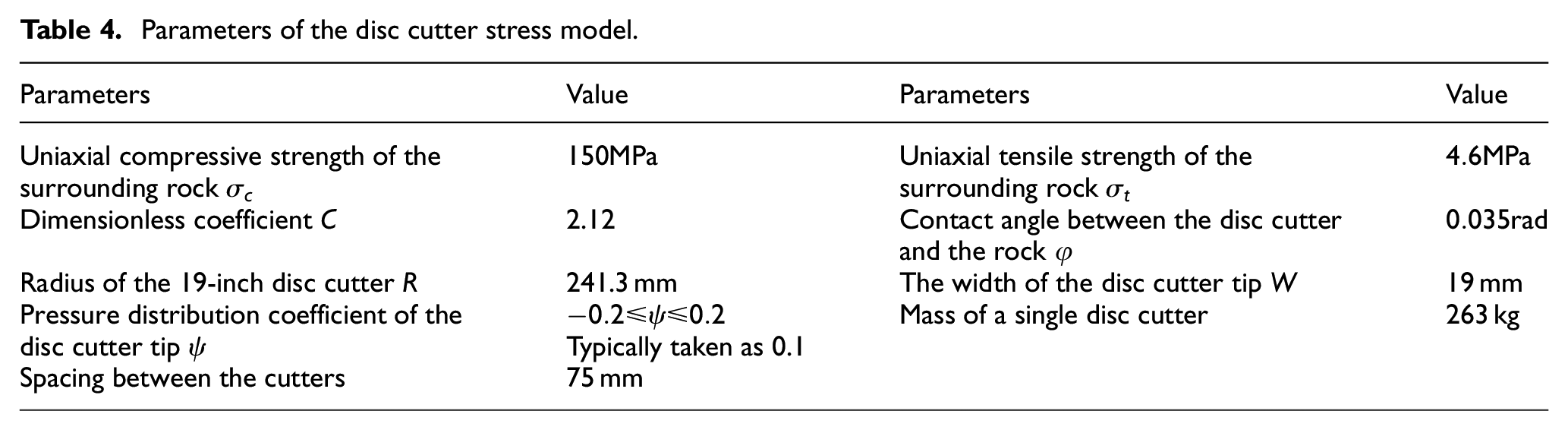
By substituting the geological parameters, excavation parameters, and tool arrangement into the equation, the force on the disc cutter can be calculated. Combining the analysis of the disc cutter force obtained from the on-site data collected during the TBM excavation process, the values of
Moreover, based on the calculation formula for bolt preloading in the previous text, the selectable range of bolt preloading is determined to be 78–730 kN. Grounded in the principles of bolt pre-tensioning, this study ensures that all pre-tensioning schemes remain within a safe operational range. Taking into account the reliability and material properties of the bolts, and heeding the advice of experts from China Railway Equipment Group, four bolt pre-tensioning schemes have been selected. These schemes align with practical engineering experience and the advisable range of pre-tensioning forces, enumerated as follows: 120, 150, 250, and 350 kN.
Analysis of bolt structural parameters
The selection of bolt specifications is extremely important for the novel disc cutter box bolt connection. Research has shown that larger bolt specifications result in better connection performance, but it is also necessary to consider the feasibility of assembly. Therefore, considering the size of the disc cutter box, four different bolt specifications were chosen. Based on national standards for bolts and the thickness of the steel plates in the disc cutter box and cutter-head, four different bolt lengths were selected. The arrangement of bolts is a key factor affecting bolt connection performance. Considering the bolt specifications and the size of the disc cutter box, four different bolt connection methods were used for assembly. The specific physical model of the disc cutter box bolt connection is shown in Figure 6. Several common bolt materials for high-strength bolts available in the market were compared comprehensively, and the detailed parameters of the selected bolt structures are shown in Table 5.

Physical model of disc cutter box bolt connection: (a) 12 bolts, (b) 16 bolts, (c) 20 bolts, and (d)24 bolts.
Header design of orthogonal experimental table with five factors and four levels.

Determination of bolt connection layout design based on orthogonal experimental method
Referring to the bolt connection configuration parameters mentioned in the previous text, the level factors are selected, and the header design of the orthogonal table
Orthogonal experimental design table.

Finite element model establishment for disc cutter box bolt connection
The bolted connection system under investigation in this study, involving TBM cutter-head and cutter box, exhibits a symmetrical structure. Its specific physical model is depicted in Figure 5. As this paper primarily delves into the quest for the optimal bolt configuration, certain intricacies within the physical model, such as thread effects, are intentionally omitted for the sake of simplification.
The comprehensive model comprises a simplified cutter-head, cutter box, rolling cutters, two rolling cutter spacers, and several bolts. Key steps for constructing the finite element model of the disc cutter box bolted connection are as follows:
1. Define the physical properties of model materials: Typically, the cutter-head is constructed from welded steel plates. In the present study, Q345 (GB/T1591-2018) steel material is employed for both the cutter-head and cutter box. The rolling cutters are made of AISI4340 steel, and the bolt materials are selected according to experimental serial numbers, following the orthogonal table. The finite element model is discretized using tetrahedral elements, with a C3D10 element type. Mesh densities are set to 25 for bolts, 30 for rolling cutters, and 35 for the disc cutter box and its casing. The resulting mesh is illustrated in Figure 7(a).
2. Define contact, loads, and boundary conditions: To closely emulate real working conditions, mutual contact relationships between components are established. With a friction coefficient of 0.3, obtained from relevant sources, surface-to-surface contact is employed between the parts. The bolted connections are modeled as tied constraints between the bottom surface of the bolts and the disc cutter box, as depicted in Figure 7(b).
3. Apply external loads and specify boundary conditions: Boundary conditions are set on both sides of the cutter box, constraining all degrees of freedom to achieve complete fixation. External loading on the entire model consists of two main components. One is the compressive force exerted on the rolling cutter during the rock-breaking process, transmitted through the contact surface as determined in the preceding text. The other component is the preloading force acting on each bolt, distributed across the internal section of the bolt, with the specific load conditions and boundary conditions detailed in Figure 7(c).

Finite element model of the disc cutter box bolted connection: (a) Meshing results, (b)Schematic of bolt connection contact, and (c)Boundary conditions and load settings.
Finite element analysis result range analysis
Based on the orthogonal table, utilizing the finite element model established in the previous text, a simulation analysis was conducted on the 16 bolt connection schemes. This analysis provides stress and strain distribution maps of the entire model. Three observation points were set: the bolt, the cutter disk, and the disc cutter box. The maximum stress and strain values were calculated and averaged, and a range analysis was performed. The range trends of each level factor are shown in Figure 8.
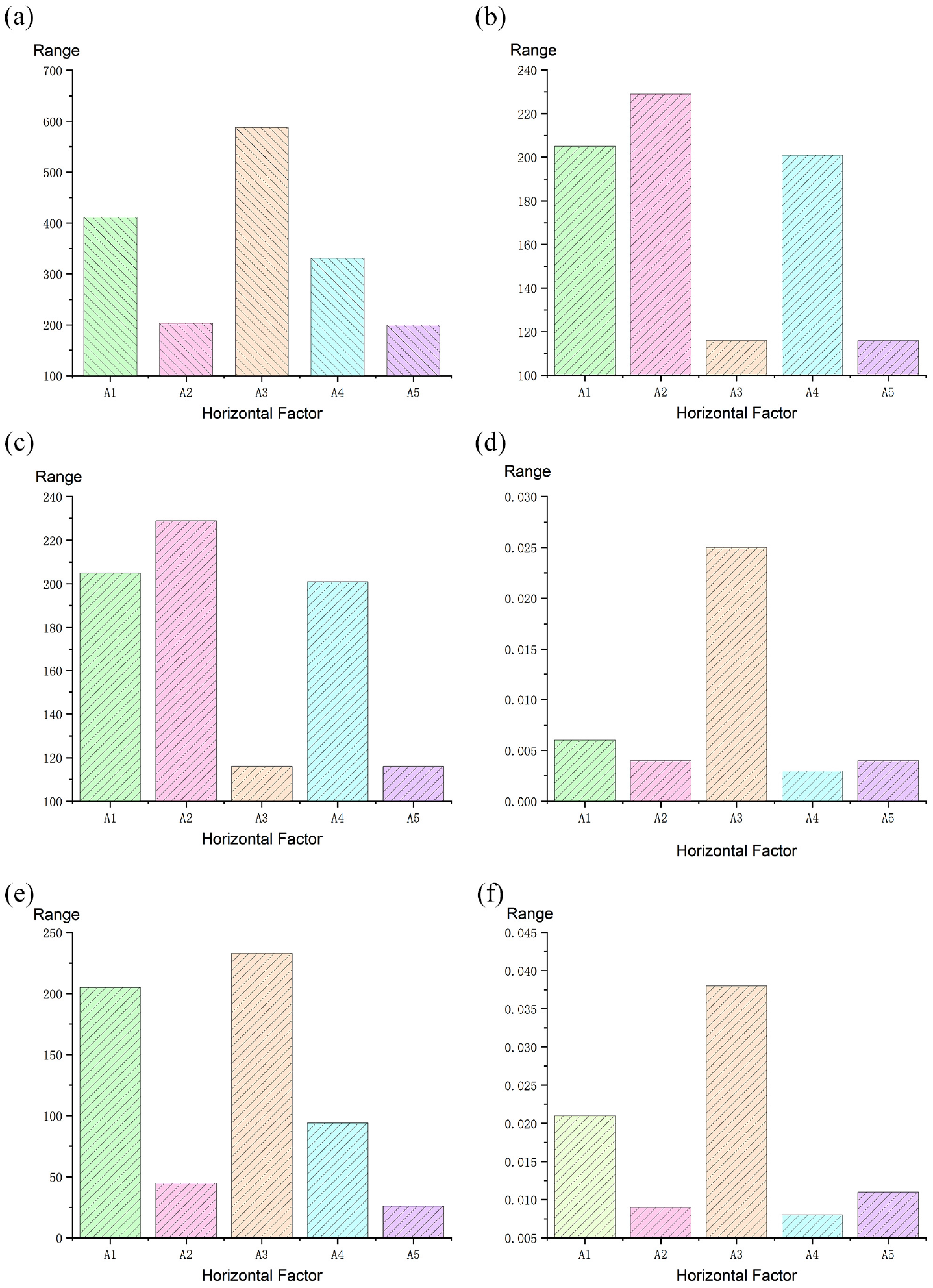
Trend chart of range for respective horizontal factors Analysis results of: (a) bolt stress, (b) bolt strain, (c) cutter head stress, (d) cutter head strain, (e)roller box stress, and (f) roller box strain.
The range in Figure 8 represents the difference between the maximum and minimum values of the average values for each level factor. Based on the aforementioned range analysis results, the comprehensive analysis indicates the primary and secondary relationships affecting the bolt connection performance as A3 > A1 > A4 > A2 > A5. This means that the impact of the level factors on bolt connection performance is as follows: bolt preloading force > bolt specification > bolt material > bolt arrangement > bolt length. This provides decisive guidance for establishing the judgment matrix in the next step of the evaluation system.
Constructing the judgment matrix and determining the weights
Constructing the decision-making model using the AHP involves three main steps: establishing an evaluation criteria system, constructing judgment matrices, and performing consistency checks to determine the weights of the criteria. When constructing the judgment matrix, it is necessary to make pairwise comparisons among the indicators. In the criterion layer, a judgment matrix M1 is formed by comparing each criterion with every other criterion. Similarly, in the sub-criterion layer, six secondary criteria are compared based on their corresponding higher-level criteria to construct judgment matrices. For example, the two criteria in the sub-criterion layer corresponding to the criterion of “arrangement rationality” are compared to obtain judgment matrix M2. Likewise, judgment matrices M3 and M4 are obtained for the sub-criterion layers corresponding to “reliability” and “economy,” respectively. By using the data from the orthogonal experimental range analysis, the importance of each criterion is evaluated, and the four judgment matrices are obtained as follows:


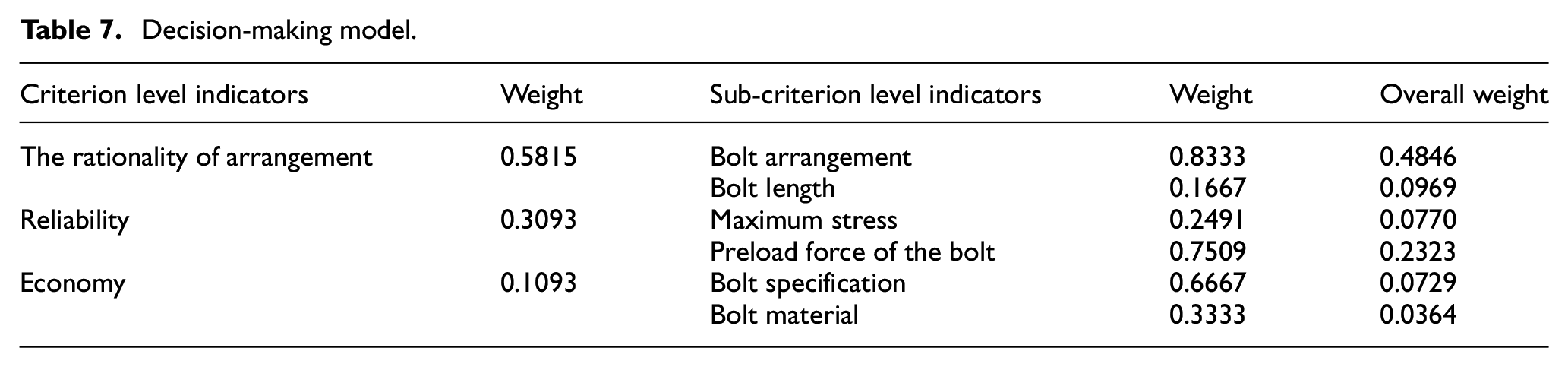
The normalization of the feature vectors within the characteristic matrix yields weight vectors for each indicator. Utilizing these weight vectors, we establish a decision model, as depicted in Table 7.
Decision-making model.
Establishing an evaluation system and selecting the optimal solution based on the AHP
Comprehensive evaluation of the new disc cutter box bolt connection scheme begins with normalizing the indicators of the 16 proposed solutions. For the bolt specification and bolt pre-tightening force indicators, a higher value is more favorable for the component. Therefore, each indicator value is divided by the maximum value in its respective indicator. For the bolt arrangement, bolt material, and maximum stress indicators, a lower value is more favorable for the component. Hence, each indicator value is inverted and multiplied by the minimum value in its respective indicator. As for the bolt length

Then, using the weights of each indicator obtained in the previous text, the overall scores of each solution are calculated. The results are shown in Table 8.
Normalization and overall scores of the 16 solutions.

Using the TBM disc cutter box bolt connection design method based on AHP, the overall scores of each option were calculated. From Table 8, it can be observed that the overall scores of each option are as follows: Option 1 < Option 6 < Option 5 < Option 2 < Option 9 < Option 11 < Option 15 < Option 3 < Option 10 < Option 14 < Option 13 < Option 7 < Option 8 < Option 4 < Option 16 < Option 12. Therefore, Option 12 has the highest overall score in terms of layout rationality, reliability, and economy. Hence, Option 12 is chosen as the optimal solution for the new TBM disc cutter box bolt connection method, with the following specifications: bolt specification of M30, bolt layout rule of 12, bolt preload of 150 kN, bolt material of 40Cr, and bolt length of 105 mm.
Conclusion
This paper focuses on the TBM disc cutter box and addresses the issues of complex assembly processes and high labor costs in the welding assembly process. To solve these problems, a TBM disc cutter box bolt connection design method based on AHP is proposed. The following conclusions are drawn from this study:
(1) The use of bolted connections instead of welding assembly techniques enables fast assembly of the disc cutter box, facilitating equipment maintenance in the future. The selected bolt connection configuration design provides an economical, reliable, and operationally feasible solution.
(2) Using the AHP, we have established a design methodology for TBM disc cutter box bolt connections. This approach combines orthogonal experiments with finite element simulation analysis. Four factors are considered: bolt specifications, bolt arrangement rules, bolt materials, and bolt pre-tension force. We select three observation points and employ maximum stress and strain as evaluation criteria for assessing bolt connection performance. The result is a systematic determination of the hierarchy of factors influencing bolt connection performance using the Range Analysis method.
(3) The weights of each indicator in the AHP hierarchy are objectively and rationally determined based on the degree of influence of each factor on bolt connection performance. A decision evaluation model is established to comprehensively evaluate the schemes and obtain the rankings of comprehensive scores. The optimal bolt connection configuration scheme is selected, providing a new solution for TBM disc cutter box assembly.
(4) This study presents a more efficient and economical alternative for the assembly of TBM disc cutter box. By employing a composite bolted connection, the assembly process is streamlined, reducing the need for labor and production time, thereby diminishing costs. This innovation not only accelerates construction speed and enhances safety but also fortifies the reliability and maintainability of the equipment, propelling industrial automation, and technological advancement. Moreover, it opens avenues for designing more cost-effective and sustainable architectural and mining equipment, contributing to the industry’s long-term development and environmental conservation.
Footnotes
Handling Editor: Aarthy Esakkiappan
Declaration of conflicting interests
The author(s) declared no potential conflicts of interest with respect to the research, authorship, and/or publication of this article.
Funding
The author(s) disclosed receipt of the following financial support for the research, authorship, and/or publication of this article: This work was supported by the 2023 Annual Key Research Project of Henan Province Higher Education Institutions, Basic Research Project (Project No. 23ZX013); the Henan Academy of Sciences Science and Technology Open Cooperation Project (Project No. 220907016); and the National Natural Science Foundation of China (Project No. 51805490).
