




Abstract
In this article, the performance of a domestic refrigerator employing isobutane and graphite nanolubricants as working fluids is investigated experimentally. The character of graphite nanoparticles and the nanolubricant was observed through scanning electron microscope, Fourier-transform infrared spectrometer, and dynamic light scattering. It is confirmed that the surface-modified graphite nanoparticles steadily suspend in the form of clusters for a long period of time. The application of the graphite nanolubricants with mass fractions of 0%, 0.05%, 0.1%, 0.2%, and 0.5% to domestic refrigerator was examined by a refrigerator test system according to the National Standard of China (GB/T 8059.1-4). The results showed that graphite nanolubricants work normally and safely in the refrigerator. There were certain reductions on pull-down time, discharge pressure, discharge temperature, suction pressure, and shell compressor temperature. In addition, power consumption of the refrigerator decreased 4.55% using graphite nanolubricant with a mass fraction of 0.1%, while the on-time rate also decreased as well as the pressure rate. Each test lasts for 15 days; the energy saving effect is stable.
Introduction
In this research, the application of different kinds of nanoparticles as lubricant additives has been investigated in many fields.1–4 Nanolubricant, which was prepared by dispersing nanoparticles in lubricant, performed better than base fluid when using in refrigeration compressor. Several works have applied nanolubricant in vapour-compression refrigeration systems and found that it is an effective way to reduce refrigerator ir-reversibility, 5 enhance energy efficiency ratio of domestic refrigerator6,7 and residential air conditioners, 8 as well as increase the coefficient of performance of the refrigeration system. 9 In a domestic refrigerator, lubricant plays roles of lubricating internal parts, cooling the compressor during working, cleaning the system, and circulating with refrigerant as working fluid. Therefore, there were two main causations for the improving performance of refrigeration system using nanolubricant.
On one hand, adding of nanoparticles should change tribological properties of the lubricant, which could improve the energy efficiency of refrigerating compressor. Kedzierski 10 found that CuO nanoparticles increased the density and viscosity of base lubricant (synthetic polyolester), while Kole and Dey 11 discovered the same tendency by dispersing Cu nanoparticles into gear oil (IBP Haulic-68). Lee et al. 12 investigated the friction and antiwear characteristics of fullerene added nanolubricant in scroll compressors. The result indicated that the fullerene nanoparticles improved the lubrication property of base lubricant by coating the friction surfaces. And higher volume concentration of fullerene nanoparticles resulted in the lower friction coefficient and less wear. 13 Furthermore, the viscosity of lubricant played a major role in the wear behavior of sliding contacting surfaces experiencing extreme contact pressure conditions. 14 Thus, it is necessary to measure the viscosity of nanolubricant.
Chang et al. 15 observed the piston ring surface after operation for 30 days through scanning electron microscope. The result showed that there were less scraping and lower wear rates using TiO2 nanolubricant, and the diameter of TiO2 nanoparticles in the lubricant remained 25 nm in average. Since domestic refrigerator should be on service for several years, it is necessary to observe dispersion stability of the nanolubricant. Furthermore, performance of the refrigerator should be tested for a period of time to ensure the reliability and stability of the compressor when using nanolubricant.
On the other hand, the thermal behavior of the base fluid should be improved by dispersing of nanoparticles, such as effective thermal properties and their applications under convective and boiling conditions. For instance, Jiang et al. 16 found that the thermal conductivities of CNT-R113 were much higher than other R113 nanorefrigerants mixed with spherical nanoparticles. The result indicated that the influence factor included morphological thermal properties and volume fraction of nanoparticles, which was in agreement with many investigations.17–19 According to these researches, appropriate type and mass fraction of nanomaterials should be chosen to improve lubrication effect and heat transfer characteristics. Among various materials, nano-graphites have been selected in this article for its easy acquisition, high thermal conductivity (about 110–190 W m−1 K−1), 20 and excellent lubrication characteristics as an additive. 21 Meanwhile, a large number of studies reported that nanofluids showed significant enhancement on heat transfer coefficient and critical heat flux.22–25 Based on these researches, the enhancement of boiling heat transfer by nanofluids was related to the particle size suspended in the liquid medium and the deposition of nanoparticles on the heating surface. As the nanolubricant circulated with refrigerant as working fluid in the domestic refrigerator, nanoparticles may migrate with refrigerant during its evaporating-condensing cycle. Ding et al. 26 found that the migration ratios of nanoparticles in the nanorefrigerant are larger than those in the nanorefrigerant–oil mixture in the pool boiling process. Yang and Liu 27 prepared nanofluids with surface-functionalized nanoparticles to take boiling experiment. They found that there was no porous sediment layer on the heated surface after boiling process when using the functionalized nanofluid comparing with conventional nanofluid. Thus, preparing nanolubricant with good dispersion stability is a potential way to prevent nanoparticles from depositing on the internal surface of evaporator and condenser. Moreover, few works about the performance of domestic refrigerator using graphite nanolubricant have been reported yet.
The objective of this investigation is to test and verify the efficiency and reliability of refrigerators using nanolubricants under semitropic operating conditions. First, graphite nanolubricants were prepared in different mass fractions. Then the graphite nanoparticles and nanolubricants were observed with scanning electron microscope (SEM), Fourier-transform infrared spectrometer (FT-IR), and dynamic light scattering (DLS). Finally, a domestic refrigerator using Isobutane (R600a) as working fluid was selected to take measurement in a refrigerator test system. Furthermore, the pull-down time test, energy consumption test, and freeze capacity test were conducted to compare the performance of the refrigerator with nanolubricant and pure lubricant.
Preparation and characterization of nanolubricant
Surface modification of nano-graphite
Nano-graphite, silane coupling agent KH570, and ethyl alcohol were introduced gradually into a beaker with a mass of 0.1, 1, and 20 g, respectively. The mixture was stirred for 30 min at room temperature with a magnetic stirring apparatus. Then, the mixture was vibrated for 12 h at 50°C with an ultrasonic dispersing device. After that, a suction filtration process was taken to separate the modified nanoparticles from the mixture employing a Buchner flask, which obtained a filter cake. The filter cake was cleaned for several times, followed by a vacuum drying process for 8 h at 100°C. Finally, the surface-modified graphite nanoparticles were prepared by pulverizing the filter cake.
Preparation and stability of nanolubricant
The graphite nanolubricant was prepared in the following two steps. First, modified nano-graphite was added to base lubricant (naphthenic mineral oil) at different mass fractions and homogenized for 60 min at 50°C by magnetic stirring at 2000 r/min. Then the product was vibrated for 1 h at 50°C every 4 h for three times with an ultrasonic dispersing device (150 W and 40 Hz). Finally, graphite nanolubricants were prepared at mass fractions of 0.05, 0.1, 0.2, and 0.5 wt%. SEM photograph of the nano-graphite is shown in Figure 1(a). It is seen that the nano-graphites are spherical or analogously spherical and the nominal diameter of the nanoparticles is ∼50 nm. After surface modification, the property of the modified graphite nanoparticles is investigated by FT-IR technology, as present in Figure 1(b). Five new IR bands were observed, centering at 2964, 1163, 1091, 1029, and 804 cm−1, respectively. The bands between 2964 and 2900 cm−1 are associated with –CH3 and –CH2, while the bands at 1163 and 1028 cm−1 are characteristic absorption peak of Si-O-C group. The appearance of Si-C stretching peak (804 cm−1) for the graphite means that KH570 has altered the surface properties of graphite nanoparticles to easily disperse in lubricant. Cluster size of nano-graphite in the nanolubricant (2 h after prepared), which was determined by DLS measurements using the Malvern ZS90 Nano S analyzer, is shown in Figure 1(c). It is observed that the nano-graphite in nanolubricant contacts each other and forms some clusters. The average diameters of nano-graphite clusters are 253.7, 315.3, 369.4, and 418.7 nm at mass fractions of 0.05%, 0.1%, 0.2%, and 0.5%, respectively. The results indicate that the mass fraction may be the key factors influencing the cluster size. The suspension stability of the prepared nanofluid was observed for a period of time. It was found that functionalized nano-graphite can keep dispersing well after 60 days even at the mass fraction of 0.5 wt%. A typical set of photo graphite nanolubricant (0.1 wt%) is shown in Figure 1(d). It is important to note that some groups of silane coupling agents KH570 can be combined with nano-graphite to form organic chains after surface modification. The organic chains adhere to the surface of graphite to cause the steric hinder, which prevents nano-graphite from continuously growing up or agglomerating. Overall, the prepared graphite nanolubricants could meet application needs for performance tests of the domestic refrigerator.

(a) SEM image of the graphite nanoparticles, (b) FT-IR spectrum of the modified graphite nanoparticles, (c) DLS data obtained for graphite nanolubricants with various mass fractions, and (d) typical photographs of graphite (0.1 wt%) nanolubricant standing for 60 days.
Performance of domestic refrigerator employing nanolubricant
Experimental system
The schematic diagram and photograph of performance tests apparatus for refrigerator are shown in Figure 2(a) and (b), respectively. It consists of a testing environment chamber, controlling system of temperature and humidity, domestic refrigerator, and data collection and processing system. As shown in Figure 2(a), the refrigerator is placed on a wooden solid-top platform, painted dull black so as to prevent direct radiation to or from any equipment in the test room according to the National Standard of China (GB/T8059.1-4-1995). 28 The ambient temperature and relative humidity of environment chamber are controlled by heater, air-conditioning, and humidifier in the way of perforated ceiling air supply on the roof. The fluctuations of ambient temperature as well as relative humidity are ±0.3°C and ±2%, respectively, in 24 h. The airflow velocity in the room is less than 0.25 m/s.

Refrigeration performance tests system: (a) the schematic and (b) the photograph.
The domestic refrigerator tested in this work is a BCD-206TAS type provided by Haier Group, which is a double-door, double-temperature, double-controlled refrigerator. The gross volume of refrigerator is 206 L, which is divided into two compartments (128 L for fresh food and 78 L for frozen food). R600a is employed as working fluid of the domestic refrigerator with a mass charge of 44 g, while the compressor is a hermetically sealed reciprocating one. The layout of the domestic refrigerator and the locations of the relevant thermocouples and pressure transducers used in the experiments are shown in Figure 3. Among them, T1, T2, and T3 are the temperatures of fresh food compartment measured in the center of tinned copper cylinder, while T4, T5, and T6 are the temperatures of frozen food storage compartment. The inside cabinet temperatures are very similar to each other, implying that an average value can represent quite well the cabinet temperature. Furthermore, other thermocouples are placed on the surfaces of refrigeration system pipelines and compressor. A pipeline with a valve was connected to the bottom of the compressor for replacing the lubricant. The volume charge of the lubricant was 150 mL with an accuracy of ±1 mL for each test. Table 1 summarizes all characteristics of the measurement device and sensors.

Schematic diagram of domestic refrigerator experimental apparatus.
Measured quantities and their uncertainties.

Experimental procedure
The refrigerator performance tests comprise pull-down test, energy consumption test, which were conducted according to the National Standard of China. In order to obtain the base data, R600a and pure lubricant were charged in the refrigerator to take three times of pull-down test and 15 days of energy consumption test. Then, R600a and nanolubricants with various mass fractions of nano-graphite were taken for the same tests. Each experiment period lasted for 20 days.
Results and discussion
Pull-down characteristics
Pull-down time is the time required to reduce the air temperature inside the storage compartment from ambient condition to the design temperature, when the refrigerator takes continuous running test. Pull-down tests were carried out at 32°C ambient temperature and 60% relative humidity. And the refrigerator was placed in the test room for more than 24 h to ensure every part of the refrigerator reached 32°C. The time variation in the air temperature within the freezer cabinet during pull-down time test is shown in Figure 4. It cost 92 min to reach the desired freezer air temperature (−18°C) for pure lubricant as a baseline test. The pull-down time reduces about 11.96%, 15.22%, 14.67%, and 10.87% for using nanolubricant with a mass fractions of 0.05%, 0.1%, 0.2%, and 0.5%, respectively, compared to pure lubricant. Moreover, the pull-down time of fresh food compartment shows the same trend that using of graphite nanolubricant can speed up the cooling rate of the refrigerator.
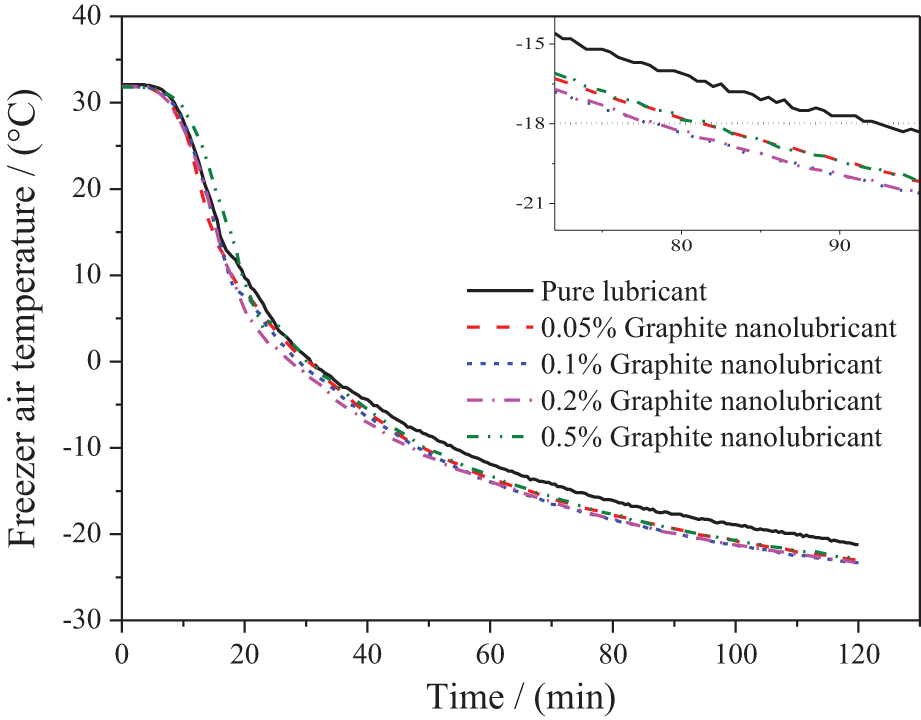
Variation in freezer cabinet temperature during pull-down time test at 32°C (continuous running test).
When the refrigerator works, certain lubricant will circle with refrigerant in the system. Adding nanoparticles could enhance the solubility between lubricant and refrigerant,29,30 which leads to a decrease in the viscosity of lubricant due to refrigerant solution. It could cause a friction reduction between piston and cylinder surface of the compressor to improve the efficiency of the compressor. Furthermore, formation of a transferred solid lubricant film from nanoparticles is possibility another potential factor. Meanwhile, the presence of nanoparticles could improve the pool boiling heat transfer coefficient of lubricant/refrigerant mixture,1,25,31 which could be another reason for a decrease in pull-down time.
Energy consumption characteristics
The system parameters of the energy consumption test are summarized in Table 2. Every parameter is the mean value of five ON–OFF cycles at the same condition (25°C ambient temperature and 60% relative humidity) to ensure the repeatability. From Table 2, there were certain reductions on evaporator temperature, condenser temperature, and suction temperature. This is probably because the graphite nanoparticles enhance the heat transfer coefficient of R600a/lubricant mixture in the evaporator and condenser. Besides, the reduction on evaporator temperature was lower than condenser temperature, which caused a reduction on the pressure rate (the ratio between the discharge pressure and the suction pressure of compressor). A decrease in the pressure rate may improve the efficiency of the compressor. When the mass fraction of graphite nanoparticles increased, the system parameters reduced at first and then raised.
Operation parameters of the refrigerator using nanolubricants with different mass fractions.
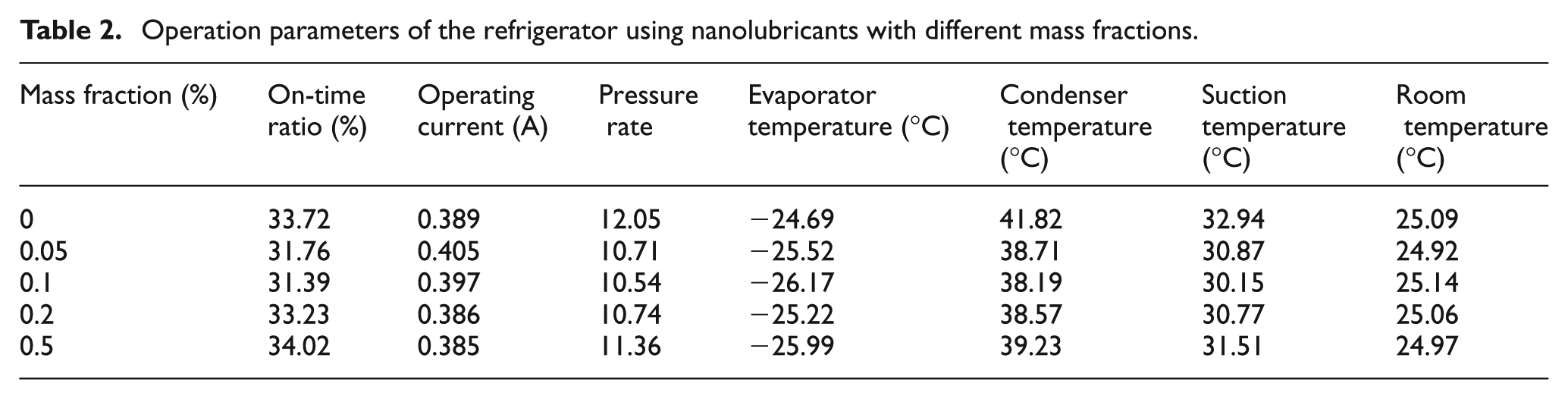
The on-time ratio, which is the ratio of operating time to total time of cycles, reaches the minimum at 0.1 wt% nanolubricant system, which leads to the minimum energy consumption as shown in Figure 5. The energy consumption is calculated from the measure value for a period of 24 h. Compared with baseline test, the energy consumption saved about 3.54%, 4.55%, 3.61%, and 0.64% for using graphite nanolubricant with a mass fractions of 0.05%, 0.1%, 0.2%, and 0.5%, respectively. Each test lasted for 15 days; the refrigerator worked normally and safely with stable energy consumption.

Energy consumption of the refrigerator using nanolubricants at different mass fractions.
Figure 6(a)–(d) shows the operation parameters of the compressor for the various mass fractions of graphite nanolubricant in one ON–OFF cycle. The discharge pressure and temperature present a downward trend as shown in Figure 6(a) and (b), respectively. The decrease in discharge temperature will cause a fall in temperature of the stator winding in compressor, which improves the stability, efficiency, and durability of the compressor motor. Figure 6(c) shows the compressor temperature obtained from the top of compressor shell. It indicates that the shell temperatures are reduced at the mass fraction of graphite below 0.1%. When the mass fraction is more than 0.1%, the shell temperature increased with it, even higher than the baseline at 0.5%. This is probably because graphite nanoparticles are spherical in shape and have a high hardness, which play a key role in the enhancement of lubrication between piston and cylinder in the compressor. Furthermore, adding certain amount of nanoparticles can reduce the friction coefficient of base lubricant, 32 which may decrease the frictional loss and the frictional heat of compressor. On the other hand, the thermal conductivity of graphite nanoparticles is much higher than the base lubricant. And nanoparticles can enhance the solubility between lubricant and refrigerant, 8 which make the heat to escape from compressor more easily with lubricant–refrigerant mixture. However, the viscosity of nanolubricant increased with the increase in the concentrations of nanoparticles, 33 which could increase the pressure drop of the R600a–nanolubricant mixture flowing through the evaporator and condenser of refrigerator. It could increase the load of the compressor, which may produce more heat in the compressor. Thus, the energy consumption increased after the concentrations of nano-graphite higher than 0.1%.

Comparison on operation parameters of the refrigerator for one ON–OFF cycle: (a) discharge pressure, (b) discharge temperature, (c) compressor temperature, and (d) suction pressure.
Figure 6(d) shows the suction pressure of compressor for graphite nanolubricants with various mass fractions under steady working condition. The variation tendency of suction pressure in one ON–OFF cycle is similar to discharge pressure, which reduces at first and then raises. This is due to the viscosity of nanolubricant increase with the increase in mass fraction, which influences the frictional loss of compressor. Thus, these influencing factors lead to a significant decrease in energy consumption of the refrigerator when graphite nanolubricant is applied.
Conclusion
In this work, the preparation of graphite nanolubricants and their character were investigated experimentally. Furthermore, the performance of a domestic refrigerator employing graphite nanolubricants with mass fractions of 0%, 0.05%, 0.1%, 0.2%, and 0.5% was examined by a refrigerator test system according to the National Standard of China. The main conclusions are listed as follows:
The silane coupling agent KH570 can alter the surface properties of graphite nanoparticles to easily disperse in naphthenic lubricant. The surface-modified graphite nanoparticles steadily suspend in the form of clusters.
There were certain reductions on evaporator temperature, condenser temperature, discharge pressure, discharge temperature, suction pressure, and compressor temperature when graphite nanolubricant is applied. In addition, the pull-down time and the energy consumption of the refrigerator decreased 15.22% and 4.55%, respectively, at a mass fraction of 0.1%. Meanwhile, there is a downtrend on compressor temperature, pressure rate, and on-time rate, which lead to a significant decrease in energy consumption. Each test lasted for 15 days; the refrigerator worked normally and safely with stable energy consumption. These results could confirm that the graphite nanolubricant can improve the performance of domestic refrigerator employing R600a as working fluid.
Footnotes
Acknowledgements
This study was supported by National Natural Science Foundation of China (51176124) and Shuguang Project of Shanghai (10GG21).
Academic Editor: Sanjeeva Witharana
Declaration of conflicting interests
The author declares that there is no conflict of interests regarding the publication of this article.
Funding
This research received no specific grant from any funding agency in the public, commercial, or not-for-profit sectors.