



Abstract
As environmentally friendly cutting fluids, vegetable-based oil and ester oil are being more and more widely used in metal cutting industry. However, their cooling and lubricating properties are required to be further improved in order to meet more cooling and lubricating challenges in high-efficiency machining. Nanofluids with enhanced heat carrying and lubricating capabilities seem to give a promising solution. In this article, graphite oil–based nanofluids with LB2000 vegetable-based oil and PriEco6000 unsaturated polyol ester as base fluids were prepared by ultrasonically assisted two-step method, and their dispersion stability and thermophysical properties such as viscosity and thermal conductivity were experimentally and theoretically investigated at different ultrasonication times. The results indicate that graphite-PriEco6000 nanofluid showed better dispersion stability, higher viscosity, and thermal conductivity than graphite-LB2000 nanofluid, which made it more suitable for application in high-efficiency machining as coolant and lubricant. The theoretical classical models showed good agreement with the thermal conductivity values of graphite oil–based nanofluids measured experimentally. However, the deviation between the experimental values of viscosity and the theoretical models was relatively big. New empirical correlations were proposed for predicting the viscosity of graphite oil–based nanofluids at various ultrasonication times.
Introduction
Heat generation and friction in machining zone affect tool life and surface quality negatively in metal cutting processes. Cutting fluids have been the conventional choice to reduce the surface friction of machining processes and dissipate the heat generated, thus improving the tool life and surface finish. However, application of conventional cutting fluids brings about some environmental and health problems. For example, cutting fluids contaminate water, ground, and air during huge disposal. Prolonged contacts of machine operators with cutting fluids cause skin and respiratory diseases.1,2 Increasing consciousness for green manufacturing globally promotes investigations on the use of environmentally friendly cutting fluids. Because of their good biodegradability and low environmental impact, the use of vegetable-based oil and synthetic polyol ester in machining may alleviate the problems associated with conventional cutting fluids. Furthermore, vegetable-based oil and synthetic polyol ester used as lubricants can increase tool life and improve surface quality in many machining processes through reduction in the cutting zone temperature and friction.3–7 Today, higher metal removal rate is increasingly needed to obtain higher efficiency in cutting process. But higher heat generation and more severe friction caused by increase in metal removal rate make the oil work not so well. The above demand requires further improvement of cooling and lubricating properties of vegetable-based oil and synthetic polyol ester to meet more demanding cooling and lubricating challenges in machining.
Nanofluids refer to fluids obtained by suspending nanoparticles with average sizes below 100 nm in base fluids. 8 Recent studies have shown that the suspension of nanoparticles can enhance the heat transfer and tribological properties of base fluids.9,10 Thus, nanofluids seem to give a promising solution to meet the requirement mentioned above. Some research work has been done on application of vegetable oil–based and ester oil–based nanofluids in machining. Krishna et al. 11 prepared nanoboric acid particle suspensions in SAE-40 oil and coconut oil and investigated their application in turning of AISI 1040 steel with carbide tool. It was reported that cutting temperature, tool flank wear, and surface roughness were decreased significantly with nanolubricants compared to base oil. Moreover, coconut oil–based nanoparticle suspensions showed better performance compared to SAE-40-based lubricant. Padmini et al. 12 evaluated the applicability of micro and nano suspensions of MoS2 and boric acid in coconut and sesame oils in machining and found that performance of nanofluids was better than micro fluids in reducing cutting temperatures, cutting forces, tool flank wear, and surface roughness of the machined surface. Park et al. 13 carried out minimum quantity lubrication (MQL) balling milling experiments and reported that nanographene additive (xGnP)-enhanced vegetable oil presented better performance than vegetable oil. Furthermore, the optimal concentration of xGnP for the improvement of cutting performance was 0.1 wt%. Nam et al. 14 performed a series of micro-drilling experiments under the conditions of compressed air lubrication, pure MQL with vegetable oil, and vegetable oil–based diamond nanofluid MQL in the miniaturized desktop machine tool system. The results showed that vegetable oil–based diamond nanofluid MQL displayed better performance than pure MQL with vegetable oil. For vegetable oil–based diamond nanofluid MQL, the optimal concentration of nanodiamond particles for reducing drilling torque and thrust force was 2.0 vol%. Sridharan and Malkin 15 evaluated grinding performance of MQL using ester oil and ester oil–based carbon nanotube and molybdenum disulfide nanofluids in terms of specific energy, G-ratio, surface roughness, and thermal distortion. The results indicated that high G-ratios and reduced specific energy and thermal distortion were obtained with application of MQL with nanofluids compared to MQL with plain ester oil. The above-mentioned studies suggest that the use of vegetable oil–based and ester oil–based nanofluids can provide significant benefits in machining. The cooling and lubricating capacity of nanofluids is closely related to their machining performance. Prior to the use of vegetable oil–based and ester oil–based nanofluids as cutting fluids, significant knowledge about their dispersion stability and thermophysical properties is required because the dispersion stability and thermophysical properties influence their cooling and lubricating capability strongly. However, until now, only a few studies investigate the dispersion stability and thermophysical properties of environmentally friendly oil-based nanofluids. For instance, Rashin and Hemalatha16,17 prepared the coconut oil–based CuO and ZnO nanofluids of various concentrations by two-step method and investigated their viscosity at various temperatures and shear rates experimentally and theoretically. It was found that the viscosity of nanofluids prepared increased with loading of nanoparticle and decreased exponentially with rising of temperature. The shear thinning was higher at lower shear rates and higher concentrations. Hence, an attempt has been made in this work to experimentally investigate the dispersion stability, viscosity, and thermal conductivity of graphite oil–based nanofluids using vegetable-based oil and ester oil as base fluids at various ultrasonication times and predict the viscosity and thermal conductivity using typical theoretical models and new empirical correlations.
Methods
Formation of graphite oil–based nanofluids
In this study, graphite oil–based nanofluids were synthesized by ultrasonically assisted two-step method. The base fluids used were environmentally friendly LB2000 vegetable-based oil (ITW Rocol North America Co., Ltd, USA) and PriEco6000 unsaturated polyol ester (NACO Lubrication Co., Ltd, China), which are widely used in machining. Graphite nanoparticles with the diameter of 35 nm, procured from Beijing DK nanotechnology Co., Ltd, China, were used throughout these experiments. The properties of graphite nanoparticles and base oils are listed in Tables 1 and 2, respectively.
Properties of graphite nanoparticles.

Properties of base oils.

The graphite oil–based nanofluids of various concentrations (0.05, 0.25, and 0.5 vol%) were prepared by dispersing appropriate amount of graphite nanoparticles in base oils using KQ-100DE ultrasonic cleaner with a 100 W output power and 40 kHz frequency. In order to study the effect of ultrasonication time on dispersion stability and thermophysical properties of graphite oil–based nanofluids, two ultrasonication times, namely, 0.5 and 1.0 h, were used.
Characterization of graphite oil–based nanofluids
Zeta potential value and particle size distribution were measured with a dynamic light scattering (DLS) equipment (Nanotrac Wave; Microtrac Instruments, USA) for evaluating the dispersion stability of graphite oil–based nanofluids. This equipment has an accuracy of 1%. In order to ensure the accuracy of data, each experiment was repeated for three times and the mean value of the data was quoted.
The dynamic viscosity of graphite oil–based nanofluids for various concentrations at different ultrasonication times was measured by a rotational-type viscometer (NDJ-9S; Shanghai Fangrui Instrument Co., Ltd, China). The viscometer drived the spindle (code 01) immersed in nanofluids at a revolution rate of 60 r/min. The spindle type and speed combinations produced satisfactory results when the applied torque was between 10% and 80%. The accuracy of the measurements was checked by measuring the viscosity of distilled water, and the deviation was found to be less than 3%. Viscosity measurements were repeated three times to ensure repeatability of measurements, and the average value was considered for analysis.
The thermal conductivity values of nanofluids prepared were obtained using TC3010L thermal conductivity measuring instrument manufactured by Xi’an Xiatech Electronic Technology Co., Ltd, China. This instrument is based on the working principle of transient hot wire method. Before measurements, the instrument was calibrated using distilled water. The measurement error was estimated to be within 1%. Thus, the precision and the reliability of the applied instrument were verified. Five measurements were taken for each nanofluid to ensure the uncertainty of measurement within 1%. The measurements on the dispersion stability and thermophysical properties of graphite oil–based nanofluids in this work were done at 25°C.
Results and discussion
Dispersion stability of graphite oil–based nanofluids
The investigation on stability is very important as it influences the performance of nanofluids as coolants and lubricants. The zeta potential of graphite-LB2000 and graphite-PriEco6000 nanofluids with different volume fractions for various ultrasonication times is given in Table 3. The value of zeta potential is related to the stability of nanofluids. It is pointed out by Müller 18 that suspensions with a measured zeta potential above 30 mV (absolute value) have good stability and above 60 mV (absolute value) represent excellent stability. According to this criterion, most of graphite oil–based nanofluids prepared had good or excellent stability, except that 0.05 vol% graphite-LB2000 nanofluid prepared with 1.0 h sonication and 0.05 vol% graphite-PriEco6000 nanofluid prepared with 0.5 h sonication showed limited stability. In terms of suspension stability, 0.5 and 1.0 h were the optimum time of sonication for the preparation of graphite-LB2000 and graphite-PriEco6000 nanofluids, respectively. It can be seen from Table 3 that overall the suspension stability of graphite-PriEco6000 nanofluid was better than that of graphite-LB2000 nanofluid. This was due to the higher viscosity of PriEco6000 unsaturated polyol ester compared to that of LB2000 vegetable-based oil.
Zeta potential for graphite oil–based nanofluids at various ultrasonication times.

The particle size is an important parameter for thermal property management in nanofluids. Its distribution is one of the dispersion characteristics measured to ascertain the state of dispersion. The effect of ultrasonication time on the particle size distribution in graphite oil–based nanofluids is presented in Table 4. Based on the results shown in this table, the increase in sonication time from 0.5 to 1.0 h broke down the agglomeration into smaller sizes in general. It can also be seen from Table 4 that the cluster size of graphite nanoparticles and volume content of cluster size in PriEco6000 unsaturated polyol ester were smaller than those in LB2000 vegetable-based oil. This indicates that the dispersion of graphite nanoparticles in PriEco6000 unsaturated polyol ester was better than that in LB2000 vegetable-based oil.
Particle sizes for graphite oil–based nanofluids at various ultrasonication times.

Effect of concentration and ultrasonication time on viscosity
Viscosity is an important index property that is used to measure the internal friction and flow resistance of a fluid. A fluid with higher viscosity has better lubrication performance. Figure 1 shows the variation in viscosity of graphite oil–based nanofluids with volume fraction of graphite nanoparticles for various ultrasonication times. A volume fraction of 0% means pure base oil without nanographite. As shown in Figure 1, the addition of nanographite in LB2000 vegetable-based oil and PriEco6000 unsaturated polyol ester raised the viscosity of base oil. Furthermore, with increasing volume fraction of graphite nanoparticles, the viscosity of graphite oil–based nanofluids increased regardless of the type of base oil and ultrasonication time. The observed increase in viscosity resulted from the increase of internal shear stress in graphite oil–based nanofluids with increase in nanographite concentration. When the ultrasonication time increased from 0.5 to 1.0 h, the viscosity of graphite-LB2000 and graphite-PriEco6000 nanofluids intensified. This can be attributed to the fact that long sonication broke up the agglomerates and dispersed the graphite nanoparticles well (Table 4), thus leading to an increase in the surface area of suspended nanographite. It can be seen clearly from Figure 1 that at the same volume fraction, graphite-PriEco6000 nanofluids showed higher viscosity than graphite-LB2000 nanofluids. The higher viscosity of graphite-PriEco6000 nanofluids may help to reduce the friction in the machining zone, subsequently preventing the cutting tool from rapid wear. The percentage enhancement in viscosity was determined by the formula

Variation in viscosity of graphite oil–based nanofluids with particle volume concentration for various ultrasonication times.
Percentage enhancement in viscosity.

Effect of concentration and ultrasonication time on thermal conductivity
Thermal conductivity is an important parameter for assessing heat transfer performance of a fluid. Figure 2 shows the variation of thermal conductivity of graphite oil–based nanofluids as function of nanographite volume concentration at various ultrasonication times. As shown in Figure 2, the addition of graphite nanoparticles in LB2000 vegetable-based oil and PriEco6000 unsaturated polyol ester improved the thermal conductivity of base oil because of the Brownian motion of nanoparticle, the existence of a nanolayer at the solid–liquid interface, and the nanographite aggregation. Moreover, as nanographite volume fraction increased, the thermal conductivity of graphite oil–based nanofluids increased on the whole, irrespective of the type of base oil and ultrasonication time. As can be seen in Figure 2, increased ultrasonication time resulted in an increase or decrease in the thermal conductivity of graphite oil–based nanofluids. According to the optimized agglomeration theory proposed by Prasher et al.,
19
the optimized aggregation size, which is not the smallest, can lead to the surprising improvements in thermal conductivity of nanofluids with chain-like aggregates (see Figure 3). In this study, different ultrasonication times brought about the difference in the cluster size of graphite nanoparticles in base oil, which approached or kept away from the optimized agglomeration size, consequently causing an increase or decrease in thermal conductivity. When the volume fraction of graphite nanoparticles was the same, graphite-PriEco6000 nanofluids presented higher thermal conductivity than graphite-LB2000 nanofluids. Thus, graphite-PriEco6000 nanofluids had better capability to carry away the heat generated in the machining zone, reducing the cutting temperature and tool wear. The percentage enhancement in thermal conductivity was determined by the formula

Variation of thermal conductivity of graphite oil–based nanofluids as function of nanographite volume concentration at various ultrasonication times.

Aggregation effect on thermal conductivity. 19
Percentage enhancement in thermal conductivity.

Efficiency of graphite oil–based nanofluids in laminar regime
Introduction of nanographite to LB2000 vegetable-based oil and PriEco6000 unsaturated polyol ester not only enhanced thermal conductivity but also led to significant increase in viscosity. The latter effect was undesirable for application of nanofluid as coolant. According to the literature,20,21 the use of nanofluids as coolants is beneficial under laminar flow mode if the increase in the viscosity is less than four times of the increase in thermal conductivity

where
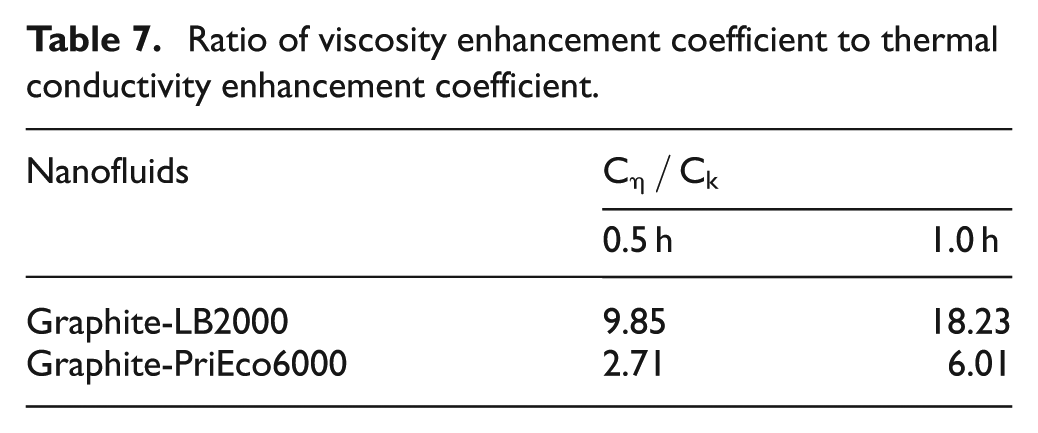
Using the experimental results of viscosity and thermal conductivity reported above, the ratio of viscosity enhancement coefficient to thermal conductivity enhancement coefficient can be calculated. The obtained values are presented in Table 7. It can be observed from Table 7 that the graphite-PriEco6000 nanofluids prepared with 0.5 h sonication had viscosity increment lower than four times the thermal conductivity increment, indicating that the nanofluids became efficient in laminar regime. However, for the left nanofluids, the ratio of viscosity enhancement coefficient to thermal conductivity enhancement coefficient was higher than 4. This means that the cooling efficiencies of these nanofluids were low due to the increase in pumping power and pressure drop.
Ratio of viscosity enhancement coefficient to thermal conductivity enhancement coefficient.
Theoretical predictions
Viscosity
Some typical theoretical models have been proposed to predict the viscosity of nanofluids. These models are listed in Table 8. Figures 4 and 5 show comparisons between the experimental values of viscosity of graphite oil–based nanofluids at various ultrasonication times and predictions by three different models, that is, Einstein model, 22 Batchelor model, 23 and Wang model. 24 It is found that the theoretical models underestimate the viscosity of graphite oil–based nanofluids, especially at higher volume fractions. Compared with Einstein and Batchelor models, Wang model predicts the viscosity of graphite oil–based nanofluids with higher accuracy and lower deviation. For graphite-LB2000 nanofluids, the maximum experimental result deviations from Wang model at 0.5 and 1.0 h ultrasonication times are 7.29% and 9.14%, respectively. For graphite-PriEco6000 nanofluids, the maximum experimental result deviations from Wang model at 0.5 and 1.0 h ultrasonication times are 9.42% and 11.82%, respectively. The conventional theories on viscosity do not consider the effects of various parameters such as particle size, solution chemistry, particle aggregation, and shape effects,16,17 consequently resulting in this deviation. It is obvious that none of the models give acceptable predictions of viscosity of graphite oil–based nanofluids.
Models for viscosity of nanofluids.


Comparison of the experimental viscosity of graphite-LB2000 nanofluids with theoretical models at various ultrasonication times: (a) 0.5 h and (b) 1.0 h.
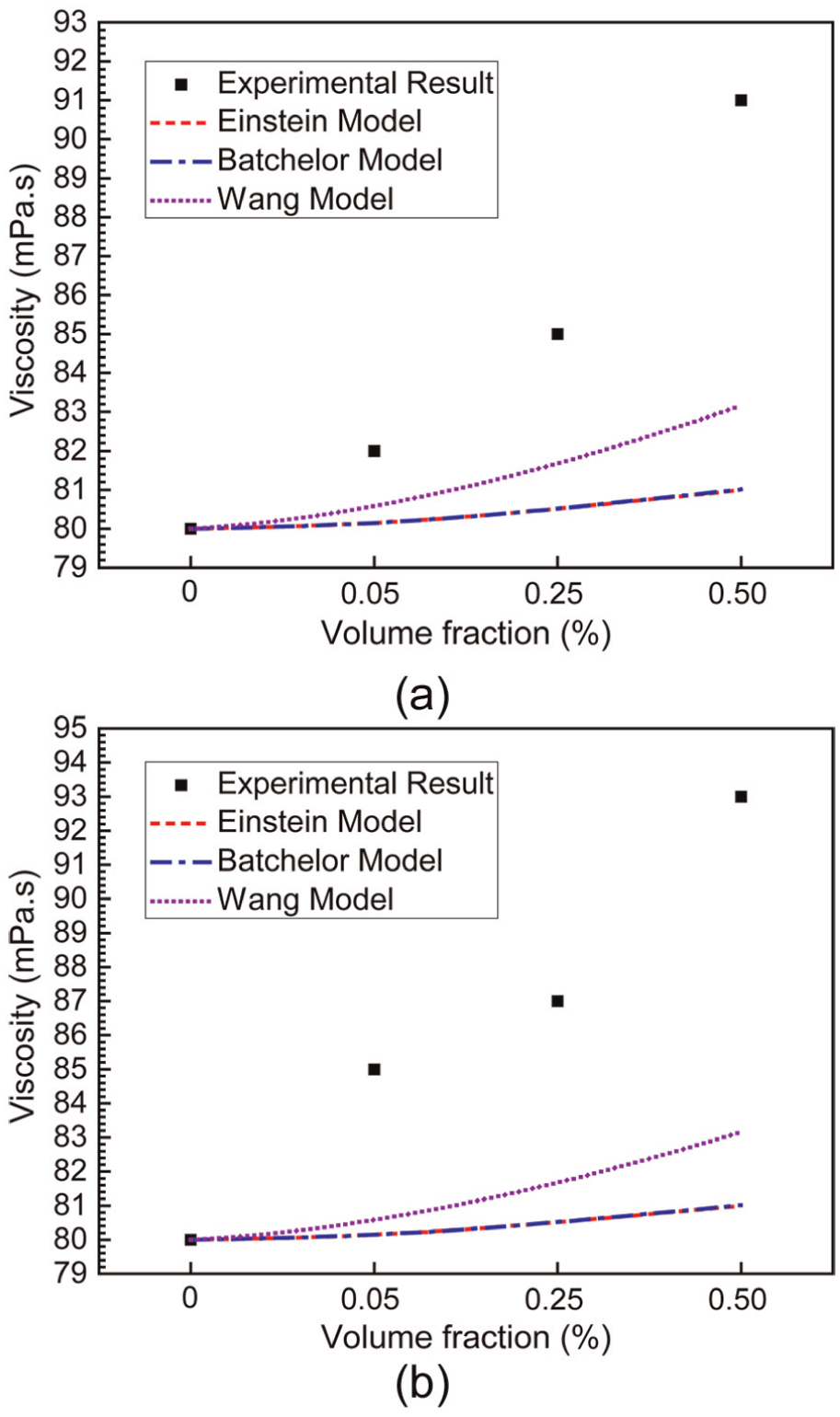
Comparison of the experimental viscosity of graphite-PriEco6000 nanofluids with theoretical models at various ultrasonication times: (a) 0.5 h and (b) 1.0 h.
As shown in Figures 4 and 5, the viscosity of graphite oil–based nanofluids increased non-linearly with particle volume concentration. Thus, for predicting the viscosity effectively, a non-linear correlation is suggested based on the experimental results. It writes as follows

where
The empirical correlations for the viscosity of graphite oil–based nanofluids can be achieved by non-linear regression and given in Table 9. It can be seen from Table 9 that the proposed empirical correlations exactly fit the data with high correlation coefficient (R2 > 0.99). The experimental result deviations from the empirical correlations are found to be less than 3.8%, which indicates good predictions of the viscosity of graphite oil–based nanofluids using the proposed empirical correlations under the condition of this study.
Empirical correlations for viscosity of graphite oil–based nanofluids at various ultrasonication times.

By comparing Table 8 with Table 9, it can be found that the coefficients in the proposed empirical correlations were significantly higher than those in the typical theoretical models. DLS results of graphite oil–based nanofluids confirm the presence of aggregates whose size is greater than that of the primary nanoparticles (Table 4). When the hydrodynamic forces are not powerful enough to break the particle aggregation down to individual particles, the aggregates as a whole form spherical flow units with effective volume fraction

with

where
Aggregate data obtained from the fitted viscosity ratio.

Thermal conductivity
In this study, Maxwell, 27 Jeffrey, 28 Timofeeva, 29 and Chen 25 models have been used to predict the thermal conductivity of graphite oil–based nanofluids. These models are listed in Table 11. The thermal conductivity values of graphite oil–based nanofluids measured at various ultrasonication times are compared with the theoretical models as depicted in Figures 6 and 7. It can be seen that Maxwell model and Chen model give same theoretical values and show higher results than Timofeeva model, but lower than Jeffrey model. As shown in Figure 6, for graphite-LB2000 nanofluids, the theoretical models underestimate and overestimate the experimental results at lower and higher volume fraction, respectively. However, for graphite-PriEco6000 nanofluids, the theoretical models underpredict measured experimental thermal conductivities for almost all the volume concentrations, regardless of ultrasonication time (Figure 7). The percentage deviation Δ of experimental values of thermal conductivity from theoretical predictions is calculated and listed in Table 12. All the percentage deviations are found to be less than 4.5%, indicating the four theoretical models predict the thermal conductivity of graphite oil–based nanofluids well.
Models for thermal conductivity of nanofluids.


Comparison of the experimental thermal conductivity of graphite-LB2000 nanofluids with theoretical models at various ultrasonication times: (a) 0.5 h and (b) 1.0 h.

Comparison of the experimental thermal conductivity of graphite-PriEco6000 nanofluids with theoretical models at various ultrasonication times: (a) 0.5 h and (b) 1.0 h.
Percentage deviation of experimental values of thermal conductivity from theoretical predictions at various ultrasonication times.

Conclusion
In this study, the dispersion stability, viscosity, and thermal conductivity of environmentally friendly graphite oil–based nanofluids of various concentrations were investigated experimentally and theoretically. Based on this investigation, the following conclusions can be drawn:
The dispersion stability of graphite-PriEco6000 nanofluids was better than that of graphite-LB2000 nanofluids. As far as suspension stability was concerned, 0.5 and 1.0 h were optimal ultrasonication time for the preparation of graphite-LB2000 and graphite-PriEco6000 nanofluids, respectively. Generally, increasing sonication time from 0.5 to 1.0 h improved the dispersion of graphite nanoparticles in LB2000 vegetable-based oil and PriEco6000 polyol ester.
The addition of graphite nanoparticles in LB2000 vegetable-based oil and PriEco6000 unsaturated polyol ester raised the viscosity and thermal conductivity of base oil. Moreover, with increasing particle volume concentration, the viscosity and thermal conductivity of graphite oil–based nanofluids increased non-linearly, regardless of the type of base oil and ultrasonication time. This property made environmentally friendly graphite oil–based nanofluids more suitable for application in high-efficiency machining as coolants and lubricants. Overall, at the same volume fraction, graphite-PriEco6000 nanofluids presented higher viscosity and thermal conductivity enhancement than graphite-LB2000 nanofluids, irrespective of ultrasonication time.
Ultrasonication time influenced the viscosity and thermal conductivity of graphite oil–based nanofluids. Prolonged ultrasonication time led to the increase in viscosity of graphite-LB2000 and graphite-PriEco6000 nanofluids due to better dispersion of graphite nanoparticles by long sonication. Increased ultrasonication time resulted in an increase or decrease in the thermal conductivity of graphite oil–based nanofluids. This was attributed to the fact that different cluster sizes of graphite nanoparticles brought about by various ultrasonication times approached or kept away from the optimized agglomeration size for thermal conductivity enhancement.
Graphite-PriEco6000 nanofluids showed higher viscosity and thermal conductivity than graphite-LB2000 nanofluids. Thus, graphite-PriEco6000 nanofluids had better capacity to reduce the friction and carry away the heat in the machining zone. Therefore, compared with graphite-LB2000 nanofluids, graphite-PriEco6000 nanofluids were considered to be preferable.
The efficiency of graphite oil–based nanofluids as coolants was evaluated in laminar flow regime from the thermophysical values determined. It was found that the graphite-PriEco6000 nanofluids prepared with 0.5 h sonication became efficient due to the fact that the ratio of viscosity enhancement coefficient to thermal conductivity enhancement coefficient was lower than 4. However, the cooling efficiencies of the left nanofluids prepared were low.
The typical theoretical models such as Maxwell, Jeffrey, Timofeeva, and Chen models predicted the thermal conductivity of graphite oil–based nanofluids well. However, there was relatively big deviation between the experimental values of viscosity of graphite oil–based nanofluids and three different models, that is, Einstein model, Batchelor model, and Wang model. The new empirical correlations proposed could predict the viscosity of graphite oil–based nanofluids at various ultrasonication times with high accuracy and low deviation.
Footnotes
Appendix 1
Academic Editor: David R Salgado
Declaration of conflicting interests
The author(s) declared no potential conflicts of interest with respect to the research, authorship, and/or publication of this article.
Funding
The author(s) disclosed receipt of the following financial support for the research, authorship, and/or publication of this article: this work was supported by National Natural Science Foundation of China under contract nos 51205177 and 51305174, Natural Science Foundation of Jiangsu Province under contract no. BK2012277, Natural Science Program for Basic Research of Jiangsu Province under contract no. 08KJB460002, Qing Lan Project, and Research Fund of DML-HYIT (HGDML-0901).