



Abstract
This dynamic study investigates hydrothermal and rheological properties of two-dimensional ternary nanofluid flow by using active passive control mechanisms on nanoparticles navigating a porous curved surface. The working fluid contains nanometer sized spherical shaped particles of three different metals
Keywords
Introduction
Fluids and energy are the most essentials elements for human lives. These serve as vital foundations to human civilizations, constituting fundamental necessities for homes, industries, technological development and overall support to diverse process of modern-day livings. Growing energy needs necessitate prudent approaches for optimization of energy resources. Researchers has been diligently exploring innovative methods to optimize energy utilization by employing both experimental and theoretical approaches. One of such effective technique is to improve thermal efficiency of heat transferring fluids. Water being abundant in nature and cost effective is the most widely used heat careering fluid in industries; however, its low thermal conductivity makes it unsuitable for satisfying ultramodern high heating and cooling processes requirements. Other commonly used fluids such as oils and ethylene glycols etc. are also not good thermal conductors. As the metals are good conductors, one way of improving thermal conductivity of such fluids is adding small particles of metals in these fluids. Hamilton and Crosser 1 in 1960s conducted some experiments on this idea; however, such solutions were having stability issues because metal powders are heavier than base fluid molecules. The nanotechnological advances by end 20th century made the nanosized particles available and in 1995 Choi and Eastman 2 carried out series of experiments by adding nanoparticles of various metals in base fluids. They established that nanoparticles were stable and thermal conductivity was increased manifold even by very small nanoparticles volume fractions. Since their pioneer work, the field of nanofluids is evolving at very rapid pace and researchers are increasingly engaged in theoretical and experimental work related to this dynamic new type of fluids. Extensive investigations have been carried out in recent years to extract marvelous thermal features of nanofluids in diverse range of geometries and under various constraints. Researchers developed hybrid nanoliquid to intersperse properties of two different materials in base fluids. More recently, the development of ternary nanofluid, which blends three various types of nanoparticles in base fluid and possesses excellent thermal and rheological features has caught greater attention of research community. Abbasi et al. 3 analyzed ternary nanoliquid flow past curved shape geometry by focusing impacts of various shapes of nanoparticles and two different base fluids. They reported that shape and type of base fluid has considerable impact on density and boundary layer thickness of nanofluid on curved structure. In another relevant study, Heyhat et al. 4 deliberated influences of type and volume fraction of ternary nanofluid on density and thickness of boundary layer and revealed that both were increasing function of volume fraction of nanoparticle concentration. Abbasi et al. 5 numerically explored peristalsis flow of hybrid nanoliquid with curved structure of channel considering variable thermal conductivity and deduced that effect of variable thermal conductivity was significant on thermo-rheological properties. Wenhao et al. 6 carried out a comparative study of ternary nanoliquid with free, forced and mixed convection considering thermal radiations and slip conditions. Their results indicate that skin friction was minimum when slip conditions with free conviction was employed. Babu et al. 7 examined flow of ternary nanofluid across a permeable channel considering joule heating and observed that temperature was a decreasing function of Reynolds numbers. Some more recent studies on ternary nanofluids with various regulatory factors on stretching surfaces are given at Shahsavar et al.8–13
The boundary layer concept was presented by Prandtl, 14 in 1904. Boundary layer flow over a continuous moving surface was first studied by Sakiadis. 15 The exact solution of two dimensional fluid flow past stretching surface was first computed by Crane 16 in 1970. Gupta and Gupta 17 extended the work of Crane by considering the suction and blowing factors. There have been countless studies on fluid flow at flat stretching surface, however, the curved stretching surface is very rarely investigated. Such surface has numerous applications in industries and engineering procedures where extraction takes place by movement of curved planes like hot rolling, annealing of copper wires, rubber and plastic sheets manufacturing etc. The everyday significance of flow past a curved surface can be exemplified by soap films that are widely employed in studying classical two-dimensional hydrodynamic phenomenon. Due to their extremely thin nature, these films adhere to the Navier-Stokes equations at lower Mach numbers. Moreover, curved surfaces find applications in curved jaws of flexible assembly machines. One prominent biological aspect is the lipid bilayer membrane, which forms boundary of many cells. Lipid bilayer exhibits hydrodynamic properties such as viscosity and diffusion, which have been validated through various experiments. Sajid et al. 18 numerically investigated flow of viscous fluid on curved stretching surface and noted that drag force was lesser and boundary layer was greater at curved surface in comparison to flat surface. In another study, Sajid et al. 19 examined flow of micropolar fluid past curved surface and noted that velocity was superior on curved surface comparison to flat surface. Rosca and Pop 20 scrutinized the fluid flow generated by shrinking and stretching curved sheet. Naveed et al. 21 studied flow of fluid on curved surface considering magnetohydrodynamic. Waqas et al. 22 analyzed MHD hybrid nanofluid flow past curved sheet. Their results revealed that increase in curvature factor and volume fraction of nanoparticles amplifies velocity profile. Okechei et al. 23 deliberated flow of viscous fluid over a rapidly stretching curved surface and observed that curvature factor was directly proportional to the shear stress. Some other researchers have also studied flow past curved surface.24–28
Thermal radiation, which involves transfer of heat energy in the form of electromagnetic waves, is a fundamental mechanism of energy transfer. From physical point of view, these are photons emitted by atoms or molecules of a substance having temperature above absolute zero. This form of heat transfer is unique in a way that it occurs without the need of a physical medium. Thermal radiations play a crucial role in numerous applications including heating processes like microwave oven, industrial processes, solar energy systems, nuclear power plants and many more. Venkateswarlu et al. 29 explored the heat transfer of hybrid nanofluid flow past a porous stretching surface considering thermal radiations and observed that thermal factor increases the temperature by 14.89 %. Harinath Reddy et al. 30 investigated the influence of thermal radiations on stagnation point chemically reactive MHD hybrid nanofluid flow and deduced that temperature panel rises with higher radiation parameter. Thermal radiations are a prominent heat transfer parameter in numerous other studies involving heat transfer.31–37
Earlier, it was believed that concentration of nanoparticles at the surface remains constant. However, Nield and Kuznetsov 38 extended the idea by introducing a new boundary condition which incorporates two nanometric phenomenon, the Brownian motion and thermophoresis. The previously assumed hypothesis of constant concentration is now termed as active control while that influenced by the Brownian and thermophoresis 39 effects is referred as passive control. Acharya et al. 40 evaluated thermal analysis of nanofluid flow using active passive controls over a linear curved stretching surface and observed lower heat transport rate for passive control nanofluid flow. Revanna Lalitha et al. 41 explored effects of active passive controls on Jeffery nanofluid fluid flow over a stretching sheet and deduced that temperature boosts sharply for active controls as compared to passive controls. In another relevant study, Hayat et al. 42 employed active passive controls to examine thermal and rheological behaviour of MHD Jeffery fluids flow generated by nonlinear stretching sheet and observed increasing trend in thermal as well as nanoparticles concentration panels for both active and passive controls with rising thermophoresis while reverse behaviour was reported for increase in Brownian movement. Kalaivanan et al. 43 scrutinized second grade nanofluid flow with activation energy using nanoparticles active and passive controls and observed that concentration and Nusselt number improve by greater activation energy. Moreover, impact of thermophoresis and Brownian motion on concentration was lower in active control. Khan et al. 44 investigated the hydrothermal behaviour of nanoliquid past curved surface using active and passive controls and declared that Brownian and thermophoresis factors augment the thermal boundary layer.
Cobalt
A close scrutiny of literature reviewed reveals us that hydrothermal investigation of loading ternary nanoparticles navigating a porous curved surface with active passive controls using non-Fourier approach has not yet been studied by any researcher. Motivated by the practical aspects of such investigation as conferred in former paras, it is apparent that this communication offers valuable insights into various heat and mass transport challenges. Extensive studies are available in literature on nanoliquid flow past flat stretching sheet; however, exploration of how specific factors within the flow influence the hydrothermal characteristics is relatively rare. Furthermore, flow over flat surface is a particular case of such flow over curved surface. Therefore, this embodies broader configuration. To address this research gap, this premier investigation is aimed at evaluating the following research objectives.
(a) To determine the impact of curvature factor and porosity of medium on the flow and thermal pattern of ternary hybrid nanofluids past a curved stretching surface.
(b) To explore influences of adding metal nanoparticles in base fluid on skin friction at the curved surface.
(c) To analyze effects of different control mechanisms (active vs passive) on rheological and thermal profile in boundary layer.
(d) To investigate impression of radiations intensity on nanoparticles concentration in active and passive control scenarios and under different conditions?
(e) To evaluate bearing of Brownian motion and thermophoresis on nanoparticles concentration and mas transport rates in active versus passive strategies.
Model formulations
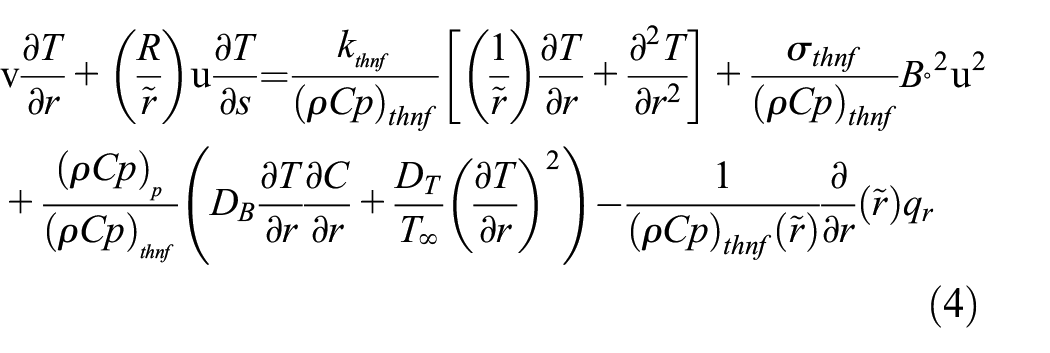
we have selected curvilinear coordinates system





Geometrical representation of the flow.
In above
Where,

Here

Using equations (8) in (7), we can have

Normalization analysis
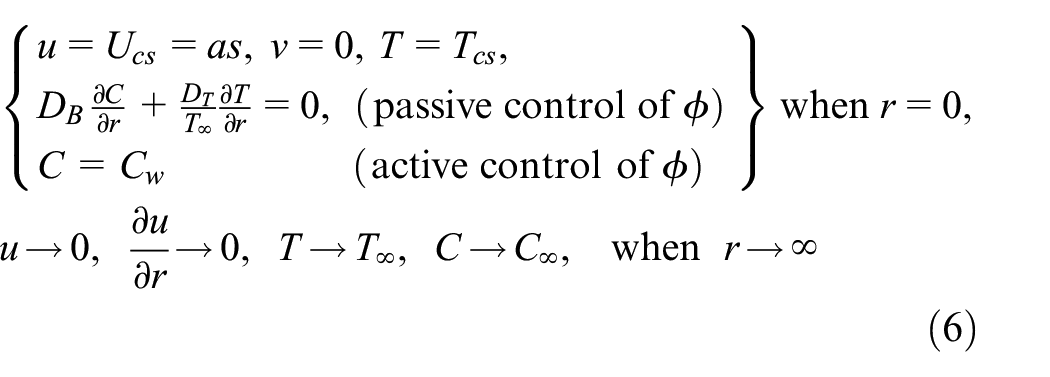
In order to convert the governing equations into non-dimensional format, we employ the appropriate unitless functions as53,56,57

The renovated equations (1)–(5) by employing the stated similarity variables becomes as

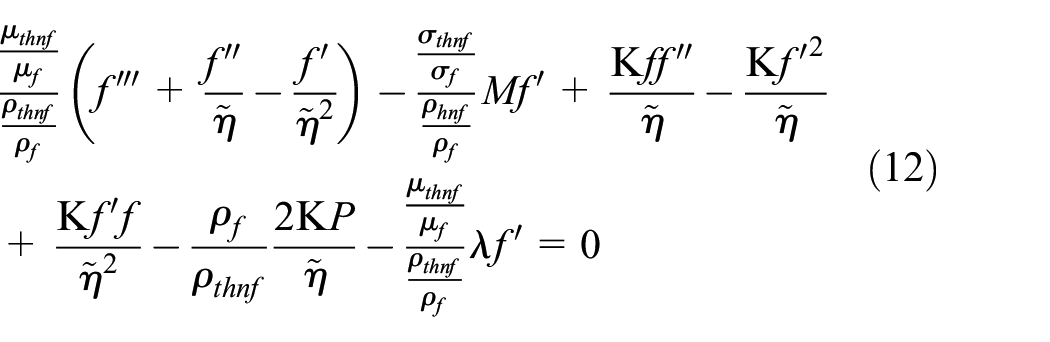
The pressure function can be expressed as follows

In order to eliminate the pressure term from above equation (13) we differentiate it with respect to



In equations (14)–(16) which represent the flow profile of this problem,

In above equations the dimensionless factors are defined as:

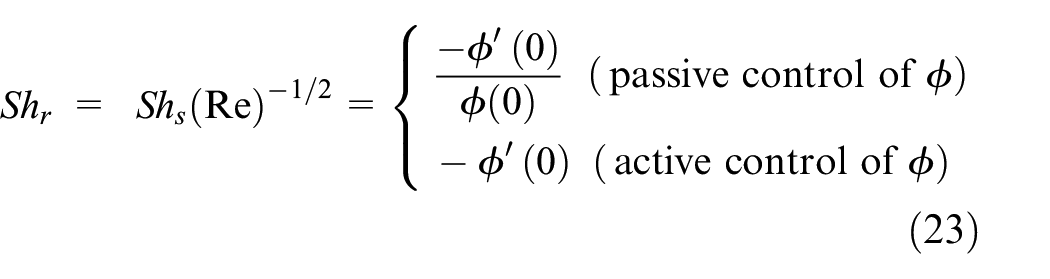
Physical engineering parameters
The noteworthy parameters of engineering significance in this investigation include reduced skin friction


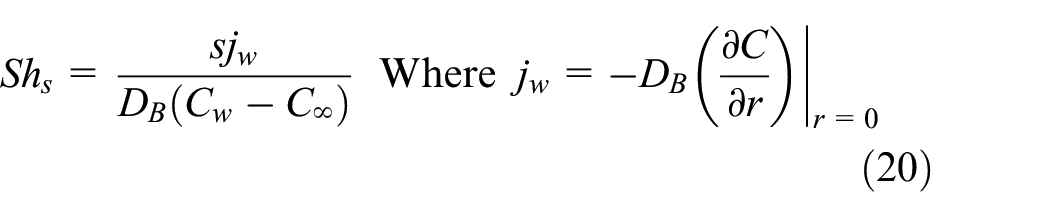
In above,


Thermophysical characteristics
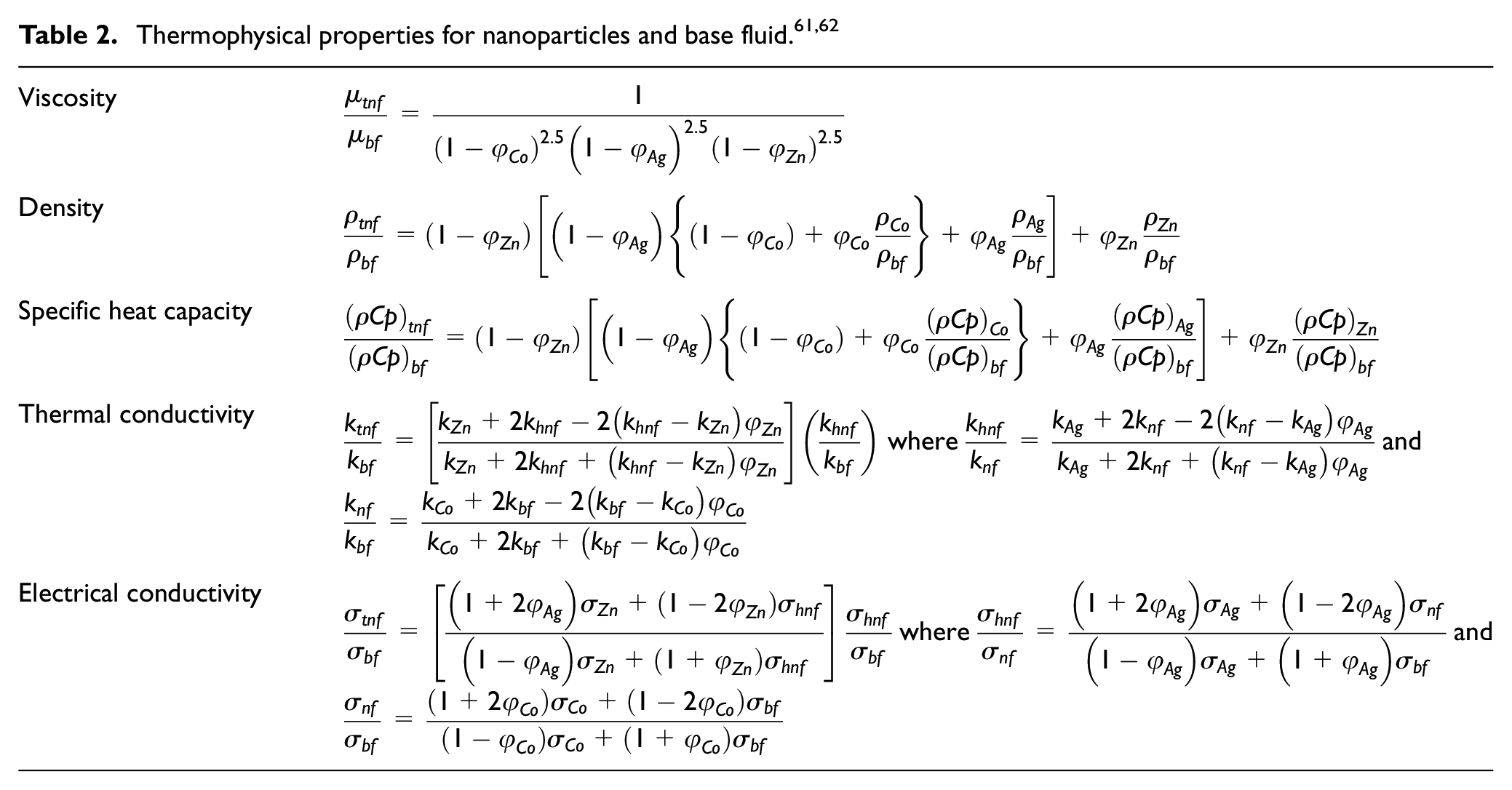
To gain deeper insights into flow dynamics of ternary nanofluids across various physical conditions and flow scenarios, it is imperative to consider their thermophysical properties. Table 1 presents numerical values of key thermophysical properties of nanoparticles and base fluid.

Various relationships, theoretical models as well as experimental investigations are employed to compute thermophysical characteristics of nanoliquid. The relations for vital thermophysical characteristics are presented in Table 2.
Numerical solution
The acquired system of ODEs being highly non-linear and coupled is not possible to solve analytically. In order to get a numerical solution, MATLAB bvp4c package has been employed on the system of equations (14)–(16) along with boundary conditions given by equation (17). The bvp4c is an efficient numerical technique which has been specifically designed to solve boundary value problems related to ODEs. This method employs a combination of shooting method and finite difference method to compute an approximate solution to the boundary value problem. This method requires expressing the higher order ODEs system and the associated boundary values to a first order ODEs system. Moreover, an initial guess of the solution is also required. The solver integrates the first order ODEs system taking the initial guess toward end of the given domain. At the end of domain, it computes the residual error. For the convergence of solution, this residual error must be less than a specified level. On reaching a specified level of convergence, results can be acquired for analysis in the form of numerical data or graphs as per the requirement. This method is easy to operate, computationally cost effective as it takes less time to execute as compared to other methos and is frequently used to solve highly non-linear ODEs systems.63,64
Method validation
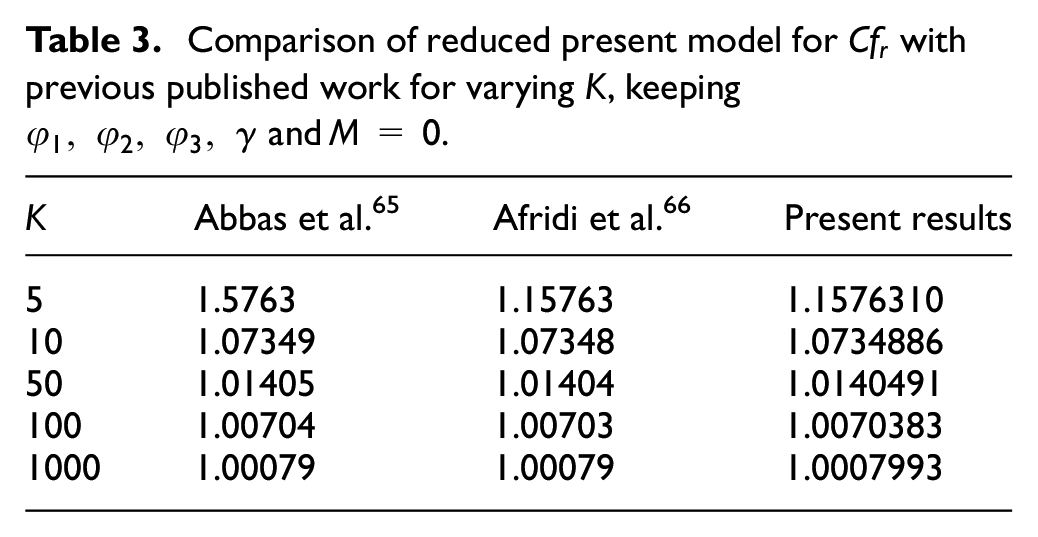
To confirm the accuracy of coded problem, Table 3 presents a comparison of obtained results for skin friction across different curvature parameter values with the data previously published in open literature by Rosca et al., 20 Abbas et al. 65 and Afridi et al. 66 A fine agreement amongst results validates our code.
Comparison of reduced present model for
Results and discussion
This segment constitutes most important portion of this pragmatic study, playing a crucial role in parametric examination of the overall flow regime. It contributes in better understanding the results of the pertinent physical quantities which have been obtained by employing the bvp4c numerical technique. Here the explanation covers how the parameters at play impact the velocity, temperature and mass transport. It is highlighted that prime objective of this study is was to investigation of thermo-rheological behaviour of water based ternary hybrid nanofluid containing nanoparticles of
The values of skin friction, heat transfer rate and mass transport factors have been presented in the tabular form given in Tables 4–6. The findings and their implications are thoroughly discussed and explained, supported by logical justifications.
Numerical values of

The numerical values of

The numerical values of

Figure 2(a) portrays impression of curvature factor on dimensionless velocity profile. It is observed that velocity profile amplifies with an increase in values of curvature factor. Parametric representation of

Dimensionless curvature (K) and porosity parameter (λ) on dimensionless velocity.

Variations of streamlines for various values of dimensionless curvature

The impression of dimensionless curvature factor
The effects of porous media parameter (λ) on temperature and concentration profiles are depicted in Figure 5. It is evident from the portrayal in Figure 5(a) that porosity parameter increases the temperature panel for both active and passive controls. This increase in temperature is greater for active control of nanoparticles in comparison to passive control. Physically, this rise of temperature is due to increased interaction of nanoparticles with porous surface area which enhances heat transfer rate from nanoparticles to surface.

The effect of porosity parameter (λ) on
Also, the numerical values in Table 4 for frictional force at curved surface as result of increasing the porosity parameter show a rising trend. This resistive force also contributes in augmentation of temperature in boundary layer region. Figure 5(b) indicates that porosity factor augments the nanoparticles concentration in boundary layer for active control of nanoparticles whereas reverse effects is observed for passive control. Figures 6 and 7 elucidate the impression of Brownian motion parameter

The effect of Brownian parameter
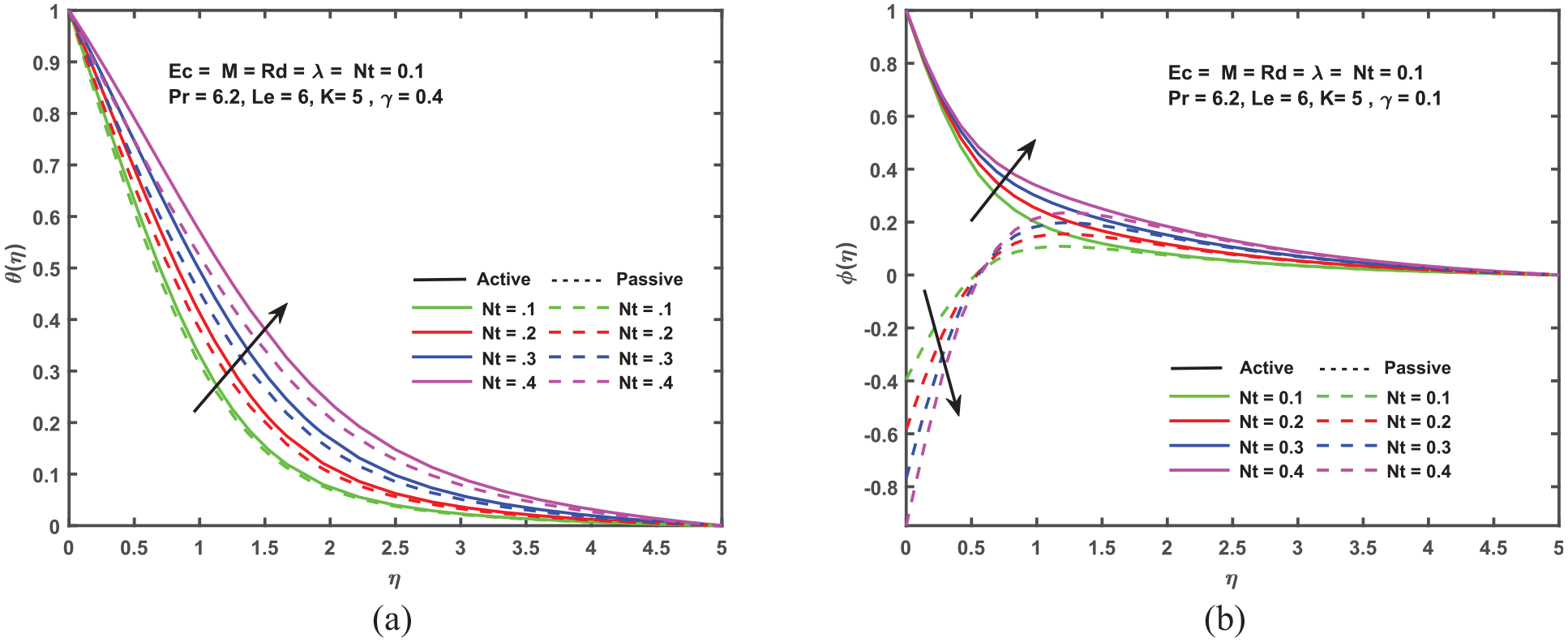
The effect of thermophoresis parameter
Thermal radiations influence on temperature and concentration is portrayed in Figure 8. It can be seen that temperature elevates by intensifying the radiations factor. Additionally, the radiations give better heat transfer rate for active control of tiny particles at surface rather than the passive control. Figure 7(b) communicates that results are opposite for passive and active control strategies inside

The effect of thermal radiations constant
Figures 9 and 10 demonstrate impressions of Eckert number and Lewis number on thermal and concentration boundary layers. Figure 9(a) depicts the inspiration of Eckert number on temperature profile. The increase of Eckert number increases temperature for both active and passive controls. On the other hand, decrease in mass diffusivity is noted for both active and passive strategies. Eckert number is interpreted as ratio of kinetic energy and heat enthalpy. Augmentation of
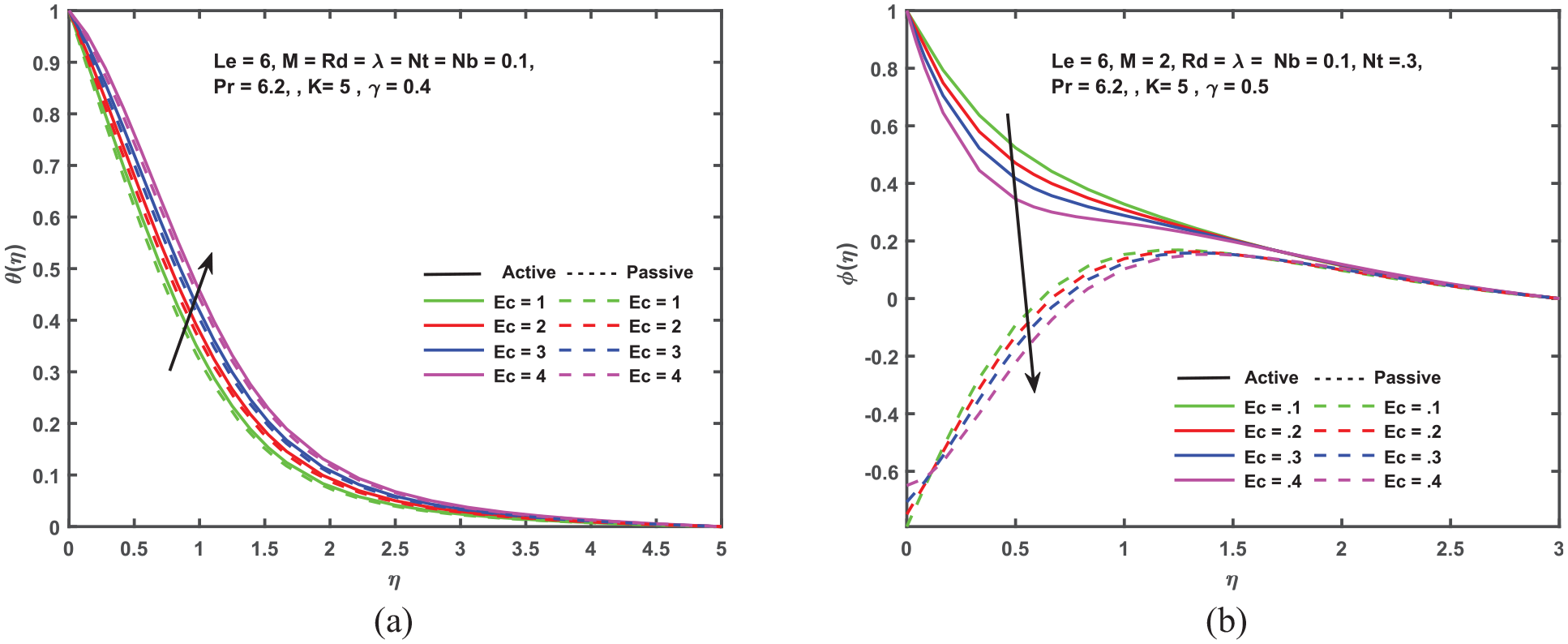
The effect of Eckert Number

The effect of Lewis number
We receive distinct consequences on thermal boundary for active and passive control strategies in Figure 10(a). Temperature rises for passive control whereas converse is observed for active control. We know that Lewis number relates thermal diffusivity to the Brownian diffusivity. Hence augmentation of Lewis number values dominates the thermal diffusion leading to elevated thermal profile. However, heat transport gets lower owing to high er
Conclusion
This dynamic study explores thermo-rheological properties of ternary nanofluid flow by use of active and passive control mechanisms on nanoparticles navigating a curved geometry. We presumed that a porous surface is coiled in a circular region of radius
Curvature and porosity factors have opposite effects on velocity profile. Increase in radius of curvature reduces pressure and shear stress in boundary layer blowing velocity while porosity factor acts as damping force declining velocity.
All involved parameters augment temperature profile in both active and passive controls except curvature factors. In passive control flow, a static perspective is maintained by temperature panel when Brownian factor is varied. In all cases, active control assures higher temperature profiles over passive control.
Concentration of nanoparticles decreases for higher radiations and Eckert number For all other pertinent parameters, dual consequences have been noted for active and passive controls. Moreover, under action of passive control, a sudden cross over is observed only in
Skin friction at surface decreases for increase in curvature factor while porosity and Lorentz force cause frictional force to decrease. Also, an increasing trend in skin friction is prominent as we add nanoparticles of metals which can be ordered as
Heat transport rate is a decreasing function of
Brownian motion and Lewis number improve the nanoparticles concentration for active control of tiny particles, however the impact of former for passive control is stagnant. Thermophoresis reduces the mass transport rate for both active and passive controls. Here the rate of reduction is better at active control than passive strategy.
This study is helpful in optimizing thermal energy in industrial applications by advancing understanding of heat and mass transport phenomena in ternary hybrid nanofluids on curved porous surface, having implications for both research and practical applications. This study can be expanded to include nanoparticles of different metals, metal oxides or nanotubes, different base fluids with changing volume fractions, boundary constraints, geometries and noval active and passive controls.
Limitations of the study
This study is a theoretical in nature. Experimental investigations may be carried out to validate the theoretical outcomes of this study and its prospective applications in heat and mass transfer domains.
Footnotes
Handling Editor: Sharmili Pandian
Declaration of conflicting interests
The author declared no potential conflicts of interest with respect to the research, authorship, and/or publication of this article.
Funding
The author received no financial support for the research, authorship, and/or publication of this article.
