




Abstract
Here, we scrutinize the entropy analysis in magnetohydrodynamic flow of second-grade nanomaterials with melting effect subject to stretchable bended surface. Heat attribution is modeled through first law of thermodynamics with radiation effect. Major physical effect of random and thermophoretic motion is also addressed. Feature of irreversibility (entropy rate) analysis is also discussed. Isothermal cubic autocatalyses chemical reaction at catalytic surface is discussed. Nonlinear dimensionless differential system is developed through adequate transformation. Optimal homeotypic analysis method (OHAM) is employed to construct convergent solution. Influence of physical variables on entropy rate, fluid flow, concentration, and thermal field is discussed. An augmentation in fluid flow is noticed through curvature variable, while reverse effect holds for magnetic variable. A reverse effect holds for fluid flow and thermal field through melting variable. Entropy analysis is augmented with variation in melting variable. Reduction occurs in concentration through thermophoretic variable, while an opposite effect holds for thermal field. An increment in melting variable leads to reduced concentration. Larger estimation of radiation variable improves entropy analysis.
Keywords
Introduction
It is known fact that melting phenomenon plays a vital role in various industrial and engineering applications. Melting phenomenon is sufficiently utilized in welding process, heat engines, permafrost melting, semiconductor material processing, coil exchangers, magma solidification, and many others. Melting phenomenon was first studied by Robert. 1 He considered a slab of ice and investigated its melting process when in contact with hot stream air. Hayat et al. 2 explored the effects of melting heat transfer in magnetohydrodynamic non-Newtonian Oldroyd-B fluid with variable thickness due to stretching surface. They achieved convergent series solutions by utilizing homotopic technique. Das 3 considered thermal radiation effects while exploring melting phenomenon in magnetohydrodynamic boundary layer flow due to moving surface. Khan et al. 4 discussed the melting effect in dissipative flow of nanomaterials with entropy analysis toward a stretchable surface. Further investigations of melting phenomenon are illustrated in Refs.5–10
Fluids as carriers are used in a variety of heat transfer equipment. The efficiency of these devices can be improved by enhancing the thermal conductivity of fluids. It is done by adding small nanosize particles in base fluid. This idea was initially revealed by Choi et al.11,12 Due to superior thermal properties, nanofluids have numerous applications in heat transfer related devices, boiling heat transfer, solar thermal systems, convective heat transfer as well as condensation and evaporation. 13 Nanofluids with stable suspension of nanoparticles in base fluid have a great prospect to meet the modern requirements of innovative thermal, industrial, and cooling technology. 14 Buongiorno 15 gives accomplished advanced concept on nanomaterials heat conduction augmentation. A comprehensive analysis on challenges, opportunities, synthesis, and stability of nanofluids is performed by Urmia et al. 16 Reddy and Makinde 17 examined buoyancy forces, thermophoretic, and Brownian motion for magnetohydrodynamic nanofluid flow in an asymmetric channel. Nonlinear mixed convection, thermo diffusion, and diffusion thermo effects in nanofluid flow are addressed by Hayat et al. 18 Irreversibility analysis in radiative flow of second-grade nanomaterials with Lorentz force and radiation effect subject to stretched sheet is performed by Hayat et al. 19 Some recent developments in nanofluids are given in Refs.20–25
Entropy generation is used to determine the performance of various isolated thermal systems in manufacturing, engineering, refrigerators, thermal transportation phenomenon, hybrid-powered engines, industrial, and various biological processes. Entropy production occurs due to fluids friction, Joule heating, diffusion, friction of solid surfaces, electric resistance, molecules vibration, unstained expansion chemical reaction, thermal resistance to the liquid flow, etc. Entropy minimization is used to augments of any thermal system performance. Bejan26,27 gives the concept of entropy minimization in convective fluid flow. Kumar et al. 28 discussed irreversibility investigation in magnetohydrodynamic incompressible flow of Williamson nanoliquid. Irreversibility in reactive magnetohydrodynamic couple stress liquid flow through a saturated permeable channel is illustrated by Hassan. 29 Few recent investigations about irreversibility (entropy rate) analysis are highlighted in Refs.30–40
Motivated from above-mentioned studies and the numerous industrials applications of the recent problem, it is main interest in this exploration to discuss the melting effect in hydromagnetic flow of second-grade nanofluid with entropy analysis by a stretchable curved surface. Heat equation is scrutinized through first law of thermodynamics with radiation effect. Random and thermophoresis motion are considered. Features of entropy generation are addressed. Homogeneous–heterogeneous chemical reactions are considered at catalytic surface. By employing similarity variables, we get dimensionless ordinary differential system. Optimal homotopic analysis technique (OHAM) is implemented to develop convergent solution.41–45 Influence of fluid flow, entropy generation, thermal field, and concentration against physical parameters are graphically discussed.
Statement
Two-dimensional hydromagnetic flow of an incompressible second-grade nanomaterial with melting effect is addressed. Heat equation is developed through first law of thermodynamics with thermal radiation. Brownian motion and thermophoretic effects are considered. Entropy features are also considered. Furthermore, homogeneous–heterogeneous chemical reactions are considered at catalytic surface. Magnetic force of strength Flow sketch.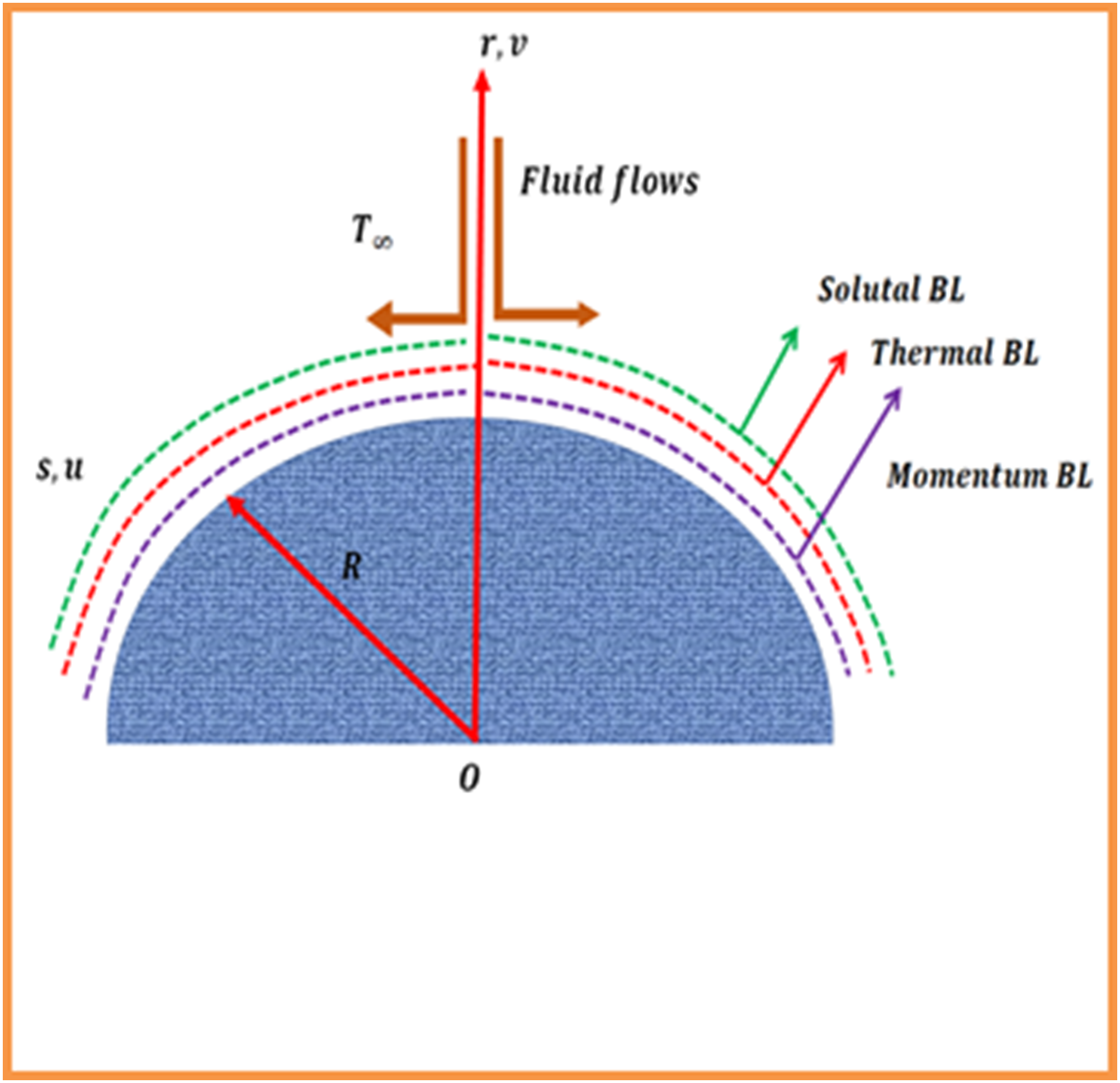
Isothermal cubic autocatalytic reactions satisfy46–49

First-order chemical reaction is given as

Under above assumption, the governing equation becomes50–52


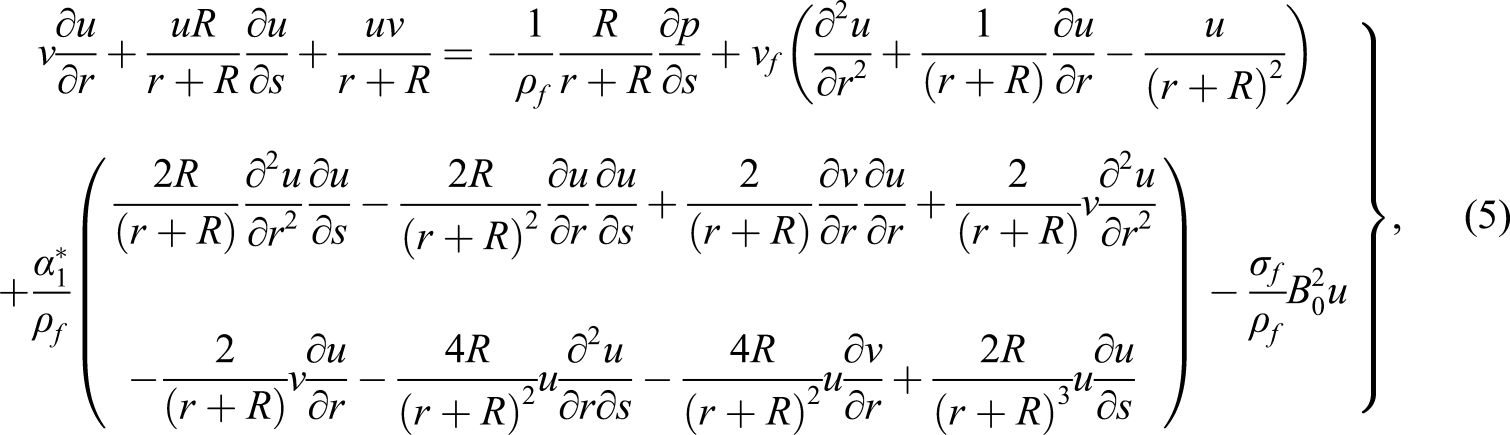
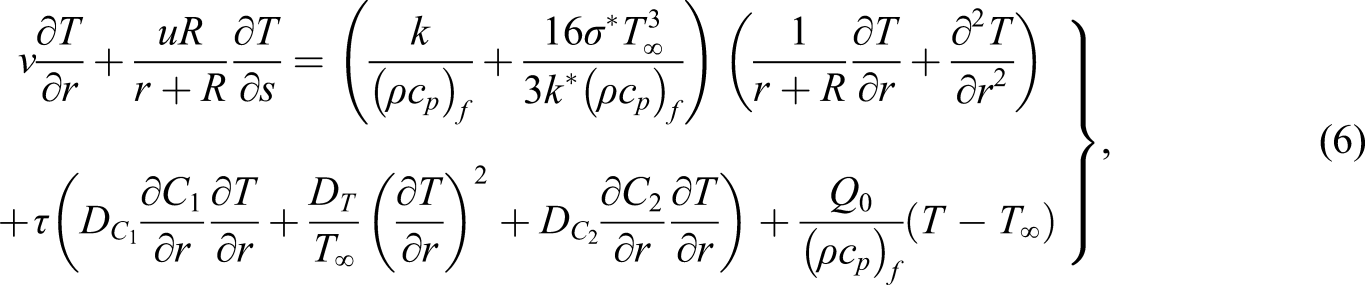


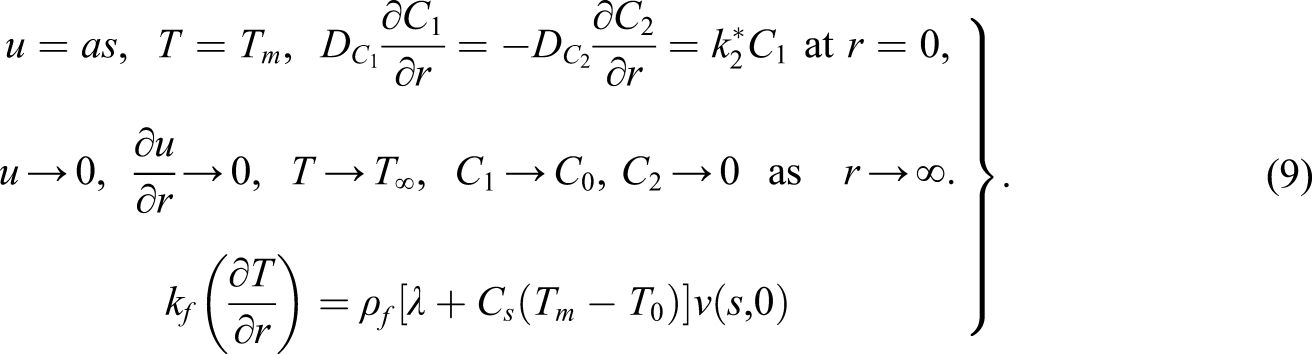
By using







In above expression, the dimensionless parameters are
By neglecting the pressure we get
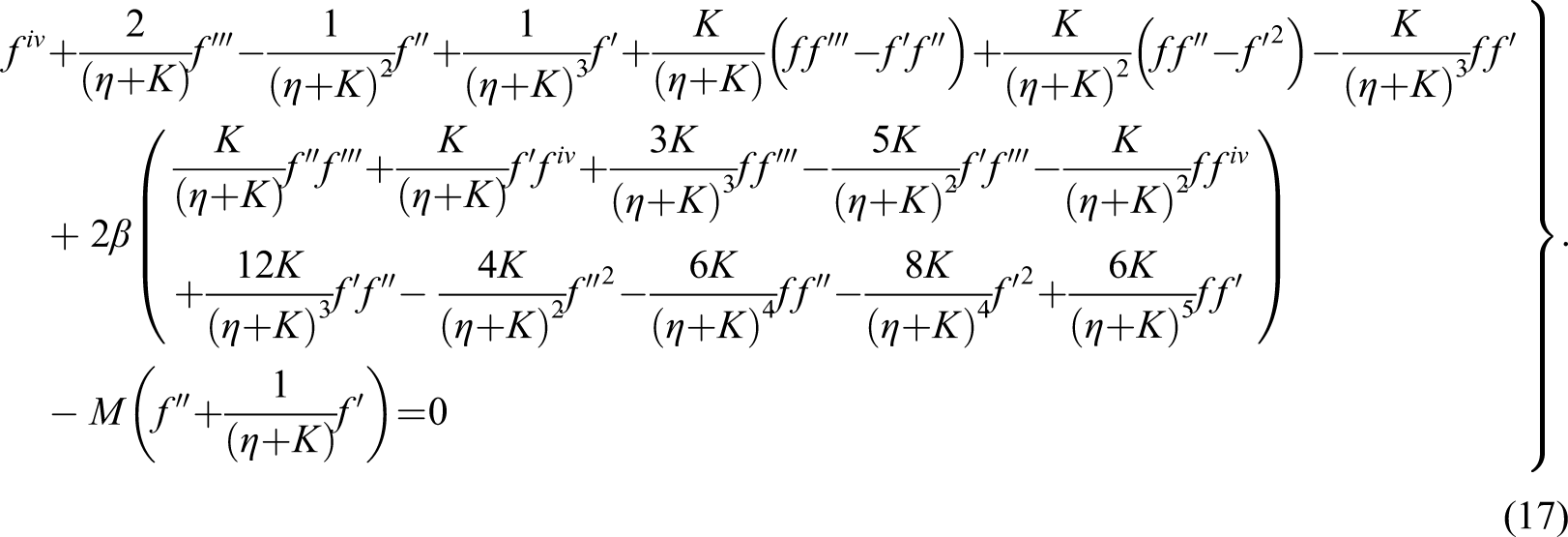
Consider we have



Physical quantities
Skin friction coefficient
Mathematically


One can found

Heat transfer rate
It is expressed as

Here

We get

Entropy modeling
It is expressed as

One can write

Here dimensionless variables are
Solution methodology
Optimal homotopic analysis method (OHAM) is employed to develop convergent solution.46,47 Here, linear operators and initial approximation are defined as
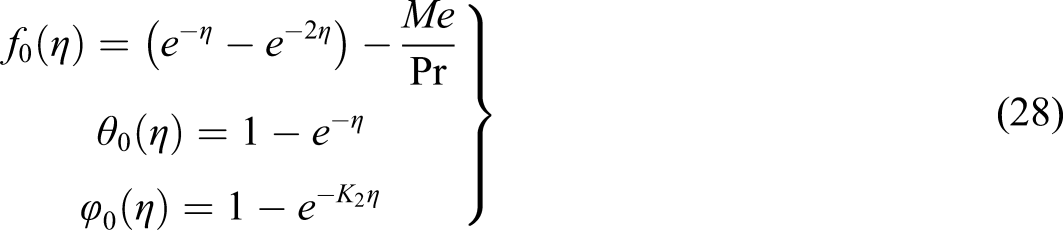
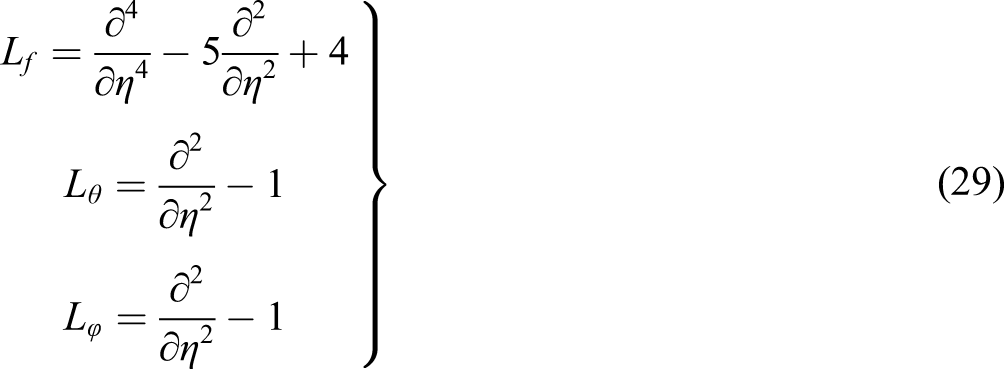

Here,
Convergence Analysis
Initially, Liao 46,47 gives the concept of optimal homotopic analysis technique. Mathematically it is expressed as



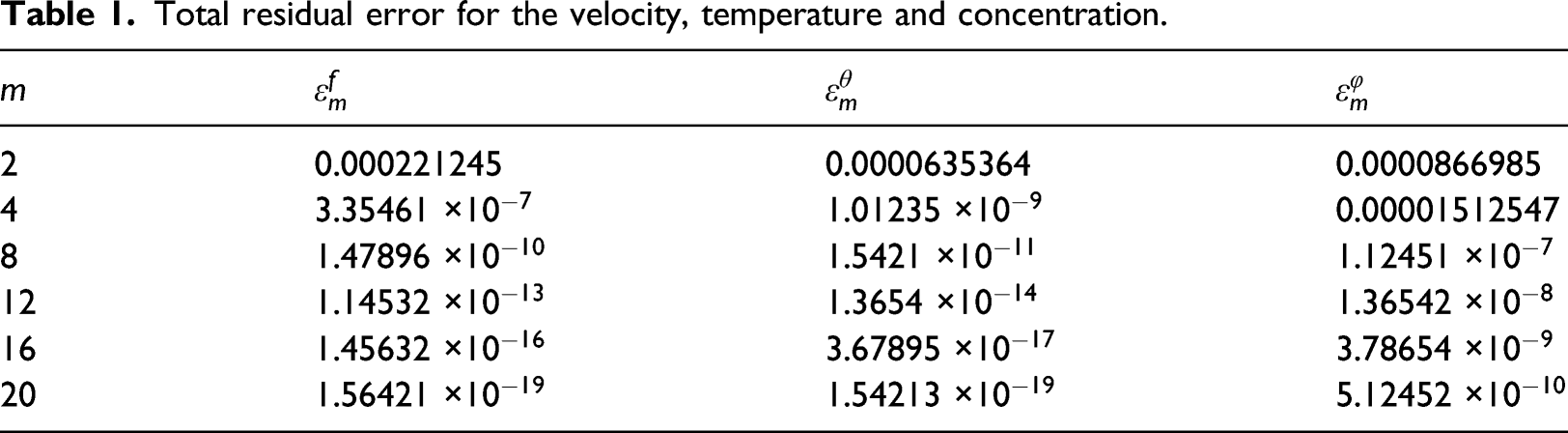
Total squared residual error is 46,47

Figure 2 shows the total averaged squared residual error. Total residual error.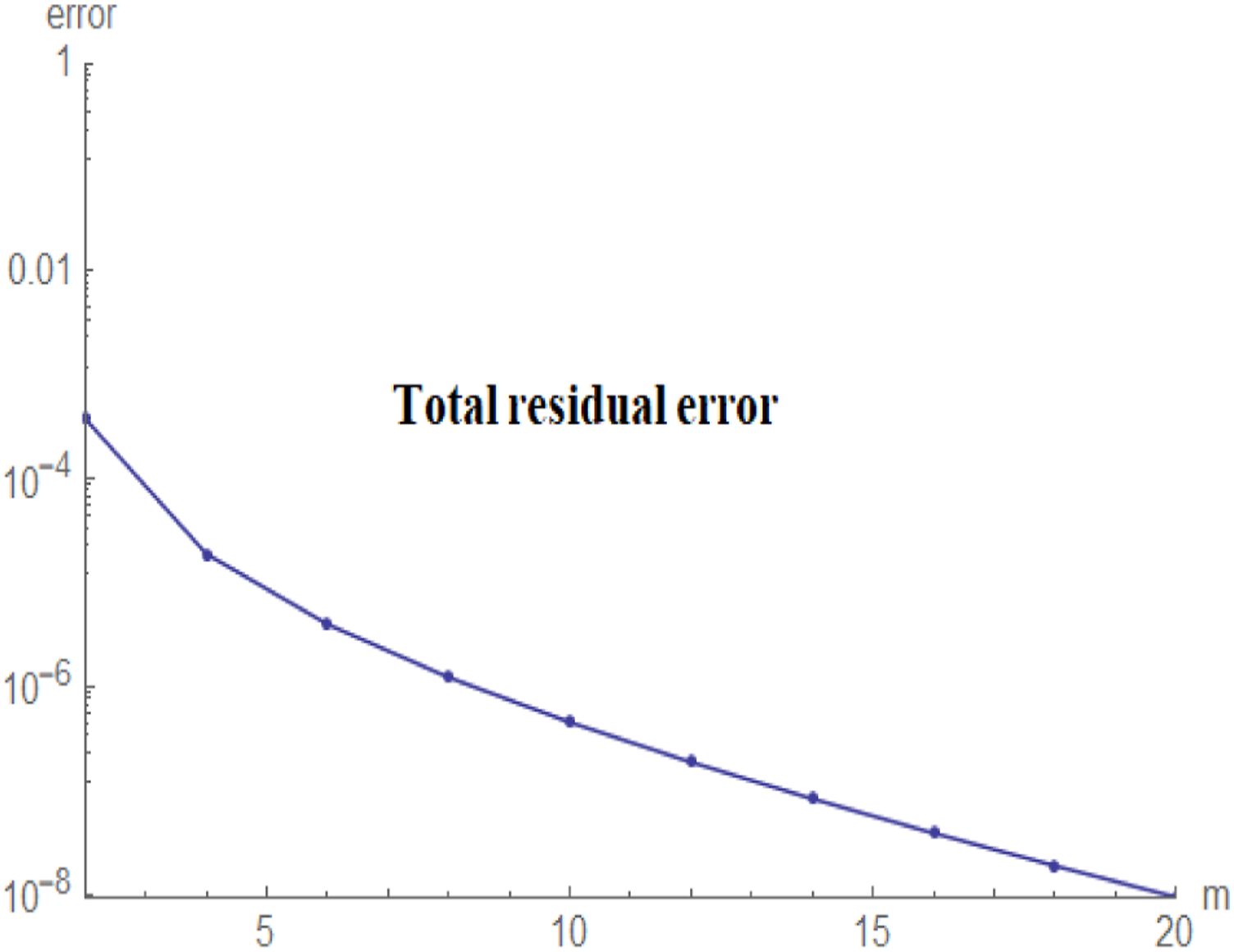
Total residual error for the velocity, temperature and concentration.
Graphical results and analysis
Significant performance of fluid flow, entropy rate, thermal field, and concentration against physical variable are studied.
Velocity
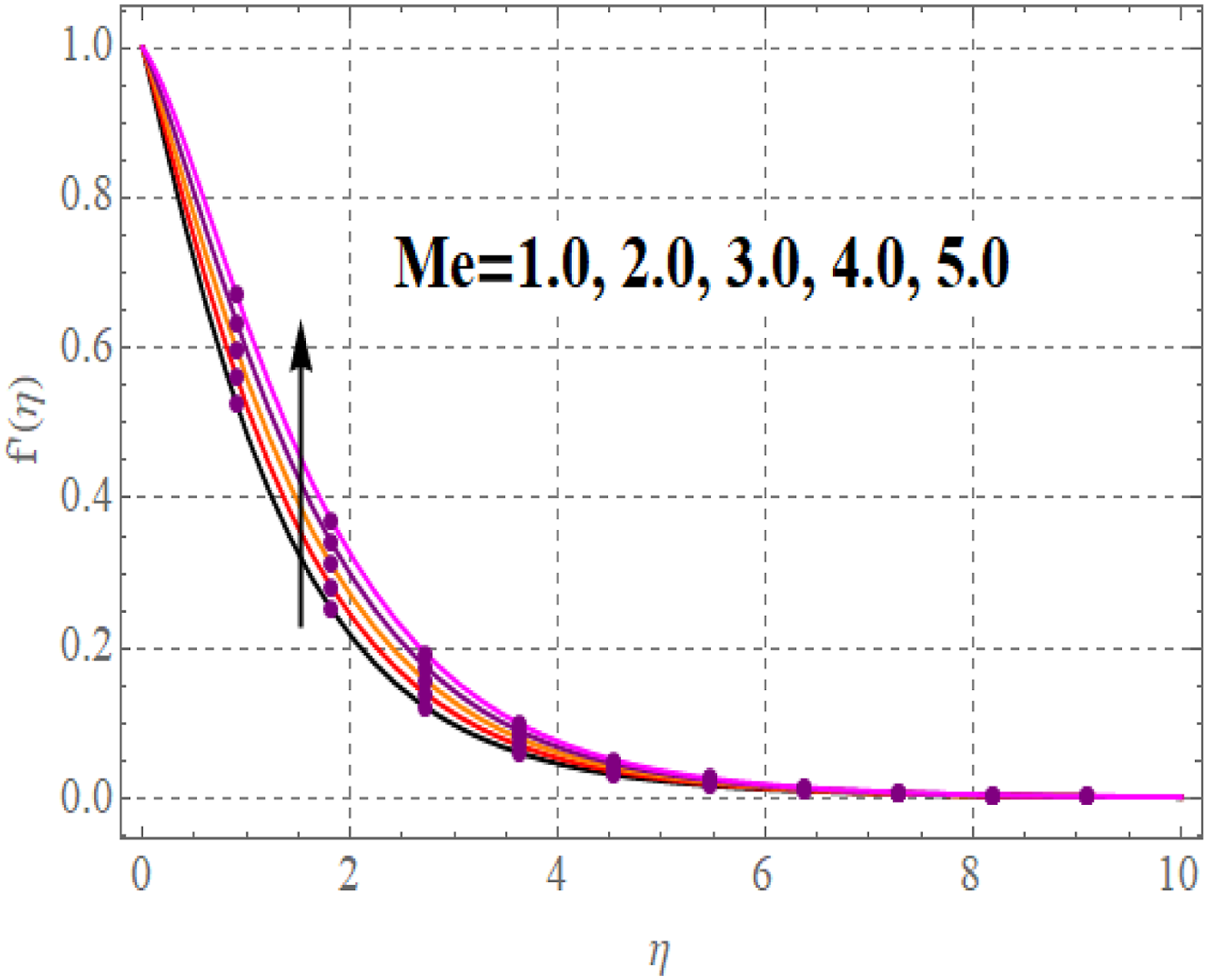
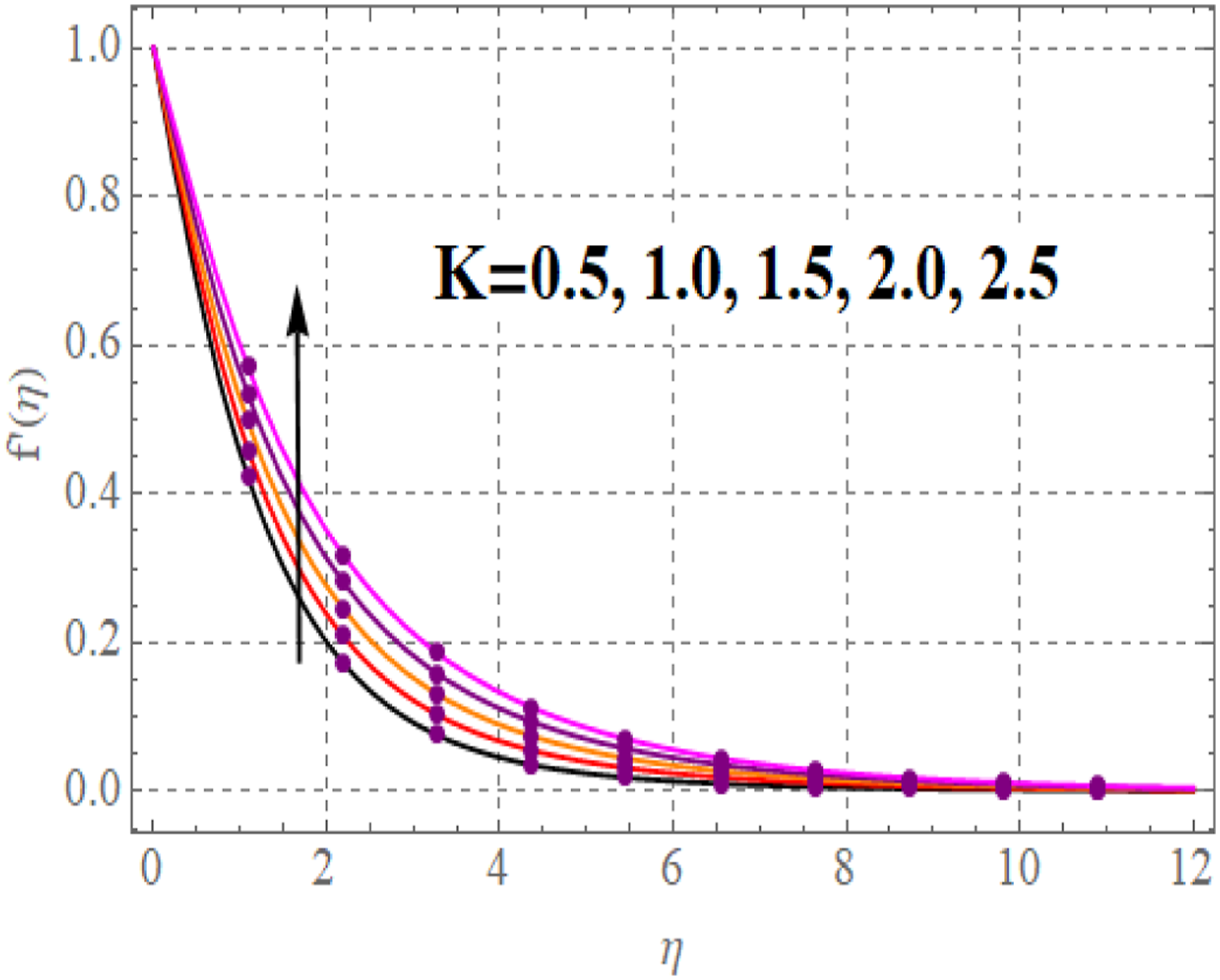
Performance of fluid flow against magnetic variable is portrayed in Figure 3. An amplification in magnetic effect improves the resistive force which reduced the fluid flow. Influence of melting effect on velocity 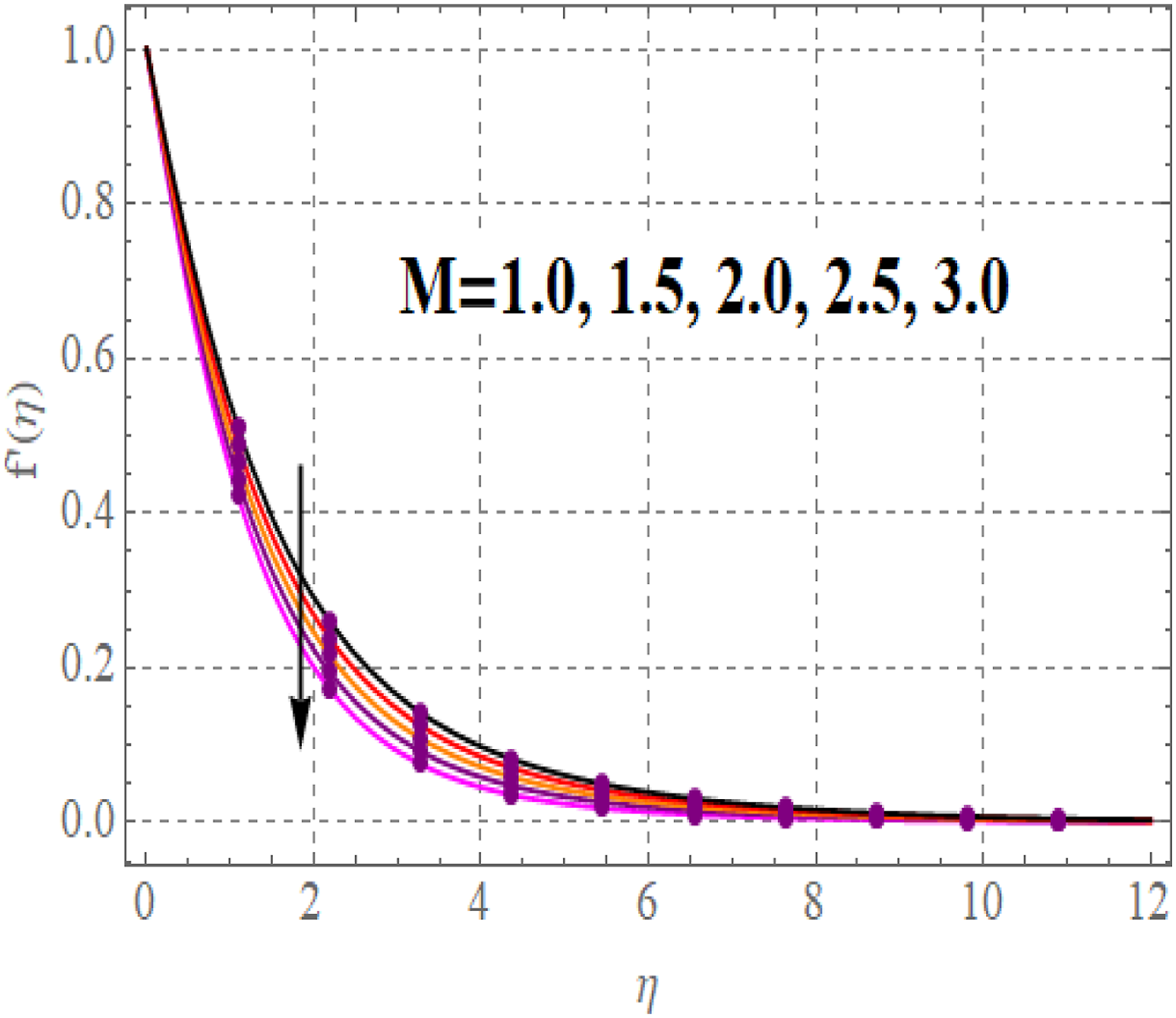
Temperature
Influence of thermal field via melting variable is depicted in Figure 6. Larger approximation in melting 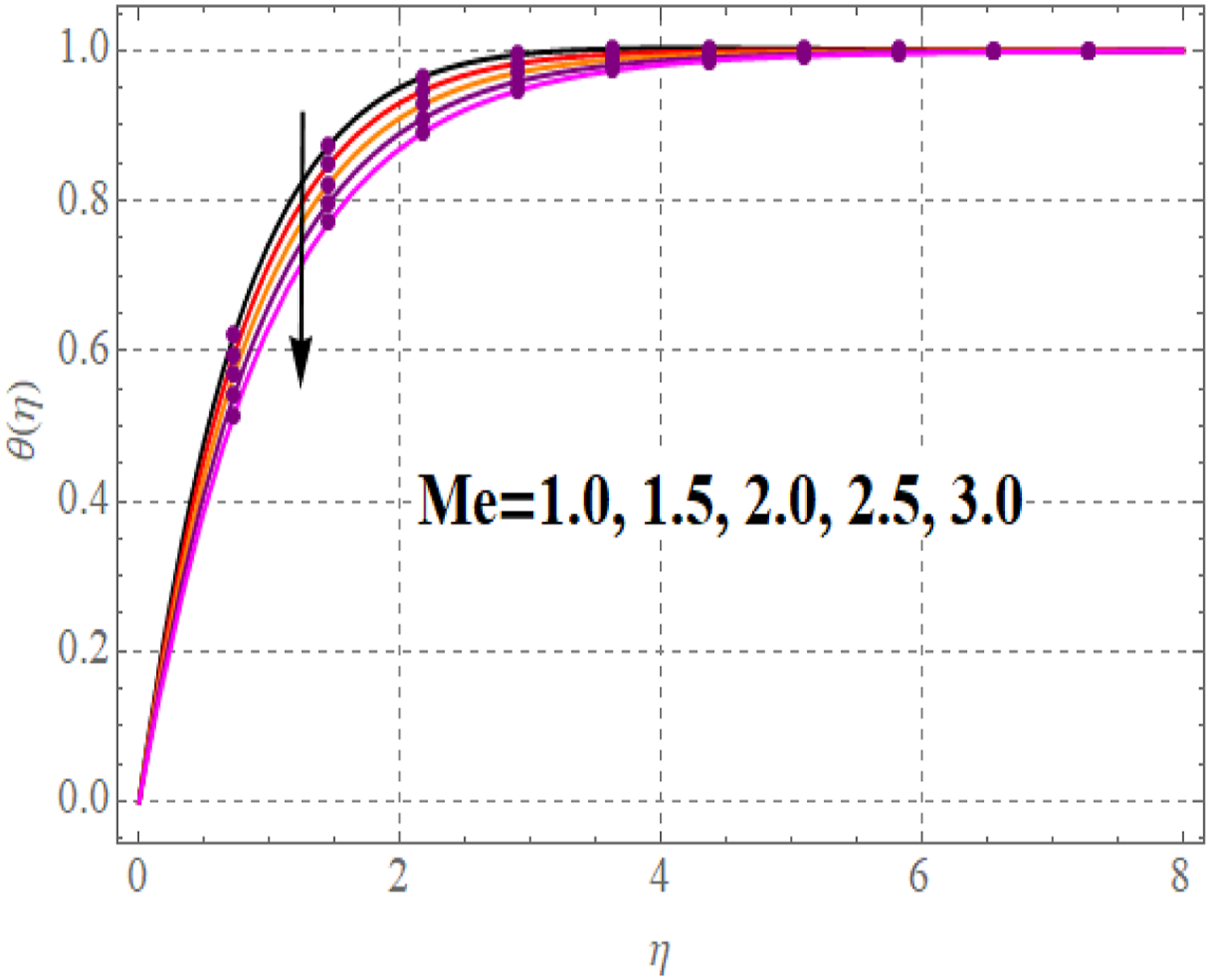
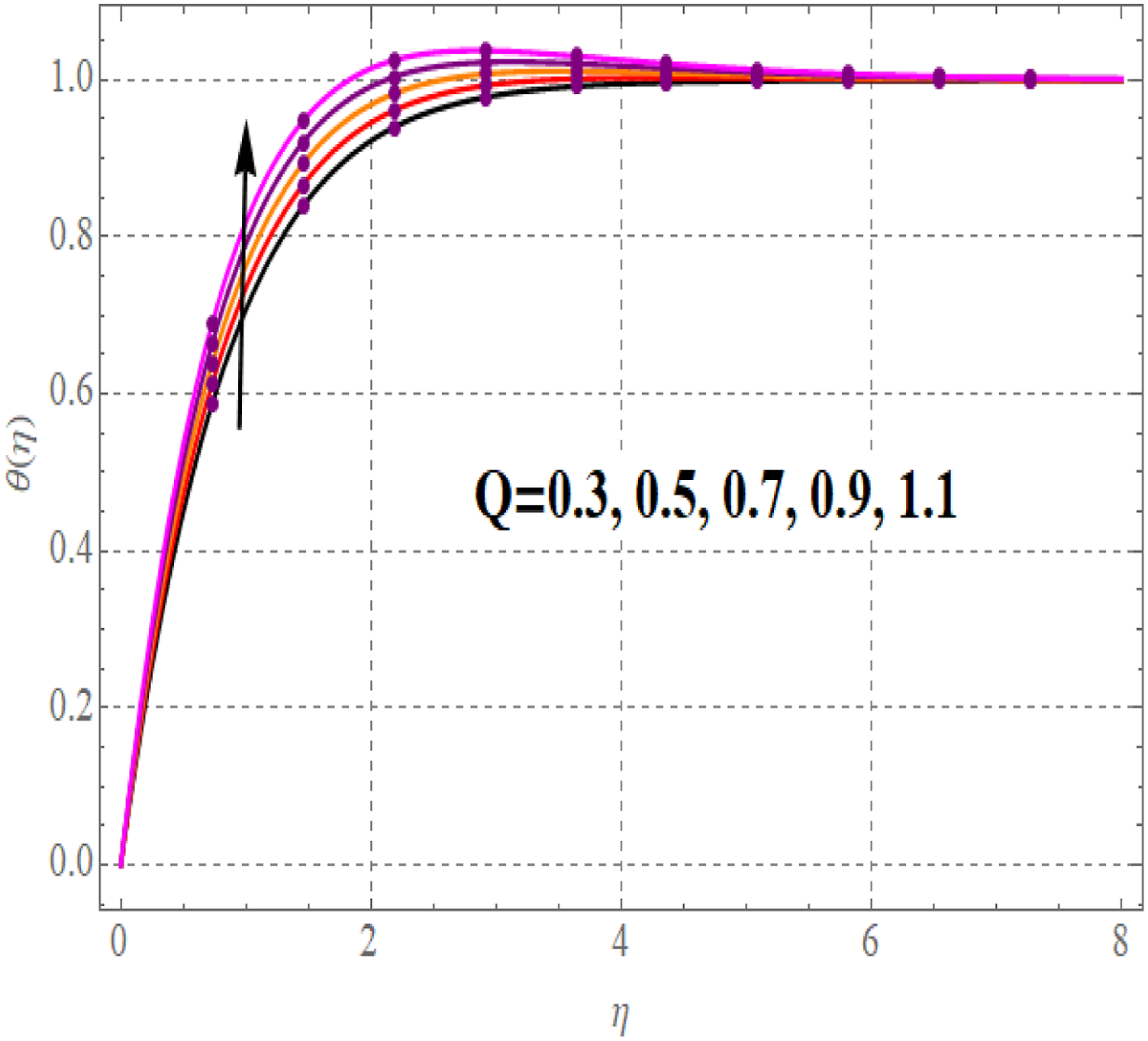
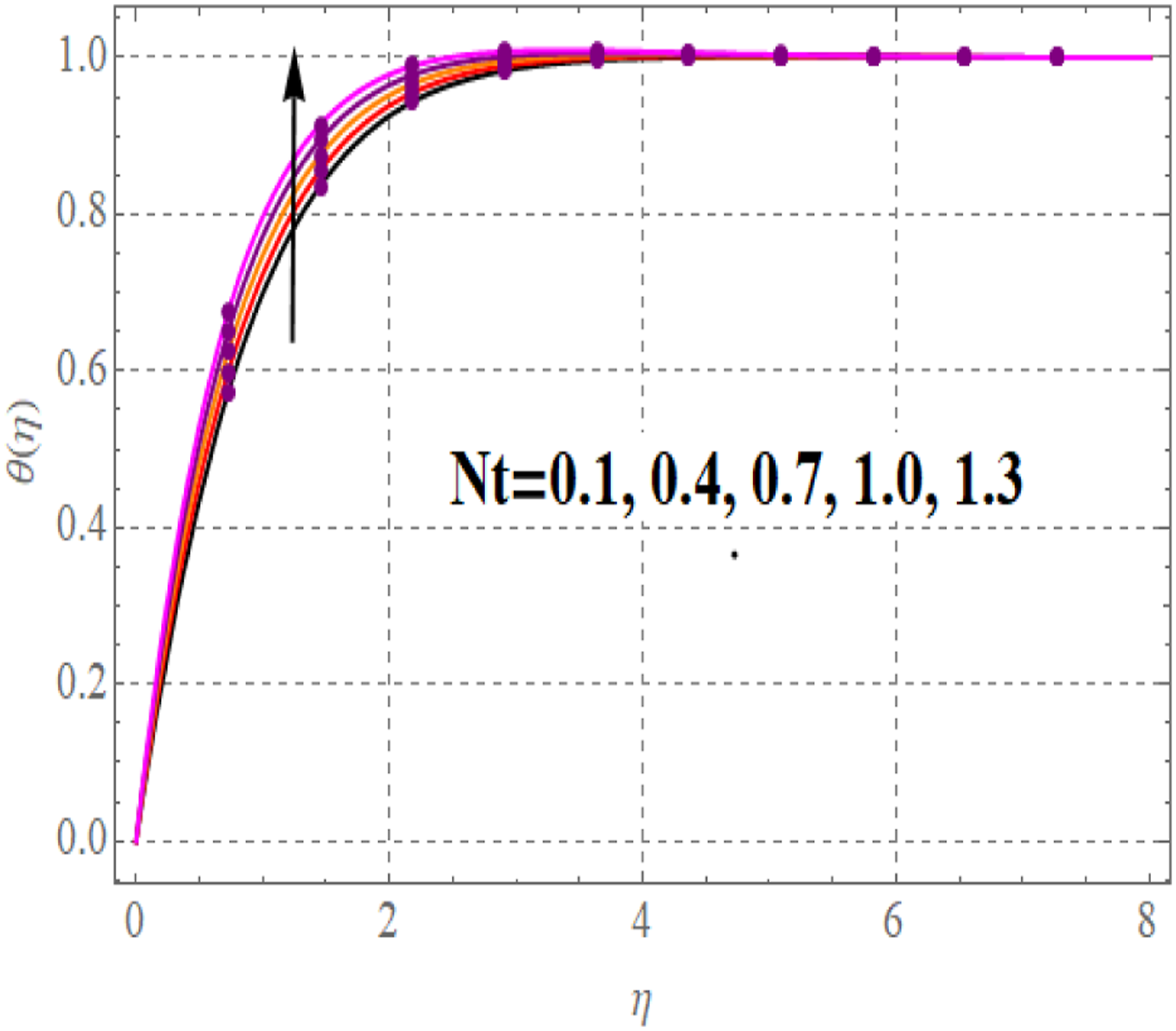
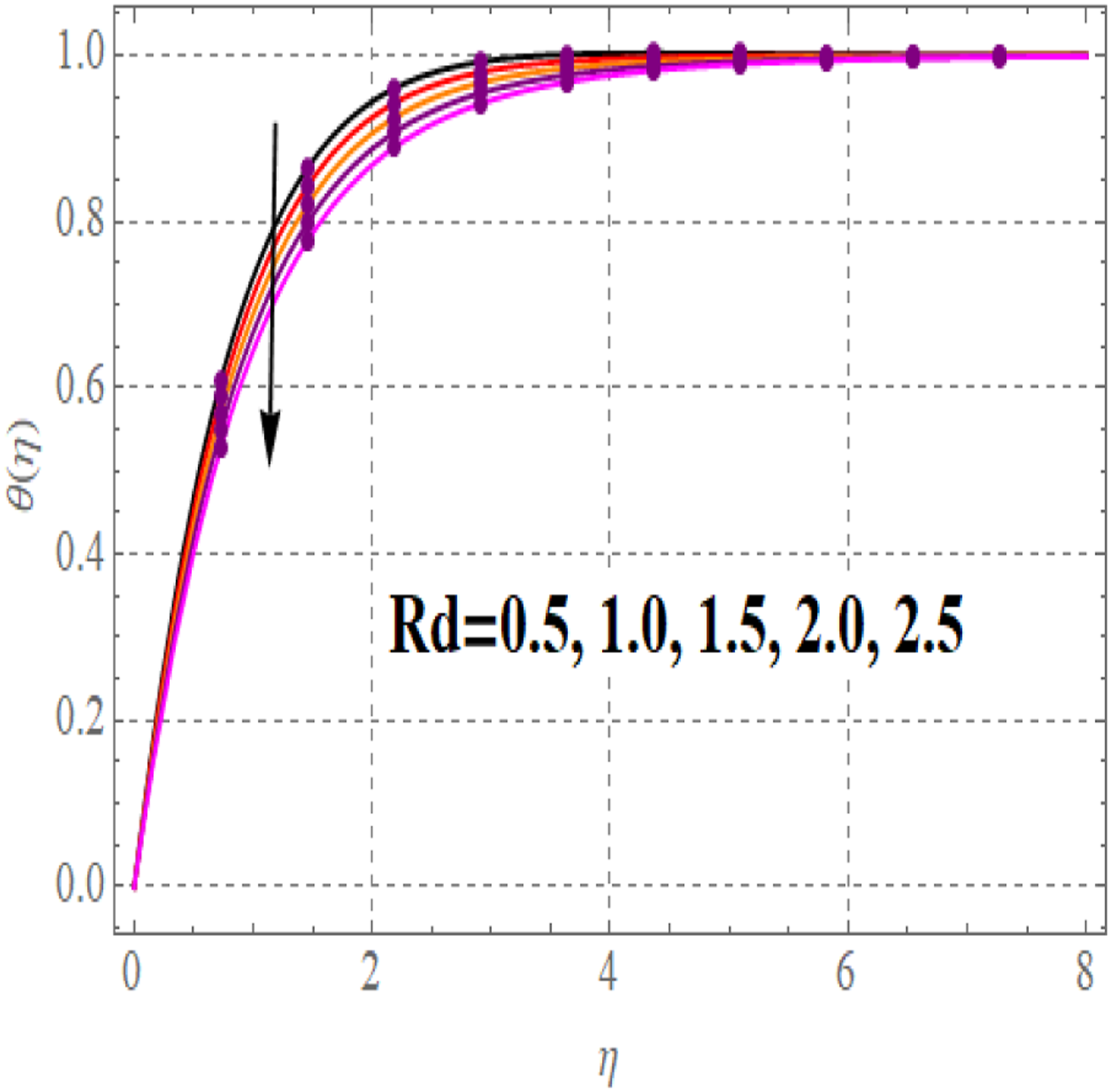
Concentration
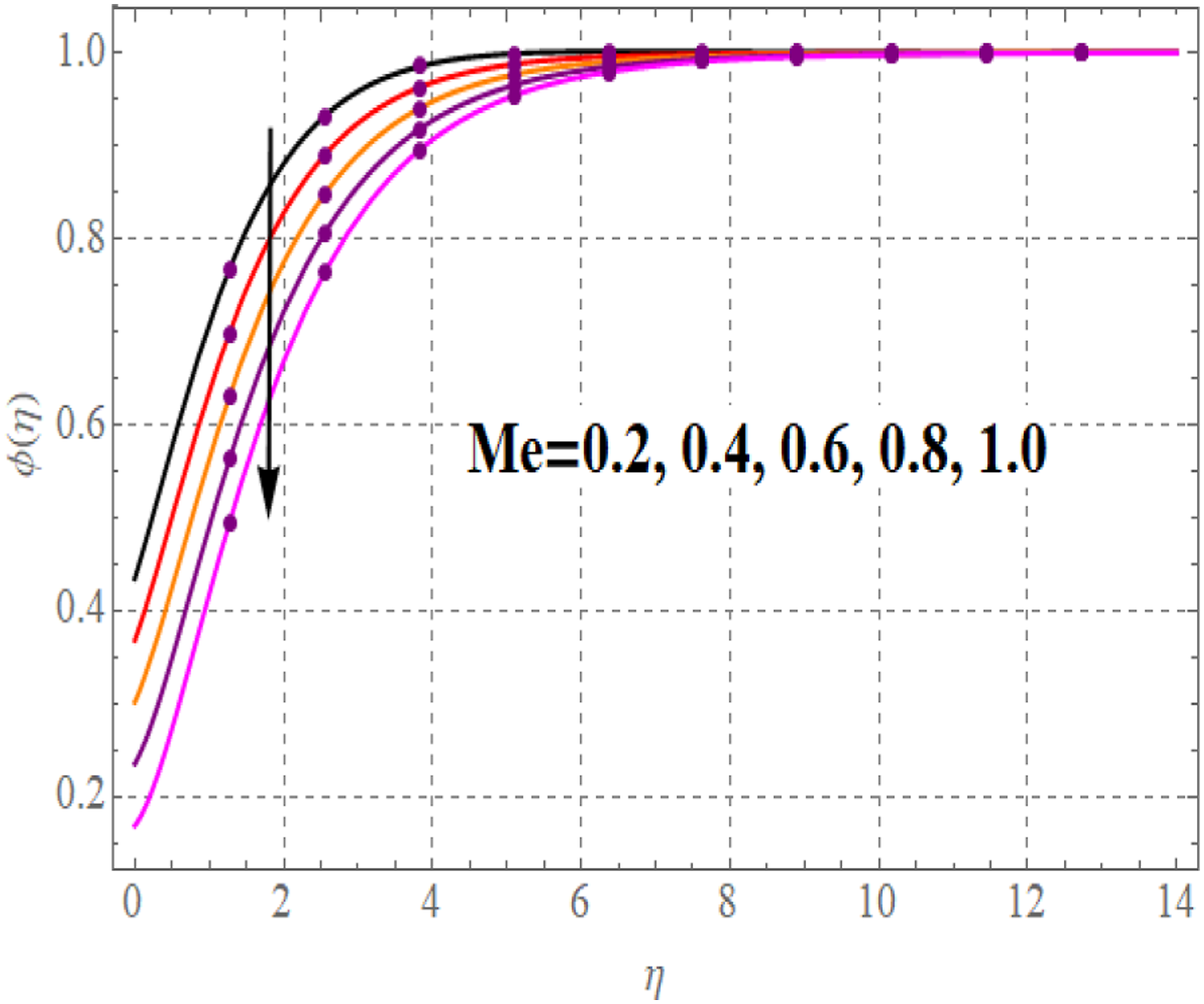
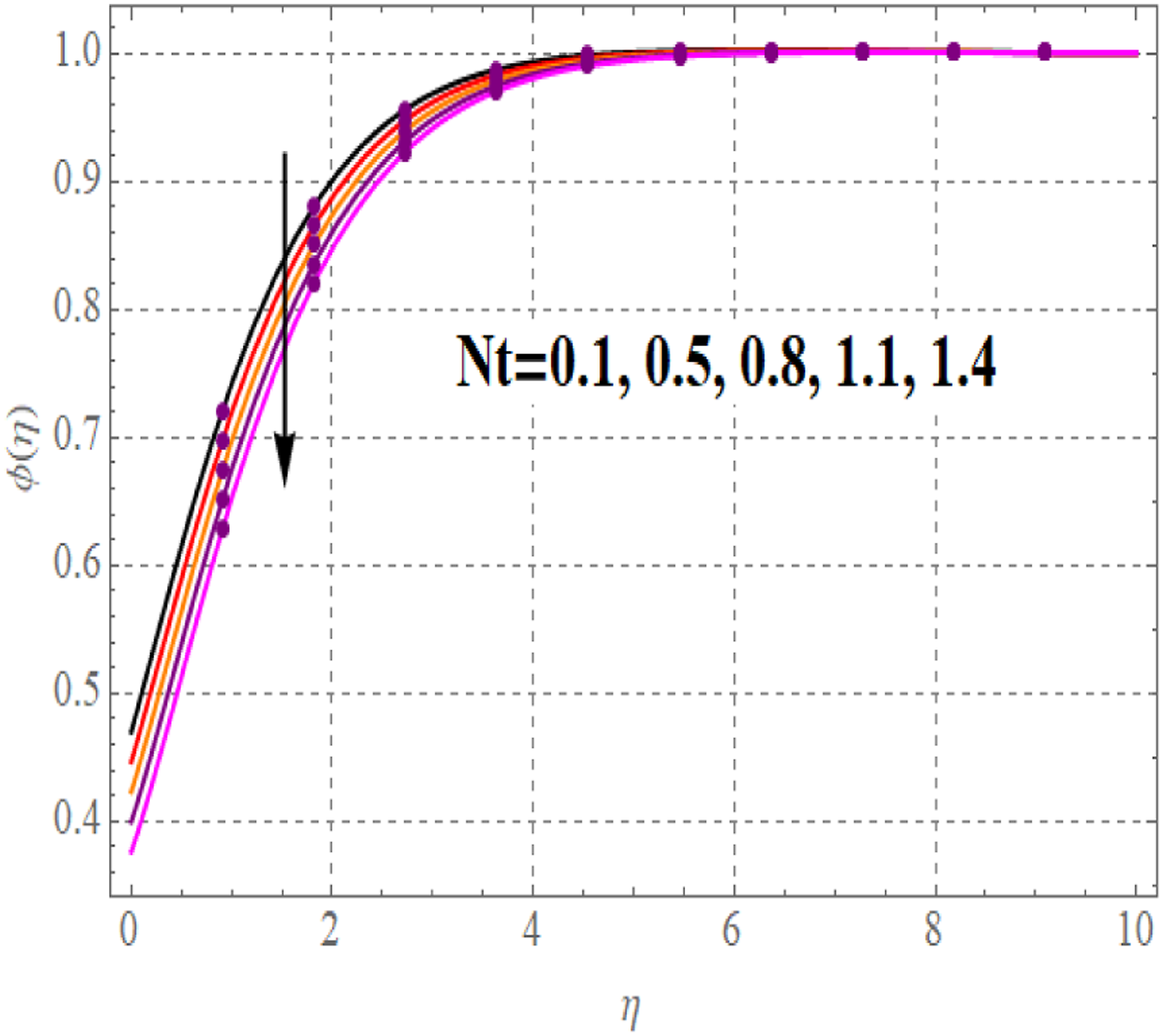
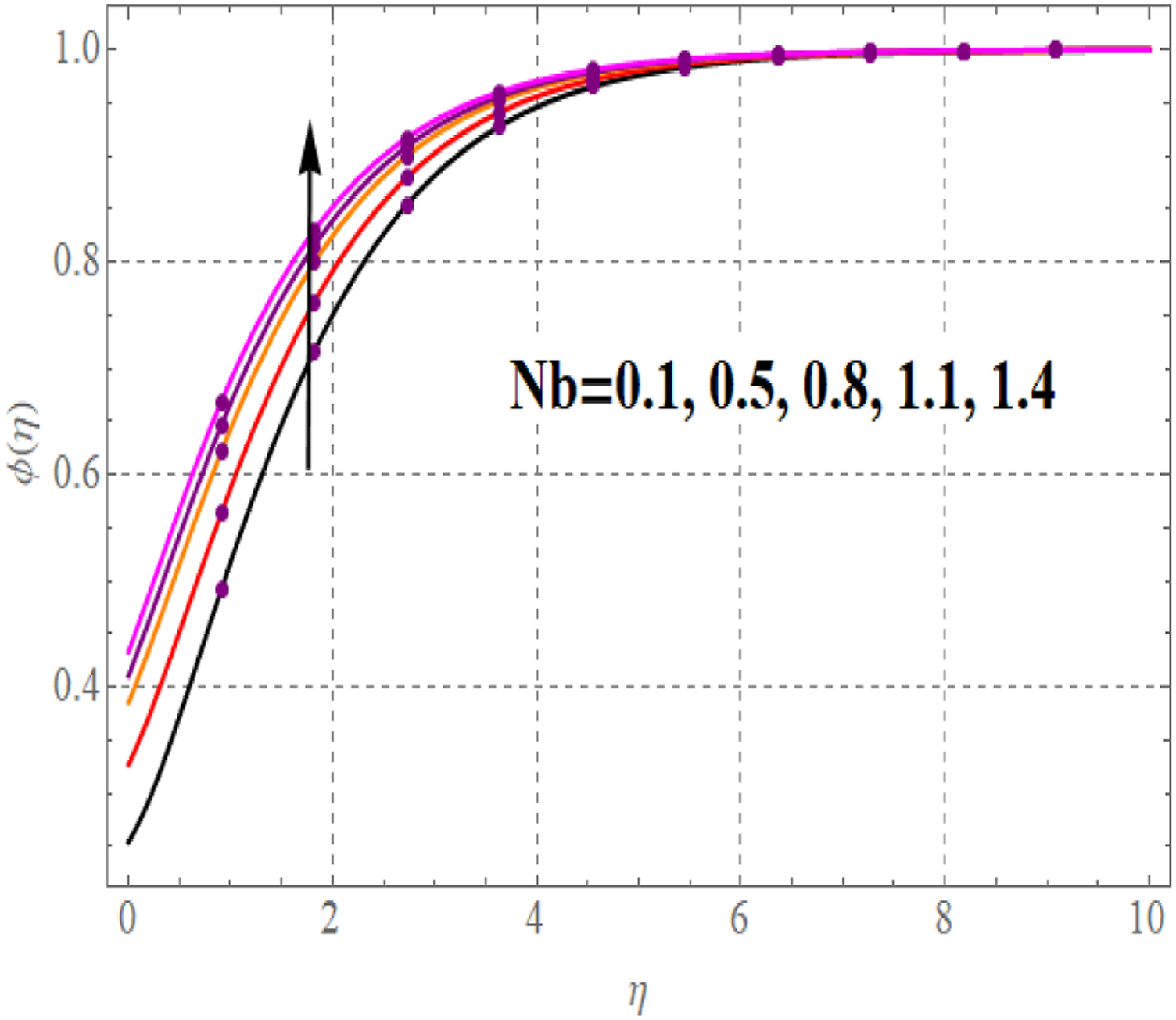
Outcome of concentration with higher Schmidt number is depicted in Figure 10. A decrement in mass diffusivity is noticed with rising Schmidt number, which decreases concentration. Reduction occurs in concentration with variation in melting variable (see Figure 11). Influence of random and thermophoretic motion variables on concentration is revealed in Figures 12 and 13. Clearly reverse trend holds for concentration through thermophoretic and random motion variables.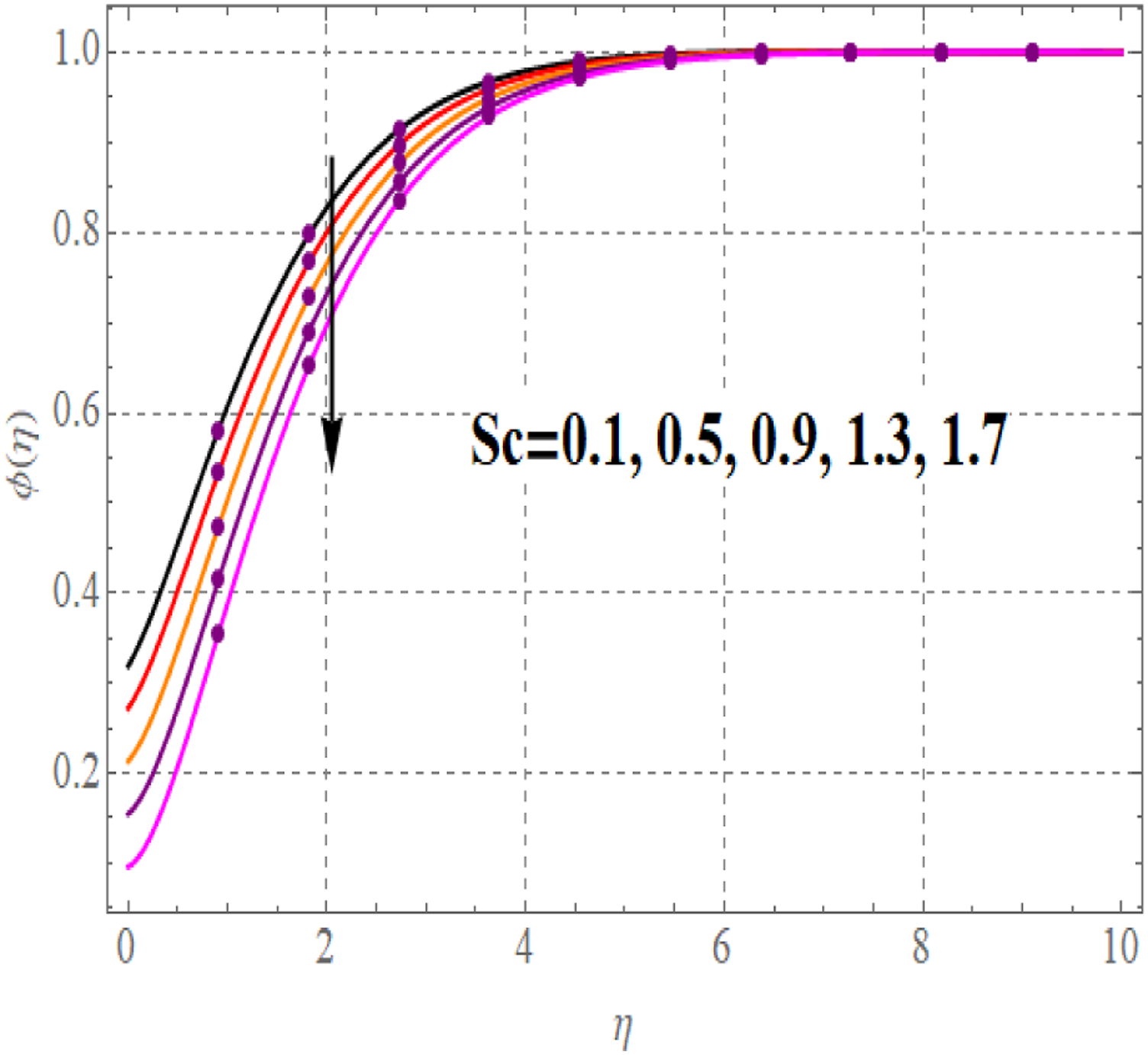
Entropy rate
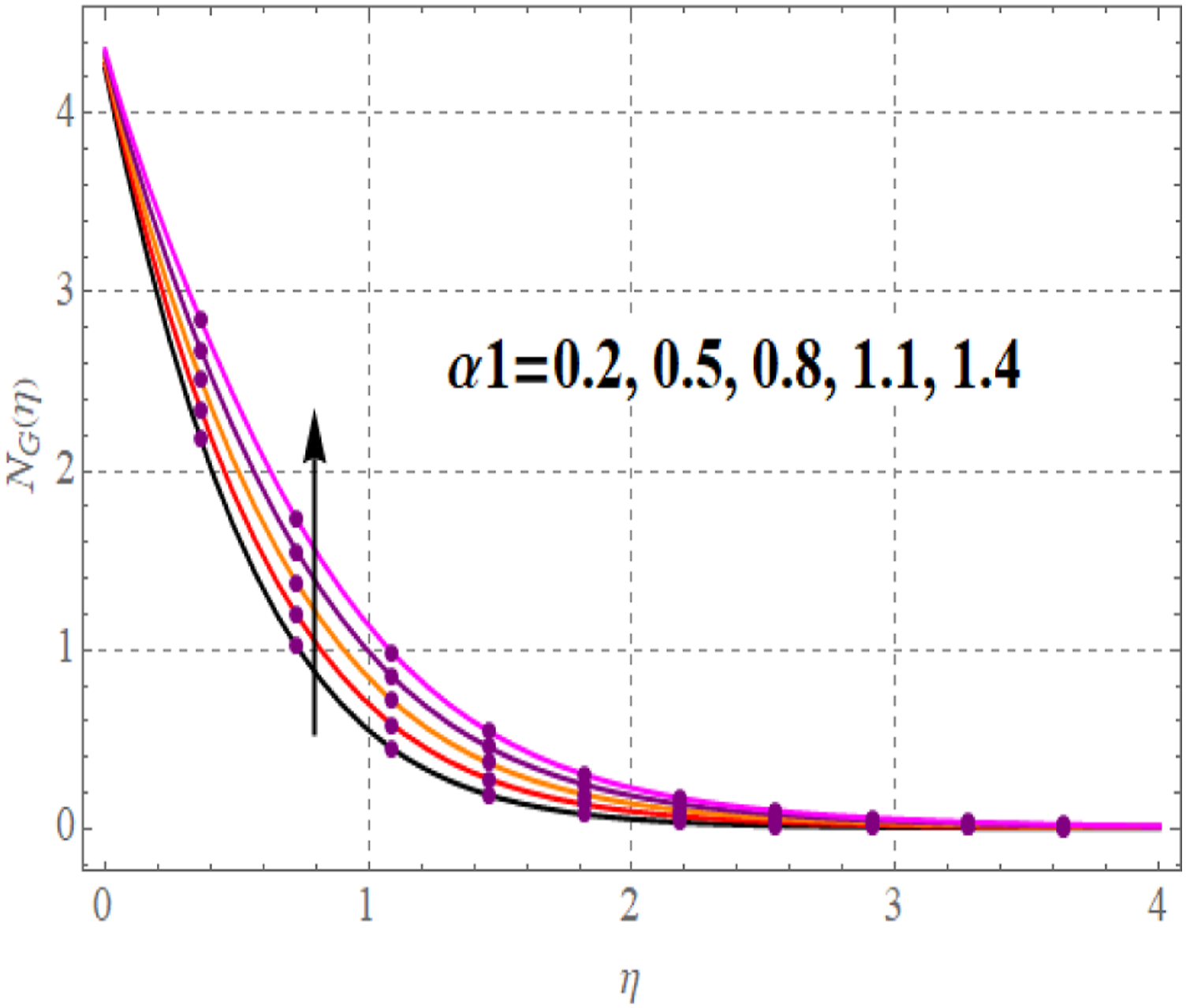
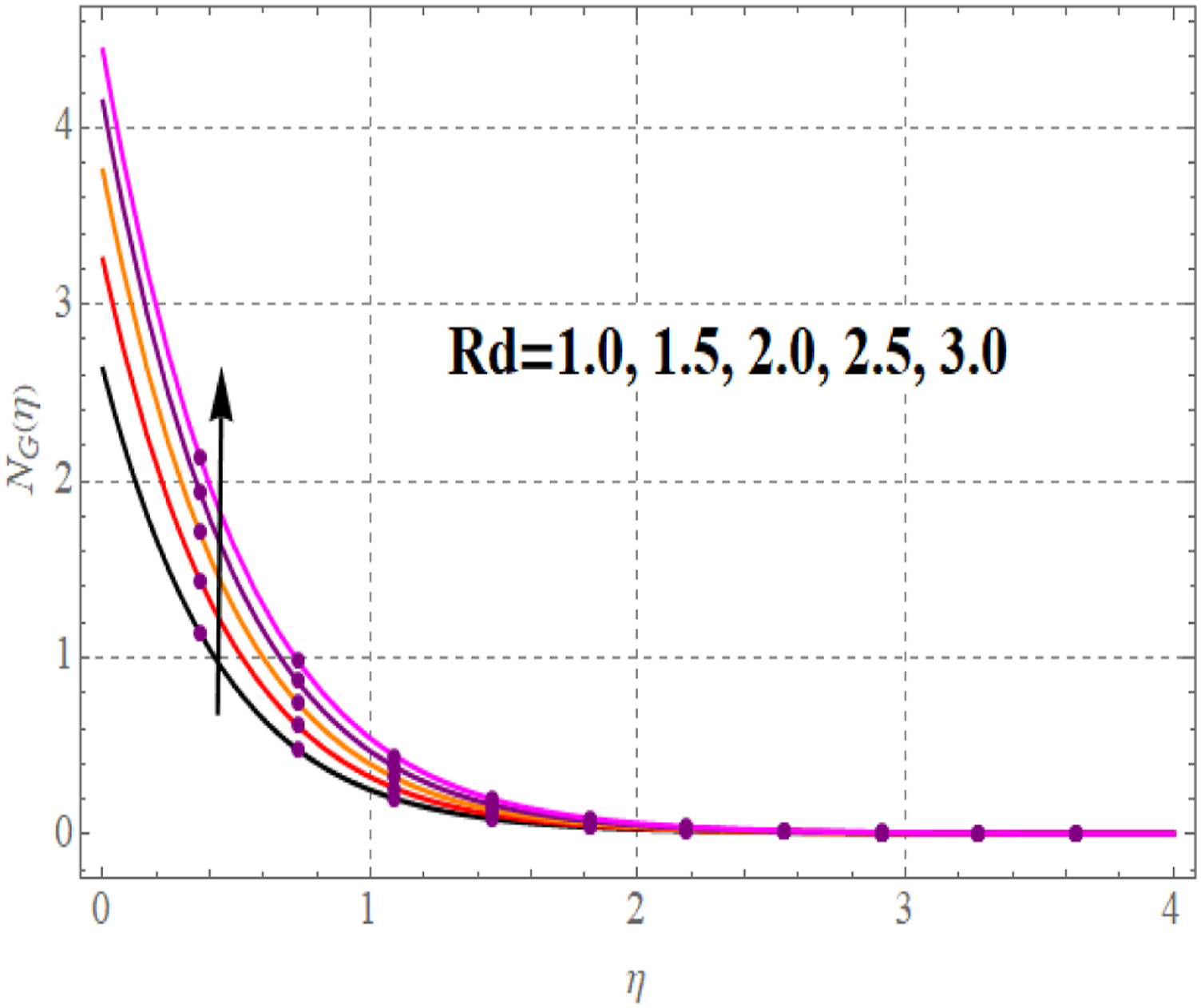
Figure 14 elucidates influence of entropy rate against magnetic variable. An intensification in magnetic effect improves the resistive force between liquid particles, which enhances the disorderness in thermal system. As a result, entropy rate boosted. An increment in thermal ratio variable 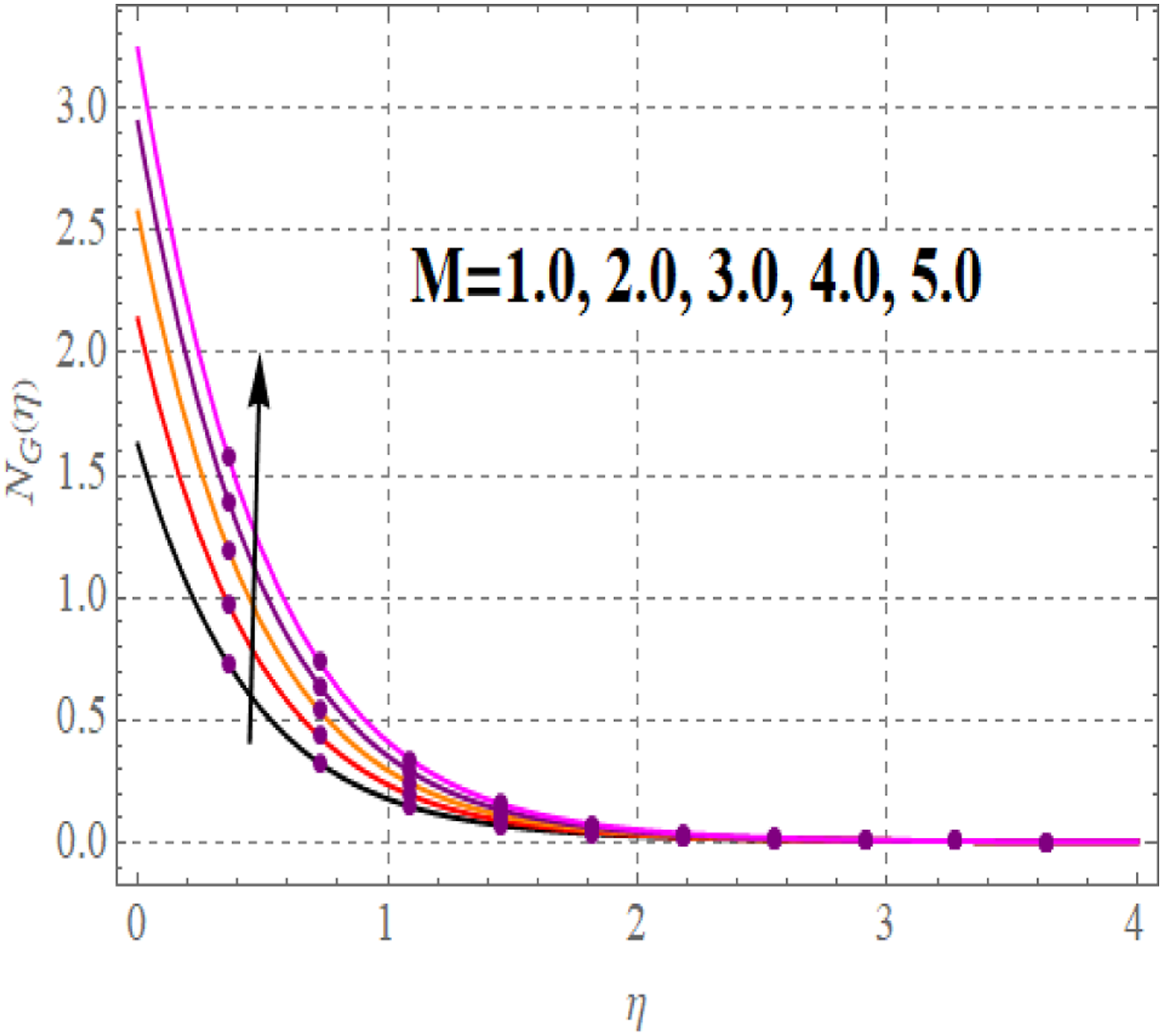
Conclusions
The key findings are given below. • An amplification in fluid flow is observed through curvature variable, while opposite impact holds for magnetic variable. • An opposite behavior holds for fluid flow and thermal field through melting variable. • Thermal field increased with variation in heat generation variable. • Larger estimation of radiation boosts up entropy rate, while opposite impact holds for thermal field. • An opposite impact in concentration is noticed through random and thermophoretic variable. • A decrement in concentration is seen through Schmidt number. • An intensification in thermal field is seen through magnetic variable.
Footnotes
Acknowledgment
The Deanship of Scientific Research (DSR) at King Abdulaziz University (KAU), Jeddah, Saudi Arabia has funded this project under grant no (G: 328-130-1443).
Declaration of conflicting interests
The author(s) declared no potential conflicts of interest with respect to the research, authorship, and/or publication of this article.