




Abstract
The present study deals with the unsteady Walter’s-B fluid with hybrid fractional derivative namely constant proportional Caputo type with singular kernel. In this paper, we find new analytical solutions of a well-known problem of the fluid dynamics known as Stokes’ first problem. Using dimensional variables governing equations convert into dimensionless form. To solve the model analytically, one uses the Laplace transform approach. Analytical and numerical evaluations of the inverse Laplace transform have been conducted. The influence of several embedded flow properties, including the magnetic parameter, Grashof number, dimensionless time, Prandtl number, Schmidt number, and fractional parameter is analyzed graphically. More specifically, compared to the classical model, the fractional model provides a wider range of integral curves and better represents the flow behavior. The temperature and velocity of the fluid decrease with increasing fractional parameters during short intervals of time, but exhibit the reverse pattern over longer durations. Skin friction, the Sherwood number, and the Nusselt number are numerical quantities linked to engineering that are statistically computed and provided in tabular form.
Keywords
Introduction
Recent advancements have greatly expanded the understanding and modeling of non-Newtonian fluids, particularly viscoelastic fluids like Walter’s-B fluid. These fluids, characterized by their unique combination of elasticity and viscosity, are critical in various engineering and industrial applications. Researchers have extensively applied fractional calculus to capture the complex behavior of these fluids, using modern fractional derivative definitions to improve accuracy. Innovations in modeling techniques, such as the use of the constant proportional Caputo operator, have allowed for more precise simulations of heat and mass transfer under various conditions, including the presence of magnetic fields and oscillating boundaries. This study builds on these developments by investigating the transient behavior of Walter’s-B fluid with the constant proportional Caputo operator, offering new insights into the dynamics of viscoelastic fluid flow.
The method used to transfer thermal energy from one place to another is known as heat transfer. Each time there is a thermal change, heat transfer takes place; it can happen immediately, like in a saucepan, or gradually, similar to clay materials. Over time, heat transfers from a warmer to a colder state. Consequently, heated items cool to room temperature, and cold ones warm to room temperature. Continuous heat exchange keeps the same temperature across the whole system. There are three ways in which heat is carried: conduction, convection, and radiation. Convection is the process of heat moving through a fluid as a result of molecular movement.1–5
Researchers have lately been interested in viscoelastic fluids, a subtype of non-Newtonian fluids. Perhaps for this reason, researchers are using it in many branches of engineering and science, particularly the chemical industry. Viscoelastic fluids are characterized as having both elasticity and viscosity. Many academics and industry professionals are interested in Walter’s-B fluid model, a well-known viscoelastic model that is presented by Walter’s. 6 The flow behavior of many industrial liquids, such as paints, polymer solutions, and hydrocarbons, may be accurately predicted using the labeled fluid model. It is challenging to appropriately handle the governing equations of Walter’s-Bflow because they are substantially more nonlinear than those of Newtonian fluid flow. Additionally, the elastic properties and extensional behavior are considered in this model. The Walter’s-B fluid model has inspired several remarkable approaches which are mentioned in Ramzan et al., 7 Nisa et al., 8 and Javaherdeh et al. 9 But from all of this research, fundamental derivatives and traditional Walter’s-B fluid models are used. Prior to now, fractional models have been used in viscoelastic materials like glassy states and polymers. 10
Fractional calculus holds theintegration of functions and derivatives of non-integer order, and for this quality, the entire and generalized form of classical calculus is considered to be fractional calculus. Fractional calculus has an approximately 300-year history, but due to its abstract nature, it initially received little attention from academics and mathematicians. Fractional calculus is currently an important research field as a result of the shift over the last several decades from mathematics to various other areas. Nearly all fields of engineering, research, and industry have used fractional calculus, particularly the fractional derivative. 11 Abbas et al. 12 looked at the free convective non-Newtonian flows over flat, thermal surfaces as significant natural phenomenathat may also occur in many mechanical and physical situations during human-made engineering processes. The current study examines the mass and heat transfer associated with natural convection magnetohydrodynamic Jeffrey fluid flow across an infinite vertical plate. Abbas et al. 13 used the Prabhakar operator to study the heat and mass transmission of the Brinkman fluid down a vertical conduit. Abbas et al. 14 studied the biological convection flow of fractionalized second-grade liquid up a vertical conduit using Fourier and Fick’s equations Abbas et al. 15 used the CaputoFabrizio derivative approach to investigate the applicability of the transfer of heat and mass to Casson fluid with convection in a microchannel. According to Abbas et al., 16 a CPC operator was used to investigate the Soret impact on MHD Casson fluid across an accelerating plate. Concerning the heat and mass transmission mechanism in carbon nanotubes, Abbas et al. 17 looked into a CPC fractional model with slip effects on velocity. An analysis of fluid with fractional derivatives under active and passive control was covered by Al Agha et al. 18 According to Abbas et al., 19 a second-grade ternary nanofluid with a Caputo fractional derivative was seen flowing across a vertical infinite plate.
According to Hayat et al., 20 Laplace transform analysis was used to characterize the hydromagnetic oscillation flows of a second-grade spinning fluid surrounded by a permeable plate Siddheshwar and Mahabaleswar 21 explored the viscoelastic liquid of MHD fluid and heat transport in elastic sheets with radiation and heat source. Walter’s-B flow of heat transfer properties across an unfolding non-isothermal sheet were analyzed by Ghasemi et al. 22 Prakash et al. 23 examined the heat transfer properties of MHD flow over a porous material of dirty viscoelastic fluid taking into consideration the variable viscosity.
The rheological equation for viscoelastic fluids was classically modeled by Ali et al. 24 The viscoelastic fluid model is the most effective at explaining the intricate flow behavior of many including paints, hydrocarbons, and resin solutions. Navier-Stokes (NS) equations for Newtonian fluid flow, the Walter’s-B model creates extremely non-linear equations that are difficult to control. This model also introduces the extensional behavior of polymers as well as their elastic characteristics. 25 Qaiser et al. 26 numerically studied mixed convection flow of a Walters-B nanofluid over a stretching surface with Newtonian heating and mass transfer. Singh et al. 27 examined Walters’-B fluid hydromagnetic natural convection flow over a vertical surface with surface characteristics that changed over time. Mahat et al. 28 looked at the relationship between thermal radiation and viscous Walters’-B nanofluid flowin a cylinder with a circle under convection and continuous heat flux. Because of the way that heat and mass transfer cause porosity to stretch and contract, Anusha et al. 29 looked at how Navier slip affected the thermal Walter’s-B fluid. Many industrial processes involve the transfer of heat fluid. The transfer heat characteristics of Walte’s-Bflow over a vertical plate can be directly applicable to the design and optimization of heat exchangers used in industries such as chemical processing, power generation, HVAC (heating, ventilation, and air conditioning), and food processing.
Anupama et al. 30 looked into the impacts of heat and mass transmission by two non-Newtonian fluids (hyperbolic tangent and Walters B fluids) into the boundary layer through an upward-facing, semi-infinite porous plate. Saini et al. 31 provided a computational study of the interplay between mixed convective, porous media, and Newtonian heating processes when Walter’s B fluid flow is electrically conducted via a nonlinear permeable stretched sheet. Ayegbusi et al. 32 investigated the dynamics of micropolar – water B fluids flow simultaneously under the influence of heat radiation and Soret-Dufour processes.
The discussed literature reveals several research gaps in the field of Walter’s-B fluid studies. Notably, the fractional behavior of mathematical models has not been solved before. Furthermore, there is a lack of studies on fractional models that incorporate fractional derivatives, concentration, and magnetic effects. This gap highlights the need for comprehensive research to better understand the complex dynamics and interactions in Walter’s-B fluid under these conditions.
Inspired by previous research, this study investigates Walters-B fluid with a Caputo-Fabrizio operator under Newtonian heating in the presence of a transverse magnetic field along an oscillating vertical plate. Extending the concept of Abdullah et al., 33 the Walters-B fluid model is formulated using constant proportional Caputo fractional derivatives. The classical model is transformed into a dimensionless form and further into a fractional model using modern fractional derivative definitions. Analytical solutions to the governing equations are obtained via the Laplace transform method, satisfying all initial and boundary conditions. Verified results are achieved through Stehfest’s and Tzou’s numerical methods for inverse Laplace. The study examines the effects of various parameters, including the order of constant proportional, mass, Caputo fractional order, Grashof numbers, Prandtl parameter, and magnetic number using Mathcad software.
Novelties:
Introduction of a novel CPC fractional derivative model for Walters-B fluid flow, enhanced with a power law kernel.
Analytical solutions using the Laplace transform method for accurate fluid behavior representation.
Comprehensive parametric analysis linking theoretical findings with practical engineering applications, such as skin friction, Sherwood number, and Nusselt number calculations.
Formulation of problem
Assumptions of the present Walter’s-B fluid model:
The flow has one dimension and is unidirectional.
The heat dissipation is ignored.
The flow is incompressible.
Plate is considered of infinite length.
Non-Newtonian and free convective flow
Strong magnetic field
The MHD convectional free flow of a Walter’s-B liquid moving over a vertical plate is described as incompressible and unstable in the problem description. The plate is parallel to the x*-axis, whereas the y*-axis is perpendicular to it. The liquids and plate initially stay stationary at a constant concentration

Flow geometry.


subject to IBCs 34


using variables that are not dimensional 34

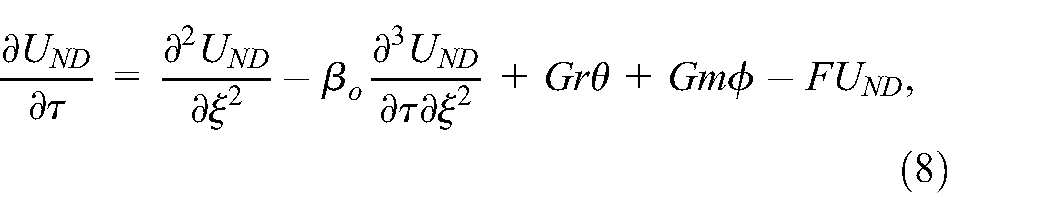
Using equation (7), we obtain the dimensionless equations and conditions


where the unit step function =
Solution of fractional model
Fractional thermal diffusion
Thermal balance equation

using Fourier’s law 36

Equation (14), with equation (15) substituted, and the dimensionless connection from equation (7) are obtained

Equation (16) solved by applying the Laplace transform technique

Equation (17) solution subject to condition

The energy solution for equation (17) is written in the form:

Equation (19) is the temperature solution that satisfies the necessary boundary constraints in equation (18)

In suitable form

Inverting Laplace transform on above equation, we get

Fractional concentration
The equation of concentration is

using Fick’s law 37

Substituting equation (24) in equation (23), and using dimensionless relation from equation (7), we get

Applying Laplace transform on above equation, we get

Satisfy

The mass solution for equation (26) is written in the form:
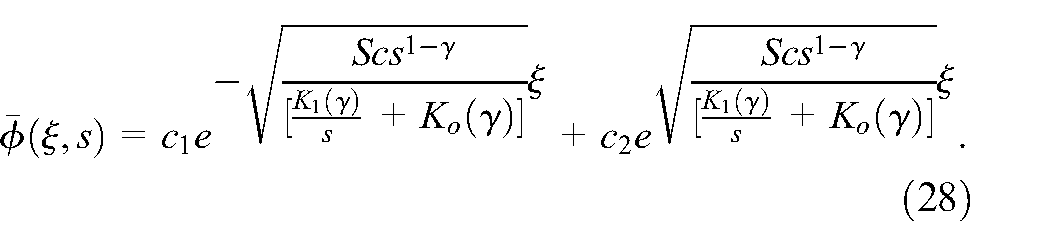
This expression represents the concentration solution of equation (28) that satisfies the boundary conditions of equation (27)

In suitable form

Taking inverse Laplace transform on both sides

Fractional velocity
Momentum equation Walter’s-B fluid containing the concentration and temperature term is given

where

Using dimensionless relation given equation (7) in equation (32), we have

Taking Laplace transform on above equation, we get

Solution of equation (35) subject to condition

The solution for the velocity fractional differential equation (35), together with

This expression provides the velocity solution of equation (37) that satisfies the boundary conditions of equation (36)
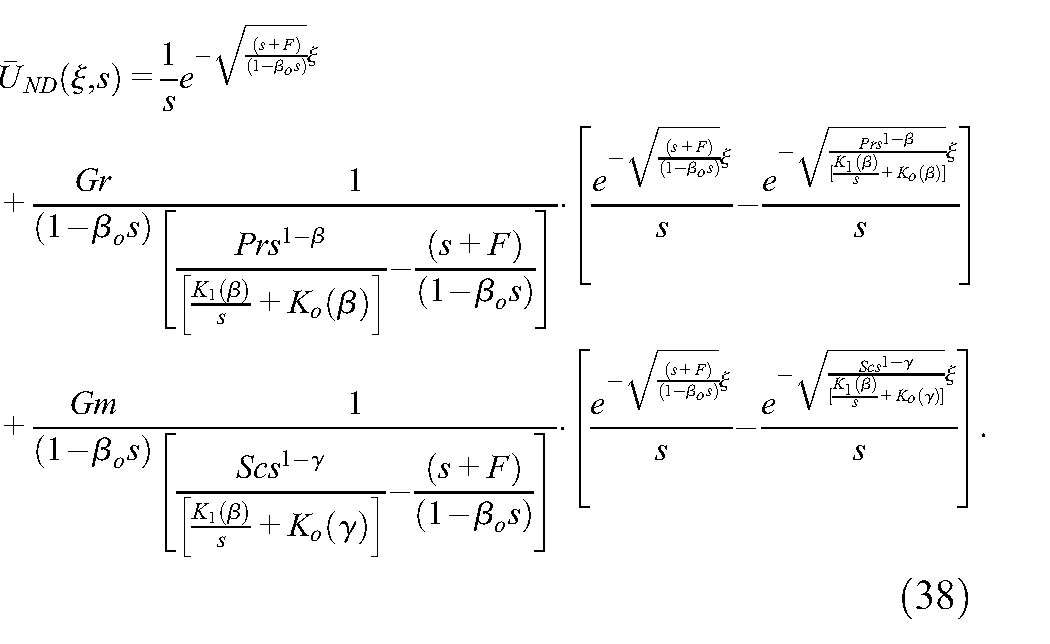
Due to the complexity of inverting equation (38), Tzou’s and Stehfest’s algorithms were employed to recover the velocity field from its transformed state. The resulting inversion is presented in Figure 2.
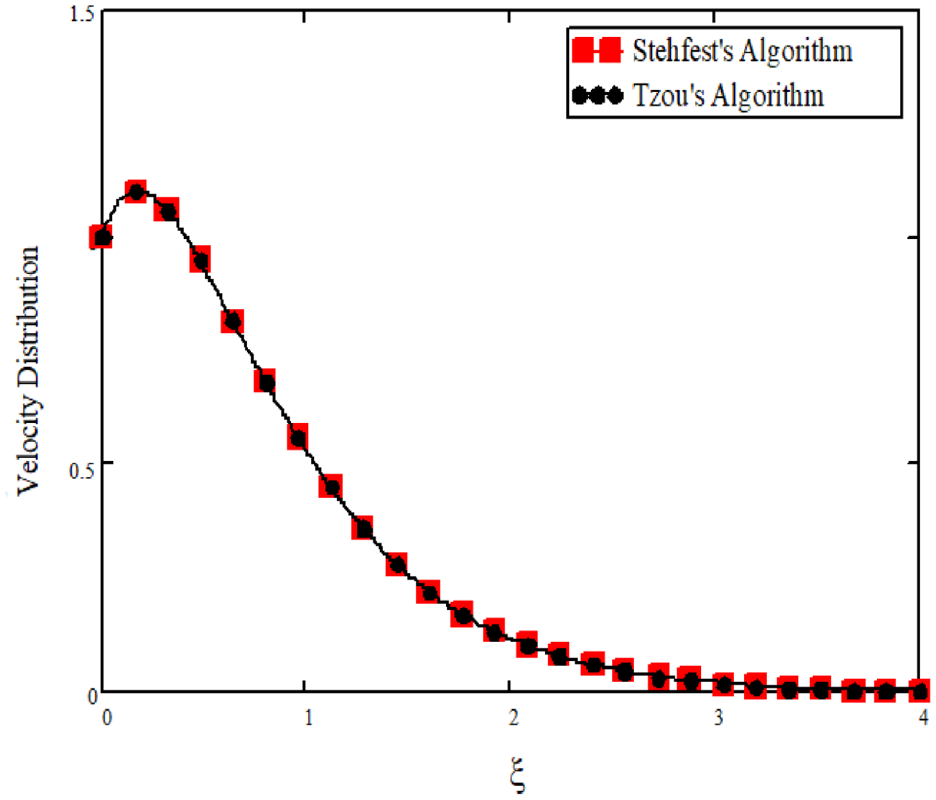
Inversion velocity with Stehfest’s and Tzous’s algorithm.
Result and discussion
The present study highlights various significant results concerning the behavior of Walter-B fluid under the influence of different parameters. The interpretations and results of the study are presented below with a focus on improving the clarity and depth of the analysis.
Grashof Number (Gr) and modified Grashof Number (Gm)
The Grashof number is crucial as it illustrates the balance between buoyant forces due to spatial variations and viscous resistance forces within the fluid. Figures 3 and 4 show velocity distributions for various values of Gr and Gm. As both Gr and Gm increase, buoyancy effects become more pronounced, resulting in higher fluid velocity. This indicates that thermal buoyancy significantly impacts the momentum of the fluid flow.

Velocity distribution of some value of Gr.

Velocity distribution of some value of Gm.
Prandtl Number (Pr)
The dimensionless Prandtl number represents the ratio of momentum diffusivity to thermal diffusivity, effectively indicating the relative thicknesses of the thermal and velocity boundary layers. As shown in Figure 5, higher Pr values correspond to a thicker velocity boundary layer compared to the thermal boundary layer, leading to reduced fluid velocity. This behavior demonstrates that fluids with higher Prandtl numbers resist thermal diffusion more effectively, which in turn influences the flow velocity.

Velocity distribution of some value of Pr.
Schmidt number (Sc)
The Schmidt number (Sc) is indicative of the ratio of viscous forces to mass diffusivity. In Figure 6, an increase in Sc results in decreased fluid velocity, as higher Schmidt numbers enhance viscous effects, thereby reducing the velocity profile. This finding is crucial for understanding mass transfer processes in fluid flows, especially in applications involving chemical species transport.

Velocity distribution of some value of Sc.
Walters-B fluid parameter (
)
Figure 7 illustrates the effect of the Walter’s-B fluid parameter on velocity. As the value of

Velocity distribution of some value of
Magnetic parameter (M)
The influence of the magnetic parameter (M) on fluid velocity is depicted in Figure 8. Increasing M strengthens the Lorentz force, which opposes the fluid motion and consequently reduces the velocity. This phenomenon is significant in magnetohydrodynamic (MHD) applications where magnetic fields are used to control fluid flow.
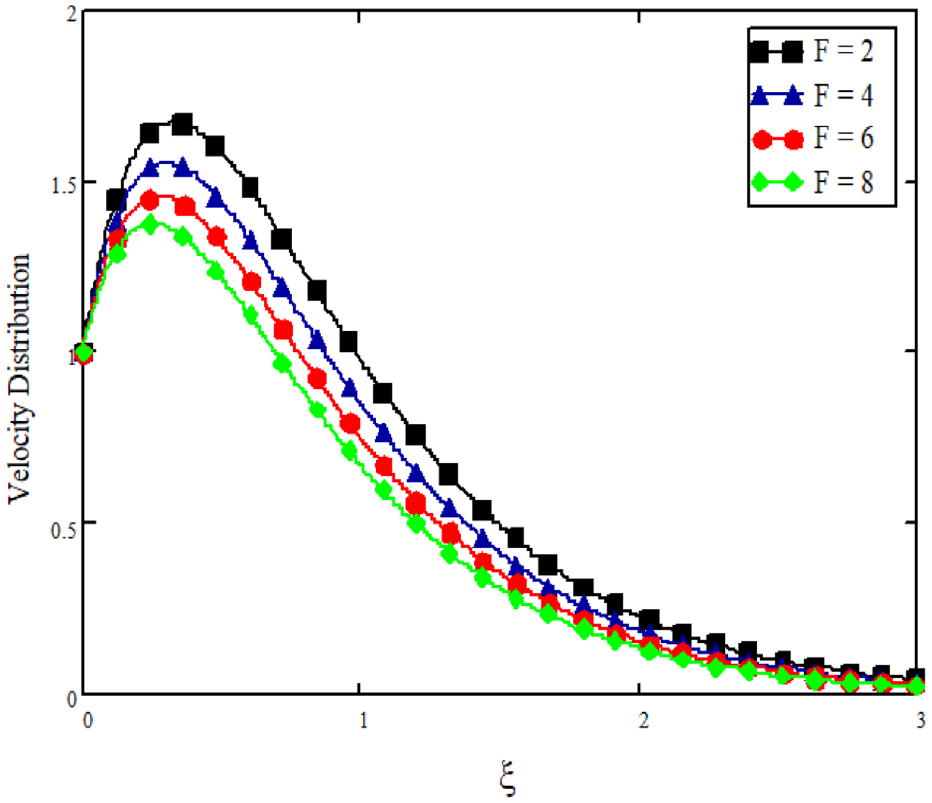
Velocity distribution of some value of F.
Constant proportional caputo (CPC) operator
The impact of the CPC operator on velocity and temperature profiles is illustrated in Figures 9–11. Increases in the CPC fractional derivative parameter result in decreased fluid velocity and temperature. This behavior suggests that the CPC operator introduces memory effects into the fluids response, affecting both momentum and thermal diffusion.

Velocity distribution of some value of fractional parameter.

Temperature distribution of some value of fractional parameter.

Concentration distribution of some value of fractional parameter.
Temperature distribution and Prandtl number (Pr)
The temperature distribution for different Prandtl numbers is shown in Figure 12. As Pr increases, the rate of thermal diffusion across the boundary layer slows down, leading to a decrease in temperature distribution. This finding is essential for designing thermal systems where precise temperature control is required.

Temperature distribution of some value of Pr.
Concentration profile and Schmidt number (Sc)
Figure 13 presents the effects of the Schmidt number on the concentration profile. An increase in Sc leads to a decrease in mass concentration, which can be attributed to enhanced viscous forces that limit the spread of the solute.

Concentration distribution of some value of Sc.
Validation of inversion algorithms
Figure 2 validates the effectiveness of the Stehfest and Tzou algorithms for inverting the Laplace transforms, demonstrating their reliability in analyzing velocity distributions.
The study reveals several important insights into the behavior ofWalters-B fluid under various physical and fractional parameters. Enhancing the presentation of these results involves clearer graphical representations and more detailed explanations of the underlying physical phenomena. These improvements will aid in better understanding and application of the findings in practical scenarios such as biomedical engineering, petroleum extraction, cooling systems, polymer processing, and environmental engineering.
When a unit step function is applied to the flow of Walter’s-B fluid under unsteady conditions, it introduces a sudden perturbation that allows for the analysis of the fluid’s transient response. This includes observing the overshoot, settling time, and the time to reach a new steady state, highlighting the memory effects captured by fractional derivatives, which offer a more accurate depiction of the fluid’s dynamic behavior compared to ordinary derivatives.
Physical significance of parameters
Unit step function
Time
Step value
Walters-B fluid
Shear rate
Relaxation time
Viscosity
Elastic modulus
Unsteady state
Time
Velocity field
Pressure field
Temperature field
Physical values for rheological parameters in Walter’s-B fluid (Hypothetical)
Since Walter’s-B fluid is a fictional material, we can’t definitively assign specific physical values. However, based on the context of heat transfer analysis over a vertical plate and the use of fractional calculus, here are some possible ranges for its rheological parameters:
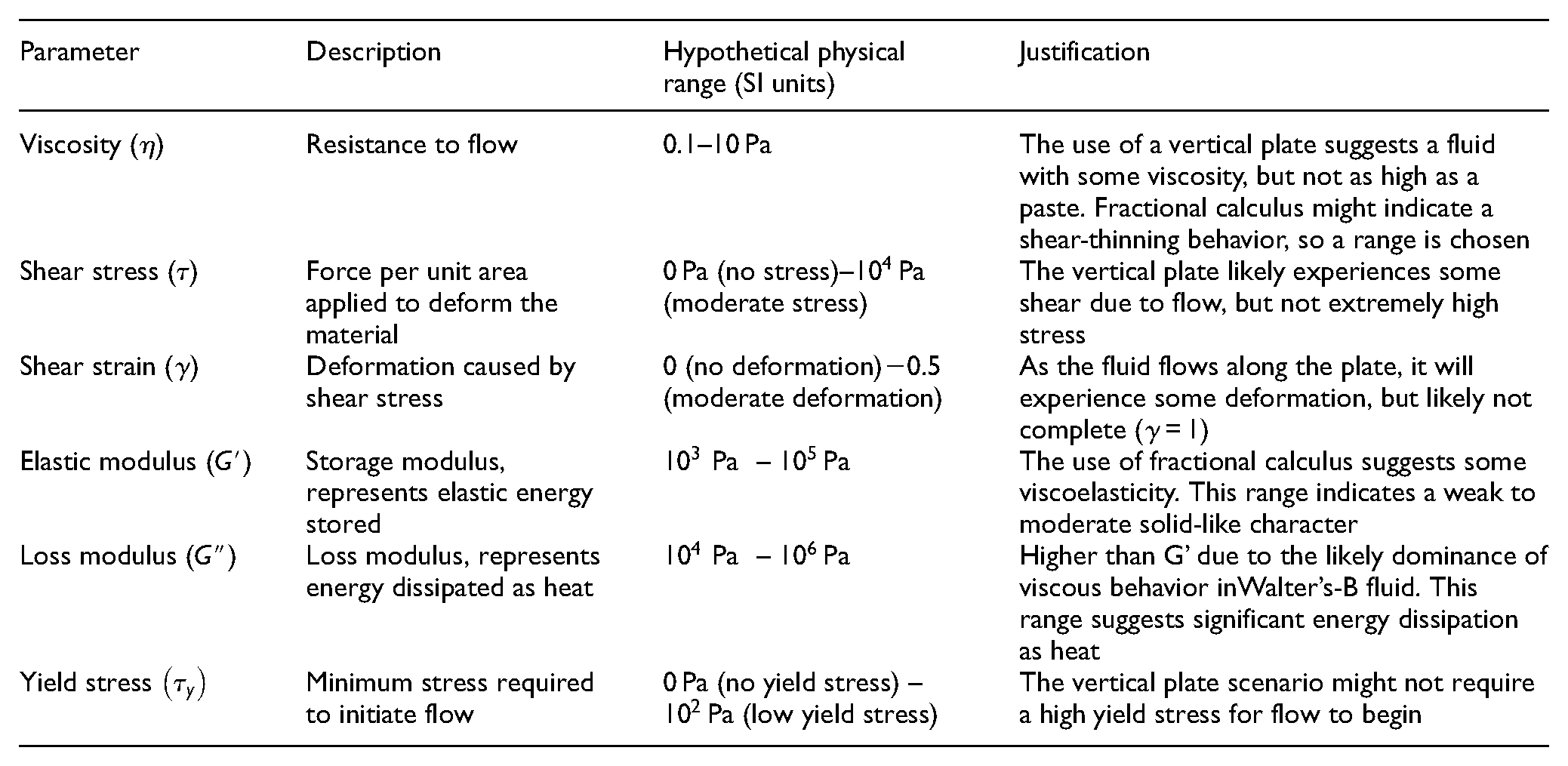
Skin friction
Skin friction is defined as
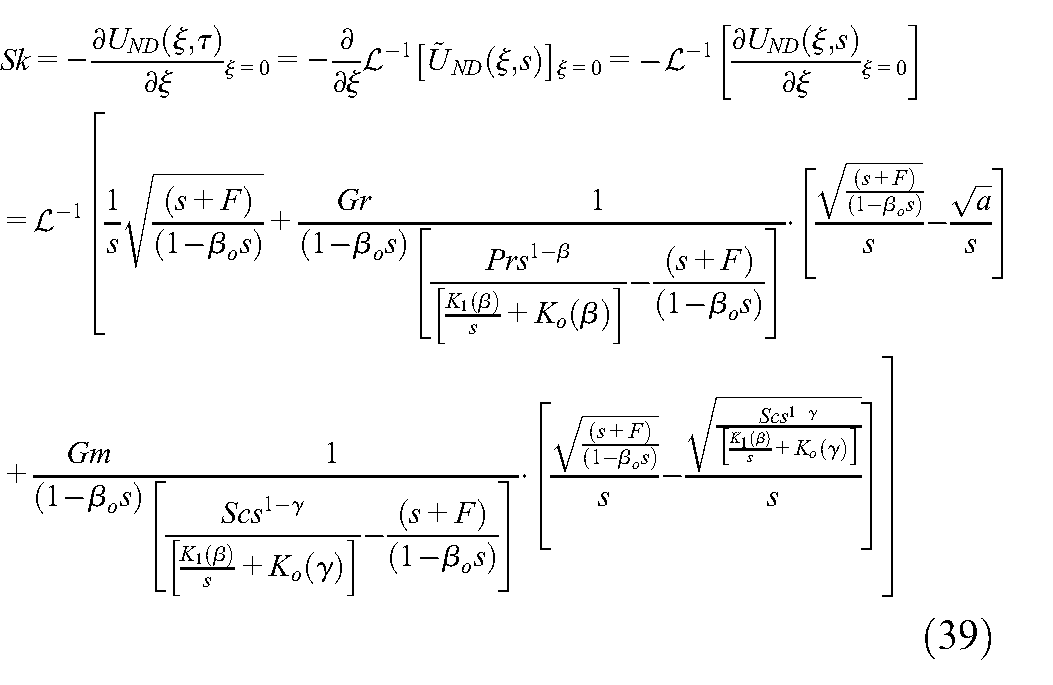
Also show that the effect of fractional parameter on skin friction as shown in Table 1.
Skin friction.

Nusselt number
Using the Nusselt number as a definition, the local coefficient of the heat transfer rate is

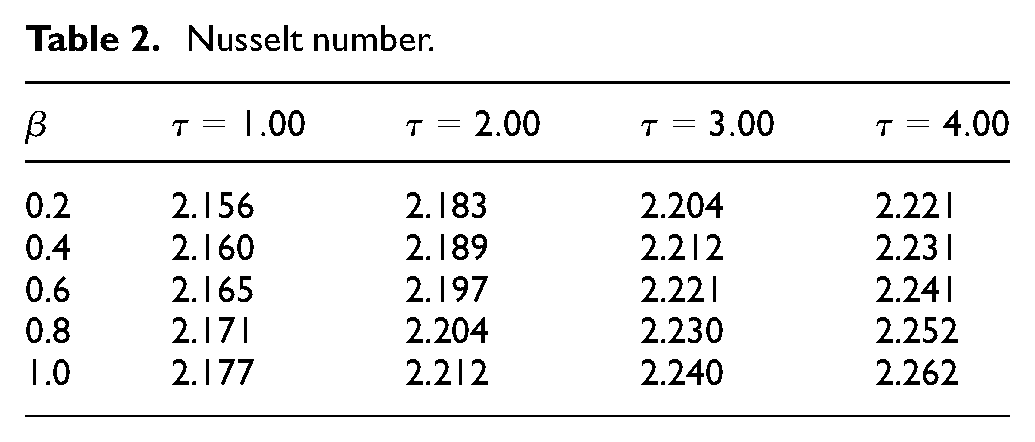
Also show that the effect of fractional parameter on Nusselt number as shown in Table 2.
Nusselt number.
Sherwood number
The following relation defines the local coefficient of the mass transfer rate in terms of the Sherwood number.

Also show that the effect of fractional parameter on Sherwood number as shown in Table 3.
Sherwood number.

Conclusion
Free convection Walter’s-B flow across a vertical flat plate has been modeled using a fractional time derivative. Laplace transform is applied to produce exact and semi-analytically solutions for velocity, concentration, and temperature after applying the Constant Proportional Caputo fractional derivatives. Following is an overview of the study’s key findings:
Fluid velocity rises when rising the value of Gr, Gm,
Increases in F, Pr, and Sc values cause a decrease in fluid velocity.
Temperature fluid decay when rising the value of Pr and
Fluid concentration decays when the value of Sc and
Fractionalized Newtonian fluid: If Walters-B fluid is ignored, then the fluid becomes fractionalized Newtonian fluid. In this situation, the behavior of the non-Newtonian fluid reduces to that of the Newtonian fluid.
The behavior of the non-Newtonian fluid reduces into the Newtonian fluid in this situation, and the velocity equation (52) is turned out as follows, assuming that the Jeffrey fluid parameters
Real applications in industries and technologies:
Biomedical Engineering: Understanding the behavior of non-Newtonian fluids like Walters-B fluid is crucial for biomedical applications, such as drug delivery systems, where precise control of fluid flow can enhance treatment effectiveness.
Petroleum Industry: The modeling of non-Newtonian fluids helps in the extraction and transportation of crude oil, which often exhibits non-Newtonian characteristics. The use of magnetic fields can improve the efficiency of these processes by controlling the flow properties.
Cooling Systems: Insights into heat and mass transfer can be applied to design more efficient cooling systems for electronic devices and nuclear reactors, where precise thermal management is essential.
Polymer Processing: In the manufacturing of plastics and polymers, the flow behavior of non-Newtonian fluids significantly impacts the quality and properties of the final product. This research can aid in optimizing processing conditions.
Environmental Engineering: The findings can be applied to environmental remediation processes, such as the cleanup of oil spills, where controlling the flow of non-Newtonian fluids can improve the effectiveness of the cleanup efforts.
These applications demonstrate the broad relevance and potential impact of the research in enhancing various industrial processes and technological advancements.
Limitations of the problem
The Walters-B model, while providing a reasonable approximation for certain fluid behaviors, is a simplified representation and may not accurately capture the complexities of real fluids, especially those with strong shear-thinning or shear-thickening properties. The study is restricted to two-dimensional flow, limiting its applicability to real-world scenarios where three-dimensional effects are significant. The assumption of constant fluid properties might not hold true for a wide range of temperature and pressure conditions, potentially affecting the accuracy of the results. The study does not consider the effects of thermal radiation, which can be significant in high-temperature applications. Without experimental data, the accuracy of the numerical results cannot be fully verified.
Future recommendations
The current work could be extended by exploring the behavior of Jeffrey fluids using different nanoparticles on a porous plate. Additionally, the problem could be addressed by employing the MittagLeffler kernel associated with the YangAbdelCattani fractional derivative. Alternatively, the Prabhakar type MittagLeffler fractional derivative might be utilized to tackle the same issue.
Footnotes
Appendix
Handling Editor: Sharmili Pandian
Declaration of conflicting interests
The author(s) declared no potential conflicts of interest with respect to the research, authorship, and/or publication of this article.
Funding
The author(s) disclosed receipt of the following financial support for the research, authorship, and/or publication of this article: This work was funded by the Researchers Supporting Project No. (RSP2024R363), King Saud University, Riyadh, Saudi Arabia.
Data availability
No data associated in the manuscript.
