



Abstract
In order to assess the reliability of electrical connector seals under storage environment, the failure analysis of 771 silicone seals for electrical connectors under storage environment determines that the failure mechanism of 771 silicone seals is mainly hydrolysis and oxidation of silicone matrix material. Based on the response surface design theory, the combination of temperature and humidity stress levels was determined, and the accelerated degradation test program of seals under combined temperature and humidity stress was constructed. Using the accelerated degradation test data, the degradation trajectory model of 771 silicone seals, the failure life distribution model, and the accelerated equation that characterizes the mathematical relationship between temperature and humidity and the life index of 771 silicone seals are established and validated at the statistical level, which realizes the reliability assessment of 771 silicone seals for electrical connectors in storage environments.
Keywords
Introduction
Model equipment constitutes an essential strategic asset within China, noted for protracted storage periods and single-usage scenarios. 1 Electrical connectors, which serve as fundamental elements for the enactment of signal conveyance and electrical current regulation, represent a vulnerability within the equipment architecture. The preservation dependability of these connectors exerts a consequential influence on the overall system reliability.
At present, most of the reliability studies on electrical connectors are about contact parts and insulating parts, such as Jiang, 2 Pan et al. 3 established a degradation model of electrical connector contact resistance performance based on the Wiener process, and verified the reasonableness of the model through the accelerated degradation data of the relevant examples. Luo et al. 4 investigated the influence of various dimensional material parameters on the insertion and extraction characteristics of contact parts, and proposed to improve the concentration of stress distribution at the root of the jack by changing the shape of the root of the jack reed. Ni et al. 5 investigated the influence of temperature and insertion/extraction speed on the contact performance by measuring the contact resistance and the wear of the contact surfaces. Ren et al. 6 recorded the contact resistance of electrical connectors under different mechanical vibration environments in real time, established the vibration transmission path of electrical connectors and the related dynamic response model, which incorporated the structural-mechanical performance parameters of the electrical connector plugs, sockets, and housings, and explained the physical mechanisms of the fluctuation and degradation of the contact resistance under vibration environments. Jiang et al.7,8 analyzed the effect of ambient temperature on the insulation failure of electrical connectors, and proved the relationship between the insulation resistance of electrical connectors and the ambient temperature from the theoretical analysis and experimental validation. Kloch et al. 9 studied the insulation performance of automotive electrical connectors in harsh operating environments, and concluded that the formation of conductive paths between the contacting pairs is the main reason for the degradation of the performance of the insulating parts. Guo et al. 10 used the finite element method to simulate the electric field intensity distribution of electrical connector insulators, and analyzed the effects of different material parameters on the performance of insulators by changing the conductivity and relative dielectric constant of the insulating materials. Zhang et al. 11 carried out a simulation study of electrical connectors with insulation failure, which showed that the aging of the insulating material causes the formation of current leakage paths between the contact pairs, resulting in signal distortion in the electrical connector.
771 Silicone seals are key components inside electrical connectors and can be commonly used in all types of electrical connectors. Its main function is to prevent water vapor, harmful gases, dust, etc. from entering the interior of the electrical connector. Under the long-term action of the storage environment stress, its performance gradually degraded, will directly affect the contact reliability and insulation reliability of the electrical connector.
At present, some scholars at home and abroad have studied the impact of seal structure parameters and environmental stress on sealing performance, for example, Hu et al. 12 studied the O-type rubber seals of electrical connectors, analyzed the sealing of O-type seals in the static sealing state, and concluded that the structural dimensions of rubber seals, compression rate and other factors on the sealing performance of the rubber seals. Liu et al. 13 analyzed the sealing failure phenomenon of a certain type of rubber seal connector, and obtained the main reasons for the failure are the mixing process of sealant, water vapor on the bonding surface and the width, and through the improvement measures to make the sealing performance of the rubber seal connector qualified rate increase. Nguyen et al. 14 used the leakage rate as a sealing performance index to study the sealing performance of electrical connector seals under different temperature stresses. The above studies are of some significance in analyzing the environmental effects of electrical connector seals, but there is still a lack of quantitative evaluation and judgment of the evolution of sealing performance of electrical connectors under the combined stresses of temperature and humidity.
Addressing the aforementioned issues, this study addresses the 771 silicone seals employed in electrical connectors as its focal research entity. Commencing with a statistical analysis of test data, it investigates the impact of environmental stressors and structural design variables on the progression of sealant efficacy. Subsequently, it formulates a storage reliability model for the 771 silicone seals pertinent to electrical connectors, thereby facilitating an evaluation of their storage longevity.
Environmental effect analysis of 771 silicone seals for electrical connectors
The 771 silicone serves as a prevalent sealing agent for electrical connectors and is classified under the category of room-temperature vulcanizing (RTV) silicone rubber. This material is synthesized from α, ω-dihydroxy polysiloxane along with hydroxydimethylmethicone terminated polydimethylsiloxane mixtures. As depicted in Figure 1, the 771 silicone sealant is typically situated between two layers of insulation board and the casing. It is introduced into the grooves via an extrusion process and bonds the insulating components, contact elements, and casing together, thereby establishing a barricade. This barrier is instrumental in segregating the internal environment of the connector from external influences, consequently ameliorating the propensity for contact elements and other internal constituents to succumb to environmentally induced contamination, which could precipitate failure of the connector.

Schematic structure of a certain type of electrical connector socket: 1-case; 2-pin; 3-insulator 1; 4-771 silicone seal; 5-insulator 2.
Analysis of temperature effects
When 771 silicone seals are stored alongside electrical connectors in a warehouse over an extended duration, temperature and oxygen interactions may induce the cleavage of the Si-O bonds within the main siloxane chain of the silicone macromolecules. This results in a reduced cross-linking degree and a diminished density of the spatial network, thereby leading to a lessened compaction of the adhesive material. Consequently, the diminished barrier properties facilitate the permeation of small molecules such as water vapor and air, culminating in infiltration and leakage.
Simultaneously, the 771 silicone gel’s matrix side chains, which include methyl among other organic groups, engage in oxidation reactions with hydrogen atoms and oxygen, leading to the formation of unstable peroxides, silicon hydroxyl groups, and other oxidative degradation byproducts. During the aging process, these degraded fragments proceed to crosslink bidirectionally or with unoxidized matrix molecules, provoking the collapse of the original three-dimensional spatial network. This collapse is followed by a secondary reformation of a nonuniform network characterized by the presence of voids. The erratic nature of oxidative cross-linking engenders variable distributions of reaction intensities and molecular densities across different sectors, broadening the intermolecular gaps within the silicone matrix and inducing internal stress—factors that predispose the material to microcrack propagation. 15
Over time, the aforementioned cavities and fissures augmented by the oxidative crosslinking will expand and coalesce, allowing oxygen ingress from the external surface to the matrix’s interior, thereby expedited the deterioration of the 771 silicone seals and exacerbating the degradation of their sealing efficacy. As postulated by chemical kinetics, elevated temperatures will amplify molecular motion through thermal activation, hastening oxygen’s penetration rate into the matrix, and thereby accelerating the chemical reaction rates. This thermal dynamic precipitates a swifter deterioration of the sealing attributes of the 771 silicone seals.
Analysis of humidity effects
In the context of prolonged storage environments, 771 silicone seals are susceptible to water molecule absorption from ambient air resulting in a cascade of irreversible alterations that may ultimately precipitate seal failure. Initially, water molecules infiltrate the sealant and interface with the connector shell, engaging with the adhesive’s binding surfaces. There, they undergo hydrolysis with the sealant molecules, compromising the adhesive bond strength and interface cohesion, leading to diminished adhesive force, interface gap formation, and eventual debonding.
As time progresses, the water molecules further permeate the sealant matrix, inducing hydrolytic reactions that undermine the sealant’s internal cohesion and lowering the material’s overall sealing bond strength. Furthermore, these reactions have the potential to adversely affect the material’s mechanical integrity and other physical properties. The protracted incursion of water molecules may also initiate a swelling phenomenon 16 within the silicone matrix, characterized by the expansion of the 771 silicone molecules and a resultant decrease in material density, potentiate leakage issues.
Analysis of the combined effects of temperature and humidity
During extended storage, seals indeed endure the synergistic impacts of temperature and humidity, which together accelerate the degradation of the sealant material. Elevated temperatures expedite both oxygen and water molecule penetration into the sealant. Oxygen accelerates the oxidation reaction, whereas water molecules catalyze the onset of hy-drolysis. These processes not only affect the polymer directly but also mutually reinforce one another. The hydrolysis induced by moisture leads to the formation of voids and cracks within the matrix, thereby providing pathways that facilitate further oxygen penetration. These additional routes for oxygen intrusion expedite the degradation process via oxidation, which in turn can create more voids, perpetuating a cycle of deterioration.
Both temperature and humidity have simultaneous and interactive effects on the sealant, markedly increasing the overall rate of aging. Each environmental factor does not act in isolation; rather, their combined effect is greater than the sum of their individual parts, leading to a more rapid decline in the material’s integrity and sealing ability.
The thickness of the seal also plays a significant role in its susceptibility to aging. Thicker seals tend to have a lower probability of penetration by holes and microgaps that arise from oxidation and hydrolysis, primarily due to the larger volume of material which water molecules and oxygen must traverse to affect the integrity of the seal. As a result, thicker seals can provide a greater barrier against environmental degradation and typically exhibit slower rates of aging compared to thinner counterparts.
Accelerated degradation test
Type of test stress and stress level
An examination of the environmental impact on 771 silicone seals indicates that, within the storage milieu, parameters such as temperature, humidity, and thickness significantly influence the degradation of the seal’s performance. Utilizing temperature and humidity as testing stressors, and seal thickness as a design variable, the study considered structural dimensions pertinent to various electrical connector seals. Three thickness levels—1.0, 1.5, and 2.0 mm—were selected. Building upon preliminary exploratory test results and the stress limits of the available equipment, the temperature stress levels were set at 85°C, 75°C, and 65°C. Concurrently, humidity stress levels were determined to be 96%RH, 84%RH, and 72%RH. To ensure statistical robustness, each combination of stress variables was subjected to accelerated degradation testing on a sample set of 13.
Stress level combination method
Exploiting the benefits inherent in Response Surface Design (RSD), which include “reduced experimental requirements, enhanced predictive capabilities, and the capacity to analyze interactions among multiple factors,” the RSD methodology was employed to ascertain the optimal interplay of temperature, humidity, and thickness stress levels. This approach culminated in a total of 15 distinct experimental groups. The precise configurations of these groups are delineated in Table 1.
771 accelerated degradation test program for silicone seals.

Test parameters and failure thresholds
Drawing upon the outcomes of the initial mapping test and recognizing the benefits of helium leakage rate as a convenient and quantifiable metric that can effectively represent seal performance, helium leakage rate was identified as the key test parameter for seals and assessed using a helium mass spectrometry leak detector.
As per GJB 101A-97, 17 the helium leakage rate failure threshold for 771 silicone seals for electrical connectors is 1 × 10⁻⁸ Pa·m3/s.
Test intervals and cut-off times
Based on the findings from the initial mapping test, 771 silicone seals exhibit varying degradation rates under distinct stress level combinations. In order to maximize the acquisition of test data, it was decided that the test duration for the groups involving (85°C, 96%RH), (85°C, 84%RH), (85°C, 72%RH), and (75°C, 96%RH) would be set at 168 h, with a termination point at 1000 h. For the groups featuring (75°C, 84%RH), (75°C, 72%RH), (65°C, 72%RH), (65°C, 84%RH), and (65°C, 96%RH), the test duration is established at 336 h, with a cut-off point at 1500 h.
Statistical modeling of accelerated degradation test
Accelerated degradation test data
Based on the test program outlined in Table 1, 15 sets of accelerated degradation tests were carried out under dual stress conditions of temperature and humidity to gather data on the degradation of helium leakage rate performance. The actual cumulative test durations for the tests were 1680 and 1008 h. Due to the volume of data generated, only the degradation trajectory of helium leakage rate for the sample with a thickness of 1.5 mm is displayed in Figure 2, as space constraints limit the presentation of additional data. For further details, see Appendix.

Degradation trajectory of helium leakage rate for 1.5 mm thickness sample: (a) 65°C, 84%RH, 1.5 mm, (b) 75°C, 72%RH, 1.5 mm, (c) 75°C, 84%RH, 1.5 mm, (d) 75°C, 96%RH, 1.5 mm, (e) 85°C, 84%RH, 1.5 mm.
Statistical modeling of performance degradation
Analysis of Figure 2 reveals that the helium leakage rate exhibits a rising and approximately concave pattern, a trend that aligns with the characteristics inherent in power and exponential functions. To facilitate statistical analysis, linearized models of the power function (equation 1) and the exponential function (equation 2) have been employed to approximate the least squares fit for degradation trajectories of helium leakage rates in a dataset comprising 771 silicone seals.
Exponential function model linearization:

Linearization of power function models:

where t is the test time and
To evaluate the precision with which the two functions characterize the degradation pattern of 771 silicone seals’ performance, a determination coefficient, denoted as R2, was employed to assess the fitting accuracy of equations (1) and (2). An R2 value approaching 1 indicates an enhanced fit. The formula for R2 is delineated as follows:

where,
The (85°C, 84%RH, 1.5 mm) test group was used as an example and its R2 values are shown in Table 2, and the remaining 14 groups were treated in the same way.
Test group exponential function and power function R2 comparison (85°C, 84%RH, 1.5 mm).

By fitting the test to 15 sets of data, the findings indicate that the exponential function model provides a better fit for the performance degradation trajectory of 771 silicone seals. Thus, the exponential function is identified as the degradation trajectory model for the 771 silicone seals, that is:

where, tijk denotes the time of the measurement of the k test group, the j sample, and the i measurement, hour; Q(t
ijk
) denotes the helium leak rate at tijk, Pa·m3/s; α
jk
, β
jk
, denotes the model parameters of the k test group, the j sample; ε
jk
denotes the test error of the k test group, the j sample, and the helium leak rate is affected by various random factors in the measurement process, and according to the Central Limit Theorem, it is subject to a normal distribution,
Life distribution model
Utilizing the performance degradation trajectory model delineated for the 771 silicone seals, it is feasible to ascertain the temporal juncture at which the helium leakage rate attains the failure threshold—referred to as the pseudo-failure life—for each specimen subjected to the 15 distinct sets of test stress conditions. For instance, the pseudo-failure life of each specimen corresponding to the test conditions of 85°C, 84% relative humidity, and 1.5 mm is computed and presented in Table 3.
Experimental group sample pseudo-failure life (85°C, 84%RH, 1.5 mm).

Utilizing the pseudo-lifetime data delineated in Table 3, an Anderson-Darling test 18 was employed to evaluate the conformity of the life distribution of 771 silica gel seals to various prevalent distribution models including the normal, Weibull, lognormal, exponential, and Gamma distributions. The resultant test statistics, encompassing AD values and p-values, are presented in Table 4.
A-D statistics for the five common distributions.

A significance threshold was set at 0.05, with a p-value surpassing this benchmark suggesting adherence to the stipulated distribution. Inversely, a diminutive AD value indicates a heightened correspondence with the proposed distribution. The hypothesis testing conducted on the pseudo-failure life distribution for 15 clusters of data affirmed conformity to the normal, lognormal, Weibull, and Gamma distributions. Notably, 10 sample groups predominantly conformed to the lognormal distribution, 3 to the Weibull distribution, and 2 to the normal distribution. The aggregate AD value for the lognormal distribution was the most negligible, substantiating that the lifespan of the 771 silica gel seals is best described by the Lognormal distribution.
Subsequently, the method of maximum likelihood estimation was applied to deduce the values of the elusive parameters characterizing the lifetime distribution for the 15 test sample sets, specifically the log mean μ i and log standard deviation σ i of the lognormal distribution, detailed in Table 5.
Estimates of the parameters of the lognormal distribution obeyed by the 15 groups of test samples.

To ascertain the validity of the 15 test cohorts, it is crucial to assess the homogeneity in the failure mechanisms associated with the accelerated tests across various stress level combinations. This necessitates confirmation that the logarithmic standard deviation of the life distribution model remains invariant under disparate stress amalgamations. In this context, Bartlett’s test is utilized to evaluate the uniformity of the failure mechanisms pertaining to the accelerated tests, hypothesizing that the log standard deviations under each group (σ i , where i = 1, 2, …, 15) are equivalent.
Original hypothesis H0:
Constructing statistics:

Among them,



where,
Taking the significance level α = 0.05, when the statistic
Accordingly, the storage reliability function of the 771 silicone seal is:

Acceleration equation for 771 silicone seals at temperature and humidity
Analysis of the effects of temperature, humidity and thickness on 771 silicone seals
Acknowledging the inherent variabilities among individual samples and the stochastic errors encountered during experimentation, the incremental rate of helium leakage concurrent with each stress condition is designated as the response variable. Specifically, the incremental helium leakage rate observed at the 1008-h juncture within the param-eters of temperature, humidity, and material thickness serves as the dependent variable index. This approach facilitates a qualitative examination of the influences exerted by temperature, humidity, and thickness upon the average incremental rate of helium leakage, thereby underpinning the development of an acceleration model for the 771 silicone seal under thermal and hygrometric stresses.
Analysis of temperature and humidity effects at the same thickness
From Figure 3(a), it can be seen that the changes of helium leakage rate increment at 65°C and 85°C under 72% humidity are not parallel to the changes of increment under 96% humidity, indicating that there is an interaction between temperature and humidity. According to Figure 3(b), it can be seen that the effect of different temperatures on the increment of helium leakage rate under the same thickness of humidity is an upward trending folded line, which indicates that there is a non-linear effect of temperature on the increment of helium leakage rate and the higher the temperature, the bigger the increment of helium leakage rate at the same time, the faster the degradation of 771 silicone seals. The higher the temperature, the larger the increment of helium leakage rate in the same time, and the faster the degradation of 771 silicone seals.
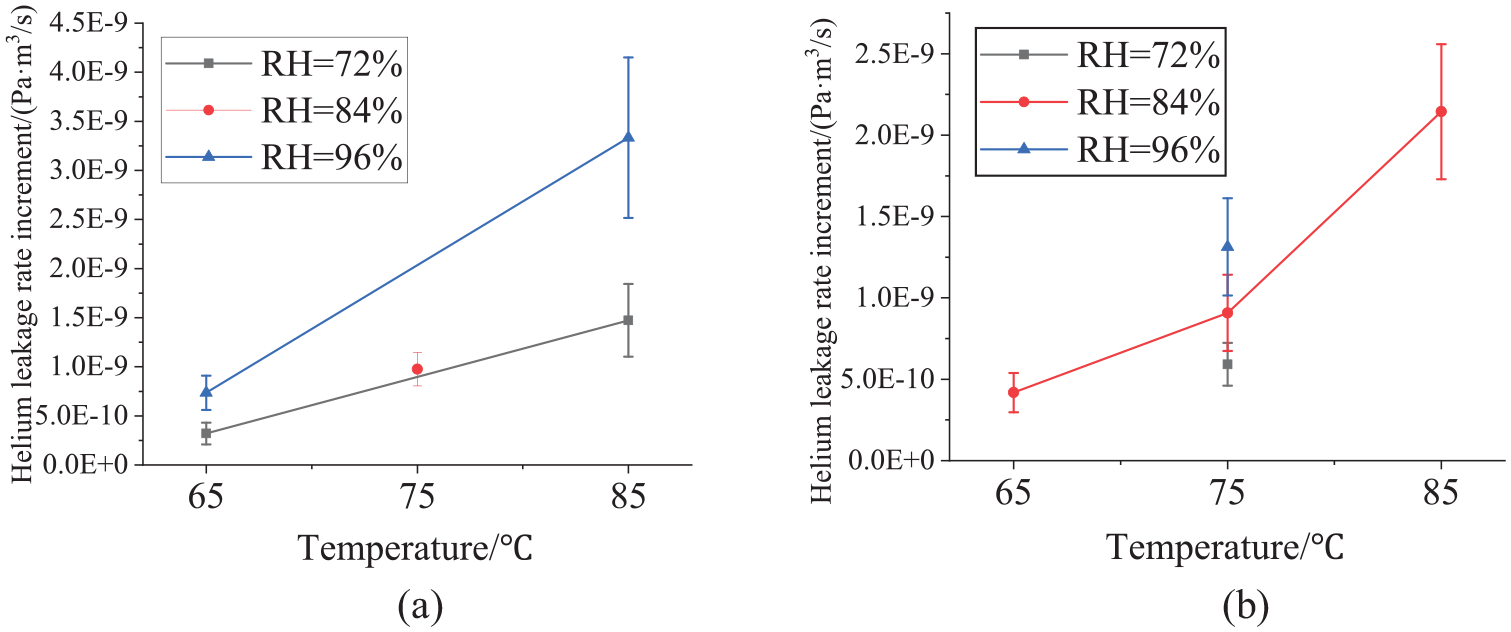
Incremental helium leak rate versus temperature and humidity for the same thickness: (a) 1 mm thickness, (b) 1.5 mm thickness.
Analysis of temperature-thickness effects at the same humidity level
From Figure 4(a), the changes of 1.0 and 2.0 mm helium leakage rate increment at 65°C are almost parallel to the changes of increment at 85°C, indicating that the effect of thickness on helium leakage rate increment is almost unchanged at different temperatures, and there is no interaction between the temperature and the thickness. According to Figure 4(b), at the same temperature and humidity, the effect of thickness on the increment of helium leakage rate is approximately a straight line with a downward trend, which indicates that the effect of thickness on the increment of helium leakage rate is a linear effect, and the larger the thickness is, the smaller the increment of helium leakage rate is in the same time, and the slower the degradation of 771 silica seals.
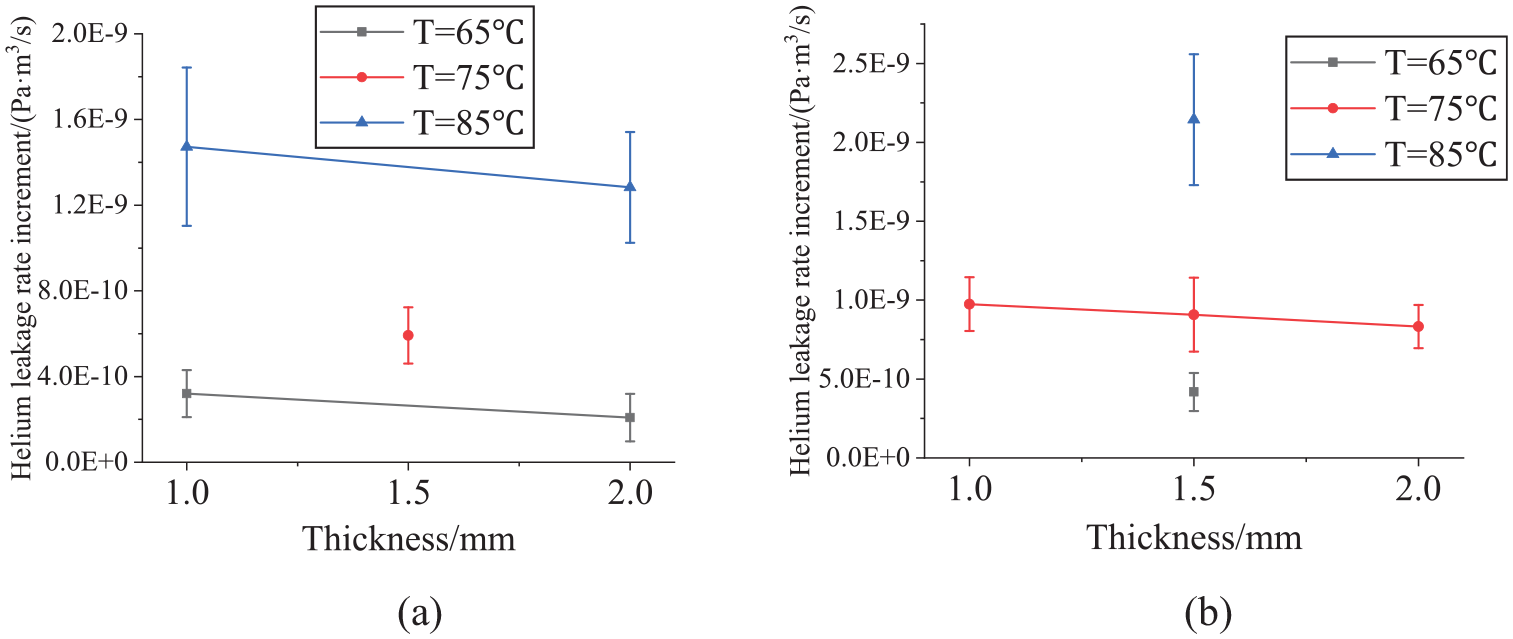
Incremental helium leak rate versus temperature-thickness for the same humidity: (a) 72% humidity, (b) 84% humidity.
Analysis of humidity thickness effects at the same temperature
From Figure 5(a), the change of helium leak rate increment at 72%RH and 96%RH under 1.0 mm thickness is almost parallel to the change of increment at 2.0 mm thickness, which indicates that the effect of humidity on the helium leak rate increment is almost unchanged under different thicknesses, and there is no interaction between the humidity and the thickness; according to Figure 5(b), the effect of humidity on the helium leak rate increment under the same thickness of the temperature almost shows a straight line with an upward trend, indicating that there is a linear effect of humidity on the increment of helium leakage rate, the larger the humidity, the larger the increment of helium leakage rate in the same time, and the faster the degradation of 771 silicone seals.

Incremental helium leak rate versus humidity thickness at the same temperature: (a) 65°C, (b) 75°C.
In summation, the data delineates primary and secondary influences of temperature on the incremental mean helium leak rate, as well as primary impacts of humidity and material thickness on this rate. Additionally, there is an observable interactive effect between temperature and humidity on the rate.
Establishment of acceleration equations based on response surface theory
In order to quantitatively analyze the mathematical relationship between the storage life of 771 silicone seals and temperature, humidity, and thickness. According to the results of the analysis of the interaction effect of temperature, humidity, and thickness on the performance of 771 silicone seals, based on the response surface theory to construct the quadratic response surface model of the distribution of the logarithmic mean of the temperature, humidity, thickness, and 771 silicone seals life span, that is, the acceleration equation is:

where
In order to compare the magnitude of the effect of each factor in the acceleration equation on the response value, the primary term, the secondary term of temperature, and the interaction term of temperature and humidity of each influence factor were analyzed by ANOVA (analysis of variance) and tested for significance. Take the significance level α = 0.05, if the significance result p-value is less than 0.05, the effect of the factor term is considered significant. Through the analysis, it was found that the p-value of the secondary term of temperature was 0.082 > 0.05, and the effect on the logarithmic mean of the seal life distribution was not significant, so the factor term was excluded to refit the accelerated equation, and the results of the ANOVA are shown in Table 6.
ANOVA for the acceleration equation.

The acceleration equation for 771 silicone seals at temperature humidity is obtained from Table 6:

where T is the temperature, °C; RH is the humidity,%; d is the thickness, mm.
Validation of the acceleration equation
771 Silicone Seals Acceleration at Temperature and Humidity equation (10) is established on the premise that the error term obeys a normal distribution. The results of the error normality test for 15 sets of data are given here using the normal probability plot test, as shown in Figure 6, where all the residuals are roughly uniformly distributed on a straight line, indicating that the error term of the acceleration equation obeys a normal distribution.
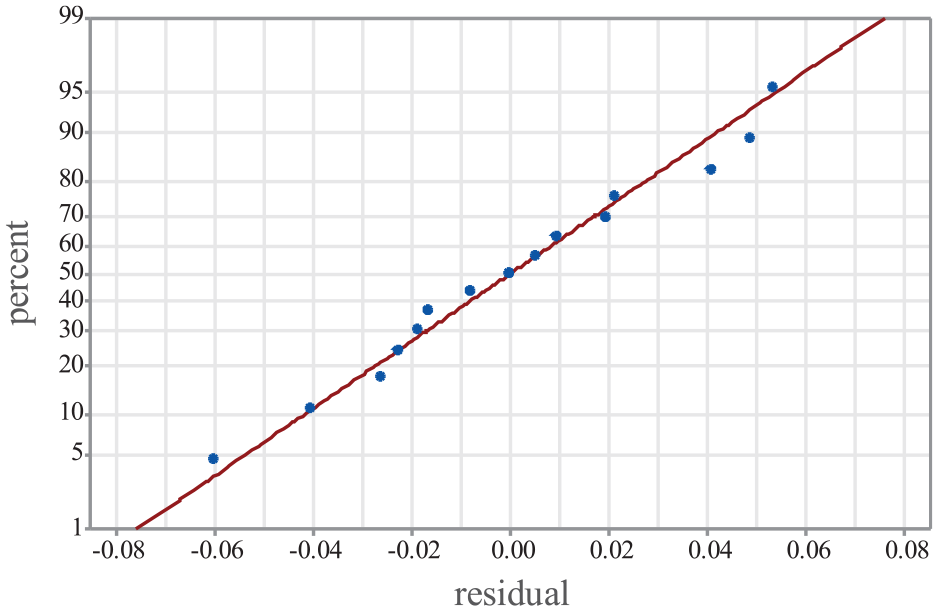
Plot of normal probability distribution of the acceleration equation error.
To further evaluate the accuracy of the accelerated equation in describing the mathematical relationship between 771 silicone seals and temperature and humidity, the root mean square error (RMSE) was used to assess the degree of fit of the accelerated equation, which is expressed as

where
Evaluation of storage life of 771 silicone seals for electrical connectors
Based on the established acceleration equations and reliability functions of 771 silicone seals under temperature and humidity, the specific life distributions of 771 silicone seals with thicknesses of 1.0, 1.5, and 2.0 mm at a temperature of 20°C and a humidity of 50%RH can be obtained as shown in Table 7, and the reliability curves are shown in Figure 7, and the point estimates and interval estimates of the reliable life of 771 silicone seals are shown in Tables 8 and 9, respectively.
Life distribution of 771 silicone seals in three thicknesses.


Reliability curve of 771 silicone seal at 20°C, 50%RH.
Reliable life point estimates for 771 silicone seals at 20°C, 50%RH storage environment.

Estimated reliable life intervals for 771 silicone seals at 20°C, 50%RH storage environment.

Conclusion
This paper takes 771 silicone seals for electrical connectors as the research object, studies the evolution of its sealing performance, and evaluates its reliable life in the storage environment. The article clarifies the electrical connector with 771 silicone seals in the storage environment is mainly affected by the temperature and humidity two kinds of environmental stress, and 771 silicone seals for failure analysis, to determine the cause of 771 silicone seals failure mechanism is mainly for the 771 silicone matrix material hydrolysis and oxidation.
Based on response surface design theory, 15 sets of constant accelerated degradation tests with combined temperature and humidity stresses were developed and implemented. Based on the overall evolution trend of the collected helium leakage rate data, the exponential function model and power function model were selected to fit the test data, and the degradation trajectory of the performance of 771 silicone seals based on the exponential function model was determined using the R2 coefficient test method. The qualitative effects of temperature, humidity and thickness on the performance degradation of 771 silicone seals were analyzed by taking the mean helium leakage rate increment as the analytical index.
The pseudo-failure life was extrapolated from the failure threshold, and the optimal pseudo-failure life distribution was determined to be a lognormal distribution using the AD test. Acceleration equations characterizing the mathematical relationships between temperature, humidity, and thickness and 771 silicone seal life indexes were constructed. The reasonableness and correctness of the model were tested using residual analysis and root mean square error. Based on the constructed model, the logarithmic life mean values of 771 silicone seals for electrical connectors with 1, 1.5, and 2 mm thicknesses at 20°C and 50%RH were extrapolated, and point and interval estimates of the reliable life of 771 silicone seals in storage environments were given.
Footnotes
Appendix A
According to the accelerated test program, 15 sets of accelerated degradation tests under temperature and humidity double stress were conducted to obtain the helium leak rate performance degradation data with cumulative test duration of 1680 and 1008 h. The helium leak rate degradation trajectories of the samples with 1.0 mm thickness and 2.0 mm thickness are shown in Figures A1 and A2, respectively.
Handling Editor: Aarthy Esakkiappan
Declaration of conflicting interests
The author(s) declared no potential conflicts of interest with respect to the research, authorship, and/or publication of this article.
Funding
The author(s) disclosed receipt of the following financial support for the research, authorship, and/or publication of this article: This study was supported by Zhejiang Provincial Key Research and Development Program (2021C01133).
