



Abstract
Multi-aperture electrical connectors are widely used in the aerospace system to provide high-reliability and high-quality connections. The existing reliability assessment methods only focus on the single-aperture electrical connectors, and ignored the influence of the aperture difference on the reliability of electrical connectors, which may lead to errors in the evaluation results. In order to assess the contact reliability of multi-aperture electrical connectors at storage environment, this paper build a mathematical relationship between structure parameter of contact pairs and contact force by analyzing the slotted leaf spring jack reed structure of the contact pair and using the cantilever beam model. Based on the growth law of the oxide layer on the surface of the contact pair, the degradation trajectory model of the contact pair performance was set up which incorporating the structure parameters of contact pairs, such as pin diameter, reed length, radius of curvature of the inner and outer surfaces, and the acceleration model was established by combining the Arrhenius equation. Then based on the established degradation trajectory model, the degradation failure distribution model of contact pairs was derived, and the contact reliability evaluation model of multi-aperture electrical connectors was established by using the weakest ring model. The test scheme of constant stress accelerated degradation of electrical connectors was formulated and carried out. Finally, this paper verified the correctness of the model through analyzing the test data, and obtained the reliable life of multi-aperture electrical connectors under the storage environment temperature, which realized the contact reliability assessment of multi-aperture electrical connectors.
Keywords
Introduction
As the main component of electrical signal transmission in the electronic systems, electrical connector is widely used in aerospace, national defense, military, and other fields. Contacts are the main component of electrical connector to realize electrical signal transmission, and the contact reliability directly determines the life of electrical connector.
At present, the electrical connectors used for different systems can be divided into containing a single aperture and multi-aperture class according to the different sizes of contact pairs, and also can be divided into slotted leaf spring, wire spring hole, and twist pin type according to the different structural forms of contact pairs. Among them, the electrical connectors with multi-aperture slotted leaf spring contact pairs have the advantages of diverse and stable signal transmission, and the application range of this type of electrical connector will be more extensive with the increasing of diversity and complexity of signal transmission requirements.
In China and other countries, previous studies of contact reliability modeling and assessment of electrical connectors were all focused on single-aperture electrical connectors, and ignored the effects of aperture difference of contact pairs on contact reliability of electrical connectors. Chen et al. 1 deduced the life distribution model of aerospace electrical connectors by using the extreme value distribution theory, and obtained the reliability index of Y11X series aerospace electrical connectors under the comprehensive action of ambient temperature and vibration stress through the comprehensive stress accelerated life test. In order to shorten the test time, Chen et al. 2 also established a statistical model of degradation failure, and proposed the theory and method of accelerated life test of aerospace electrical connectors based on performance degradation by studying the statistical analysis method of degradation data. Pan et al. 3 established a contact performance degradation model for electrical connectors based on the winner process under random vibration stress, and established the relationship between contact life and vibration magnitude through carrying out stepped stress accelerated degradation test, which realized the rapid contact reliability assessment of the electrical connector under the vibration environment. Xu et al. 4 established a contact performance degradation model and reliability assessment model for electrical connectors based on the mechanism of contact performance degradation under fretting wear conditions. Through fretting cycle test, they obtained the variation law of contact reliability with fretting cycle under different fretting amplitude. Ling et al. 5 established a fretting wear life estimation model based on Archard’s equation and achieved reliability assessment of electrical connectors fretting wear conditions. Zhong et al. 6 solved the reliability modeling problem of electrical connectors under the temperature-insertion stress condition, and laid a foundation for the further research on the reliability assessment and the accelerated degradation testing plan for electrical connectors in the storage environment with task profiles. Ren et al. 7 summarized some problems of physical failure model and reliability assessment of circular electrical connectors, and proposed a new method combining accelerated degradation test and physical failure modeling. Wang et al. 8 proposed a systematic method for the reliability assessment of connector and verified the effectiveness of the method by applying it to leaf spring connectors, and verified the effectiveness of the method by applying it on blade-spring connector. However, a large number of test data showed that the degradation rate of different aperture contact pairs has difference in the same test environment. If the influence of the aperture difference between contacts on the reliability of electrical connectors is ignored, the results of reliability evaluation would produce errors.
The paper takes a type of electrical connector as the research object. On the basis of failure mechanism analysis, a mathematical model between structural parameters of contacts and contact reliability of electrical connectors was established by combining the structural characteristics of contacts. Then through constant stress accelerated degradation test, the contact reliability model was verified, and the reliability assessment of the multi-aperture electrical connector was realized.
Contact failure mechanism of electrical connector
Contact failure mechanism analysis
A type of electrical connector is composed of contact parts, insulation parts, seals, shell, and locking separation mechanism. Among them, the contact parts are composed of three kinds of contact pair with Φ1.1, Φ2.2, and Φ3.5 mm aperture specifications, which adopt slotted leaf spring structure.
In peacetime, the electrical connector will be stored for a long time with missiles and other weapons. In the storage environment, the main failure mode of electrical connectors is contact failure, and the growth of oxide film on the surface of contact parts is the main reason for contact failure.
9
The basal material of the contact part is copper, and the surface is gold-plated, but the gold-plated layer is very thin because of the economic cost limited. Therefore, the surface of the coating will inevitably have defects such as pores, which will lead to the

Temperature can significantly affect the growth rate of the oxide film, because of the increase of temperature can increase the internal energy of the
Based on the results of contact failure mechanism analysis, the contact reliability model of electrical connectors is established, the roadmap of the modeling is shown in Figure 1.

The roadmap for modeling contact reliability of the electrical connector.
Influence of aperture structure parameters of contact pair on contact failure mechanism
At present, many scholars have studied the contact force model,10–14 while these models are mainly based on dynamic contact forces generated by impact and collision of moving objects. The contact pressure between contact pairs belongs to the static contact force. The slotted leaf spring contact pair consists of a pin and a jack. The pin is rigid part of cylindrical and the jack is slotted to form several reeds, then the reed is closed evenly to the center through the shell nosing device, the contact pair provides contact pressure through the closed reed to ensure reliable contact of the contact parts. The diffusion of ions is carried out in most cases by means of the vacancy mechanism with the minimum activation energy required for diffusion. According to the diffusion mechanism of ions, the growth of oxide film is not only related to temperature, but also affected by contact pressure. 15 The contact pressure will affect the energy required to overcome the barrier for ion migration in the oxide film. The higher the contact pressure is, the greater the energy required to overcome the barrier for ion migration will be, thus reducing the ion mobility and ultimately slowing down the growth rate of the film layer. The contact pressure is determined by the structure of the contact parts, and the structure diagram of the contact pair is shown in Figure 2.
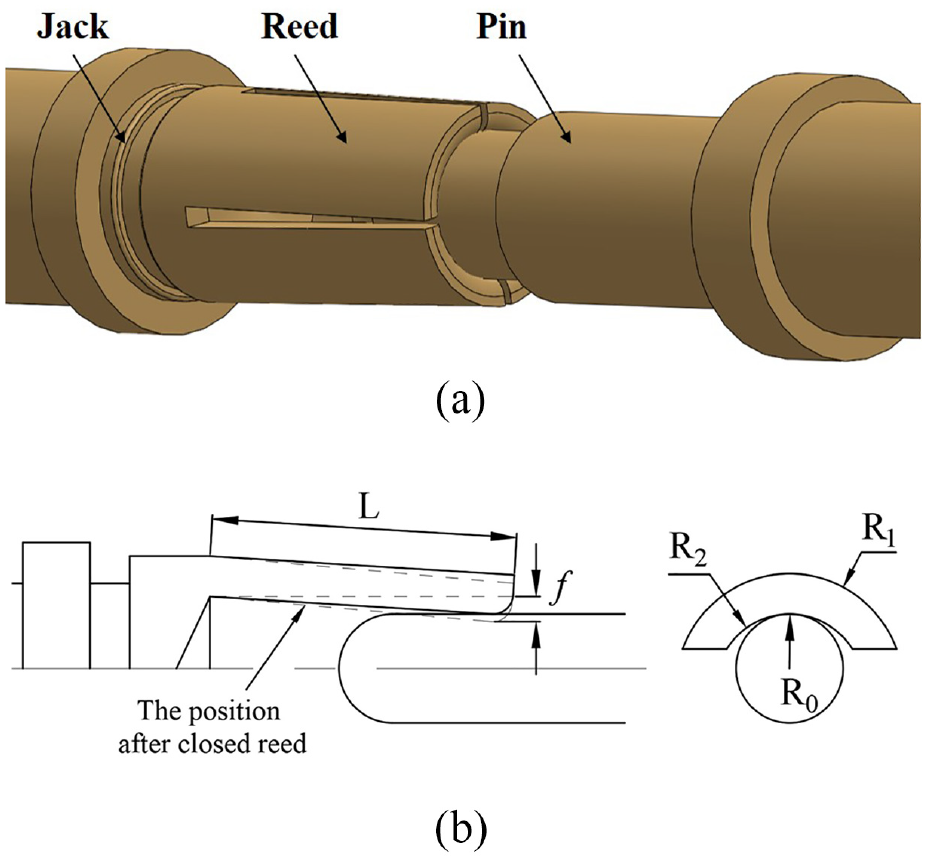
The structure diagram of contact pair: (a) the assembly drawing contact pair and (b) the axial and radial section drawing of contact pair.
where
The reed is simplified into a cantilever structure, as shown in Figure 3.

The cantilever structure of the reed.
The expression of the contact pressure

where
Reed deflection

The transverse section diagram of reed is shown in Figure 4.

The transverse section diagram of reed.
The moment of inertia of the transverse section of the reed

where
As shown in the expression of the contact pressure, when the materials of the contact pair are the same, the size of the contact pressure is mainly determined by the size parameters of the contact pair such as the length of the reed, the amount of the orifice, the radius of curvature of the outer surface, the radius of curvature of the inner surface. Meanwhile, the radius of the pin, and the size of the contact pressure will affect the growth rate of the oxide film. Therefore, the contact pressure between different aperture contact pairs is different, which leads to different failure conditions of different aperture contact pairs.
Degenerate trajectory model for contact pairs
Mathematical model of contact resistance of slotted leaf spring contact pair
At the microscopic level, the real conductive region of the contact pair is composed of raised contact spots on the contact surface. The contact resistance of the contact pair consists of three parts: the bulk resistance of the material, the contraction resistance of the contact spot, and the film resistance of the contact spot. Ignoring the difference in the randomness of the morphological structure of each contact spot, 17 it is considered that the jack reed has the same structure and is completely centering when inserted. The contact resistance of the contact pair with three slotted reeds can be expressed as:

where
According to the failure mechanism, the contact failure of electrical connectors in storage environment is caused by the increase of film resistance, while the bulk resistance and contraction resistance are mainly determined by the material, structure, and process parameters. When the contact parts leave the factory, these parameters have been determined and can be regarded as fixed values, denoted as

Mathematical model of film resistance
Barkan and Tuohy 18 established the calculation formula of film resistance through the study of contact resistance:

where
According to Dietrich and Fisher’s theoretical analysis and experimental derivation of tunneling effect, 9 the relationship between the tunnel resistivity of the film and the average thickness of the film is as follows:

where
With the continuous increase of the film thickness, the growth rate of film layer will gradually slow down. Therefore, the relationship between film thickness

where
Here, it is considered that the pore shape of the contact surface is approximately circular, and the oxide film layer will become more uniform with time. If the porosity of the contact zone is represented by

where
The expression of film resistance can be obtained from equation (1) and equations (6)–(9):

By substituting equation (10) into equation (5), the performance degradation trajectory model of the contact pair can be obtained:

Equation (11) contains various parameters such as the length of the reed

where
Acceleration model
According to the theory of chemical reactions, the higher the temperature, the faster the reaction. The relationship between reaction rate constant and temperature can be expressed by Arrhenius equation 19 :

where
By substituting equation (13) into the expression of the degradation rate

Taking the logarithm of both sides of equation (14) can be expressed as:

It can be seen from equation (15) that

where
Equation (16) indicates that the degradation rate
Contact reliability model for multi-aperture electrical connectors
Degenerate failure distribution model for contact pairs
In the storage environment, the contact resistance will increase with time. If the contact resistance of a contact pair at time

The lifetime of the contact pair can be obtained from equation (12) as:

Since the effect of the randomness of

Since the degradation rate

Thus, the degradation failure distribution model of the contact pair can be obtained as:
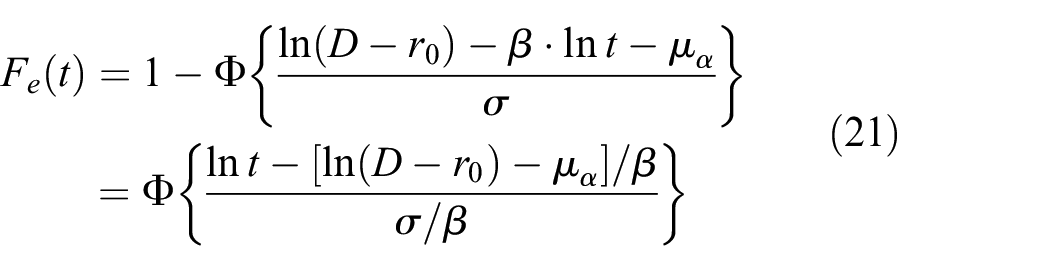
where
Then the reliability function of the contact pair at time

Life distribution model of electrical connectors
Assuming that there are

Because each contact pair is mutual independence and the

The multi-aperture electrical connector contains several groups of contact pairs with different apertures, and each contact pair group aslo contains multiple contact pairs with the same apertures. The failure of any one contact pair will lead to the failure of the entire electrical connector. Therefore, the life distribution model of electrical connector is the minimum extreme value problem of series system. According to the reliability model theory of series system, the life distribution function of electrical connector can be expressed as:
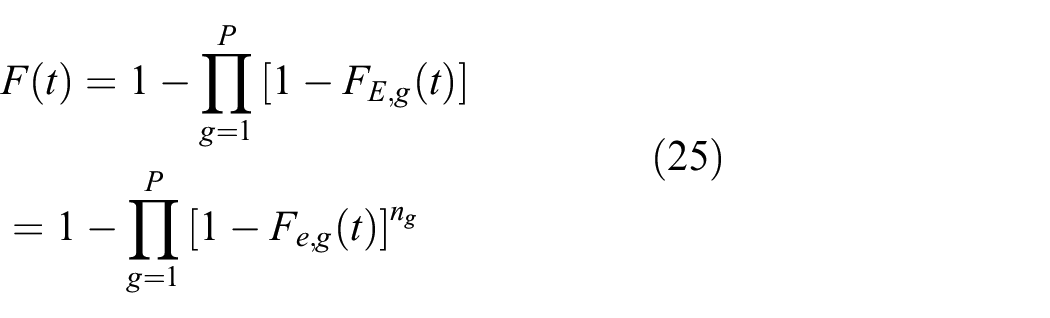
Then at time

By substituting equations (16) and (21) into equation (26), the mathematical relationship between the structural parameters of the contact and the contact reliability of the electrical connector can be obtained:

Accelerated test scheme and statistical analysis of test data
Constant stress accelerated test scheme
A type of multi-aperture electrical connector contains contact pairs with three aperture specifications, and the dimensions, numbers, and material parameters of contact parts are shown in Table 1.
The basic parameters of the contact parts.

According to the criterion that the test stress cannot change the failure mechanism, the three temperature levels of the test are determined as
Accelerated test scheme.

In order to determine whether the sample fails during the experiment, according to the product manual of this type of electrical connector, the failure criterion is determined as:
(a) The contact resistance of the contact pair of
(b) The contact resistance of the contact pair of
(c) The contact resistance of the contact pair of
During the test, once any of the above phenomena occur, the test sample is judged to be invalid.
The measurement of low resistance value needs to eliminate the influence of wire resistance, so this paper adopts the Kelvin’s four-wire method to measure the contact resistance, and its testing principle as shown in Figure. 5. In the figure,

The test principle of contact resistance.
The test device is shown in Figure 6. The contact pair of the electrical connector leads out two wires at both ends, forming two loops with the voltmeter and the ammeter. In one loop, the DC power supply is connected in series with the ammeter, which providing 5 V voltage and 1 A constant current in the loop, and the other loop is connected to the voltmeter to measure the voltage at both ends of the contact pair. According to the Ohm’s law, the value displayed by the voltmeter is the contact resistance. Each contact resistance measurement is performed three times, and the average value is taken as the final result.

The test device for contact resistance.
The test results of contact resistance
In the test, the contact resistance of each sample was tested according to the test interval in Table 1. The degradation track of contact resistance of each contact pair group of a sample at 120°C is shown in Figure 7. The number in the legend indicates the number of the contact pair. Among them, there are 206 contact pairs with Φ1.1 mm aperture. In order to show the performance degradation clearly, only eight contact pairs are selected for display.

Degradation trajectories of contact resistance for each contact pair group of a sample at 120°C: (a) degradation trajectory of Φ1.1 mm contact pairs, (b) degradation trajectory of Φ2.2 mm contact pairs, and (c) degradation trajectory of Φ3.5 mm contact pairs.
The statistical analysis of test data
The contact resistance value of the

where
According to equation (29), the estimated values of the degradation model parameters
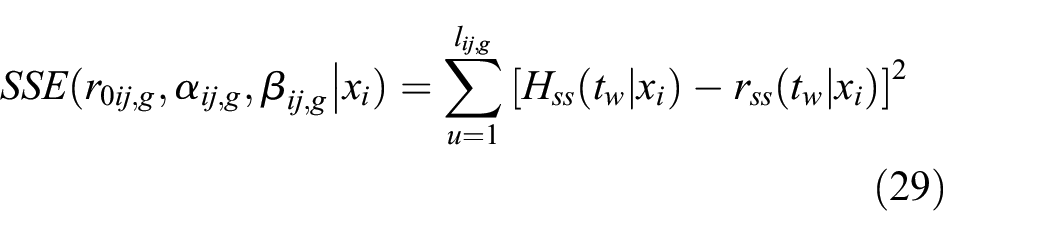
where
The estimated values of


The estimated value

According to equation (32), the estimated values of the parameters
Model validation and reliability evaluation
Validation of the degradation trajectory model
According to the performance degradation model in equation (12), a nonlinear regression model is established:

where

The validation of the degradation trajectory model is to test the goodness of fit of the model to the degradation data. The linear regression model was tested by residual analysis, and the fit of the linear regression model to the test data can be measured by the ratio

where
According to the data of the accelerated degradation test, the
The
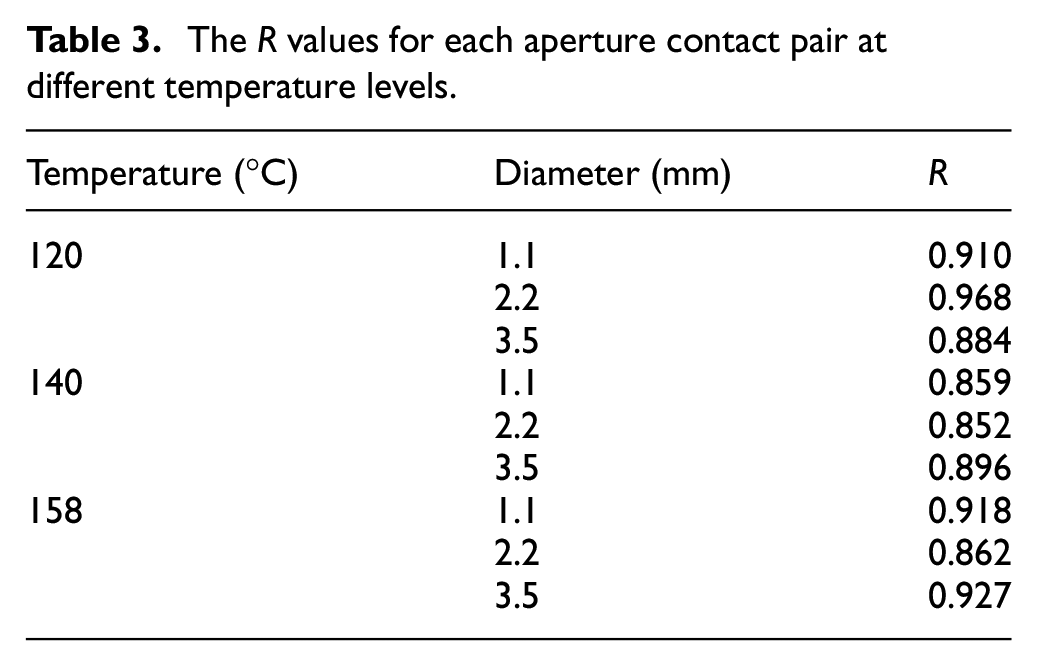
The closer the
The validation of accelerated model
The validation of the accelerated model is to test whether the linear regression between the log mean

where
The estimated value
The significance of equation (36) can be tested by the residual analysis, and the test statistic can be expressed as:

where
Here the significance level is
The test statistic F values for contact pairs with different apertures.

Table 4 shows that the test statistic
Contact reliability assessment of electrical connectors
The estimated values of the degradation model parameters can be obtained by using the statistical analysis method in Section “The statistical analysis of test data” to deal with the test data, as shown in Table 5.
The estimated values of the degradation model parameters.

By substituting the estimated values in Table 3 into equation (24), the reliability function of each contact pair group in the storage environment (25°C) can be obtained, and its reliability curve is shown in Figure 8.

The reliability curves for each contact pair group at 25°C.
It can be seen from Figure 8 that the reliability level of each contact pair group is significantly different, and the reliability of Φ1.1 mm contact pair group is the highest, followed by the Φ2.2 mm contact pair group, and the reliability of Φ3.5 mm contact pair group is the lowest reliability.
According to equation (27), the contact reliability function of the electrical connector can be obtained, and its reliability curve under the storage environment temperature (25°C) is shown in Figure 9.

The contact reliability curve of electrical connector at 25°C.
The contact reliable life of the multi-aperture electrical connector at 25°C is shown in Table 6. The evaluation results meet the reliability requirements of this type of electrical connector.
The contact reliable life of the electrical connectors at 25°C.

Conclusion
This paper focuses on the reliability evaluation of multi-aperture electrical connectors. Considering the influence of the aperture difference between the contact pairs on the contact reliability of the electrical connector, a reliability model of the multi-aperture electrical connectors is established by analyzing the structure and failure mechanism of contact pairs. Through the mathematical model of contact force, the main structural parameters of the contact pair are related to the contact reliability model of the electrical connector, which is helpful to explore the influence law of the structural parameters of the contact pair such as pin radius, reed length, curvature radius of reed inner and outer surface, and reed number on the contact reliability of the electrical connector.
In order to validate the proposed model, this paper conducts an accelerated test on a type of multi-aperture electrical connector. Through the test data, the correctness of the established model is verified, and the unknown parameters in the model is determined by using the least square estimation method and the maximum likelihood estimation method. The reliability levels of each aperture contact pair group in the electrical connector is compared, and the results showed that there were large differences between the contact pair groups, and the contact reliability of the multi-aperture electrical connector is evaluated in the final.
In conclusion, this paper presents a comprehensive approach for modeling and evaluating the contact reliability of multi-aperture electrical connectors, this approach is applicable when the contact pair groups of electrical connectors are independent of each other. Further research can be carried out on the basis of this paper when the contact pair groups of electrical connectors interfere with each other.
Footnotes
Appendix
The detailed derivation process of equation (3) is as follows. The area of the transverse section in Figure 4 can be expressed as:
The static moment
The moment of inertia
The distance
According to the parallel-axis formula, the moment of inertia
Handling Editor: Chenhui Liang
Declaration of conflicting interests
The author(s) declared no potential conflicts of interest with respect to the research, authorship, and/or publication of this article.
Funding
The author(s) disclosed receipt of the following financial support for the research, authorship, and/or publication of this article: This study was supported by Zhejiang Provincial Key Research and Development Program (2021C01133).
