




Abstract
There has been a tremendous development in the field of modeling and optimization methods starting from Taylor’s tool life model. Use of costly tools such as polycrystalline cubic boron nitride, polycrystalline diamond and ceramics in high-end computer numerical control machining forces the researcher to minimize the experimental runs to achieve the best cutting conditions with minimum tool wear and overall production cost. Machining process optimization to achieve said objectives comprises selecting optimum cutting parameters by applying low-cost mathematical models. This article attempts to evaluate the applicability of various modeling and optimization methods to specific response parameters in hard turning problems. Various empirical modeling techniques such as linear regression modeling, artificial neural networks, polynomial and fuzzy modeling along with process optimization through Taguchi, response surface methodology and genetic algorithm for hard turning applications have been discussed in length to provide the production engineers a ready database to compare relative merits and suitability of these techniques for a particular machining application. Also, article discusses integration of different modeling and optimization techniques to achieve desired goals when a single optimization technique is not able to provide the acceptable solution. The last part of the article highlights the current trends in hard turning applications and research priorities for future work.
Introduction
In today’s fast growing manufacturing sector, applications of modeling and optimization methods in metal cutting are essential to minimize tooling, production and maintenance costs and to improve the overall productivity. Selection of optimum cutting conditions can lead to a substantial reduction in the operating costs. Taylor 1 proposed an optimum/economic cutting speed that yields maximum metal removal rate. In manufacturing industries, the skill and experience of foreman and machine tool operators are utilized to evaluate the optimal cutting tools and cutting conditions. But they cannot be taken for granted every time. This unscientific approach results in low productivity due to underutilization of machine tool abilities. Therefore, an improvement in decision-making for enhancing the efficiency of process/product can be achieved by identifying the critical process/product parameters that control the process followed by optimizing these in order to achieve the desired responses within the constraints to achieve a low-cost manufacturing. 2 The objective functions most commonly used are as follows: minimization of production cost, tool wear, surface roughness, maximization of production rate, tool life and profit with respect to input machining variables such as feed, depth of cut, machining speed, combination of work and tool material and their properties. Machining process parameter optimization comprises two steps: (a) evaluating the input–output relationship of parameters and (b) identifying optimal or near-optimal machining conditions. Modeling the relationship between input–output parameters comprises correlating causes and effects. 3 The predicted model establishes the equation linking input and output to define the objective function of the machining process. Thereafter, optimization method generates optimal or near-optimal solution(s) as per the defined objective function which the production engineer may implement on shop floor. Several modeling techniques proposed for metal cutting are regression analysis, 4 neural networks (N-Ns) 5 and fuzzy modeling. 6 Some optimization techniques to achieve the desired responses in hard turning applications are Taguchi orthogonal design combined with signal-to-noise (S/N) ratio analysis, 7 response surface methodology (RSM) 8 and genetic algorithm (GA). 9 Whereas some optimization techniques for general metal cutting applications are mathematical programming, 10 Tabu search 11 and simulated annealing. 12 Although a number of authors have conducted studies for process optimization, yet one is unable to find a model that defines the input and output parameters’ relationship that is universal, applicable to whole world of metal cutting applications. 13 Luong and Spedding 14 revealed that a universal mathematical model that defines the cutting behavior over the whole range of cutting parameters does not exist at all. There are constraints with various optimization techniques, namely, assumptions and limitations made before analysis that limit the implementation of solutions generated therein in shop floor cutting process problems. Abuelnaga and El-Dardiry, 15 in their article, have described many conventional optimization techniques and compared them for their relative merits and demerits in different applications.
In the field of hard turning, a large variety of empirical models have been put forward by various authors to analyze the effect of process parameters (cutting tool geometry, microstructure of work material, feed, depth of cut and speed), tool and workpiece characteristics on tool performance (tool wear, tool life and surface finish of machined surface) and so as to achieve optimum machining conditions for various grades of hardened steel during its hard turning.16–18 The influence of machining conditions on cutting forces and roughness of the machined surface was investigated during finish machining of hardened steel (MDN 250) using ceramic tool through RSM. 19 The best fit was described by a linear model for cutting forces, and the significant contributing factors were the depth of cut and feed. The quadratic model was noticed to best fit the observed variation in surface roughness, with the major contributing factor as feed rate. Dureja et al.20,21 and Dureja 22 applied multiple linear regressions and RSM to model tool flank wear and roughness of the machined surface as functions of feed, depth of cut, cutting speed and workpiece hardness during hard machining of die steel (H11) with low cubic boron nitride (CBN) content and mixed ceramic tools. Quadratic models were found to fit the observed data. Three-dimensional (3D) response plots were used to depict the influence of independent parameters on output parameters. Optimum cutting conditions were arrived at through point prediction in desirability function optimization of RSM. Aslan et al. 23 optimized tool wear and roughness of the machined surface by using analysis of variance (ANOVA) and Taguchi optimization technique during hard turning of high-tensile steel (AISI 4140) by using ceramic (Al2O3 + TiC) tool. Ozel et al. 24 developed mathematical models for describing surface finish and flank wear by employing multiple linear regression analysis along with N-N method during machining of AISI-D2 steel by ceramic tools. It was observed that nose geometry of cutting tool strongly influences the productivity and surface finish of hard turning process. Huang and Liang 25 in their study on hard turning of die steel (AISI 52100) developed models to predict flank wear of CBN tools. The adhesion wear is observed to dominate the tool wear under normal machining conditions, but chemical diffusion becomes the leading wear mechanism over extended machining period and even under extreme machining conditions. The chip formation during hard turning of 16MnCr5 steel under hardened condition using CBN tools was investigated by Klocke and Frank. 26 They used finite element method (FEM) to model tool wear as a function of temperature at the tool-chip junction, chip geometry and cutting forces. Horng et al. 27 evaluated machinability of Hadfield steel through model based on RSM–central composite design (CCD). The ANOVA was applied to evaluate the influence of tool nose radius, feed, depth of cut and speed on roughness of the machined component and tool wear. It is revealed that tool wear is primarily affected by machining speed and interactive effect of feed and tool edge radius. Singh and Rao 28 developed RSM model to predict roughness of the bearing steel obtained from hard machining. It was noticed that feed significantly influences the finish of machined surface. The rake angle was found to have insignificant effect on roughness of the machined surface. Ozel et al. 29 conducted 24 factorial experiments, to study the influence of work material hardness, feed rate, speed and tool edge geometry on cutting forces and roughness of the machined surface during finish machining of tool steel with polycrystalline cubic boron nitride (PCBN) inserts. The machinability of coated PCBN and carbide inserts in hard turning of alloy steel (AISI 4340) was investigated by More et al. 30 They studied the effect of feed and machining speed on tool wear, cutting forces and roughness of the machined surface by using ANOVA technique. Bhardwaj et al. 31 established the empirical relationships between the machining parameters and average surface roughness using RSM. The first-order and quadratic models have been developed in terms of feed, cutting speed, depth of cut and nose radius. Furthermore, the Box–Cox transformation has been employed to improve the prediction ability of the first-order model. Zhang et al. 32 developed an intelligent model using back-propagation neural networks (BPNNs) to estimate the profile of longitudinal and circumferential residual stresses generated during finish hard turning. The predicted results matched well with the experimental results. The BPNN model performs better compared to conventional linear regression methods. Xue et al. 33 predicted tool life by particle swarm optimization (PSO)-back-propagation model and found that this model is much better than that of the back-propagation model. It proves that PSO-back-propagation model has better convergence, stronger robustness and higher generality. This model also provides a theoretical basis for the economization of tool demand analysis and production planning.
Thus, from the literature review, it is very much clear that numerous modeling and optimization techniques have been applied to achieve optimal setting of machining parameters targeting best quality machining at lowest cost. The models have been applied to predict tool flank and tool crater wear, cutting forces, tool life and residual stresses during hard turning of alloy steels. This article attempts to review the different modeling and optimization techniques to ascertain their suitability to modeling and optimization problems in metal cutting and specifically to hard turning area.
Empirical modeling techniques
The first step to optimize process parameters during hard turning operation is to enlist the factors that control the cutting process followed by development of an explicit mathematical model. These are categorized into two types: mechanistic and empirical. 34 An analytical approach can be applied to evaluate the functional relationship between input–output process parameters to yield a “Mechanistic model.” A very limited effort has been put by researchers to develop effective and efficient mechanistic models pertaining to metal cutting operations; 14 therefore, empirical models are generally employed for controlling metal cutting processes. Statistical regression models, 4 RSM, Taguchi designs, artificial neural network (ANN) approach 5 and fuzzy modeling6,35 also find application in modeling input–output process parameter relationships in metal cutting. Although these modeling techniques provide satisfactory solutions in some applications, the use of specific method is limited due to constraints involved, assumptions made and shortcomings of the modeling technique. The methodology of different modeling techniques, their merits and demerits along with their suitability to hard turning are discussed in the next section. The empirical model for evaluating the machinability of cutting tools is based on conducting experiments. This method analyzes the effect of independent variables, namely, depth of cut, tool geometry, feed and machining speed on output parameters such as surface roughness, residual stresses, tool wear and cutting forces. The empirical equations are developed for predicting values of response factors corresponding to input parameters. F.W. Taylor in 1957 first realized the importance of tool life estimation and the impact of economic performance models on production cost. Taylor 1 conducted extensive life testing of tools using the increases in tool wear-land as the limiting criteria. The empirical relation developed by Taylor to establish the tool life equation for turning operations, commonly referred to as Taylor’s tool life equation, is given below

where “a” is a speed exponent of the form 0 < (a = 1/n)< 1 and “T” is the tool life. Whereas “V” is the cutting speed and C1 is an empirical constant of the form C1 = C1/n. Since the early work of Taylor, further equations have been established for other machining operations, namely, drilling, milling and turning. The equations developed are similar to equation (1), but are extended to incorporate exponents for different cutting tool geometry, tool–work material combinations and other operation variables. Empirical models are most extensively used for establishing relations between input and output process parameters in hard turning. The most commonly used empirical modeling techniques are discussed in the next section.
Linear regression modeling
Statistical regression modeling is a technique to model and analyze several variables, to develop functional relationship between one or more dependent variable(s) and independent variables. Regression analysis enables to evaluate how any variation in any of the independent variables influences the change in value of dependent variable while keeping the other input variables as constant. Statistical regression may be applied for parameter estimation and control. 36 Multiple linear regressions along with ANOVA as reported in literature review are most commonly used for modeling responses in terms of different independent variables in hard turning applications. Multiple linear regressions establish the functional relationship between two or more input and output variables by applying linear equation on machining (experimental) data. Each value of the input parameter (x) corresponds to a definite value of the output parameter (y). The model regression curve/line for “p” independent variables x1, x2, x3, x4, x5,..., xp−1, xp is defined as

The above model describes how the mean response μy varies with the variation in independent variables. The experimentally recorded values of output variables (y) deviate around their mean values μy and are supposed to occupy the same value of standard deviation. Knowing the estimates of coefficients β0, β1,..., βp, one may get the parameters 0, 1, 2, 3,..., p − 1, p of the model regression curve. Since the experimental values of dependent variable (y) deviate around their mean values μy, the fitted model consists a constant corresponding to the noticed variation. The regression analysis expresses the model as Data = Fit + Residual. The expression β0 + β1x1 + β2x2 + β3x3... + βpxp describes the FIT of predicted model. The deviation of the experimental values of dependent variable “y” from means μy indicates the “RESIDUAL” term which have normal distribution having mean “0” and variance “σ.” The ε denotes residual or deviations of model terms from their respective means. The multiple linear regression model for n observations is defined as follows

Fitting the model means fitting the best fit line to experimentally observed data. For a least-squares model, the best fit curve corresponding to experimentally observed values is estimated by minimizing the sum of the squares of the residuals from the observed data points from the model curve describing model equation. In case, where the observed point falls exactly on the model curve, its vertical deviation is equal to 0. A statistical software is used to evaluate the least-squares estimates β0, β1,... βp. The sum of the residuals = 0. The term s2 is used to ascertain the variance σ2, which is also called mean-squared error (MSE). The standard error “s” is the square root of MSE. Extensive applications of regression modeling in hard turning are reported in section “Introduction.”20–22, 24 Apart from this, several other authors also applied regression modeling in their work.35-39 Ozel et al. 24 developed numerical models for describing finish of the machined surface and flank wear, using regression technique and N-N method during turning of die steel with wiper inserts made of ceramic material. Hassan and Suliman 13 used multiple regressions for modeling turning operation of medium carbon steel. Feng and Wang 40 observed that the surface roughness predicted during the turning operation by using regression analysis is comparable to those estimated from ANN models. Lin et al. 41 found that statistical regression model predicts tool wear more effectively than ANN during turning of aluminum metal composite. Uthayakumar et al. 42 used multiple linear regressions to model cutting forces as a function of feed, depth of cut and speed as independent parameters. El-Tamimi et al. 43 also used regression analysis to model cutting force tool life and roughness of the machined surface during machining of hardened martensitic stainless steel (AISI-420). The cutting conditions were optimized using different optimization functions. El-Hossainy et al. 44 applied regression analysis for modeling surface roughness and cutting forces in terms of various input parameters. Bartarya and Choudhury 45 applied regression modeling to evaluate the influence of machining parameters on cutting forces and surface roughness during finish hard turning of EN 31 steel using uncoated CBN insert. The predicted models were found statistically significant. ANOVA revealed the depth of cut as the most significant parameter affecting the cutting forces. Feed was also found to be a significant parameter. In most of the cases, cutting speed had only a marginal influence. Chinchanikar and Choudhury 46 applied multiple linear regression models to optimize and compare the machining performance of physical vapor deposition (PVD), TiAlN-coated carbide inserts with chemical vapor deposition (CVD) and TiCN/Al2O3/TiN-coated carbide inserts during turning of hardened AISI 4340 steel. Optimum cutting conditions were determined using RSM technique and the desirability function approach. Bhardwaj et al. 47 made an attempt to develop a surface roughness prediction model using RSM (CCD)with Box–Cox transformation in turning of AISI 1019 steel in terms of feed, speed, depth of cut and nose radius. The analysis has been carried out in three stages. In the first stage, a quadratic model has been developed in terms of feed, speed, depth of cut and nose radius. In the second stage, an improved prediction model has been developed by improving the normality, linearity and homogeneity of the data using a Box–Cox transformation. This improved model has been found to yield good prediction accuracy when compared to the previous one. In the third stage, confirmation experiments have been carried out, which clearly show that the Box–Cox transformation has a strong potential to improve the prediction capability of empirical models. Regression modeling is very effective for simple problems but has inherent limitations in situations wherein the relation between the output and input parameters is non-linear. 36 Statistical modeling has pre-requisite of making assumptions regarding functional relationship(s) that must exist between independent and dependent variables, namely, linear, quadratic, higher order polynomial and exponential. Moreover, the regression models are applicable over the range of independent variables selected in the study and not to whole universe such as analytical modeling. So this method can help in checking the cause and effect relationship, but not to establish the cause and effect relationship. For the model to be effective in predicting future results, the residuals appearing in regression equation must have mutual independence and should follow normal distribution, apart from having a constant value of variance. 4 In spite of all these limitations, multiple linear regressions are very suitable for modeling responses in terms of input factors in hard machining applications, where a broad relation between these variables can be hypothecated in advance.
Artificial neural networks (ANNs)
The software that mimics the structure of interconnected nerve cells of human brain are generally termed neural networks. Different types of N-Ns comprise individual nodes that function analogous to brain cells, arranged in different layers. The input data are fed into the input layer to obtain the results from the output layer. In between input and output layers, there is some hidden layer(s). Signals are received by each node from the previous layer, and these are summed up. If the total signal generated is big enough, thereafter, the node in one layer sends signals on to nodes in the next layer. The data are fed into the N-N as an array of “off” or “on” states in the input layer; network architecture processes the information and generates the output as a series of off or on states. However, the analyst has the flexibility to change the output by adjusting the strength of signals sent out by a single node to others. The N-Ns have inherent ability to simultaneously process and learn the concepts from the data fed in without having to be fed an exhaustive set of if-then rules. In this same manner, the network can characterize the cutting parameters and conditions of a machining operation. In response to the growing need for conducting tests, various N-Ns that attempt to mimic higher biological functions have been employed to evolve models for evaluating performance of various metal cutting processes.42–44 This means that for an individual tool manufacturer, the N-N will adapt and predict for their product or used as a more general system. The N-N research45–50 has been directed toward online monitoring of cutting tool performance using sensors fitted to the machine tool, in order to provide increased performance prediction and indicate potential tool failure. The performance of N-N systems is highly dependent on an optimal training strategy for their applicability to realistic machining situations. 47 This specialization by training of the network architecture to specific applications suggests that they are not suitable for a general cutting tool database for prior predictive performance because these systems are data driven in order to refine their predictive ability. For offline systems, however, training data sets will differ from an end-users’ working conditions and not represent the results of the end user, unless a training component is available and continually updated. Work materials from the same supplier can also vary, thus may alter the results significantly. This is because of the reliance on training the database to establish internal coefficients or network architecture for the software to work. As a result, the database that has been trained under certain conditions may be unsuitable for another user. The large variety of cutting conditions unrelated to the cutting geometries is a major hurdle before researchers while applying N-N for metal cutting. A few limitations of the N-N approaches are as follows:
The predicted model may render inconclusive parameters for non-linear dependence between independent and dependent variables.
The efficiency of N-Ns to accurately predict the results is dependent on an optimal training so as to ensure their applicability to practical problems at the shop floor.
Identification of significant observations, non-significant observations affecting the model termed as outliers and contribution of predictor terms may not be evaluated through this technique.
No universal criteria exist for selecting a specific ANN model, which is suited to a particular machining problem.
Due to the number of assumptions made and constraints associated with ANN, the technique is used only when the regression analysis fails in developing a suitable model. But if sufficient data are available to train the model, then the results can be astonishing as very few experiments are required to be performed in comparison to other modeling techniques. N-N modeling is used extensively for predicting cutting forces, tool wear and residual stress profile in hard turning applications in terms of process parameters.32,45
Polynomial networks
The advantage of polynomial networks over N-Ns and empirical modeling is that they require a much smaller set of training data to develop relationships between the parameters and evolve results specific to the data entered. Unlike RSM and N-Ns, the technique is able to self-establish or synthesize the optimal network architecture where the aforementioned methods require the network architecture in advance. A major advantage of this technique is the ability for the approach to be interpolated for different machining conditions and processes. In this method, the functional node can be expressed specifically into various types of nodes to provide different functions. These nodes are known as normalizer, unitizer, single node, double node, triple node and white node. These nodes are then used to construct a polynomial network. This form of network architecture has been applied to drilling 51 and turning 52 processes with promising results, yet its full potential in hard turning applications is required to be explored.
Fuzzy modeling
Fuzzy logic modeling technique has the ability to learn by reasoning through human intelligence, decision-making and other aspects related to human thinking. 53 The fuzzy set theory is used to strike a relationship between the input–output and intermediate process parameters. This technique also provides a module for optimizing cutting conditions and other features such as tool selection. The fuzzy logic modeling works on the principle that there exists an indecisiveness in process controlling variables due to ambiguity known as fuzzy uncertainty besides randomness alone. 54 Fuzzy modeling finds applications where clear-cut goals are not defined and the subjective opinion(s) of production engineer(s) has a deciding role in describing the objective function control is in uncertain environment. Klir and Yuan 35 revealed that fuzzy logic consists of (a) fuzzy interference engine and (b) fuzzification/defuzzification module. This module defines the input parameters as fuzzy membership values that are derived from different membership functions. Then on the basis of experimental observations, various rules that govern linguistic form are framed, for example, when the machining force is large and machining time is more than the tool will have more wear. These rules dictate the outcome of fuzzy engine on membership value. The outcome obtained from each rule is then combined to strike a final solution. The true predicted value of a response parameter such as tool wear is then obtained by defuzzifying the membership values using various techniques. 47 Shin and Vishnupad 55 revealed that a combination of fuzzy and ANN modeling techniques is more suitable to control complex machining processes. Kou and Cohen 56 also stressed that the combination of ANN and fuzzy-based techniques is required for controlling the process in manufacturing environment. Various authors have used fuzzy modeling for controlling problems in metal cutting operations. Karnatala et al. 57 used fuzzy modeling to predict surface roughness during finish machining process. The logic based on fuzzy set theory was used by Hashmi et al. 58 to decide the various machining parameters. Lee et al. 51 found that for a turning operation, fuzzy-based non-linear model was far more superior to conventional mathematical modeling subject to existence of “fuzziness” in the variables governing the process. The limitations of fuzzy modeling are that rules framed based on the knowledge and skill of process expert(s) cannot cope up with dynamic changes that may creep in cutting process thereafter. Moreover, these models cannot use analytical models developed for metal cutting operations. 55
Process optimization techniques
Taguchi orthogonal array
Dr Genichi Taguchi, a Japanese Engineer and industrialist, designed an experimental plan popularly known as “Taguchi’s orthogonal arrays.” These experimental designs are highly fractional designs that combine statistical techniques and engineering analysis to achieve quality output in terms of minimizing the production cost and optimizing the product design and manufacturing conditions. Taguchi designs have been developed to look into the main effects by conducting fewer experimental runs. Taguchi’s design are most suitable for two-level factorial experiments, but can also be used to evaluate the main effects when the level of factors is more than 2. These designs are also applicable during mixed level experiments when the independent parameters do not have equal number of levels. Taguchi’s design enables to design a robust product or process through its distribution-free orthogonal array design that is less prone to variation from random or noise variables. 7 These noise variables that are random in nature are not economical to control. These designs can be implemented with fewer resources and in less time and can identify significant factors influencing metal cutting operations so as to achieve quality product at minimum cost. 59 Taguchi designs integrate the design of experiments (DOEs) and parametric optimization to achieve desired goals. This performance of Taguchi’s design is ascertained by an index defined as S/N ratios. During the optimization process, S/N ratios, which are logarithmic functions of the targeted responses, are used as the objective functions. S/N ratio takes into account mean as well as variability and is expressed as below

The S/N ratio is controlled by product or process quality characteristics that are to be optimized. The optimal solution is provided by combination of parameter level that yields the maximum value of S/N ratio. S/N ratio optimization is often combined with ANOVA to identify parameters that are statistically significant in influencing the responses thereby predicting the optimal combination of process parameters. Numerous studies have been carried out using Taguchi designs to arrive at optimal setting of machining conditions in finish machining. Singh and Kumar60–63 used Taguchi’s orthogonal designs to minimize tool wear, cutting force, power consumption and surface finish during turning of En24 steel using coated carbide inserts. Aslan et al. 23 combined Taguchi technique and ANOVA to optimize roughness of the machined surface and tool wear during hard turning of alloy steel (AISI 4140) by mixed ceramics tool. Sahoo et al. 64 optimized surface profile during computer numerical control (CNC) turning by using L27 orthogonal design. Thamizhmanii et al. 65 used Taguchi method to analyze surface roughness generated in turning process. Thamizhmanii et al. 66 used Taguchi approach to optimize tool wear and surface roughness apart from cutting force during hard turning operation. It was revealed that Taguchi orthogonal design is an efficient technique to achieve desired responses by optimizing the independent parameters with only fewer experimental runs. Gopalsamy et al. 67 applied Taguchi method and ANOVA to find optimum values of process parameters during hard milling of steel using L18 orthogonal array. The results of Taguchi modeling matched that of ANOVA. Kazancoglu et al. 68 used integration of gray relational analysis (GRA) and Taguchi approach for multi-response optimization to minimize cutting forces and surface roughness and to maximize the maximum material removal rate (MRR). Taguchi method was used by Kolahan et al. 69 to achieve the best combinations of machining parameters and tool specifications to minimize surface roughness during machining of AISI1045 steel parts. Bagawade et al. 70 in their review article explained the steps and procedures used to optimize turning parameters using Taguchi’s DOE. They stressed that Taguchi method is a form of experimental design with special applications. Ananthakumar et al. 71 revealed that quality attributes for turning operation are surface finish, tool flank wear and MRR. When one quality characteristic is optimized, it leads to loss of other quality attribute. Therefore, multi-objective optimization is required to simultaneously satisfy all the quality requirements. The desired goal of multi-response optimization can be achieved by combining principal component analysis (PCA) with GRA or utility-based Taguchi approach. The combinational approach very well meets the objectives as compared to simple/existing Taguchi method wherever simultaneous optimization of large number of responses is required. Miroslav Radovanovic 72 optimized cutting parameters by Taguchi method based on cutting force in tube turning of S235 G2T steel by coated carbide tool using smaller-the-better quality characteristic. Furthermore, ANOVA was applied to evaluate statistically significant parameters influencing cutting forces. They reported that Taguchi method provides an efficient DOE technique to obtain efficient and systematic methodology for the optimization of the cutting conditions. Çydaş 73 applied Taguchi optimization and ANOVA to evaluate optimum machining conditions in hard turning of AISI 4340 steel with CBN, ceramic and carbide tools. Sahu et al. 74 applied Taguchi optimization and ANOVA to evaluate optimum machining conditions in hard turning of AISI 1015 steel under spray impingement cooling and dry environment. It is observed that with spray impingement cooling, cutting performance improves compared to dry cutting. The predicted multi-response optimization setting (N3-f1-d1-P2) ensures minimization of surface roughness, cutting temperature and maximization of MRR. Puh et al. 75 employed Taguchi experimental design and ANOVA to find optimum process conditions during finish machining of AISI 4142 steel using CBN insert. Multiple linear regressions were applied to predict model for surface roughness as a function of process parameters. It was revealed from the validation experiments that Taguchi design is a successful technique for optimizing turning parameters to achieve the best surface finish. Thus, from above and as reported in section “Introduction,” Taguchi modeling is an excellent technique to predict responses in machining applications with fewer experimental runs and is less prone to variation from random or noise variables. This is particularly suitable for forecasting tool wear, roughness of the machined surface and cutting forces during finish machining process requiring fewer tests.
Response Surface Methodology (RSM)
RSM is a combination of various statistical and mathematical techniques to develop, improve and optimize various processes.76–77 RSM is mainly suitable for applications wherein a dependent variable or response simultaneous depends on various input variables. The independent parameters are decided by the shop floor engineer. The empirical modeling method, described earlier, requires investigators to study the impact of cutting conditions on output parameter such as tool life by considering one variable at a time. This requires a set of trials corresponding to various combinations of tool and work materials. The resources to be mobilized for such a large number of experiments will be draining the resources needed to conduct the experiments. When the simultaneous variation in the number of input parameters (e.g. speed, depth of cut and feed rate) is taken into account to predict a dependant variable known as response factor (e.g. tool life), the best approach is RSM, where the response of the dependent variable, that is, tool life is projected as a surface. This allows the response parameter such as tool wear to be plotted as a contour against cutting speed and feed. The RSM technique shows potential for determining optimal tool life with reduced experimental testing in comparison to pure empirical methods. RSM consists of determining and fitting from experimental data an appropriate response surface model, using statistical experimental design principles and regression modeling in establishing an effective relationship between the response and the process parameters. RSM combines modeling and optimization methods to obtain the levels of machining parameters to obtain the desired level of response. The generalized relationship between the process variables A, B, C and D and the response (Y) is defined as

where φ is the response function that describes a response surface. The response Y is approximated by fitting a quadratic regression model in the following form

In the above equation, b0 is the constant and bi, bii and bij are, respectively, the coefficients of first-order (linear), second-order (quadratic) and cross-product terms. The term xi represents the input variables in coded form. The coding of input machining parameters xi (i = 1–4) is achieved from transformations given below
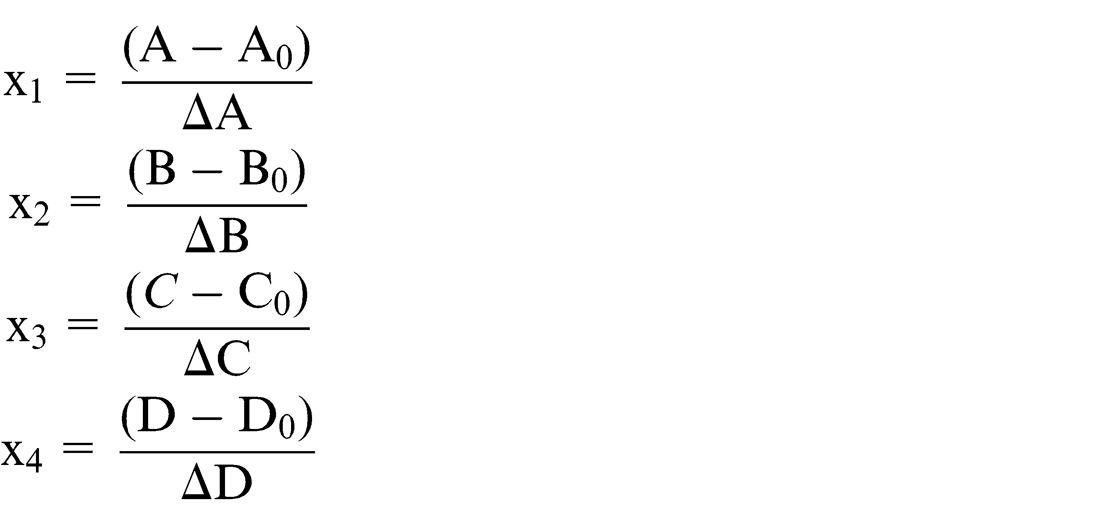
where A0, B0, C0 and D0 denote the values of respective input variables at zero level. The variation in respective input parameters, as mentioned above, is indicated by ΔA, ΔB, ΔC and ΔD. RSM has been extensively applied for simultaneous optimization of multiple responses in hard turning field.19–21,27,28 Box–Behnken design (BBD), CCD and D-optimal design are most commonly used for optimizing multiple responses in metal cutting applications. Box and Behnken 72 introduced RSM factorial designs (BBDs) for three-level factors to fit quadratic models to the responses. The designs obtained are combination of 2n factorial templates having incomplete block designs. The combination gives statistically sound plan of experiments where a few number of experiments are required to be conducted as compared to 3n factorial design.34,74,78 BBDs in RSM are very popular as they require only three levels of each process factor and only a fraction of all the possible combinations to model the output parameters and investigate the influence of independent variables. The best fit of experimental data is generally observed for quadratic model which is satisfactory for the purpose of process optimization. CCD is one more popular RSM template that requires five levels of each factor, that is −α, −1, 0, 1 and +α. The important feature of CCD is that it leads to sequential experimentation. CCDs can be carried out in blocks. There are three design points in CCDs: (a) fractional factorial (two-level) design points, (b) axial or star points and (c) center points. The D-optimal designs in RSM were developed to select design points in such an order so as to minimize the variance in the estimates of predicted coefficients appearing in the model. Various authors have different RSM experimental designs to model responses in terms of input parameters where simultaneous optimization of all responses is required. Chauhan and Dass 79 used CCD in RSM to predict models for tangential forces and surface roughness during turning of titanium alloy. They revealed that the fitted quadratic models are quite accurate for prediction of responses within the range of parameters investigated. Premnath et al. 80 used CCD template in RSM and numerical optimization to model and optimize surface roughness and cutting forces as a function of feed, depth of cut, speed and content of Al2O3. Bouchelaghem et al. 81 developed statistical models for tool life, tool wear and roughness of the machined surface by using RSM. Saini et al. 82 used BBD in RSM to model and optimize distribution of residual stress during hard turning of die steel (H11) with ceramic tool. Khamel et al. 83 applied desirability function optimization in RSM to optimize tool wear, cutting forces and surface roughness during finish turning using PCBN tool. There are three optimization tools available in RSM, namely, numerical optimization, graphical optimization and point prediction. Out of these, numerical optimization using desirability function module is most widely used in metal cutting applications.
Genetic Algorithm (GA)
GA is an optimization technique to solve complex problems through the process of natural evolution. GA comes from the family of larger class of evolutionary algorithms (EAs) that apart from modeling are employed for optimization, simulation and future prediction of processes. This technique provides a solution space (set of solutions) which initiates from a set of points, instead of one point. In machining, GA is generally recommended for optimization of quite complex cutting operations. The technique involves three basic principles: reproduction, crossover and mutation, to obtain the solutions set.10,84,85 The GA technique is implemented in three steps. The first step consists of binary encoding of cutting conditions as genes (strings of 0s and 1s), providing a trial solution called chromosomes. GA then generates new succeeding population from the initial random population through principle of natural evolution, that is, evaluating various feasible combinations of decision variables of the related process by reproduction, crossover (information exchange between the individuals) and mutation (self adaptation) in an iterative process. The successive solutions are selected through a fitness-based selection process. A suitable objective function or goal function is to be described for computations. Generally, a non-negative fitness function is obtained by appropriate scaling of the primary objective/goal function. The iteration is continued by taking the current population as the initial population till the stop limit is arrived at. Optimum cutting conditions or solution is provided by comparing different objective functions among all individuals through iterative process. The number of iterations of the process made is decided by the stop condition/predefined criteria. The GA optimization procedure requires GA parameters, objective functions and set of machining performance criterion. GA is a powerful tool for solving single- and multi-objective optimization problems. 85 GA-based optimization is applicable in large number of situations, yet there are certain inherent limitations: (a) convergence of the GA is not always guaranteed; (b) there exists no universal rule for selection of appropriate algorithm parameters (population size, string length, successive iterations, mutation probability, crossover probability, etc.); (c) GA may need substantial time to arrive at near-optimal solutions, accompanied with low speed of convergence and repeatability of results. 35 All these limitations still cannot hinder the ever-increasing horizon of GA in solving complex metal cutting problems. Various researchers and authors have applied GA for modeling of turning operations. Ko and Kim 86 employed multilayered N-N (back-propagation) integrated with an iterative learning through GAs to model and optimize cutting conditions in a turning operation. It was proved from experimental results that online modeling of turning process is possible with N-N. Moreover, by using GAs, the inputs, namely, feed and number of revolutions of spindle, can be adaptively changed to obtain maximum MRR. In order to minimize the production cost during CNC machining, simplified GA was used to determine the near-optimal values of various process and machining variables. 87 Multi-objective optimization technique was employed by Sardinas et al. 88 for multi-pass turning. They used micro-GA for Pareto analysis, through a group of non-dominant solutions. Paszkowicz 89 stated that GA can be used to solve complex computational problems related to modeling, optimization and simulation. Onwubolu and Kumalo 90 applied GA for multi-pass turning operations optimization. Thus, from the above paragraph, it is revealed that the use of GA in metal cutting optimization is increasing.
Integration of modeling and optimization techniques to achieve best results
Sometimes when a single optimization technique is not able to provide the acceptable solution, often an integration of different modeling and optimization techniques is made to achieve best results. Some recent studies have reported the integration of Taguchi design for initial DOEs along with RSM to develop and optimize models of response parameters. A comparison of optimization results of Taguchi analysis and that obtained RSM modules have been made. Sahoo and Sahoo 91 applied integration of RSM and gray-based Taguchi mathematical modeling and optimization for evaluating tool wear and roughness of the machined surface roughness during finish turning of stainless steel (AISI 4340) with carbide tools. For RSM models, the coefficient of correlation (R2) was greater than 75%, indicting good correlation between modeled and observed values of responses. The integral approach of Taguchi and GRA for simultaneous optimization of responses resulted in improvement of Grey relational grade (GRG) by 0.3093 and the optimal parametric combination is (d1–f1–v3). Elbah et al. 92 conducted a comparative study on ceramic tools with conventional and wiper geometry to evaluate their influence on surface roughness of the alloy steel (AISI 4140) during finish machining. Experiments were conducted as per Taguchi’s DOE (L27 orthogonal array) combined with analysis through RSM and ANOVA to model the responses, validate the fitted regression model (quadratic model) and identify the principal parameters influencing the surface roughness. The optimization was carried out by desirability function module in RSM to achieve best surface finish. Wonggasem et al. 93 explored multi-objective optimization during hard turning of AISI 6150 using PCA-based desirability index (DI) for correlated objectives. They proposed that in order to apply optimization methods, such as the DI, the conditional independence assumption is usually made. However, this assumption rarely holds true in real-world applications and the optimal solution obtained might be biased toward the performance measures which have strong positive correlations with the others. Therefore, in their investigation, they explored the integration of modified PCA and DI, based on empirical models of hard turning of AISI 6150 steel in which uncertainties are propagated by model errors. The results with integration of two methodologies, that is, PCA-based DI, show that the degree of importance of each performance measure has been adjusted by the integration of the covariance information into the overall performance index. It was revealed that the optimal solutions obtained from PCA-based DI slightly differ from the solutions obtained from the existing desirability indices, the arithmetic mean of desirability scores (DIa) and the geometric means of DI (DIg), due to the integration of covariance information in PCA-based DI. Pontes et al. 94 applied an integral approach of Taguchi’s orthogonal design and N-Ns (radial basis function) optimization to forecast roughness of the machined surface during finish machining. The ANNs were trained with training sets of different sizes to evaluate the best network capable of accurate and economical future prediction of surface roughness. The study revealed that radial basis function optimization approach achieves the best results while designing the experiments based on DOE methodology rather than mere trial-and-error approach. Ahilana et al. 95 designed experiments using Taguchi’s method with depth of cut, feed, speed and tool edge radius as the input parameters and power consumption and roughness of the machined surface as the objectives. ANN-based models were employed for prediction of process parameters during CNC turning. The results obtained from the experiments were employed for training the proposed hybrid models based on ANN. Out of all the models, the ANN model, which was trained by swarm particle optimization, was found to be accurate apart from having higher computational speed. The proposed model can be used in automotive industries for deciding the machining parameters to attain quality with minimum power consumption and hence maximum productivity. Asiltürk and Çunkaş 96 integrated ANN and multiple linear regression techniques to predict roughness of the machined surface during finish machining of AISI 1040 steel. Predictions made by regression analysis and N-Ns were compared through various statistical techniques. Although models predicted by both techniques effectively predict the surface roughness, ANN model provides better estimates of roughness. Singh and Rao 97 fitted first- and second-order RSM models for surface roughness on experimental data. The model obtained was optimized by GA. The GA provided optimal process conditions within the desired range of surface roughness. GA approach finds application in the high-quality process planning and products having close tolerances in a number of machining processes including hard turning. Saini et al. 98 in their articles have expressed in tabular form (Tables 1–6) the application of various modeling and optimization techniques used by various authors. It has been summarized that ANOVA, Taguchi technique and RSM are mainly used for modeling surface roughness during hard turning applications and RSM, FEM and N-Ns are used to model and optimize residual stresses’ profile. To model and optimize tool wear during hard turning, Taguchi along with multiple regression, FEM and neuro fuzzy techniques are used. Gaitonde et al. 99 used 33 full-factorial design and then used ANN and RSM to propose models to analyze the influence of machining variables on machinability during turning of die steel (AISI-D2) using ceramic tools with wiper geometry. The 3D response surface plots clearly indicated the existence of non-linear relationships between the process parameters and the machinability characteristics and thus justifying the use of ANN model. Gaitonde et al.99,100 planned experiments as per full-factorial design and employed RSM for the machinability study and model fitting of machining force, power and specific cutting forces and machining force, power and specific cutting forces, tool wear and surface roughness, respectively, in terms of machining parameters. Quiza et al. 101 proposed two models to predict tool wear for different values of cutting speed, feed and time; one of them based on statistical regression, and the other based on a multilayer perceptron N-N. Parameters of the design and the training process, for the N-N, have been optimized using the Taguchi method. Outcomes from the two models were analyzed and compared. The N-N model has shown better capability to make accurate predictions of tool wear under the conditions studied. Villeta et al. 102 applied statistical and Taguchi’s lower-the-better and S/N ratio techniques for optimizing surface finish during dry turning of magnesium. M. Chandrasekaran et al. 103 in their study proposed that an online optimization methodology with continuous learning is proposed and applied to finish turning process. Surface roughness is predicted using a virtual machine modeled with N-N and empirical equation/modeling. Optimization was carried out using simplex search or a fuzzy optimization method to determine optimum process parameters. Gaitonde et al. 104 combined full-factorial DOEs with RSM modeling and PSO to optimize the parameters during turning of tungsten–copper alloy. PSO program provided minimum values of surface roughness and the corresponding optimal machining parameters, namely, cutting speed, feed rate and depth of cut. Paul and Varadarajan 105 applied a regression model and an ANN model to fuse the cutting force, cutting temperature and displacement of tool vibration signals to predict tool flank wear during hard turning AISI 4340 alloy steel (46HRC) using a multicoated hard metal insert with a sculptured rake face. The fusion model based on the ANN was found to be superior to the regression model in its ability to predict tool wear. Farahnakian et al. 106 integrated N-N and electromagnetism-like algorithm for multi-constrained optimization in ultrasonic-assisted turning of hardened steel (AISI 4140). N-N was employed to model process outputs (surface roughness and cutting force). Then electromagnetism-like algorithm was coupled to N-N to maximize the MRR with regard to outputs of process as constraints to achieve the machined part requirements. It was observed that electromagnetism-like algorithm reported more accurate results in comparison to GA. Jafarian et al. 107 presented a hybrid method based on the ANNs, multiobjective optimization and finite element analysis (FEA) for evaluation of thermo-mechanical loads during hard turning of AISI H13 (52HRC). First, using an iterative procedure, controllable parameters of simulation (including contact conditions and flow stress) were determined by comparison between FEA and experimental results from the literature. Then, the results of FE simulation at the different cutting conditions and tool geometries were employed for training N-Ns by GA. Finally, the functions implemented by N-Ns were considered as objective functions of nondominated GA and optimal nondominated solution set was determined at the different states of thermal loads (workpiece temperature) and mechanical loads (workpiece effective strain). Comparison between the obtained results of nondominated GA and predicted results of finite element simulation showed that the hybrid technique of FEM–ANNs–multi-objective optimization provides a robust framework for machining simulation of AISI H13.
Summary of modeling and optimization techniques.

RSM: response surface methodology; ANOVA: analysis of variance; GRA: Gray relational analysis; 2FI: two-factor interaction; ANN: artificial neural network; GA: genetic algorithm.
Summary
The difference between empirical, Taguchi and RSM techniques to ANN and polynomial networks is that the latter two have to evolve a network architecture, which can be considered equivalent to evolving the exponents used in the empirical equations. However, all modeling techniques require a form of empirical testing to establish and train the models. The advantage ascribed to them is the reduced experimental runs to establish the relationships between the individual variables and the desired output such as tool life. This is because they are able to consider multiple variables rather than the one at a time factor (OFAT) approach which is used to establish the traditional empirical forms of testing. Ultimately, the relationships established by all the methods for a response factor such as tool life should converge as their accuracy is improved resulting in a mathematical relation considering all the possible variables. It is obvious that all prediction methods require significant resources to develop accurate relationships. The cutting tool employed in hard turning applications, namely, ceramics, PCBN and polycrystalline diamond (PCD), is very expensive leading to higher production cost. Unless a judicious selection of cutting conditions/parameters and tool–workpiece combination is made, the results can be quite disappointing because of extreme cutting conditions used in hard turning applications that result in early tool failure. Various modeling and optimization techniques have specific horizon of their applicability. The selection of an appropriate technique for a particular application needs a strong subject matter knowledge about the potential and suitability of these techniques thereby decreasing the machining cost and time. In order to achieve the specified objective, a comparative study of the various modeling techniques, highlighting their field of applications and limitations, is given in Table 1. It may be helpful to the production engineers for selecting the most appropriate modeling and optimization techniques for a given hard turning problem.
Current trends in hard turning applications
The critical review of literature has revealed that majority of the researchers applied RSM or Taguchi design without actual preliminary screening of significant process variables, whereas the right approach should have been application of OFAT to find the best operating range for parameters assuming that there is no two-factor interaction (2FI). But, many times, 2FIs exist in nature (especially in hard turning problems), and eliminating 2FIs sometimes proves disastrous in achieving optimum process conditions. Thus, there is interest in full-factorial design, where all the probable combinations are tested. But its biggest disadvantage is huge amount of experimental work, when the number of process variables or levels of factors increases beyond a certain limit, for example, eight variables with maximum and minimum levels (two levels) will yield 256 (28) experimental runs. As both work material (die steel, stainless steel, inconel, etc.) and tooling (ceramic, CBN, PCD, etc.) for hard turning applications are consumable and considerably costlier items, researchers generally avoid full-factorial design. To overcome this problem, researchers directly apply Taguchi or RSM design which includes many a times redundant variables. This redundancy in variables adds to model noise and produces results deviating from the optimum results.
Research priorities for future work
In mechanical engineering, majority of the researchers start applying Taguchi experimental design (L9, L18, L27, etc.) with not much understanding about significant process variables (main effects) and sometimes some noise variables are taken as process variables. Second major shortcoming is that Taguchi designs assume that factors are discrete in nature and there is no 2FI between the independent factors. But, in reality, main factors are mostly confounded with 2FI and researchers miss this aspect. Moreover, the independent factors in hard turning applications, namely, cutting speed, feed rate, depth of cut, tool angle, and workpiece hardness, can be varied continually and are not discrete in nature, thus contradict with Taguchi assumption. When Taguchi designs were first introduced, the computational power of computers was quite low and the robust process controls only limited to few independent parameters, whereas majority of process variables were uncontrollable and considered as noise variable. Thus, S/N ratio (%) was coined an important term during statistical investigation to check the main effects. In general, signal represents average response value and noise represents standard deviation, whose reciprocal will become coefficient of variance (standard deviation/mean), an important parameter to check the variability of response. The robust experiment design must include the following: first applying OFAT or fractional factorial design (Resolution-III, IV or V) to screen significant variables. Resolution-V design considers all 2FIs, whereas Resolution-IV design considers few 2FIs and their appropriate selection needs strong process understanding so as to eliminate non-significant 2FIs. Resolution-III design does not consider any 2FI and comparable with Taguchi design but assumes that process variables are continuous in nature. An experimental design with higher resolution level can fit higher order terms and some 2FIs, thus providing more useful information but at the cost of more experimental runs. Thus, there is a need to balance between experimental run and desired information so as to minimize the resources required. 108 Thereafter, using half normal probability plots, significant process variables can be selected based on t-test or stringent test such as Bonferroni limits. These selected/significant process variables should then be investigated using fractional factorial design and statistical investigation be performed to check for significant curvature in the predicted model, which indirectly may indicate that higher order model terms improve the model statistics. Finally, response surface optimization using center composite design (CCD), BBD or optimal design may be used for fine tuning of the process conditions. Once we are able to shortlist significant factors (say two or three important process variables) along with their narrow range, then design augmentation may be achieved by adding additional experimental runs (axial and center runs), for example, CCD or BBD for fine tuning of the process conditions. ANN modeling coupled with GA is a stochastic approach for finding optimum conditions, but researchers must ensure overfitting problem in ANN architecture, which fits all the experimental data but with poor predictions at not investigated design space. Although fitted ANN model coupled with GA can be used to evaluate optimum process conditions using Pareto front applying the principle of equally likely objectives. The methodology of sequential experimentation explained above will result in sound and robust DOE, wherein experimentation will be carried with significant variables only, eliminating all noise variables at preliminary stage and the analysis will yield a model with excellent predictions, excellent model variability explained and strong signal as compared to model noise. Finally, experimental design has no use, if researcher cannot reproduce the results, which is pre-requisite to DOE.
Footnotes
Declaration of Conflicting Interests
The author(s) declared no potential conflicts of interest with respect to the research, authorship, and/or publication of this article.
Funding
The author(s) received no financial support for the research, authorship, and/or publication of this article.