



Abstract
A mechanism has been developed to achieve rapid deployment of longitudinally folding wings by utilizing compound actuation from the firing powder and the compressive spring. A theoretical model based on rigid-body dynamics was first proposed to study the deployment characteristics of longitudinal folding wings under compound-driven effects. Subsequently, deployment experiments were conducted using a prototype to validate the theoretical model. It was observed that the folding wings are deployed in 11 ms. Further parametric analysis indicates that the mass of both the propellant and the locking rod has a positive effect on the deploying velocity. However, the angular moment of inertia of folding wings has a negative effect on the initial angular velocity. This work can be helpful for designing the folding wing structures of missiles and aircrafts.
Introduction
The utilization of deployment mechanisms is prevalent for designing aircraft with constrained space. Typically, the wings are initially folded for storage and transportation, and subsequently unlocked and deployed to attain full aerodynamic functionality. It is clear that a reliable deployment mechanism is essential for aircraft to achieve optimal attitude adjustments during flight. Researchers have developed and investigated various designs for deployment mechanisms, allowing the folding wings to rotate around a shaft, which can be oriented either parallel (i.e. transverse folding wing)1–16 or perpendicular (i.e. longitudinal folding wing)17–20 to the wing surface.
For transversely folded wings, Kroyer 1 investigated the static and dynamic behavior of double-segment transversely folded wings through numerical analysis, examining wing angular displacement, acceleration, and contact forces during deployment. Yang et al. 2 performed numerical and experimental wind tunnel analysis on a double-segment transverse folding wing, to establish a nonlinear aerodynamic governing equation for calculating the vibrational characteristics of the folding wing system. Huang et al. 3 investigated the unsteady aerodynamic characteristics of the Z-shaped wings during the upward folding process. Gao et al. 4 proposed multi-body dynamic theoretical models for the flexible cable-spring folding wing system to predict deployment properties. They also introduced a novel reliability method with angular precision control to analyze the reliability of the deployment process. Wang et al. 16 analytically and numerically investigates the optimal deployment mode of the transverse folding wing under different airspeed. Zhao et al. 5 designed a slider-crank folding wing system that utilizes a slider-crank mechanism to extend the wings, demonstrating the effectiveness of applying shape memory alloy to enhance support stiffness and eliminate clearance in the sliding pairs.
In the case of longitudinal folding wings, Lv et al. 17 developed theoretical models to analyze the dynamic deployment and aerodynamic behavior of the secondary wing within a double-segment deployment system. Their findings indicated that the aerodynamic performance of the folding wing is influenced by the initial deployment conditions. Additionally, they observed that the deployment process at various angles of attack significantly impacts the overall stability of the missile. 18 Lv et al. 19 further explored the deformation of double-segment wings during deployment using dynamic models that incorporate both rigid and flexible components. Sahin and Kulunk 20 employed the Bees algorithm to optimize the geometrical and mechanical parameters of torsion and compressive springs in a longitudinal folding wing deployment mechanism. The optimized design was verified through numerical simulations and experimental trials, revealing a deployment time of approximately 90 ms.
Current research on deployment mechanisms is constrained, as the majority of existing designs use springs to achieve the deployment. This study introduces a new deployment mechanism featuring longitudinal folding wings, which enables rapid and stable deployment by utilizing both firing powder and a compressive spring. The deployment characteristics are evaluated through dynamic theoretical models and experiments. Additionally, the study delves into a detailed discussion on the effects of the mass of the firing powder and locking rod, the angular moment of inertia of the folding wing, and the stiffness of the spring on the deployment process.
Structural design and principle
Structural design
The deployment mechanism consists of several components including a pedestal, folding wing, shaft and its holder, locking rod, buffer block, firing powder, locking bolt, compressive spring and its sleeve, as depicted in Figure 1. It is important to note that the geometric model and discussion herein focus on a single deploying unit with one folding wing for simplification purposes. Further details on the installation of these components can be observed in the cross-section view provided in Figure 2. The shaft and its holder are affixed to the pedestal, with the folding wing mounted on the shaft and rotating around it. The locking bolt is securely screwed onto the pedestal through its lower end and connected to the locking rod through its upper end, forming a sealed chamber between the locking bolt and pedestal. The locking rod locks the wing in its initial position by fitting into a slot on the folding wing’s trailing edge. The firing powder, contained within the sealed chamber, generates high pressure to initially propel the folding wing. The compressive spring and sleeve are inserted into a channel near the shaft in the pedestal, providing ongoing driving force for the folding wing during deployment and securing the deployed wings afterward. Additionally, the buffer block, fixed on the pedestal, acts as a stopper for the folding wing.

Geometric model of the deployment mechanism.
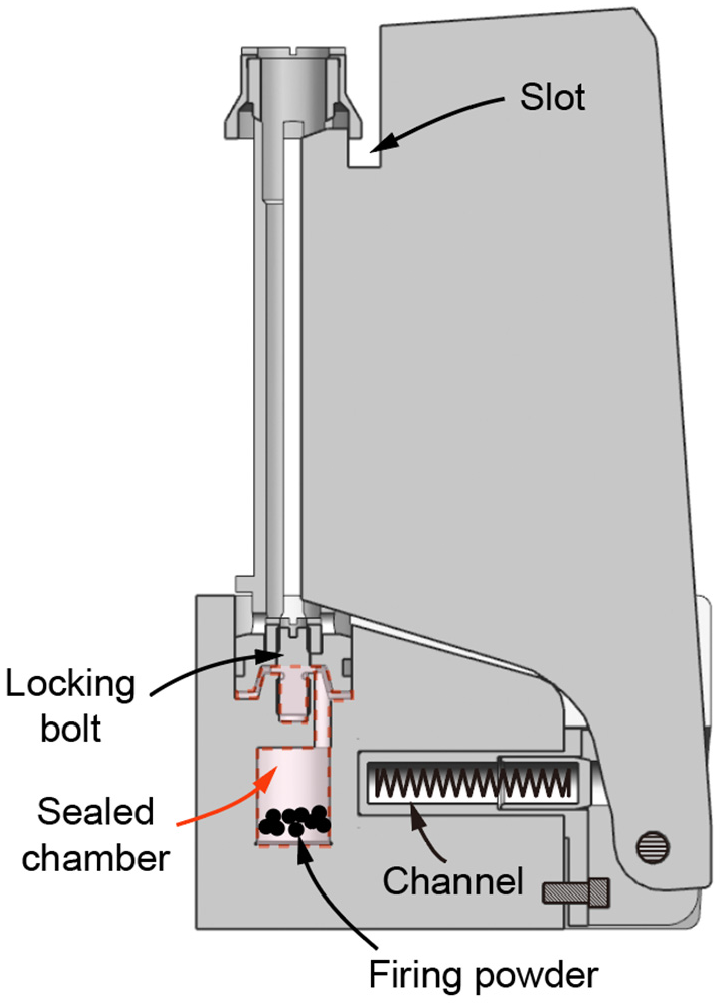
Cross-section view of the deployment mechanism.
Deployment principle
As illustrated in Figure 3, the deployment process of the mechanism can be divided into four stages: the initial locking stage (Stage I), the unlocking stage (Stage II), the rotating stage (Stage III), and the final locking stage (Stage IV). In Stage I (Figure 3(a)), the folding wing is secured in its initial position by the locking rod, with the spring compressed by the wing’s root. Stage II (Figure 3(b)) is initiated when the powder is ignited, causing the locking bolt to fracture and be ejected by the explosive shock. Subsequently, the folding wing is struck by the locking rod, acquiring an initial angular velocity to rotate around the shaft. Throughout the ongoing rotation of the folding wing in Stage III (Figure 3(b)), the spring continuously rebounds, and the sleeve remains attached to the folding wing, contributing additional dynamic energy to the rotation. Upon reaching the predetermined position, the folding wing is halted by the buffer block and restrained by the sleeve at Stage IV (Figure 3(c)). The residual dynamic energy of the folding wing is then dissipated by the combined restriction of the buffer block and sleeve. As the oscillation of the folding wing reaches a stationary state, the entire deployment process concludes.

Deploying process of the deployment mechanism, (a) Stage I, (b) Stage II and Stage III, and (c) Stage IV.
Theoretical model
A theoretical model based on energy balance and principles of angular momentum has been developed to predict the deployment characteristics of the deployment mechanism from Stage I to Stage III, while the oscillation process in Stage IV is neglected. It is also noted that the theoretical model employs the rigid body assumption, which means that the elastic and plastic deformations of parts of the deployment mechanism are disregarded.
Stage I
In Stage I, the folding wing is held in place by the compressive spring and locking rod. The static equilibrium is depicted in Figure 4 and is expressed as

where

Static equilibrium at Stage I.
Stage II
As shown in Figure 5, the powder is stimulated by an external electrical signal at the beginning of Stage II, generating explosive shock waves to fracture the locking bolt. Subsequently, the lower part of the locking bolt remains fixed on the pedestal, while the upper part is ejected along with the locking rod by the shock waves, unlocking and striking the folding wing. At the moment of impact, the dynamic energy of the combination part,

where

Unlocking process at Stage II.
Assuming that the locking bolt is composed of metallic materials, its quasi-static uniaxial tensile behavior may be characterized by a bilinear elastic-plastic model as Figure 6, and

where

Bilinear elastic-plastic model for the locking bolt.
Following unlocking and striking, the folding wing acquires an initial angular velocity



where
Stage III
The rotational movement of the folding wing in Stage III as shown in Figure 7 is derived as

where

Deployment process in Stage III.
The contact area between the sleeve and the folding wing varies during rotation. To facilitate the estimation of the spring’s driving torque, it is assumed that the contact condition is idealized, as depicted in Figure 8. Based on quantitative relationships, the transient compression length of the spring

where

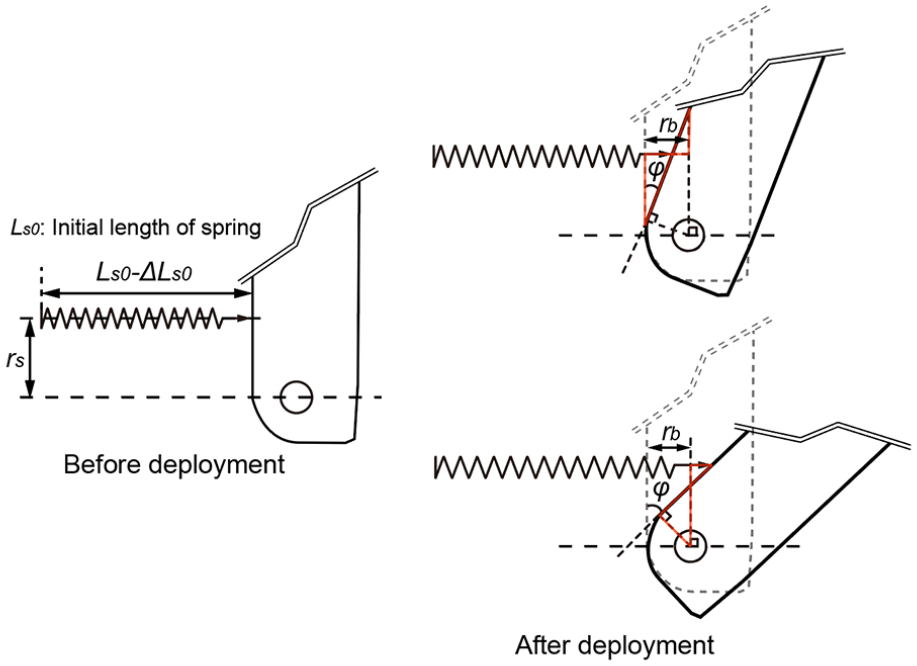
Ideal contact conditions between the spring and the folding wing.
Experiment
To validate the proposed theoretical model, deployment experiments were carried out by using a prototype for four-channel longitudinal folding wings with compound actuation. The prototype, as depicted in Figure 9, was constructed using a pedestal made of 7075 aluminum alloy, featuring a hole for the passage of wires of an electric squib. The sealed chamber contained blasting powder with an energy density of 0.03 MJ/Kg and a mass of 180 mg. Upon ignition by a 3.5A current signal, the electric squib immediately ignited the powder. The locking rod, spring, folding wing and holder are made of steel and mounted on the pedestal. The locking rod has a mass of 55.54 g. The spring has a stiffness factor of

Prototype for four-channel longitudinal folding wings with compound actuation.

Dimensions of folding wings of the prototype (Unit: mm).
Figure 11 shows the setups for the deployment experiments. The prototype was mounted on a protective holder and placed on a flat table. The electric squib was linked to an external power by long wires. A high-speed camera with frame rate 2000 fps was used to capture the deployment process. By identifying characteristic points of the folding wing in each frame, experimental time history curves for the angular displacement and angular velocity of the folding wing were obtained.

Setup of deployment experiment.
Results and discussion
While deploying, the high speed camera captured the revolution process of two folding wings, W-1 and W-2, as shown in Figure 12. The corresponding time history curves of experimental angular displacement are presented in Figure 13. Upon powder ignition, it is clear that the angular displacement of both wings increases almost linearly from zero to 90°. After that, the curves show fluctuation within a limited range, indicating the halting of the folding wings by the buffer block and the sleeve. Throughout the deployment process, the rotation of the folding wing takes approximately 11 ms, while the subsequent oscillation endures for a long period.

High-speed camera frames of the deployment process, (a) t = 0 ms, (b) t = 2.5 ms, (c) t = 5 ms, (d) t = 7.5 ms, (e) t = 10.0 ms and (f) t = 12.5 ms.

Comparison of experimental and theoretical results.
Analytical predictions are derived by substituting the key parameters of each component into the theoretical model. Assuming an energy loss factor k p of 0.7 and disregarding the influences of gravity and friction, the angular displacement time history curve is predicted using the fourth-order Runge-Kutta method (Figure 13). The analytical results demonstrate good agreement with the experimental data, signifying the sufficient accuracy of the theoretical model. It also reveals that the effects of gravity and friction play a minor role during the deployment process.
Experimental results disclose the initial angular velocity of the folding wing has significant influence on the time costing of the entire deployment. By substituting equation (4) to equation (5), the initial angular velocity

The effects of the mass of firing powder on the angular displacement and initial angular velocity of the folding wing are shown in Figures 14 and 15, respectively. Figure 14 demonstrates that a minimum powder mass of 64.29 mg is necessary to fracture the locking bolt. With an increase in powder mass from 64.29 to 270 mg, the angular velocity of the folding wing increases as well, thereby reducing the deployment time from around 49 to 8 ms. The initial angular velocity exhibits a non-linear positive proportionality to the powder mass, as depicted in Figure 15, indicating that the enhancement effect diminishes with further increases in the firing powder mass. Moreover, an excessive amount of firing powder could cause the sealed chamber to fracture and lead to significant oscillations in the final locking stage, emphasizing the importance of determining an appropriate powder mass.

Time histories of angular displacement of the folding wing under different powder mass.
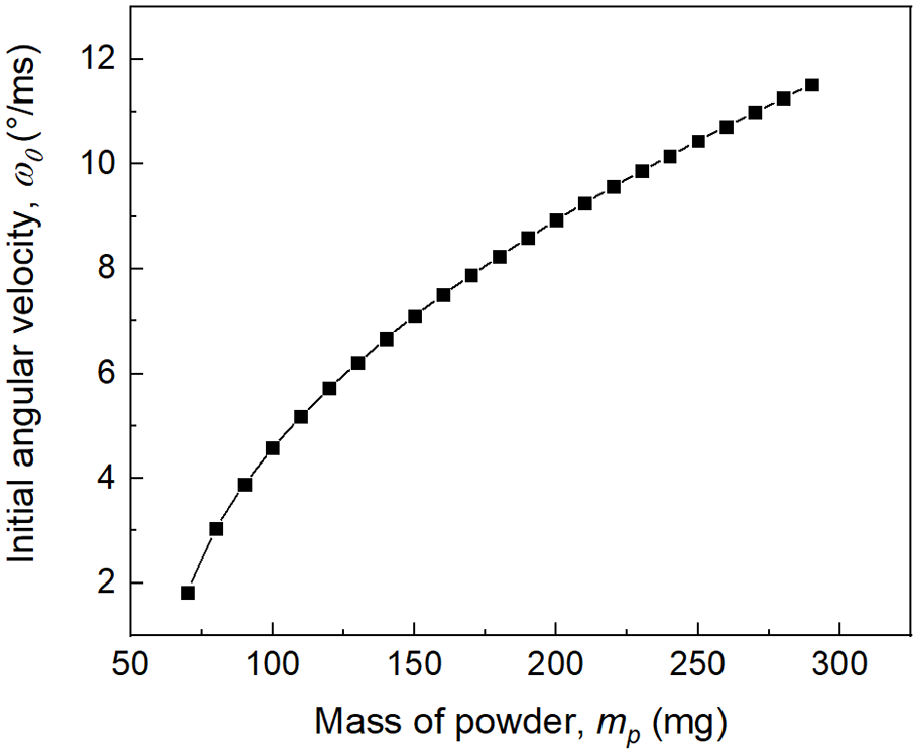
Initial angular velocity of the folding wing versus powder mass.
The initial angular velocity exhibits a non-linear positive correlation with the mass of the locking rod, as depicted in Figure 16. As the mass of the locking rod increases, the initial angular velocity experiences a rapid rise followed by a plateau. This suggests that the mass of the locking rod significantly impacts the initial angular velocity when it is below 1 kg. Considering that excessively high initial velocity may cause severe oscillation of the folding wing in the final locking stage. It is therefore supposed to find an appropriate locking rod mass for the deployment mechanism in practical applications.

Initial angular velocity of folding wing versus locking rod mass.
The effect of the angular moment of inertia of a folding wing on the initial angular velocity is shown in Figure 17. Initially, the angular velocity experiences a rapid decrease, followed by a slower decline. Noted that when the angular moment of inertia is relatively small, the initial angular velocity can reach unrealistically high levels, nearly approaching

Initial angular velocity versus angular moment of inertia of the folding wing.
The effect of the angular moment of inertia of the folding wing on the rotation process is further investigated by assuming a constant initial angular velocity, as shown in Figure 18. It is evident that as the angular moment of inertia increases, the deployment time rapidly rises before stabilizing. Excluding the unrealistic region with high angular velocity, it indicates that the folding wing’s angular moment of inertia has a slight effect on the rotation process.

Deployment time cost versus angular moment of inertia of the folding wing.
The influence of spring stiffness on the angular displacements of the folding wing is depicted in Figure 19. The compressive spring has a positive effect on the angular velocity, albeit less than the effect of the firing powder. For a smaller firing powder mass, the impact of the spring stiffness may be more noticeable.

Angular displacement versus time curves under different spring stiffness.
Concluding remarks
A new deployment mechanism has been developed to investigate the deployment characteristics of longitudinal folding wings with compound actuation in the current work. The compound actuation involves the use of firing powder and a compressive spring to achieve rapid rotation of the folding wing. Experimental findings demonstrate that the folding wing can be deployed within a short time period by the mechanism. A theoretical model, based on the assumption of rigid body behavior, is presented to forecast the deployment characteristics of the folding wings, and its accuracy is confirmed through experimentation. Effects of mass of firing powder, mass of locking rod, angular moment of inertia of folding wing and stiffness of spring on the deployment process are further discussed in details. It is observed that increasing the mass of both the firing powder and the locking rod can elevate the initial angular velocity of the folding wing. However, this enhancement diminishes gradually with further increases in the mass of the firing powder and locking rod. Excessively high angular velocity may lead to structural failures. Hence, it is crucial to judiciously select the geometric and mechanical parameters of each component. The compressive spring exerts a beneficial influence on the rotation process. The insights derived from this exploration of the proposed deployment mechanism can offer valuable guidance for designing folding wing structures of missiles and aircrafts.
Footnotes
Appendix
Handling Editor: Sharmili Pandian
Author contributions
Conceptualization, Experiment designing and conducting, Result analysis, J.Z.; Conceptualization, Theoretical analysis, Writing, T.C.; Conceptualization, Investigation, Review & Editing, H.Z.; Investigation, Review & Editing, Q.Q.
Declaration of conflicting interests
The author(s) declared no potential conflicts of interest with respect to the research, authorship, and/or publication of this article.
Funding
The author(s) disclosed receipt of the following financial support for the research, authorship, and/or publication of this article: The authors are grateful for financial support of National Natural Science Foundation of China (No.61975161).
Data availability
The dataset generated and analyzed in this study may be available from the corresponding authors on reasonable request.
