



Abstract
The current analysis aims is to investigate the steady-state visco-plastic Casson nanofluid flow over an electrically conducting stretching porous surface. Thermophoresis and Brownian motion parameters are utilized for modeling and analysis. Also, Joule heating, thermal radiation, thermal robin condition, thermo-solutal stratifications, and viscous dissipation are considered for energy and nanoparticle concentration. Using appropriate similarity transformation, the partial differential equations (PDEs) system is altered into ordinary differential equatons (ODEs). The Homotopy analysis method (HAM) is used for solving governing equations. The effect of distinct physical parameters on the velocity, concentration, temperature, and microorganism’s density is revealed graphically and discussed tabularly. Additionally, numerical analysis is conducted on designed Nusselt number, Sherwood number, skin friction, and motile microorganism’s density. The major finding of the study is that the fluid velocity decreases as both the magnetic parameter and Casson fluid parameter increases. Instead, increasing the values of the Deborah number and activation energy results in an increase in fluid temperature. The current study is useful for coating deposition of magnetic nanomaterials at comparatively higher temperatures.
Keywords
Introduction
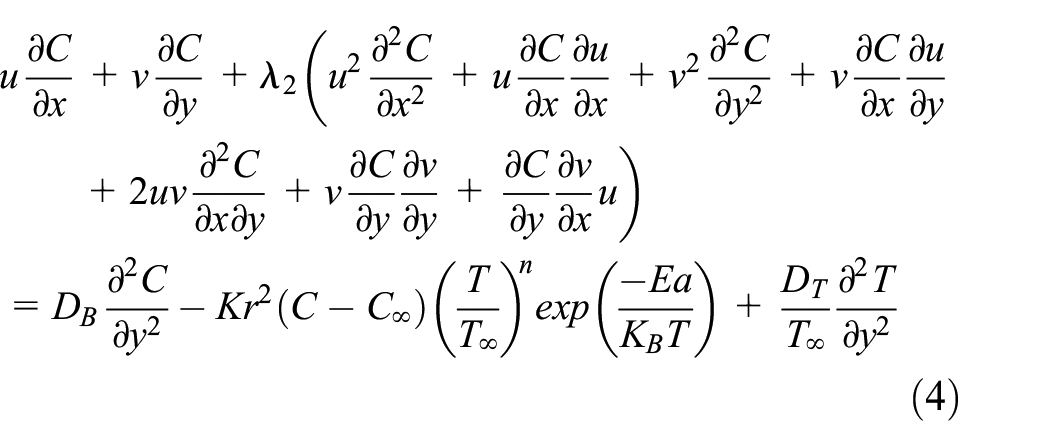
Researchers from all over the world are interested in nanotechnology because of its applications in a variety of fields, including chemical sensors, fuel cells (nano-plates), medicine (drug delivery, clinical trials), batteries (silver-zinc, lithium-ion), food (bottles, cartons), electronics (electronic circuits, switches, silicon nano-photonic), and solar cells (graphene, nanowires). The application of Casson nanofluid flow over electrically conducting vertically stretched porous surfaces in the field of electrochemical engineering particularly in the advanced development of batteries that is, electrochemical reactors (electroplating, water electrolysis, or wastewater treatment), battery cooling systems, fuel cells and electrolytic cells etc. In today’s industrialized world, efficient heat transfer is becoming more and more important. Conventional cooling agents might not be sufficient to meet future demands. Due to their special properties, nanofluids, which are systems that contain small particles called nanoparticles typically around 100 nanometers in size are thought to be highly effective heat conductors. Fluids including water, oil, ethylene, and glycol can all include these nanoparticles. The nanoparticles such as metals, nitrides, oxides, carbon graphite, carbides, and nanotubes can be added to the fluid and subsequently lodged inside them to increase the thermal conductivity of nanomaterials. Nanofluids are the essential in a variety of engineering uses because of their transmission of heat properties. Choi and Eastman 1 studied the effects of nanoparticles on the thermophysical features of liquid. According to Choi the nanometer sized particles added to base fluids improved its thermal conductivity. The importance of different transfer limits of MHD bioconvection nanofluid flow was discussed by Awais et al. 2 Anjum et al. 3 investigate the effect of chemical reaction with dual stratification in MHD- based nanofluid flow. The effect of radiative heat in unsteady electrically conductive MHD boundary layer Casson nanofluid flow containing chemical reactive material completely examined by Sedki and Qahiti 4 Khan et al. 5 studied the two-dimensional flow of Carreau fluid. Bilal et al. 6 studied the analytical solution of Casson fluids on the Riga surface. The activation energy influence on stretching flow was examined by Batool et al. 7 The effective approach of Prandtl’s number was applied by Lee et al. 8 to tackle the nanofluid problem of non-Newtonian nature. Hussain et al. 9 used the combined Carreau-Yasuda model for nanofluids to study the numerical solutions for the stagnation point. Farooq et al. 10 develop a mathematical model to examine the effect of chemical reactions of non-Newtonian nanofluid on the bioconvection features of self-propelled microbes, examing the fluid model of Casson and inclined stretching geometry. Minea 11 examined oxide nanoparticles’ ability to transport heat in single and hybrid nanofluids for use in energy applications. The effects of non-uniform heat source and heat on magnetic nanofluid flow over a cylinder which is porous were examined by Singh et al. 12 using the Keller box approach. The effects of injection/suction and analysis of entropy on MHD convection nanofluid flow via a cone which were inverted are studied by Vedavati et al. 13 Seethamahalakshmi et al. 14 calculated the significance of exploring the combined effects of convective boundaries, thermal radiation, and (MHD) slip flow over a stretching porous surface. By using a stretched cylinder, Sohail and Naz 15 were able to detect the Sutter boundary layer movement caused by nano liquid. The study of nanofluids was reviewed by Ahmad et al., 16 who also discussed the four different sizes of nanofluids: macroscale, microscale, molecular scale, and megascale. These scales are related to each other. Before discussing the use of suspensions containing both motile bacteria and nanoparticles in micro-systems, it is important to examine how these suspensions behave. Hafez et al. 17 examine the Darcy-Forchheimer Casson nanofluid flow over a stretching sheet. Specifically, the research concentrations on examining the effects of Joule dissipations and viscous induced by electro osmosis forces (EOF) of the Casson nanofluid on the boundary layer. The influence of Joule heating and viscous dissipation on Brinkman-Darcy- Forchheimer of third-grade MHD flows fluid between two parallel plates were examined by Zhang et al. 18 Chakraborty et al. 19 deliberated on the expansion below the boundary layer and the magnetic fields effect on bio-convectional nano liquid flow. The relation of Buongiorno for the flow of bio-convectional nano liquid in a porous channel with increasing relaxation and contraction was considered by Beg et al. 20 Abbas et al. 21 investigate the steady state flow features of a Williamson Casson fluid induced by a stretchable and impermeable sheet, while seeing dissipation Ohmic effects. The analysis was carried out by Khan et al. 22 though the observation of the Oldroyd-B nanofluid bioconvection flows over the extended sheet, which is believed to demonstrate oscillations. According to Sandeep and Raju 23 research, the rotating cone offers substantially superior heat and mass transfer when it comes to non-Newtonian fluid of MHD bioconvection flow with cross diffusion past over a rotating plate. Tarakaramu 24 studied the effect on the motion of a Casson liquid of variable thermal conductivity over a porous stretching sheet. Akbar et al. 25 related to a latest analysis regarded viscous flow for temperature-dependent several shaped nanoparticles in a stretchy tube. The characteristics of bioconvection EMHD nanofluid flows effect through a Riga plate with the activation energy were revealed by Bhatti and Michaelides. 26 Makhdoum et al. 27 examine magnetohydrodynamic (MHD) flow of 50%EG-water, 30%EG-water, water, with nanoparticles graphene with zero mass flux conditions, thermal convection, and velocity slips over a stretched surface comprising nanoparticles and motile microorganisms. Bioconvection characteristics of squeezing couple-stress nanofluids flow across a horizontal channel were studied by Srinivasacharya and Sreenath. 28
The literature mentioned above demonstrates a wide range of studies conducted on nanofluid flow. In light of the aforementioned literature, the current study aims to examine steady-state visco-plastic Casson nanofluid flow across a vertically extended porous surface that conducts electricity. The effects of Joule heating, thermal radiation, thermal Robin condition, thermo-solutal stratifications, and viscous dissipation are taken into account. HAM is used to resolve the transformed equation. The influences of distinct parameters on temperature, concentration of nanoparticle, velocity, and motile microbes density are calculated by Mathematica, though which a systematic study has been conducted to examine the influences of distinct parameters. The current work finds applicability in magnetic nanomaterials coating deposition at substantially higher temperatures; moreover, the intended values for Sherwood number, skin friction, the motile microorganism’s density, and Nusselt number are analyzed numerically.
Formulation
Consider a visco-plastic steady-state (Casson) nanofluid flow over a vertically porous stretched surface. The flow is incompressible, laminar, and two-dimensional. A stretching flow that is electrically conducting under the influence of a magnetic field with strength




Geometry of the problrm.
With conditions


In the aforementioned equations,
The similarity alteration for the above model is:

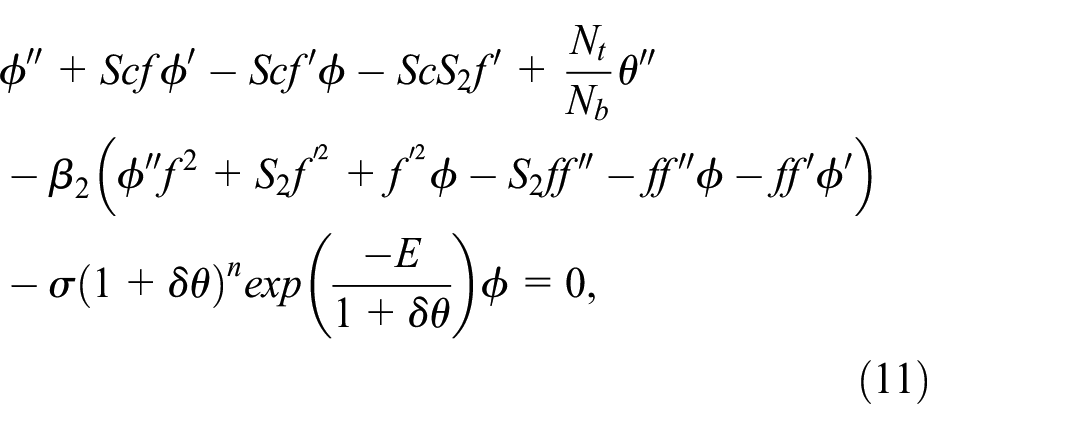
The transform equations are following:



The transform BCs are:

In the above equation

The coefficient of skin friction



After simplification, equation (15)–(18) we acquire




in which
HAM solution
In order to solve equations (9)–(12) under the BCs (13), the HAM is used with a subsequent technique. The solutions exhibit and control the solutions convergence through the incorporation of auxiliary parameters
The following are initial guesses chosen as


This contains the subsequent properties:

Where the general solution constants are
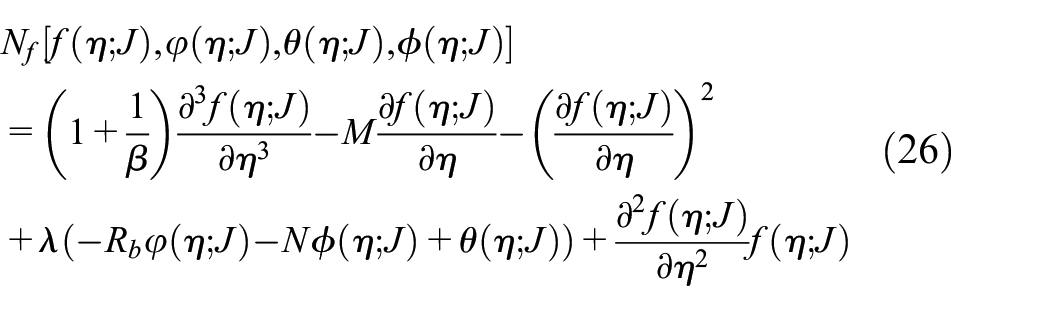

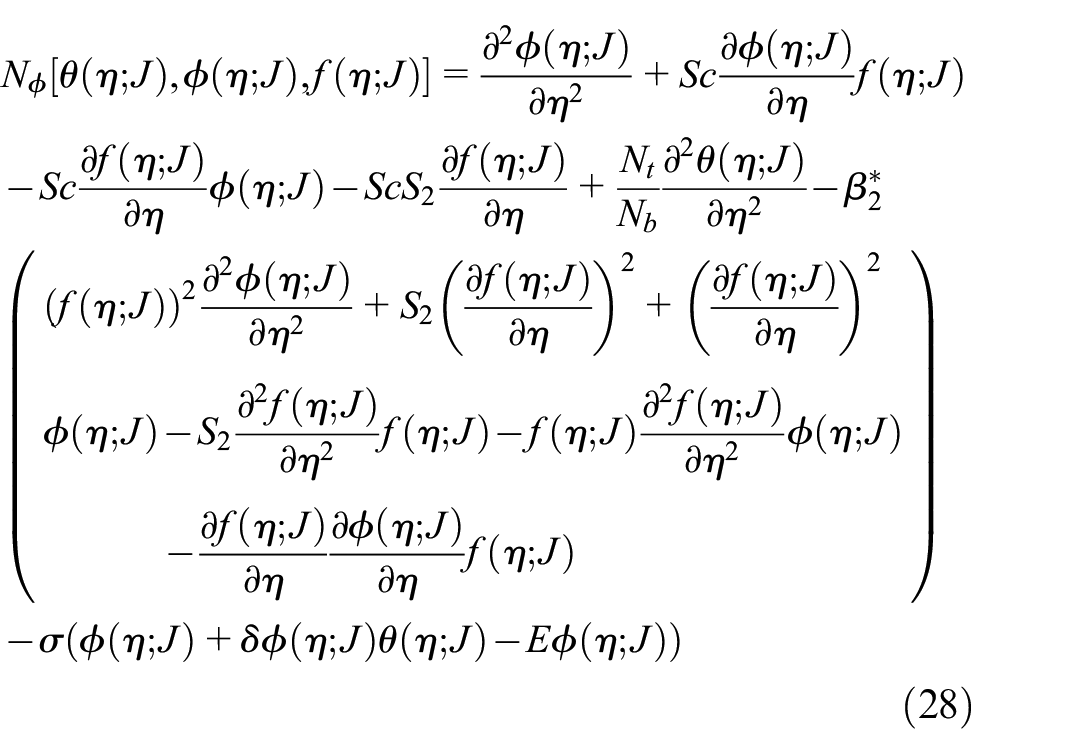
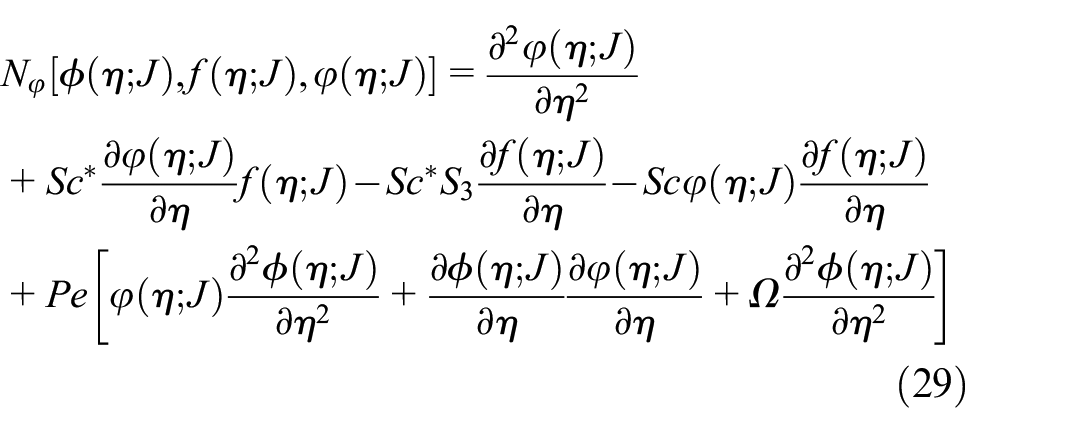
The HAM elementary concept is defined in Refs. 29–35, from equations (9)–(12) the zeroth -order problems are:



The corresponding BCs:

Where imbedding parameter is

Taylor’s series expansions of
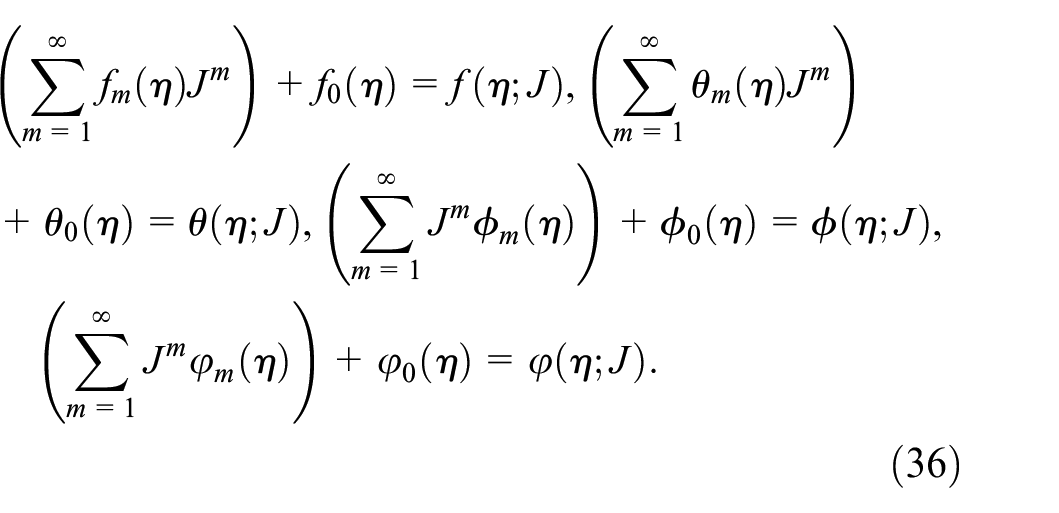
Where


The problem of

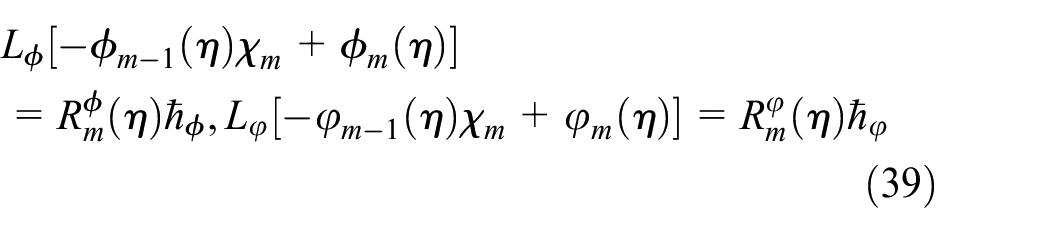
The corresponding BCs are:

Here


Where,

Convergence analysis
The series convergence given in equation

The combined graph of
Convergent table for

Results and discussion
The consequence of the

Effect of M on f′(η).
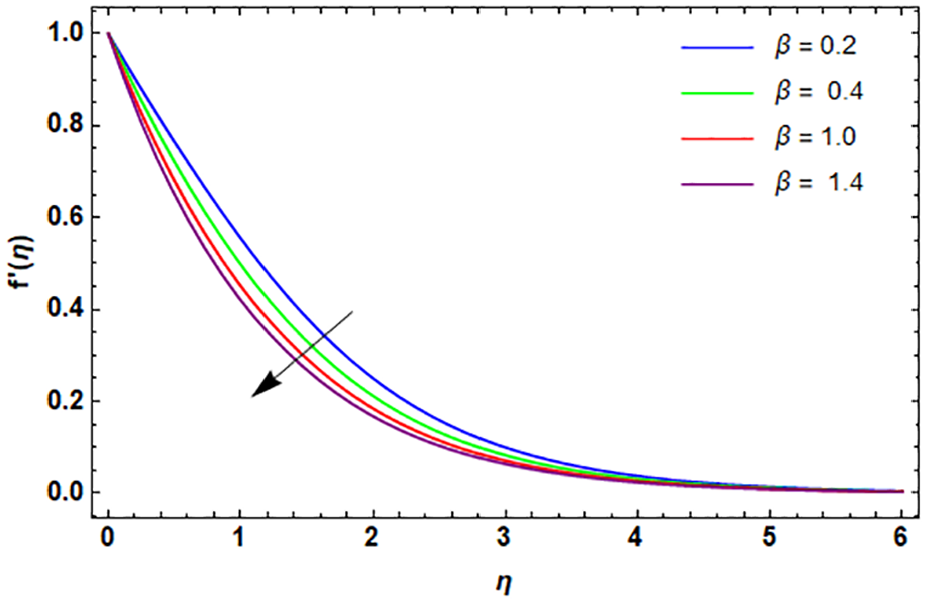
Effect of β on f′(η).

Effect of R on θ(η).

Effect of Pr on θ(η).

Effect of Nt on θ(η).

Effect of Nb on θ(η).

Effect of β*1 on θ(η).

Effect of Nt on φ(η).

Effect of Nb on φ(η).

Effect of E on φ(η).

Effect of S3 on ϕ(η).

Effect of Pe on ϕ(η).

Effect of Ω on ϕ(η).

M and β effect of on Cfx Rex-1/2.

Ec and R effect of on Nux Rex-1/2.

Sc and h effect of on Shx Rex-1/2.

Pe and h effect of on Nhx Rex-1/2.

Local Nusselt number for distinct parameters

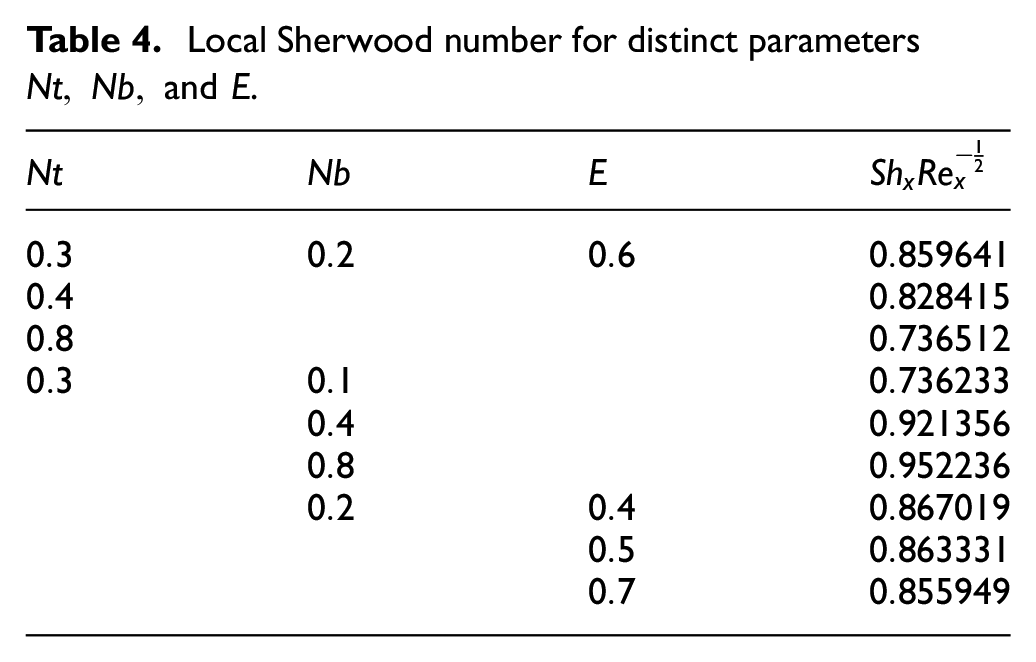
Local Sherwood number for distinct parameters
Motile microorganism number for distinct parameters

Conclusion
The current study examines steady-state visco-plastic Casson nanofluid flow over an electrically conducting vertically stretched porous surface. The effect of bioconvection, joule heating, thermal radiation, viscous dissipation, thermo-solutal stratifications, and thermal robin condition are into account. By using appropriate similarity transformations, the governing equations are transformed into ordinary differential equations (ODEs). The Homotopy Analysis Method (HAM) is useful to attain the results. The possessions of different parameters that control the flow, such as velocity, nanoparticle volume fraction, temperature, gyrotactic microorganisms, local Sherwood number, shear stress rate, Nusselt numbers, and density of microorganisms, are numerically and graphically presented. Some of key finding are as follows:
The fluid velocity decreases as both the Casson parameters and magnetic parameters increase.
Increasing the values of
Raising the thermophoresis parameter significantly quickens the fluid’s concentration and the temperature of the nanoparticles. On the other hand, raising the Brownian motion parameter raises the fluid’s temperature and reduces the nanoparticle concentration.
The fluid’s temperature is marginally raised by raising the values of Deborah’s number and activation energy.
Motile microorganisms’ field
The material features are improved by minimizing the profiles of motile microorganisms. The peclet number Pe and the microbe concentration differential parameter Ω.
Footnotes
Handling Editor: Aarthy Esakkiappan
Declaration of conflicting interests
The author(s) declared no potential conflicts of interest with respect to the research, authorship, and/or publication of this article.
Funding
The author(s) disclosed receipt of the following financial support for the research, authorship, and/or publication of this article: This study received funding from King Saud University, Saudi Arabia through researchers supporting project number (RSP2024R145). Additionally, the APCs were funded by King Saud University, Saudi Arabia through researchers supporting project number (RSP2024R145).
Ethical approval
Not applicable
Informed consent
Not applicable
Data availability statement
All data include in this manuscript.
