



Abstract
The effects of induced magnetic field, thermal and concentration convection on the peristaltic flow of Prandtl nanofluids are explored in this study in an inclined asymmetric channel. A detailed mathematical explanation is given for Prandtl nanofluids with double-diffusivity convection and induced magnetic field. To simplify non-linear partial differential equations, the long wavelength and low approximation of the Reynolds number are used. Using numerical technique, the non-linear differential equations are solved. Exact solutions of thermal and concentration are calculated. The impact of the various physical parameters of flow quantities is shown in graphical results.
Keywords
Introduction
Peristaltic flow has become a centre of attention for many mathematical and industrial studies in the recent years. This flow is known to be highly relevant in many commercial and biological processes. Modern studies have found a number of its applications in human body as well. Movements of longitudinal and circular muscles in our digestive system are said to create peristaltic waves. Such motions are also common in the oesophagus, stomach and intestines. On the commercial end of things, peristaltic pumps have been scaled and marketed for quite some time now. The Newtonian constitutive equation is responsible for characterizing the deformation and flow of fluid passing through a peristaltic mechanism. Due to this very reason, the process of describing such flow usually incorporates an essential step of considering these fluids to be Newtonian. However, there are a number of instances where this consideration does not seem to fit perfectly well. Most of the fluids present in a human body are non-Newtonian. These fluids are not only difficult to model but also reveal a new set of challenges that are much more difficult to deal with. They are governed by prominently different equations. These equations can reveal many interesting features when studied in detail. Unlike Newtonian fluids, non-Newtonian fluids have a very sophisticated and complex rheological behaviour. This has effectively limited mathematicians and numerical analysts to come up with a single constitutive relation that can fit every non-Newtonian fluid. Due to their simpler nature, Newtonian fluids were preferred in the initial studies performed by Latham. 1 Though, some subsequent studies on peristaltic motion gradually started to confirm their findings with non-Newtonian fluids. A few of those studies are cited in references as well.2−10
While working with peristaltic flow, magnetohydrodynamics has played a key role in many investigations. As a conductive fluid flows, it influences the behaviour of any magnetic field in its vicinity. Correspondingly, the flow of electric current through any such field can impart a significant amount of change in the fluid as well. With an elaborate understanding of this phenomenon, scientists have started to employ it in several technological and industrial procedures. When one gets to compare these applications with the extent of research in this field, the amount by which these studies are lagging behind is easily noticeable. There is a dire need of extending these explorations to as many fluid models as we can. Some recent work performed in this regard is included in references.11−15 For the most part, researchers have not even considered the impressions caused by the magnetic field. Vishnyakov and Pavlov 16 were the first ones to contemplate the effects of magnetic fields in their findings. Still, their study revolved around a Newtonian fluid. Moreover, Akram et al. 17 have worked on the impacts of induced magnetic fields as well. They modelled the peristaltic flow of Williamson fluid in an asymmetric channel. After that, Nadeem and Shahzadi 18 continued this study and examined the same effect on a hyperbolic tangent fluid in a curved channel.
Researchers are encouraged to investigate progressively in the field of thermal engineering due to rise in need of modern technology. At present, a crucial quest is to give consideration on novel type of heat transfer fluids. Researchers found the development of solid particles for base fluid that may boost thermal exchange ability. Therefore, nanofluid has been familiarized, it has grasped attention of experts and it has kept them passionate during last two decades. The word ‘nanofluid’ was first utilized by Choi. 19 Brownian motion and thermophoresis play significant role in dynamics of nanofluids as suggested by Buongiorno 20 in Ref. 20. Nanofluid is the term used to denote suspension of ultrafine elements having diameter of about 50 nm. These elements can be non-metals, for example, carbon nanotubes and graphite, or it may include metals, for example, carbides, oxides and nitrides. Normally, water, ethylene glycol and oil can be utilized as base liquids that have naturally low level of thermal conductivity. Since metals have superior thermal conductivity, therefore, these can be included in conventional fluids that give chances to enhance considerably higher thermal conductivity for base fluids. Recent research exposes that framework based on nanofluid have an extensive potential zone like we can consider examples; cooling electronics, modulators, nuclear reactor cooling, sink float separations, optical gratings, heat exchangers, solar collectors and refrigerators.21−23 Nanoparticles are used significantly in field of medicine, for example, drug delivery. In process of drug delivery, these nanoparticles are concocted in a way that these only fascinate to malignant cells that allow synchronize treatment of cells. This procedure is widely used in the treatment of cancer, as it helps to cause less damage to healthy cells. The potential usage for such mixture fluids for several systems has revealed the significance of examination on properties of nanofluids, for reference, see Refs. 24−26. The nanoparticles are regarded to be quite useful for many medical applications. According to Mekheimer and Abd Elmaboud, 27 as the temperature starts to reach 40–45°C, cancer tissues can effectively get eliminated. This study reflects a decent amount of light on how nanoparticles can help us find a sustained cure for cancer. Succeeding this, Xuan and Roetzel 28 examined the nanofluid flow within a tube. They used a dispersion model for this purpose. The literature review for their research exhibited that nanofluids can remarkably increase the heat transfer capabilities of oil and water. All of this was executed with a preconceived determination to study nanofluids. Thanks to Nadeem and Akbar, 29 these efforts were then directed towards peristaltic literature. Their study was focused on the turbulences within peristaltic flow of nanofluids due to endoscopic effects. For this purpose, they ingeniously utilized a setup marked with two concentric tubes. Apart from all of this, most recent articles on nanofluids and their behaviour are stated within references.30−34
Double-diffusive convection is a type of convection where two different density gradients are involved. These two gradients can have different diffusion rates as well. We can consider this phenomenon in terms of any two quantities. Let us take a case with temperature and concentration. In this scenario, if the temperature difference across a particular system does not fluctuate, diffusion in one gradient can cause a noticeable change in the other. Due to its far-ranging applications, double-diffusive convection has already been extensively studied. Huppert et al. 35 have listed varying natural and artificial processes where double-diffusive convection plays an integral part. This is also the case with what was done by Bég et al. 36 In regard of double-diffusive convection, they worked on detailed mathematical models of nanofluids that are peristaltically pumped. Kefayati 37 included pseudoplastic fluids in his study of double-diffusive convection as well. While working on double-diffusive convection, Rout et al. 38 carried out an elaborative examination of peristaltic movement in MHD flow. Collectively, this huge body of literature shows the importance of double-diffusive convection and what it holds for the processes that surround us. In addition to what we have already discussed, Gaffar et al. 39 have studied the variation in heat absorption of a fluid engaged in double-diffusive convection, whereas Mohan et al. 40 inspected its effects in lid-driven cavity. Refs. 41−45 provide information on some recent work in this area.
In review of what we observed in previously performed studies, there was an intrinsic drive to advance the communal understanding of peristaltic transport in non-Newtonian nanofluids. In our study, we tried to jointly associate the effects of concentration, temperature and induced magnetic field on peristaltic flow of Prandtl nanofluid. This was done in an asymmetric channel. The mathematical formulation was completed while taking Brownian diffusion and thermophoresis into account. In our research, the governing equations are developed with an existing assumption of long wavelength and low numbers of Reynolds. Lastly, in order to realize an inclusive comparison, reduced equations are numerically evaluated.
Mathematical analysis
A peristaltic flow of an incompressible, electrically conducting Prandtl nanofluid is considered in a channel of two dimensions whose width is
(Figure 1) The wall surface is geometrically defined as Geometry of the problem.


In laboratory frame (X,Y), the equations of motion containing nanofluid, induced magnetic field and inclined channel are defined as


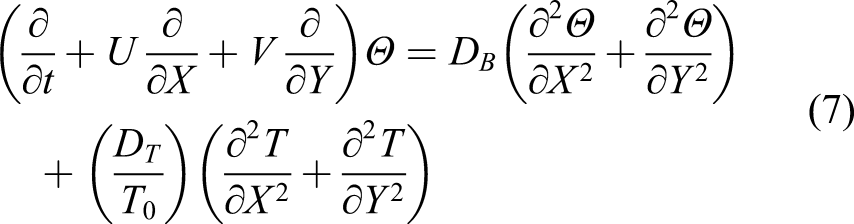
As we know, flow is unsteady in

For Prandtl fluid, the stress tensor is given by Patel and Timaol
41

here
The dimensionless quantities for the present problem are described as

Where
Using equations (8) and (10), equation (2) is satisfied automatically, but equations (3)–(7) in wave frame (after dropping bars) become

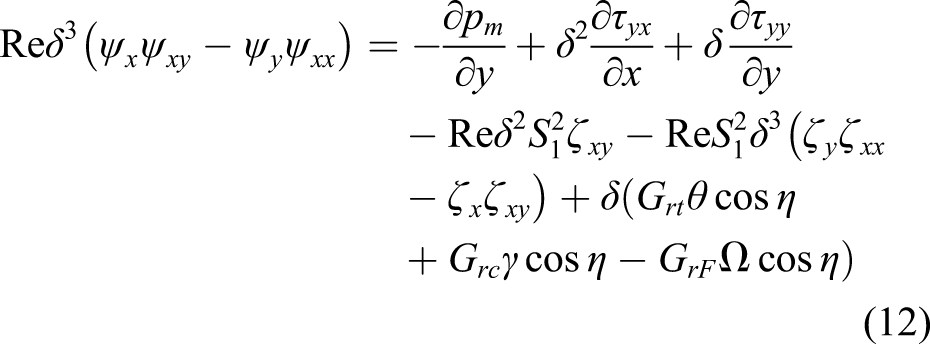
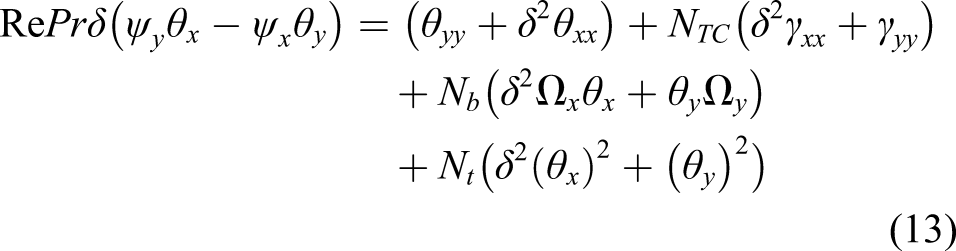



Now under long wavelength and low number of Reynolds conjecture, the equations (11)–(16) become




From equations (17) and (18), we get


The boundary conditions in wave frame related to stream function





The flow

Methodology of solutions
Closed form solution
The solution of temperature that fulfils the boundary condition (26) is depicted as

The precise solution of the nanoparticle volume fraction that fulfils the boundary condition (27) is defined as

The solution to the concentration of solutal (species) that fulfils the boundary condition (28) is described as


Numerical solution
Equations (17), (22) and (23) are non-linear PDE’s, so it is difficult to find the exact solution of these equations. Numerical methods are employed to solve these equations. Using Mathematical software, the non-linear equations are illuminated using ND Solve. Thus, by numerical approximation to solutions, graphical illustration is achieved.
Special case
In the absence of induced magnetic field and
Graphical assessment
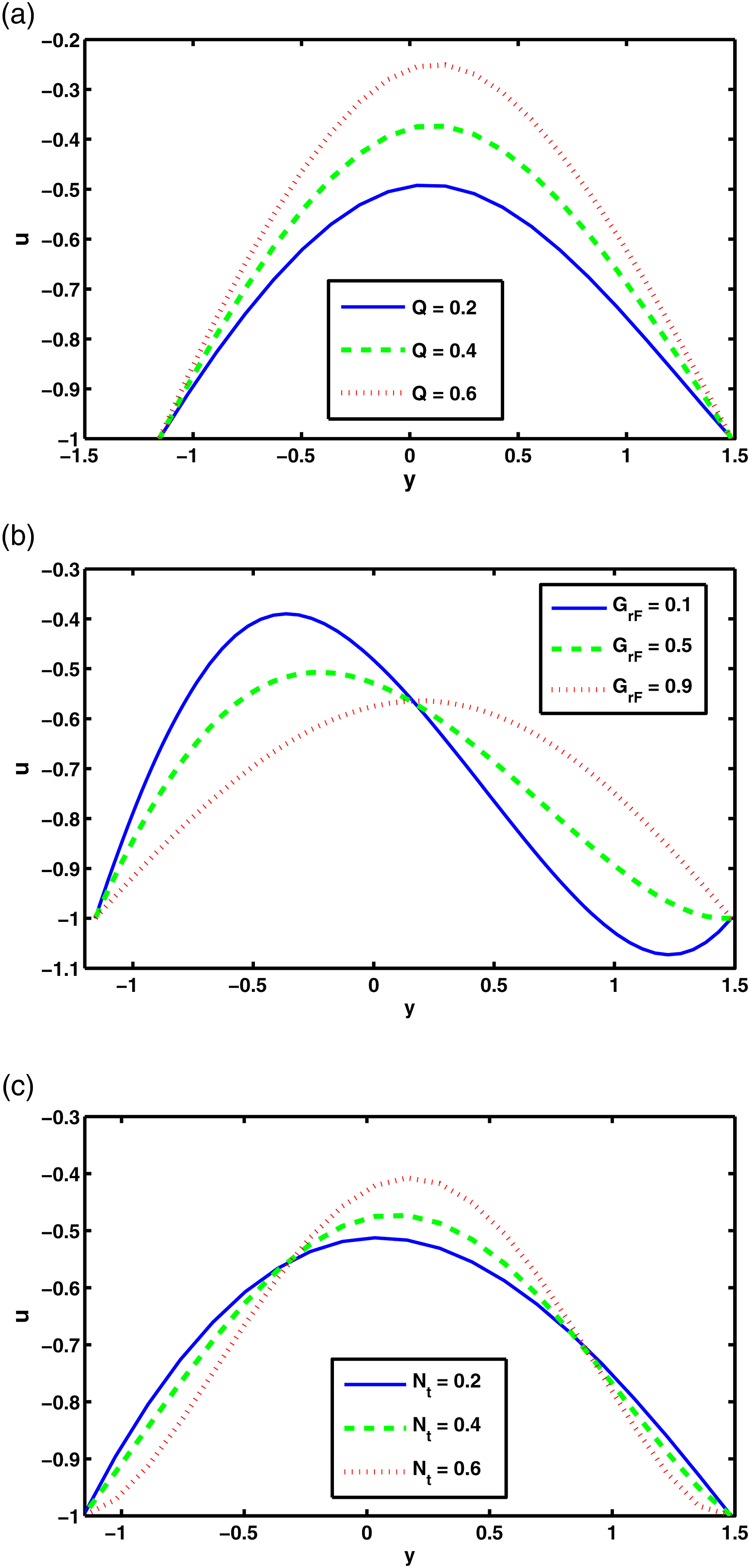
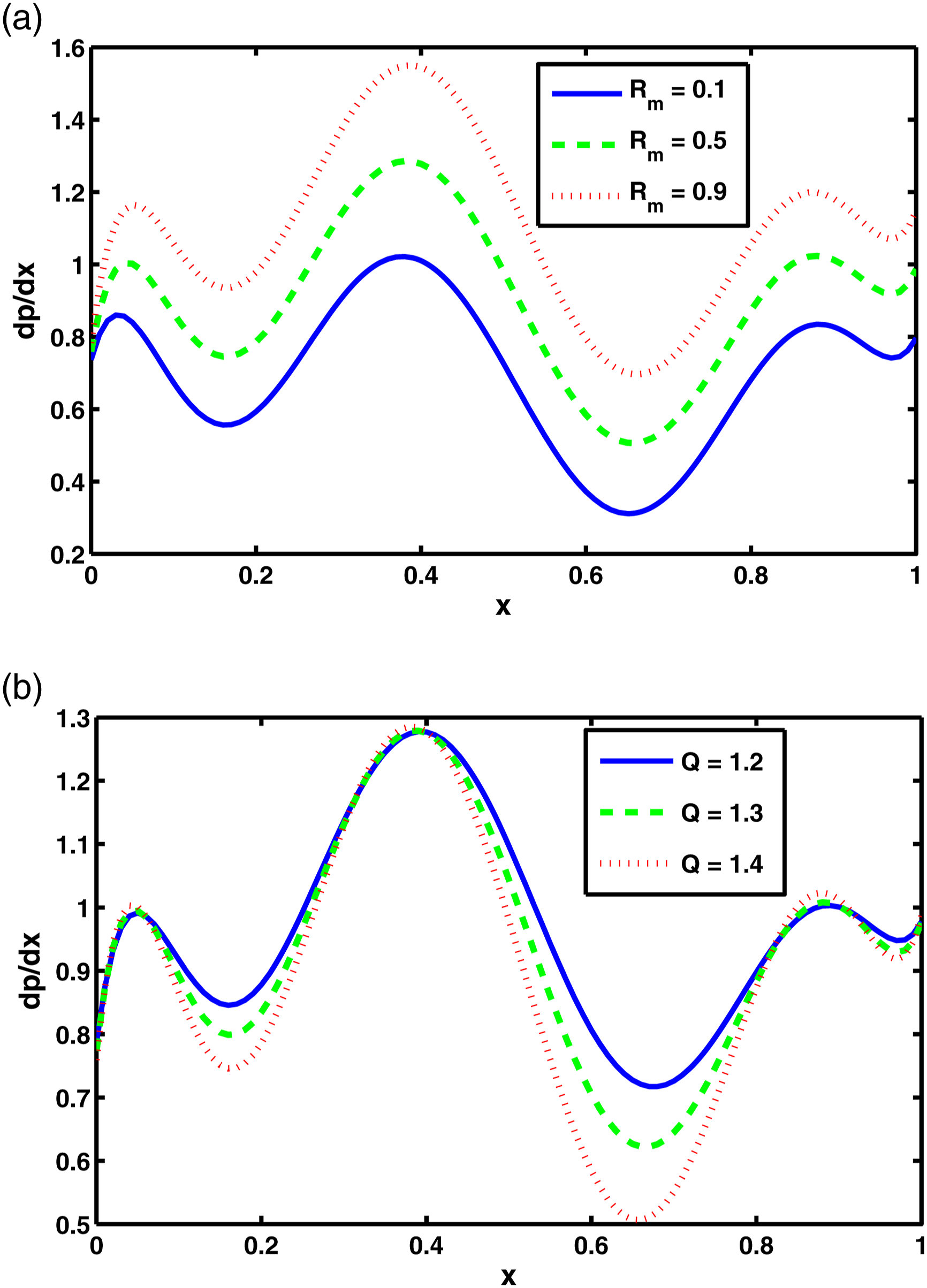
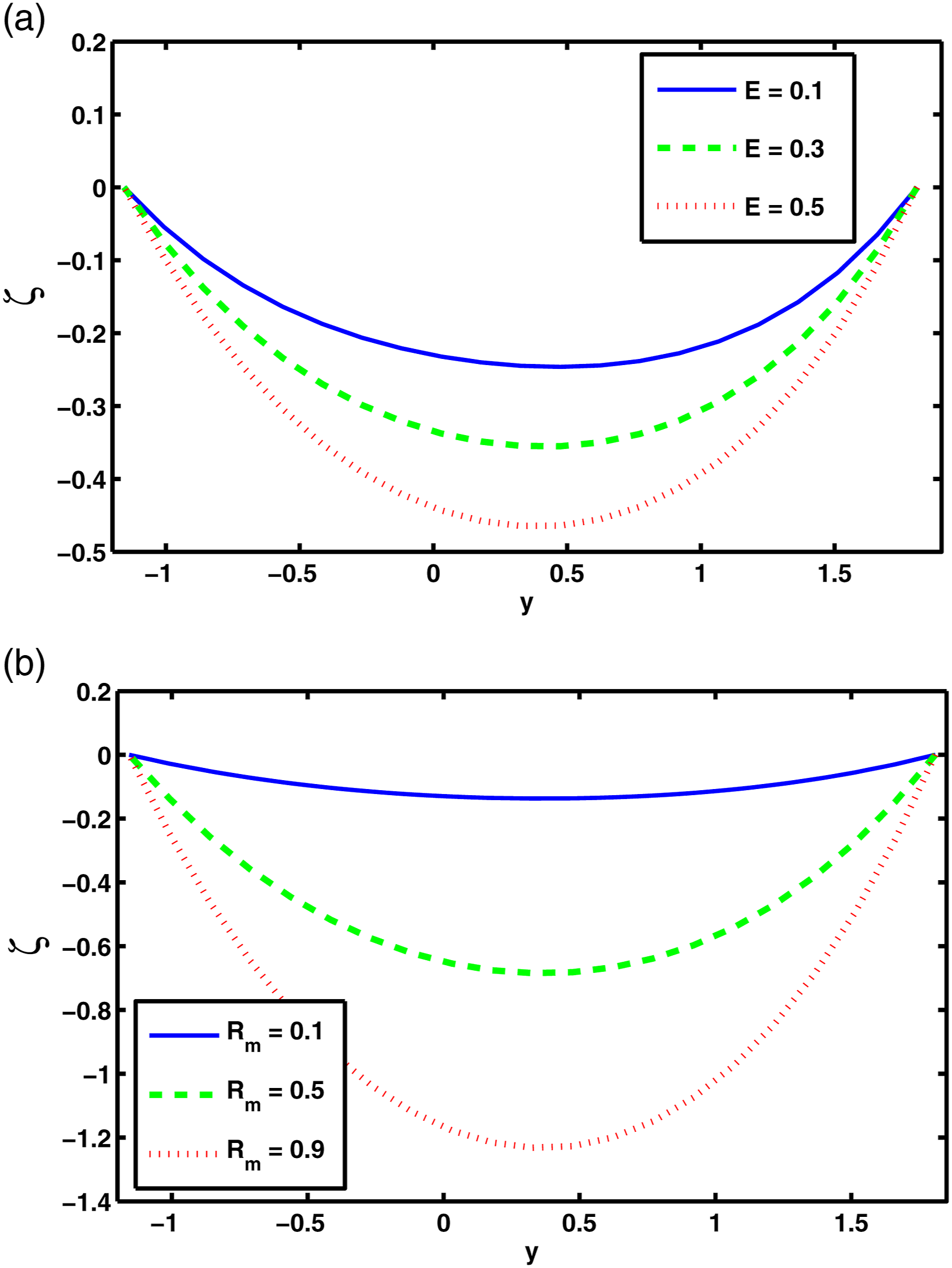
Figures 2–8 are plotted to examine the physical and graphical noteworthiness of different parameters of flows on Prandtl nanofluids in asymmetric channel. Figure 2(a) and (b) are graphed to examine the effects of temperature on Brownian motion Temperature profile for various values of Concentration profile for various values of
3
Nanoparticle fraction profile for various values of Velocity profile for various values of Profile of pressure rise for various values of Profile of pressure gradient for various values of Profile of magnetic force 



Concluding Remarks
In our study, we tried to jointly associate the effects of temperature and concentration on peristaltic transport of Prandtl nanofluid under the influence of induced magnetic field. The mathematical formulation was completed while taking Brownian diffusion and thermophoresis into account. In our research, the governing equations are developed with an existing assumption of long wavelength and low numbers of Reynolds. Lastly, to realize an inclusive comparison, reduced equations are numerically evaluated. The main results are being summarized as follows: (1) Rising values of Brownian motion and Dufour parameters increase the temperature profile. (2) By increasing values of thermophoresis and Soret parameter, the concentration profile decreases. (3) The nanoparticles fraction increases by increasing Brownian motion values; but by increasing values of thermophoresis parameters, nanoparticles fraction decreases. (4) The pressure gradient increases by increasing values of magnetic Reynolds numbers, but it decreases by increasing volume flow rate. (5) The magnitude values of velocity profile decrease by increasing values of volume flow rate
Footnotes
Declaration of conflicting interests
The author(s) declared no potential conflicts of interest with respect to the research, authorship, and/or publication of this article.
Funding
The author(s) received no financial support for the research, authorship, and/or publication of this article.
