



Abstract
In a recent study, researchers investigated the flow behavior of Casson Hybrid nanofluids (HNFs) combination of single and multi-walled carbon nanotubes (SWCNTs), (MWCNTs) on a Riga plate for drug delivery applications. The study found that the Casson HNFs exhibited non-Newtonian behavior on the Riga plate, with the presence of nanoparticles causing an increase in viscosity and shear-thinning behavior. This rheological behavior is favorable for drug delivery applications as it improves the stability and dispersion of drug particles in the fluid. The similarity equations of the flow problem are easily tackled with the homotopy analysis method (HAM) built on fundamental homotopy mapping. In high-speed flows, Riga actuators are expected to achieve the requirements, since HNF is enhanced by modified Hartmann numbers. As the Eckert number, heat generation/absorption parameter, and thermal relaxation time parameter decrease the temperature, thermal transport increases. Furthermore, with the increments in paramount parameters, the skin friction coefficient and heat transfer rate are remarkably meliorated under higher modified Hartmann number. Furthermore, the study also found that the Casson Hybrid nanofluids showed enhanced heat transfer properties on the Riga plate, which is beneficial for localized drug delivery applications that require precise temperature control.
Keywords
Introduction
Hybrid nanofluids (HNFs), which are a combination of nanoparticles (NPs) dispersed in a base fluid, play a significant role in drug delivery. These nanofluids have unique properties that make them ideal for delivering drugs to specific target areas in the body. One of the key advantages of using hybrid nanofluids for drug delivery is their ability to improve the solubility and stability of drugs. By dispersing nanoparticles in a base fluid, the surface area available for drug interactions is increased, allowing for enhanced drug solubility.1,2 This helps to improve the bioavailability of the drug and ensure that it reaches its target site in the body more effectively. Hybrid nanofluids (HNFs) are engineered to have specific properties that make them ideal for targeted drug delivery. By modifying the size, shape, and surface chemistry of the NPs, researchers design nanofluids that selectively target specific tissues or cells in the body. 3 This helps to reduce the side effects of the drug and improve its therapeutic efficacy. HNFs are also used as carriers for drug delivery. By encapsulating drugs within NPs dispersed in a base fluid, researchers protect the drug from degradation and ensure that it is delivered to the target site intact. This helps to improve the stability of the drug and enhance its therapeutic effects.
Casson Hybrid nanofluids, in particular, have shown great potential for drug delivery applications due to their ability to transport drugs through biological tissues efficiently. Alnahdi et al. 4 and Arif et al. 5 investigated the flow behavior of Casson Hybrid nanofluids on a Riga plate for drug delivery applications.
The Riga plate is a device that is used to influence the flow of hybrid nanofluids. It is constructed with a specific configuration of electrodes and permanent magnets that have a direct impact on the movement and behavior of the nanofluid particles. When the nanofluid flows through the Riga plate, the electrodes and magnets interact with the particles, causing them to align or move in a certain direction. This is used to control and manipulate the flow of the nanofluid, allowing for more precise and efficient processes in various applications. The study found that the Casson Hybrid nanofluids exhibited non-Newtonian behavior on the Riga plate, with the presence of nanoparticles causing an increase in viscosity and shear-thinning behavior. The non-Newtonian fluids used in a variety of industrial and medical applications can be seen in Kocić et al., 6 Abbas et al., 7 Aslani et al., 8 Aslani and Sarris, 9 Bejawada and Nandeppanavar, 10 Wang et al. 11 This rheological behavior is favorable for drug delivery applications as it improves the stability and dispersion of drug particles in the fluid.
Furthermore, the Casson Hybrid nanofluids showed enhanced heat transfer properties on the Riga plate, which could be beneficial for localized drug delivery applications that require precise temperature control.12–15
(CNTs) have shown significant promise in various applications due to their unique properties. In the context of blood flow and heat transfer in the presence of a magnetic field, CNTs can potentially enhance these processes through their exceptional thermal and magnetic properties. CNTs have the potential and be used as drug carriers in blood flow. Similarly, therapeutics are delivered to specific locations in the body by functionalizing the sidewalls of CNTs with the right drug molecule.16–21 Heat and mass transfer play a crucial role in drug delivery applications using carbon nanotubes (CNTs) hybrid nanofluids flow. CNTs have garnered significant attention in the field of drug delivery due to their unique properties, such as high surface area, thermal conductivity, and mechanical strength.22,23 The incorporation of CNTs into nanofluids enhances the mass transfer properties of the fluid, enabling efficient and controlled drug delivery to targeted areas in the body. Heat transfer is essential in drug delivery applications as it affects the rate at which the drug is released from the carrier and delivered to the target site. The thermal conductivity of CNTs helps in improving the temperature distribution within the hybrid nanofluid, ensuring that the drug is released at the desired rate and temperature. Furthermore, heat transfer mechanisms are also utilized to trigger drug release through thermal stimuli, such as ultrasound or magnetic fields.24,25
Double diffusion hybrid nanofluids flow on a Riga plate refers to a complex flow phenomenon where a mixture of nanoparticles and multiple fluids with different properties interact on a Riga plate.
In this case, the double diffusion hybrid nanofluids flow on the Riga plate involves the interaction of heat transfer, mass transfer, and fluid flow, making it a challenging and interesting research topic. Nayak et al. 26 and Nadeem et al. 27 studying this flow phenomenon aim to understand how the presence of nanoparticles and different fluid properties affect the heat transfer and flow characteristics on the surface of the Riga plate. This knowledge has applications in various fields such as thermal management systems, energy conversion, and heat exchangers. 28
The effects on flow and heat transfer are illustrated graphically and statistically. The current work novelizes the published work of 29 by extending it as follows:
Novelty
The newness of the present work is highlighted as:
(SWCNTs) and (MWCNTs) Casson hybrid nanofluids are suggested for the applications of drug delivery.
Riga plate in combination with the magnetic field is assumed for the proposed problem to strengthen the magnetic particles of the blood flow to work as medication.
Heat and mass transfer properties are studied by using the Cattaneo-Christov thermal flux model, which incorporates double diffusion, instead of the conventional Fourier’s equation.
The Darcy-Forchheimer medium is considered including the combination of thermophoretic and Brownian motion.
In Mathematica software, the homotopy analysis method (HAM) is used to solve the reduced ordinary differential system (ODS).
Mathematical formulation
We have envisioned simultaneous thermal and mass transport through a steady and incompressible MHD Casson hybrid nanofluid flow induced by a permeable Riga plate. The hybrid nanofluid is fabricated in the context of injecting the nanocomposites, made by hybridization of single and multi-walled carbon nanotubes, into blood. Moreover, the surface is continually set stretching/shrinking with constant velocity

The flow in a Cartesian system with planar geometry.
Assumptions of the problem
The fluid flow is considered steady,
The fluid is assumed laminar,
The fluid flow is two-dimensional,
The external forces are considered negligible,
The pressure is considered constant such that the pressure gradient is zero.
In the view of,14,30,31 the governing model is thus given as:



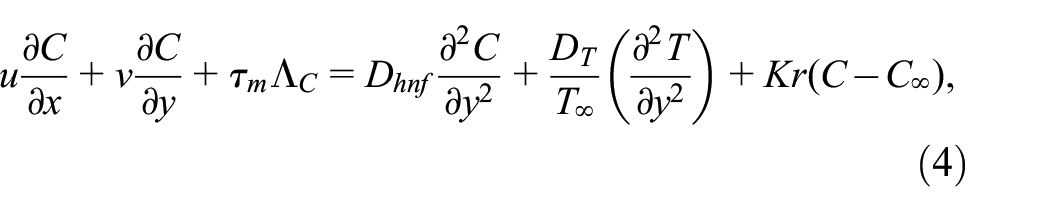
where

along with the boundary conditions,

Here,


In Table 1,

Equations (1)−(7) transform as:


where

and

After transformation the obtained dimensionless parameters are the Forchheimer number (

respectively.
Besides, the physical quantities associated with the behaviors of drag force, heat transfer, and mass transfer are skin friction coefficient (

where
Results and discussions
The unique properties of CNTs have made them highly promising in various applications. CNTs have exceptional thermal and magnetic properties that can potentially enhance blood flow and heat transfer in the presence of a magnetic field. For example, therapeutics are delivered to specific locations in the body by functionalizing the sidewalls of CNTs with the appropriate drug molecules. The bloodstream’s movement is guided and controlled by the magnetic properties of CNTs. So, in view of the above importance of CNTs the parameter discussion is pointed out as.
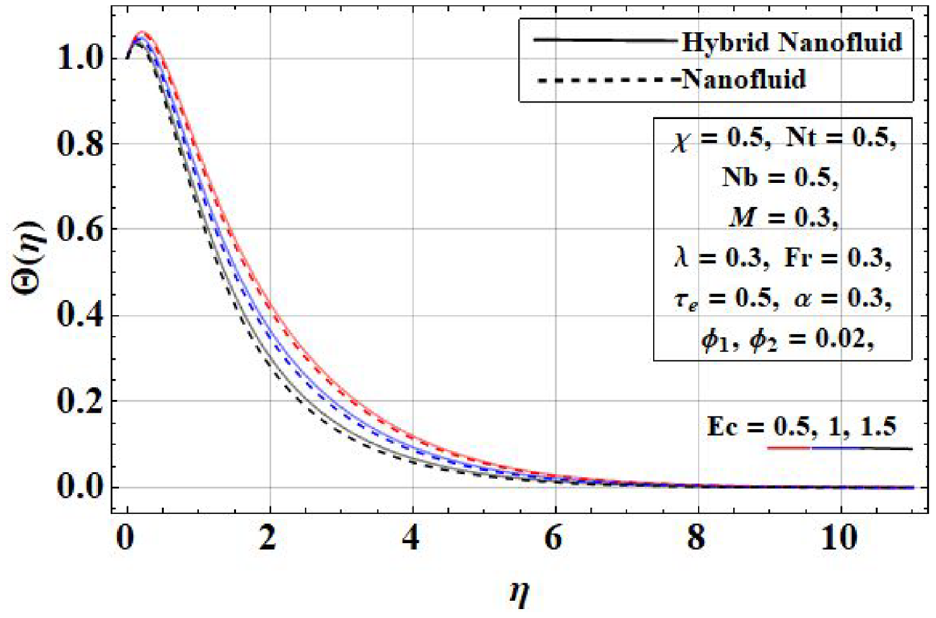
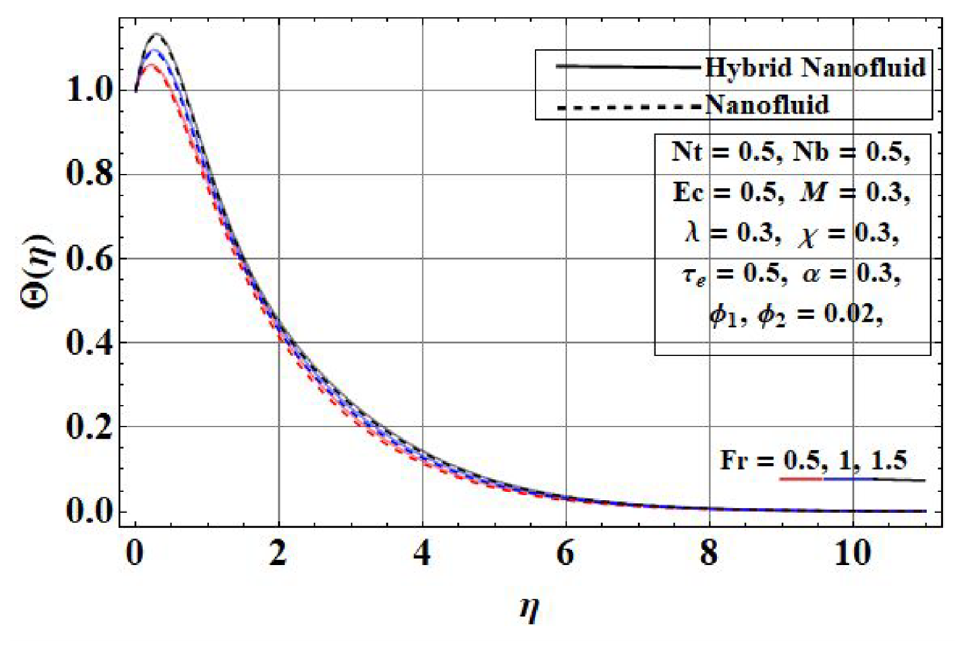
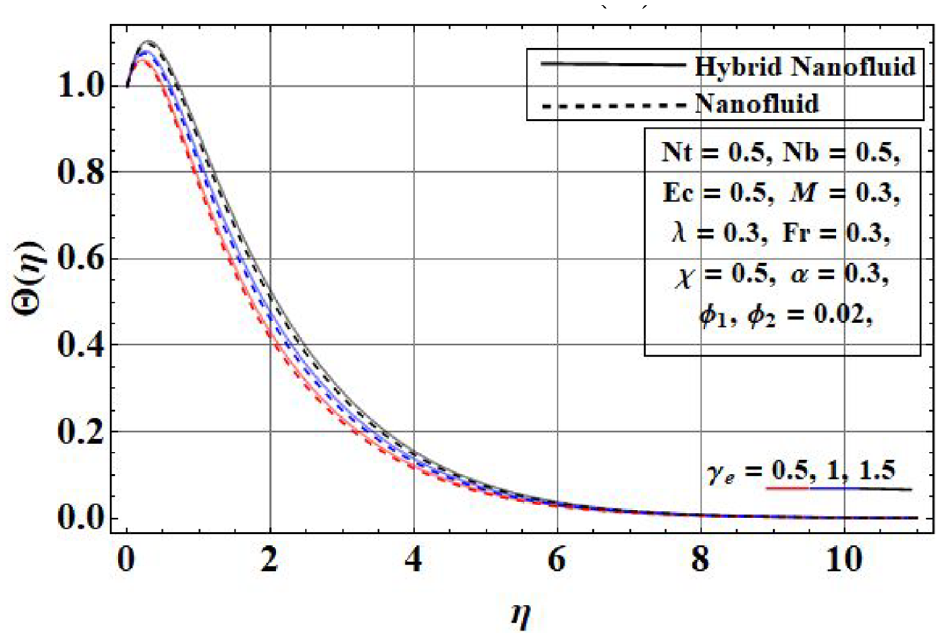
Through the use of schematic plot, this section presents the fluctuations in dimensionless outlook of various quantities based on the variations in sundry parameters. The impacts on non-dimensional velocity field (



I







Velocity profile f′(η)
Figures 2 to 6 demonstrate the crucial influences of parameters
From Figure 3, it is observed that intensified Casson parameter
In terms of the momentum boundary layer thickness, it minimizes with the incremental change in
Temperature profile Θ (η)
Physical significance of
As the Eckert number increases, the impact on the blood-based CNTs nanofluids can be significant in terms of heat transfer. A higher Eckert number suggests a higher kinetic energy compared to the thermal energy of the fluid flow. This can lead to enhanced heat transfer and better cooling capability in the nanofluid. By enhancing
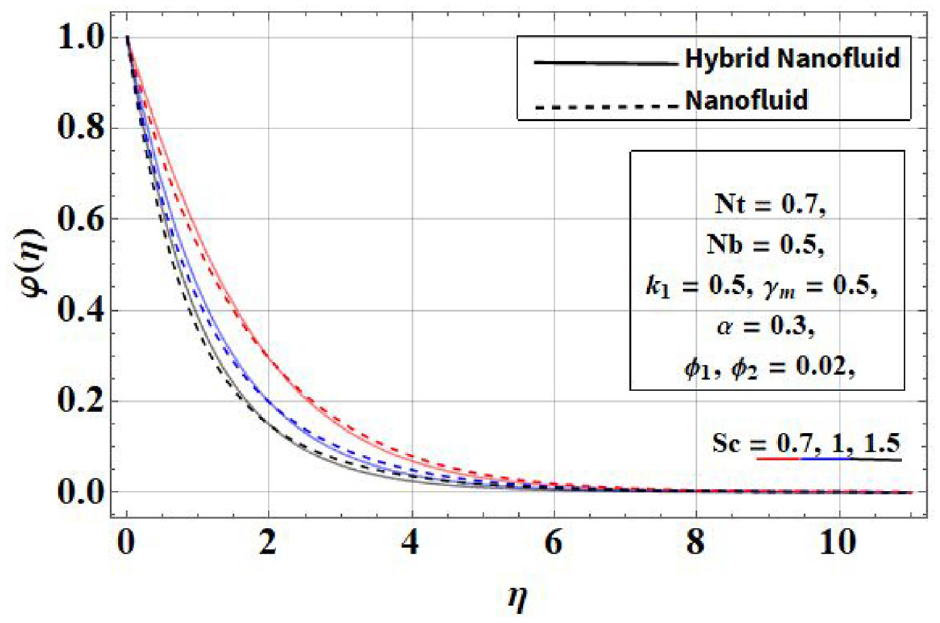
Concentration profile φ (η)
Despite of dimensionless velocity
The skin friction coefficient
, Nusselt number
, and Sherwood number
Among the important characteristics associated with heat and mass transfer through corresponding boundary layers, evolved in viscoelastic fluids, can be depicted by the behaviors of skin friction coefficient


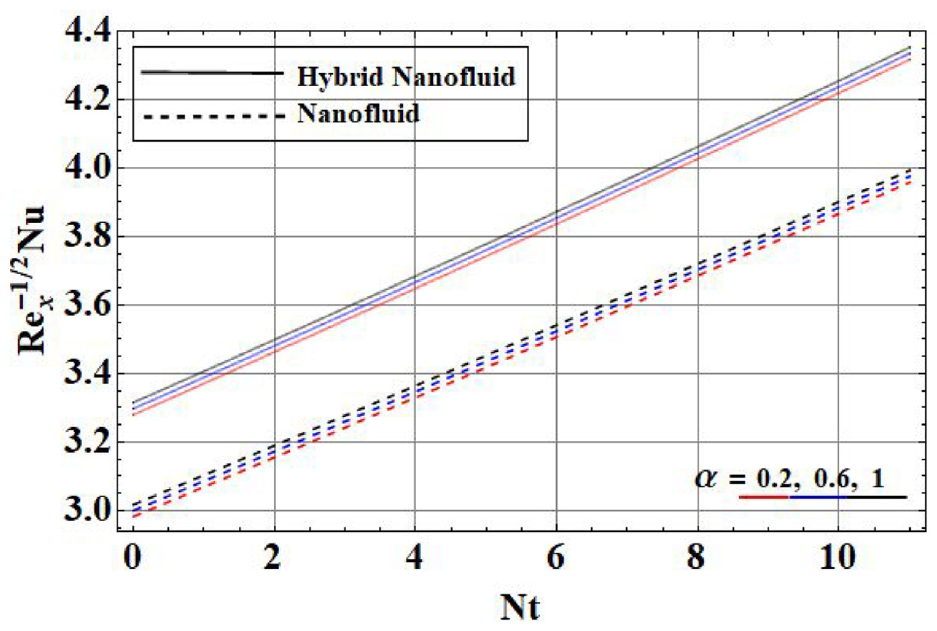


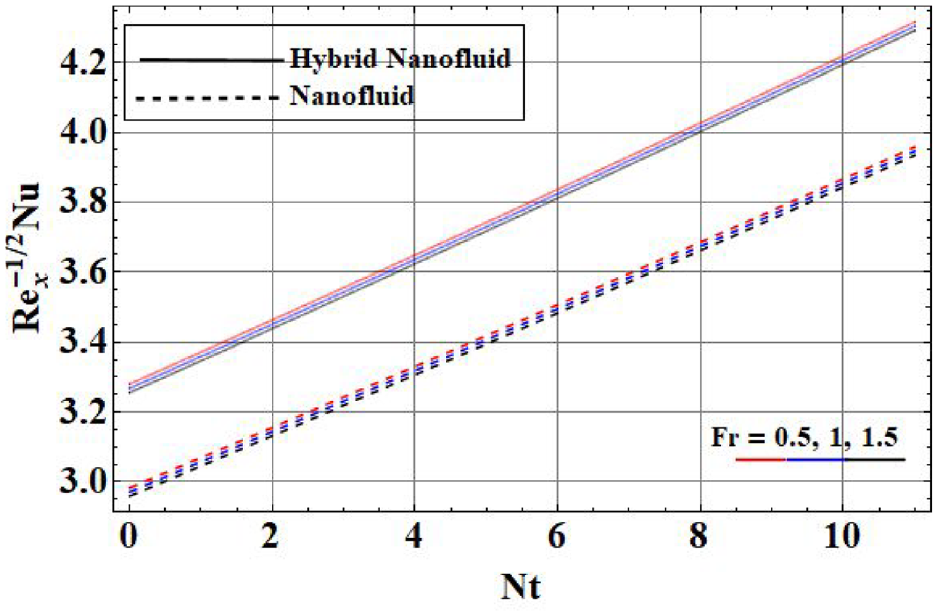


The present study on fluid flow over a Riga plate focuses specifically on the analysis of skin friction, which is the force per unit area acting parallel to the surface of the plate. This is a significant parameter in fluid flow analysis as it represents the resistance experienced by the fluid as it moves along the surface of the plate. In comparison to existing literature,
14
the present study offers a detailed investigation into the skin friction characteristics over a Riga plate as shown in Table 3. The common parameters
Common parameters are taken into account in comparison with existing literature.

Conclusions
Current study focuses on the theoretical study of the blood-based hybrid nanofluid over a Riga device. Here, a number of terms are introduced throughout the governing equations due to the effects of Darcy-Forchheimer medium, uniform magnetic field, heat generation/absorption, thermal expansion, joule heating, viscous dissipation, and chemical reaction. Two types of carbon nanotubes, that is, SWCNTs and MWCNTs, are incorporated into blood (shear-thinning non-Newtonian fluid). A set of similarity variables shrink the describing PDEs to a system of ODEs, that are analyzed and numerically solved using the HAM. Based on above discussions, the prime conclusions are as follows:
In the case of blood-based CNTs nanofluids, an increase in the Eckert number can result in more efficient removal of heat from the system. This is particularly important in medical applications where efficient cooling is necessary, such as during hyperthermia treatment or in cooling systems used in medical devices.
The flow rate of the blood-based hybrid nanofluid improvise against
A higher Casson parameter would indicate a higher viscosity, which means that the fluid would have a thicker consistency. This higher viscosity would result in a slower flow rate of the CNTs nanofluid.
The temperature field enhances for
The concentration field is seen to occupy accumulation of nanoparticles with respect to
Based on the increments in paramount parameters, the skin friction coefficient and heat transfer rate is remarkably ameliorated under higher
The thickness of MBL is revamped for an upsurge in
Footnotes
Appendix
Handling Editor: Sharmili Pandian
Declaration of conflicting interests
The author(s) declared no potential conflicts of interest with respect to the research, authorship, and/or publication of this article.
Funding
The author(s) disclosed receipt of the following financial support for the research, authorship, and/or publication of this article: (Researchers Supporting Project number (RSPD2024R576), King Saud University, Riyadh, Saudi Arabia).
