



Abstract
The study of magnetohydrodynamic (MHD) fluids has significant implications across various scientific disciplines, particularly in understanding complex phenomena in astrophysics, engineering, and geophysics. The Casson fluid model stands as a crucial tool for describing non-Newtonian behaviors observed in certain fluid systems. The current work shows an analytical analysis to determine the ramped effect on the fractionalized MHD Casson fluid over an vertical plate. Fractional partial differential equations are used to formulate the problem along with initial and boundary conditions. The governing equations are transformed into the dimensionless form and developed fractional models like Caputo-Fabrizio and Atangana-Baleanu Derivative. We used the Laplace transform technique to find the closed form solution of the dimensionless governing equation analytically. MATHCAD software is being used for numerical computations and the physical attributes of material and fractional parameters are discussed. To analyze their behavior clearly, two-dimensional graphical results are plotted for velocity profile and temperature as well. It has been concluded that the fluid’s velocity are reduced for larger values of the fractional parameter and Prandtl number and is maximum for small values of both parameters.
Introduction
Heat and mass transfer processes hold immense significance from an industrial perspective, captivating the attention of numerous researchers and scientists. In the realm of modern technologies and diverse industrial applications, the theory of non-Newtonian fluids exerts a profound influence due to the limitations of Newtonian fluid models in capturing a wide range of flow characteristics. Non-Newtonian fluids exhibit complex relationships involving shear strain rate and stress, transcending the simplistic assumptions of Newtonian fluid models. The theory of non-Newtonian fluids finds significant application in contemporary engineering, namely, within the petroleum sector, where it plays a crucial role in extracting crude oil from various petroleum reservoirs. Researchers have investigated a diverse range of non-Newtonian fluid models, each with its own unique computational properties. For instance, while the power-law model effectively captures viscosity characteristics, it fails to account for the effects of elasticity. This motivates researchers and mathematicians to delve deeper into the study of these complex fluids. For theoretical research as well as real world applications in contemporary engineering, a methodical examination of these fluid flow models is crucial. Due to this reason, non-Newtonian fluids give birth to abundant rheological mathematical models of fluids. Such fluids models are classified by us in terms of century wise: 18th century from 1867 to 1893 (Barus and Maxwell model) and 19th century from 1922 to 1995 (Blatter model, Ellis model, Giesekus model, Phan-Thien-Tanner model, Johnson-Tevaarwerk model, Carreau-Yasuda model, Carreau model, Cross model, Rivlin-Ericksen model, Oldroyd-8 constants model, Oldroyd-B model, Rivlin model, Generalized Burgers, Eyring and Williamson fluid model) and few others. Amongst these fluid models that is most accurate and treated fluid model in bio-field so called Casson fluid model (1959). The main significance of this model is to characterize yield stress pseudoplastic properties. The common useful examples of Casson model lie as concentrated fruit juices, jelly, tomato sauce, honey, and few others.1–5 Asifa et al. 6 investigate the radiative MHD Casson fluid flow with heat source through a porous medium with generalized boundary conditions. Unsteady MHD natural convection flow of Casson fluid incorporating heat injection and suction mechanism under variable wall conditions studied by Anwar et al. 7 in existence of thermal radiative flux. Hussain et al. 8 investigates the mixed convection boundary-layer flow of Casson fluid with an internal heat source on an exponentially stretched sheet. The Buongiorno model, incorporating thermophoresis and Brownian motion, describes fluid temperature. Saeed et al. 9 analyzed the exact symmetric solutions of MHD Casson fluid using chemically reactive flow with generalized boundary conditions. Casson fluid over a persuaded steady spinning plane based on the three-dimensional nanofluid thin-film flow has been examined by Saeed et al. 10 They imposed homotopy analysis method on the governing equation for the numerical solutions of velocity, temperature, and concentration gradient.
Fractional calculus is the generalization classical calculus. In fractional calculus the derivative of real order are consider instead of integer order derivative and have been applied efficiently to explain the several real life problem. Several investigation are reported regarding nanofluid and ordinary fluid flows with different definitions of fractional derivatives. Imran et al. 11 presented a comparative study of viscous fluid flow with two definitions of fractional derivatives. Sheikh et al. 12 carried out the results for free convection flow of Casson fluid with Atangana-Baleanu and Caputo-Fabrizio fractional derivatives. Rehman et al. 13 investigated the fractional models of generalized Casson fluid with oscillatory flow. Ahmad et al., 14 Sheikh et al., 15 Sadia et al., 16 and Sehra et al. 17 have successfully apply the fractional derivative approaches to different real life physical phenomenons. Qayyum et al. 18 developed the fractional modeling of Casson fluid between two parallel plates. Furthermore, author 19 investigated the fractional modeling and analysis of unsteady squeezing flow of Casson nanofluid via extended He-Laplace algorithm in Liouville-Caputo sense. Rehman et al. 20 developed the application of novel hybrid fractional derivative operator on Casson fluid. Some more interesting studies with application of fractional derivatives are investigated in References 21–30.
The focal attention of this research is to extend the work 13 for ramped conditions on temperature and concentration and apply the Caputo-Fabrizio 11 and Atangana-Baleanu 12 fractional operator and also compare the result of both operators. Laplace transform and numerical inverse algorithms are utilized to acquired the solution of velocity, temperature, and concentration with ramped conditions.
Model of flow problem
In this problem, the fluid flow of Casson model along with heat and mass transfer over an infinite vertical plate has been considered. The direction of the fluid’s flow is x-axis, while y-axis represent the normal to the plate. A uniform magnetic field of strength


Geometrical presentation for Casson Model.
The appropriate conditions are given below:




By inserting the dimensionless variables:


We have required set of dimensionless governing equations and corresponding conditions are given below:



At

At

At

where
Solution of fractional model with Caputo-Fabrizio (CF) differential operator
Concentration profile
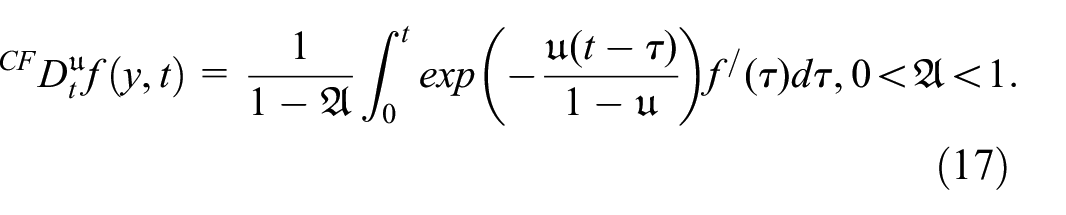
Fractional operators offer remarkable flexibility in depicting the dynamics of mass transfer in Casson fluids through the formulation of governing equations. By employing the CF-fractional operator (17), facilitates the transformation of the concentration governing equation (12) into a fractionalized form, taking

where,
Using the Laplace transform method, we solve equation (16). This requires utilizing a fundamental property of the CF operator as defined in equation (18).

By utilizing the Laplace transform on equation (16) and resolving it with the assistance of equation (18), we investigated a second-order partial differential equation (PDE).

invoking the elementary concept of differential equation for homogeneity, we get simplified expression as

applying the initial, boundary, and natural conditions as defined in equation (14), we eliminated the arbitrary constants

The convenient form of above function to implement the Laplace inversion is

The exact solution can be written as

In the above expression,

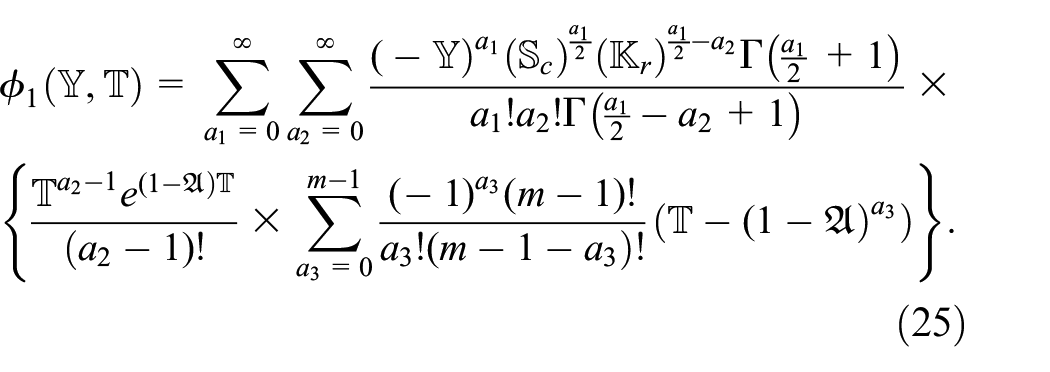
The current form of equation (24) makes it challenging to compute the Laplace inverse. Therefore, it is necessary to convert it into a series form, which will yield the following expression
Temperature profile
Fractional operators offer remarkable flexibility in depicting the dynamics of heat transfer in Casson fluids through the formulation of governing equations. By employing the CF-fractional operator (17), facilitates the transformation of the concentration governing equation (11) into a fractionalized form, taking

By utilizing the Laplace transform on equation (26) and resolving it with the assistance of equation (18), we investigated a second-order partial differential equation (PDE).

invoking the elementary concept of differential equation for homogeneity, we get simplified expression as

applying the initial, boundary, and natural conditions as defined in equation (14), we eliminated the arbitrary constants

The convenient form of above function to implement the Laplace inversion is

The exact solution can be written as

In the above expression,
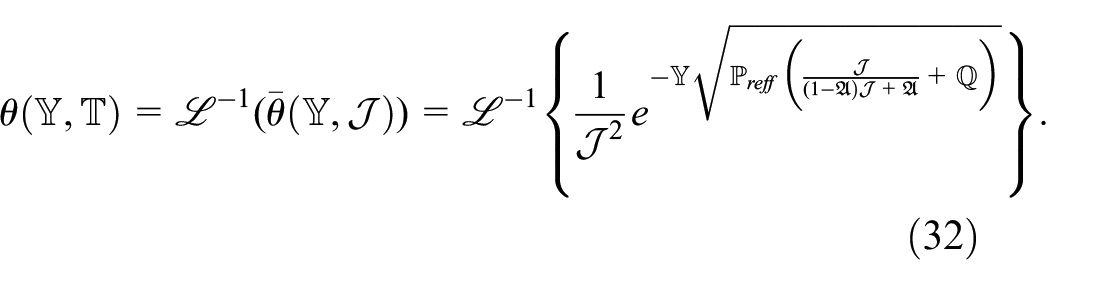
The current form of equation (32) makes it challenging to compute the Laplace inverse. Therefore, it is necessary to convert it into a series form, which will yield the following expression

Velocity profile
We transform the governing equation of velocity (10) into a fractionalized form. Solving this uncoupled fractionalized equation of velocity (10) is accomplished through the Laplace transform method, yielding the desired outcome.


applying the initial, boundary, and natural conditions as defined in equation (14), we eliminated the arbitrary constants

The convenient form of above function to implement the Laplace inversion is

and

The inverse Laplace of above equation is

where

The current form of equation (40) makes it challenging to compute the Laplace inverse. Therefore, it is necessary to convert it into a series form, which will yield the following expression

Similarly,

We get
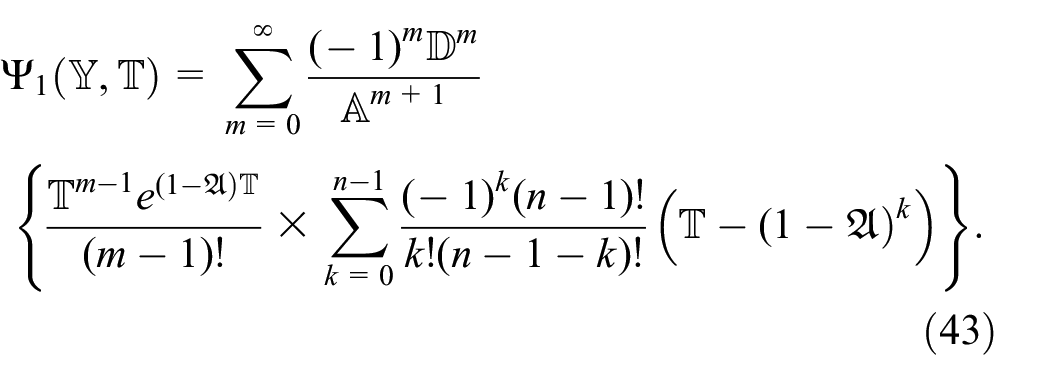
The required velocity solution for CF operator after employing the definition of inverse Laplace is

Solution of fractional model with Atangana Baleanu (AB) differential operator
Concentration profile
Fractional operators offer remarkable flexibility in depicting the dynamics of mass transfer in Casson fluids through the formulation of governing equations. By employing the AB-fractional operator (45), facilitates the transformation of the concentration governing equation (12) into a fractionalized form, taking

where,

Using the Laplace transform method, we solve equation (12). This requires utilizing a fundamental property of the AB operator as defined in equation (47).

By utilizing the Laplace transform on equation (45) and resolving it with the assistance of equation (47), we investigated a second-order partial differential equation (PDE).

invoking the elementary concept of differential equation for homogeneity, we get simplified expression as

applying the initial, boundary, and natural conditions as defined in equation (14), we eliminated the arbitrary constants

The convenient form of above function to implement the Laplace inversion is

The exact solution can be written as

In the above expression,

The current form of equation (53) makes it challenging to compute the Laplace inverse. Therefore, it is necessary to convert it into a series form, which will yield the following expression

Temperature profile
Fractional operators offer remarkable flexibility in depicting the dynamics of heat transfer in Casson fluids through the formulation of governing equations. By employing the AB-fractional operator (45), facilitates the transformation of the concentration governing equation (11) into a fractionalized form, taking

By utilizing the Laplace transform on equation (55) and resolving it with the assistance of equation (47), we investigated a second-order partial differential equation (PDE).

invoking the elementary concept of differential equation for homogeneity, we get simplified expression as

applying the initial, boundary, and natural conditions as defined in equation (14), we eliminated the arbitrary constants

The convenient form of above function to implement the Laplace inversion is

The exact solution can be written as

In the above expression,
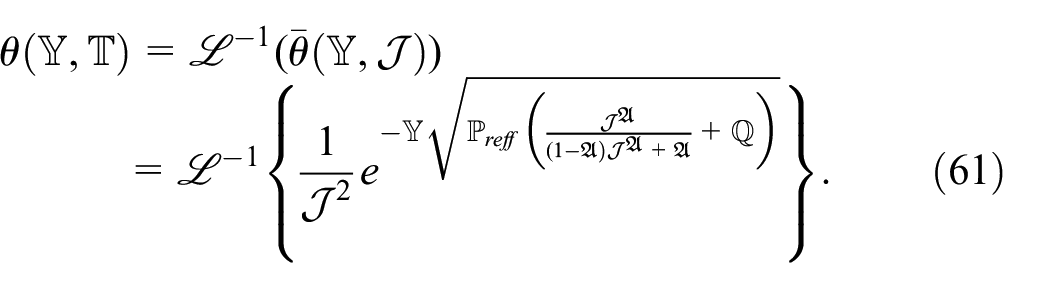
The current form of equation (32) makes it challenging to compute the Laplace inverse. Therefore, it is necessary to convert it into a series form, which will yield the following expression
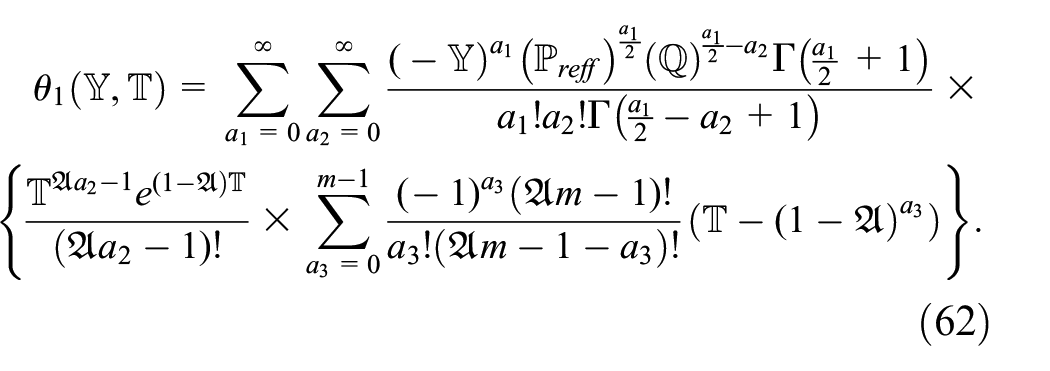
Velocity profile
We transform the governing equation of velocity (10) into a fractionalized form. Solving this uncoupled fractionalized equation of velocity (10) is accomplished through the Laplace transform method, yielding the desired outcome.


applying the initial, boundary, and natural conditions as defined in equation (14), we eliminated the arbitrary constants

The convenient form of above function to implement the Laplace inversion is

and

The inverse Laplace of above equation is

where

The current form of equation (69) makes it challenging to compute the Laplace inverse. Therefore, it is necessary to convert it into a series form, which will yield the following expression
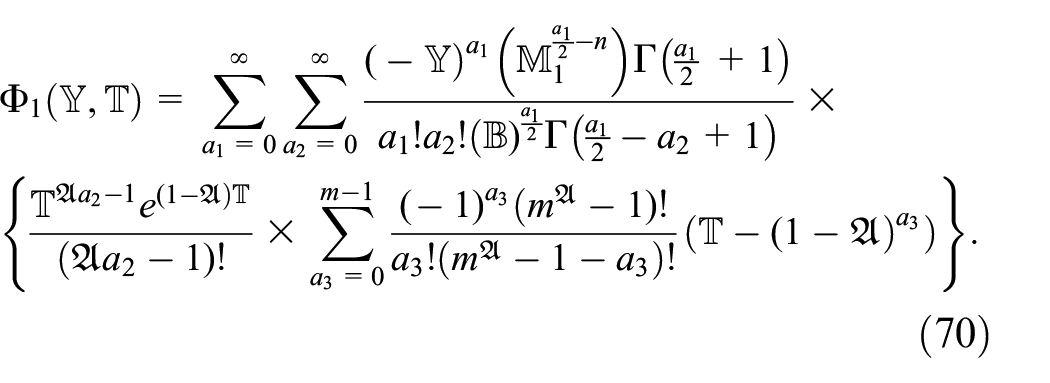
Similarly,

We get
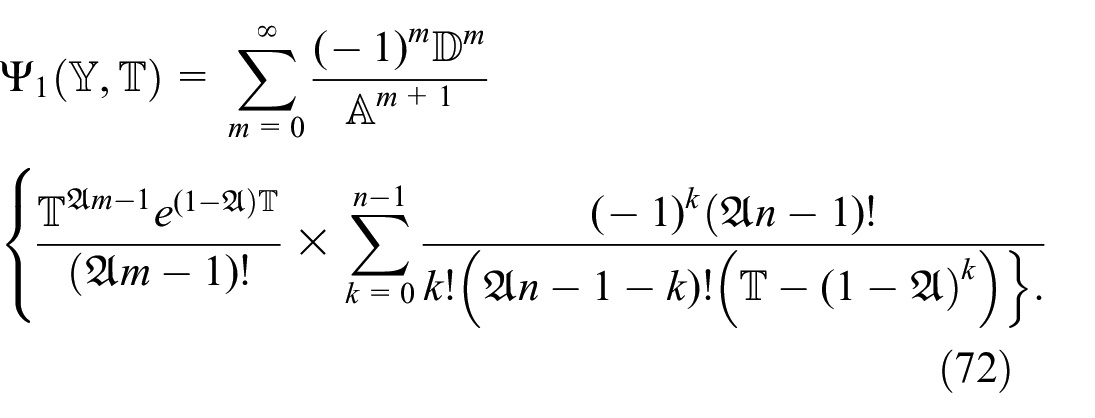
The required velocity solution for AB operator after employing the definition of inverse Laplace is

Skin friction
The non dimensional skin friction is given in equation (74)

Nusselt number
The non dimensional Nusselt number, the rate of heat transport is given in equation (75)

Sherwood number
The non dimensional Sherwood number provides the rate of mass transfer is given in equation (76)

Results and discussion
This study contributes to the understanding of complex fluid flow phenomena in MHD Casson fluids and provides valuable insights into their behavior under ramped conditions. This part focus on chemical effect in the MHD flow of fractional Casson fluid over an infinite plate with with consideration of heat and mass transfer through a porous media. This study presents analytical solutions for the velocity, temperature, and concentration using non-integer differential operators. The results are achieved in series form and also represent in term of special functions. Additionally, the physical impact of the relevant parameters is illustrated through graphical representation.
Figure 2 describes the influence of fractional parameter

Comparability of temperature profile to Caputo-Fabrizio and Atangana-Baleanu for fractional parameter

Comparability of temperature profile to Caputo-Fabrizio and Atangana-Baleanu for effective Prandtl number

Comparability of temperature profile to Caputo-Fabrizio and Atangana-Baleanu for
The effect of Grashof number

Comparability of velocity profile to Caputo-Fabrizio and Atangana-Baleanu for

Comparability of velocity profile to Caputo-Fabrizio and Atangana-Baleanu for

Comparability of velocity profile to Caputo-Fabrizio and Atangana-Baleanu for
Figure 8 investigate the behavior of Prandtl number

Comparability of velocity profile to Caputo-Fabrizio and Atangana-Baleanu for
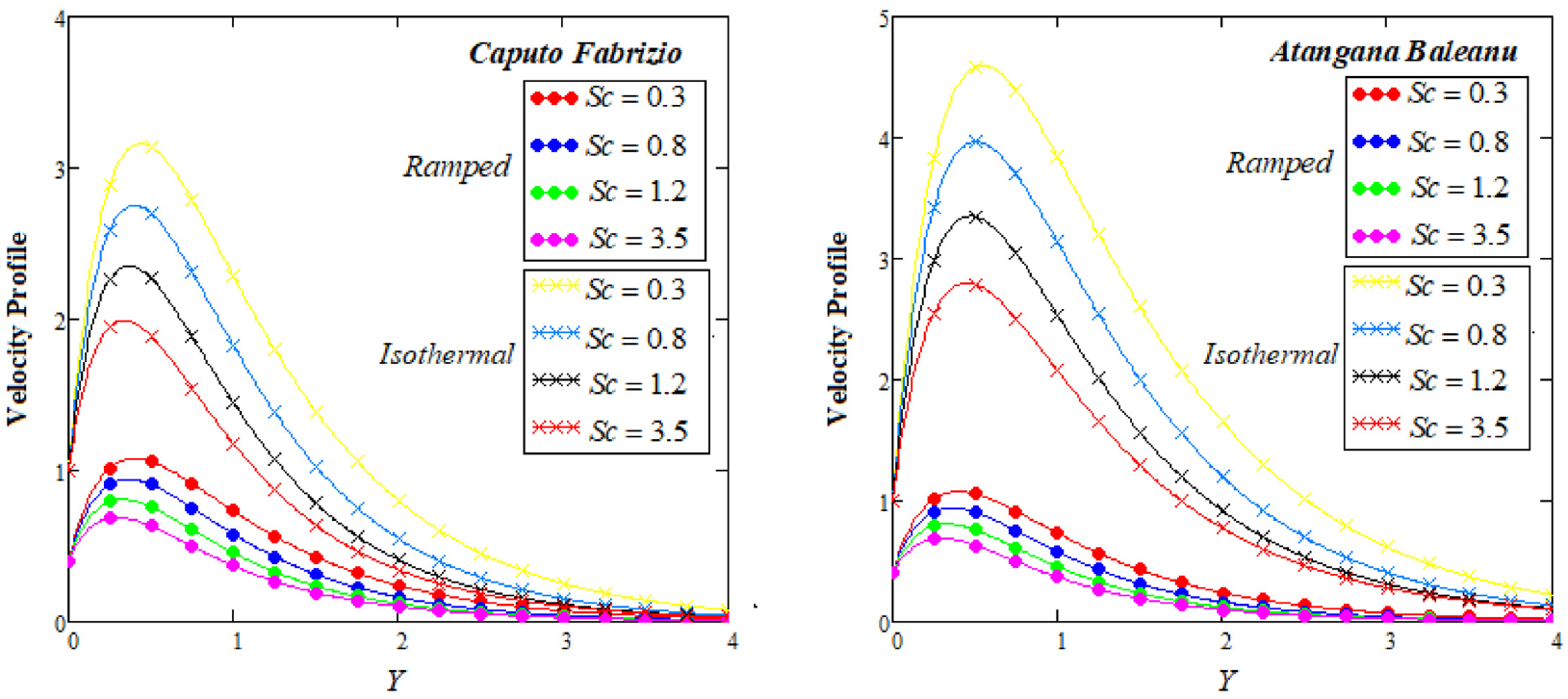
Comparability of velocity profile to Caputo-Fabrizio and Atangana-Baleanu for
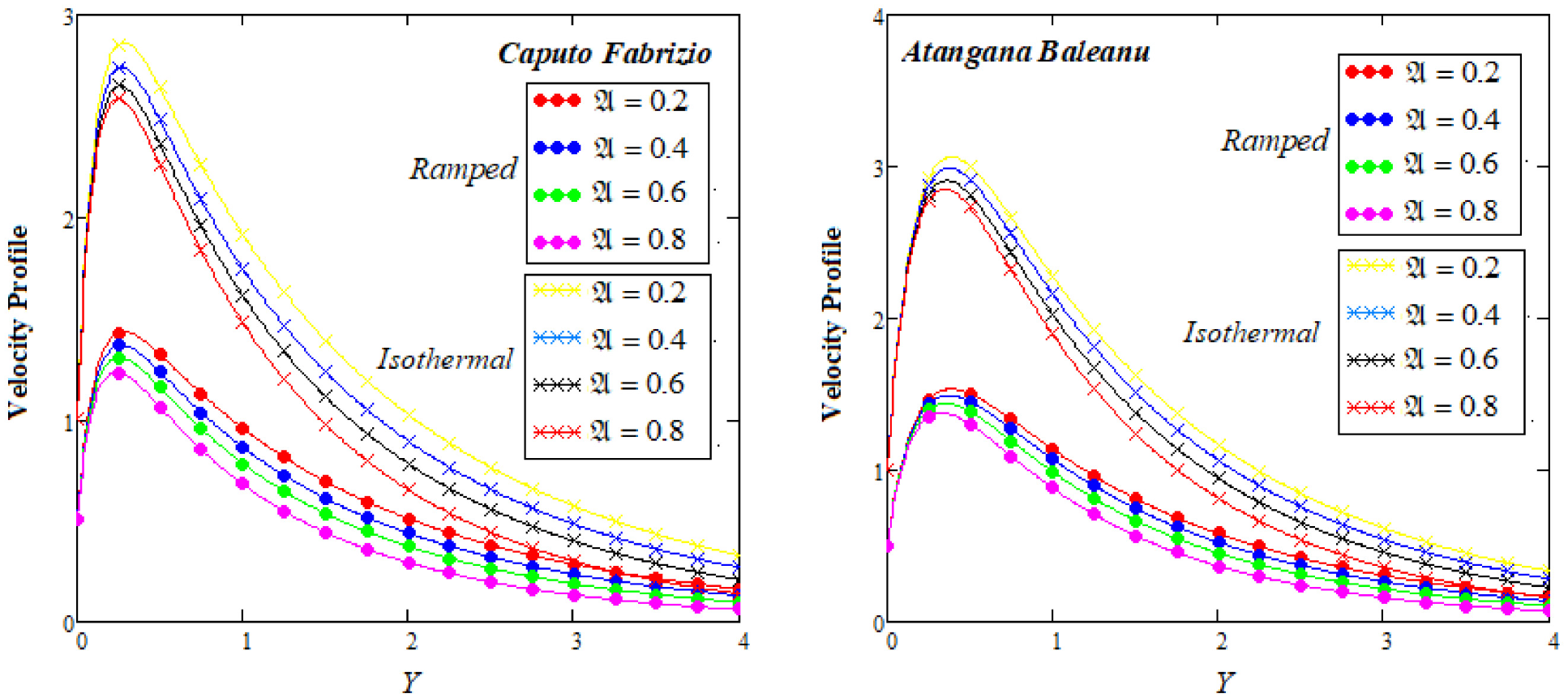
Comparability of velocity profile to Caputo-Fabrizio and Atangana-Baleanu for

Comparison with published work.

Comparison of the rate of heat transfer.
Conclusion
This work explore the results for Casson fluid by obtaining analytical solutions using Caputo-Fabrizio and Atangana Baleanu fractional derivative. The fluid flow of Casson model along with heat and mass transfer over an infinite vertical plate has been considered. The Laplace transform is used to analyze the solution of non-dimensional fractional governing equations. Special functions with particular characteristics that are frequently utilized to explain complicated phenomena are also used to display the derived solutions. More accurate and succinct results can be displayed by using series solution. The following parameter includes the Prandtl number, Grashof number, Schmidt number, mass Grashof number, and fractional parameter as well as their impacts on velocity and temperature.
Temperature and velocity profiles in case of ramped conditions are less than in isothermal conditions.
Applications of the magnetic field retards the flow to a remarkable extent.
Flow is accelerated under mass and heat Grashof effect.
Fluid velocity decrease as the magnetic force rises.
Fluid temperature drops with the increase in radiation parameter.
Ramped plate has the tendency to augment the heat transfer rate.
Rate of heat transfer of mercury is less than oxygen, air, water, and ethanol at room temperature.
Developing efficient and accurate numerical methods for solving fractional differential equations and integral equations. This includes exploring new algorithms, software implementations, and optimization techniques tailored to the computational challenges posed by fractional calculus.
Footnotes
Appendix
Notation

| Symbol | Quantity |
|---|---|
| Fractional parameter | |
| Kinematic viscosity | |
| Acceleration due to gravity | |
| Thermal expansion coefficient | |
| Volumetric expansion coefficient | |
| Fluid density | |
| Electrical conductivity | |
| Specific heat | |
| Chemical molecular diffusivity | |
| Laplace parameter | |
| Heat generation/absorption | |
| Dimensionless chemical reaction | |
| Dimensional velocity | |
| Dimensionless velocity | |
| Dimensional temperature | |
| Dimensionless temperature | |
| Dimensional fluid concentration | |
| Dimensionless fluid concentration | |
| Porosity parameter | |
| Mass Grashof number | |
| Thermal Grashof number | |
| Temperature of the plate | |
| Temperature of fluid far away from the plate | |
| Concentration on the plate | |
| Concentration of the fluid far away from the plate | |
| Effective Prandtl number | |
| Schmidt number | |
| Magnetic field | |
| Hartmann number | |
| Thermal conductivity | |
| Radiative heat flux | |
| Electrical conductivity of the fluid | |
| Stafan–Boltzman constant | |
| Permeability |
Handling Editor: Chenhui Liang
Declaration of conflicting interests
The author(s) declared no potential conflicts of interest with respect to the research, authorship, and/or publication of this article.
Funding
The author(s) received no financial support for the research, authorship, and/or publication of this article.
