The study of micropolar nanofluids unveils intriguing applications, propelled by their exceptional heat transfer capabilities in comparison to conventional fluids. This investigation focuses on analyzing the behavior of magnetized micropolar nanofluid flow over a stretched surface, taking into account crucial factors such as viscous dissipation and heat source. The chosen base fluid is blood, with Copper nanoparticles serving as the selected material. Incorporating the single-phase (Tiwari-Das) model with boundary layer assumptions for micropolar nanofluid flow, we introduce the volume fraction of nanoparticles to assess heat transport. The governing system undergoes transformation into a set of dimensionless non-linear coupled differential equations through appropriate transformations. This transformation involves the utilization of a combination of the local non-similarity technique and bvp4c (MATLAB tool) to derive the system of nondimensional partial differential equations (PDEs) for micropolar nanofluid. Our systematic exploration delves into the consequences of nondimensional parameters on velocity, microrotation, and temperature profiles within the boundary layer, including the Eckert number, micropolar parameter, magnetic field parameter, heat source, Prandtl number, and microorganism parameter. Graphical representations vividly demonstrate that the velocity and temperature of micropolar nanofluid increase with the rise in material parameter values, while the microrotation profile decreases. Increasing the magnetic field parameter leads to a reduction in the velocity profile. Moreover, the micropolar temperature profile shows an increase with the rising Eckert number. Crucially, the research emphasizes that factors like the heat source and Eckert number play a role in decreasing the local Nusselt number. In contrast, an increase in the local Nusselt number is observed for material parameters. Furthermore, the skin friction coefficient decreases as micropolar parameter values increase, whereas an increase in the skin friction coefficient is noted for the magnetic field. The primary focus of this research lies in the development of suitable non-similar transformations for the investigated problem, aiming to yield authentic and efficient results. These results hold substantial promise to make meaningful contributions to future research on nanofluid flows.
Nanofluid research has seen the most rapid growth in the recent years due to their wide variety and complicated applications. These are nanoparticle suspensions in a base fluid that have been engineered by researchers. Typically, these are made from oxides, alloy, or carbon nanotubes. Firstly, nanofluid defined by Choi and Eastman,1 a new type of solid/liquid suspension. Nanofluids suggest abstract challenges because the measured thermal conductivity of a nanofluid accommodating a low concentration of nanoparticles or carbon nanotubes is one sequence of magnitude greater than that forecasted by existing hypothesis. Most research has concentrated on water and ethylene glycol-based nanofluids,2–4 with only a few reports of oil-based nanofluid production conducted by Choi et al.5 Ramesh et al.6 studied thermodynamic activity of a nanofluid flow over a permeable surface with the consequences of boundary slip conditions, and heat source/sink factor. Ramesh et al.7 examined the nanofluid flow with the impacts of porous medium across a stretchable convergent/divergent channel. Different forms of nanofluids have been designed for several technical applications, including autos, solar devices, coolant, braking fluids, domestic refrigerator, home refrigerators, and so on.2,8–11
Micropolar fluids have gained a lot of attention because of their demand in different technical, chemical, mechanical engineering, and medical fields such as improving oil recovery, cooling electronic equipment, and so on. Eringen12 offered the hypothesis of internal mobility and the local features that appeared from the microstructure. The micropolar fluid pattern is used to detect the actuality of emulsions. The influence of the magnetic characteristics of micropolar particles based on a magnetic dipole has been studied by Ali et al.13 Kazakia and Ariman14 came up with a way to include thermal effects in the theory. Gangadhar et al.15 examined the influence of shape on a 3D MHD micropolar hybrid nanofluid consisting of Au-MgO and blood, taking into account joule heating. Khader and Sharma16 examined the various characteristics of MHD micropolar fluid as it flows through a heat source/sink over a sheet. Recently many researchers have investigated different aspects of micropolar fluids.17,18
Biswas et al.19 explored the effects of magneto-hydrodynamic (MHD) mixed thermo-bioconvection on oxytactic microorganisms. Their study unveiled notable correlations between the concentration of motile microorganisms and the speed and direction of translating walls. Furthermore, they observed distinct influences on flow patterns, temperature distribution, and microorganism dispersion with the augmentation of magnetic field intensity. Belabid and Öztop20 looked at how nanofluids behaved thermo-bioconvectively in a horizontal porous annulus with wavy walls. Their study focus was interplay between microbes and nanoparticle distribution. Khan et al.21 conducted an investigation into entropy generation in a hydromagnetic flow with gyrotactic motile microorganisms during bioconvection. Their study aimed to build complicated interactions between fluid mechanics and microorganism movement and create a new concept about entropy generation linked to these interactions. Patil et al.22 investigated magneto-bioconvective Sutterby nanofluid, especially focusing on the g-Jitter effect. Li et al.23 did a detailed analysis of heat transfer in bioconvective Casson nanofluid flow across a non-linear sheet. Their research application lies in biomechanics and thermal science. Awais and Salahuddin24 investigated a thermophysical model of radiative magnetohydrodynamic cross-fluid flow over a parabolic surface, taking into account activation energy.
The problem of steady boundary streamlines flow over a stretching continuous heat transfer surface is principal with respecting both mechanical and compose applications. Such laminar flow generally involves glass fiber creation, hotsystematic, extrusion of soft leaves, in a cooling dip a metal salver is chilled, and others. A stretching surface has more classified the stream matter about its assembly and form to polymer extruder. The boundary layer movement over a permeable nonlinear expanding sheet is judged by Mukhopadhyay.25 Khechekhouche et al.26 analyzed energy audit, and Improvements to the Collector Cover. Sajjad et al.27 studied on the improvement of highly melted liquid. The results of the upward flow of nonlinear MHD radiation of a Jaffrey nanofluid through a nonlinearly porous sheet is shown Gireesha et al.28 Cortell29 refined a mathematical outline to determine nonlinear fluid flow above a stretching surface. Dhanai et al.30 controlled several MHD heat exchange flow with viscous dissolution techniques. The solution of the mixed-convective heat transfer flow over an extending sheet was numerically explored by Ellahi et al.31 Tlili et al.32 investigated the thermal transport of unstable MHD narrow-film flow. Radiative MHD nanofluid flow in 2D demising through a needle motion was explored by Sulochana et al.33
Because of their large range of uses, non-similar boundary layer investigations are more significant both theoretically and practically. Non-similar modeling is an extremely effective tool. Non-similarity can occur due to a variety of factors, including changes in free flow velocity, heated wall fluctuations, suction effect of liquid injection on the outer surface, and surface mass transfer, as studied by Sparrow and Yu.34 Mabood et al.35 examined the magnetohydrodynamic (MHD) flow over an exponentially radiating stretching sheet using the homotopy analysis method. Razzaq and Farooq36 investigated non-similar boundary layer flow along linear stretching surfaces. Their study encompasses various fluid models, providing a detailed exploration of the distinct flow behaviors observed under different fluid model conditions. Razzaq et al.37 explore the complex dynamics of a nanofluid flowing across a vertical sheet. Within the field of fluid dynamics, a nanofluid is defined as one that contains nanoparticles; in this work, the rheological characteristics of the fluid are particularly described using the Sisko model. Jan et al.38 conducted a study on the magnetohydrodynamic (MHD) flow behavior of a Maxwell fluid with nanomaterials over an exponentially stretching surface. The research specifically investigated how the inclusion of nanomaterials influenced the flow dynamics under this particular boundary condition. Mushtaq et al.39 employed the bvp4c scheme to evaluate the precision of non-similarity in predicting mixed convection flow. Their study focused on a second-grade fluid along a vertically stretching flat surface with a variable surface temperature.
Numerous challenges encountered in real-world scenarios exhibit inherent uniqueness. This article distinguishes itself by introducing a novel perspective on such challenges. The non-dimensionalization process, achieved through non-similarity transformations, is approached with a greater emphasis on physical relevance and accountability. Our key concern lies in effectively handling non-similar terms that arise from similarity transformations. To the best of our knowledge, the investigation into the flow characteristics of a micropolar-based magnetic nanofluid over a stretching geometry remains unaddressed, as revealed by the existing literature survey. Objective of this work is to investigate the magnetized micropolar fluid flow with viscous dissipation and heat generation/absorption effects. Copper is being used as a nanoparticle, while blood is being used as the base fluid. Through the utilization of suitable non-similarity variables, the nonlinear partial differential equations undergo a transformation into non-dimensional counterparts. Numerical findings of the coupled transformed differential expression were solved by local non-similar method using bvp4c MATLAB command/package. Some intriguing results are shown for velocity, microrotation and temperature against the physical parameters.
As part of our future initiatives, we plan to integrate this research with Mechatronics to design and develop complex systems. Our main emphasis is on the realms of biomedical devices and biomechanics. More specifically, our ongoing efforts are toward developing nanofluid mattresses designed to alleviate patient pressure ulcers. The synergy across disciplines has significant potential, utilizing insights from our research to foster innovative solutions in healthcare and biotechnology. Our primary aim is to translate theoretical knowledge into practical applications, contributing substantially to scientific understanding and technological progress.
Problem formulation
Consider a 2-D, incompressible, steady flow of micropolar magnetohydrodynamic (MHD) fluid over a stretching sheet. The fluid motion occurs perpendicular to the y-direction, leading to gradients in both velocity and temperature. The stretching surface is positioned along the x-axis with a linear velocity profile . The surface temperature is denoted as , while represents the ambient temperature. The schematic nanofluid flow model is illustrated in Figure 1. A magnetic field with strength is applied normally to the stretching surface. The governing equations for continuity, momentum, microrotation, and energy in this two-dimensional setting, under boundary layer assumptions, are expressed as Tiwari and Das40 and Patel et al.41 These equations collectively describe the intricate dynamics of micropolar effects, magnetohydrodynamics, and nanofluid behavior, forming the basis for a comprehensive analysis of the system.
Here represents magnetic field strength, is fluid density, is spin gradient, is micro-rotation vector, is electrical conductivity, is micro inertia, is kinematic viscosity, is dynamic viscosity, is vortex viscosity, is thermal conductivity, and is heat source/sink.
where is the uniform velocity at wall, is the coefficient of heat transfer. Adding a new variable and to create a non-similar flow.
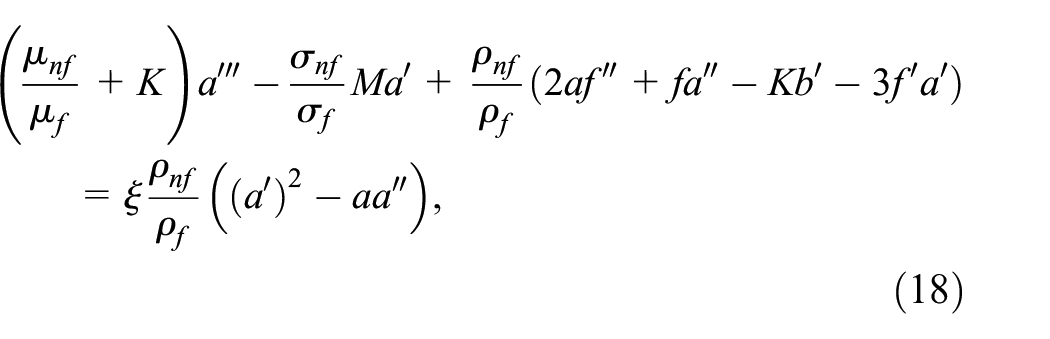
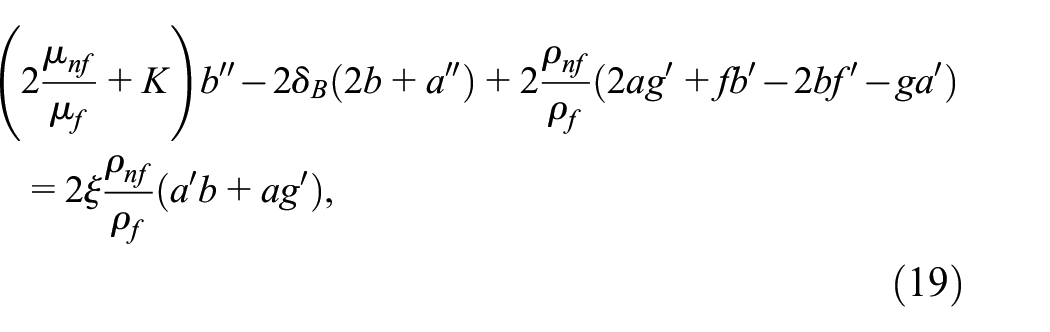
We acquire the following dimensionless non-similar system by using (6) in (1)–(4).
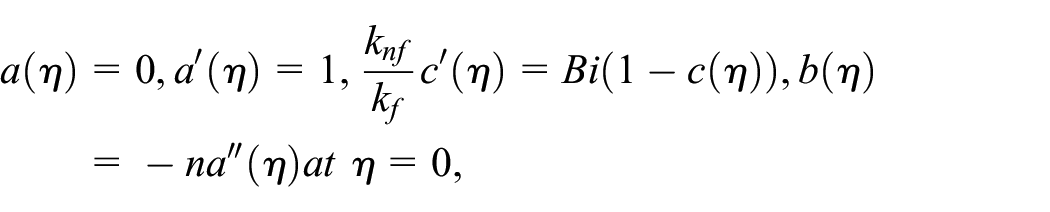
Non-similar boundary conditions are
Where is constant, and are dimensionless stream function and dimensionless microrotation velocity, M denotes magnetic field parameter, Prandtl number is , Eckert number is , Heat source is , is Biot number, is microorganism parameter, and is material parameter.
See Salahuddin et al.43 and Devi and Devi44 for a list of physical quantities of interest.
Where is the skin friction coefficient, is the Nusselt number, is the surface shear stress, and is the surface flux.
To investigate the flow of micropolar nanofluid over a stretched surface within the boundary layer, we apply the Local Non-Similarity (LNS) method to the dimensionless governing model presented in equations (7)–(9), taking into account the specified boundary conditions (10).
First level of truncation
Suppose that , and the right-hand side of equations (7)–(9) are equal zeros.
To achieve a second-order truncation, it is crucial to differentiate equations (7)–(9) concerning the parameter and integrate additional functions into these equations. To reach the targeted second level of truncation, the following relationships are introduced:
As a result, the changed system at the second iteration level is:
Associated boundary conditions are
Results and discussion
The numerical solutions for the coupled transformed differential expression were obtained through the application of the bvp4c MATLAB command/package using a local non-similar method. Our approach underscores the importance of physical relevance and accountability, with the non-dimensionalization process being pivotal and facilitated through non-similarity transformations. The primary focus of our methodology is to manage non-similar terms arising from these transformations. To address numerical challenges, we utilize the bvp4c algorithm in MATLAB to create a non-similar model and implement the Local Non-Similarity (LNS) approach. This comprehensive strategy ensures the reliability of our numerical solutions, aligning them with physical principles throughout the modeling process.
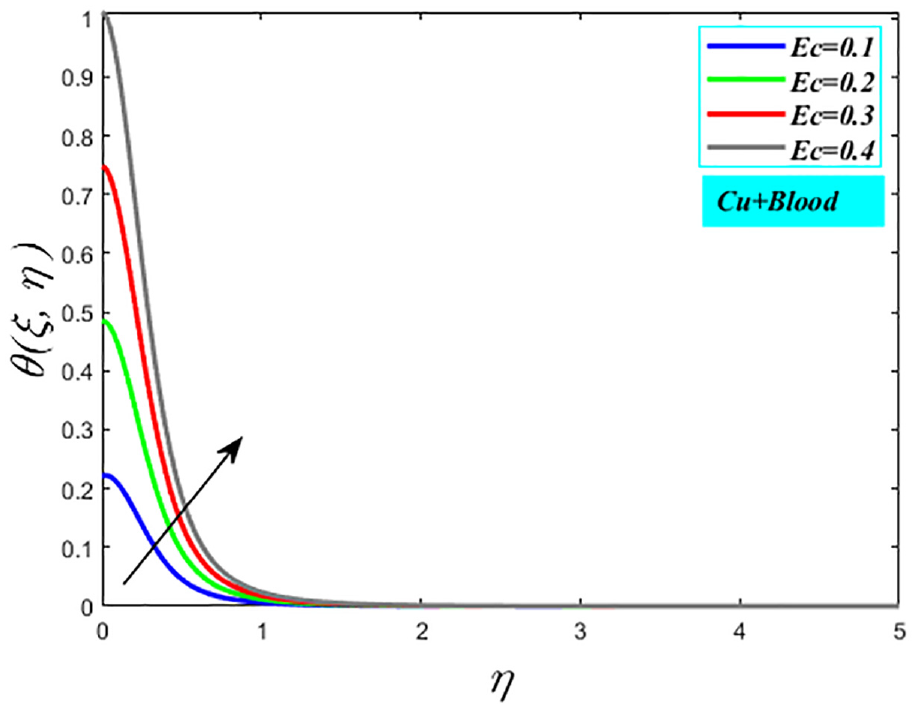
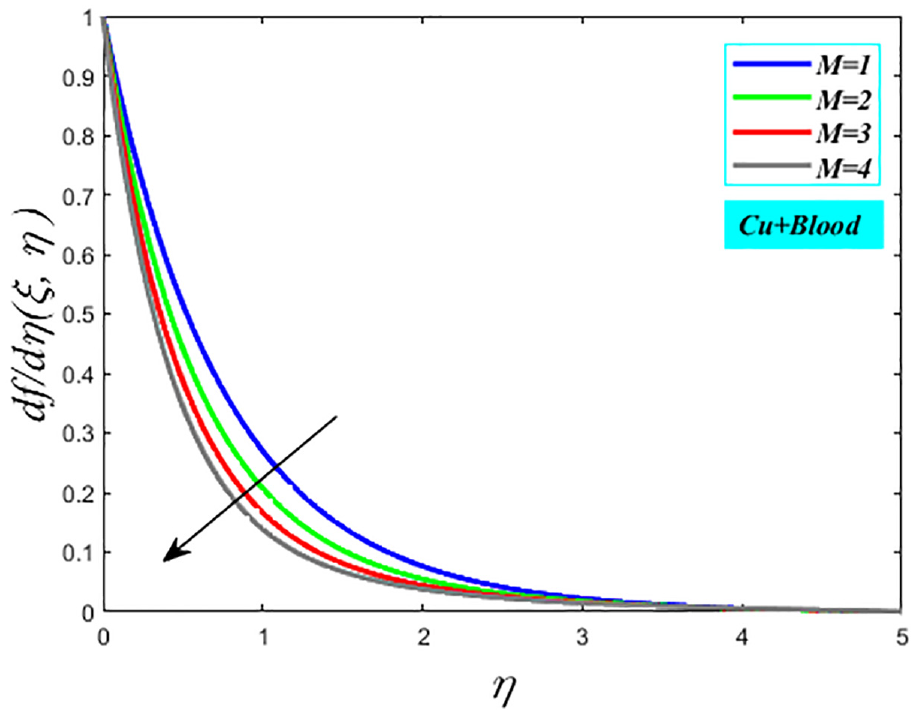
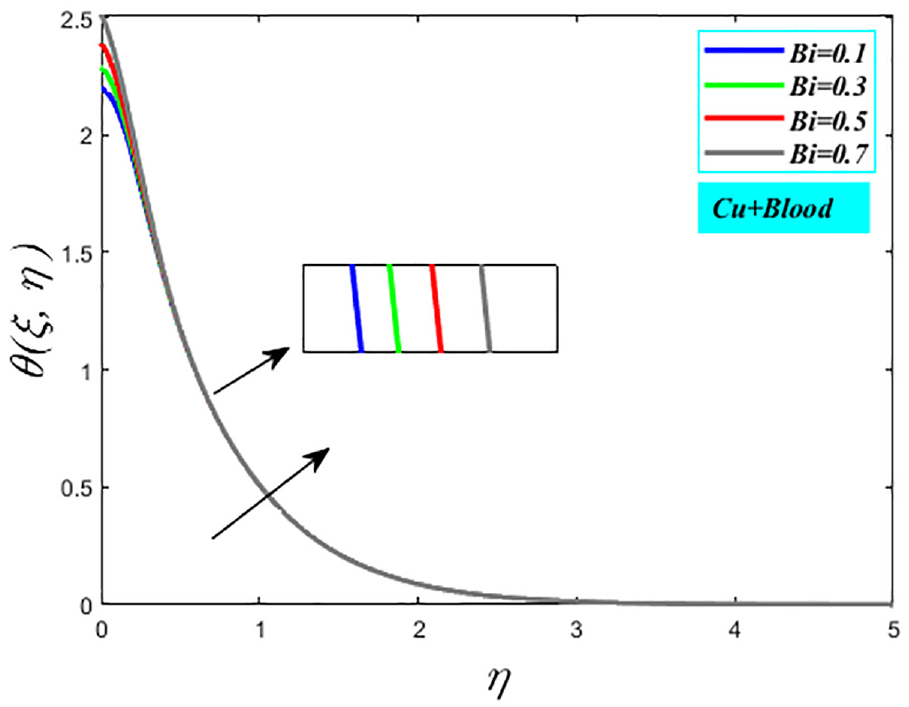
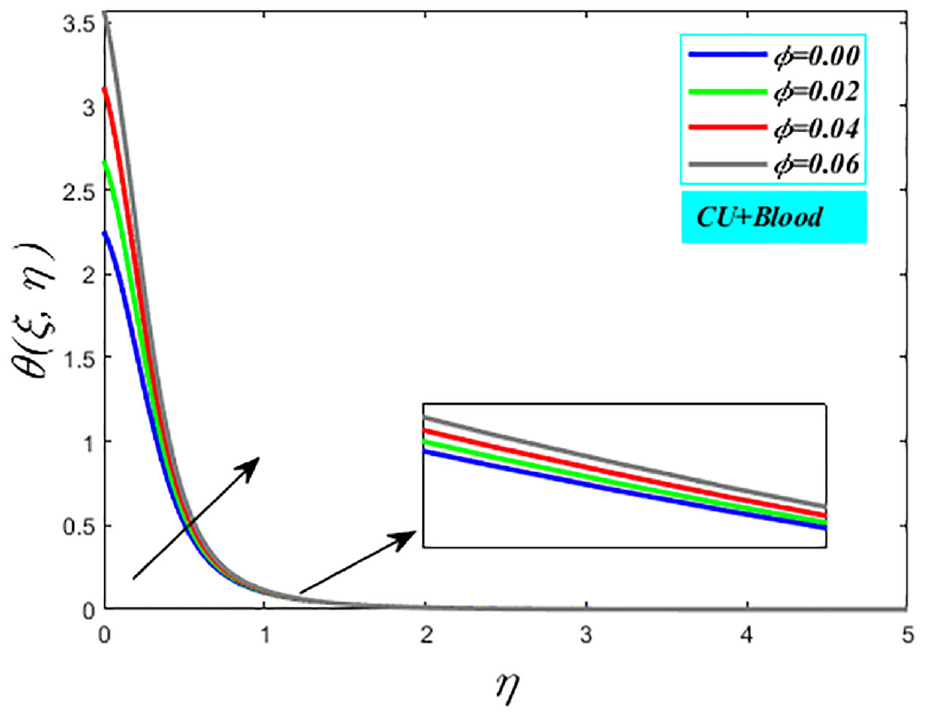
The MATLAB package, bvp4c, employs the 3-stage Lobatto III formula through finite difference code. This formula ensures a uniformly fourth-order accurate C1-continuous solution within the integrated function’s interval. The package includes a residual error module for simulating numerical errors in the simulation. In this study, the presented tabular data and graphical simulations meet the bvp4c tolerance criteria . The findings could help to investigate the thermal efficiency and heat exchanger of microsystems. Our aim is to examine the influence of several variables such as the micropolar parameter (), magnetic field parameter (M), Eckert number (), is microorganism parameter, heat source () on velocity , microrotation , and temperature profile. By analyzing Figures 2–11, this study illustrates the variations in the parameters and provides insight into their impact on flow characteristics.
for different values of . Taking .
for different values of “K”. Taking .
for different values of “K”. Taking .
for different values of “”. Taking .
for different values of . Taking .
for different values of “”. Taking .
for different values of “”. Taking .
for different values of . Taking .
for different values of . Taking .
for different values of . Taking .
Figures 2–4 explore the behaviors exhibited by micropolar nanofluids, concentrating specifically on velocity, microrotation, and temperature as material parameters (). As we systematically increase the , distinct changes become evident in the nanofluid dynamics. Notably, both the velocity and temperature profiles show an upward trend, signifying the heightened internal microstructure influenced by the augmented . This increase in velocity suggests an intensified fluid flow, while the simultaneous rise in the temperature profile reflects alterations in the overall thermal characteristics of the nanofluid within the boundary layer. Conversely, a clear pattern emerges in the microrotation profile. With an elevation in the , there is an apparent decrease in microrotation. This fall plays an important role in the boundary layer and shows complicated patterns between material characteristics and nanofluid rotational behavior.
A noticeable correlation is revealed in Figure 5. As we enhanced the values of the Eckert number , we noticed temperature profiles declining within the boundary layer. The rise in temperature profile shows that micropolar nanofluid’s thermal characteristics are greatly affected by the Eckert number. The temperature profile increasing trend is consistent since increasing values show high kinetic energy in the system. This increase within the boundary layer is a consequence of fluid flow interactions and heat transfer properties. Figure 6 reveal the effect of magnetic field parameter on the velocity profile of magneto-micropolar nanofluid flow within the boundary layer. To study the fluid motion systematically, we manipulate the magnetic field parameter values. As we enhances the values nanofluids velocity profile decreased. By raising the values, the velocity profile lowers because of the Lorentz force, which inhibits flow because motion is opposed by the Lorentz force, which is produced by the magnetic field. This finding reveals interesting information about the connection between and magneto-micropolar nanofluid flow and its possible uses in the field of mechatronics and other engineering applications.
Figure 7 reveals valuable concepts about heat sources and an understanding of the role of micropolar nanofluid flow within the boundary layer. We get a piece of important information by varying the heat source value, especially on the temperature profile of nanofluid flow. There was an increase in the temperature profile as the heat source value was raised. This temperature rise indicates that the heat source has a significant effect on the thermal characteristics of the micropolar nanofluids in the boundary layer. Enhancing the fluid system’s thermal behavior involves using the heat source as an energy input. Comprehending this enhanced thermal responsiveness is crucial to examining how external energy inputs, such as the heat source, affect the thermal dynamics of micropolar nanofluids. It is thought that heat sources generally convert fluid thermal energy, which accounts for the temperature profile’s observed increasing trend. In Figure 8, a significant correlation is evident between the Biot number and the temperature profile of magneto-micropolar nanofluid flow. The Biot number exhibits a distinctive connection with fluid temperature within the context of micropolar nanofluid flow. As the Biot number increases, the magnetic nanofluid experiences a notable rise in convective heating, influencing the interactions at the extremely small micropolar scale. It seems natural that a greater Biot number would have profound impacts on the temperature profile given the micropolar features. Concurrently, the increased leads to an expansion of the boundary layer, which has a complicated impact on the temperature distribution of the magnetic nanofluid. The intricate relationship between the Biot number and temperature profile, as seen in Figure 8, offers complicated details on the flow of magneto-micropolar nanofluids.
In Figures 9–11, we examine in detail the properties of micropolar nanofluids, focusing on the effect of the boundary layer’s volume fraction . The results show that variations in volume percent have a discernible effect on the microrotation profiles, temperature, and velocity. As the volume fraction systematically increases, a substantial and simultaneous elevation is observed in both the velocity and temperature profiles within the boundary layer. This suggests that augmenting the concentration of nanoparticles within the nanofluid results in increased fluid flow velocity and a higher temperature. The fundamental reason for this lies in the heightened thermal conductivity and momentum transfer linked to a greater volume fraction of nanoparticles, thereby enhancing both heat transfer and fluid motion. However, a contrasting trend is notable in the microrotation profile within the boundary layer, which shows a discernible decrease with the enhancement of volume fraction. This observation can be explained by considering the intensified interaction and agglomeration of nanoparticles as the volume fraction increases. The heightened volume fraction imposes more pronounced constraints on the rotational freedom of particles, resulting in a reduction in microrotation.
Table 1 represents the thermo physical relation of nanofluid and base fluid.
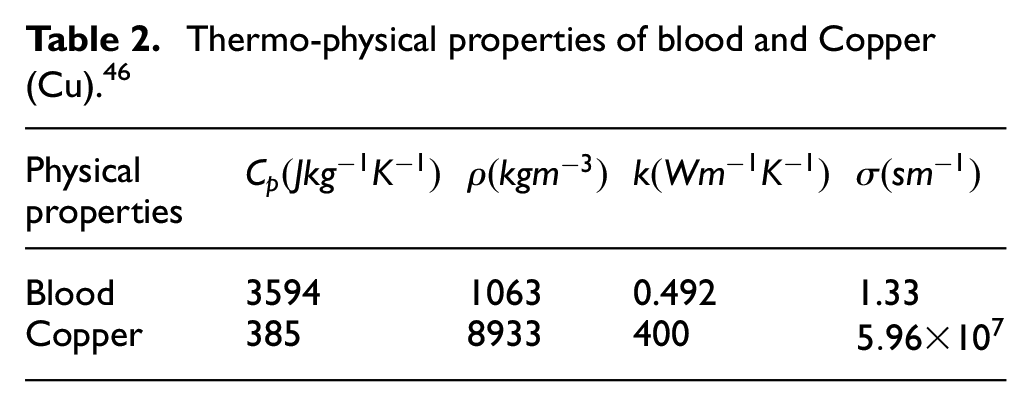
Table 2 represents the numerical values of blood and copper.
Thermo-physical properties of blood and Copper (Cu).46
Physical properties
Blood
3594
1063
0.492
1.33
Copper
385
8933
400
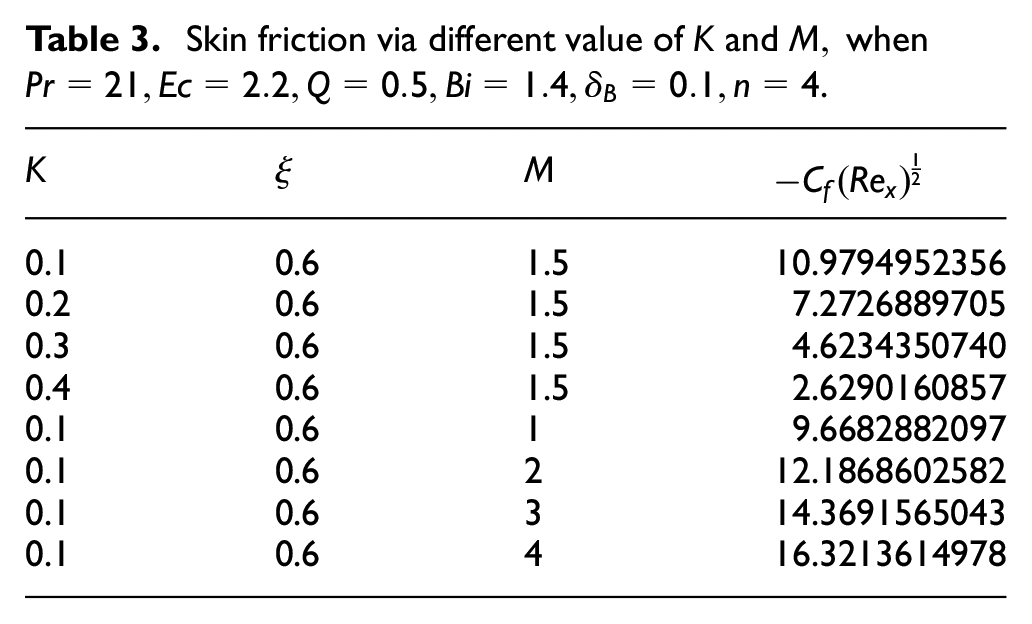
Table 3 illustrates the impact of dimensionless factors and on local skin friction coefficients. The data indicate that the local skin friction coefficient rises with increasing values and decreases with higher values.
Skin friction via different value of and when .
0.1
0.6
1.5
10.9794952356
0.2
0.6
1.5
7.2726889705
0.3
0.6
1.5
4.6234350740
0.4
0.6
1.5
2.6290160857
0.1
0.6
1
9.6682882097
0.1
0.6
2
12.1868602582
0.1
0.6
3
14.3691565043
0.1
0.6
4
16.3213614978
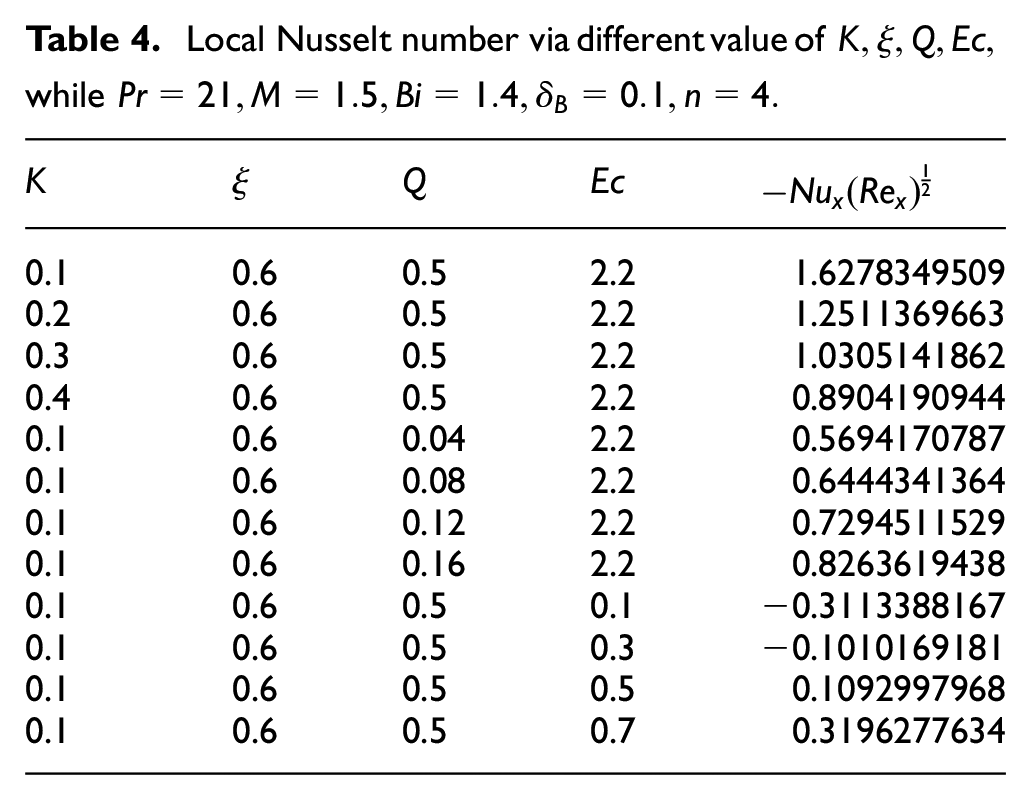
Table 4 exhibits the local Nusselt number values for various parameters , and . As values increase, there is a corresponding rise in the local Nusselt number. However, the trend is different for and , causing a decrease in the local Nusselt number.
Local Nusselt number
0.1
0.6
0.5
2.2
1.6278349509
0.2
0.6
0.5
2.2
1.2511369663
0.3
0.6
0.5
2.2
1.0305141862
0.4
0.6
0.5
2.2
0.8904190944
0.1
0.6
0.04
2.2
0.5694170787
0.1
0.6
0.08
2.2
0.6444341364
0.1
0.6
0.12
2.2
0.7294511529
0.1
0.6
0.16
2.2
0.8263619438
0.1
0.6
0.5
0.1
−0.3113388167
0.1
0.6
0.5
0.3
−0.1010169181
0.1
0.6
0.5
0.5
0.1092997968
0.1
0.6
0.5
0.7
0.3196277634
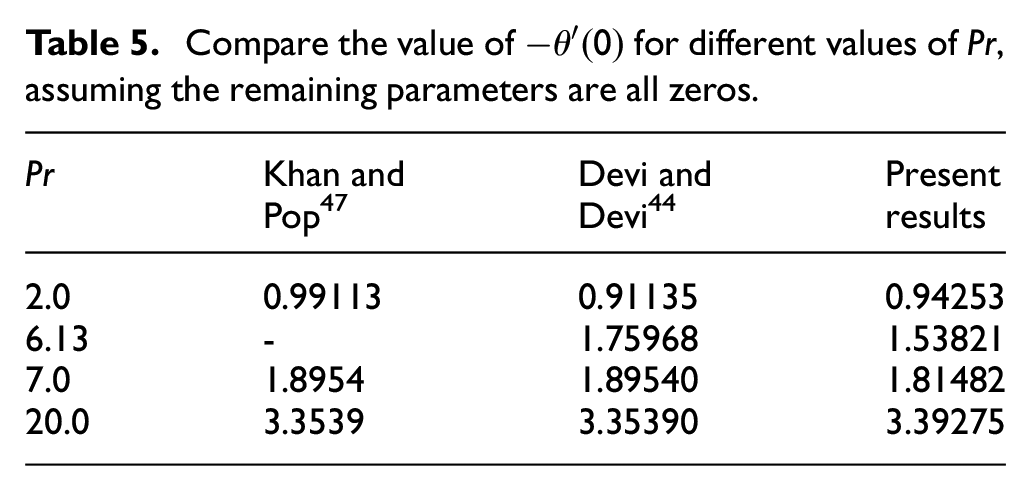
Table 5 depicts the comparison of numerical estimations of for present study against the findings of Khan and Pop47 and Devi and Devi.44
Compare the value of for different values of , assuming the remaining parameters are all zeros.
In this study, we explore the governing equations of steady, incompressible micropolar magnetohydrodynamic (MHD) fluid flow across a stretched sheet. In order to examine the coupled governing differential expressions, we used the bvp4c MATLAB package for numerical solutions using the local non-similar method. Graphs and tables illustrate intricate details of micropolar-based magnetized nanofluid flow near stretching sheets, emphasizing the dynamic properties of the boundary layer. Employing the non-similar method offers insights into deviations from traditional solutions, providing a nuanced understanding of how micropolar effects and magnetic fields influence the structure of the boundary layer. These findings significantly contribute to the comprehension of micropolar-based magnetized nanofluid behavior, especially in applications related to materials science and engineering.
Significantly, as both the material parameter and volume fraction values increase, we observe a rise in the velocity profiles (as depicted in Figures 2 and 9) and in the temperature profiles (illustrated in Figures 4 and 11). This observed increase can be attributed to the intensified interaction and enhanced thermal conductivity resulting from higher concentrations of nanoparticles and an augmented material parameter. Conversely, a decline is evident in the microrotation profiles (depicted in Figures 3 and 10). This reduction in microrotation can be explained by the increased constraints on rotational freedom due to heightened particle interaction and agglomeration, underscoring the complex interplay between these parameters in micropolar nanofluid dynamics within the boundary layer system.
As the magnetic field parameter increases in micropolar-based magnetized nanofluid flow, there is a notable decrease in the velocity profile (as depicted in Figure 6). This decline in velocity profile is associated with the Lorentz force, which is the barrier to boundary layer flow. One of the aspects that notice this change in boundary layer flow is the connection between the magnetic field, Lorentz force, and micropolar nanofluid properties.
Regarding the stretched sheet, a significant association has been seen between the temperature profile and the Biot number . As seen in Figure 8, a noticeable rise in convective heating on the sheet is linked to a rise in the Biot number, which produces a more noticeable temperature gradient. A rise in the Biot number is accompanied by a corresponding increase in the boundary layer’s broadness and the temperature of the nanofluid. This study highlights the intricate link between radiative heating, the Biot number, and the resulting thermo and flow patterns in this specific nanofluid system.
It is noteworthy that, as Figure 5, the temperature increases in proportion to the Eckert number . This makes it abundantly clear how important the Eckert number, is in characterizing thermal performance. This dynamic interaction provides greater may explain the apparent increase in temperature distribution in the boundary layer.
An intriguing finding about the influence of dimensionless parameters and on local skin friction coefficients is shown in Table 3. The results show that the local skin friction coefficient increases proportionally with increasing values of . Conversely, as values increase, there is a noticeable drop in the local skin friction coefficient.
Interestingly, there is a positive correlation between values and local Nusselt numbers. Remarkably, for and , a unique pattern appears that reduces the local Nusselt number, as seen in Table 4. This disparity highlights the intricate dynamics present in the heat transport pathways that our research looks into.
In the future, our target is to innovate smart nanofluid mattresses that prevent skin problems for pressure ulcer patients. This innovation will enhance the best understanding of the biotech and healthcare departments.
Footnotes
Appendix
Handling Editor: Chenhui Liang
Declaration of conflicting interests
The author(s) declared no potential conflicts of interest with respect to the research, authorship, and/or publication of this article.
Funding
The author(s) received no financial support for the research, authorship, and/or publication of this article.
ORCID iD
Umer Farooq
References
1.
ChoiSUEastmanJA. Enhancing thermal conductivity of fluids with nanoparticles (No. ANL/MSD/CP-84938; CONF-951135-29). Argonne, IL: Argonne National Lab, 1995.
2.
YuWXieH. A review on nanofluids: preparation, stability mechanisms, and applications. J Nanomat2012; 2012: 1–17.
3.
MurshedSMSLeongKCYangC. Investigations of thermal conductivity and viscosity of nanofluids. Int J Therm Sci2008; 47: 560–568.
4.
EastmanJAChoiSUSLiS, et al. Anomalously increased effective thermal conductivities of ethylene glycol-based nanofluids containing copper nanoparticles. Appl Phys Lett2001; 78: 718–720.
5.
ChoiCYooHSOhJM. Preparation and heat transfer properties of nanoparticle-in-transformer oil dispersions as advanced energy-efficient coolants. Curr Appl Phys2008; 8: 710–712.
6.
RameshGKMadhukeshJKDasR, et al. Thermodynamic activity of a ternary nanofluid flow passing through a permeable slipped surface with heat source and sink. Waves Random Complex Media Epub ahead of print 25 March 2022. DOI: 10.1080/17455030.2022.2053237.
7.
RameshGKMadhukeshJKShehzadSA, et al. Ternary nanofluid with heat source/sink and porous medium effects in stretchable convergent/divergent channel. Proc IMechE, Part E: J Process Mechanical Engineering2024; 238: 134–143.
8.
DuddaBShinD. Effect of nanoparticle dispersion on specific heat capacity of a binary nitrate salt eutectic for concentrated solar power applications. Int J Therm Sci2013; 69: 37–42.
9.
MahianOKianifarAKalogirouSA, et al. A review of the applications of nanofluids in solar energy. Int J Heat Mass Transf2013; 57: 582–594.
KaoMJLoCHTsungTT, et al. Copper-oxide brake nanofluid manufactured using arc-submerged nanoparticle synthesis system. J Alloys Comp2007; 434-435: 672–674.
12.
EringenAC. Theory of micropolar fluids. Journal of Mathematics and Mechanics1966; 16: 1–18.
13.
AliLLiuXAliB, et al. Analysis of magnetic properties of nano-particles due to a magnetic dipole in micropolar fluid flow over a stretching sheet. Coatings2020; 10: 170.
14.
KazakiaYArimanT. Generalization of thermal effects on micropolar fluid. Rheologica Acta1971; 10: 319.
15.
GangadharKSubba RaoMVSurekhaP, et al. Shape effects on 3D MHD micropolar Au-mgo/blood hybrid nanofluid with Joule heating. Int J Ambient Energy2022; 43: 8428–8437.
16.
KhaderMMSharmaRP. Evaluating the unsteady MHD micropolar fluid flow past stretching/shirking sheet with heat source and thermal radiation: implementing fourth order predictor–corrector FDM. Math Comput Simul2021; 181: 333–350.
17.
SeddeekMA. Flow of a magneto-micropolar fluid past a continuously moving plate. Phys Lett A2003; 306: 255–257.
18.
IshakANazarRPopI. Heat transfer over a stretching surface with variable heat flux in micropolar fluids. Phys Lett A2008; 372: 559–561.
19.
BiswasNDattaAMannaNK, et al. Thermo-bioconvection of oxytactic microorganisms in porous media in the presence of magnetic field. Int J Numer Methods Heat Fluid Flow2021; 31: 1638–1661.
20.
BelabidJÖztopHF. Nanofluid thermo-bio-convection in a horizontal porous wavy-walled annulus: interaction of phototactic microorganisms and nanoparticles distribution. Int J Heat Mass Transf2023; 215: 124476.
21.
KhanSAHayatTAlsaediA. Entropy generation in bioconvection hydromagnetic flow with gyrotactic motile microorganisms. Nano Adv2023; 5: 4863–4872.
22.
PatilPMGoudarBPatilM, et al. Unsteady magneto bioconvective Sutterby nanofluid flow: influence of g-Jitter effect. Chin J Phys2023; 89: 565–581.
23.
LiYMajeedAIjazN, et al. Melting thermal transportation in bioconvection Casson nanofluid flow over a nonlinear surface with motile microorganism: application in bioprocessing thermal engineering. Case Stud Therm Eng2023; 49: 103285.
24.
AwaisMSalahuddinT. Radiative magnetodydrodynamic cross fluid thermophysical model passing on parabola surface with activation energy. Ain Shams Eng J2024; 15: 102282.
25.
MukhopadhyayS. Analysis of boundary layer flow over a porous nonlinearly stretching sheet with partial slip at the boundary. Alex Eng J2013; 52: 563–569.
26.
KhechekhoucheAManokarAMSathyamurthyR, et al. Energy, exergy analysis, and optimizations of collector cover thickness of a solar still in El Oued Climate, Algeria. Int J Photoenergy2021; 2021: 1–8.
27.
SajjadUSadeghianjahromiAAliHM, et al. Enhanced pool boiling of dielectric and highly wetting liquids - a review on enhancement mechanisms. Int Commun Heat Mass Transf2020; 119: 104950.
28.
GireeshaBJUmeshaiahMPrasannakumaraBC, et al. Impact of nonlinear thermal radiation on magnetohydrodynamic three dimensional boundary layer flow of Jeffrey nanofluid over a nonlinearly permeable stretching sheet. Physica A2020; 549: 124051.
29.
CortellR. Viscous flow and heat transfer over a nonlinearly stretching sheet. Appl Math Comput2007; 184: 864–873.
30.
DhanaiRRanaPKumarL. Critical values in slip flow and heat transfer analysis of non-Newtonian nanofluid utilizing heat source/sink and variable magnetic field: multiple solutions. J Taiwan Inst Chem Eng2016; 58: 155–164.
31.
EllahiRZeeshanAShehzadN, et al. Structural impact of kerosene-Al2O3 nanoliquid on MHD poiseuille flow with variable thermal conductivity: application of cooling process. J Mol Liq2018; 264: 607–615.
32.
TliliISamratSPSandeepN, et al. Effect of nanoparticle shape on unsteady liquid film flow of MHD Oldroyd-B ferrofluid. Ain Shams Eng J2021; 12: 935–941.
33.
SulochanaCSamratSPSandeepN. Boundary layer analysis of an incessant moving needle in MHD radiative nanofluid with joule heating. Int J Mech Sci2017; 128-129: 326–331.
MaboodFKhanWAIsmailAIM. MHD flow over exponential radiating stretching sheet using homotopy analysis method. J King Saud Univ - Eng Sci2017; 29: 68–74.
36.
RazzaqRFarooqU. Non-similar forced convection analysis of Oldroyd-B fluid flow over an exponentially stretching surface. Adv Mech Eng2021; 13: 1–7.
37.
RazzaqRFarooqUCuiJ, et al. Non-Similar solution for magnetized flow of Maxwell nanofluid over an exponentially stretching surface. Math Probl Eng2021; 2021: 1–10.
38.
JanAMushtaqMFarooqU, et al. Nonsimilar analysis of magnetized Sisko nanofluid flow subjected to heat generation/absorption and viscous dissipation. J Magn Magn Mater2022; 564: 170153.
39.
MushtaqMAsgharSHossainMA. Mixed convection flow of second grade fluid along a vertical stretching flat surface with variable surface temperature. Heat Mass Transf2007; 43: 1049–1061.
40.
TiwariRKDasMK. Heat transfer augmentation in a two-sided lid-driven differentially heated square cavity utilizing nanofluids. Int J Heat Mass Transf2007; 50: 2002–2018.
41.
PatelHRMittalASDarjiRR. MHD flow of micropolar nanofluid over a stretching/shrinking sheet considering radiation. Int Commun Heat Mass Transf2019; 108: 104322.
42.
HazarikaSAhmedS. Brownian motion and thermophoresis behavior on micro-polar nano-fluid—a numerical outlook. Math Comput Simul2022; 192: 452–463.
43.
SalahuddinTKhanMSaeedT, et al. Induced MHD impact on exponentially varying viscosity of Williamson fluid flow with variable conductivity and diffusivity. Case Stud Therm Eng2021; 25: 100895.
44.
DeviSUDeviSA. Heat transfer enhancement of cu− $ al_ {2} o_ {3} $/water hybrid nanofluid flow over a stretching sheet. J Nigerian Math Soc2017; 36: 419–433.
45.
RiazSNaheedNFarooqU, et al. Non-similar investigation of magnetized boundary layer flow of nanofluid with the effects of joule heating, viscous dissipation and heat source/sink. J Magn Magn Mater2023; 574: 170707.
46.
YasirMKhanM. Comparative analysis for radiative flow of Cu–Ag/blood and Cu/blood nanofluid through porous medium. J Pet Sci Eng2022; 215: 110650.
47.
KhanWAPopI. Boundary-layer flow of a nanofluid past a stretching sheet. Int J Heat Mass Transf2010; 53: 2477–2483.