



Abstract
The sugarcane field excitation, the engine excitation and reaction forces acting on cutters constitute complicated excitations of sugarcane harvesters. Axial cutter vibration displacement measuring and sugarcane cutting experiments were done on a self-developed sugarcane harvester experiment platform (SHEP) with complicated excitations simulated through a simulated sugarcane field exciter and an actuating engine. Effects of the sugarcane field excitation, the engine excitation and cutting parameters on the axial cutter vibration, three-directional cutting forces and the sugarcane cutting quality (SCQ) were studied through single-factor and orthogonal experiments. Effects of the axial cutter vibration on three-directional cutting forces and those of these two influence factors on the SCQ were also studied. Significance levels of effects in the sugarcane cutting process form high to low are as follow, the sugarcane field excitation, the cutter rotating speed, the engine excitation, the cutter installing angle, the sugarcane harvester moving speed. The axial cutter vibration has a directly and highly significant monotonic negative correlated effect on the SCQ. For the best SCQ, the cutter rotating speed is 700 r/min, the sugarcane harvester moving speed is 0.6 m/s and the cutter installing angle is 8°, providing a reference for setting cutting parameters of sugarcane harvesters with a good SCQ.
Keywords
Introduction
Currently, research on effects of influence factors on sugarcane ratoon breaking and the sugarcane cutting wastage of sugarcane harvesters have been carried out to improve the sugarcane cutting quality. Valued achievements have been obtained.
Thanomputra improved the cutting efficiency of sugarcane harvesters through abrasive-sand-added high-pressure water cutting. 1 Mello and Momin used different cutters to do sugarcane cutting experiments and found the one with the best cutting quality for sugarcane harvesters.2,3 Silva evaluated the sugarcane ratoon damage degree caused by the cutting height of sugarcane harvesters through statistical experiment data. 4 Ripoli designed a cutter with an automatic in-soil-cutting-depth-controlling system dependent on sugarcane field roughness for sugarcane harvesters. 5 Johnson and Mathanker studied effects of the cutting speed and the cutting edge angle on the cutting energy for sugarcane harvesters.6,7 Kroes established a kinematic double-cutter model to study the cutter trajectory and calculate the maximum ratio between the sugarcane harvester moving speed and the cutter rotating speed, then to improve the cutting quality of sugarcane harvesters theoretically through kinematics. 8 Liu obtained the shear modulus and the tensile strength of sugarcanes through tension and compression experiments. 9 Taghijarah obtained the bending strength of sugarcanes through measuring cutting forces generated by sugarcane harvesters. 10 Lai found the sugarcane field excitation has a bad effect on the cutting system of sugarcane harvesters, causing the axial cutter frame vibration and making the sugarcane cutting quality poor.11,12 Wang established a cutter vibration model to study the effect of the bearing clearance on the cutting system vibration for sugarcane harvesters. 13 Huang simulated the sugarcane cutting process through infinite element analysis to study relationships among cutting forces, the cutter installing angle and the sugarcane cutting speed for sugarcane harvetsers. 14 Liu studied relationships among the sliding cutting angle, the cutter installing angle, the sugarcane cutting speed and cutting forces for sugarcane harvesters. 15 Xu established a cutting system model to obtain curves of cutting force changing with time and cloud pictures of the cutting system vibration displacement in the sugarcane cutting process through simulations for sugarcane harvesters. 16 Yang and Pelloso studied effects of the cutter rotating speed and the sugarcane harvester moving speed on the cutting quality of sugarcane harvesters.17,18
Research above was about mechanics characteristics of sugarcanes, effects of the sugarcane cutting form, design parameters of the cutters, the cutting system vibration, the sugarcane harvester moving speed and the cutter rotating speed on the cutting quality of sugarcane harvesters and effects of influence factors on cutting forces generated by sugarcane harvesters. However, under actual complicated excitations in sugarcane fields, that is, the sugarcane field excitation, the engine excitation and reaction forces generated by sugarcanes acting on cutters, effects of the sugarcane field excitation, the engine excitation, the cutter rotating speed, the cutter installing angle, the sugarcane harvester moving speed and their interactions on the cutting quality of sugarcane harvesters, direct influence factors and their affecting mechanisms in the sugarcane cutting process, that is, the axial cutter vibration and cutting forces, then to study how to improve the sugarcane cutting quality (SCQ) haven’t been considered yet.
In this paper, a sugarcane harvester experiment platform (SHEP), a dynamic sugarcane cutting experiment platform with complicated excitations well simulated through a simulated sugarcane field exciter and an actuating engine was developed to study effects of the sugarcane field excitation, the engine excitation and cutting parameters on the axial cutter vibration, three-directional cutting forces and the sugarcane cutting quality (SCQ) as well as effects of the axial cutter vibration on three-directional cutting forces and those of these two influence factors on the SCQ through single-factor experiments and orthogonal experiments. Based on research mentioned above, influence factors and related affecting mechanisms of the SCQ and the axial cutter vibration were further studied and analyzed through high-speed photographing. Therefore, the SHEP makes the sugarcane cutting process of sugarcane harvesters in sugarcane fields achieved through related simulated experiments in labs, which has never been achieved in previous research, so simulated experiments of sugarcane harvesters under complete vibration causing conditions of the engine, cutting forces existing in the sugarcane cutting process and sugarcane field roughness can be done in labs instead of sugarcane fields to avoid the low efficiency, poor security and bad reliability during experiments in sugarcane fields. 19 SPSS, Excel and MATLAB were used to analyze the experimental data. It is shown through this series of experimental investigations that for the best SCQ, the cutter rotating speed is 700 r/min, the sugarcane harvester moving speed is 0.6 m/s and the cutter installing angle is 8°. This study provides a reference for setting such cutting parameters as the cutter rotating speed, the cutter installing angle and the sugarcane harvester moving speed of sugarcane harvesters with a good cutting quality.
Materials and methods
Design analysis on the sugarcane harvester experiment platform
The sugarcane harvester experiment platform (SHEP) is mainly made up of the sugarcane-fixing device, sugarcane-transporting vehicle, sugarcane-transporting pathway (STP), two simulated sugarcane field exciters (SSFE), two vibration absorbers, the actuating engine, the cutting system, the body frame and the logistics frame. The manufactured SHEP and its three-dimensional model are shown in Figure 1.

The self-developed SHEP: (a) the three-dimensional model of the SHEP and (b) the manufactured SHEP.
The sugarcane field excitation is simulated through two SSFEs. The engine excitation is simulated through the actuating engine. The SHEP simulates a sugarcane harvester working in a sugarcane field. Sugarcanes clamped in the sugarcane-fixing device are fed by the sugarcane-transporting vehicle to move along the STP, then to cut by the two cutters driven by a stepless speed-adjusting hydraulic motor, so the sugarcane transporting speed simulates the sugarcane harvester moving speed.
The SSFE was developed based on sugarcane field roughness with the excitation frequency band within 10 Hz, the main excitation frequency band being 1–6 Hz and the excitation frequency band with the greatest contribution being 0.5–3.5 Hz. 20
The manufactured SSFE and its three-dimensional model with one upper spring and four lower springs are shown in Figure 2. 21

The SSFE: (a) the three-dimensional model of the SSFE and (b) the manufactured SSFE.
The SSFE vibration is produced through unbalanced forces generated by the high-speed eccentric mass block rotation and changed through the number of eccentric mass blocks. In this paper, four eccentric mass blocks were installed on the SSFE in all experiments.
Sugarcane cutting quality evaluating indexes
An improved entropy value method22–25 was used to calculate the sugarcane cutting quality (SCQ) evaluating value, y called the comprehensive cutting quality evaluating value (CCQEV) through four evaluating indexes of the SCQ, the number of axial sugarcane cracks, the axial crack depth, the axial crack length and the number of sugarcanes with broken ratoons, 26 as is calculated through the following equations. The greater the CCQEV is, the poorer the SCQ is.


Where:
Equipment for experiments
Fresh No.42 Guitang sugarcanes with an average diameter of 28 ± 3 mm were used to do sugarcane cutting experiments.
Axial cutter vibration displacements without cutting sugarcanes and in the sugarcane cutting process were measured through a laser displacement sensor. Three-directional cutting forces were measured through a common milling force-measuring system. Axial sugarcane crack depths and lengths were measured through a vernier caliper to calculate the CCQEV.
Effects of the sugarcane field excitation and the engine excitation were characterized by the SSFE output frequency dependent on the input one and the actuating engine output frequency equal to the input one. 27 Input frequencies of the SSFE and the actuating engine were respectively controlled through two digital frequency convertors.
The cutter rotating speed was controlled through a stepless speed-adjusting hydraulic motor and measured through a laser tachometer. The sugarcane transporting speed was controlled through a variable-frequency speed-adjusting motor to simulate the sugarcane harvester moving speed. The cutter installing angle was measured through a digital inclinometer.
The sugarcane cutting process was observed through a high-speed camera with the greatest shoot frame number being 4000/s, the screen resolution being 1024 × 768 and the shoot rate being 1000 frames/s.
Block diagrams of the axial cutter vibration displacement-measuring system and the common milling force-measuring system are shown in Figures 3 and 4.

The block diagram of the axial cutter vibration displacement-measuring system.

The block diagram of the common milling force-measuring system.
In this paper, the x axis is along the STP, pointing to the back of the SHEP, the y axis is vertical to the STP, pointing to the left of the SHEP and the z axis is along the cutter axis when the cutter installing angle is 0°, pointing vertically and upwards. The laser of the laser displacement sensor fell on the cutter along the z axis to measure the axial cutter vibration displacement, as is shown in Figure 5. The digital inclinometer was put on the cutter to measure the cutter installing angle, as is shown in Figure 6.

The laser of the laser displacement sensor falling on the cutter along the z axis.

The digital inclinometer put on the cutter.
The three-directional force-measuring device was installed under the sugarcane-fixing device, as is shown in Figure 7.
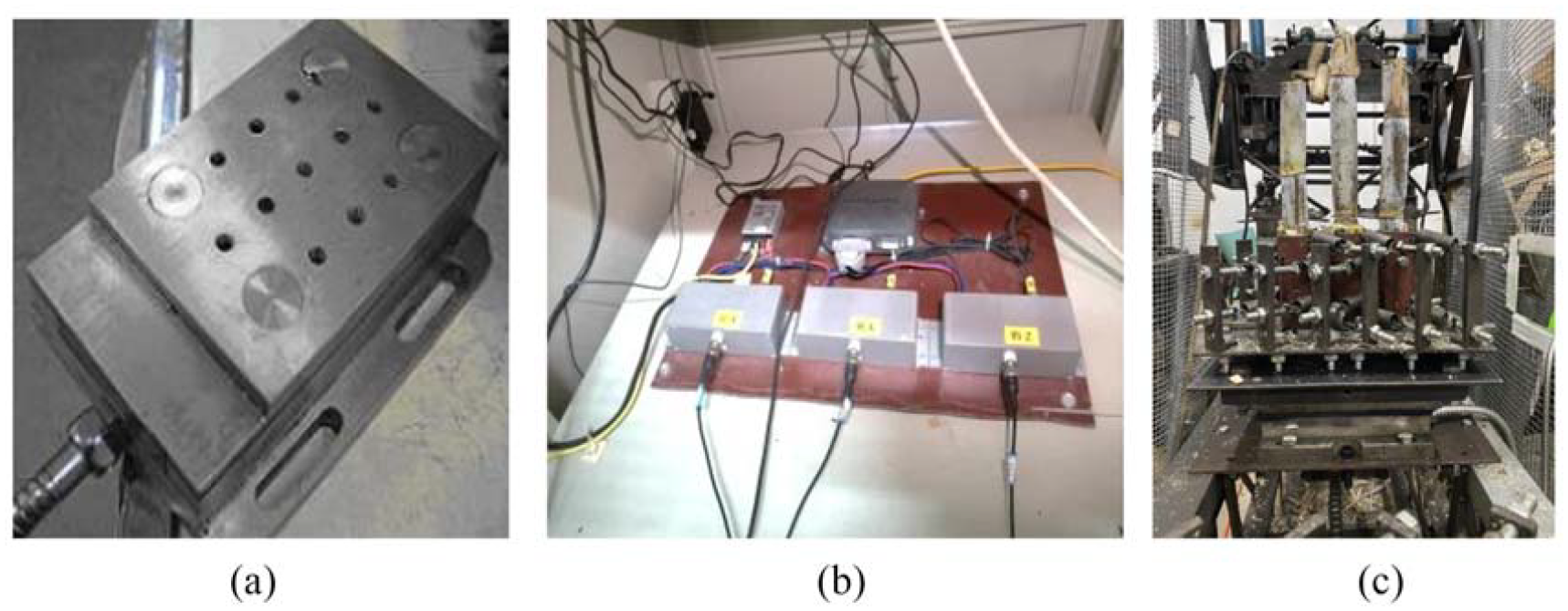
The three-directional force-measuring device: (a) the three-directional force-measuring device, (b) three channels corresponding to the x, the y and the z axes, and (c) the three-directional force-measuring device installed under the sugarcane-fixing device.
Experiment design
The block diagram of the experiment methodology is shown in Figure 8.

The block diagram of the experiment methodology.
The SSFE output frequency calibration experiment design
Before all single-factor experiments and orthogonal experiments, the SSFE output frequency calibration experiment was done to obtain the SSFE output frequencies dependent on the input ones and make sure whether the SSFE output frequencies are in the main excitation frequency band of sugarcane field roughness.
The laser tachometer was used to measure the eccentric axis rotation speed of the SSFE used to calculate its corresponding frequency. This frequency is just the SSFE output frequency dependent on the input one at this moment. The SSFE input and output frequencies and the eccentric axis rotation speed of the SSFE have nothing to do with the eccentric mass of the SSFE.
Single-factor experiment design
Design on single-factor experiments measuring the axial cutter vibration displacement without cutting sugarcanes
Experimental factors of these single-factor experiments were input frequencies of the SSFE and the actuating engine as well as the cutter rotating speed. Their levels are shown in Table 1. The experimental index was the axial cutter vibration displacement without cutting sugarcanes. These single-factor experiments were aimed at studying effects of the sugarcane field excitation, the engine excitation and the cutter rotating speed on the axial no-load cutter vibration.
Levels of the three experimental factors.

When the effect of one single factor on the axial cutter vibration displacement without cutting sugarcanes was studied, levels of the other two single factors were set as 0.
Design on single-factor experiments cutting sugarcanes under simulated complicated excitations
Experimental factors of these single-factor experiments were input frequencies of the SSFE and the actuating engine, the cutter rotating speed, the sugarcane transporting speed and the cutter installing angle. Levels of the former three experimental factors are shown in Table 1. Levels of the rest two experimental factors are shown in Table 2. Experimental indexes were the axial cutter vibration displacement, three-directional cutting forces and the CCQEV. These single-factor experiments were aimed at studying effects of the sugarcane field excitation, the engine excitation, the cutter rotating speed, the sugarcane harvester moving speed and the cutter installing angle on the axial cutter vibration in the sugarcane cutting process, three-directional cutting forces and the SCQ. Effects of the axial cutter vibration in the sugarcane cutting process on three-directional cutting forces and the SCQ as well as effects of three-directional cutting forces on the SCQ were further studied.
Levels of the sugarcane transporting speed and the cutter installing angle.

Constant levels of the SSFE input frequency, the actuating engine input frequency, the cutter rotating speed, the sugarcane transporting speed and the cutter installing angle were 20 Hz, 22 Hz, 700 r/min, 0.6 m/s and 8°.
Orthogonal experiment design
Design on the orthogonal experiment measuring the axial cutter vibration displacement without cutting sugarcanes
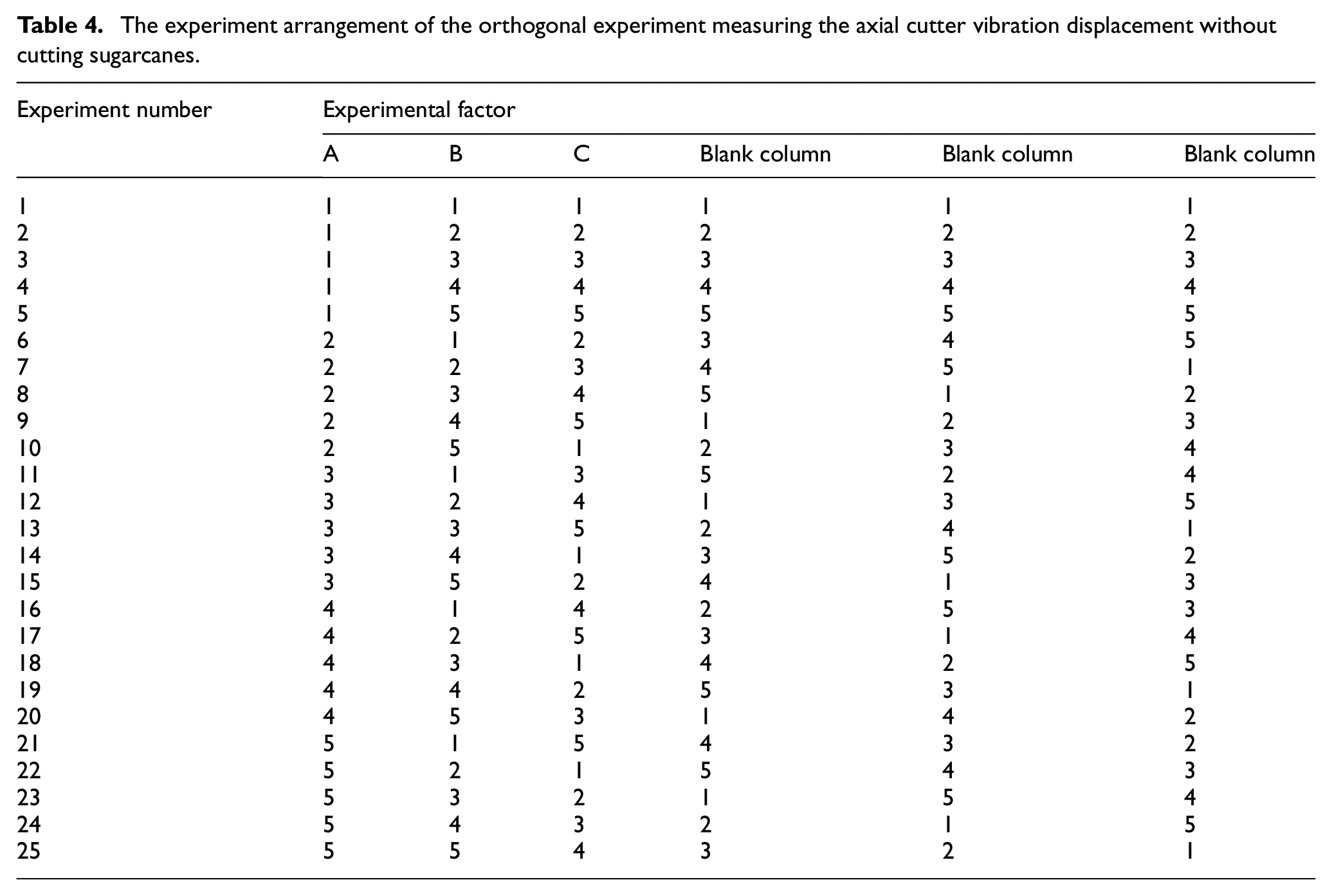
Experimental factors of this orthogonal experiment were input frequencies of the SSFE and the actuating engine as well as the cutter rotating speed. Their levels are shown in Table 3. The experimental index was the axial cutter vibration displacement without cutting sugarcanes. This orthogonal experiment was aimed at studying significance levels of effects of the sugarcane field excitation, the engine excitation, the cutter rotating speed and their interactions on the axial no-load cutter vibration. The L25(56) orthogonal table was chosen. The experiment arrangement is shown in Table 4.
Levels of the three experimental factors.

The experiment arrangement of the orthogonal experiment measuring the axial cutter vibration displacement without cutting sugarcanes.
Design on the orthogonal experiment cutting sugarcanes under simulated complicated excitations
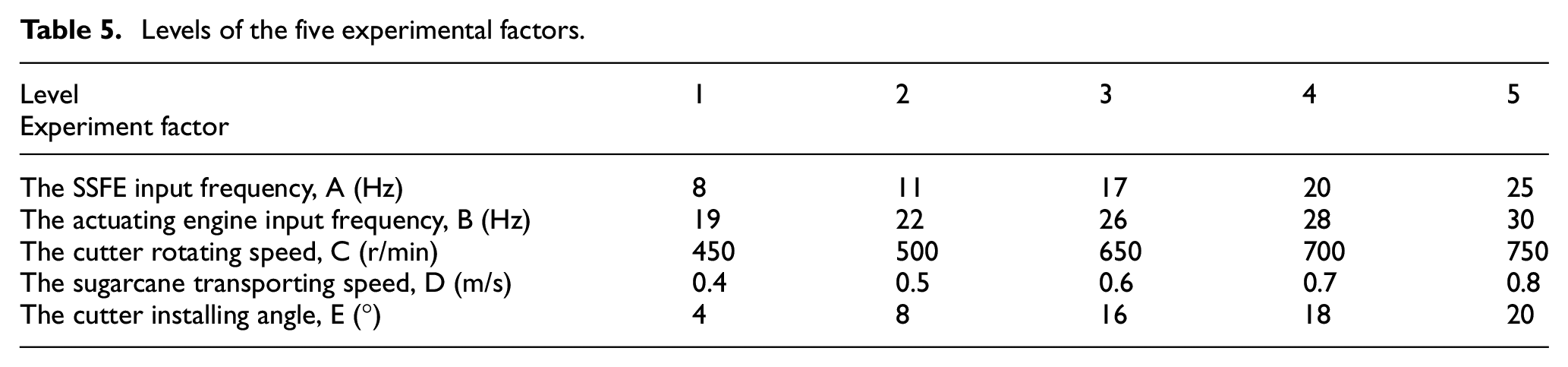
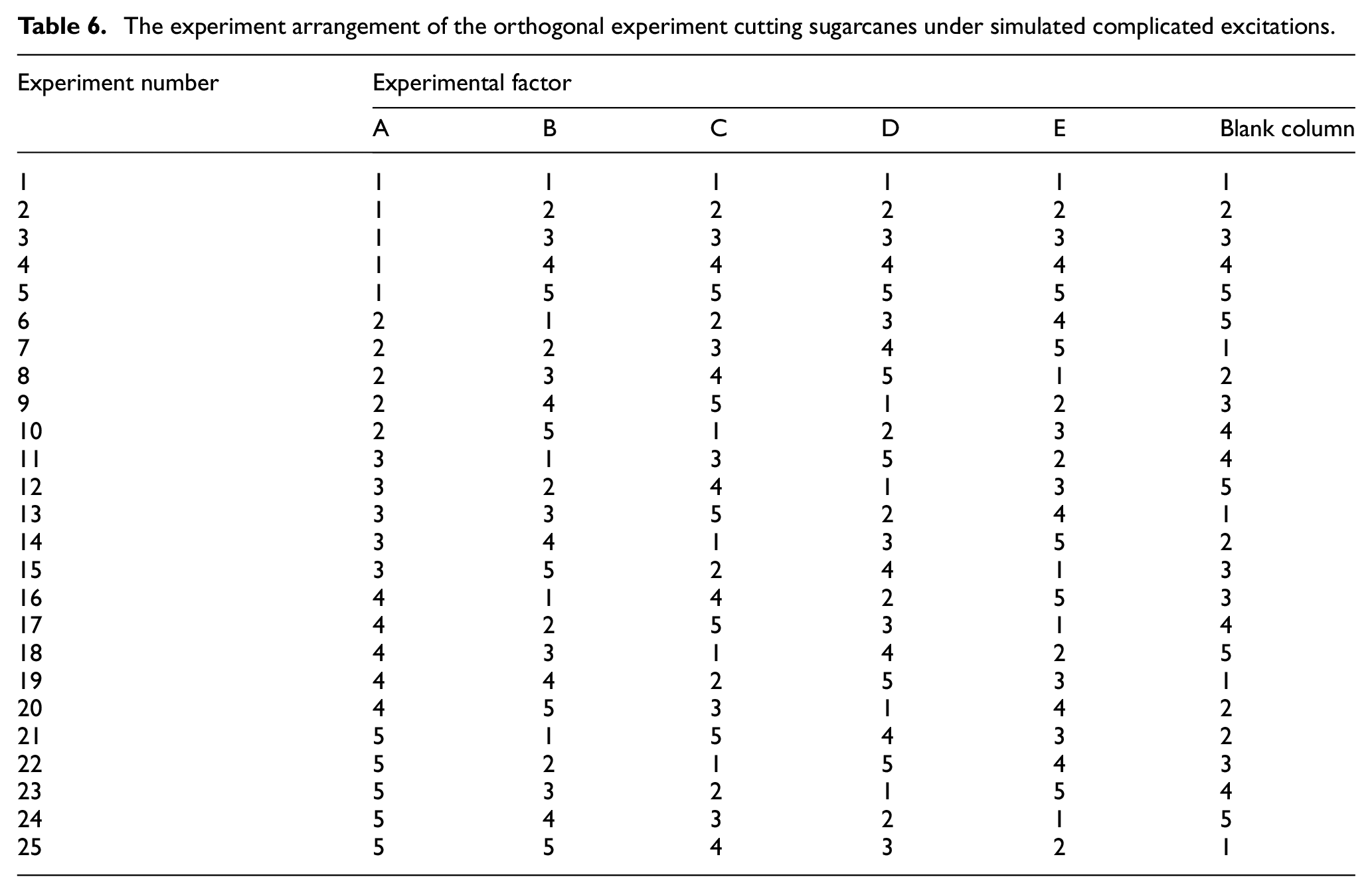
Experimental factors of this orthogonal experiment were input frequencies of the SSFE and the actuating engine, the cutter rotating speed, the sugarcane transporting quality, the cutter installing angle. Their levels are shown in Table 5. Experimental indexes were the axial cutter vibration displacement, three-directional cutting forces and the CCQEV. This orthogonal experiment was aimed at studying significance levels of effects of the sugarcane field excitation, the engine excitation, the cutter rotating speed, the sugarcane harvester moving speed, the cutter installing angle and their interactions on the axial cutter vibration in the sugarcane cutting process, three-directional cutting forces and the SCQ. The L25(56) orthogonal table was chosen. The experiment arrangement is shown in Table 6.
Levels of the five experimental factors.
The experiment arrangement of the orthogonal experiment cutting sugarcanes under simulated complicated excitations.
In all single-factor experiments and orthogonal experiments, every group of experiments were done for three times. The average value of results of these three times of experiments was chosen as the final result under this experiment condition.
Results
Analysis on the SSFE output frequency calibration experiment result
The SSFE output frequency calibration experiment result is shown in Table 7.
The SSFE output frequency calibration experiment result.

According to Table 7, the SSFE output frequencies range from 1.3 Hz to 4.81 Hz, approximately in the excitation frequency band with the greatest contribution of sugarcane field roughness, 0.5–3.5 Hz.
Analysis on single-factor experiment results
Analysis on results of single-factor experiments measuring the axial cutter vibration displacement without cutting sugarcanes
Analysis on the effect of the sugarcane field excitation on the axial no-load cutter vibration
The curve of the axial cutter vibration displacement changing with the SSFE input frequency without cutting sugarcanes drawn through Excel is shown in Figure 9.

The curve of the axial cutter vibration displacement changing with the SSFE input frequency without cutting sugarcanes.
According to Figure 9, the greater the SSFE input frequency is, the greater the axial cutter vibration displacement without cutting sugarcanes is. Their monotonic correlation analysis result and the single-factor variance analysis result with the SSFE input frequency as the independent variable obtained through SPSS are shown in Tables 8 and 9.
The monotonic correlation analysis result of the axial cutter vibration displacement without cutting sugarcanes and the SSFE input frequency.

The single-factor variance analysis result with the SSFE input frequency as the independent variable.

According to Table 8, the monotonic correlation significance coefficient is 0, so there is a significant monotonic correlated relationship between the axial cutter vibration displacement without cutting sugarcanes and the SSFE input frequency. Moreover, the monotonic correlation coefficient is 0.839 > 0, so there is a significant positive monotonic correlated relationship between the axial cutter vibration displacement without cutting sugarcanes and the SSFE input frequency, verifying the discovery obtained through Figure 9. Therefore, the more obvious the sugarcane field excitation is, that is, the more bumpy sugarcane fields are, the more severe the axial no-load cutter vibration will be.
On the other hand, according to Figure 9, when the input frequency of the SSFE is 20 Hz, a wave crest of the axial cutter vibration displacement without cutting sugarcanes appears. According to Table 7, the output frequency corresponding to 20 Hz is 5.86 Hz close to 6 Hz, in the main excitation frequency band of sugarcane field roughness, 1–6 Hz. According to the LMS modal test result of the SHEP got previously by our research group, 26 the first natural frequency of the SHEP is 6.819 Hz which is between 6 Hz and 7 Hz. 5.86 Hz is close to the first natural frequency of the SHEP, 6.819 Hz. Therefore, the sympathetic vibration of the SHEP appeared when the input frequency of the SSFE was 20 Hz. Then the sympathetic vibration of the SHEP made the peak value, also the maximum value of the axial cutter vibration displacement without cutting sugarcanes appear. Therefore, low-stage natural frequencies of sugarcane harvesters should be improved to be away from the main excitation frequency band of sugarcane field roughness to avoid the sympathetic vibration, then to weaken the axial no-load cutter vibration.
According to Table 9, the significance coefficient is 0, so the SSFE input frequency has a significant effect on the axial cutter vibration displacement without cutting sugarcanes. Therefore, the sugarcane field excitation has a significant effect on the axial no-load cutter vibration.
Analysis on the effect of the engine excitation on the axial no-load cutter vibration
The curve of the axial cutter vibration displacement changing with the actuating engine input frequency without cutting sugarcanes drawn through Excel is shown in Figure 10.

The curve of the axial cutter vibration displacement changing with the actuating engine input frequency without cutting sugarcanes.
According to Figure 10, when actuating engine input frequencies are 8, 11, 14, 19, 22 and 28 Hz with equal output ones, 8 Hz is close to the first natural frequency of the SHEP and 11, 14, 19, 22 Hz as well as 28 Hz are close to the second and the third natural frequencies of the SHEP, 11.514 Hz and 23.198 Hz according to the LMS modal test result of the SHEP, making the sympathetic vibration of the SHEP appear, then making peak values of the axial cutter vibration displacement without cutting sugarcanes appear. Besides, according to Figure 10, when the actuating engine input frequency was 22 Hz, the axial cutter vibration displacement without cutting sugarcanes reached the maximum value. Therefore, it is shown again that low-stage natural frequencies of sugarcane harvesters should be improved to avoid the sympathetic vibration, then to weaken the axial no-load cutter vibration.
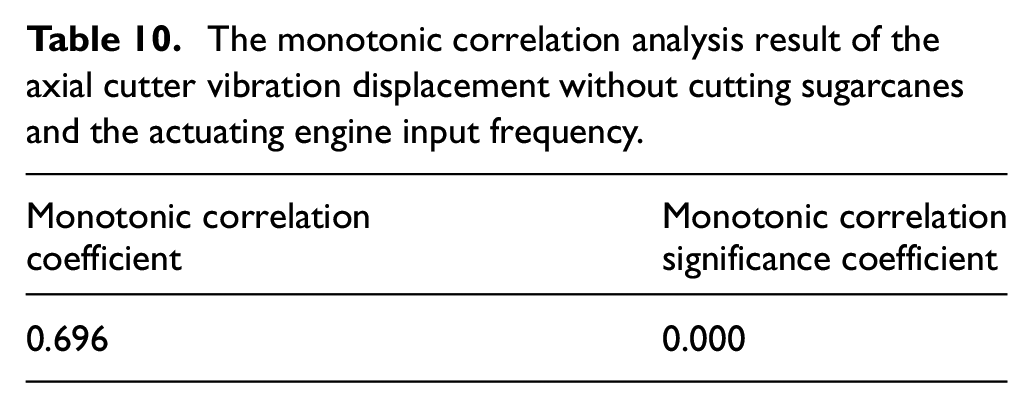
SPSS was used to obtain the monotonic correlation analysis result of the axial cutter vibration displacement without cutting sugarcanes and the actuating engine input frequency and the single-factor variance analysis result with the actuating engine input frequency as the independent variable, as is shown in Tables 10 and 11.
The monotonic correlation analysis result of the axial cutter vibration displacement without cutting sugarcanes and the actuating engine input frequency.
The single-factor variance analysis result with the actuating engine input frequency as the independent variable.

According to Table 10, the monotonic correlation significance coefficient is 0 < 0.01, so there is a significant monotonic correlated relationship between the axial cutter vibration displacement without cutting sugarcanes and the actuating engine input frequency. Moreover, the monotonic correlation coefficient is 0.696 > 0, so there is a significant positive monotonic correlated relationship between the axial cutter vibration displacement without cutting sugarcanes and the actuating engine input frequency, that is, the greater the input frequency of the actuating engine is, the greater the axial cutter vibration displacement without cutting sugarcanes will be. Therefore, the more obvious the engine excitation is, that is, the more severe the engine vibration is, then the more severe the axial no-load cutter vibration will be.
According to Table 11, the significance coefficient is 0, so the actuating engine input frequency has a significant effect on the axial cutter vibration displacement without cutting sugarcanes. Therefore, the engine excitation has a significant effect on the axial no-load cutter vibration.
Analysis on the effect of the cutter rotating speed on the axial no-load cutter vibration
The curve of the axial cutter vibration displacement changing with the cutter rotating speed without cutting sugarcanes drawn through Excel is shown in Figure 11.

The curve of the axial cutter vibration displacement changing with the cutter rotating speed without cutting sugarcanes.
According to Figure 11, the axial cutter vibration displacement without cutting sugarcanes increased along with the cutter rotating speed increasing at the beginning. According to Table 7, when the cutter rotating speed was 400 r/min, the cutter vibration displacement without cutting sugarcanes reached the first peak value. Then the cutter vibration displacement without cutting sugarcanes decreased and increased again from the cutter rotating speed of 450 r/min. When the cutter rotating speed was 550 r/min, the cutter vibration displacement without cutting sugarcanes reached the second peak value, also the maximum value. The output frequency corresponding to 400 r/min is 6.67 Hz close to the first natural frequency of the SHEP, 6.819 Hz. The output frequency corresponding to 550 r/min is 9.17 Hz close to the second natural frequency of the SHEP, 11.514 Hz. Therefore, the sympathetic vibration of the SHEP appeared when the cutter rotating speed was 400 r/min and 550 r/min. Then the sympathetic vibration of the SHEP made peak values of the axial cutter vibration displacement without cutting sugarcanes appear. Therefore, it is further shown that low-stage natural frequencies of sugarcane harvesters should be improved to avoid the sympathetic vibration, then to weaken the axial no-load cutter vibration.
SPSS was used to obtain the monotonic correlation analysis result of the axial cutter vibration displacement without cutting sugarcanes and the cutter rotating speed and the single-factor variance analysis result with the cutter rotating speed as the independent variable, as is shown in Tables 12 and 13.
The monotonic correlation analysis result of the axial cutter vibration displacement without cutting sugarcanes and the cutter rotating speed.

The single-factor variance analysis result with the cutter rotating speed as the independent variable.

According to Table 12, the monotonic correlation significance coefficient is 0, so there is a strong correlated relationship between the axial cutter vibration displacement without cutting sugarcanes and the cutter rotating speed. Moreover, the monotonic correlation coefficient is −0.007 < 0, so there is a significant negative correlated relationship between the axial cutter vibration displacement without cutting sugarcanes and the cutter rotating speed, that is, the greater the cutter rotating speed is, the smaller the axial cutter vibration displacement without cutting sugarcanes will be. Therefore, the greater the cutter rotating speed is, the more severe the axial no-load cutter vibration will be.
According to Table 13, the significance coefficient is 0, so the cutter rotating speed has a significant effect on the axial cutter vibration displacement without cutting sugarcanes. Therefore, the cutter rotating speed has a significant effect on the axial no-load cutter vibration.
Analysis on results of single-factor experiments cutting sugarcanes under simulated complicated excitations
Analysis on effects of the sugarcane field excitation on the axial cutter vibration, three-directional cutting forces and the SCQ
Curves of the axial cutter vibration displacement, three-directional cutting forces and the CCQEV changing with the SSFE input frequency in the sugarcane cutting process drawn through Excel are shown in Figures 12 to 14. The curve of the axial cutter vibration displacement changing with the SSFE input frequency without cutting sugarcanes is also put in Figure 12 to compare effects of the SSFE input frequency on the axial cutter vibration displacement without cutting sugarcanes and in the sugarcane cutting process.

Curves of the axial cutter vibration displacement changing with the SSFE input frequency without cutting sugarcanes and in the sugarcane cutting process.

Curves of three-directional cutting forces changing with the SSFE input frequency.

The curve of the CCQEV changing with the SSFE input frequency.
According to Figure 12, the greater the SSFE input frequency is, the greater the axial cutter vibration displacement in the sugarcane cutting process is. Their monotonic correlation analysis result obtained through SPSS is shown in Table 14.
The monotonic correlation analysis result of the axial cutter vibration displacement in the sugarcane cutting process and the SSFE input frequency.
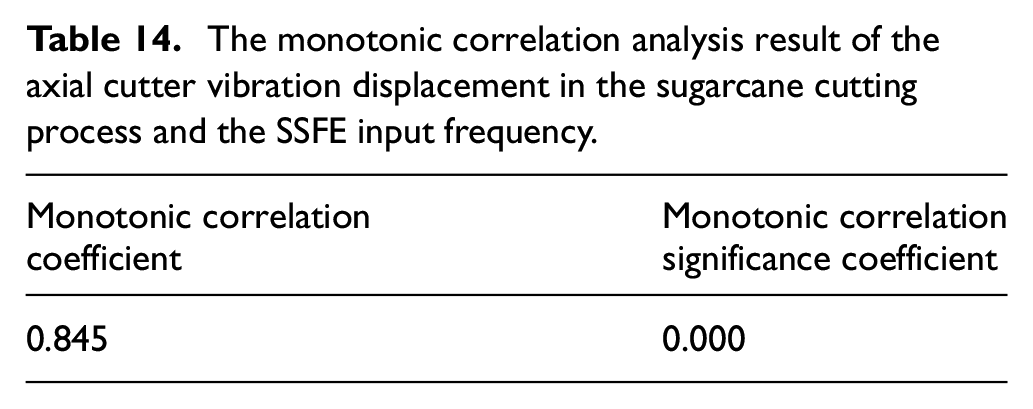
According to Table 14, the monotonic correlation significance coefficient is 0, so there is a significant monotonic correlated relationship between the axial cutter vibration displacement in the sugarcane cutting process and the SSFE input frequency. Moreover, the monotonic correlation coefficient is 0.845 > 0, so there is a significant positive monotonic correlated relationship between the axial cutter vibration displacement in the sugarcane cutting process and the SSFE input frequency, verifying the discovery obtained through Figure 12. Therefore, the more obvious the sugarcane field excitation is, that is, the more bumpy sugarcane fields are, the more severe the axial cutter vibration in the sugarcane cutting process will be.
Moreover, when the SSFE input frequencies are 20 Hz and 21 Hz with output ones being 5.86 Hz and 6.14 Hz, close to the first natural frequency of the SHEP, making the sympathetic vibration of the SHEP appear, then making peak values of the axial cutter vibration displacement appear according to Figures 8 and 11. Therefore, low-stage natural frequencies of sugarcane harvesters should be improved to be away from the main excitation frequency band of sugarcane field roughness to avoid the sympathetic vibration, then to weaken the axial cutter vibration in the sugarcane cutting process.
When the SSFE input frequencies are 9, 11, 14, 17, 19 and 21 Hz with output ones being 2.56, 3.18, 4.09, 4.99, 5.57 and 6.14, 2.56 and 3.18 Hz are in the excitation frequency band of sugarcane field roughness with the greatest contribution, 0.5~3.5, 4.09 and 4.99 Hz are in the main excitation frequency band of sugarcane field roughness, 1–6 Hz and 5.57 Hz as well as 6.14 Hz are close to the first natural frequency of the SHEP, making the sympathetic vibration of the SHEP appear, then making peak values of three-directional forces appear according to Figure 13. Therefore, it is shown again that low-stage natural frequencies of sugarcane harvesters should be improved to be away from the main excitation frequency band of sugarcane field roughness to avoid the sympathetic vibration, then to weaken the axial cutter vibration in the sugarcane cutting process and decrease three-directional cutting forces, so there may be positive correlated relationships between three-directional cutting forces and the axial cutter vibration in the sugarcane cutting process.
SPSS was used to obtain monotonic correlation analysis results of three-directional cutting forces and the SSFE input frequency, as is shown in Table 15.
Monotonic correlation analysis results of three-directional cutting forces and the SSFE input frequency.

According to Table 15, monotonic correlation significance coefficients are all 0, so there are significant monotonic correlated relationships between three-directional cutting forces and the SSFE input frequency. Moreover, monotonic correlation coefficients are 0.504, 0.268 and 0.48 > 0, so there are significant positive monotonic correlated relationships between three-directional cutting forces and the SSFE input frequency, that is, the greater the SSFE input frequency is, the greater three-directional cutting forces will be. Therefore, the more obvious the sugarcane field excitation is, that is, the more bumpy sugarcane fields are, then the greater three-directional cutting forces will be.
When the SSFE input frequencies are 9, 16, 19 and 21 Hz with output ones being 2.56, 4.69, 5.57 and 6.14, 2.56 and 4.69 Hz are in the excitation frequency band of sugarcane field roughness with the greatest contribution and the main excitation frequency band of sugarcane field roughness and 5.57 Hz as well as 6.14 Hz are close to the first natural frequency of the SHEP, making the sympathetic vibration of the SHEP appear, then making peak values of the CCQEV appear according to Figure 14. Therefore, it is further shown that low-stage natural frequencies of sugarcane harvesters should be improved to be away from the main excitation frequency band of sugarcane field roughness to avoid the sympathetic vibration, then to weaken the axial cutter vibration in the sugarcane cutting process and make the SCQ better, so there may be a negative correlated relationship between the SCQ and the axial cutter vibration in the sugarcane cutting process.
Additionally, according to Figure 14, when the SSFE input frequency was 21 Hz with its output frequency being 6.14 Hz, close to the main excitation frequency band of sugarcane field roughness and the first natural frequency of the SHEP, the CCQEV was the greatest, the SCQ was the poorest. Therefore, it is further shown that low-stage natural frequencies of sugarcane harvesters should be improved to be away from the main excitation frequency band of sugarcane field roughness to avoid the sympathetic vibration, then to weaken the axial cutter vibration in the sugarcane cutting process.
SPSS was used to obtain the monotonic correlation analysis result of the CCQEV and the SSFE input frequency, as is shown in Table 16.
The monotonic correlation analysis result of the CCQEV and the SSFE input frequency.

According to Table 16, the monotonic correlation significance coefficients is 0, so there is a significant monotonic correlated relationship between the CCQEV and the SSFE input frequency. Moreover, the monotonic correlation coefficient is 0.03 > 0, so there is a significant positive monotonic correlated relationship between the CCQEV and the SSFE input frequency, that is, the greater the SSFE input frequency is, the CCQEV will be, the poorer the SCQ will be. Therefore, the more obvious the sugarcane field excitation is, that is, the more bumpy sugarcane fields are, then the poorer the SCQ will be.
Single-factor variance analysis results with the SSFE input frequency as the independent variable obtained through SPSS is shown in Table 17.
Single-factor variance analysis results with the SSFE input frequency as the independent variable.

According to Table 17, significance coefficients are smaller than 0.05, so the SSFE input frequency has significant effects on the axial cutter vibration displacement, three-directional cutting forces and the CCQEV. Therefore, the sugarcane field excitation has significant effects on the axial cutter vibration, three-directional cutting forces and the SCQ.
Analysis on effects of the engine excitation on the axial cutter vibration, three-directional cutting forces and the SCQ
Curves of the axial cutter vibration displacement, the three-directional cutting forces and the CCQEV changing with the actuating engine input frequency in the sugarcane cutting process drawn through Excel are shown in Figures 15 to 17. The curve of the axial cutter vibration displacement changing with the actuating engine input frequency without cutting sugarcanes is also put in Figure 15 to compare effects of the actuating engine input frequency on the axial cutter vibration displacement without cutting sugarcanes and in the sugarcane cutting process.
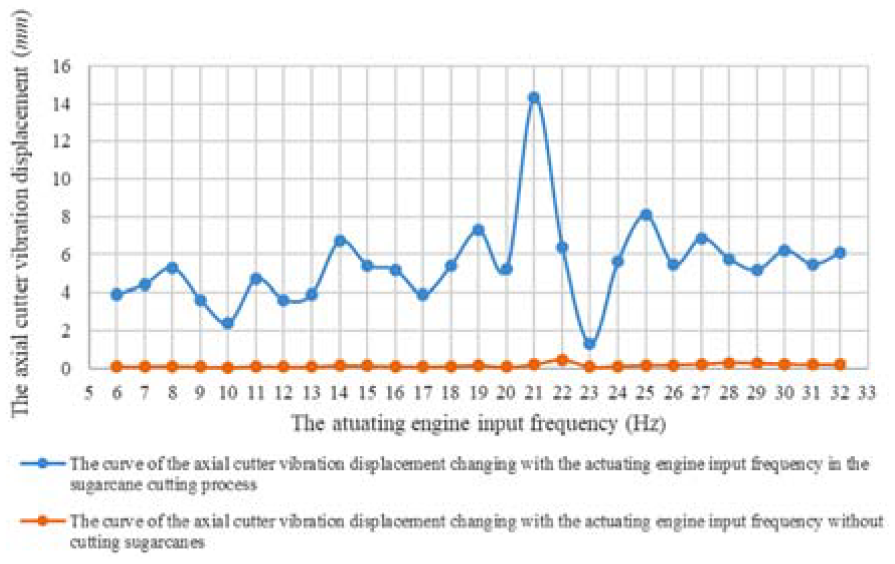
Curves of the axial cutter vibration displacement changing with the actuating engine input frequency without cutting sugarcanes and in the sugarcane cutting process.

Curves of three-directional cutting forces changing with the actuating engine input frequency.

The curve of the CCQEV changing with the actuating engine input frequency.
When actuating engine input frequencies are 8, 11, 14, 19, 21, 25, 27 and 30 Hz, close to the first, the second and the third natural frequencies of the SHEP, the sympathetic vibration of the SHEP appeared, making peak values of the axial cutter vibration displacement appear according to Figure 15. Therefore, it is further shown that low-stage natural frequencies of sugarcane harvesters should be improved to avoid the sympathetic vibration, then to weaken the axial cutter vibration in the sugarcane cutting process.
SPSS was used to obtain the monotonic correlation analysis result of the axial cutter vibration displacement in the sugarcane cutting process and the actuating engine input frequency, as is shown in Table 18.
The monotonic correlation analysis result of the axial cutter vibration displacement in the sugarcane cutting process and the actuating engine input frequency.

According to Table 18, the monotonic correlation significance coefficient is 0, so there is a strong correlated relationship between the axial cutter vibration displacement in the sugarcane cutting process and the actuating engine input frequency. Moreover, the monotonic correlation coefficient is 0.543 > 0, so there is a significant positive correlated relationship between the axial cutter vibration displacement in the sugarcane cutting process and the actuating engine input frequency, that is, the greater the actuating engine input frequency is, the greater the axial cutter vibration displacement will be. Therefore, the more obvious the engine excitation is, that is, the more severe the engine vibration is, then the more severe the axial cutter vibration in the sugarcane cutting process will be.
When actuating engine input frequencies are 8, 11, 14, 19, 21, 25 and 28 Hz, close to the first, the second and the third natural frequencies of the SHEP, the sympathetic vibration of the SHEP appeared, making peak values of the axial cutter vibration displacement appear according to Figure 16. Therefore, it is further shown that low-stage natural frequencies of sugarcane harvesters should be improved to avoid the sympathetic vibration, then to weaken the axial cutter vibration in the sugarcane cutting process and decrease three-directional cutting forces, so it is shown again that there may be positive correlated relationships between three-directional cutting forces and the axial cutter vibration in the sugarcane cutting process.
SPSS was used to obtain monotonic correlation analysis results of three-directional cutting forces and the actuating engine input frequency, as is shown in Table 19.
Monotonic correlation analysis results of effects of three-directional cutting forces and the actuating engine input frequency.

According to Table 19, monotonic correlation significance coefficients are all 0, so there are strong correlated relationships between three-directional cutting forces and the actuating engine input frequency. Moreover, monotonic correlation coefficients are 0.597, 0.415 and 0.551 > 0, so there are significant positive monotonic correlated relationships between three-directional cutting forces and the actuating engine input frequency, that is, the greater the actuating engine input frequency is, the greater three-directional cutting forces will be. Therefore, the more obvious the engine excitation is, that is, the more severe the engine vibration is, the greater three-directional cutting forces will be.
When actuating engine input frequencies are 8, 11, 19, 21, 25 and 27 Hz, close to the first, the second and the third natural frequencies of the SHEP, the sympathetic vibration of the SHEP appeared, making peak values of the CCQEV appear according to Figure 17. Therefore, it is further shown that low-stage natural frequencies of sugarcane harvesters should be improved to avoid the sympathetic vibration, then to weaken the axial cutter vibration in the sugarcane cutting process and make the SCQ better, so it is shown again that there may be a negative correlated relationship between the SCQ and the axial cutter vibration in the sugarcane cutting process.
Additionally, according to Figure 17, when the actuating engine input frequency was 21 Hz, the CCQEV was the greatest, the SCQ was the poorest.
SPSS was used to obtain the monotonic correlation analysis result of the CCQEV and the actuating engine input frequency, as is shown in Table 20.
The monotonic correlation analysis result of the CCQEV and the actuating engine input frequency.

According to Table 20, the monotonic correlation significance coefficient is 0, so there is a significant monotonic correlated relationship between the CCQEV and the actuating engine input frequency. Moreover, the monotonic correlation coefficient is 0.17 > 0, so there is a significant positive monotonic correlated relationship between the CCQEV and the actuating engine input frequency, that is, the greater the actuating engine input frequency is, the CCQEV will be, the poorer the SCQ will be. Therefore, the more obvious the engine excitation is, that is, the more severe the engine vibration is, then the poorer the SCQ will be.
Single-factor variance analysis results with the actuating engine input frequency as the independent variable obtained through SPSS is shown in Table 21.
Single-factor variance analysis results with the actuating engine input frequency as the independent variable.

According to Table 21, significance coefficients are smaller than 0.05, so the actuating engine input frequency has significant effects on the axial cutter vibration displacement, three-directional cutting forces and the CCQEV. Therefore, the engine excitation has significant effects on the axial cutter vibration, three-directional cutting forces and the SCQ.
Analysis on effects of the cutter rotating speed on the axial cutter vibration, three-directional cutting forces and the SCQ
Curves of the axial cutter vibration displacement, three-directional cutting forces and the CCQEV changing with the cutter rotating speed in the sugarcane cutting process drawn through Excel are shown in Figures 18 to 20. The curve of the axial cutter vibration displacement changing with the cutter rotating speed without cutting sugarcanes is also put in Figure 18 to compare effects of the cutter rotating speed on the axial cutter vibration displacement without cutting sugarcanes and in the sugarcane cutting process.
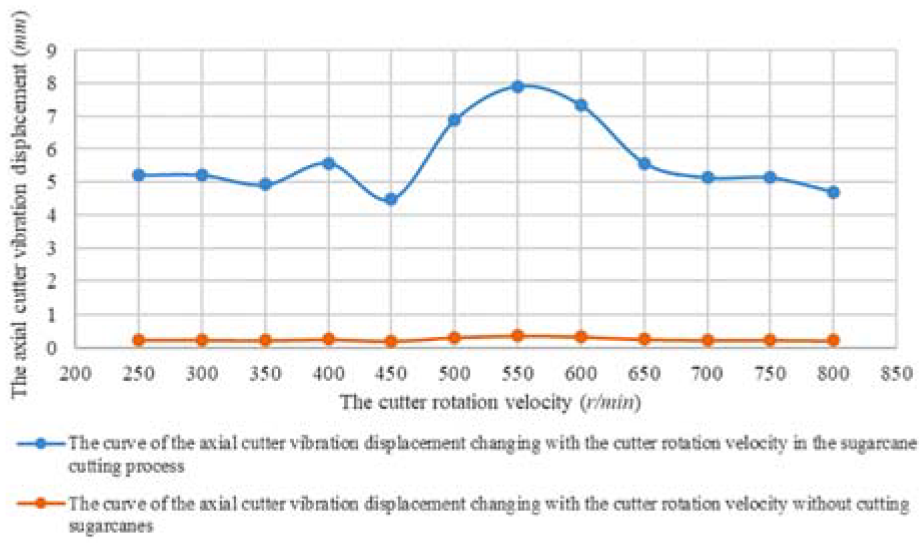
Curves of the axial cutter vibration displacement changing with the cutter rotating speed without cutting sugarcanes and in the sugarcane cutting process.

Curves of three-directional cutting forces changing with the cutter rotating speed.

The curve of the CCQEV changing with the cutter rotating speed.
According to Figure 18, the axial cutter vibration displacement increased along with the cutter rotating speed increasing at the beginning. When the cutter rotating speed was 400 r/min with its corresponding output frequency being 6.67 Hz, close to the first natural frequency of the SHEP, the cutter vibration displacement reached the first peak value. Then the cutter vibration displacement decreased and increased again when the cutter rotating speed was 450 r/min with its corresponding output frequency being 7.5 Hz, close to the first natural frequency of the SHEP. When the cutter rotating speed was 550 r/min with its corresponding output frequency being 9.17 Hz, close to the second natural frequency of the SHEP, the cutter vibration displacement reached the second peak value, also the maximum value. Therefore, the sympathetic vibration of the SHEP appeared when the cutter rotating speed was 400 r/min and 550 r/min. Then the sympathetic vibration of the SHEP made peak values of the axial cutter vibration displacement without cutting sugarcanes appear. Therefore, it is further shown that low-stage natural frequencies of sugarcane harvesters should be improved to avoid the sympathetic vibration, then to weaken the axial cutter vibration in the sugarcane cutting process.
SPSS was used to obtain the monotonic correlation analysis result of the axial cutter vibration displacement in the sugarcane cutting process and the cutter rotating speed, as is shown in Table 22.
The monotonic correlation analysis result of the axial cutter vibration displacement in the sugarcane cutting process and the cutter rotating speed.

According to Table 22, the monotonic correlation significance coefficient is 0, so there is a strong correlated relationship between the axial cutter vibration displacement in the sugarcane cutting process and the cutter rotating speed. Moreover, the monotonic correlation coefficient is −0.025 < 0, so there is a significant negative monotonic correlated relationship between the axial cutter vibration displacement in the sugarcane cutting process and the cutter rotating speed, that is, the greater the cutter rotating speed is, the smaller the axial cutter vibration displacement will be. Therefore, the greater the cutter rotating speed is, the weaker the axial cutter vibration in the sugarcane cutting process will be.
According to Figure 19, along with the cutter rotating speed increasing, three-directional cutting forces increased firstly and then decreased in that when the cutter rotating speed decreases, causing lack of cutting energies, the cutters will push down and compress sugarcanes instead of cutting off them at once, causing accumulation of cutting forces.
SPSS was used to obtain monotonic correlation analysis results of three-directional cutting forces and the cutter rotating speed, as is shown in Table 23.
Monotonic correlation analysis results of three-directional cutting forces and the cutter rotating speed.

According to Table 23, monotonic correlation significance coefficients are all 0, so there are strong correlated relationships between three-directional cutting forces and the cutter rotating speed. Moreover, monotonic correlation coefficients are −0.041, −0.023 and −0.012 < 0, so there are significant negative monotonic correlated relationships between three-directional cutting forces and the cutter rotating speed, that is, the greater the cutter rotating speed is, the smaller three-directional cutting forces will be.
SPSS was used to obtain the monotonic correlation analysis result of the CCQEV and the cutter rotating speed, as is shown in Table 24.
The monotonic correlation analysis result of the CCQEV and the cutter rotating speed.

According to Table 24, the monotonic correlation significance coefficient is 0, so there is a significant monotonic correlated relationship between the CCQEV and the cutter rotating speed. Moreover, the monotonic correlation coefficient is −0.014 < 0, so there is a significant negative monotonic correlated relationship between the CCQEV and the cutter rotating speed, that is, the greater the cutter rotating speed is, the smaller CCQEV will be, the better the SCQ will be. Therefore, the cutter rotating speed should be increased to improve the SCQ.
According to Figure 20, when the cutter rotating speed was 700 r/min, the CCQEV was the smallest, the SCQ was the best. When the cutter rotating speed was 550 r/min, the CCQEV was the greatest, the SCQ was the poorest.
Single-factor variance analysis results with the cutter rotating speed as the independent variable obtained through SPSS is shown in Table 25.
Single-factor variance analysis results with the cutter rotating speed as the independent variable.

According to Table 25, significance coefficients are smaller than 0.05, so the cutter rotating speed has significant effects on the axial cutter vibration displacement, three-directional cutting forces and the CCQEV. Therefore, the cutter rotating speed has significant effects on the axial cutter vibration, three-directional cutting forces and the SCQ.
Analysis on effects of the sugarcane harvester moving speed on the axial cutter vibration, three-directional cutting forces and the SCQ
Curves of the axial cutter vibration displacement, three-directional cutting forces and the CCQEV changing with the sugarcane transporting speed in the sugarcane cutting process drawn through Excel are shown in Figures 21 to 23.

The curve of the axial cutter vibration displacement changing with the sugarcane transporting speed.

Curves of three-directional cutting forces changing with the sugarcane transporting speed.

The curve of the CCQEV changing with the sugarcane transporting speed.
According to Figure 21, the greater the sugarcane transporting speed is, the smaller the axial cutter vibration displacement is. Their monotonic correlation analysis result obtained through SPSS is shown in Table 26.
The monotonic correlation analysis result of the axial cutter vibration displacement and the sugarcane transporting speed.

According to Table 26, the monotonic correlation significance coefficient is 0, so there is a significant monotonic correlated relationship between the axial cutter vibration displacement and the sugarcane transporting speed. Moreover, the monotonic correlation coefficient is −0.893 < 0, so there is a significant negative monotonic correlated relationship between the axial cutter vibration displacement and the sugarcane transporting speed, verifying the discovery obtained through Figure 21. Therefore, the greater the sugarcane harvester moving speed is, the weaker the axial cutter vibration in the sugarcane cutting process will be.
Moreover, according to Figure 21, the axial cutter vibration displacement decreased firstly and then it increased along with the sugarcane transporting speed increasing. When the sugarcane transporting speed was 0.5 m/s, the axial cutter vibration displacement reached a peak value. Then the axial cutter vibration displacement decreased and increased again when the sugarcane transporting speed was 0.6 m/s. When the sugarcane transporting speed was 0.1 m/s, the axial cutter vibration displacement was the greatest. Therefore, when the sugarcane harvester moving speed is 0.1 m/s, the axial cutter vibration in the sugarcane cutting process is the most severe. When the sugarcane transporting speed was 0.6 m/s, the axial cutter vibration displacement was the smallest. Therefore, when the sugarcane harvester moving speed is 0.6 m/s, the axial cutter vibration in the sugarcane cutting process is the weakest.
According to Figure 22, the greater the sugarcane transporting speed is, the smaller three-directional cutting forces are. Their monotonic correlation analysis results obtained through SPSS are shown in Table 27.
Monotonic correlation analysis results of three-directional cutting forces and the sugarcane transporting speed.

According to Table 27, monotonic correlation significance coefficients are all 0, so there are significant monotonic correlated relationships between three-directional cutting forces and the sugarcane transporting speed. Moreover, monotonic correlation coefficients are −0.688, −0.665 and −0.867 < 0, so there are significant negative monotonic correlated relationships between three-directional cutting forces and the sugarcane transporting speed, that is, the greater the sugarcane transporting speed is, the smaller three-directional cutting forces will be, verifying the discovery obtained through Figure 22. Therefore, the greater the sugarcane harvester moving speed is, the smaller three-directional cutting forces will be.
According to Figure 23, the greater the sugarcane transporting speed is, the smaller the CCQEV is. Their monotonic correlation analysis result obtained through SPSS is shown in Table 28.
The monotonic correlation analysis result of the CCQEV and the sugarcane transporting speed.

According to Table 28, the monotonic correlation significance is 0, so there is a significant monotonic correlated relationship between the CCQEV and the sugarcane transporting speed. Moreover, the monotonic correlation coefficient is −0.662 < 0, so there is a significant negative monotonic correlated relationship between the CCQEV and the sugarcane transporting speed, that is, the greater the sugarcane transporting speed is, the smaller CCQEV will be, the better the SCQ will be. Therefore, the greater the sugarcane harvester moving speed is, the better the SCQ will be, so the sugarcane harvester moving speed should be increased to improve the SCQ.
According to Figure 23, when the sugarcane transporting speed, the CCQEV was the smallest, the SCQ was the best. Therefore, when the sugarcane harvester moving speed is 0.6 m/s, the SCQ is the best. When the sugarcane transporting speed was 0.1 m/s, the CCQEV was the greatest, the SCQ was the poorest. Therefore, when the sugarcane harvester moving speed is 0.1 m/s, the SCQ is the poorest.
Single-factor variance analysis results with the sugarcane transporting speed as the independent variable obtained through SPSS is shown in Table 29.
Single-factor variance analysis results with the sugarcane transporting speed as the independent variable.

According to Table 29, significance coefficients are smaller than 0.05, so the sugarcane transporting speed has significant effects on the axial cutter vibration displacement, three-directional cutting forces and the CCQEV. Therefore, the sugarcane harvester moving speed has significant effects on the axial cutter vibration, three-directional cutting forces and the SCQ.
Analysis on effects of the cutter installing angle on the axial cutter vibration, three-directional cutting forces and the SCQ
Curves of the axial cutter vibration displacement, three-directional cutting forces and the CCQEV changing with the cutter installing angle in the sugarcane cutting process drawn through Excel are shown in Figures 24 to 26.

The curve of the axial cutter vibration displacement changing with the cutter installing angle.
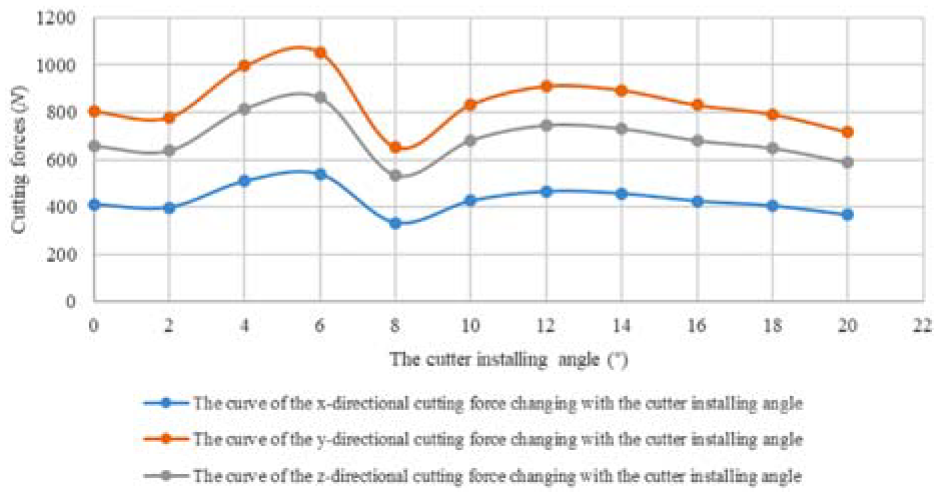
Curves of three-directional cutting forces changing with the cutter installing angle.

The curve of the CCQEV changing with the cutter installing angle.
According to Figure 24, when the cutter installing angle increased, the axial cutter vibration displacement decreased firstly and then increased when the cutter installing angle was 2°. When the cutter installing angle was 6°, the axial cutter vibration displacement reached the first peak value, also the maximum value. Then the axial cutter vibration displacement decreased and then increased when the cutter installing angle was 8°. When the cutter installing angle was 12°, the axial cutter vibration displacement reached the second peak value. When the cutter installing angle was 8°, the axial cutter vibration displacement was the smallest. Then the axial cutter vibration displacement decreased again. Therefore, when the cutter installing angle is 6°, the axial cutter vibration in the sugarcane cutting process is the most severe. When the cutter installing angle is 8°, the axial cutter vibration in the sugarcane cutting process is the weakest.
SPSS was used to obtain the monotonic correlation analysis result of the axial cutter vibration displacement and the cutter installing angle, as is shown in Table 30.
The monotonic correlation analysis result of the axial cutter vibration displacement and the cutter installing angle.

According to Table 30, the monotonic correlation significance coefficient is 0, so there is a significant monotonic correlated relationship between the axial cutter vibration displacement and the cutter installing angle. Moreover, the monotonic correlation coefficient is −0.181 < 0, so there is a significant negative monotonic correlated relationship between the axial cutter vibration displacement and the cutter installing angle, that is, the greater the cutter installing angle is, the smaller the axial cutter vibration displacement will be. Therefore, the greater the cutter installing angle is, the weaker the axial cutter vibration in the sugarcane cutting process will be.
SPSS was used to obtain monotonic correlation analysis results of three-directional cutting forces and the cutter installing angle, as is shown in Table 31.
Monotonic correlation analysis results of three-directional cutting forces and the cutter installing angle.

According to Table 31, monotonic correlation significance coefficients are all 0, so there are significant monotonic correlated relationships between three-directional cutting forces and the cutter installing angle. Moreover, monotonic correlation coefficients are −0.154, −0.144 and −0.194 < 0, so there are significant negative monotonic correlated relationships between three-directional cutting forces and the cutter installing angle, that is, the greater the cutter installing angle is, the smaller three-directional cutting forces will be.
SPSS was used to obtained the monotonic correlation analysis result of the CCQEV and the cutter installing angle, as is shown in Table 32.
The monotonic correlation analysis result of the CCQEV and the cutter installing angle.

According to Table 32, the monotonic correlation significance coefficient is 0, so there is a significant monotonic correlated relationship between the CCQEV and the cutter installing angle. Moreover, the monotonic correlation coefficient is −0.166 < 0, so there is a significant negative monotonic correlated relationship between the CCQEV and the cutter installing angle, that is, the greater the cutter installing angle is, the smaller CCQEV will be, the better the SCQ will be. Therefore, the cutter installing angle should be increased to improve the SCQ.
According to Figure 26, when the cutter installing angle was 8°, the CCQEV was the smallest, the SCQ was the best. When the cutter installing angle was 6°, the CCQEV was the greatest, the SCQ was the poorest.
In conclusion, the best cutting parameters of sugarcane harvesters with the best SCQ are as follow: the cutter rotating speed is 700 r/min, the sugarcane harvester moving speed is 0.6 m/s and the cutter installing angle is 8°.
Single-factor variance analysis results with the cutter installing angle as the independent variable obtained through SPSS is shown in Table 33.
Single-factor variance analysis results with the cutter installing angle as the independent variable.

According to Table 33, significance coefficients are smaller than 0.05, so the cutter installing angle has significant effects on the axial cutter vibration displacement, three-directional cutting forces and the CCQEV. Therefore, the cutter installing angle has significant effects on the axial cutter vibration, three-directional cutting forces and the SCQ.
Analysis on effects of the axial cutter vibration on three-directional cutting forces and the SCQ
According to Figures 12, 15 and 18, the axial cutter vibration displacement in the sugarcane cutting process is greater than that without cutting sugarcanes, showing the sugarcane cutting process increased the axial cutter vibration displacement, so the axial cutter vibration and the sugarcane cutting process may have effects on each other.
According to Figures 12, 13, 15, 16, 18, 19, 21, 22, 24 and 25, when wave crests of the axial cutter vibration displacement appear, wave crests of three-directional cutting forces also appear. Therefore, it is considered that peak values of the axial cutter vibration displacement made those of three-directional cutting forces appear. Moreover, curves of the axial cutter vibration displacement and three-directional cutting forces changing with the same experimental factor are highly similar and there exist same significant monotonic correlated relationships between these two experimental indexes and the same experimental factor. Therefore, the axial cutter vibration may have directly and highly significant positive monotonic correlated effects on three-directional cutting forces.
Curves of three-directional cutting forces changing with the axial cutter vibration displacement with different single factors drawn through Excel are shown in Figures 27 to 31.
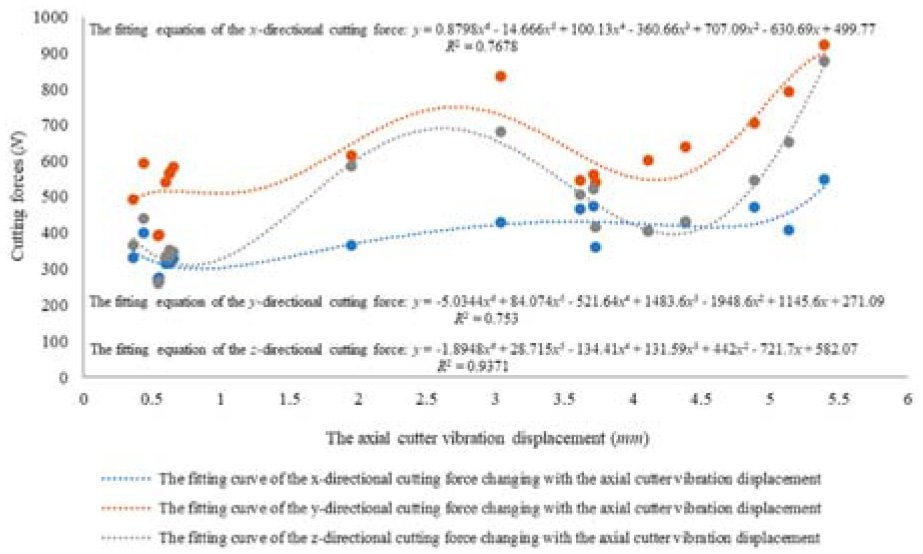
Fitting curves of three-directional cutting force changing with the axial cutter vibration displacement with the SSFE input frequency as the single factor.

Fitting curves of three-directional cutting force changing with the axial cutter vibration displacement with the actuating engine input frequency as the single factor.

Fitting curves of three-directional cutting force changing with the axial cutter vibration displacement with the cutter rotating speed as the single factor.

Fitting curves of three-directional cutting force changing with the axial cutter vibration displacement with the sugarcane transporting speed as the single factor.

Fitting curves of three-directional cutting force changing with the axial cutter vibration displacement with the cutter installing angle as the single factor.
According to Figures 27 to 31, no matter what is the single factor, determination coefficients of these fitting curves and fitting equations are all greater than 0.66, so they have high accuracies. There are obvious positive monotonic correlated relationships between three-directional cutting forces and the axial cutter vibration displacement, that is, the greater the axial cutter vibration displacement is, the greater three-directional cutting forces is in that the greater the axial cutter vibration displacement is, the greater the compressive frequency and the pressure generated by cutters acting on sugarcanes will be, causing three-directional cutting forces to increase. Their monotonic correlation analysis results obtained through SPSS are shown in Table 34.
Monotonic correlation analysis results of three-directional cutting forces and the axial cutter vibration displacement with different single factors.

According to Table 34, no matter what is the single factor, monotonic correlation significance coefficients are all smaller than 0.01, so there are significant monotonic correlated relationships between three-directional cutting forces and the axial cutter vibration displacement. Moreover, monotonic correlation coefficients are all greater than 0, so there are significant positive monotonic correlated relationships between three-directional cutting forces and the axial cutter vibration displacement, that is, the greater the axial cutter vibration displacement is, the greater three-directional cutting forces will be, verifying discoveries obtained above. Therefore, the more severe the axial cutter vibration in the sugarcane cutting process is, the greater three-directional cutting forces will be.
According to Figures 12, 14, 15, 17, 18, 20, 21, 23, 24 and 26, when wave crests of the axial cutter vibration displacement appear, wave crests of the CCQEV also appear. Therefore, it is considered that peak values of the axial cutter vibration displacement made those of the CCQEV appear, then making the SCQ poorer. Moreover, curves of the axial cutter vibration displacement and the CCQEV changing with the same experimental factor are highly similar and there exist same significant monotonic correlated relationships between these two experimental indexes and the same experimental factor. Therefore, the axial cutter vibration may have directly and highly significant negative monotonic correlated effects on the SCQ.
Curves of the CCQEV changing with the axial cutter vibration displacement with different single factors drawn through Excel are shown in Figures 32 to 36.

The fitting curve of the CCQEV changing with the axial cutter vibration displacement with the SSFE input frequency as the single factor.

The fitting curve of the CCQEV changing with the axial cutter vibration displacement with the actuating engine input frequency as the single factor.

The fitting curve of the CCQEV changing with the axial cutter vibration displacement with the cutter rotating speed as the single factor.

The fitting curve of the CCQEV changing with the axial cutter vibration displacement with the sugarcane transporting speed as the single factor.

The fitting curve of the CCQEV changing with the axial cutter vibration displacement with the cutter installing angle as the single factor.
According to Figures 32 to 36, no matter what is the single factor, determination coefficients of these fitting curves and fitting equations are all greater than 0.65, so they have high accuracies. There are obvious positive monotonic correlated relationships between the axial cutter vibration displacement and the CCQEV, that is, the greater the axial cutter vibration displacement is, the greater the CCQEV is, the poorer the SCQ will be. Their monotonic correlation analysis results obtained through SPSS are shown in Table 35.
Monotonic c analysis results of the CCQEV and the axial cutter vibration displacement with different single factors.

According to Table 35, no matter what is the single factor, monotonic correlation significance coefficients are all 0, so there are significant monotonic correlated relationships between the CCQEV and the axial cutter vibration displacement. Moreover, monotonic correlation coefficients are all greater than 0, so there are significant positive monotonic correlated relationships between the CCQEV and the axial cutter vibration displacement, that is, the greater the axial cutter vibration displacement is, the greater the CCQEV will be, the poorer the SCQ will be, verifying discoveries obtained above. Therefore, the more severe the axial cutter vibration in the sugarcane cutting process is, the poorer the SCQ will be, so it is further shown that low-stage natural frequencies of sugarcane harvesters should be improved to avoid the sympathetic vibration, then to weaken the axial cutter vibration in the sugarcane cutting process to improve the SCQ.
Analysis on effects of three-directional cutting forces on the SCQ
According to Figures 13, 14, 16, 17, 19, 20, 22, 23, 25 and 26, when wave crests of three-directional cutting forces appear, wave crests of the CCQEV also appear. Therefore, it is considered that peak values of three-directional cutting forces made peak values of the CCQEV appear, then making the SCQ poorer, so three-directional cutting forces may have negative monotonic correlated effects on the SCQ.
Curves of the CCQEV changing with three-directional cutting forces with different single factors drawn through Excel are shown in Figures 37 to 41.

Fitting curves of the CCQEV changing with three-directional cutting forces with the SSFE input frequency as the single factor.

Fitting curves of the CCQEV changing with three-directional cutting forces with the actuating engine input frequency as the single factor.

Fitting curves of the CCQEV changing with three-directional cutting forces with the cutter rotating speed as the single factor.

Fitting curves of the CCQEV changing with three-directional cutting forces with the sugarcane transporting speed as the single factor.
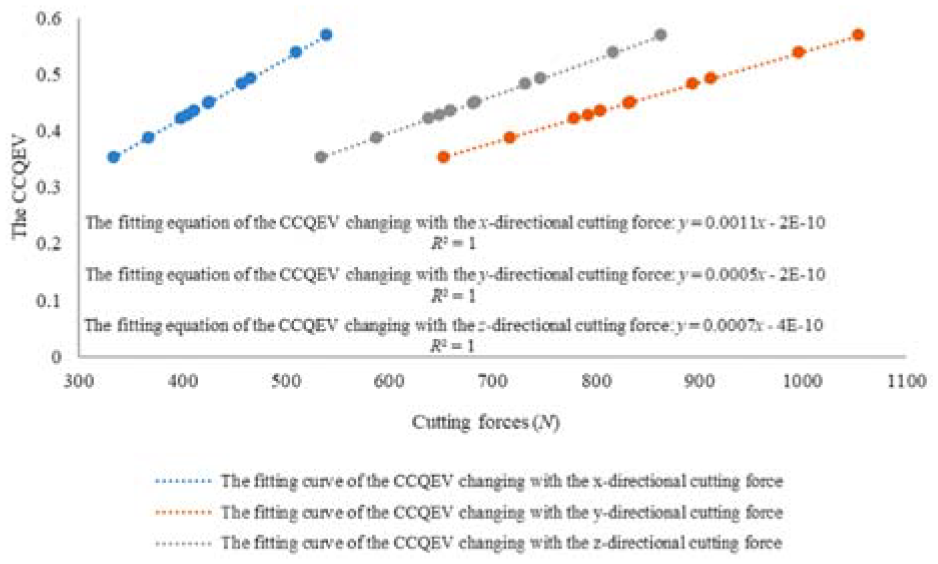
Fitting curves of the CCQEV changing with three-directional cutting forces with the cutter installing angle as the single factor.
According to Figures 37 to 41, no matter what is the single factor, determination coefficients of these fitting curves and fitting equations are all greater than 0.6, so they have high accuracies. There are obvious positive monotonic correlated relationships between three-directional cutting forces and the CCQEV, that is, the greater three-directional cutting forces are, the greater the CCQEV is, the poorer the SCQ will be, their monotonic correlation analysis results obtained through SPSS are shown in Table 36.
Monotonic correlation analysis results of the CCQEV and three-directional cutting forces with different single factors.

According to Table 36, no matter what is the single factor, monotonic correlation significance coefficients are all smaller than 0.05, so there are significant monotonic correlated relationships between the CCQEV and three-directional cutting forces. Moreover, monotonic correlation coefficients are all greater than 0, so there are significant positive monotonic correlated relationships between the CCQEV and three-directional cutting forces, that is, the greater three-directional cutting forces are, the greater the CCQEV will be, the poorer the SCQ will be, verifying discoveries obtained above.
Analysis on orthogonal experiment results
Analysis on the result of the orthogonal experiment measuring the axial cutter vibration displacement without cutting sugarcanes
SPSS was used to obtain the multi-factor variance analysis result of this orthogonal experiment, as is shown in Table 37.
The multi-factor variance analysis result of this orthogonal experiment.

According to Table 37, except that of the actuating engine input frequency, significance coefficients of the other two experimental factors and interactions are all smaller than 0.01, so they all have significant effects on the axial cutter vibration displacement without cutting sugarcanes. Therefore, except the engine excitation, the sugarcane field excitation, the cutter rotating speed and interactions all have significant effects on the axial no-load cutter vibration.
Moreover, significance levels of effects of these three experimental factors and their interactions on the axial cutter vibration displacement without cutting sugarcanes from high to low are A > C > B > B*C > A*B > A*C according to F values. Therefore, significance levels of effects on the axial no-load cutter vibration from high to low are as follow, the sugarcane field excitation, the cutter rotating speed, the engine excitation, interaction between the engine excitation and the cutter rotating speed, interaction between the sugarcane field excitation and the engine excitation, interaction between the sugarcane field excitation and the cutter rotating speed.
Without cutting sugarcanes, the significance level of the effect of the SSFE input frequency on the axial cutter vibration displacement is the highest, so it weakened effects of the actuating engine input frequency, the cutter rotating speed and interactions including the SSFE input frequency on the axial cutter vibration displacement, so among all interactions, significance levels of effects of interactions including the SSFE input frequency on the axial cutter vibration displacement are lower. Therefore, the effect of the sugarcane field excitation weakens effects of the engine excitation, the cutter rotating speed and interactions including the sugarcane field excitation on the axial no-load cutter vibration.
Besides, without cutting sugarcanes, the significance level of the effect of the actuating engine input frequency on the axial cutter vibration displacement is the lowest, so it made effects of the SSFE input frequency, the cutter rotating speed and interactions including the actuating engine input frequency on the axial cutter vibration displacement apparent, so among all interactions, significance levels of effects of interactions including the actuating engine input frequency on the axial cutter vibration displacement are higher. Therefore, the effect of the engine excitation on the axial no-load cutter vibration makes effects of the sugarcane field excitation, the cutter rotating speed and interactions including the engine excitation apparent.
Moreover, without cutting sugarcanes, the closer significance coefficients of two experimental factors are, the higher the significance level of the effect of interaction between these two experimental factors on the axial cutter vibration displacement is, so among all interactions, the significance level of the effect of interaction between the actuating engine input frequency and the cutter rotating speed on the axial cutter vibration displacement is the highest and the significance level of the effect of interaction between input frequencies of the SSFE and the actuating engine is higher than that of interaction between the SSFE input frequency and the cutter rotating speed on the axial cutter vibration displacement.
The fitting equation of the axial cutter vibration displacement without cutting sugarcanes changing with these three experimental factors and their interactions obtained through multi-factor linear regression analysis of SPSS is shown in equation (9).

Where:
According to equation (9), surface diagrams of the axial cutter vibration displacement without cutting sugarcanes changing with interactions drawn through MATLAB are shown in Figures 42 to 44.

The surface diagram of the axial cutter vibration displacement without cutting sugarcanes changing with interaction between input frequencies of the SSFE and the actuating engine.

The surface diagram of the axial cutter vibration displacement without cutting sugarcanes changing with interaction between the SSFE input frequency and the cutter rotating speed.

The surface diagram of the axial cutter vibration displacement without cutting sugarcanes changing with interaction between the actuating engine input frequency and the cutter rotating speed.
According to Figures 42 to 44, without cutting sugarcanes, in two interactions including the SSFE input frequency whose significance coefficient is the greatest, it was the SSFE input frequency which mainly affected the axial cutter vibration displacement, that is, no matter how the other two experimental factors changed, the greater the SSFE input frequency was, the greater the axial cutter vibration displacement was. Therefore, in interactions including the sugarcane field excitation, it is the sugarcane field excitation which mainly affected the axial no-load cutter vibration, so no matter how the engine excitation and the cutter rotating speed change, the more obvious the sugarcane field excitation is, that is, the more bumpy sugarcane fields are, the more severe the axial no-load cutter vibration will be. In interaction between the actuating engine input frequency and the cutter rotating speed whose significance coefficients are close, the actuating engine input frequency and the cutter rotating speed affected the axial cutter vibration displacement together, that is, the greater the actuating engine input frequency was and the smaller the cutter rotating speed was at the same time, the greater the axial cutter vibration displacement was. Therefore, in interaction between the engine excitation and the cutter rotating speed, the engine excitation and the cutter rotating speed affected the axial no-load cutter vibration together.
Analysis on the result of the orthogonal experiment cutting sugarcanes under simulated complicated excitations
SPSS was used to obtain multi-factor variance analysis results of this orthogonal experiment, as is shown in Tables 38 to 40.
The multi-factor variance analysis result of this orthogonal experiment with the axial cutter vibration displacement in the sugarcane cutting process as the dependent variable.

The multi-factor variance analysis result of this orthogonal experiment with three-directional cutting forces as dependent variables.

The multi-factor variance analysis result of this orthogonal experiment with the CCQEV as the dependent variable.
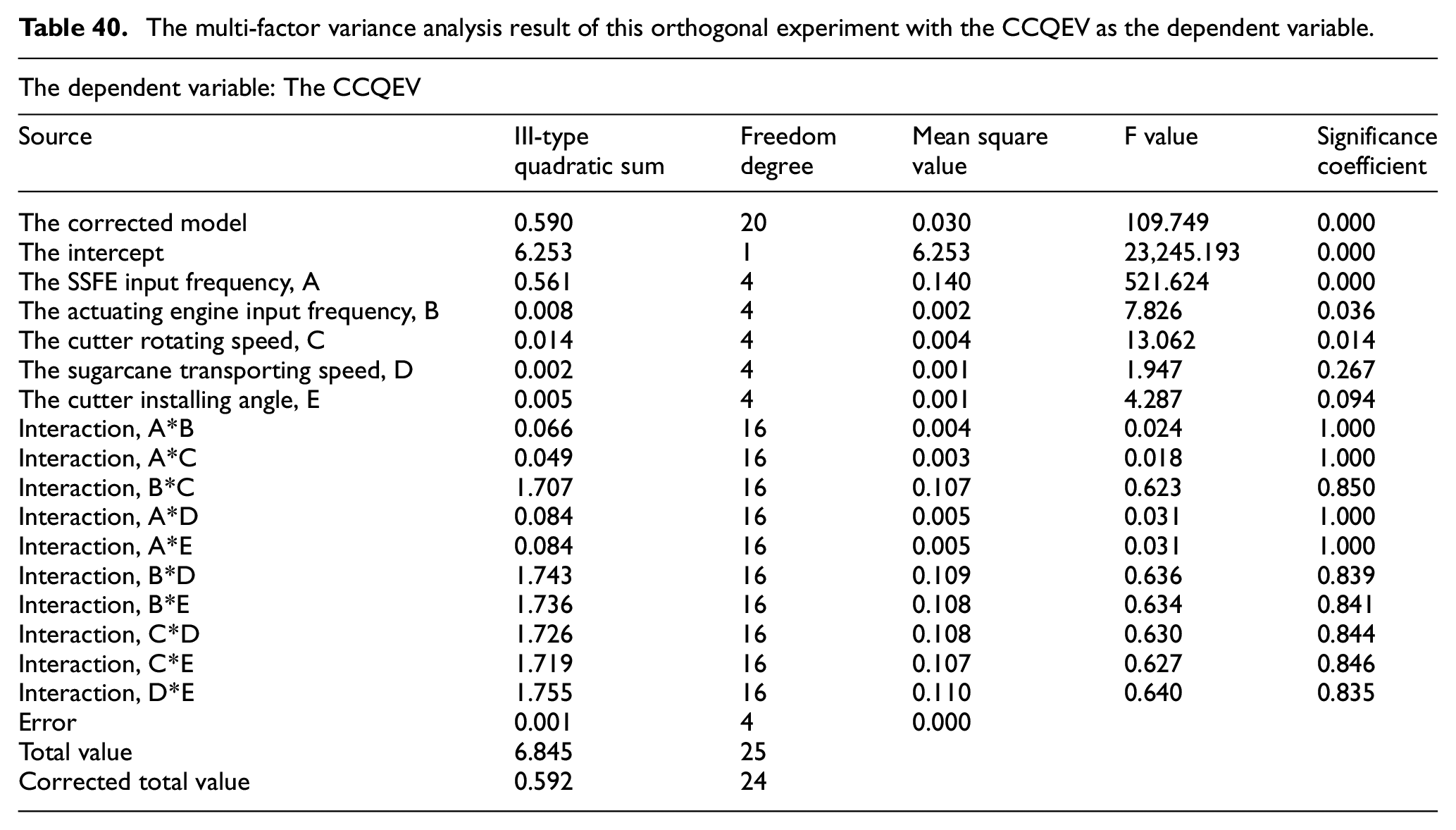
According to Tables 38 to 40, no matter what is the dependent variable, except those of the sugarcane transporting speed, the cutter installing angle and all interactions, significance coefficients of the other three experimental factors are all smaller than 0.05, so these three experimental factors all have significant effects on the axial cutter vibration displacement, three-directional cutting forces and the CCQEV. Therefore, except the sugarcane harvester moving speed, the cutter installing angle and all interactions, the sugarcane field excitation, the cutter rotating speed and the engine excitation have significant effects on the axial cutter vibration, three-directional cutting forces and the SCQ.
Moreover, significance levels of effects of these five experimental factors and their interactions in the sugarcane cutting process from high to low are A > C > B > E > D > D*E > B*D > B*E > C*D > C*E > B*C > A*D > A*E > A*B > A*C according to F values. Therefore, significance levels of effects in the sugarcane cutting process form high to low are as follow, the sugarcane field excitation, the cutter rotating speed, the engine excitation, the cutter installing, the sugarcane harvester moving speed.
In the sugarcane cutting process, the significance level of the effect of the SSFE input frequency on the axial cutter vibration displacement is the highest, so it weakened effects of the other four experimental factors and interactions including the SSFE input frequency on the axial cutter vibration displacement, so among all interactions, significance levels of effects of interactions including the SSFE input frequency on the axial cutter vibration displacement are lower. Therefore, the effect of the sugarcane field excitation weakens effects of the engine excitation, the cutter rotating speed, the sugarcane harvester moving speed, the cutter installing angle and interactions including the sugarcane field excitation on the axial cutter vibration.
Besides, in the sugarcane cutting process, what is similar to interactions in the orthogonal experiment measuring the axial cutter vibration displacement without cutting sugarcanes, the significance level of the effect of the sugarcane transporting speed is the lowest, so it made effects of the other four experimental factors apparent, so among all interactions, significance levels of effects of interactions including the sugarcane transporting speed are higher. Therefore, the effect of the sugarcane harvester moving speed makes effects of the sugarcane field excitation, the engine excitation, the cutter rotating speed, the cutter installing angle and interactions including the sugarcane harvester moving speed apparent.
Moreover, the closer significance coefficients of two experimental factors are, the more significant the effect of interaction between these two experimental factors is, so among all interactions, the significance level of the effect of interaction between the sugarcane transporting speed and the cutter installing angle is the highest while the significance level of the effect of interaction between the SSFE input frequency and the cutter rotating speed is the lowest. Therefore, the significance level of the effect of interaction between the sugarcane harvester moving speed and the cutter installing angle is the highest while the significance level of the effect of interaction between the sugarcane field excitation and the cutter rotating speed is the lowest.
On the other hand, in the sugarcane cutting process, according to Tables 30 to 32, when the axial cutter vibration displacement is the dependent variable, significance coefficients of all interactions are 0, so all interactions have significant effects on the axial cutter vibration displacement. Therefore, all interactions have significant effects on the axial cutter vibration. When the z-directional cutting force is the dependent variable, except interaction between the SSFE input frequency and the cutter rotating speed, significance coefficients of other interactions are all 0, so the other nine interactions all have significant effects on the z-directional cutting force. Therefore, except interaction between the sugarcane field excitation and the cutter rotating speed doesn’t while other interactions have significant effects on the z-directional cutting force. When the x-directional and the y-directional cutting forces are dependent variables, except interactions including the SSFE input frequency, significance coefficients of the other interactions are all 0, so the other six interactions all have significant effects on the x-directional and the y-directional cutting forces. Therefore, except interactions including the sugarcane field excitation, other interactions have significant effects on the x-directional and the y-directional cutting forces. However, when the CCQEV is the dependent variable, significance coefficients of all interactions are greater than 0.05, so all interactions don’t have significant effects on the CCQEV, that is, all interactions don’t have significant effects on the SCQ.
Fitting equations of the axial cutter vibration displacement, three-directional cutting forces and the CCQEV changing with these five experimental factors and their 10 interactions obtained through multi-factor linear regression analysis of SPSS are shown in equations (10) to (14).


Where:
According to equations (10) to (14), surface diagrams of the axial cutter vibration displacement, three-directional cutting forces and the CCQEV changing with interactions whose significance coefficients are smaller than 0.05, that is, those with significant effects in the sugarcane cutting process drawn through MATLAB are shown in Figures 45 to 75.

The surface diagram of the axial cutter vibration displacement changing with interaction between input frequencies of the SSFE and the actuating engine.

The surface diagram of the axial cutter vibration displacement changing with interaction between the SSFE input frequency and the cutter rotating speed.
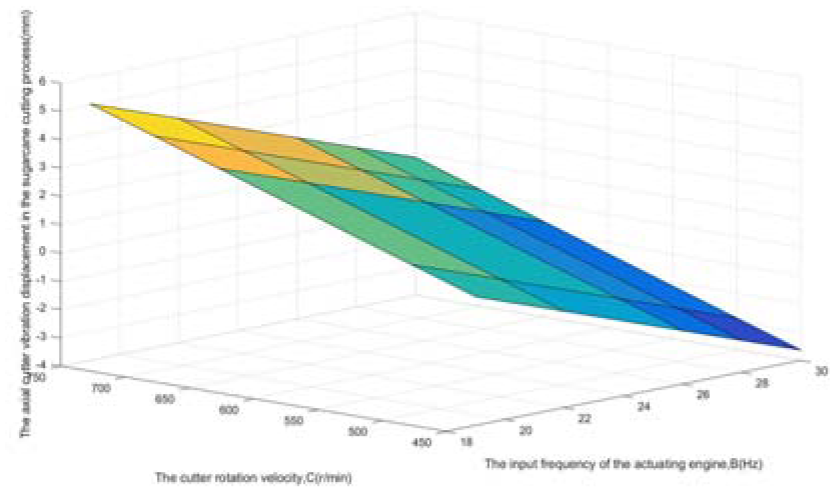
The surface diagram of the axial cutter vibration displacement changing with interaction between the actuating engine input frequency and the cutter rotating speed.

The surface diagram of the axial cutter vibration displacement changing with interaction between the SSFE input frequency and the sugarcane transporting speed.

The surface diagram of the axial cutter vibration displacement changing with interaction between the SSFE input frequency and the cutter installing angle.

The surface diagram of the axial cutter vibration displacement changing with interaction between the actuating engine input frequency and the cutter installing angle.

The surface diagram of the axial cutter vibration displacement changing with interaction between the actuating engine input frequency and the sugarcane transporting speed.

The surface diagram of the axial cutter vibration displacement changing with interaction between the cutter rotating speed and the sugarcane transporting speed.

The surface diagram of the axial cutter vibration displacement changing with interaction between the cutter rotating speed and the cutter installing angle.

The surface diagram of the axial cutter vibration displacement changing with interaction between the sugarcane transporting speed and the cutter installing angle.
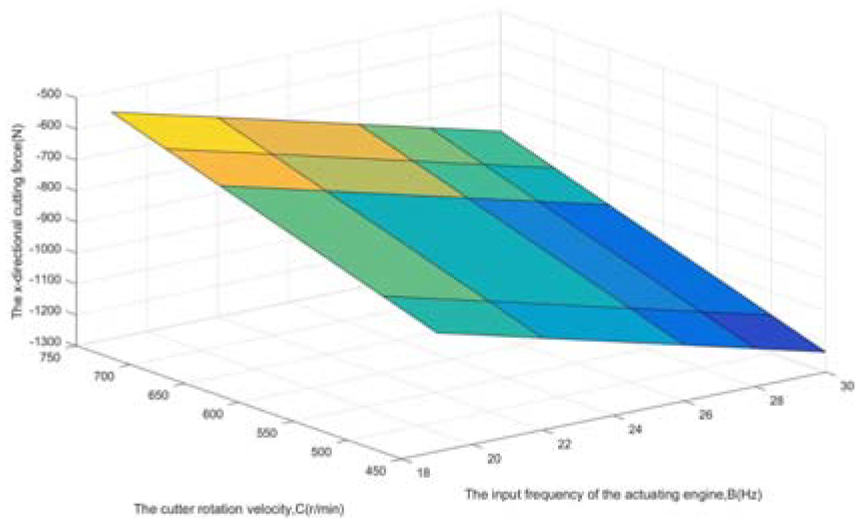
The surface diagram of the x-directional cutting force changing with interaction between the actuating engine input frequency and the cutter rotating speed.

The surface diagram of the x-directional cutting force changing with interaction between the actuating engine input frequency and the sugarcane transporting speed.
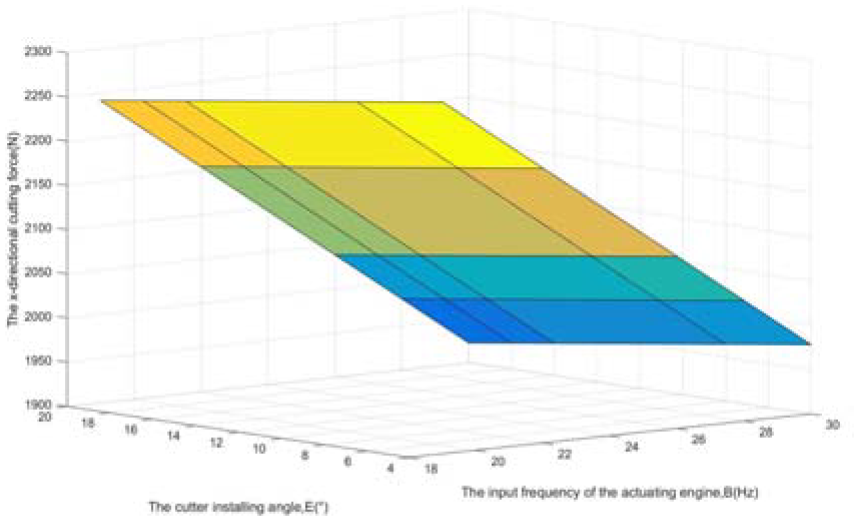
The surface diagram of the x-directional cutting force changing with interaction between the actuating engine input frequency and the cutter installing angle.

The surface diagram of the x-directional cutting force changing with interaction between the cutter rotating speed and the sugarcane transporting speed.
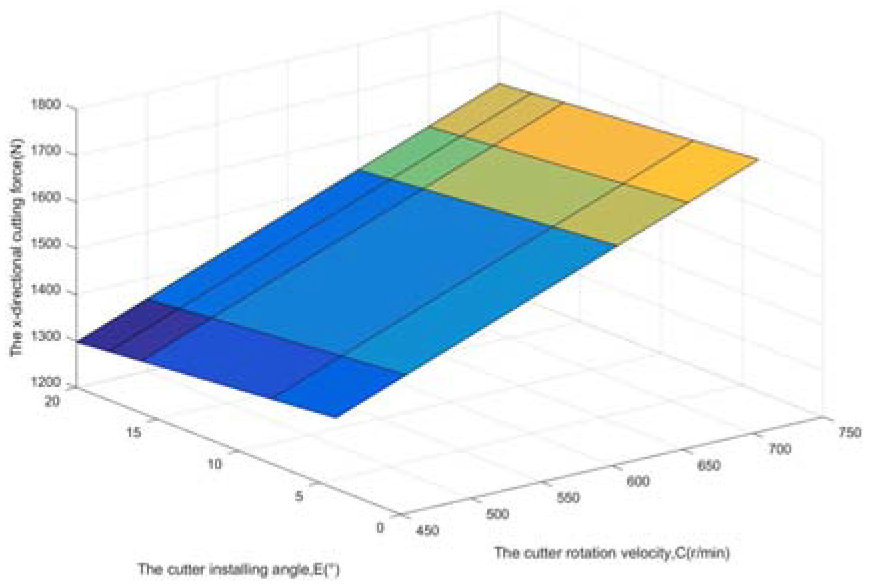
The surface diagram of the x-directional cutting force changing with interaction between the cutter rotating speed and the cutter installing angle.

The surface diagram of the x-directional cutting force changing with interaction between the sugarcane transporting speed and the cutter installing angle.
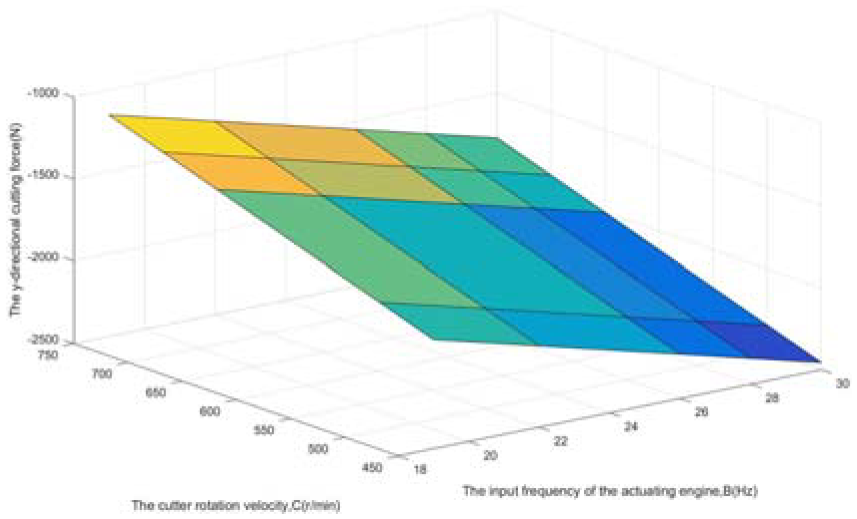
The surface diagram of the y-directional cutting force changing with interaction between the actuating engine input frequency and the cutter rotating speed.
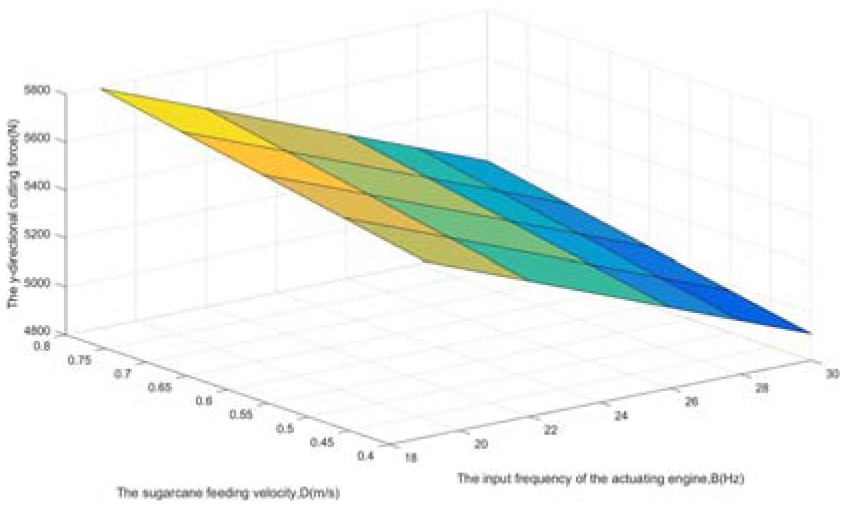
The surface diagram of the y-directional cutting force changing with interaction between the actuating engine input frequency and the sugarcane transporting speed.

The surface diagram of the y-directional cutting force changing with interaction between the actuating engine input frequency and the cutter installing angle.

The surface diagram of the y-directional cutting force changing with interaction between the cutter rotating speed and the sugarcane transporting speed.

The surface diagram of the y-directional cutting force changing with interaction between the cutter rotating speed and the cutter installing angle.
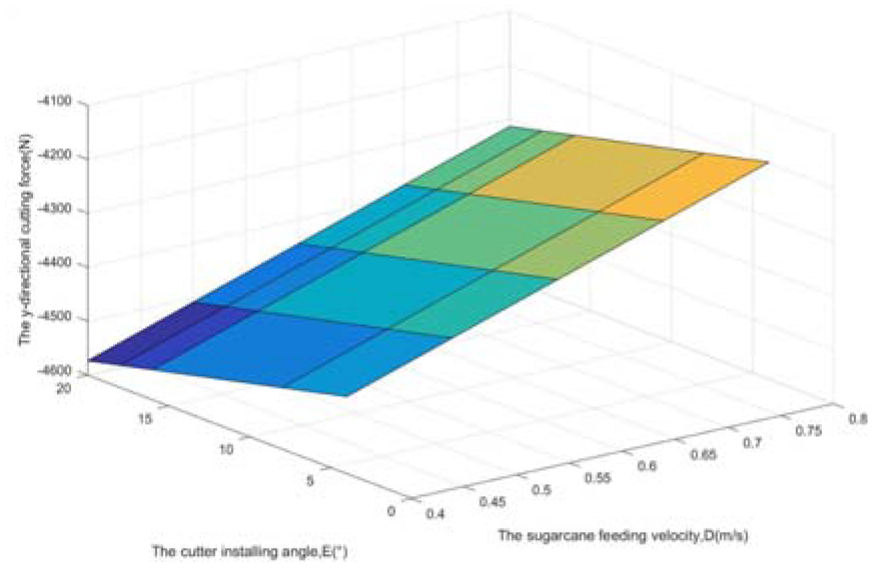
The surface diagram of the y-directional cutting force changing with interaction between the sugarcane transporting speed and the cutter installing angle.

The surface diagram of the z-directional cutting force changing with interaction between input frequencies of the SSFE and the actuating engine.

The surface diagram of the z-directional cutting force changing with interaction between the actuating engine input frequency and the cutter rotating speed.

The surface diagram of the z-directional cutting force changing with interaction between the SSFE input frequency and the sugarcane transporting speed.
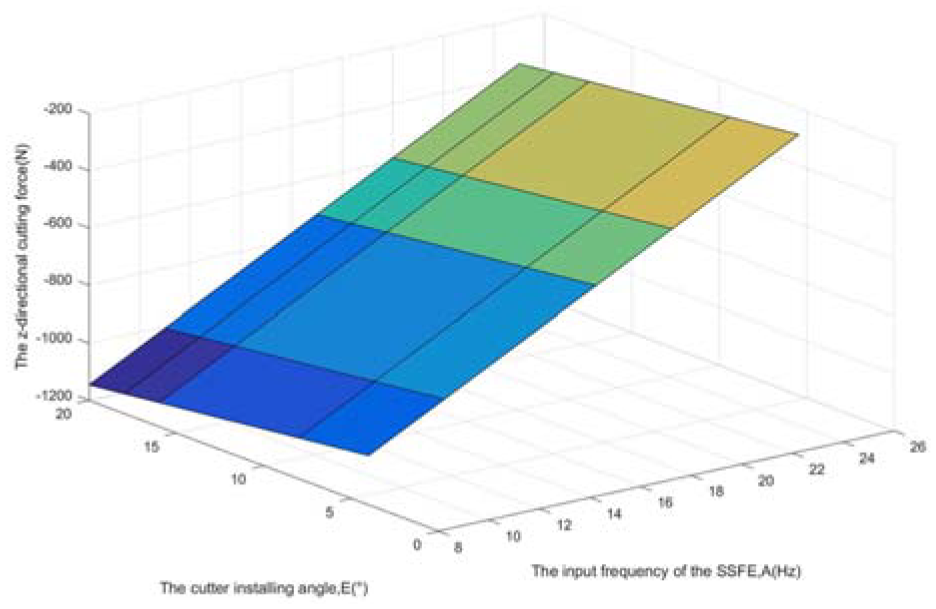
The surface diagram of the z-directional cutting force changing with interaction between the SSFE input frequency and the cutter installing angle.
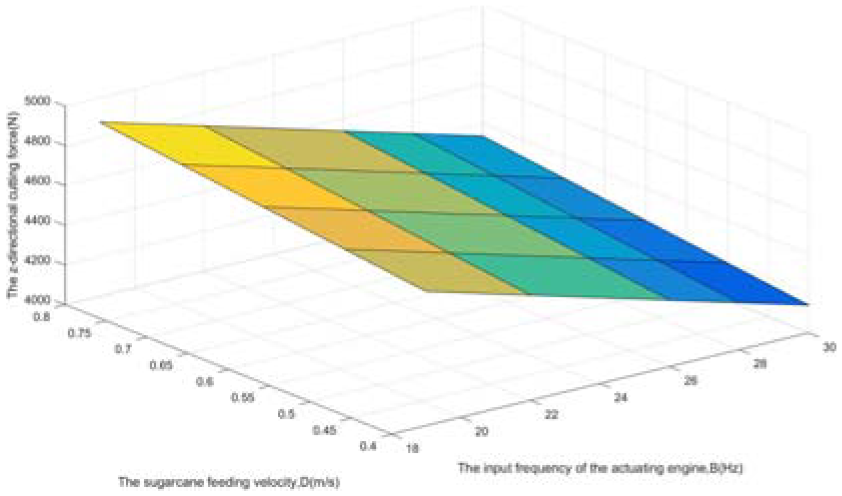
The surface diagram of the z-directional cutting force changing with interaction between the actuating engine input frequency and the sugarcane transporting speed.

The surface diagram of the z-directional cutting force changing with interaction between the actuating engine input frequency and the cutter installing angle.

The surface diagram of the z-directional cutting force changing with interaction between the cutter rotating speed and the sugarcane transporting speed.

The surface diagram of the z-directional cutting force changing with interaction between the cutter rotating speed and the cutter installing angle.

The surface diagram of the z-directional cutting force changing with interaction between the sugarcane transporting speed and the cutter installing angle.
According to Figures 45 to 75, in these interactions, it was usually the factor with the greater significance coefficient which mainly affected these five dependent variables while in interaction between the actuating engine input frequency and the cutter rotating speed and that between the sugarcane transporting speed and the cutter installing angle, it was the actuating engine input frequency and the sugarcane transporting speed with smaller significance coefficients which mainly affected these five dependent variables. When input frequencies of the SSFE and the actuating engine mainly affected these five dependent variables in interactions, the greater input frequencies of the SSFE and the actuating engine are, the greater these five dependent variables is while the greater the sugarcane transporting speed is, the smaller these five dependent variables is when the sugarcane transporting speed mainly affected these five dependent variables in interactions.
Analysis on the sugarcane cutting mechanism
A three-directional cutting force signal collected through the force-measuring system is shown in Figure 76. There are two wave crests in Figure 76, that is, the sugarcane was cut by the cutters twice. According to what were captured by the high-speed camera, the sugarcane was cut off after being cut twice by the cutters, which is shown in Figure 77. These two cut-in points were different, that is, there is a height difference between these two cut-in points. Therefore, in the sugarcane cutting process of sugarcane harvesters, a sugarcane is cut off in more than one time of cutting. When the sugarcane was cut for the second time, the cutters pressed the sugarcane and the axial cutter vibration made the sugarcane broken. Therefore, the axial cutter vibration directly affects the SCQ, further verifying discoveries obtained above.

A three-directional cutting force signal.

A high-speed photograph in the sugarcane cutting process.
Force analysis of a sugarcane cut by a blade simplified as a planar problem is shown in Figure 78. The x axis is along the sugarcane harvester moving velocity with the positive direction pointing to the back of the sugarcane harvester. The positive direction of the z axis is the upward vertical direction, that is, along the cutter axis. The supporting force generated by the ground acting on the sugarcane and gravities are not considered. Forces and motions along the y axis are not considered, either.

The force diagram of a sugarcane: (a) the effect of the upward axial blade vibration on the sugarcane and (b) the effect of the downward axial blade vibration on the sugarcane.
According to Figure 78(a) and (b), when an upward vibration or a downward vibration of the cutter along the cutter axis appears, making an upward vibration or a downward vibration of blades along the same direction also appear, the blade will be in contact with the sugarcane and then the blade will generate an upward positive pressure,


Where:
According to equation (16), the greater D,
According to the classical friction law,

Where:
According to the second Newton Law,

Where:
The axial cutter vibration can be regarded as a combination of some simple harmonic vibrations. Therefore,

Where:
Bending moments,

The axial tensile strength of sugarcanes is greater than their lateral tensile strength. If a sugarcane is not cut off at once along the lateral direction, cracks will be extended along the axial direction. Therefore, if a sugarcane is cut for several times, when the upward cutter vibration appears, under the combined action of

According to equation (18), the greater
According to Tables 37 and 38, the effect of the SSFE input frequency on the axial cutter vibration displacement is the most significant. Therefore, the SSFE input frequency may also affect the axial cutter vibration frequency significantly, that is, it may determine the axial cutter vibration frequency, so the SSFE input frequency can represent
According to the second Newton Law, the resultant force combined by all forces acting at the contact point,

Where:
There are only motions along the x and the z axes, so


Where:
Analysis and discussions
(1) When a sugarcane is cut for the second time, it will be easy to be compressed and torn. Its ratoon will be broken if the axial cutter vibration displacement is great. Therefore, the axial cutter vibration displacement should be reduced and natural frequencies of the body frame and the cutting system should be increased to avoid the resonance of sugarcane harvesters.
(2) A low cutter rotating speed causes lack of cutting energies, making cutters generate shocks acting on sugarcanes instead of cutting off them at once. Sugarcane toughness prevents cutting energies and cutters reaching sugarcane interiors rapidly. Then cutters compress and shock sugarcanes, causing sugarcane cracks. Therefore, the cutter rotating speed should be great enough to cut off sugarcanes rapidly to improve the SCQ.
(3) A great cutter installing angle increases the contact area of cutters and sugarcanes. Then sugarcane ratoons are not easy to be broken by cutters. The axial tensile strength of sugarcanes is greater than their radial tensile strength. Therefore, a great cutter installing angle helps cut off sugarcanes.
(4) The sugarcane harvester moving speed should be increased to improve the SCQ in that under a low sugarcane harvester moving speed, sugarcanes will be cut off in several times of cutting, which leads to a low SCQ. However, under a high sugarcane harvester moving speed, cutters may generate great pushing forces acting on sugarcanes, which is easy to break sugarcane ratoons. Besides, small sugarcane harvesters in hilly areas are focused in this paper. A high moving speed is not suitable for a small sugarcane harvester to move in a hilly area while it is suitable for flat areas. Therefore, according to Figure 24, the best sugarcane harvester moving speed is 0.6 m/s with the best SCQ for small sugarcane harvesters in hilly areas, which is far from the sugarcane harvester moving speed greater than1.5 m/s in flat areas.
(5) In previous research of our research group, the axial cutter vibration caused by the sugarcane field excitation was simulated through eccentric mass blocks installed on cutters of the SHEP, 25 making it not able to study effects of the sugarcane field excitation frequency on the SCQ and three-directional cutting forces. In this paper, the SSFE was used to simulate the sugarcane field excitation, making it able to study these effects. Only the number of sugarcane cracks, the crack thickness and the crack length were used to calculate the CCEQV 25 in previous research of our research group while four indexes were used in this paper.
Conclusions
(1) The sugarcane field excitation and the engine excitation have significant monotonic positive correlated effects on the axial cutter vibration and the three-directional cutting forces while they have significant monotonic negative correlated effects on the SCQ. The cutter rotating speed, the sugarcane harvester moving speed and the cutter installing angle have significant monotonic negative correlated effects on the axial cutter vibration and the three-directional cutting forces while they have significant monotonic positive correlated effects on the SCQ.
(2) Low-stage natural frequencies of sugarcane harvesters should be improved to be away from the main excitation frequency band of sugarcane field roughness to avoid the sympathetic vibration, then to weaken the axial cutter vibration.
(3) The axial cutter vibration has directly and highly significant monotonic positive correlated effects on three-directional cutting forces while it has a directly and highly significant monotonic negative correlated effect on the SCQ. Three-directional cutting forces have significant monotonic negative correlated effects on the SCQ.
(4) The best cutting parameters of sugarcane harvesters with the best SCQ are as follow: the cutter rotating speed is 700 r/min, the sugarcane harvester moving speed is 0.6 m/s and the cutter installing angle is 8°.
(5) Except the engine excitation, the sugarcane field excitation, the cutter rotating speed and interactions all have significant effects on the axial no-load cutter vibration. Significance levels of effects on the axial no-load cutter vibration from high to low are as follow, the sugarcane field excitation, the cutter rotating speed, the engine excitation, interaction between the engine excitation and the cutter rotating speed, interaction between the sugarcane field excitation and the engine excitation, interaction between the sugarcane field excitation and the cutter rotating speed.
(6) In the sugarcane cutting process, except the sugarcane harvester moving speed, the cutter installing angle and all interactions, the sugarcane field excitation, the cutter rotating speed and the engine excitation have significant effects on the axial cutter vibration, three-directional cutting forces and the SCQ. Significance levels of effects in the sugarcane cutting process form high to low are as follow, the sugarcane field excitation, the cutter rotating speed, the engine excitation, the cutter installing angle, the sugarcane harvester moving speed. The significance level of the effect of interaction between the sugarcane harvester moving speed and the cutter installing angle is the highest while the significance level of the effect of interaction between the sugarcane field excitation and the cutter rotating speed in the sugarcane cutting process is the lowest.
(7) In the sugarcane cutting process of sugarcane harvesters, a sugarcane is cut off in more than one time of cutting and there is a height difference between different cut-in points. When the sugarcane was cut for the second time, the cutters pressed the sugarcane and the axial cutter vibration made the sugarcane broken. Therefore, the axial cutter vibration directly affects the SCQ.
The pressure and the bending moment generated by the cutter acting on the sugarcane increase along with the axial cutter vibration displacement and frequency increasing. This makes axial sugarcane cracks appear and the ratoon broken, leading to a poor SCQ.
(8) Sugarcane cutting experiments in sugarcane fields should be further done to verify conclusions obtained on the SHEP. Besides, based on a weaker axial cutter vibration and a better SCQ, reverse design of sugarcane harvesters should be done according to conclusions obtained above.
Footnotes
Handling Editor: Chenhui Liang
Declaration of conflicting interests
The author(s) declared no potential conflicts of interest with respect to the research, authorship, and/or publication of this article.
Funding
The author(s) disclosed receipt of the following financial support for the research, authorship, and/or publication of this article: This research was funded by a Middle-aged and Young Teachers’ Basic Scientific Research Ability Promotion Project of Guangxi Universities, China (Project number: 2023KY0701); a Wuzhou University Research Foundation for Advanced Talents, China (Project Number: WZUQDJJ17195); a Key University-level Scientific Research Project of Wuzhou University, China (Project number: 2020B003); a Wuzhou University Research Foundation for Advanced Talents, China (Project Number: WZUQDJJ17179); a major special project of Guangxi sugarcane science and technology in the 14th Five-year Plan, China (Project number: 2022AA01010); a general program of the National Natural Science Foundation Project, China (Grant Number: 32071916); a horizontal technical service project of the Zhenkang Professor Workstation, Yunnan, China; a Double First-class Discipline Construction Project: Mechanized sugarcane harvesting equipment development of Zhenkang, Yunnan, China; the first university-directly-under-Education-Ministry-served innovative rural revitalization test project: the China-Agricultural-University-served innovative Bangdong Village revitalization test plan, mechanized-sugarcane-harvesting-assistant rural revitalization in hilly areas, Zhenkang, Yunnan, China; the Portable Sugarcane Harvester Research and Development, China (Grant Number: NK2022160504); the 2115 Talent Development Program of China Agricultural University; a Guangxi Science and Technology Project, China (Project number: Guike AA22117007); a Guangxi Science and Technology Project, China (Project number: Guike AA22117005); a Guangxi Special Project of Science Technology Bases and Talents, China (Project number: Guike AD23026033).
Prof. Shangping Li, Prof. Shaochun Ma and Prof. Zhimin Huang discussed the idea with Hanning Mo after Hanning Mo put forward the topic. Hanning Mo finally determined the title of this manuscript.
Hanning Mo and Chen Qiu designed experiments under Prof. Shangping Li’s guidance. Hanning Mo and Chen Qiu designed, manufactured and adjusted the sugarcane harvester experiment platform. Prof. Shangping Li funded the sugarcane harvester experiment platform. Chen Qiu helped Hanning Mo carry out experiments, analyze experimental results and process the data.
Hanning Mo and Chen Qiu designed the frame of this manuscript. Then Hanning Mo wrote this manuscript. Chen Qiu gave valued ideas and suggestions during Hanning Mo’s writing. Prof. Shangping Li, Prof. Shaochun Ma and Prof. Zhimin Huang reviewed this manuscript. Hanning Mo revised it according to their comments for several times. All the authors agreed on what the manuscript is presented like finally.
