




Abstract
In order to solve the problem of energy shortage and focus on the development of wave energy, a jack-up platform is used as the carrier, and a new type of wave energy power generation device is designed. Compared with other power generation devices, this new type of jack-up wave energy power generation device owns the advantage of wind and wave resistance, is continuous, highly efficient, stable, and strongly adaptable. By means of combination of theoretical analysis and physical test, the feasibility of the device implementation of wave power is explored. The results showed that the jack-up wave energy power generation device can normally work in the sea state, which verified the feasibility of the device. This device has achieved wave power efficiency by more than 15% of the technical indicators of the project and the desired effect. In general, the jack-up wave energy power generation device has achieved breakthrough in many aspects, and the overall technology has reached the leading domestic level.
Introduction
Wave energy is one of the most abundant energy reserves of marine energy, which is the most studied in the development of ocean energy. 1 Wave energy can become a member of the new energy which has attracted much attention in the family because it has the advantages of widely distributed, clean, pollution free, large energy density. 2 Though the waves of water particles in rolling motion is in place, its motion energy is very huge. It is estimated that at 1 km2, sea wave energy can reach 250,000 kW of power. Because it contains tremendous power, the destructive force of the waves is staggering. Waves have to throw dozens of tons of rock to the shore and push their shipyard ship to shore. How to ride the waves for the benefit of mankind is the dream of people for hundreds of years. The world has more than 1500 wave energy technology patents. Dozens of wave energy utilization technology is under development. Because technology starts late and still faces big problems, the application of wave energy is much lower than that of wind energy and solar energy. A lot of power generation device is damaged (bank) or sinking (ship). 3 Because of the good adaptability to water depth and good working stability, jack-up platforms have been widely used for offshore drilling and work-over operations.4,5 We use the advantage of jack-up platform and mature technology. The oscillating float-type wave power device is applied in the jack-up platform to build a small jack-up platform of wave power.
This article is based on the state oceanic administration renewable energy special fund project “High efficiency and stability of wave power generation device of self protection under severe sea state.” We design a jack-up platform as the carrier of the new wave energy power generation device. It can effectively solve the low efficiency and instability of wave energy power generation. And the reliability of the device structure is also guaranteed.
Composition and working principle of jack-up wave energy power generation device
Composition of device
In general, wave energy power generation device can be considered and includes three levels of energy conversion system. The waves can be converted into kinetic energy and potential energy of the device by primary energy conversion mechanism interaction with the waves directly. Then it can be converted into the rotating machinery hydraulic energy by the secondary energy conversion. Finally it can be converted into electricity with a generator. 2 Figure 1 shows the composition of device, whereas Figure 2 shows device object.

Jack-up wave energy power generation device. 1: Guide column; 2: piston rod; 3: buoy; 4: accumulator; 5: hydraulic cylinder; 6: generator system.

Jack-up wave energy power generation device object.
Working principle of the device
As shown in Figure 1, jack-up wave energy power generation device includes buoy, hydraulic oil cylinder, guide posts, jack-up platform, hydraulic oil cylinder mounting base, energy storage library, hydraulic control system, and power generation system. When the waves rise, it promotes the upward movement of the buoy along the guide pillar, leading the hydraulic oil cylinder piston rod to rise. Through hydraulic control system into the high-voltage energy storage library, and constant voltage regulation into the high-pressure hydraulic motor, it makes the continuous steady high-pressure hydraulic motor–driven generator to produce electricity. When the waves decline, buoy drops along the guide column by weight, which makes the hydraulic cylinder piston rod drop and the hydraulic cylinder rod chamber oil discharge. Through hydraulic control system into the low-pressure storage library, after constant voltage regulation into low-pressure hydraulic motor, it makes the continuous smooth low-pressure hydraulic motor–driven small generator to produce electricity.
Stress analysis of buoy
In the jack-up wave energy power generation device, buoy contacts with the sea directly. The wave motion forces with the buoy in the ocean, which makes buoy with wave fluctuation motion. Thus the buoy absorbs the energy form the waves. A wave of the sea water can be converted to buoy potential energy. This article ignores the mutual influence between pontoons and considers only the analysis of the performance of a single buoy. The forces acting on the buoy include vertical wave force, horizontal wave force, buoyancy, supporting force by platform, and friction between buoy and platform leg, as well as hydraulic pressure. Because the forces are complex, a simplified force model for research is necessary. Obviously, the horizontal wave force and the supporting force have the same magnitude but in opposite direction; hence, these two forces can be canceled out. The friction between buoy and platform leg is rolling friction, so the friction coefficient is equal to 0.05, which plus the horizontal wave force usually will obtain a small value; thus, the friction between platform leg and the buoy can be ignored. Therefore, the remaining forces on the buoy are hydraulic pressure, buoyancy, gravity, and vertical wave force. The article analyzes hydrodynamic responses by using the SESAM software, which is based on the theory of linear stochastic waves, PiersonMoskowitz (PM) frequency spectrum, and three-dimensional floating body wave load method.6,7 Floating body of wave force includes two parts, both of which receive buoy: Froude–Krylov and Froude–Krylov + diffraction wave forces. Table 1 shows the buoy motion response and wave force under the condition of amplitude.
Buoy motion response and wave force under the condition of amplitude.

In order to make the capture of wave energy largest, we need to increase the buoy vertical heaving motion amplitude and vertical wave forces. To make the buoy structure withstand the impact of the wave, we will reduce the horizontal wave force. On the whole, buoy can capture wave effect best with a 0.8-m water depth counterweight, and the corresponding buoy waterline is about 3 m in diameter.
Marine engineering experiment and result analysis
Jack-up wave energy power generation device is placed in east sand, Zhujiajian, Putuo District, Zhoushan City, Zhejiang Province, the specific location of the confluence of the Yangtze Estuary and Hangzhou Bay. The experiment is completed on the jack-up platform of wave power. Experiments were done three times, each time to do the experiment for 5 min, and then we take the two experiment data.
Experimental conditions
The experiment site, jack-up platform for wave power of east sand;
The main instruments of the experiment: eight bulbs of power 200 W, eight bulbs of power 100 W, laser range finder, plastic foam buoy, and multimeter.
Experimental steps
Put the plastic foam float on the sea with the sticks and let it do with the waves rolling motion. One of researchers measures float and laser emission point distance by laser range finder and acquisition wave data by computer. At the same time, another researcher measures the voltage and the current by two multimeter and use the camera shooting video in every second record data.
Result of the experiment and analysis
To observe the stability of the output power, we need to analyze the data of each load and compare with the analysis. When the load is A, the measurement data of wave, voltage, and current are shown in Figures 3–5.

Wave acquisition data graph.

Voltage acquisition data graph.

Current acquisition data graph.
From Figure 3, it can be seen that a wave of the sea is very unstable and irregular. Average period of waves is 6.2 s, and the average wave height is 0.5 m. From Figure 4, the average voltage is 137.12 V within 0–300 s, and the voltage fluctuates between 100 and 200 V. From Figure 5, the average current is 4.75 A, and the current change is not very large.
When the load is B, the measurement data of wave, voltage, and current are shown in Figures 6–8. From Figure 6, average period of waves is 6.5 s, and the average wave height is 0.55 m. From Figure 7, the voltage between 120 and 220 V changes, and the average voltage is 150.22 V. From Figure 8, the current changes between 5 and 7 A, and the average current value is 6.36 A. Through load A and load B analysis and comparison, the comparison results are shown in Table 2.

Wave acquisition data graph.

Voltage acquisition data graph.

Current acquisition data graph.
Electrical signals of loads A and B.

From Figures 9 and 10 and Table 2, two load signals are stable in a certain range and guarantee the stable power operations. According to the characteristics of the waves, wave energy power generation device sets up a hydraulic accumulator, continuously to be stable and efficient. Figures 9 and 10 have proven that jack-up wave energy power generation device can adapt to the irregular wave sea condition.

Power output of load A.

Power output of load B.
Wave energy estimation and the calculation efficiency of wave power
Linear wave theory of wave energy
According to the linear wave theory,8,9 in a wave cycle, the average wave energy of level surface per unit area is

where
Transfer rate of wave energy is


where
Wave number by the dispersion relations can be solved by iterative method


where
Therefore, a wave cycle average wave power is received in water plane area A

where
Calculation of efficiency of wave power
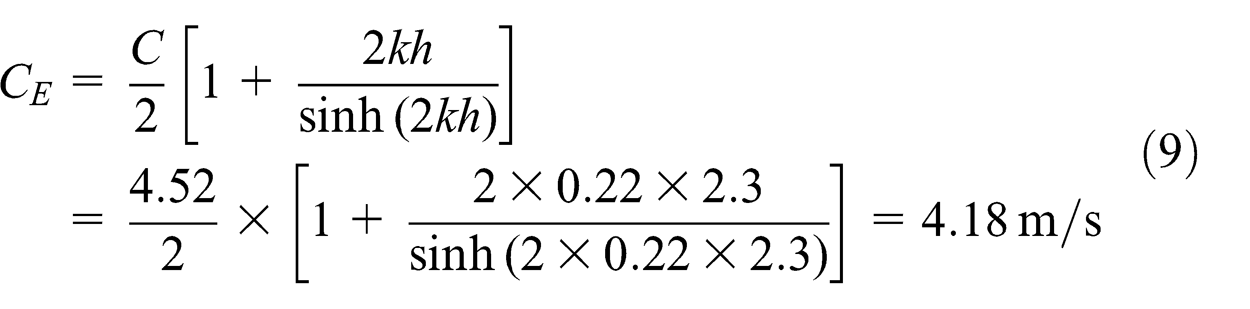
When calculating load A, the draft depth of buoy is 0.8 m, the wave period is 6.2 S, the wave height is 0.5 m, and the power generation operation sea depth is 2.3 m. At this time, the diameter of buoy is 3 m and inner diameter is 0.66 m in water plane area.
Three buoy water plane area

Wave number by MATLAB programming calculation
Wave propagation speed

Wave energy transmission speed
The average wave power of the incident wave

The total efficiency of wave power

When calculating load B, the draft depth of buoy is 0.8 m, the wave period is 6.5 S, and the wave height is 0.55 m. At this time, the diameter of buoy is 3.1 m and the inner diameter is 0.66 m in water plane area. Hence, the total efficiency of wave power is

To sum up, whether load A or load B, the efficiency of device is more than 15%. It has reached the technical indicators of the project with high conversion efficiency.
Advantage of jack-up wave energy power generation device and innovation points
Survival ability of severe sea condition: The device adopts jack-up platform support and sets up as the protection device. Before the storm hits, it will float out of the water. The device invented an elevating wave power in the project. In severe sea condition, buoy can rise above the sea and lock the platform body. It can effectively resist the impact of the storm and the waves and has experienced typhoon test;
The device is not affected by the change in water level. Stationary wave energy power generation device usually will face a big problem, which eliminates the influence of tidal range change on power generation device. Because the water-level changes frequently, the buoy need to adjust for position to ensure that equipment can work under normal operation. Device invents the water-level tidal range change adaptive servo technology in this project and develops a follow-up wave rack. It realizes the all-weather track wave motion and is able to generate wave power at different water levels.
The device invites a technology of group hydraulic oil cylinder. Hydraulic oil cylinder is balanced arrangement in pairs in the rack on both sides. It improves the energy conversion efficiency and eliminates the impact with the waves of horizontal force.
Conclusion
Jack-up wave energy power generation device has the characteristics of wind and wave resistance, is continuous, highly efficient, and stable. The device has the advantages in the power output stability, reliability, efficiency, management, and maintenance cost. It achieves technical indicators of the project and realizes the breakthrough in many aspects.
Jack-up wave energy power generation device still needs further perfection. For example, the platform should be plugged into sea area of deeper and more abundant wave energy. It is helpful to improve the efficiency of power generation. In the next work, we will develop more powerful wave energy power station.
Footnotes
Academic Editor: Fabrizio Marignetti
Declaration of conflicting interests
The authors declare that there is no conflict of interests regarding the publication of this article.
Funding
This research was financially supported by the State Oceanic Administration of China under contract no. ZJME2011BL04 and National Marine economy innovation development area demonstration project in 2014 under 2014C41013.