



Abstract
Thermal mechanism of non-Newtonian nanofluid coated by lubricated power law material has been theoretically worked out. The slip interaction constraints have been proposed for inspecting the thermal transport. The concept of microorganism is utilized to achieve the stabilization of the suspension of nanoparticles. The rheological constraints of nonlinear model are observed by second grade fluid. The flow phenomenon is governed by stagnation point flow. The second-grade (SG) axisymmetric bio-convective nanofluid flow across a moving surface is considered. The flow equations are simplified by the implementation of compatible similarity transformations. The resulting system is solved numerically and analytically by using a hybrid homotopy technique. With the use of a graph and tabular data, the importance of influencing parameters in relation to the velocity field, motile density microorganism’s, temperature and concentration profiles is investigated. The thermal profile is observed to be lowering with higher Prandtl number values. There is a noticeable drop in concentration and thermal profiles against higher viscoelastic parameter values. The microorganism profile is lower in the presence of bio-convected Lewis number. Moving from Newtonian fluid to non-Newtonian fluid, a decrease in motile organism and Nusselt number.
Introduction
The popularity of non-Newtonian fluids among modern scientists, engineers and computer scientists is well known. There are numerous engineering uses for non-Newtonian fluids, industrial operations, including lubrication, plastics processing, mining, the chemical industry and medicinal applications. These liquids can be divided into three categories: integral, rate and differential types. The non-Newtonian fluids differentially sorted known as viscoelastic type fluids. They differ from other fluids in several ways by their higher-order equations for the viscous materials as opposed to the Navier and Stokes formulas. To get a distinctive response, it is necessary to add a few more boundary criteria. Rajagopal1,2 reported the SG fluid problem and executed that SG is the most straightforward model of non-Newtonian fluids. An analytical solution of SG fluid flow is anticipated by Sahoo and Labropulu. 3
The term nanofluid refers to suspensions containing nano-sized particles (such as silver, gold, aluminum, copper, diamond and so on) and conventional base fluid. It has been experimentally discovered that the ordinary heat transmission fluids have lower thermal conductance. Therefore, a variety of experiments have been conducted to augment their thermal efficacy. The flow geometry is altered and particles of various sizes such as micro, milli and others are used. Are inserted but the desired results were not obtained. Choi and Eastman 4 considered the nano-size particles in the base liquid and discovered that the resulting fluid has higher thermal features. After that, Brownian’s movement and thermophoretic force influences of nano-particles strengthened the concept of dissipation of heat, exchange of heat in fundamental fluid, in engines of hybrid power and powerful healthcare like treat through chemicals. 5 Khan and Pop 6 demonstrated the stretched boundary-driven nanofluid flow induced by the movement of surface. They addressed that the Brownian’s movement and thermophoretic force have influential impacts on the thermal feature of materials. Khan et al. 7 investigated the non-aligned electrically conducted stagnation point nanofluid under Brownian movement and thermophoretic influences. Krishna et al. 8 investigated the radiated magnetized Casson hybrid nanomaterial induced by the vertical porous surface. Madhu et al. 9 examined the time-dependent Maxwell nanomaterial flow with the consideration of magnetohydrodynamics and thermal radiation. The effectiveness of Hall, Joule, and Soret effects in magnetic mixed convected flow is illustrated by Krishna et al. 10 The similar treatment of magnetized Newtonian fluid flowing over the surface is addressed by Chamkha and Khaled. 11 Gorla and Chamkha 12 conducted an analysis of non-isothermal flow through porous medium. Chamkha and Rashad 13 executed the dynamics of magnetohydrodynamic mixed convection flow of Newtonian fluid. Their study centered on a rotating vertical cone and considered factors such as chemical reactions as well as the Soret and Dufour effects. Khan et al. 14 conducted an assessment of irreversibility in the Casson nanofluid flow when there is leading-edge accretion or ablation. Khan et al. 15 addressed the mechanical characteristics of Maxwell nanofluid within a dynamic system.
The microorganism includes flagella or bacteria which possess higher density as comparative to water and on average, they traveled opposite to direction of gravity. The microorganisms gathering develop the suspension higher layer denser as comparison to below layer which creates an unstable distribution of density. Consequently, the convection instabilities taken the place and generated the convection patterns. This random and spontaneous movement of microorganisms’ pattern in the suspension is famous as bioconvection. The theme of investigation of microorganisms’ swimming pattern in liquids heavier than water is due to their connectivity with commercial, ecological, and industrial appliances include ethanol, ecological fuels, fuel cells, and fertilizers. The global warming and weather changing circumstances linked with the emission of carbon-dioxide emission involved an appropriate mechanism to cloister carbon from the surroundings. Microalgae system is generally implemented to pull out the carbon-dioxide from industrial exhausts through system of flue gas combustion. The hydromagnetized bioconvected water-based nanomaterial flow having motile microorganisms over vertical porous surface is addressed by Mutuku and Makinde. 16 Raees et al. 17 reported the time-dependent bioconvected nanofluid through a channel with wall contraction. The transportation of biofluid using both gyrotactic microorganism and nanoparticles is addressed by Bég et al. 18 Giri et al. 19 executed the nature of Stefan blowing on magneto bioconvected nanomaterial flow. The thermal slip behavior on SG bioconvection flow under gyrotactic microorganism is elaborated by Zuhra et al. 20 Siddiqa et al. 21 analyzed the bioconvection viscous nanomaterial flow along a wavy cone. Zuhra et al. 20 conducted a study focused on simulating bioconvection in a suspension comprising a second-grade with nanoparticles and gyrotactic microorganisms. Meanwhile, Khan et al. 22 investigated the dynamic pathways associated with bioconvection within a thermally activated rotating system.
Lubricants are used for a variety of purposes aside from industrial applications include cooking, human-bio appliances, ultrasound and clinical assessments etc. It is primarily used to decrease friction which contributed the most efficient operational mechanism in industries. The stagnation point (SP) flows attached to lubricated films are widely studied because of their applications in the design and cooling industries. Regardless their potential application in the cooling industry and design, the SP flows past a lubricated surface have received little attention. Joseph 23 assumed a thin lubricated layer over solid surface to determine an analytical slip-boundary condition. In his research, he pointed out that the gradient of velocity at the interface is directly linked to the velocity square segment. Solbakken et al. 24 performed the numerical simulation to address the influences of lubrication on the channel flow under interfacial conditions. The slip conditions influences on rotatory lubricated flow of non-Newtonian fluid were executed by Andersson and Rousselet. 25 The SP flow through the lubricated surface having axial symmetry was addressed by Santra et al. 26 Some recent studies can be seen through.27–32
Taking into account the previously conducted studies, the primary objective of the current research model is to investigate the control dynamic of second-grade (SG) nanoparticles on a lubricated surface, employing the concept of microorganisms to attain the stabilization of the nanoparticle suspension. It’s worth noting that, as of now, no prior studies have been carried out in this particular context. Current investigation deals with the thermal mechanism of SG nanofluid due to lubricated surface theoretically. Summering the different aspect of work as follows:
➢ The energy and mass transportation of SG nanofluid is studied due to stagnation point flow of stretched surface.
➢ The thin layer of surface is coated with lubricated power law material.
➢ The relation for bioconvective model is elaborated to observe insight dynamic of microorganism phenomenon.
➢ The thermal interaction of slip is proposed near the convectively heated surface.
➢ An updated algorithm is adopted for simulation outcomes namely hybrid homotopy analysis method.33–35
Modeling
We considered 2D bioconvection SP flow of SG nanofluid over lubricated surface. A thin layer having variable thickness
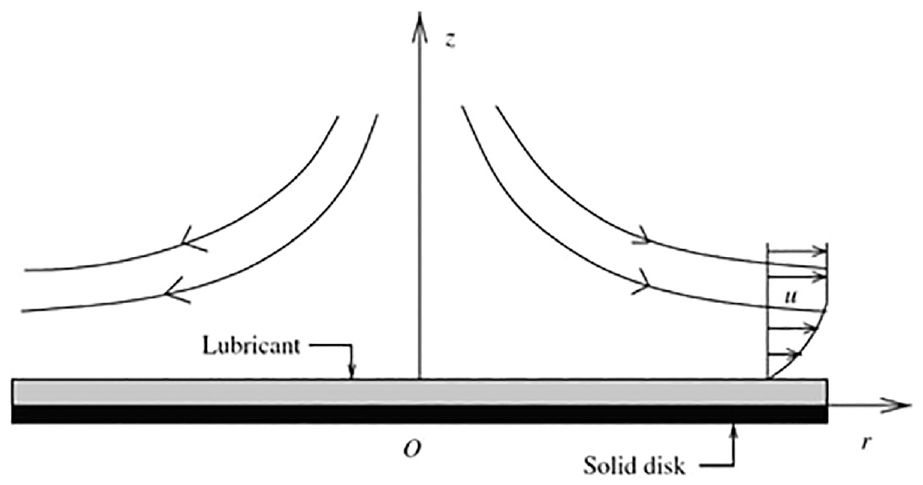
Flow configuration.
Consequently, the constant rate of flow of lubricant is established by:

The governed mathematical model is illustrated as:


In above
The power-law lubricant is presented in the region

Considering that the lubricating layer has no axial velocity, we have:

It is assumed that the SG fluid and power-law lubricant interacted at an interface region where the velocities and shear stresses for both fluids are constant. At

where the consistency index is

where the radial component of velocity for both fluids at the interface is denoted by the symbol

Equation (7) thus becomes:

Furthermore, the fluid-fluid interface’s continuous axial velocity provides:

which more gives

The interface pressure is 11 :

The free-stream conditions are described as:

The similarity variables are described as 15 :

Invoking these transformation equation, the continuity equation (2) is identically satisfied (3)–(7) takes the form:




Subject to boundary conditions.

Solution development
By using initial value problem we can convert the boundary value problem and by using Na, 36 into initial value problem by considering conditions which are missing.
We get;


Differentiating equation (3.19)–(3.24) with respect to
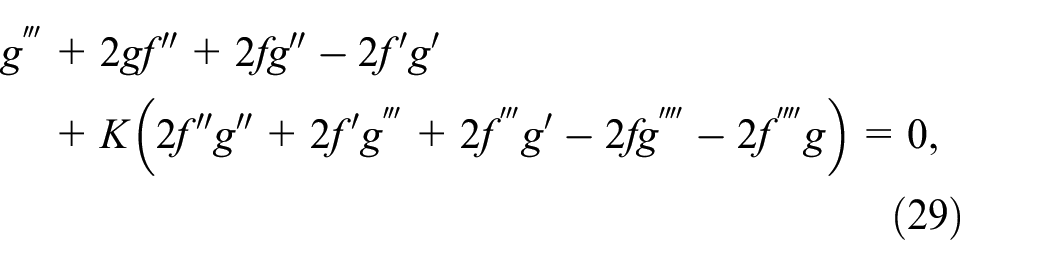



Subject to the lubricated conditions
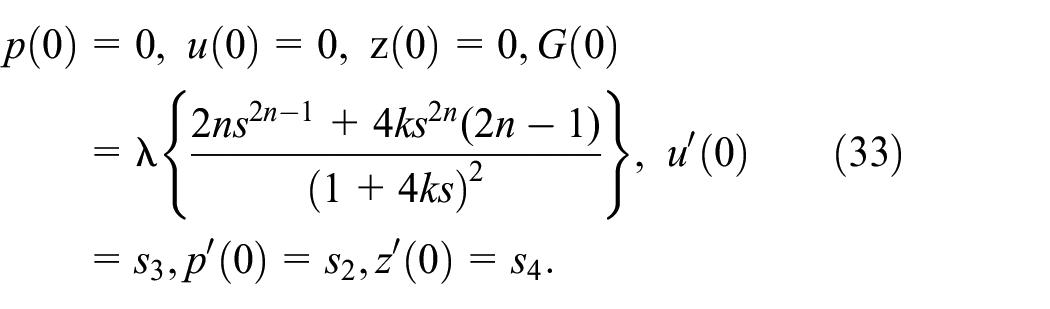
The computations of above equations cannot be achieved through general integration schemes due to the compatibility of equations and conditions. For this, the numerical scheme is adopted in which

Each sub-interval is addressed by







Subject to the condition as
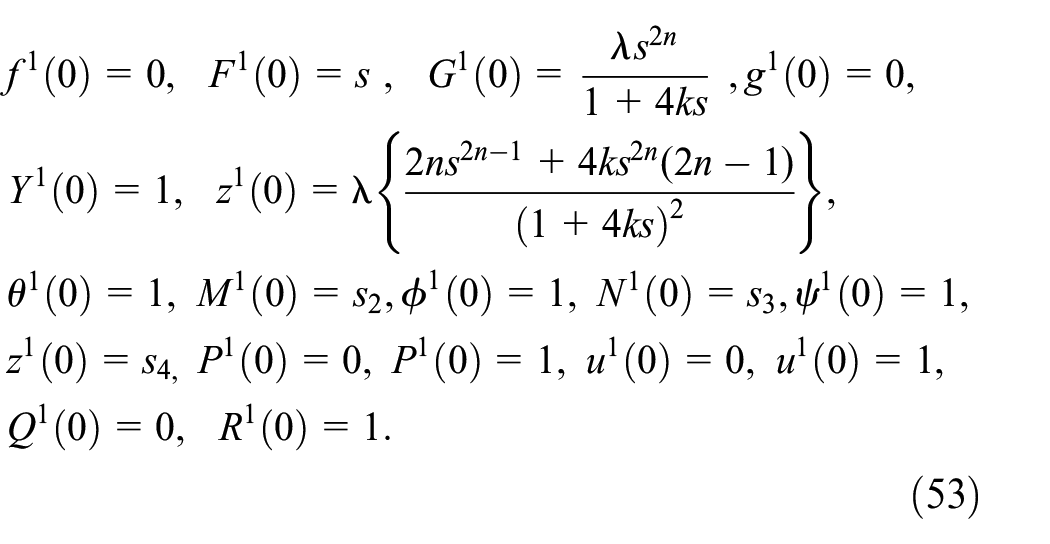
The initial value problems (35)–(53) are now solved using the homotopy analysis procedure37–39 in every subinterval. The numerical values at
Discussion of the obtained solution
With the help of the hybrid homotopy analysis method using Mathematica, the problem of SP flow of SG nanofluid confined by a lubricated disk with bioconvection is computed. Figure 2(a) to (d) illustrates the variation slip parameter
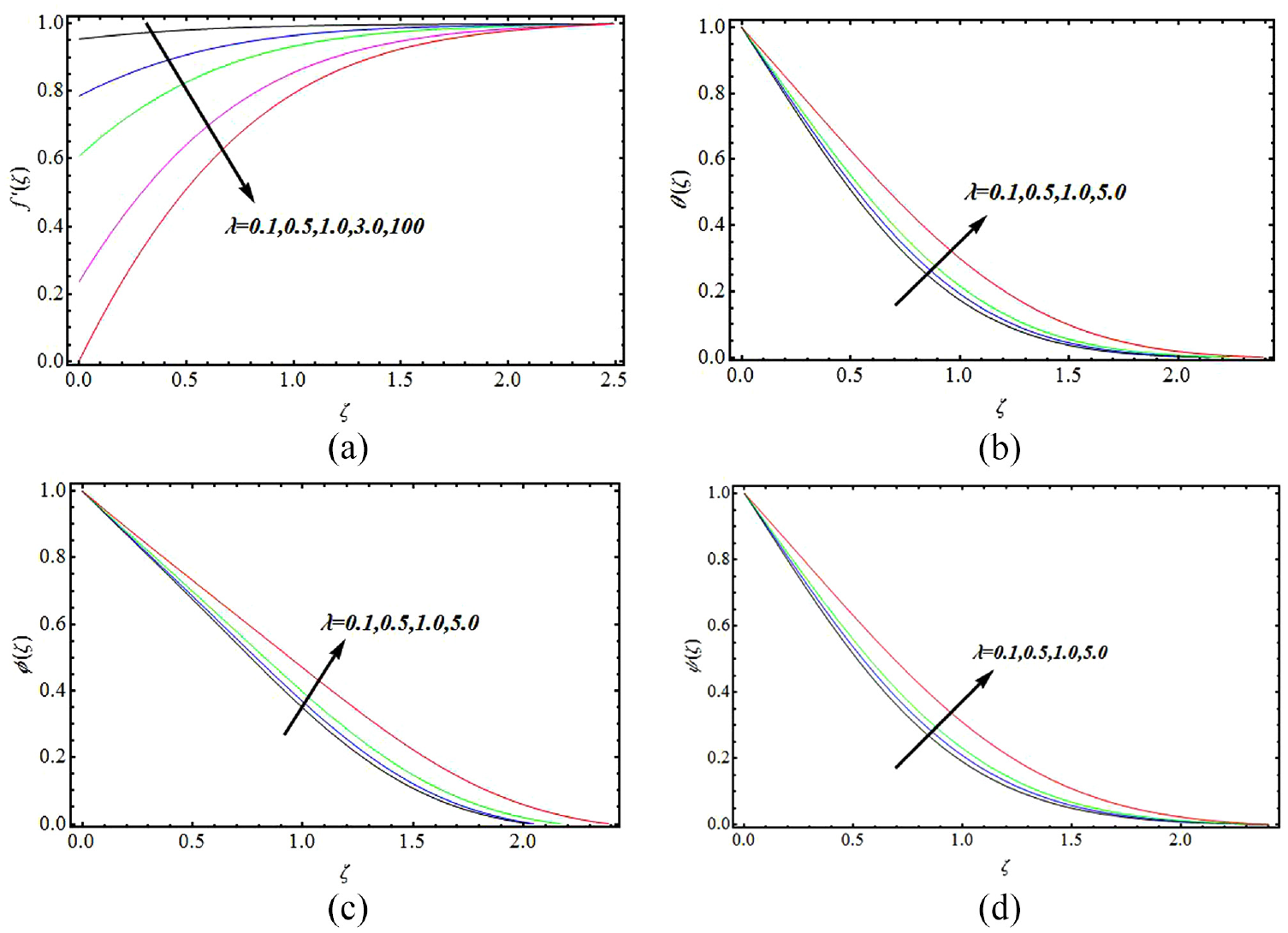
(a) Plot of

(a) Plot of

(a) Plot of

Plot of
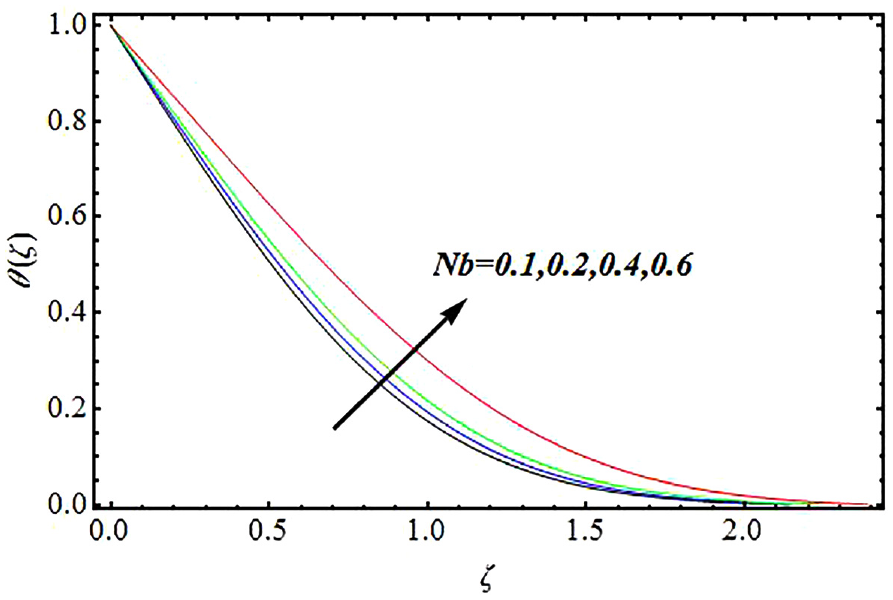
Plot of
For checking the behavior of

Plot of

lot of

Plot of

Plot of
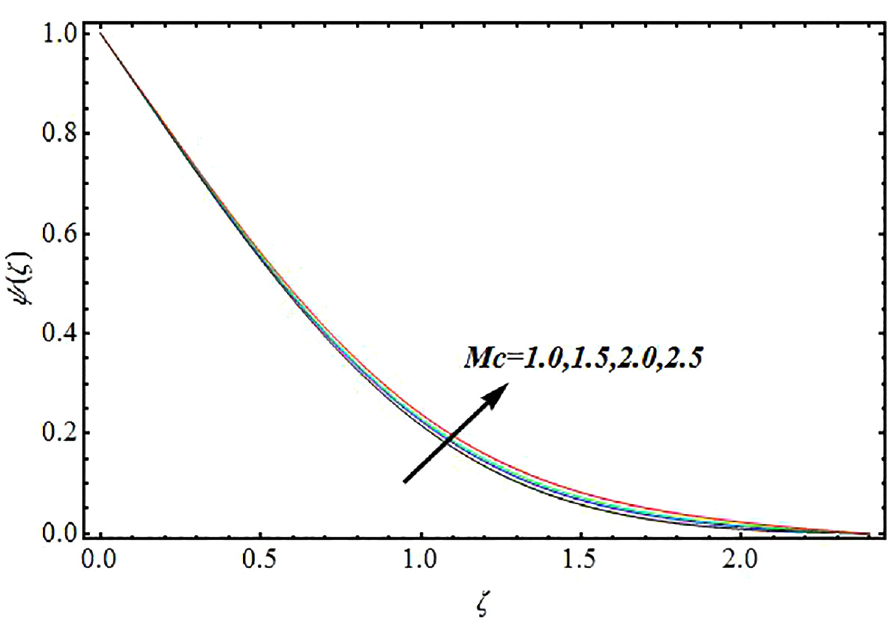
Plot of
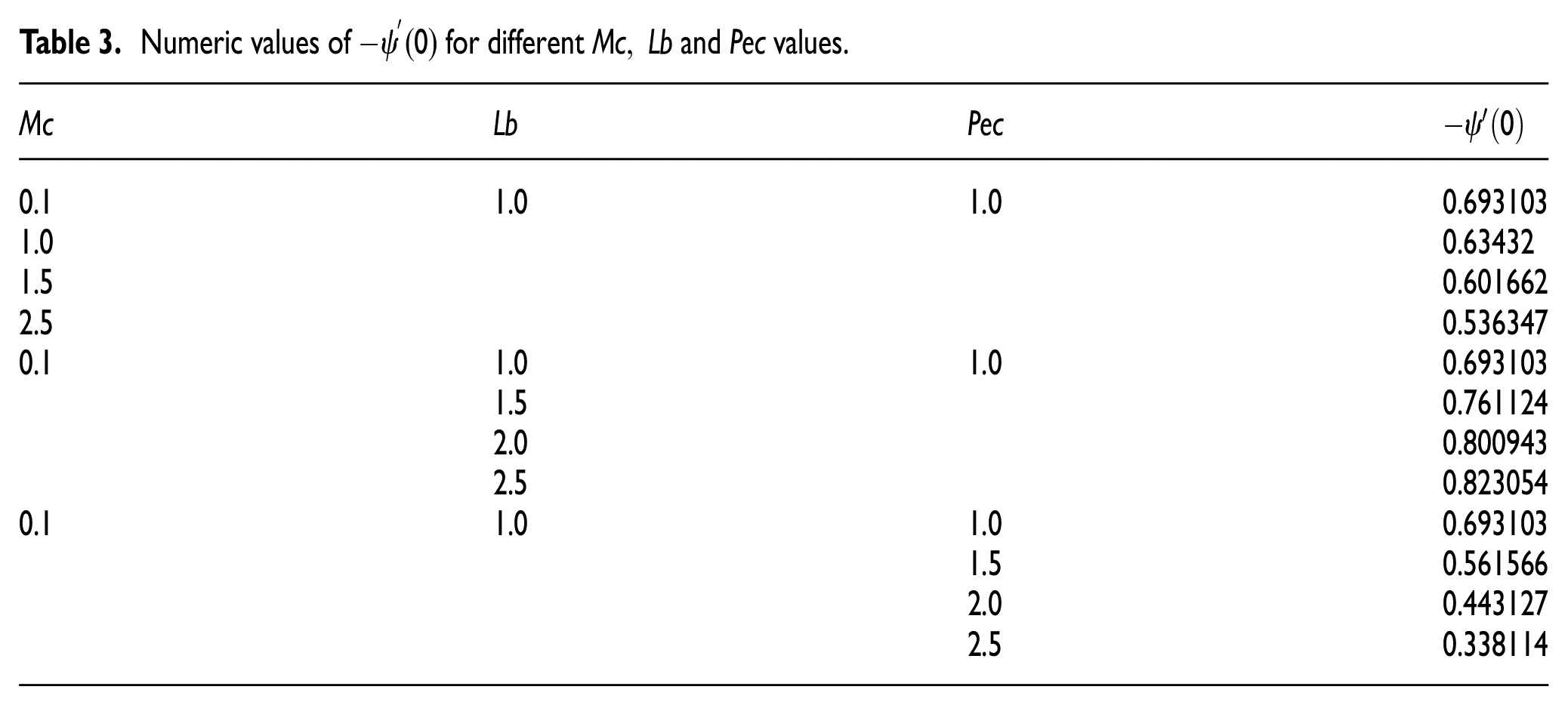
Tables 1 to 3 listed the various changes of the relevant parameters for skin friction, heat transfer rate, mass transfer rate, and microbe population. Here, we see that when the bioconvection Reyleigh number increases, the skin friction coefficient decreases. Growing microorganism increases both the Sherwood and local Nusselt populations. Tables 4 and 5 have been created to facilitate a comparison between the results obtained in this study and those previously published. This comparison is conducted for both no-slip and slip cases, specifically for viscous fluid scenarios. Notably, the current hybrid solution demonstrates an exact match with the previously published limiting results, confirming the accuracy and reliability of findings.
Numeric values of

Numeric values of

Numeric values of
The velocity field comparisons for no-slip case (

The solutions

Conclusions
Bioconvective SG nanofluid flow over lubricated surface is presented in this analysis. It has been investigated how important thermophoresis and Brownian motion are in slip impact. With the proper boundary constraints, partial differential equations are used to frame the issue. These equations are then similarly converted into ordinary differential equations (ODEs). The dimensionless ODE system was then numerically and analytically solved by HHAM. The primary take aways from the current analysis are
The slip parameter reduces the free stream velocity profile.
When the slip parameter has high values, the thickness of the boundary layer is decreased and velocity varies and increases.
The temperature within the border layer fluctuates for large viscoelastic parameters.
By having a higher Peclet number, the microorganism field is reduced.
The microorganism profile is weaker against incremented bioconvected Lewis number.
The bioconvected nanofluid flow over lubricated disk is more ideal for improving heat transfer. Problems with thermodynamics and heat transfer benefit more from the current findings.
This particular challenge focuses on a specific scenario where a particular type of fluid, known as nanofluid, flows between two surfaces, namely a lubricated disk, while being influenced by biological processes called bioconvection. The potential applications of this challenge span a wide range of fields, encompassing biomedical engineering, microfluidics, tribology, nanotechnology, environmental engineering, pharmaceuticals, energy systems, aerospace engineering, and chemical engineering. It’s important to note that this challenge is highly specialized and may not have immediate, real-world applications across all these domains. Nevertheless, the insights gained from investigating this problem have the potential to drive progress in these areas and inspire innovative solutions in future.
Footnotes
Appendix
Handling Editor: Chenhui Liang
Declaration of conflicting interests
The author(s) declared no potential conflicts of interest with respect to the research, authorship, and/or publication of this article.
Funding
The author(s) received no financial support for the research, authorship, and/or publication of this article.
