In this article, axisymmetric stagnation-point flow of a third-grade fluid over a disk lubricated with a power law fluid is considered. Due to thin lubrication layer of variable thickness, third-grade fluid experiences a partial slip on the surface. The flow problem is governed through a system of nonlinear partial differential equations with nonlinear boundary conditions. A nonsimilar solution is presented in this article by implementing hybrid homotopy analysis method. This method combines the features of homotopy analysis and shooting methods. The results varying from no-slip to full-slip case are discussed under the influence of pertinent parameters.
The flows of non-Newtonian fluids have important role in several industrial and engineering processes. Newton’s law of viscosity does not hold for such fluids, and their rheological properties cannot be explained by a single constitutive relationship. The relationship between shear stress and shear rate in the non-Newtonian fluids is nonlinear. The mathematical models based on the flows of non-Newtonian fluids are more nonlinear and have higher order derivative terms in the governing equations when compared with the Navier–Stokes equations. A glance at the literature shows that different constitutive relationships have been proposed for non-Newtonian fluids. Among these models, the differential-type fluids of second and third grades have got special attention of the researchers. Numerous studies are available for the flows of non-Newtonian fluids. Some recent studies may be directed in the investigations1–8 and references therein.
The study of flow phenomenon over a lubricated surface has important applications in machinery components such as fluid bearings and mechanical seals. Coating is another major application including the preparation of thin films, printing, painting, and adhesives. In biological fluids, the applications of such flows include flow of red blood cells in narrow capillaries and of liquid flow in the lung and eye. A review of literature suggests that various attempts are available for the flow over a lubricated surface. Stagnation-point flow considered by Homann9 in a rigid plate was discussed against a thin lubrication layer by Yeckel et al.10 for the first time. An analytical study of flow of a viscous fluid flowing over another viscous fluid was carried out by Blyth and Pozrikidis.11 A slip boundary condition was introduced by Andersson and Rousselet12 for the flow over a lubricated rotating disk. Santra et al.13 discussed the axisymmetric stagnation-point flow of a viscous fluid over a lubricated surface. In Santra et al.,13 a similarity solution was obtained for the governing equations using numerical technique. Sajid et al.14 extended the problem discussed by Santra et al.13 by including a general slip boundary condition. Recently, in another article, Sajid et al.15 analyzed the two-dimensional stagnation-point flow of a viscoelastic Walter-B fluid over a lubricated surface. They obtained a numerical solution using the hybrid method. The analysis of non-Newtonian fluid flows over a thin lubricated layer is an open area of research. This fact motivated us to discuss the axisymmetric stagnation-point flow of a third-grade fluid over a lubricated surface of variable thickness. Third-grade fluid is preferred in the sense that it can describe the shear thinning or thickening effects. The mathematical model for the axisymmetric stagnation-point flow of a third-grade fluid over a power law lubricant give rise to nonlinear differential equations with nonlinear boundary conditions. The hybrid homotopy analysis method (HAM)16 is implemented to obtain the solution of this nonlinear problem. This method combines the features of HAM17–23 and shooting method.24 This article is organized as follows: section “Mathematical formulation” contains the details of the mathematical model considered in this article. The hybrid HAM is explained in detail in section “Hybrid homotopy analysis solutions.” Section “Results and discussion” is devoted for the results and their discussion. The concluding remarks are included in section “Concluding remarks.”
Mathematical formulation
Consider a steady, incompressible, axisymmetric stagnation-point flow of a third-grade fluid over a lubricated surface. The lubricant obeys the constitutive relationship of a power law fluid. Cylindrical coordinates are chosen to develop a mathematical model of the considered flow situation. The axisymmetric nature of flow suggests that all quantities are independent of , and azimuthal component of velocity vanishes identically. It is assumed that the power law lubricant spreads on the surface from a point source at origin and makes a thin layer of variable thickness . The constant flow rate of the lubricant is given by
where is the velocity field for the lubricant. The equations that govern the axisymmetric flow of a third-grade fluid are
where , , , and are
in which and are the radial and axial components of velocity in a third-grade fluid, respectively; is the viscosity; and , , and are the material parameters. The order and magnitude analysis results in the following equation that govern the boundary layer axisymmetric flow of a third-grade fluid
where is the fluid density. The usual no-slip condition at the fluid–solid interface suggests that
It is assumed that there is no variation in the velocity of the lubricant in the axial direction, therefore
At the interface where both the fluids interact, we impose the continuity of velocity and shear stress so that
where is the consistency index and is the power law index. Furthermore, equations (11) and (12) together yield
It is assumed that power law lubricant forms a very thin layer on the disk, and thus, following Joseph,25 we impose boundary conditions (12)–(14) at the disk. The velocity at the free stream is assumed to be
where is any positive constant. Following Santra et al.,13 we assume that radial component of the power law lubricant varies linearly in the following way
where is the radial component of velocity for both the fluids at the interface. Hence, by substituting equation (16) into equation (1), one can obtain the thickness of the lubrication layer as follows
and hence the boundary condition given in equation (13) becomes
Introducing dimensionless variables
The governing boundary value problem takes the form
where
Here, we have expressed slip parameter as the ratio of viscous and lubrication length scales and , respectively. For small flow rates and highly viscous lubricants, is small, and hence, becomes large. For the case when , the conventional no-slip condition is retrieved from equation (21). In the reverse case, slip coefficient vanishes, and one obtains the full-slip boundary condition. Hence, is an inverse measure of slip.
Hybrid homotopy analysis solutions
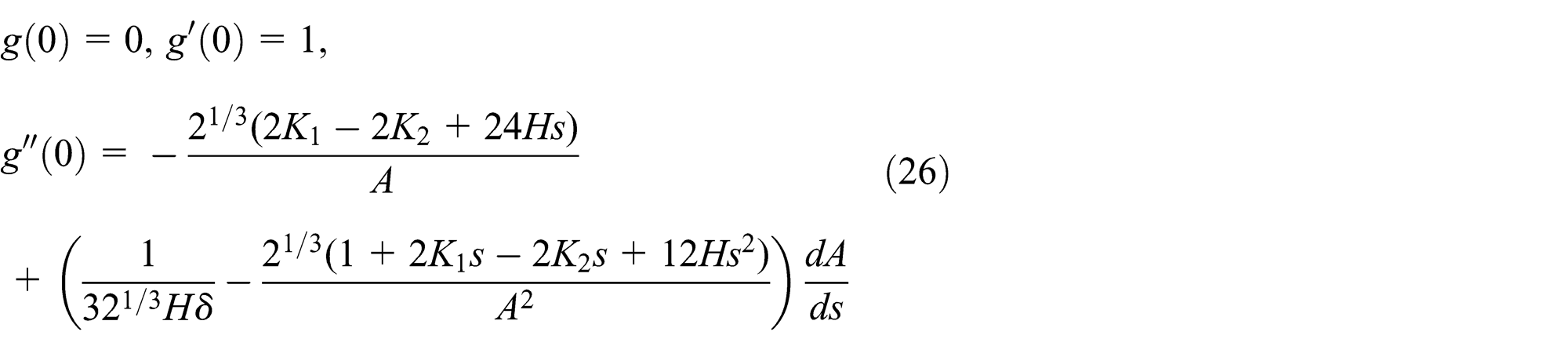
The boundary value problems (20) and (21) are first converted into two initial value problems using shooting method.20 For this, we assume
and from equation (21), one obtains the value of and is given by
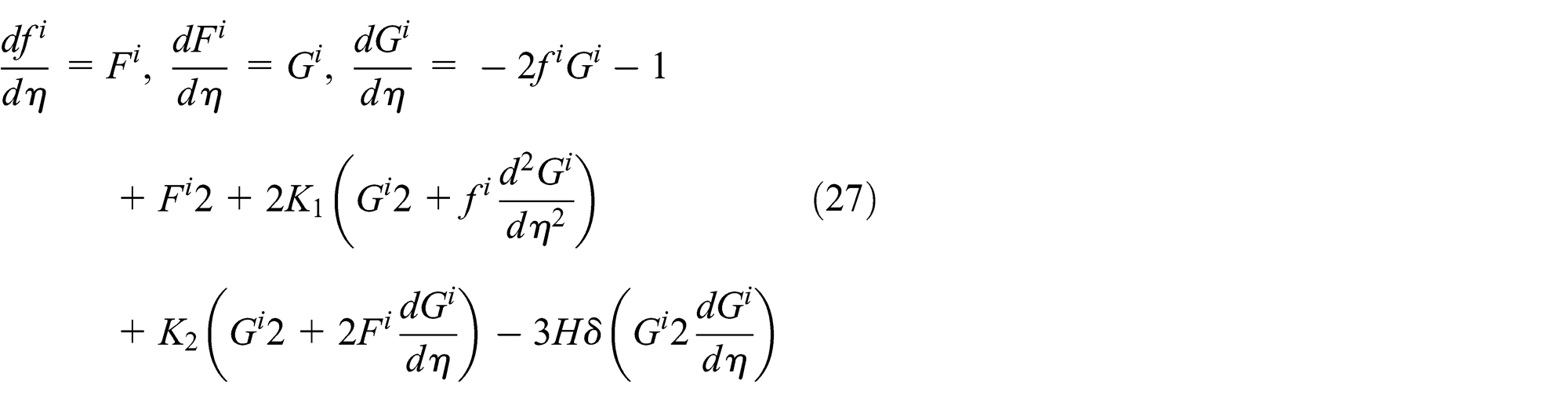
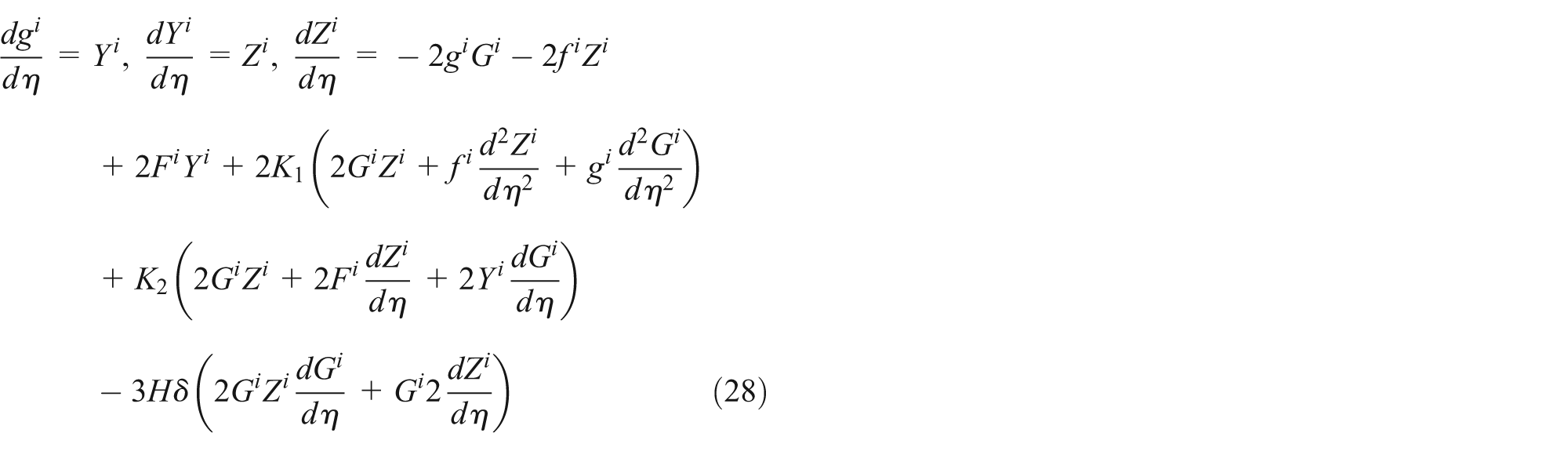
It is pertinent to mention here that equations (20) and (25) have zero coefficient with the highest derivative term when and ; therefore, they cannot be integrated by a standard integration scheme. For numerical computations, we replaced by and divided the domain into subintervals , having fixed length . The first-order initial value problems in each subinterval are
Initial value problems (27)–(29) are solved using the HAM in each subinterval. The numerical values obtained through HAM at the end point of the subinterval are used as the initial conditions for the subinterval.
Zero-order deformation problems
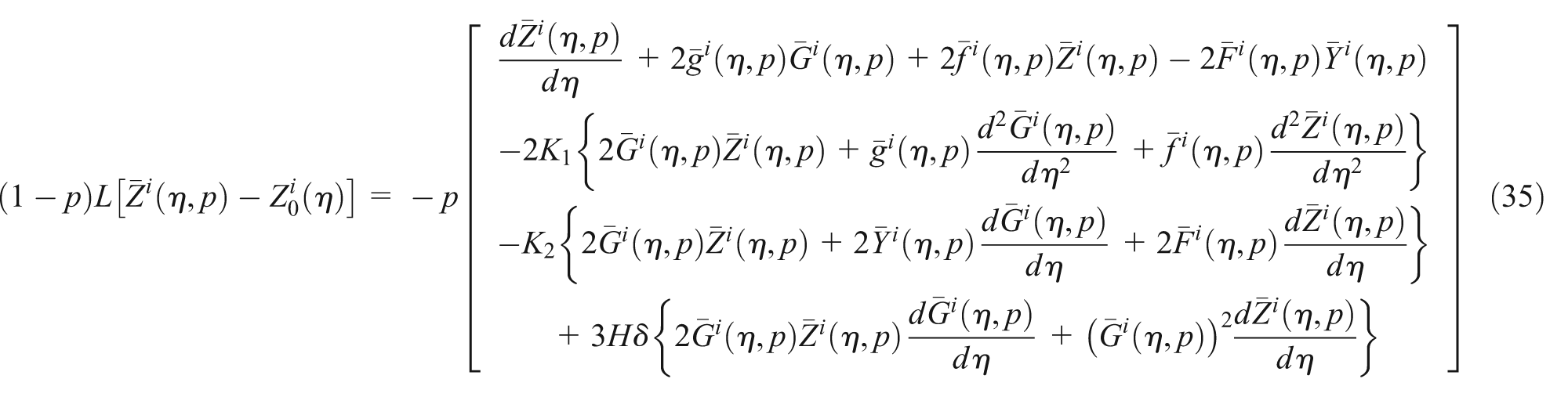
The zero-order deformation problems are
where and are embedding parameter and auxiliary linear operator, respectively, and , and are chosen as initial guesses at each subinterval. Here, we take auxiliary parameter to be and auxiliary function to be . This is due to the fact that convergence of the hybrid HAM is controlled through the subinterval length, that is, , and the order of approximation.
mth-order deformation problems
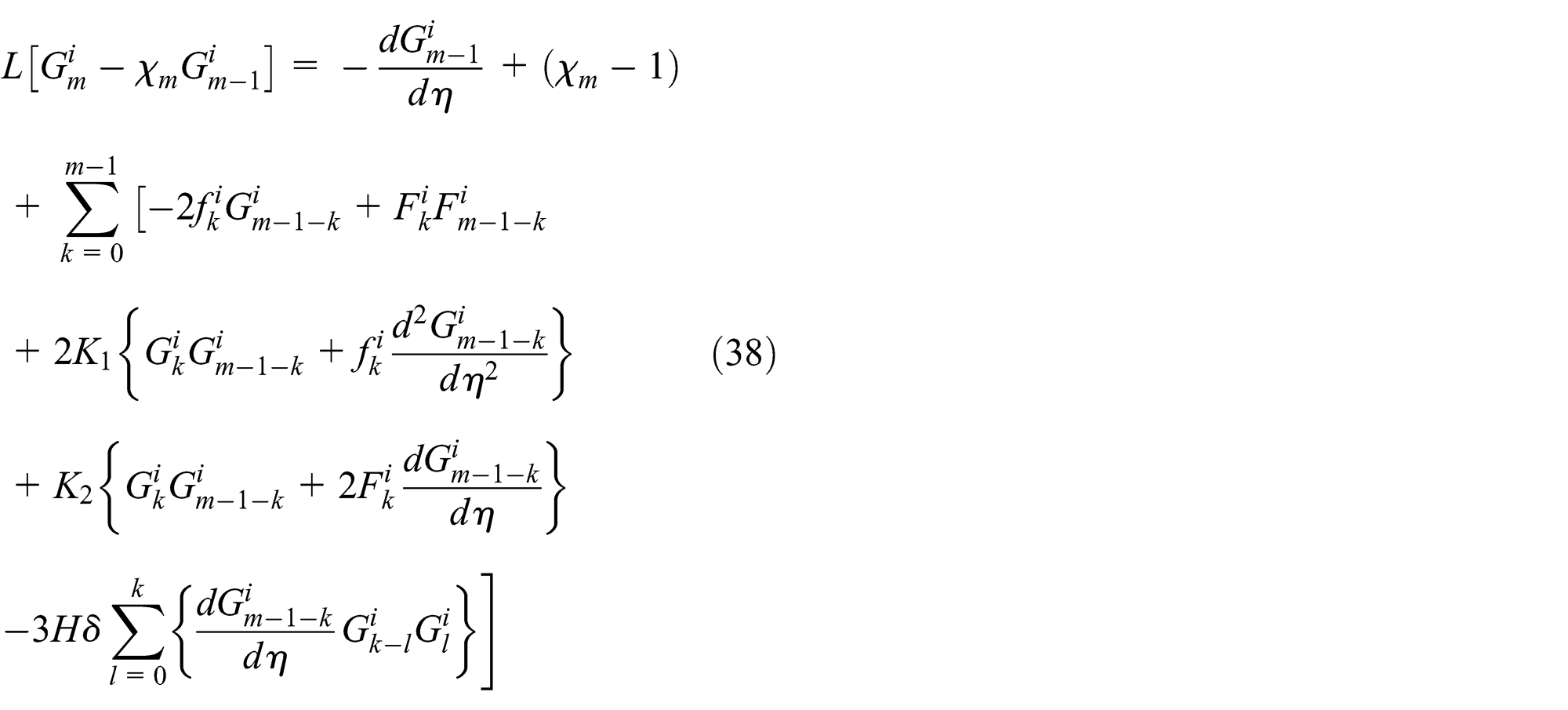
The mth-order deformation problems in each subinterval are obtained by differentiating zero-order deformation problems times with respect to and are given by
The final solutions in each subinterval are thus given by
The solutions of the problems (36)–(43) proceed in the following manner. First is assumed, and system of initial value problems is solved for . From this solution, an initial condition for the second subinterval is evaluated, and a solution is obtained for this interval. This procedure is repeated, and an analytic solution is evaluated in each subinterval. A zero-finding algorithm is chosen to evaluate the correct value of which leads to .
Results and discussion
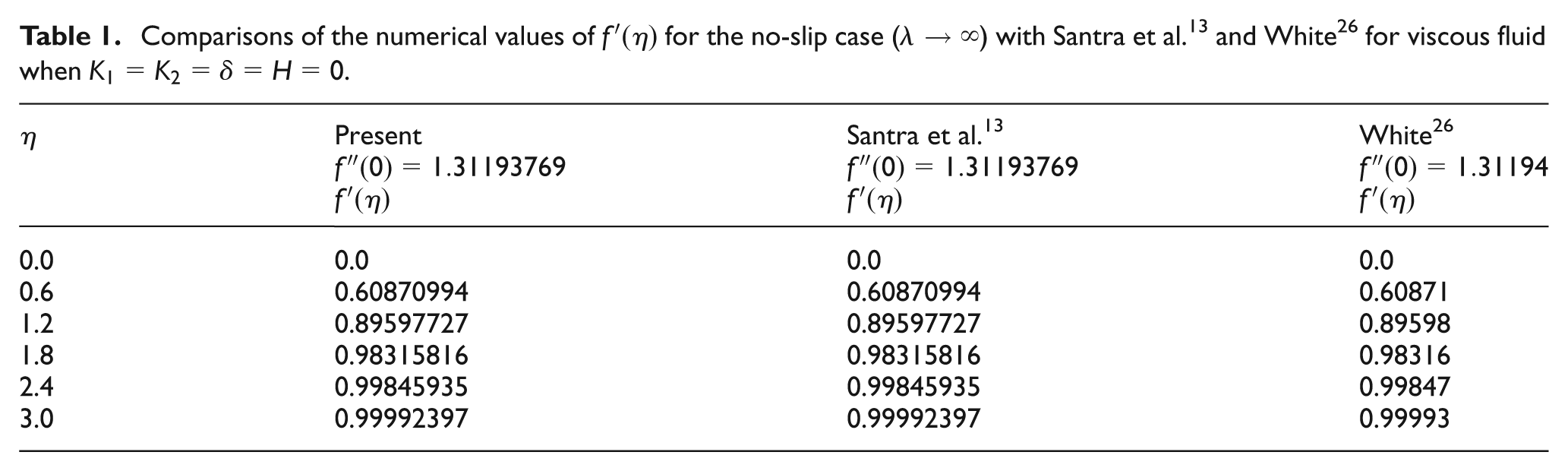
The procedure explained in previous section is implemented in computational software mathematica for finding the numerical values at the end points of the subintervals and analytic solutions inside each subinterval. For the validity of the developed algorithm, a comparison of the present solutions with the existing results in the case of no slip when for the viscous fluid is given in Table 1. It is evident from the numerical values that our results agree well with the existing results. In Table 2, the numerical values of are given for different values of the slip and third-grade fluid parameters. These numerical values provide the missing conditions for obtaining the velocity profiles. Table 2 depicts that more drag force is required when one moves from full-slip to no-slip regime. In the case of full slip, almost zero drag force is experienced by the fluid at the surface, and therefore, slip has suppressed the effects of free stream velocity. The numerical values also show that drag force at the surface is a decreasing function of the third-grade fluid parameter. The influence of the pertinent parameters on the velocity profile is plotted in Figures 1–4.
Comparisons of the numerical values of for the no-slip case () with Santra et al.13 and White26 for viscous fluid when .
Influence of slip parameter on the fluid velocity .
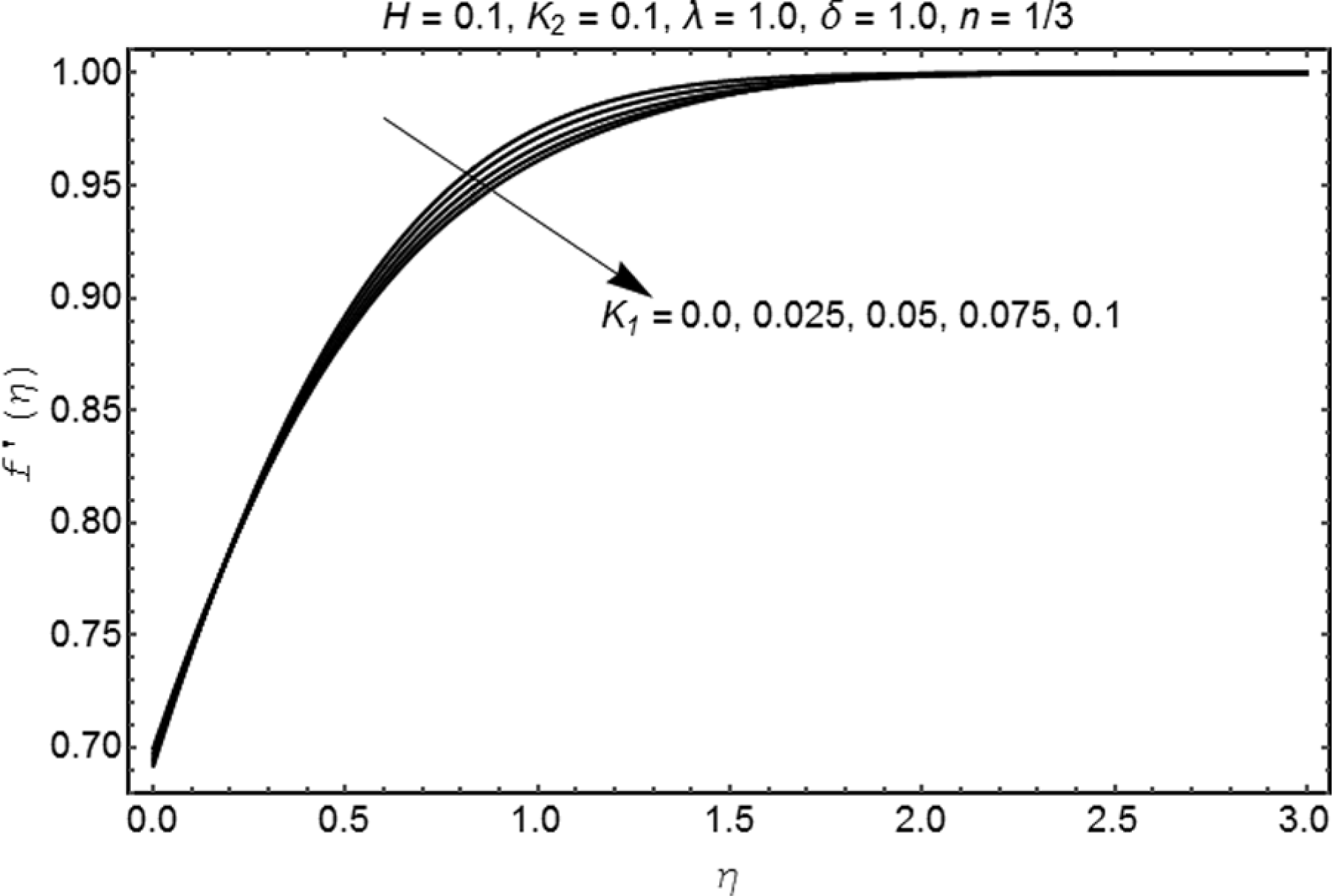
Influence of material parameter on the fluid velocity .
Influence of material parameter on the fluid velocity .
Influence of material parameter on the fluid velocity .
Figure 1 is plotted to investigate the effects of slip parameter on the velocity field . The full-slip case is represented through the profile when , and the no-slip case is represented when . It is clear from this figure that in the full-slip case, the slip on the surface dominates the effects of the free stream velocity, and almost no change is observed in the velocity throughout the semi-infinite domain. The momentum boundary layer thickness also decreases with increasing slip. The behavior of fluid parameter on the velocity profiles is presented in Figure 2. From this figure, we see that the velocity decreases by an increase in the parameter . Figure 3 is displayed to analyze the influence of third-grade fluid parameter on the velocity profile . This figure elucidate that the velocity increases, and the momentum boundary layer decreases by an increase in the third-grade fluid parameter. The effects of power law index on the velocity profile are shown in Figure 4. The results show that for a shear thinning lubricant, the boundary layer thickness is more when compared to the shear thickening fluid. Furthermore, the velocity increases by an increase in the power law index. However, the boundary layer thickness is a decreasing function of the power law index.
Concluding remarks
The stagnation-point flow of a third-grade fluid over a disk lubricated with a power law fluid is discussed in this article. The governing equations are transformed to a nonsimilar ordinary differential equation subject to nonlinear boundary conditions. A hybrid HAM is employed for obtaining the quantities of interest. The findings of this study are as follows:
Slip increases the velocity and suppresses the boundary layer thickness;
Slip effects dominate the effects of free stream velocity;
Fluid velocity is an increasing function of third-grade fluid parameter;
Fluid velocity is more for a shear thickening lubricant when compared with a shear thinning lubricant;
Comparison of the obtained results with the existing literature is in an excellent agreement.
Footnotes
Appendix 1
Academic Editor: Yunn-Lin Hwang
Declaration of conflicting interests
The author(s) declared no potential conflicts of interest with respect to the research, authorship, and/or publication of this article.
Funding
The author(s) disclosed receipt of the following financial support for the research, authorship, and/or publication of this article: This work was financially supported by Higher Education Commission (HEC) of Pakistan and AS-ICTP, Trieste, Italy.
References
1.
FetecauCMahmoodAJamilM. Exact solutions for the flow of a viscoelastic fluid induced by a circular cylinder subject to a time dependent shear stress. Commun Nonlinear Sci2010; 15: 3931–3938.
2.
SajidMHayatT. Non similar solution for the axisymmetric flow of a third grade fluid over a radially stretching sheet. Acta Mech2007; 189: 193–205.
3.
ArielPD. Axisymmetric flow of a second grade fluid past a stretching sheet. Int J Eng Sci2001; 39: 529–553.
4.
RajagopalKR. A note on unsteady unidirectional flows of a non-Newtonian fluid. Int J Nonlin Mech1982; 17: 369–373.
5.
HayatTWangYSiddiquiAM. Couette flow of a third-grade fluid with variable magnetic field. Math Mod Meth Appl S2004; 12: 1691–1706.
6.
ShafiqueANawazMHayatT. Magnetohydrodynamic axisymmetric flow of a third grade fluid between two porous disks. Braz J Chem Eng2013; 30: 599–609.
7.
AhmadI. On unsteady boundary layer flow of a second grade fluid over a stretching sheet. Add Theor Appl Mech2013; 6: 5–105.
8.
HayatTShafiqueAAlsaediA. MHD axisymmetric flow of a third grade fluid between stretching sheets with heat transfer. Comput Fluids2013; 86: 102–108.
9.
HomannF. Der Einfluss grosser Zahigkeit bei der Stromung um den Zylinder und um die Kugel. Z Angew Math Mech1936; 16: 153–164.
10.
YeckelAStrongLMiddlemanS. Viscous film flow in the stagnation region of the jet impinging on planar surface. AIChE J1994; 40: 1611–1617.
11.
BlythMGPozrikidisC. Stagnation-point flow against a liquid film on a plane wall. Acta Mech2005; 180: 203–219.
12.
AnderssonHIRousseletM. Slip flow over a lubricated rotating disk. Int J Heat Fluid Fl2006; 27: 329–335.
13.
SantraBDandapatBSAnderssonHI. Axisymmetric stagnation point flow over a lubricated surface. Acta Mech2007; 194: 1–7.
14.
SajidMMahmoodKAbbasZ. Axisymmetric stagnation-point flow with a general slip boundary condition over a lubricated surface. Chinese Phys Lett2012; 29: 1–4.
15.
SajidMJavedTAbbasZ. Stagnation point flow of a viscoelastic fluid over a lubricated surface. Int J Nonlin Sci Num2013; 14: 285–290.
16.
SajidMAhmadMAhmadI. Axisymmetric stagnation point flow of a second grade fluid over a lubricated surface. Eur Int J Sci Tech, in press.
17.
LiaoSJ. The proposed homotopy analysis technique for the solution of non-linear problems. PhD Thesis, Shanghai Jiao Tong University, Shanghai, China, 1992.
18.
LiaoSJ. Beyond perturbation: introduction to the homotopy analysis method. Boca Raton, FL: Chapman & Hall/CRC, 2003.
XuHPopI. Mixed convection flow of a nanofluid over a stretching surface with uniform free stream in the presence of both nanoparticles and gyrotactic microorganisms. Int J Heat Mass Tran2014; 75: 610–623.
21.
XuHPopI. Fully developed mixed convection flow in a horizontal channel filled by a nanofluid containing both nanoparticles and gyrotactic microorganisms. Eur J Mech B: Fluids2014; 46: 37–45.
22.
FanTXuH. New branches with algebraical behaviour for thermal boundary-layer flow over a permeable sheet. Commun Nonlinear Sci2013; 18: 1162–1174.
23.
XuHPopI. Fully developed mixed convection flow in a vertical channel filled with a nanofluid. Int Commun Heat Mass2012; 39: 1086–1092.
24.
NaTY. Computational methods in engineering boundary value problems. New York: Academic Press, 1979.