



Abstract
In modern science and technology, industrial applications that deal with the problem of continuously moving thin needle, surrounded with fluid in sectors like hot rolling, crystal growing, heat extrusion, glass fiber drawing, etc., are rapidly increasing. Such processes involve high temperatures which may affect the fluid properties that is, viscosity and thermal conductivity. So, it’s crucial to understand temperature-dependent fluid properties. Focused on these assumptions, the main objective of the current research work is to investigate how temperature-dependent fluid properties might improve the heat transfer efficiency and performance evolution of hybrid nanofluid in the presence of transverse magnetic field over a moving thin needle. Variable Prandtl number is also introduced to observe flow fluctuation, the effect of adding nanoparticles, and enhancement in heat transmission. The results are obtained for different needle thicknesses, temperature-dependent viscosity, temperature-dependent thermal conductivity, and heat generation. Moreover, Fe3O4/Graphene nanoparticles are considered to be dispersed in water. The governing partial differential equations of flow and heat transfer are transformed into a system of coupled nonlinear ordinary differential equations using analysis of similarity conversion. Subsequently, the numerical solution of the problem is attained by employing the MAPLE software. The fourth-fifth-order Runge-Kutta-Fehlberg (RFK45) approach is used by default in this MAPLE program to address the numerical problem of boundary value. The velocity and temperature field are pictured for different values of the parameters as well as physical quantities of interest such as skin friction coefficient and rate of heat transfer are visually depicted in graphs and tables. It is found that fluid motion and energy transport are highly regulated by the variation of magnetic field strength. As the volume fraction of Fe3O4 is increased, the heat generation, and thermal conductivity parameter vehemently enhance the temperature profile which leads to a rise in thermal boundary layer. A strong augmentation in the heat transfer rate has been found with the increment in the variable Prandtl number.
Keywords
Introduction
Hybrid nanofluids, the upgraded version of nanofluids 1 are more reliable fluids with exceptional heat transfer properties. The heat and mass transfer features have paramount significance in the field of modern technology. This new class of fluid promises to provide efficient thermal management as a coolant. As a result, the application of hybrid nanofluids has increased rapidly as a safe coolant for nuclear reactors 2 and electronic devices. Especially in the presence of the magnetic field,3–5 the applications of hybrid nanofluids are much promising for heat transfer enhancement. Nanoparticles with magnetic properties are significant in loudspeaker construction, medicine, separation of sink float, tumor analysis, 6 and cancer therapy. Hybrid nanofluids are created by suspending two nanoparticles with sizes ranging from 1 to 100 mm in a base fluid (water/engine oil/ethylene glycol). The mixture of metal oxide nanoparticles (ZnO, Fe3O2, CuO, Al2O3, etc.) to the traditional fluid like water/engine oil/ethylene glycol are proven to increase the thermal conductivity of hybrid nanofluids with improved thermal properties.7–11 In molten salt, 12 heat transfer capacity and enhancement in thermal conductivity are investigated for graphene nanoparticles.
Over the past few decades, the boundary layer flow over a thin needle has been vastly investigated because of the paramount applications in industrial areas such as power generation of geothermal devices, anemometer of hot wire, and delicate electronic devices. The revolutionary findings about thin needle state that the thickness of thin needle is smaller than the thickness of boundary layer. An initial study of thin needle examined for viscous fluid flow. 13 It is also found that the heat transfer characteristics affected by sloid volume fraction on thin needle. 14 Dual solutions were found in continuously moving thin needle. 15 Rosseland radiation 16 and entropy generation of moving thin needle on self-similar surface were examined in the presence of viscous dissipation. The needle sizes influenced 17 the thermal conductivity, velocity, and temperature profiles of the fluid. The forced convection on non-isothermal flow was also examined over thin needle to observe heat transition properties for power-law thermal fluctuation. 18 The investigation of temporal stability on moving thin needle 19 revealed that just one of the solutions remained stable and physically trustworthy over time. For moving thin needle, research carried out to check the flow behavior under joule heating, thermal radiation, and viscous dissipation. 20 With the prescribed heat flux of moving thin needle, investigation showed that thinner needle incremented the rate of heat transfer as well as skin friction coefficient of the surface than that of thicker needle. 21 To improve the thermophysical properties of base fluid a study was carried out for nanofluid, which revealed that suction parameter fastens the cooling process by escalating the skin coefficient. 22 Through FEM approach, 23 three-dimensional spinning flow of nanofluid observed a great impact on fluid velocity due to Lorentz force. An investigation took place to examine the thermal conductivity and viscosity of a nanofluid consisting of graphene nanoparticles on water over a magnetized stretching sheet. 24
Moving surfaces cause velocity and temperature variations to the heated or cooled surfaces, which are related to many industrial engines, space crafts, electronic devices, and many other practical applications. A heat source is something that can heat up a spacecraft. The findings of heat sources and their impact on heat transport are critical in terms of various physical problems. The heat line technique was applied to investigate the heat source effect of hybrid nanofluid. 25 Different conditions of heating and cooling were observed in a dual heat source system of ejector-compression. 26 A hydromagnetic flow over a semi-infinite flat plate, was investigated with the presence of heat generation/absorption. 27 As heat generation or absorption affects the fluid flow in many ways, researchers examined this effect on several surfaces by using different methods.28–30
Viscosity and thermal conductivity are the basic physical properties of any fluid, which fluctuate with temperature in hybrid nanofluid. For viscosity, internal friction generates heat, which raises the temperature and hence affects the stickiness of the fluid. As a result, fluid viscosity cannot be regarded as constant. So, it is necessary to assume that viscosity will vary with temperature. There are some investigations to understand the temperature dependent viscosity in different aspects and surfaces.31–35 For thin needle 36 findings suggested that the viscosity parameter undermines the fluid motion. The study revealed that the variable viscosity parameter enhances the temperature distribution of hybrid nanofluid. 37 With variations in temperature, the thermal conductivity of the fluid fluctuates linearly. Focusing on this particular point, temperature-dependent thermal conductivity was introduced. A study took place for maxwell fluid, 38 but for hybrid nanofluid 39 it was found that the fluid temperature of fluid increased with higher increments in thermal conductivity parameter. Some other investigations have been done on this topic.40–42
Our study is motivated by the above-mentioned literature where research works showed interest in scrutinizing the variable fluid properties without considering the variable Prandtl number. An unrealistic outcome may affect the flow behavior due to constant Prandtl number, as the Prandtl number fluctuates for variable viscosity and variable thermal conductivity. Thus, to our best knowledge, we witnessed that no other effort has been carried out to scrutinize the variable thermophysical properties of hybrid nanofluid over moving thin needle influenced by strong magnetic field with variable Prandtl number. The originality of this study is to explore the performance evolution of magnetic ferrite (Fe3O4) and graphene nanoparticles on the base fluid water. This problem has significant implications for enhancing the heat transmission capability through iron-based nanoparticles to the conventional base fluid. Moreover, heat transfer is a key element of widely used application sectors of thermal usage which are connected with the temperature-dependent fluid properties. The computational physical problem with a strong magnetic effect may play a vital role in heat transfer characteristics by escalating the internal heat generation. In geothermal power generation, hybrid nanofluid can be employed as a working fluid to cool down the exposed area regulated by high temperature (500°C–1000°C) due to energy extraction from the crust of earth. The evaluation of the proposed model can be used for textile production, hot rolling, paper manufacturing, wire drawing procedure, and plastic film drawing procedure. The impact of the variation of the physical parameters on the dimensionless velocity and temperature profile along with shear stress and the rate of heat transfer is studied. For validation purposes, we performed comparisons with previously published results and excellent agreement was found.
The differences in our analysis of the physical problem related to the physical problems already investigated are: (i) In this present study two-dimensional laminar flow of Fe3O4/Graphene-water hybrid nanofluid flow is considered with nanoparticle influenced by strong magnetic fluid while the published research 36 was limited to nanofluid. (ii) Both variable viscosity and variable thermal conductivity have been taken into account for hybrid nanofluid simultaneously while in the published researches37,38 these variations are investigated separately. (iii) Variable Prandtl number has been introduced for hybrid nanofluid. (iv) Different needle thicknesses are examined and discussed to understand the flow and thermal behavior throughout the whole study. We’ve attempted to provide the answer to the following questions,
How does needle thickness affect the flow behavior and heat transfer rate?
How does the magnetic field strength affect the fluid motion, shear stress, and heat transfer rate due to variable fluid properties?
How does adding nanoparticles improve the heat transmission?
What kind of impact variable Prandtl number have on thermal distribution?
Mathematical formulation
We consider the steady laminar fluid flow of an electrically conducting hybrid nanofluid past a continuously moving thin needle. The flow is subject to a magnetic field of flux B0 which is applied in the r direction. The flow configuration is illustrated at Figure 1. The needle velocity,


with associated boundary conditions,



Configuration of the flow field.
In this, T,


The thermophysical characteristics of nanoparticles and water are defined in Table 1. The volume fraction of Graphene and Fe2O3 are denoted with
Physiothermal properties of relevant nanoparticles. 7

The simplification of the basic governing equations is done by introducing the following stream function and similarity transformations,19,36


Here we consider the composite velocity,

The variable viscosity appearing at equation (2) is given by the relation,

So that the viscosity established a relation of inverse linear function of temperature T,

Where

Here,

The value of

The variation of the thermal conductivity κ in this study is expressed as a function of temperature, 39

Where, ε stands for thermal conductivity parameter.
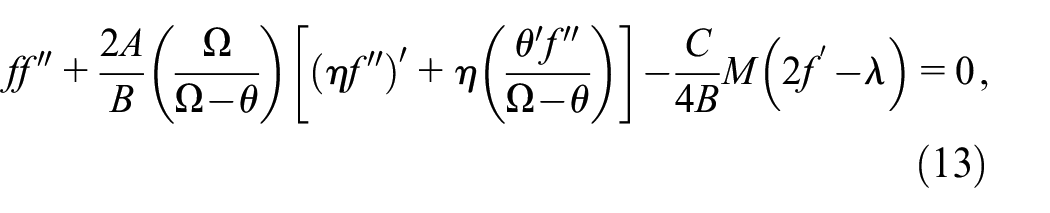
After introducing all the above relations to the system of equations (1)–(3) we have the following system of nonlinear ordinary differential equations:

Variable Prandtl number
Due to the fluctuation of viscosity over the boundary layer, the variable Prandtl Number is defined as following, 36

So, we get,

By employing (15), equation (14) became,


Subject to the corresponding boundary conditions,


Here, prime’ indicate the differentiation with respect to η, the symbolic meaning of

Though the parameters are identified as local similarity solutions, for a very small value of x, the transformed ODE equations are valid. However, if we want to consider the global similarity solutions then the magnetic field parameter, M and heat generation parameter, Q should be x independent. To achieve that,
we have,
so that we have,
Again,
Finally, we have,
The engineering interest parameters are the local coefficient of skin friction

Numerical method
The solution of the non-linear coupled system of equations (13) and (16) subject to the boundary conditions (17) is attained using MAPLE 13 worksheet software. To solve numerically the boundary value problem, this particular software uses fourth fifth order Runge-Kutta-Fehlberg (RFK45) method. For all parameter’s values, (101–100λ) is replaced the unity determined by the pertinent parameter in order to obtain the results. In the

The values used here guaranteed that all numerical solutions appropriately approached. Heat transfer related several papers have repeatedly proven the robustness and accuracy of this program.43–45 The classic Runge-Kutta (RK4) method is a widely used and effective numerical method for solving nonlinear ODEs. To achieve sufficient reasonable accuracy and overcome the challenges of solving the initial-value problems, this method is constructed with multiple small steps. Later on, another adaptive Runge-Kutta method has been proposed and named as fourth-fifth-order Runge-Kutta-Fehlberg (RKF45) method which employs embedded integration formulas. Tracking the truncation error in every step of integration, the RKF45 method is proven to reduce the error within the permitted range by adjusting the size of steps. An investigation has been carried out to look at the former’s computational advantage by comparing both classic RK4 and RKF45 methods 46 which found that the RKF45 method is more efficient to get the precise accuracy than that of the RK4 method. Through the strategy of adaptive time stepping, RKF method upgrades the code robustness, integrity of results, as well as overall efficiency.
Results and discussion
This current study interprets the attributes of distinguished physical parameters that is, viscosity parameter Ω, magnetic field parameter M, thermal conductivity parameter ε, heat generation parameter Q, Eckert number Ec, Prandtl number Pr, moving ratio parameter over the common profiles of fluid flow like velocity, temperature, skin friction coefficient, and heat transfer rate. For the computation, the volume fraction of Fe2O3 (
In Table 2, the numerical results of the present study are compared with former published data14,15,17,18 to validate the authenticity of the existing computation. The comparison of
Comparison of numerical results of

The flow behavior concerning the velocity and temperature profile of hybrid nanofluid for incremental values of magnetic field is depicted at Figures 2 and 3, respectively. By imposing higher values of M, the magnetic field increases. For these phenomena the Lorentz force induced, elevates the internal friction and hence the fluid motion is increased. So, the momentum boundary layer thickness is decreased. While the temperature distribution of the fluid shows lessen impact as stronger magnetic field is applied. The thinner the needle, the thicker the momentum boundary layer thickness is. However, reverse trend has been evident in thermal boundary layer. The hydromagnetic flow etiquette of hybrid nanofluid are represented with the nonzero (M
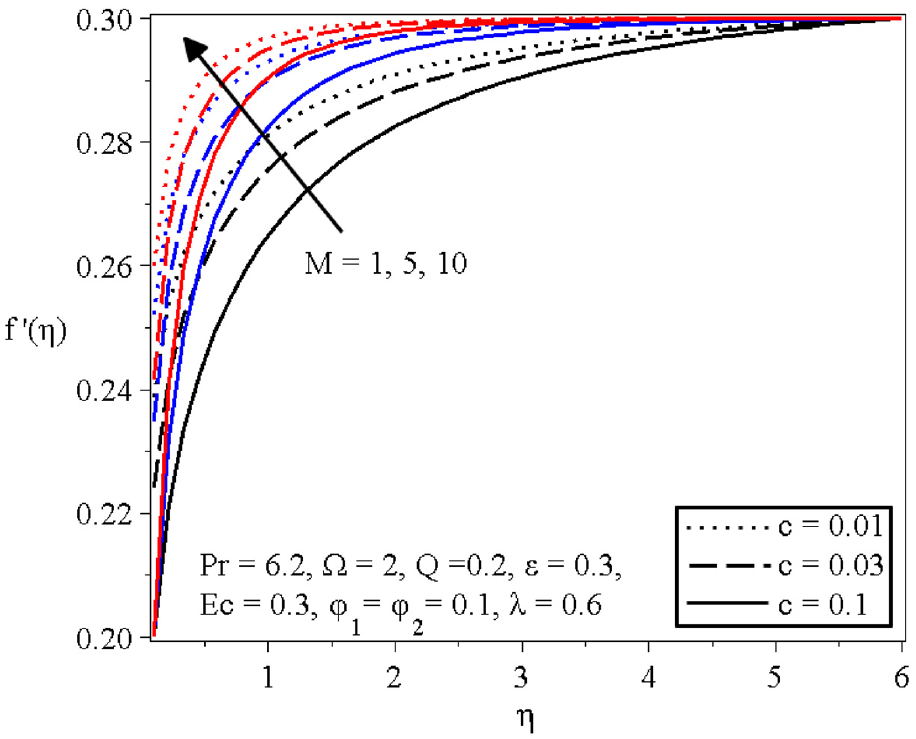
Variation of M with needle size on

Variation of M with needle size on
The performance evolution of escalated volume fraction of Fe2O3 (

Variation of

Variation of
The impact of advancing values of Eckert number, Ec is demonstrated at Figure 6 for the temperature distribution. It reveals that larger Eckert number enhance the temperature in fluid region where thermal energy is created by converting mechanical energy. The logic for this construction of upsurge is that the viscous force is produced by the heat dissipation which induces the friction between fluid particles. As a result, the drag force of particles facilitates the production of heat so internal heat generation developed which augments the temperature.

Variation of Ec with needle size on
Figures 7 and 8 demonstrate the upshot of variation of the diverse variable viscosity parameter on fluid velocity and temperature regimes. The fluid velocity upgrades with the enlarged magnitude of Ω. Whereas, a diminishing trend of fluid motion has been found with incrementing needle size. This significant formation indicates that the contact surface decreases between fluid particles and the moving thin needle. As a result, drag force recedes down, thereby velocity enhances. So, the momentum boundary layer decreased with the augment of needle thickness. Moreover, inertial force overpasses the viscous force due to belittle fluid velocity, which escalates the fluid motion. However, a reverse trend has been found in temperature distribution.
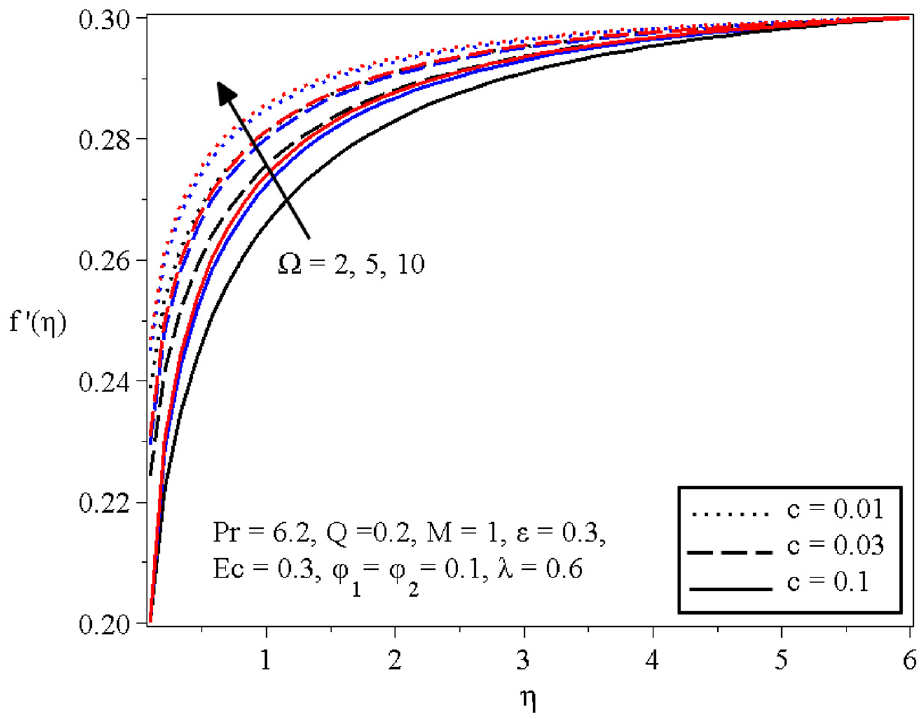
Variation of Ω with needle size on

Variation of Ω with needle size on
Figures 9 and 10 demonstrate the fluctuation of distinct values of heat generation parameter Q, on the velocity and temperature profile. Reduction of velocity

Variation of Q with needle size on

Variation of Q with needle size on
Figure 11 elucidates the influence of dissimilar thermal conductivity parameter ε, on the dimensionless temperature field. Temperature of the fluid is getting accelerated by larger input in thermal conductivity parameter. According to physical theory, the augmentation in fluid temperature fully depends on the higher thermal conductivity which is one of the fundamental physical properties of the fluid. So, it is clarified that, for constant thermal conductivity (ε = 0), the fluid temperature is minimum throughout the boundary layer while incremented thermal conductivity (ε > 0) results in a significant rise of the temperature. Moreover, the thermal boundary layer thickness is enhanced with thicker (c = 0.1) needle.

Variation of ε with needle size on
The velocity and temperature curve for the fluctuation of the Prandtl number, Pr, are respectively shown in Figures 12 and 13. While fluid motion is uplifted, fluid tempeture decreases as Pr (Pr

Variation of Pr with needle size on

Variation of Pr with needle size on
Figure 14 demonstrates the reaction of wall shear stress
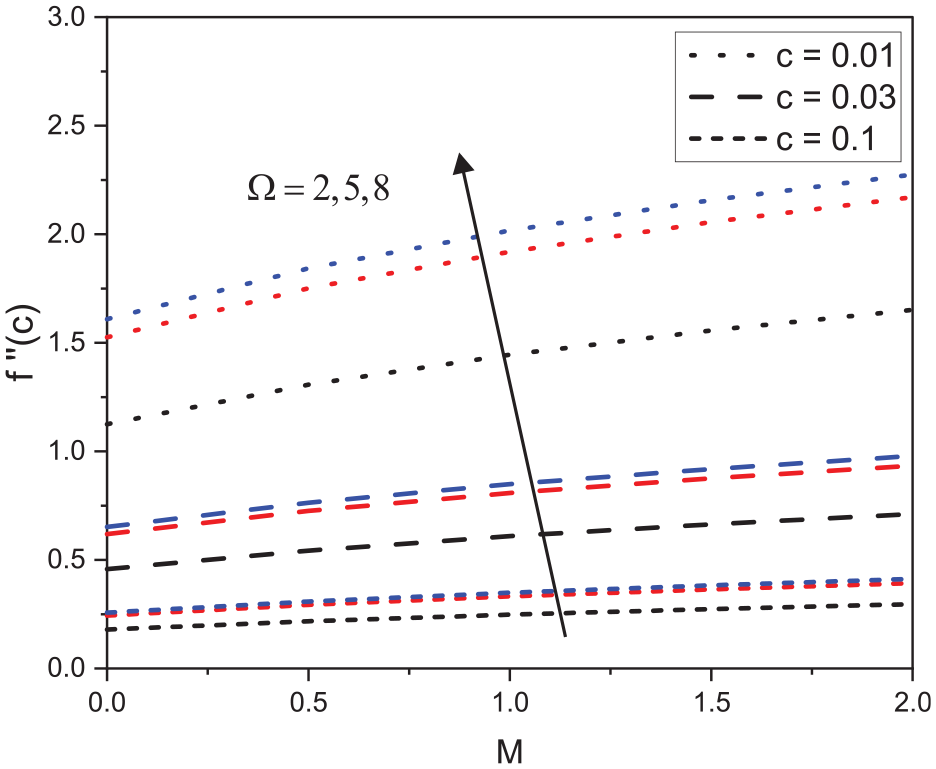
Impact of Ω and M on

Impact of ε and M on

Impact of Pr and M on -θ′(c).
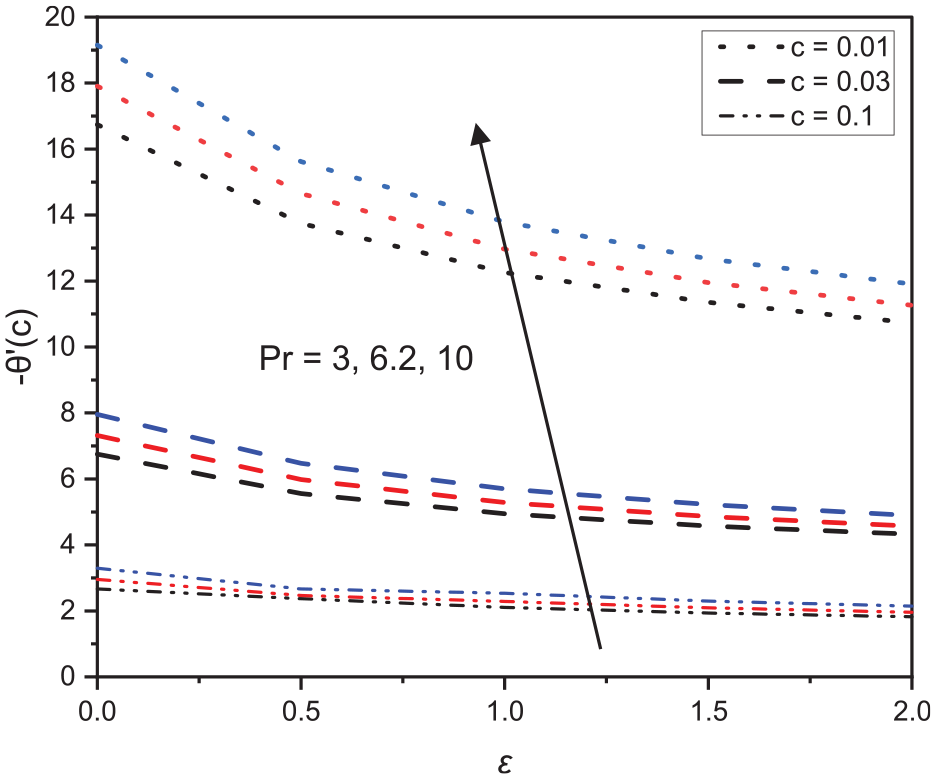
Impact of Pr and ε on
In this following section, the numerical computation of skin friction coefficient
Numerical values of shear stress and heat transfer rate.

It is concluded that thinner needle size results to higher heat transfer rate of needle surface. The boundary layer is proportional to several parameters like magnetic parameter, viscosity parameter, and Prandtl number and inversely proportional to heat generation parameter and volume fraction of Fe3O4. With a strong magnetic effect, incremented viscosity parameter and Prandtl number enhance shear stress and heat transfer rate of surface, respectively. Increasing values of thermal conductivity parameter and Prandtl number augment the rate of heat transfer to the moving needle surface.
Conclusions
The incompressible laminar steady hybrid nano-coating fluid (Fe3O4/Graphene-water) flow through moving thin needle in the presence of magnetic field has been studied numerically using the MAPLE software. The findings reveal a significant impact on the temperature adopting variable viscosity and thermal conductivity for different Prandtl numbers which have significant implications in industrial sectors of manufacturing. The flow energy and mass transport are systematically explored for various values of the parameters along with the skin friction coefficient and heat transfer rate for different needle sizes. The final outcomes are given below:
For thinner needle, the momentum boundary layer thickness is higher but opposite trend is found for the temperature boundary layer. In comparison with thicker needle, thermal boundary layer shows reduction for thin needle. This indicates that thin needle (c = 0.01) increases the velocity but decreases the fluid temperature.
With the greater values in magnetic field strength M, momentum boundary layer increases as
Augment in volume fraction of Fe2O3 (
Larger input in temperature dependent fluid viscosity parameter Ω, results to subdue the temperature of fluid but greater performance in fluid motion has been observed.
Thermal distribution shows a notable acceleration which is influenced by both temperature dependent thermal conductivity parameter ε, and Eckert number Ec, which represents enlarged thermal boundary layer.
Rise in the Prandtl number Pr, elevate the velocity and reduce the temperature.
This present work can be extended for three-dimensional flow of different fluids like Casson fluid, power-law fluid, and non-newtonian viscous fluid. Other surfaces like cylindrical, rotated cone, vertical plate, etc could be taken under consideration. We investigate the flow subject to variable thermophysical aspects to achieve thermal efficiency. Though we consider low viscous fluid in our study, it has been found that highly viscous fluid elevates skin friction as well as wall heat transfer rate. However, the peak enhancement in wall heat transfer rate was computed when the fluid absorbs no heat.
Limitations of the defined problems are:
The hybrid nanofluid (Fe3O4/Graphene-water) is flowing over a moving thin needle along the x-axis.
The heat convections are taken at the boundary of the needle surface for the purpose of temperature regulation.
Temperature of the fluid is controlled by considering the effect like heat generation where the exponential temperature dependent on heat source/sink.
The hybrid nanofluid is scrutinized to be stable without any accumulations phenomenon of selected magnetic ferrite (Fe3O4) and graphene nanoparticles.
Footnotes
Appendix
Handling Editor: Chenhui Liang
Declaration of conflicting interests
The author(s) declared no potential conflicts of interest with respect to the research, authorship, and/or publication of this article.
Funding
The author(s) disclosed receipt of the following financial support for the research, authorship, and/or publication of this article: We would like to show our gratitude and acknowledged to Bose Centre for Advance study and Research in Natural Science at University of Dhaka for contributing this research work.
