



Abstract
Marangoni convection is very useful in coating flow technology, surfactant replacement therapy for neonatal children, microfluidics, drying of semi-conductor vapors in microelectronics, foams, and film drainage in emulsions. The behavior of gyrotactic microorganisms and chemical reaction on the Marangoni convected Carreau-Yasuda liquid flowing over Riga plate with thermophoretic particle deposition is reported in this research. The Riga plate is self-possessed of magnets and electrodes. The fluid conducted electricity and the vertical Lorentz force has been exponentially increased. Thermal and mass species phenomena are investigated within the context of Dufour and Soret impacts. The PDEs are transformed into ODEs by the implication of suitable transformations. The resulting system of equations is solved by using homotopy analysis method (HAM). Using tables and graphs, the effects of dimensionless parameters on flow fields are described. The wall drag coefficient and pertinent flow rates are organized and stated. The results revealed that the temperature, concentration, and microorganisms profiles decay but the velocity profile augmented as the Marangoni ratio parameter increases.
Keywords
Introduction
The survey related to non-Newtonian fluids has been a brilliant source of attention for several scholars because of its huge applications in applied sciences, biomechanics, and enterprise. These applications consisted of clay coating, colloidal suspension solutions, sheet steel, twine drawing, food, polymer extrusion from dyes, paper production, rayon, digital chip cooling, many industrial or functional flows where the non-Newtonian viscosity effects are of high quality. Carreau and Yasuda initiated the generalized Carreau-Yasuda (CY) fluid in 1979. The CY model is one amongst the non-Newtonian fluid models that outperforms the so-called power-law fluid model. The CY model has five parameters. These parameters describe the liquid rheology when compared to two different parameters in Power-law. This model has high level accuracy in predicting the shear thinning and thickening effects. The CY fluid is the prevalent generalized Carreau fluid model having applications in food processing, chemical preparations, experimental chemical units, bio-engineering operations, drilling, metallurgy, and other industrial and non-industrial fields. Mathematically, Alloui and Vasseur 1 investigated the effect of heat carriage in CY fluid. Peralta et al. 2 investigated the analytical impact of CY fluid caused by a vertical plate. Salahuddin et al. 3 studied the compressed CY flow with a magnetic field. Many researchers have focused their efforts in recent decades on studying flow fields of various configurations. The Riga plate is one of new geometries for weakly conducting fluids (Gailitis and Lielausis 4 ). This unique plate imposed the electric and magnetic regions which uniformly initiate the Lorentz force toward the wall to keep flowing poorly conducting liquids. It can be used to reduce the subaquatic pressure drag, radiation, and skin friction by avoiding boundary layer separation. The related theory has strong characterization and is executed in various fields of science such as geophysics, engineering MHD generators, procedures industrial, and astrophysics. Khatun et al. 5 demonstrated the radiated liquid flow induced by the Riga plate under magnetic and electric fields impacts. Goud et al. 6 addressed the chemically reactive aspects on magnetized micropolar liquid flowing over magnetized Riga plate.
Carlo Marangoni, an Italian physicist presented the idea of surface tension gradients-driven fluid. Marangoni boundary layers are not different from the dissipative layers. Most dissipative layers occurred parallel to the liquid-gas or liquid-liquid interfaces. Various studies attributed that the Marangoni impact is the ratio of the thermal (EMT) to solute (EMS) Marangoni effects. Both effects occurred due to different imbalances within the geometry and heat transformation. EMT phenomenal results from a thermal imbalance in the interfacial region while EMS is the imbalance of interfacial absorption. The thermal imbalance comes due to the temperature gradient and heat source. The imbalance factors for the interfacial absorption are chemical reaction and concentration gradient in the fluid flow. A liquid with a greater surface tension appeals to the liquid in large quantity from a low-surface-tension geometry, results in fluid flow away from the low-surface-tension regions and it starts decreasing in a certain section of the profile. Temperature and concentration gradients are thus essential elements in such convections under the Marangoni effect. Due to its many applications in the fields like nanotechnology, atomic reactors, silicon wafers, semiconductor processing, soap films, materials sciences, thin film stretching, crystal growth, melting, and welding processes, the study of heat and mass convection in this phenomenon has attracted a lot of attention. Numerous researchers have identified the characteristics of the Marangoni effect in liquid flow with various physical phenomena.7–9 To preserve the soap steady and dry the silicon wafers, convection is required. The Marangoni effect is frequently used in fine art techniques, such as ground pigment. In this process, the colorant or dye is placed to the exterior of the necessary medium, such as water or another thickness fluid. After Marangoni, a large number of researchers contributed to this topic. Lin et al. 10 investigated the heat transfer of pseudo-plastic nanofluids and MHD Marangoni boundary layer flow over a porous medium with a modified model. Aly and Ebaid 11 achieved the exact solutions of flow problem of nanofluids in the presence of Marangoni convection which resulted an improvement in nano-liquid convection analysis. Some researchers significantly contributed to this research by analyzing the different Marangoni convection behaviors.12–14
Thermophoresis is the supplement of the radiometric forces caused by a temperature gradient. These forces mainly create an imbalance in small micron-sized particles and resultantly migrate from a hot surface to a cold surface. This phenomenon has numerous practical applications including remover of microscopic specks from gas streams and determining exhaust non-liquid or low-density liquid particle from various-advance combustion devices. In producing optical fiber used in communication devices, the thermophoresis principle helped to formulate graded-index germanium and silicon dioxide. It can be used to clean the microscopic particles out of gas rivulets, map the paths taken by drain gas elements from ignition systems, and study the deposition of particulate material on turbine blades. It plays a key role in the mass transfer process of many systems which used tiny micron-sized particles and significant temperature variations. Thermophoresis is also an important research topic in semiconductor technology, particularly in manufacturing high-quality controlled wafers and magnetohydrodynamic (MHD) energy. One of the most common causes of nuclear reactor accidents is the radioactive nano-sized particles thermophoretic deposition. The thermophoretic force and velocity contain a parallel relationship to the temperature gradient. They are affected by a variety of parameters such as the thermal conductivity of aerosol particles and the carrier gas. The effects of thermophoresis particle deposition on mixed convection from vertical surfaces embedded in the saturated porous medium were explored by Duwairi and Damesh. 15 Postelnicu 16 investigated thermophoresis particle deposition in porous media under natural convection over an inclined surface. Because of its practical importance, Goren 17 investigated thermophoresis in streamlining flow over a non-vertical flat plate. Dufour and Soret effects along thermophoretic micro-particles are used in many heat and mass transfer experiments. This type of effect occurs when there is a density difference in the flow system. The mixing of gases with extremely light and medium molecular weights and the separation of isotopes are the applications of the Soret effect. Soret and Dufour effects give second-order phenomena that play a vital role in petrology, hydrology, geosciences and chemical engineering among other domains. Hayatet al. 18 explored the Soret and Dufour effects in 3D flow with chemical reaction and convective state. Ramzan et al. 19 explored the Soret and Dufour impacts of a viscoelastic nanofluid’s 3D boundary layer flow. Sravanthi 20 studied MHD slip flow with Soret-Dufour phenomena in an exponentially stretched inclined sheet. In the presence of MHD and consistent suction/injection, Zaidi and Mohyud-Din 21 investigated the Soret and Dufour effects of wall jet flow.
Bioconvection is a natural phenomenon occurring when microorganisms move around independently. These self-propelled motile bacteria migrate in a certain direction (usually toward the surface’s top) and accumulate there. The base liquid’s upper surface gets denser due to this movement than the remaining half. Different flow patterns are introduced into the system due to the microorganisms’ direction-oriented motions. The system is unstable due to the dense stratification. The up swimming of motile microorganisms, on the other hand, contributes to convectional stability, resulting in bioconvection in the system. Wager 22 was the first to notice the bioconvection phenomenon. The pattern, free movement of microorganisms in bioconvection, was discovered by Platt. 23 Pedley et al. 24 presented a continuum model of bioconvection. They looked at how bacteria swims in the water. Several researchers25–27 investigated bioconvection in the presence of gyrotactic microorganisms. The chemical reaction rate in a first-order reaction is proportional to the concentration. Chemical interaction between a foreign mass and the fluid occurs in many chemical engineering procedures. These procedures are used in various industrial applications, including the production of polymers, ceramics, and glass. As a result, the research of heat and mass transport with chemical reaction effects is given top priority in the chemical and hydrometallurgical sectors. Obulesu et al. 28 inspected the effects of radiation source/sink and chemical reaction on MHD radiative liquid transient through a vertical porous plate.
This work aims to study the effects of Marangoni convection and gyrotactic microorganisms on Carreau-Yasuda fluid flow over a Riga plate with chemical reaction. By using HAM, the governing equations have been solved after applying suitable transformations and appropriate boundary conditions. The convergent series solutions are presented graphically. In current study, our main focus is to address the preceding questions:
■ What are the impacts of gyrotactic microorganisms on velocity, concentration, temperature, and microorganism profiles?
■ In the presence of Carreau-Yasuda fluid (Non-Newtonian fluid), what effects do the Weissenberg number and Carreau yasuda fluid parameter have on the velocity profile?
■ In the presence of Marangoni ratio parameter, what effects are seen on the concentration, velocity, microorganism, and temperature profiles?
■ What are the effects of Soret and Dufour on the flow of Carreau-Yasuda fluid over Riga plate?
■ How the flow is influenced in the presence of viscous dissipation and chemical reaction?
■ How the concentration profile behaves in the presence of thermophoretic parameter?
Problem formulation
For Carreau-Yasuda fluid, the extra stress can be decomposed in the form 29 :

where

where

Put

For
We consider a steady, Marangoni convective flow with gyrotactic microorganisms in Carreau-Yasuda fluid (it belongs to the non-Newtonian fluid family) over a Riga surface, which is subjected to surface tension due to concentration and temperature gradients in the presence of viscous dissipation and thermophoretic particles deposition. The flow is two-dimensional, with

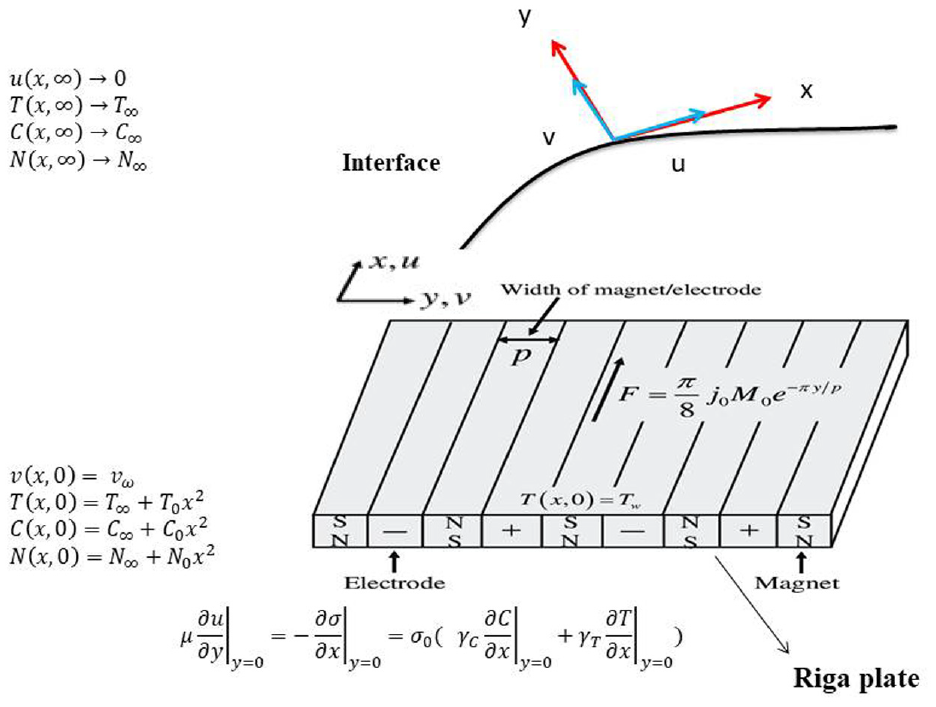
Geometrical representation of the flow.
Where

Here,
Therefore, the complete model of the flow is given as29,30


The apposite boundary conditions for this model are as presented below 30 :
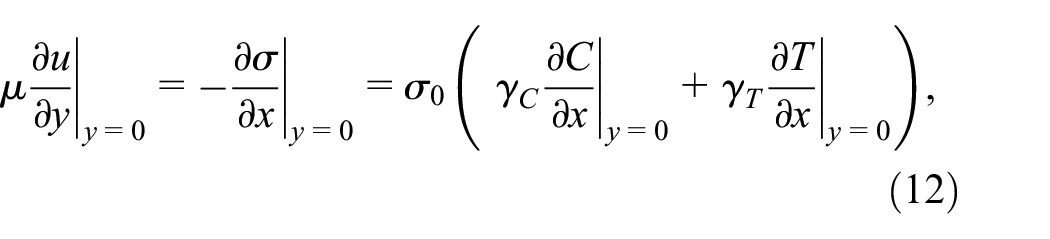


The boundary condition given equation (12) is known as Marangoni convection. We have used this condition because of its numerous applications in the fields of engineering and technology including coating flow technology, surfactant replacement therapy for neonatal children, microfluidics, drying of semi-conductor vapors in microelectronics, foams, and film drainage in emulsions. The surface tension
By introducing the stream function given below, continuity is satisfied

By introducing the following similarity transformations, equations (8) to (14) can be turned into ODEs from the PDEs:



By using above equations, the governing system of equations are transformed as follows:




The transformed boundary conditions are



Where,
Physical quantities
For non-Newtonian fluid (Carreau-Yasuda model), the Nusselt number


where


Convergence analysis
Liao
31
was the first to introduce the notion of HAM (homotopy analysis method) for computing the highly nonlinear system of differential equations. This scheme is a semi-analytic technique for generating a convergent solutions of nonlinear systems which are developed from topology. Auxiliary parameters are
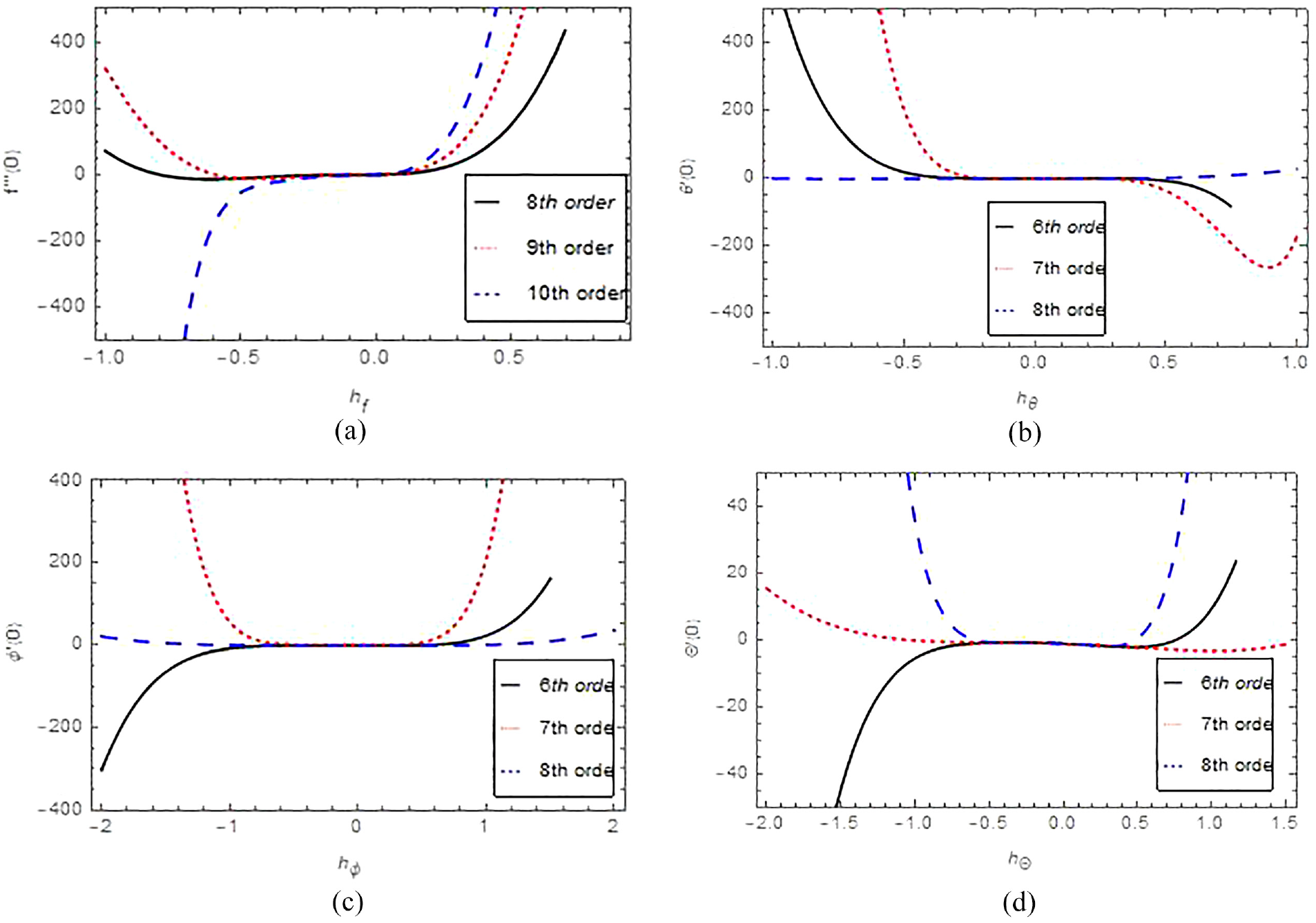
(a–d)
Results and discussion
The major goal of this part is to investigate the effects of physical parameters on velocity, temperature, concentration, and microorganisms profiles. To obtain the appropriate solutions for velocity, temperature, concentration, and microorganisms, we employed the homotopy analysis method. The best convergent approach is found to be HAM. Figures have been plotted and their preliminary performances have been examined.
Assessment of velocity distribution
This section briefs the graphical outcomes of velocity profile for different involved parameters. The Weissenberg number behavior

(a and b) Effect of
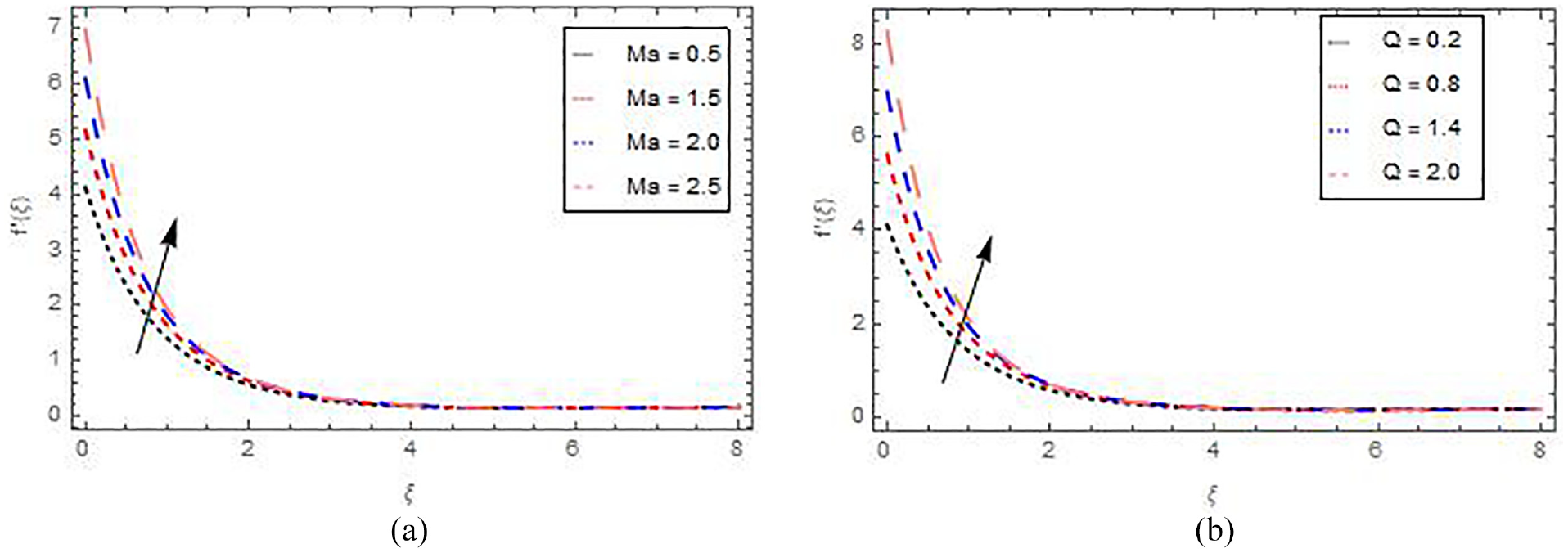
(a and b) Effect of
Assessment of temperature distribution
This section summarizes the graphical results of the temperature profile for the various parameters involved. The impact of

(a and b) Effect of
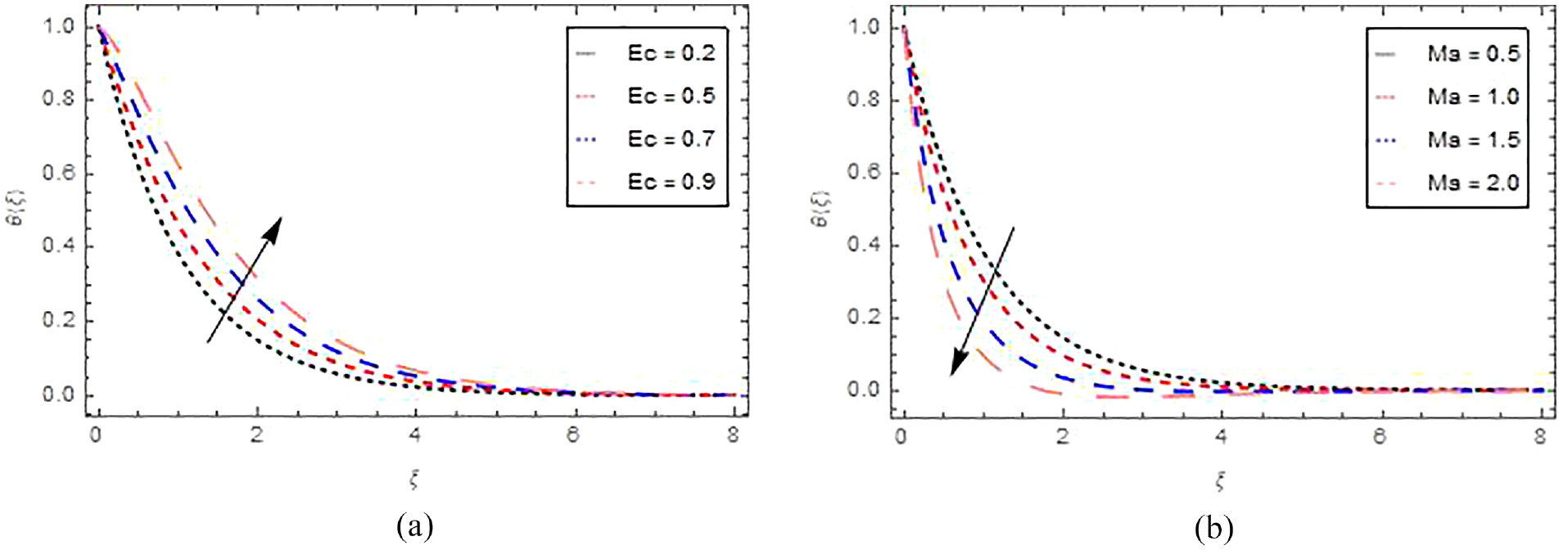
(a and b) Effect of

(a and b) Effect of
Assessment of concentration distribution
The effects of numerous embedding parameters on concentration profile have been shown in Figures 8 to 10. Figure 8(a) illustrates the effect of

(a and b) Effect of

(a and b) Effect of

(a and b) Effect of
Assessment of microorganisms distribution
This part briefs the graphical outcomes of microorganisms profile for different involved parameters. The change in

(a and b) Effect of

(a and b) Effect of
Tables Discussion
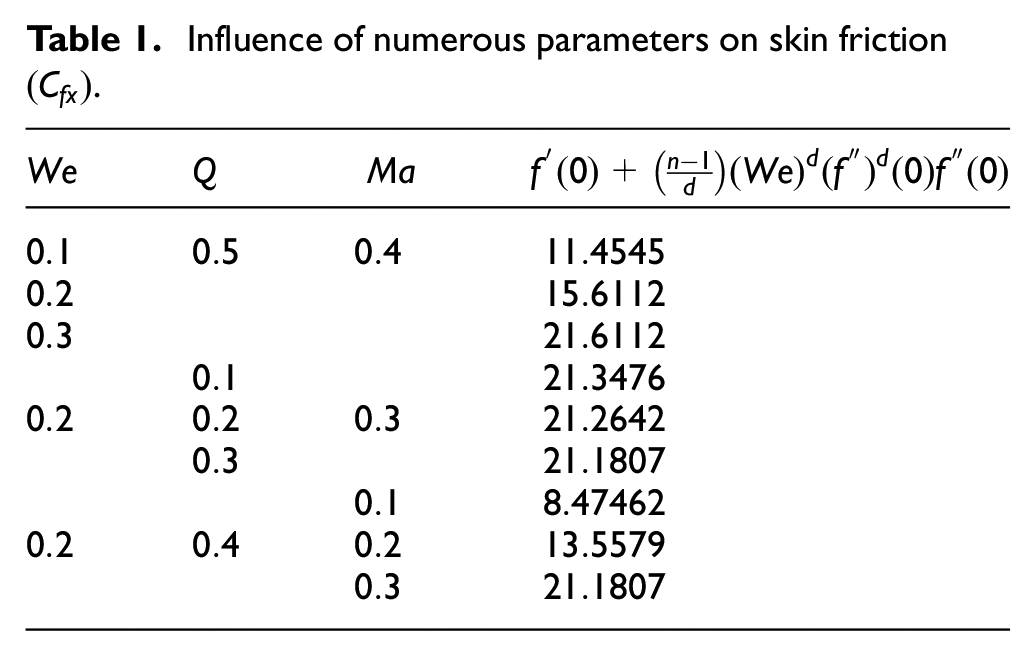
Table 1 shows the result of the
Influence of numerous parameters on skin friction
Influence of numerous parameters on Nusselt number (

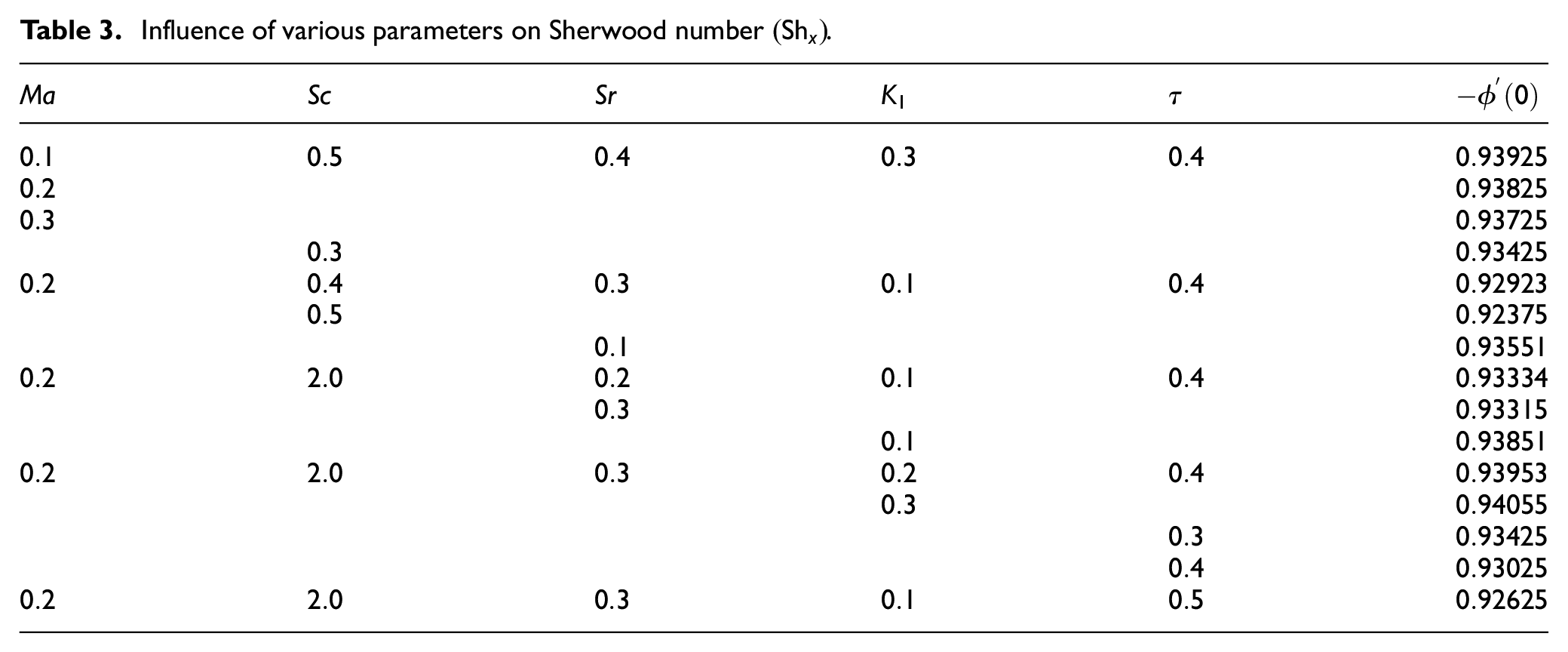
Influence of various parameters on Sherwood number
Effect of various parameters on local density of motile microorganisms

Conclusions
We have investigated the behavior of a surface tension-driven thermophoretic particle deposition on Carreau-Yasuda fluid flow under the influence of Lorentz force induced by Riga surface. The effects of gyrotactic microorganisms over a Riga plate under chemical reactive are analyzed. By using HAM, the governing equations have been solved after applying the suitable transformations and appropriate boundary conditions. The convergence of series solutions are graphically presented and examined. The following are some key results.
➢ The temperature profile declines as the value of Marangoni ratio parameter increases. The Marangoni number is physically connected to the surface tension. Surface tension in the surface film of a liquid restricted the surface area which caused by liquid to the particles bulk attraction in the surface layer. The temperature declines as surface tension increases while converse behavior occurs for velocity profile.
➢ Weissenberg number is the ratio of relaxation time to the process time. An increment in Weissenberg number improved the relaxation time which corresponds to decay in velocity profile and increase in temperature profile.
➢ Velocity profile enhances against higher Hartman number and inverse behavior is observed for Carreau-Yasuda fluid parameter.
➢ The heat flux modeled due to concentration gradient is termed as Dufour effect. Temperature profile is stronger in the presence of Dufour effect and show negative behavior in the absence of Dufour effect. The boundary layer flow pretends to be more energetic as the Dufour number increases, and the thermal boundary layer thickness increases significantly.
➢ Chemical reactive parameter, Marangoni ratio parameter, thermophoretic parameter, and suction parameter decline the concentration profile.
➢ Microorganisms’ profile decreases with the rise in Peclet number, Marangoni ratio parameter, and biconvection Schmidt number. Increasing values of microorganism concentration difference parameter increase the microorganisms profile.
Footnotes
Appendix
Handling Editor: Chenhui Liang
Declaration of conflicting interests
The author(s) declared no potential conflicts of interest with respect to the research, authorship, and/or publication of this article.
Funding
The author(s) received no financial support for the research, authorship, and/or publication of this article.
