




Abstract
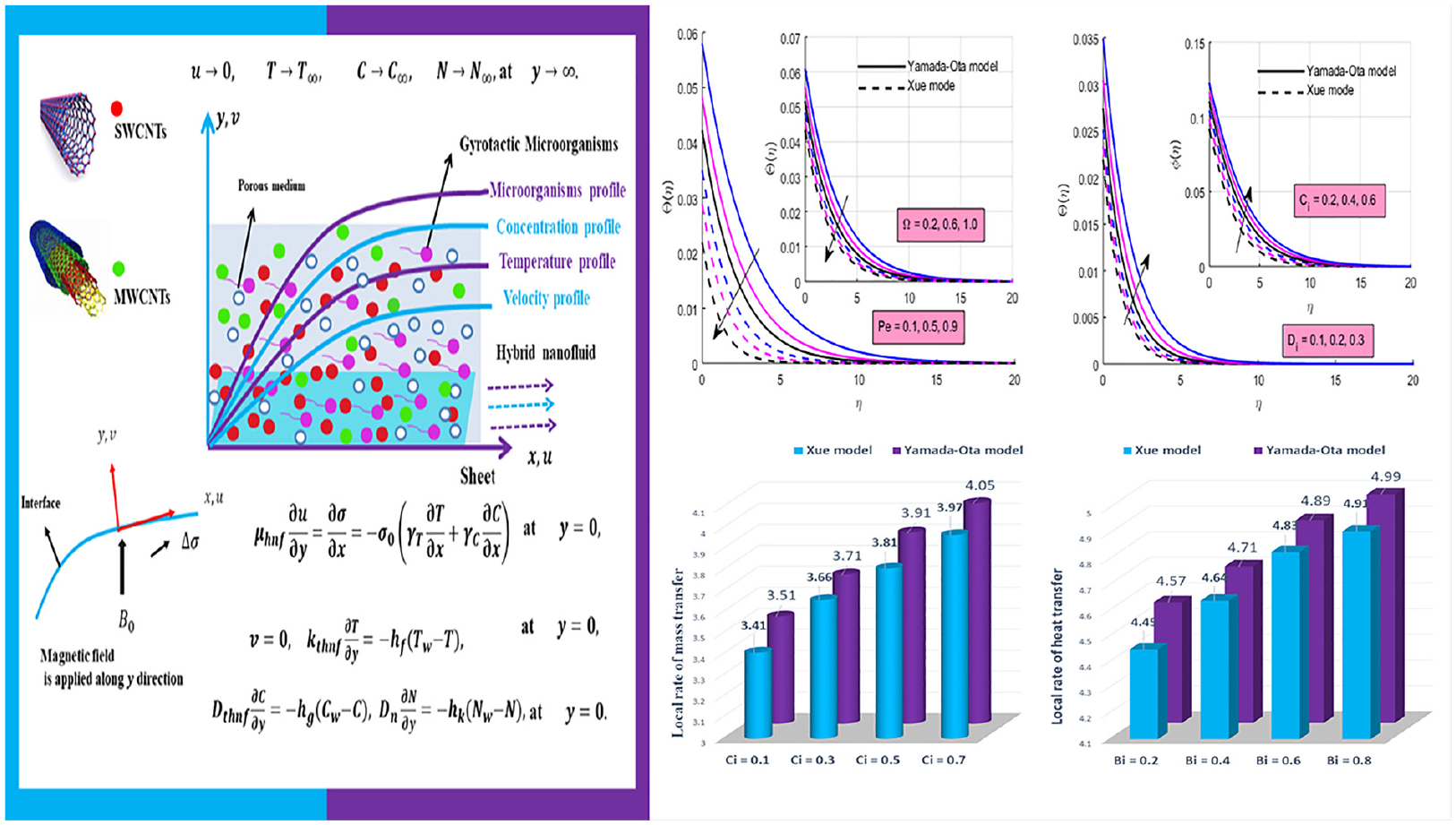
The present study inspects the importance of activation energy and surface tension gradient on the Darcy-Forchheimer flow of hybrid nanofluid with gyrotactic microorganisms. The current study offers insights that can be used to improve medication delivery techniques, materials engineering, environmental monitoring, nanofluid-based system design optimization, renewable energy technologies, microfluidics for diagnostics, and electronics cooling solutions. Additionally, the advancement of scientific knowledge provided by this study will stimulate interdisciplinary research in the future, leading to creativity and advancement. A hybrid nanofluid that is based on fluid blood and contains MWCNTs and SWCNTs nanoparticles is utilized. The suggested flow equations are converted into ODEs by using the appropriate similarity variables. To assess the reduced equations, the RKF-45th technique is applied. The influences of important parameters on temperature, microbiological, solutal, and flow profiles are determined using graphs. With a boost in the thermal and concentration, Biot number, the temperature, concentration field, rate of heat and mass transmission distribution increase.
Keywords
Get full access to this article
View all access options for this article.