




Abstract
Marangoni convection is discovered by varying gradients of surface tension. Marangoni induced flow plays a vital role in melting of coating flow technology, drying wafers, crystals, soap film stabilization, wielding and microfluidics, in which the flow creates unwanted impacts under gravity on micro-level in the same manner as buoyancy-induced natural convection. The Magneto-Marangoni convective flow of Walter-B fluid over a vertical permeable surface is addressed in the current research. The Dufour–Soret effects are taken into account along with activation energy and radiation. Flow through a porous media is modeled via Darcy and Forchheimer theory. The surface tension gradient becomes stronger by increasing the Marangoni convection parameter, which results in stronger induced flows and more efficient heat and mass movement inside the liquid. The result is a more uniform distribution of these qualities throughout the liquid as the temperature and concentration profiles drop. With higher viscoelastic parameter levels, the fluid accelerates and the velocity profile increases due to decreased viscosity. Due to an augmentation in the Dufour and Soret number, the thermal and concentration of the Walter-B fluid boost up respectively.
Keywords
Introduction
A fluid that does no obey Newton’s law of viscosity is known as non-Newtonian fluid. Scientists are interested in the innovative and distinct dynamics of non-Newtonian fluids due to their significant implications in food sectors, processing industries, medicinal science and several technological applications. Non-Newtonian fluids are used in oil refineries, paints, blood, chemical reactions, aerodynamic extrusion, food processing, biological and polymer liquids etc. Researchers have presented many articles to analyze the features of non-Newtonian materials due to their complicated and multidisciplinary nature. Walter’s liquid B is famous model of viscoelastic models proposed by Walter. 1 This viscoelastic model is capable of accurately simulating the intricate flow behavior of numerous industrial liquids. It works with elastic properties and behavior of extensional polymers, even though it creates extremely nonlinear equations. Khan et al. 2 explored the heat transfer and mixed convection nanomaterial slip flow of Walter-B fluid containing microorganisms. For higher levels of the viscoelastic parameter, the fluid’s motion accelerates. Since the viscosity of the fluid has an inverse relationship with the viscoelastic parameter, an upsurge in velocity profile results from a decrease in viscosity. Many studies have used the conventional derivatives method to illustrate the nature of this model.3–5 Chemical and biotechnology engineers can develop an array of polymeric liquids using Walter-B fluid. The Walters-B fluid flow is governed by constitutive equations.



where


where
The investigation of surface tension gradients in advance fluid was discovered by an Itlian scientist “Carlo Marangoni.” Marangoni convection is a type of fluid flow where liquid moves from areas of low surface tension to areas of high surface tension as a result of temperature-induced fluctuations in surface tension. The mass and heat inclination to travel in the regions of the surface having pressure inside the fluid is known as Marangoni convection or surface convention. Among of the well-known uses of Marangoni convection include crystal growth, soap film stabilization, drying wafers, drying silicon wafers and wielding. The artwork along with advanced engineering technology pulled the Marangoni Convection into the wide range of its significant applications welding, and the melting of electrical beams. There are two main classifications for Marangoni Convection. One of these effects is the solute Marangoni effect (EMS), and the other is the thermal Marangoni effect (EMT). EMT is introduced by the thermal discrepancy of the interfacial phase caused by the heat source and temperature differential. On the other hand, if a variation in the behavior of the concentration gradient and chemical reaction is noticed, the interfacial absorption discrepancy introduces EMS. The fluid dynamics and transport processes are significantly shaped by the Walter-B fluid, which is dependent on fluctuations in surface tension, the heat flux caused by the solutal gradient, and the mass flux caused by the temperature gradient. The computational study of the Marangoni convection flow of a hybrid nanofluid over an infinite disc with thermophoresis were explored by Abbas et al. 6 By using a greater Marangoni convection parameter, this study claims that temperature and layer thickness are decreasing. However, the velocity profile shows a completely opposite behavior. Sadiq and Hayat 7 studied the thermos-solutal Marangoni convection flow of Casson nanofluid over the disc with irreversibility and Joule heating. This study demonstrates that a higher Marangoni convection increases velocity. Physically, reduced viscosity is associated with a larger Marangoni convection parameter. The fluid motion tends to be speed up by a less viscous force. Khan et al. 8 deliberate the Marangoni convection forces in second-grade magnetohydrodynamic fluid flow. Qayyum 9 demonstrated the Marangoni convection in a hybrid nanoliquid. The impacts of mass and heat transfer on Marangoni convective nanofluid flow were studied by Raju et al. 10
The Dufour effect is the term given to the heat transfer induced by a concentration gradient as compared to the Soret effect, which is the term given to the mass transfer caused by temperature gradient. For isotope separation and in a combination of gases with light and medium molecular mass, the Soret effect is used. Understanding the Soret–Dufour effect is crucial for optimizing procedures and obtaining insight into intricate systems involving thermal and mass dispersion. It has several applications in a variety of scientific, engineering, and industrial fields. The impact of Dufour–Soret on mass and heat transmission was examined by Postelnicu. 11 In peristaltic motion of fluid in a tapered asymmetric channel in the presence of Hall current, Khan et al. 12 investigated the Soret–Dufour characteristics. Temperature distribution was demonstrated to be an increasingly characteristic of both Dufour–Soret effects. The increase in temperature distribution is, however, stronger close to the surface. As a result,13–15 show an exploration of this topic from several physical aspects.
The least amount of energy needed for a chemical reaction to take place is called activation energy. Activation energy is required for many chemical processes. The stimulation of molecules or atoms is possible only when the least energy amount is used. In some circumstances, the required amount for activation of energy is zero. Only in mass and heat transfers does a binary chemical reaction take place. Food processing, electronic device manufacture, geothermal reservoirs, chemical engineering, oil emulsion are some applications of activation energy in scientific, industrial, and engineering fields. Many scientists were compelled to investigate the implications of chemical reactions and activation energy. Especially in the area of heat and mass transmission where nanofluid flows occurs. The activated energy of Casson nanofluid is reported by Ijaz et al. 16 With an enrichment in the activation energy parameter, the modified Arrhenius function becomes smaller. This formally supports the chemical reaction that generates upswings in concentration distribution. Change in internal energy and thermophysical features of Casson fluid via energy activation is analyzed by Salahuddin et al. 17
A permeable medium is a continuous solid and restrained medium with a large number of empty holes or pores. The porous medium is defined as the aperture to medium volume ratio. Porous mediums can be both natural and artificial. It is utilized by the specifications. Human skin, mud, packed lathes with stones, cloth sponge, limestone, pumice, catalyst pellets, foamed plastics, compact sand, sandstone and dolomite are some natural permeable mediums. Numerous real-world applications are useful in many different industries. Darcy’s law defines an absolute relation between the flow of liquid via a permeable medium with the gravity of earth and the pressure gradient. Darcy, a well-known mathematician and an engineer depicted that this law is accurate for low porosity media, Newtonian fluids and small values of Reynolds numbers. However, when medium holes are diverted to bigger ones, the porosity of the medium increases and the viscosity increases by Darcy’s resistance. Forchheimer 18 revised the Darcy’s law to compute the inertial forces by adding velocity terms of square form in momentum equation. Vafai and Tien 19 used porous medium to analyze the flow of fluids in homogenous form. Pal and Mondal 20 utilized the Darcy-Forchheimer theory to explore hydro-magnetic convective diffusion with changing viscosity in porous media. Ganesh et al. 21 explored the hydro-magnetic nanomaterial flowing over porous sheet by the implication of this law. In the Darcy-Forchheimer flow model, Hayat et al. 22 explore the Cattaneo-Christov heat flux and variable thermal conductivity. Maxwell nanofluid flow in the Darcy-Forchheime model with convective conditions was examined by Muhammad et al. 23 Ferro-thermohaline convection caused by Soret in a permeable medium were explored by Vaidyanathan et al. 24 The Rayleigh-Bénard convection in porous layer through vertical flow was examined by Shivakumara and Nanjundappa. 25
The novelty of current investigation is to explore the significance of Marangoni convection in the flow of magnetized Walter’s B fluid over a vertical wall in the presence of Soret–Dufour effects. The effects of Darcy-Forchheimer medium and activation energy have also been deliberated. In view of the above literature, these effects are of vital importance, have plenty of applications and have not been studied yet. With the help of selected transformations, the governing PDEs of our current work are converted into ODEs. HAM is utilized to solve the generated ODEs. The purposes of the analysis are as follows:
The purpose of this work is to examine how Marangoni convection impacts the temperature, velocity, Nusselt number, skin friction, Sherwood number, and concentration profiles of Walter-B fluid.
Investigate how the activation energy parameter affects the profile of the concentration.
To examine that how MHD affects the Darcy-Forchheimer flow.
To investigate the Soret–Dufour effects on the concentration and temperature boundary layer flow of Walter-B fluid.
Problem formulation
We investigate the flow of Walter-B fluid in two-dimensional Marangoni convective boundary layer across a vertical surface in the existence of activation energy and nonlinear heat radiation. Due to concentration and temperature gradient, surface tension is formed in the Walter-B fluid. The flow system is subjected to an ongoing magnetic field
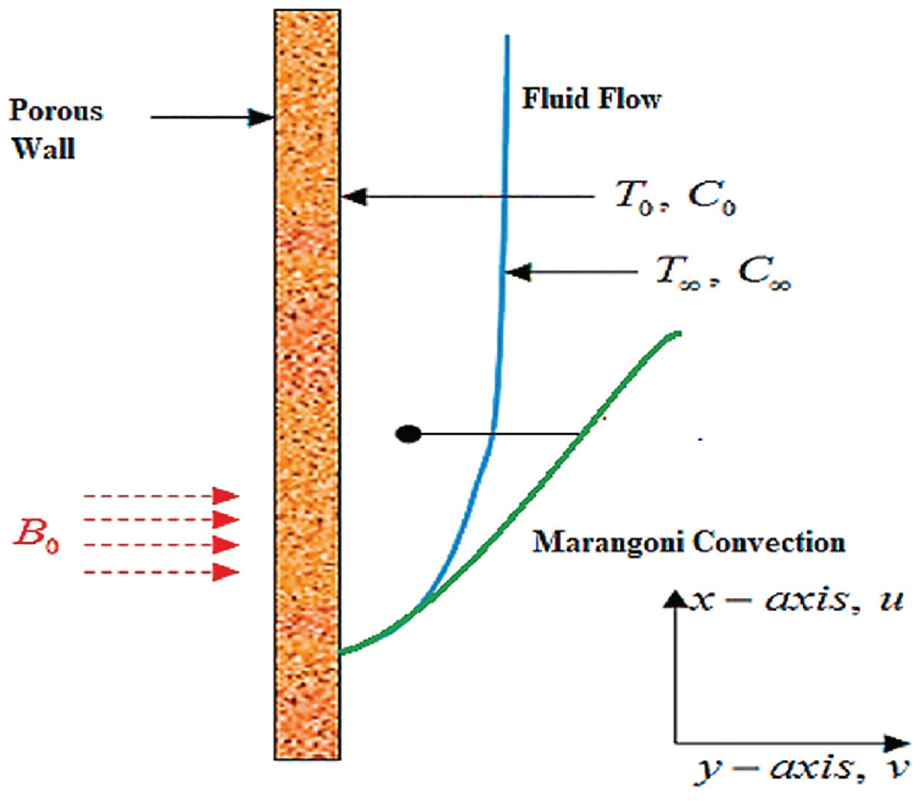
Geometrical representation of the flow.
For current flow analysis, the governing equations of energy, continuity and momentum (Khan et al. 2 and Shah et al. 13 ) re described in equation (1) to (4) while equation (5) describes the boundary conditions


The boundary conditions are given as (Khan et al. 2 ):
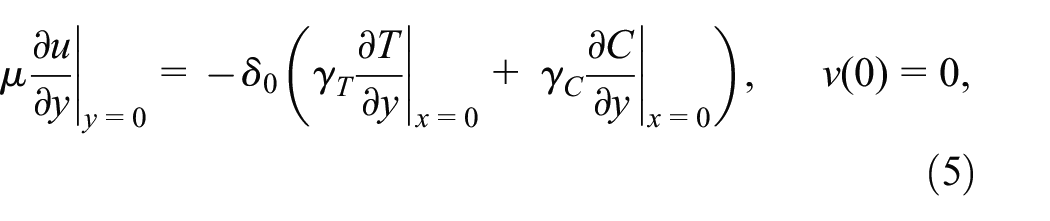


In Marangoni convection, the surface tension expands due of the presence of concentration and temperature gradients. A fluid with a higher surface tension draws more liquid from a low-surface-tension region. The surface tension is supposed to fluctuate linearly with concentration and thermal boundaries in (Abbas et al. 6 ).

where are the coefficients of surface tension for temperature and concentration

As follows is the thermal radiative heat flux

In the above expression,
The following similarity transformations are selected (Gul et al. 26 ):


With the transformation mentioned above, the governing equations’ non-dimensional form is as follows:



These are the modified boundary conditions.


Here radiation parameter, Schmidt number, inverse Darcy number, magnetic parameter, Soret parameter, Prandtl number, chemical reaction parameter, local inertia parameter, Dufour parameter, activation energy parameter, Marangoni convection parameter, viscoelastic parameter and Marangoni number are given respectively.
The local skin friction, mass and heat flux are expressed mathematically as follows:


Convergence exploration
Homotopy is a better technique among various methods. HAM is useful effectively for a nonlinear problem that arises from the physical situation in lots of various fields of engineering and science. It is essential for the implication of homotopy scheme to find convergent series solutions. The auxiliary parameters

Results and discussion
The significances of Marangoni convection and activation energy on Darcy-Forchheimer flow of magnetized Walter’s B fluid in the presence of Soret–Dufour effects are explored in this study. Our major attention is to evaluate the role of dimensionless quantities such as

(a) Impact of
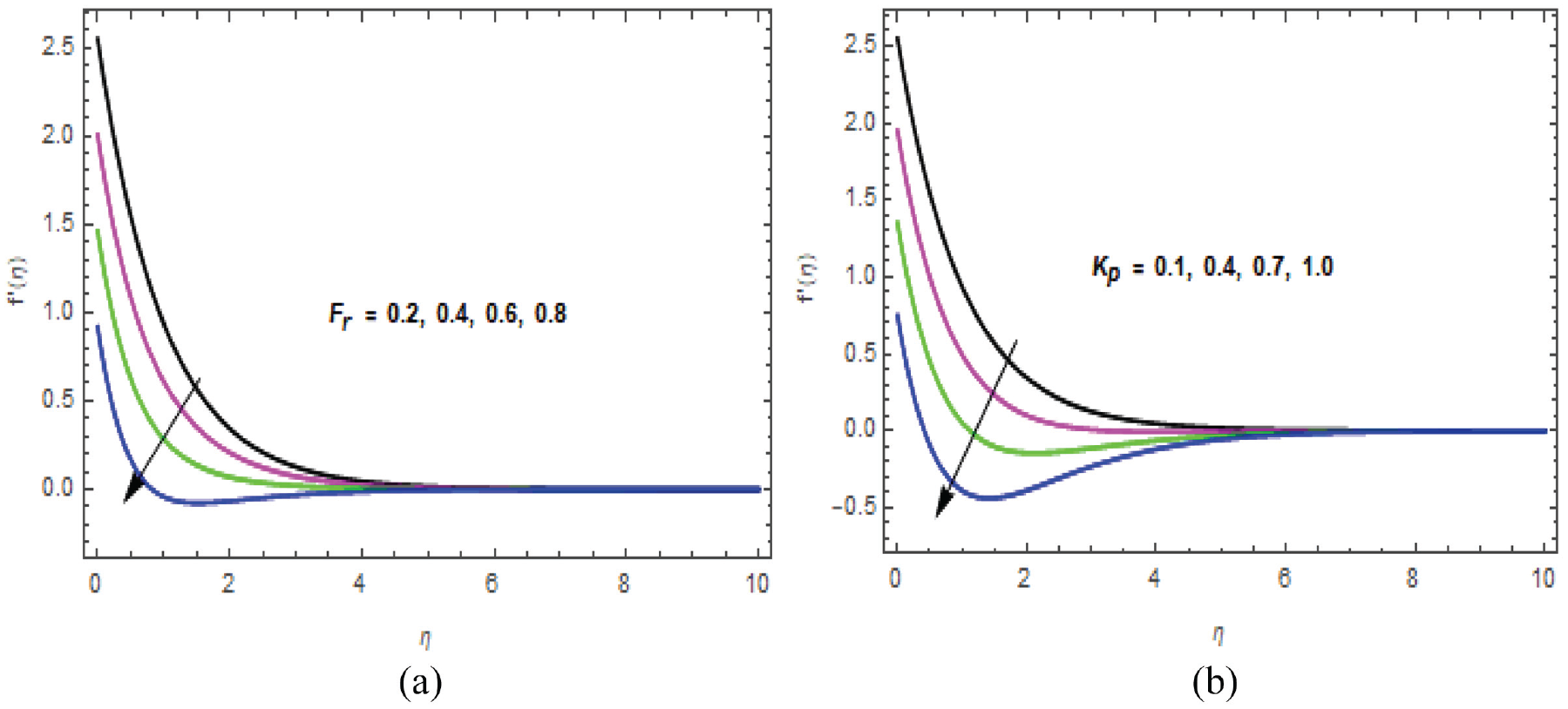
(a) Impact of

(a) Outcome of
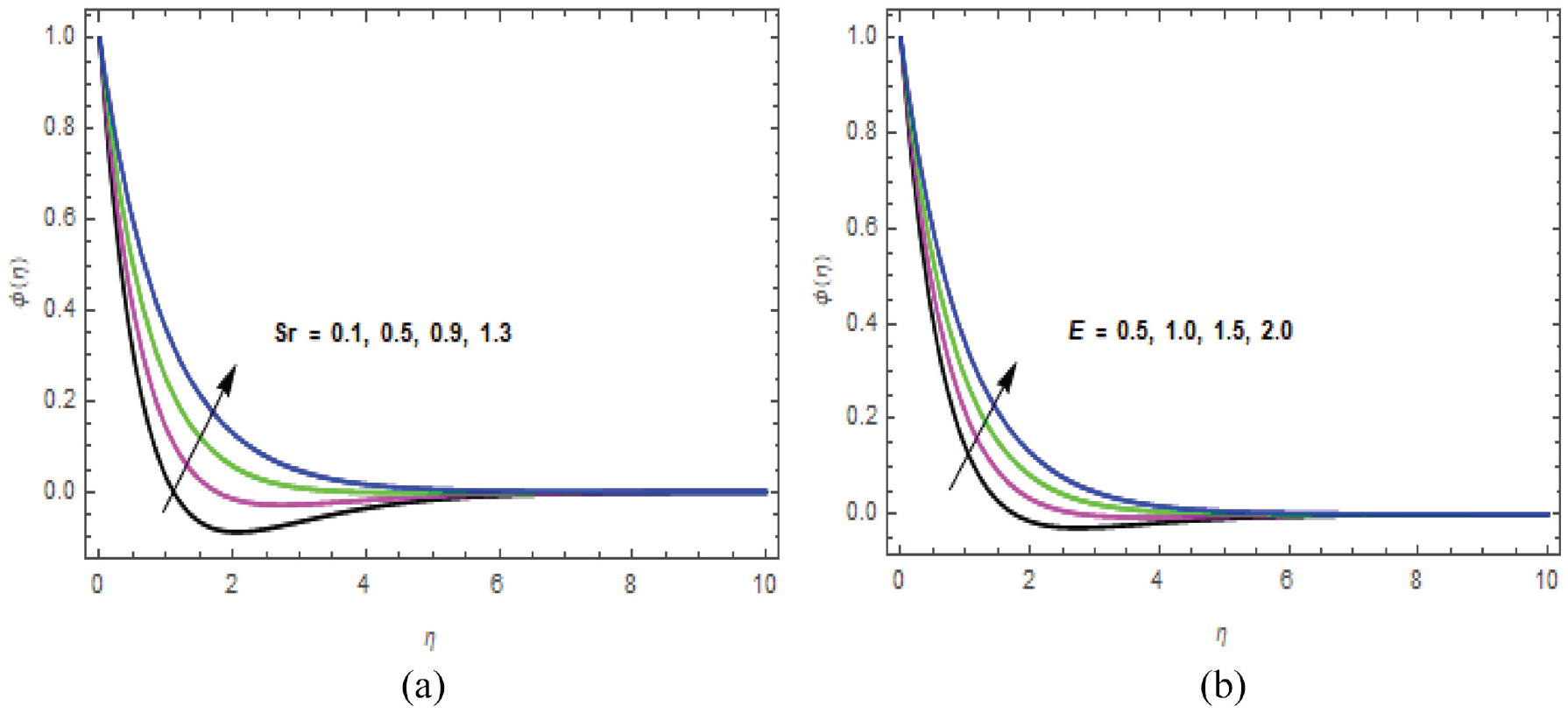
(a) Outcome of
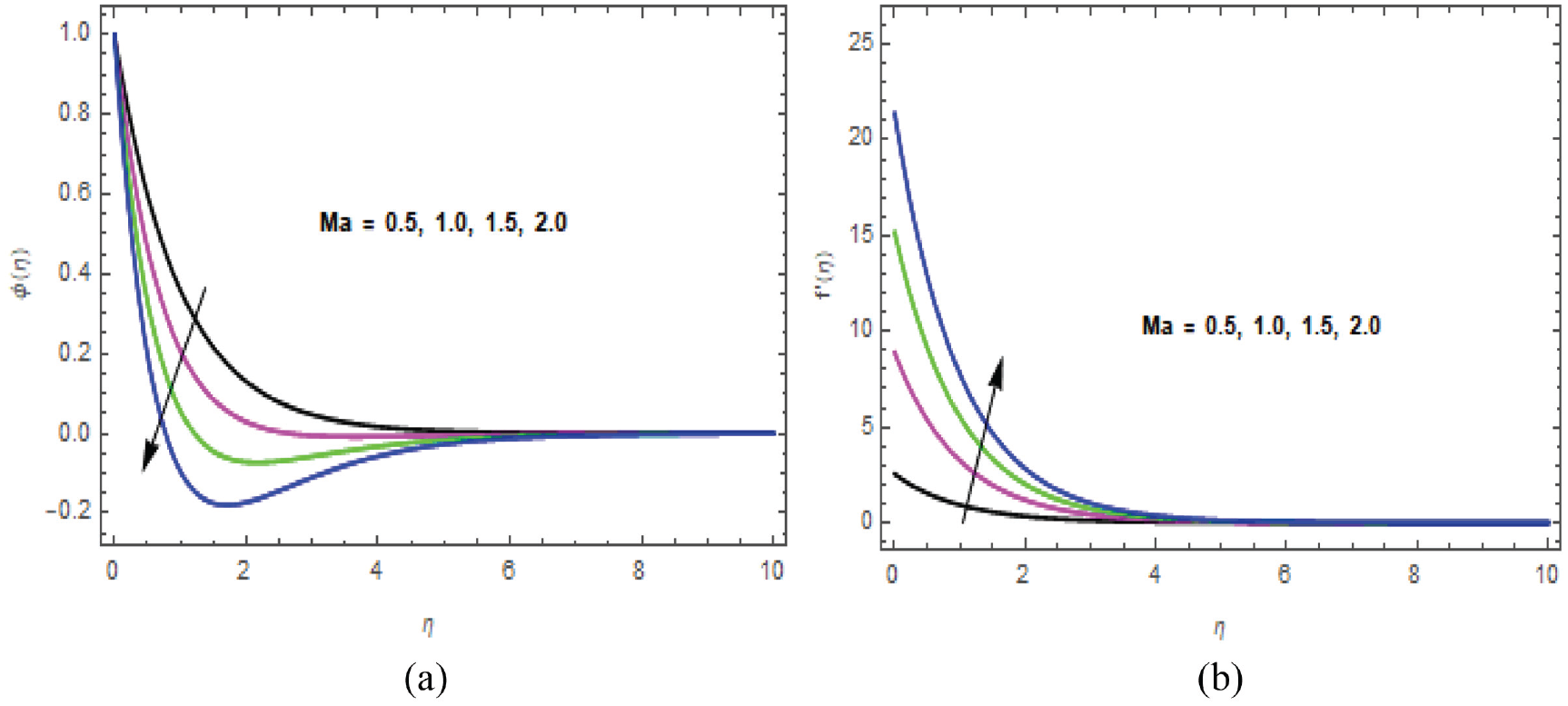
(a) Outcome of
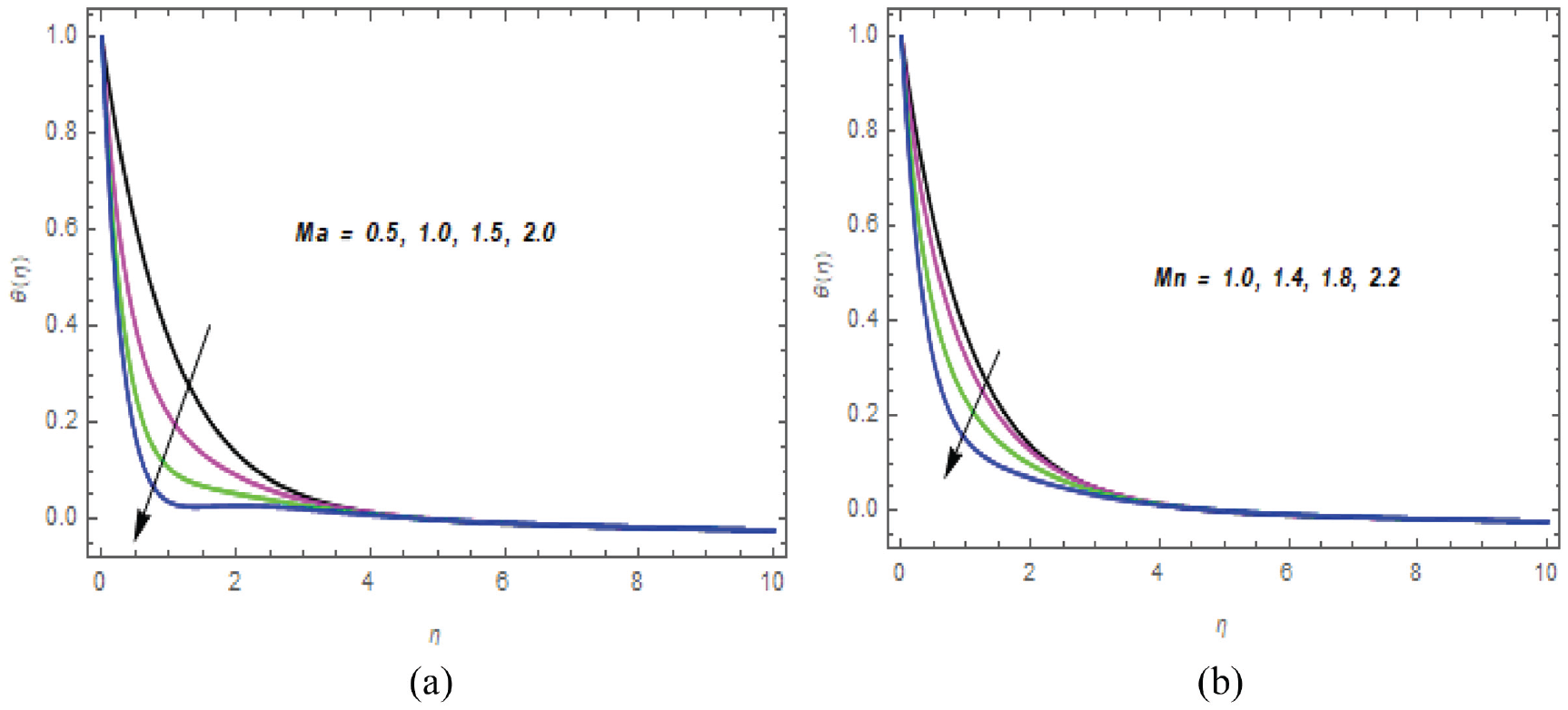
(a) Outcome of

(a) Outcome of

(a) Outcome of
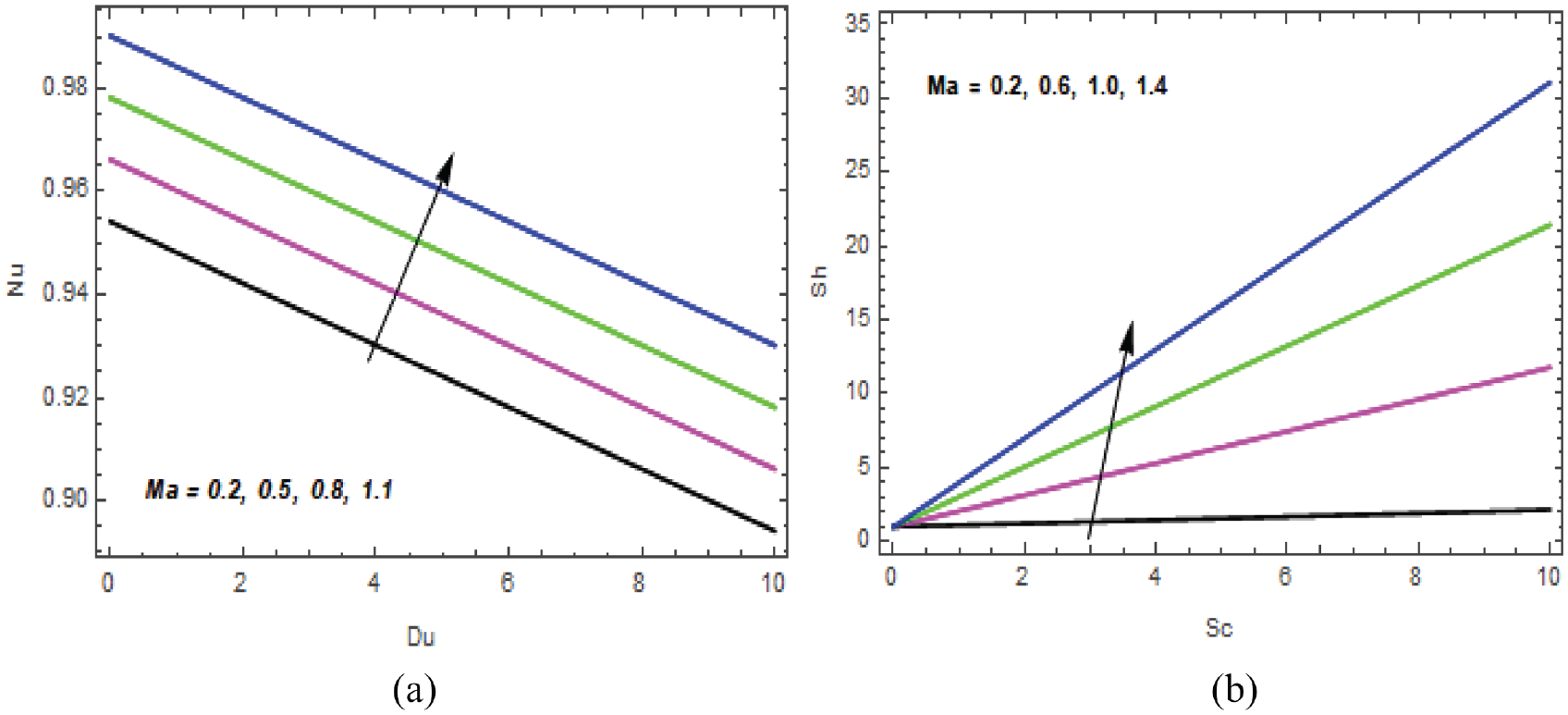
(a) Outcome of

(a) Effect of

(a) Effect of

(a) Streamlines for

(a) Isotherm for
Influence of various parameters on Nusselt number.

Impact of various parameters on Sherwood number.

Compare the mass and heat transfer rates between the current study and published research, 23 utilizing the integer case and only common parameters.

Final Remarks
The Magneto-Marangoni convective flow of Walter-B fluid under the effect of activation energy and Dufour–Soret influence are investigated in this study. The following is a summary of the results:
The velocity profile, Sherwood number and skin friction enhance due to an increase in Marangoni convection parameter, while converse behavior is found for Nusselt number, thermal and concentration profiles. The Marangoni number surface tension has a significant impact. Surface tension is a result of a liquid’s bulk attraction to the particles in the surface layer on its surface. As a result, the temperature decreases as the surface tension increases, and the bulk magnetism between the surface molecules rises or intensifies.
Due to enhancement in Dufour number, the temperature of the Walter-B fluid boosts up.
The concentration profile is enhancing when increase, activation energy parameter and Soret number while the inverse behavior is observing for chemical reaction.
For accumulated effects of radiation parameter, the Nusselt Number (Nu) gets increased.
For growing values of chemical reaction parameter, the Sherwood number decreases.
Footnotes
Appendix
Handling Editor: Chenhui Liang
Declaration of Conflicting Interests
The author(s) declared no potential conflicts of interest with respect to the research, authorship, and/or publication of this article.
Funding
The author(s) received no financial support for the research, authorship, and/or publication of this article.
