



Abstract

This paper investigates the influence of viscous dissipation on stagnation point flow of THNF (trihybrid nanofluid) in the existence of Marangoni convection and an activation energy. Also, the impact of heat generation and magnetic field are taken into account. Copper oxide
Introduction
When three different kinds of NPs (nanoparticles) are mixed together and dispersed throughout a base fluid, the result is a THNF (trihybrid nanofluid). Usually composed of metals, carbides, oxides, these nanoparticles have a size range of 1–100 nm. It is the distinct properties of the nanoparticles that distinguish ternary hybrid nanofluids from regular fluids. These qualities include increased stability, better heat transfer, increased surface area, and stronger thermal conductivity. Using non-Fourier’s law and trihybrid nanoparticles across a PS (porous surface), Algehyne et al. 1 . explored thermal improvement in pseudo-plastic physical. In ternary hybrid nanofluids with LTNEC, Abbas et al. 2 inspected the importance of thermos-phoretic particle deposition using the HCM (Hamilton–Crosser model) and YOM (Yamada–Ota model). As such, applications for THNFs have been observed in a number of fields, including energy, electronics, and biomedical engineering.3–13 The fluid movement brought on by differences in surface tension is known as Marangoni convection. When a liquid’s surface tension varies at its interface with a solid or another fluid, convection of this kind takes place. Because of the resulting ST (surface tension) gradient, which serves as a driving force, fluid flows from low ST (surface tension) areas to high surface tension areas. Applications for Marangoni convection is numerous and include materials science, engineering, biology, and more. Its usage in the creation of thin material films on a substrate for semiconductor devices is one of its most important applications. The characteristics of chemical reaction in THNF with heat generation and surface tension gradient were inspected by Abbas et al. 14 The outcome of substrate temperature on thermos-solutal MC variabilities was studied by Wang and Shi 15 in a sessile drop dispersing at constant interaction line mode. Marangoni convection is triggered when the thin film creates a surface tension gradient, helping to distribute the material evenly throughout the substrate.16–18 Figure 1(a) demonstrations the flow chart of THNF and HNF.

(a) Flow chart of THNF and HNF, (b) flow problem, and (c) flow chart of numerical solution.
A lot of chemical reactions need activation energy. Only when the least amount of energy is required can molecules or atoms be stimulated. There are situations where activation of energy requires no energy at all. Activation energy is the least amount of energy necessary for atoms or molecules to initiate a chemical reaction. Binary chemical reactions only occur in the movement of mass and heat. Food processing, chemical engineering, electronics manufacturing, geothermal reservoirs, and oil emulsion are a few scientific, industrial, and technical fields that require activation energy. Activation energy and the consequences of chemical reactions inspired numerous scientists to investigate the issue. Especially where nanofluid flow happens – the area of heat and mass transmission. For radiative flow of CN (Casson nanofluid), Ijaz et al. 19 inspected the mathematical simulation of Arrhenius AE using the CCHFM (Cattaneo–Christov heat flux model). In addition to AE, Salahuddin et al. 20 investigated the thermos-physical characteristics and internal energy modification in Casson fluid flow. Abbas et al. 21 explore the numerical solution of reactive flow of Casson fluid with radiation.
The authors inspected the characteristics of activation energy, viscous dissipation on the SP (stagnation point) flow of THNF (trihybrid nanofluid) over a sheet with thermo-solutal Marangoni convection and heat generation in this research. The trihybrid nanofluid features are said to be generated by combining particles of magnesium oxide
• The objective of this work is to inspect how the temperature, flow, and solutal fields of HNF (hybrid nanofluid) and THNF and are affected by Marangoni convection.
• To determine how the viscous dissipation affects the temperature boundary layer of the THNF and HNF.
• To determine how the MHD affects the stagnation point flow of THNF.
• The determination of this work is to scrutinize how trihybrid nanofluid solutal and thermal boundary layer flow are affected by heat generation and activation energy.
There are numerous important uses for the computational framework designed to investigate the characteristics of activation energy and heat generation on the thermos-solutal surface tension gradient flow of ternary hybrid nanofluid. It can be utilized in sophisticated electronic device cooling systems, where exact thermal control is essential to avert overheating and guarantee peak performance. This concept has additional applications in biomedical engineering, including in targeted drug delivery systems, where precise and effective therapeutic agent transportation can be achieved by regulated fluid flow. It also finds use in the design of lab-on-a-chip technologies and microfluidic devices, where a microscale understanding of fluid behavior is crucial. Additionally, it can help design solar thermal energy systems that are more efficient by enhancing heat transmission and storage capacity through fluid dynamics optimization. All things considered, this framework offers information about how to best optimize heat and mass transmission processes in a range of high-tech and industrial applications.
Mathematical formulation
Examined the effect of viscous dissipation on 2-D stagnation point flow of a THNF across a sheet with activation energy and Marangoni convection. The geometry profile of the present model is characterized in Figure 1(b). The region
• Trihybrid nanofluid is taken into deliberation while discussing the interruption of NPs (nanoparticles) because it is an incompressible and consistent flow.
• The impact of the MHD is accounted.
• Moreover, this framework investigates the viscous dissipation effects.
• The characteristics of the heat source on TBL (thermal boundary layer) is accounted.
• Marangoni convection boundary conditions are related to one part of the flow problem.
• It is believed that the uniform dispersion of spherical NPs inside the fluid occurs.
The following are the governing equations for energy, momentum, continuity, and concentration in the analysis of the current flow22–25:


Possible boundary conditions for this problem include the following1,18–21:
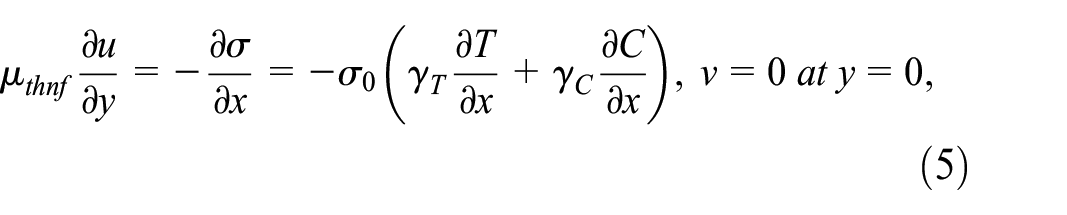


Marangoni convection is the boundary condition in equation (5). We chose this state because it has several applications in technology and engineering, microfluidics, including film drainage in emulsions, coating flow technologies, surfactant replacement therapy for neonatal patients, and drying of semiconductor vapors in microelectronics. 21
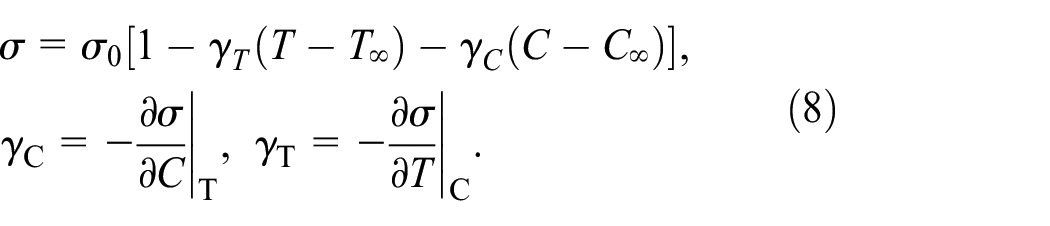
Describe the subsequent transformations;



The system of ODEs can be obtained by substituting the following fluid stream functions into equations (1–4)



Boundary conditions


Where


The local Sherwood number, and Nusselt number are discussed.



Where


Numerical method
Using the Bvp4c technique, these equations are numerically solved in a high-level language and interactive environment. Through replacements, the ODEs equations (15) and (16) are transformed into the scheme of first-order ODEs (equations (12)–(14)).

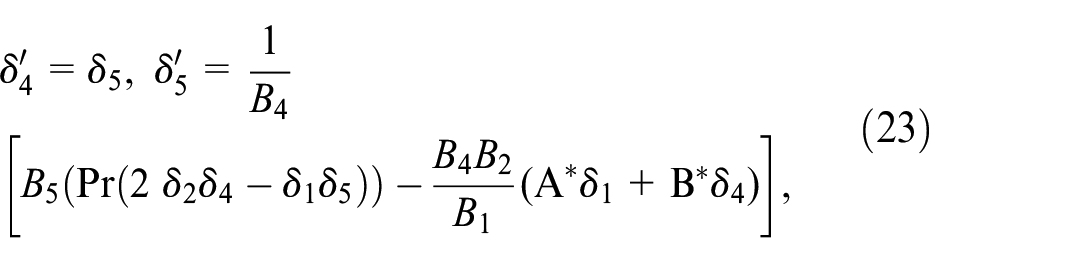

Boundary conditions


Graphically results and discussion
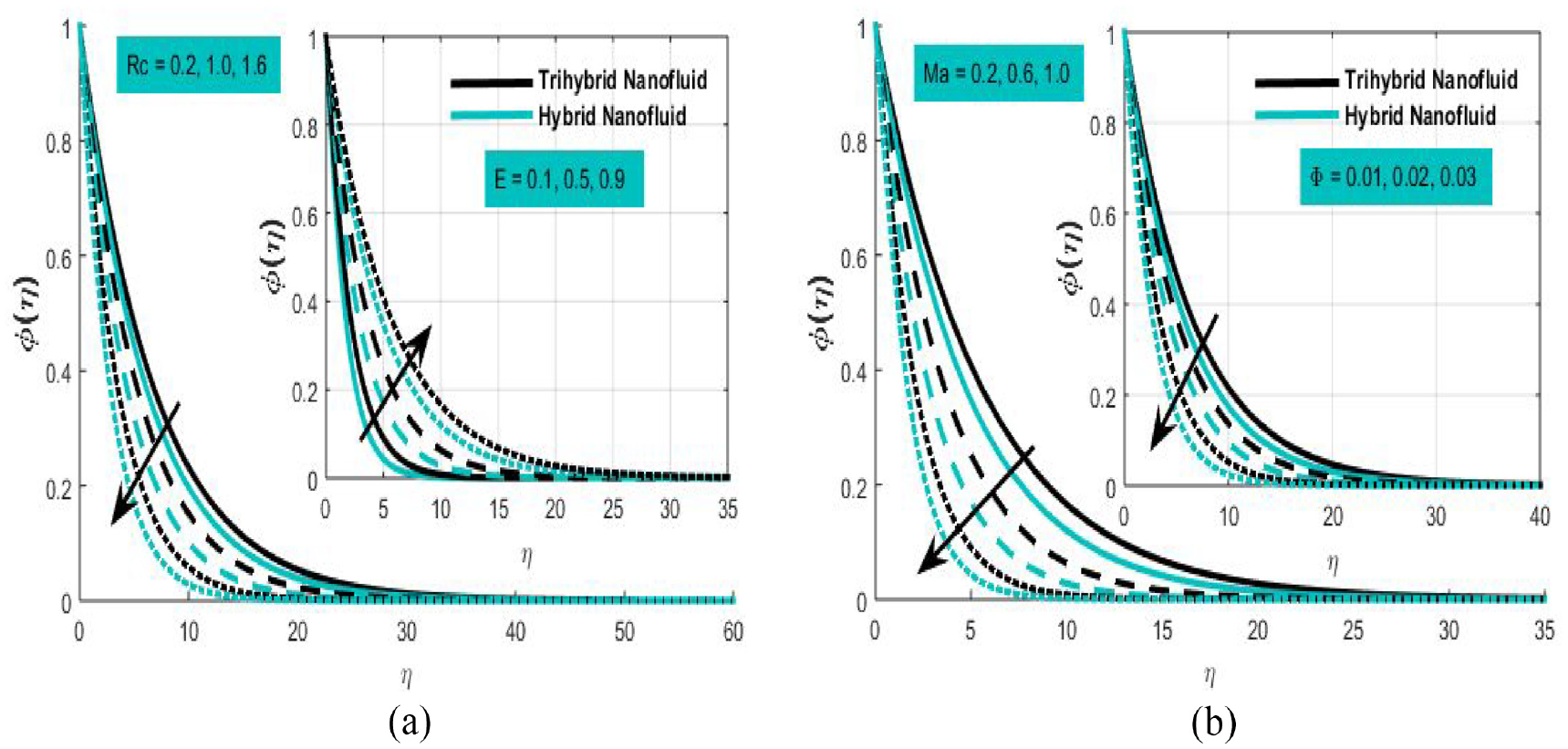
This section aims to investigate how different parameters affect the solutal, thermal, and velocity profiles. These physical conclusions are obtained by solving the reduced set of ODEs numerically using the shooting methodology and the Bvp4c method. There are numerous uses for the computational model for examining the characteristics of activation energy and heat source on the Marangoni convective stagnation point flow of ternary hybrid nanofluids in both advanced engineering and industrial operations. This architecture can be used in microelectronic cooling systems, where effective thermal control is crucial. By maximizing heat transmission and fluid flow, it also helps energy systems like heat exchangers and solar thermal collectors. Additionally, by comprehending fluid dynamics in micro-scale devices, the model helps biological disciplines with tailored medication administration. It can improve thermal performance in engines and other high-temperature systems as well as fuel efficiency in the aerospace and automotive sectors. The consequence of

Curves of

(a) Curves of
(a) Curves of

(a) Curves of

Outcome of

Outcome of
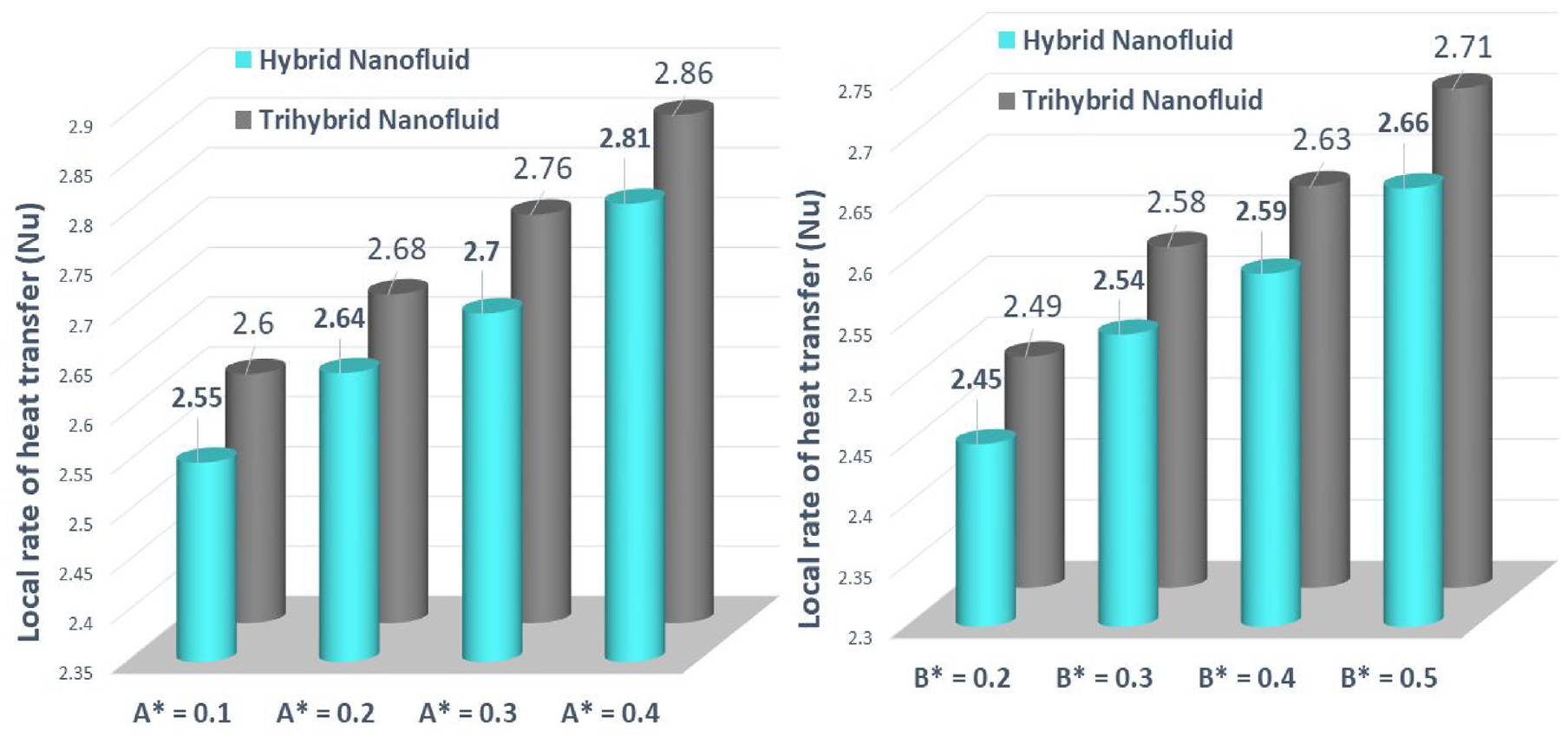
Outcome of

Outcome of
Compression results.

Conclusion
The present work discusses the consequence of heat source on SP (stagnation point) flow of trihybrid nanofluid with thermos-solutal Marangoni convection, activation energy, and viscous dissipation. The bvp4c technique is utilized to compute the flow-controlling equations using a MATLAB programmer. The numerical data is shown to show how the several non-dimension parameters vary in step with their respective distributions. The current study’s primary conclusions are as follows:
• The flow profile decline behavior for magnetic parameter but thermal distribution improves for both HNF and THNF. In the existence of magnetic field, a resistive force related to the drag force will be generated, typically slowing down and lowering the fluid’s velocity. As magnetic values increase, the thickness of the MBL declines.
• The flow profile, mass transmission rate, and rate of heat transmission all rise with an upsurge in the Marangoni convection factor, whereas the solutal and thermal profiles of both HNF and THNF show the reverse behavior. The MN (Marangoni number) exhibits a substantial impact on ST (surface tension). Surface tension is the result of the majority of the liquid being drawn to the particles in the SL (surface layer) on its surface. Surface tension increases with decreasing temperature because of the growing magnetic attraction between surface molecules.
• The trihybrid nanofluid and hybrid nanofluid thermal distributions rises as the outcome of boosts in heat generations.
• As activation energy parameter levels grow, the concentration profile increases, whereas chemical reaction behaves oppositely.
• When we raise the volume friction of NPs, the thermal distribution rises but the velocity and temperature profiles drop for both trihybrid nanofluid and hybrid nanofluid.
Footnotes
Appendix
Acknowledgements
The authors extend their appreciation to Taif University, Saudi Arabia, for supporting this work through project number (TU-DSPP-2024-92).
Handling Editor: Sharmili Pandian
Author contributions
Munawar Abbas: Supervision, Methodology, Conceptualization. Hammad Alotaibi: Methodology, Formal analysis, Data curation. Hafiz Muhammad Ghazi: Methodology. Taseer Muhammad: Writing – review & editing.
Declaration of conflicting interests
The author(s) declared no potential conflicts of interest with respect to the research, authorship, and/or publication of this article.
Funding
The author(s) disclosed receipt of the following financial support for the research, authorship, and/or publication of this article: This research was funded by Taif University, Saudi Arabia, Project No. (TU-DSPP-2024-92).

Data availability
Data used in this work is available from the corresponding author base on a reasonable request.