



Abstract
This article presents the development of a fifth-order multi-resolution finite volume weighted essentially non-oscillatory (WENO) scheme combined with the advection upstream splitting method based on flux vector splitting (AUSMV) numerical flux for analyzing two-phase flow in both horizontal and vertical pipelines. The drift flux flow model comprises of two separate mass conservation equations for each phase for liquid and gas and one momentum equation for mixture and submodels for thermodynamics and hydrodynamics. The two mass conservation equations describe the behavior of each phase in the flow. The mixture-momentum equation takes into account the frictional and gravitational forces acting on the mixture of both phases. The thermodynamic and hydrodynamic submodels provide additional information to fully describe the flow and close the drift flux model. In the presence of these source terms and submodels, it is a challenging task to develop a high order efficient and accurate numerical schemes. The proposed numerical technique captures the peaks of pressure wave, suppresses the erroneous oscillations at the transition zones and resolves the discontinuities more efficiently and accurately. The accuracy of proposed numerical technique is verified by solving the various test problems. Furthermore, the solution obtained by developed numerical technique are compared to those attained with the high-resolution improved CUP and simple finite volume WENO numerical schemes.
Keywords
Introduction
Two-phase flow models are important because they help in predicting the behavior of fluids in various industrial processes, such as oil and gas production, power generation, and cooling systems. Further, these models are extensively used for: understanding fluid behavior in pipelines, heat exchangers, and other equipment; designing and optimizing industrial processes; reducing operational costs and improving efficiency and preventing safety hazards, such as explosions and leaks.1–3 Two-phase flow models play a critical role in ensuring the safe, efficient, and cost-effective operation of many industrial processes. To study the behavior of two-phase flows, researchers have developed several two-phase flow models and a wide range of numerical approaches. Despite their importance, these models can be difficult to analyze numerically due to the complexities of the interactions between the two phases. More precisely, the two-phase flow models offer various numerical difficulties, such as the discontinous solutions, formation of shocks, and loss of hyperbolicity. To overcome such type of numerical difficulties, Zuber and Findly 4 introduced the drift flux model. Later, various authors improved and modified the drift flux flow model, for example see the articles5–9 and references therein. In the drift flux flow model, the one momentum equation for mixture is utilized instead of using separate equations of momentum and introduced the hydrodynamic submodels. This approach helps in eliminating certain problematic terms associated with phase interactions. The use of a mixture momentum equation provides a more accurate representation of the fluid flow. Further, the hydrodynamic submodels help in accurately computing the phase velocities in the solution domain. This model provides an efficient means of understanding multi-phase flows in well-bores.
There have been wide range of studies in the literature in which researchers have developed numerical schemes to approximate and analyze the drift flux model in various flow systems such as pipelines, well-bores, and marine risers. Initially, the authors developed the Roe-type numerical scheme see for example, Romate. 5 The two-phase flow model is then further analyzed using AUSM and relaxation type numerical techniques, high-resolution hybrid-upwind, hybrid flux splitting, for detail see Fjelde and Karlsen, 6 Steinar and Fjelde, 7 Baudin et al., 8 and Evje and Fjelde.10,11 Futhermore, weakly implicit-mixture flux (WIMF), multi stage approach (MUSTA) based centered schemes, space-time CESE schemes9,12,13 were developed for finding the solutions of model considered in this article. Newtonian and non-Newtonian experimental methods are used to explore both horizontal and inclined pipelines by using the drift flux flow model. 14 Next, the two-phase flow in horizontal and vertical channels are simulated in the article. 15 All above mentioned numerical schemes are of first or second order and mostly the research articles discussed the two-phase flow only for horizontal pipe-lines. Recently, the third order and fifth order WENO schemes with the central upwind flux 16 are developed for the drift flux flow model. In this article, 16 the authors considered the drift flux model without source terms and only tested the proposed numerical schemes for two-phase flow in horizontal pipe lines.
The main purpose of this study is to develop the fifth order finite volume multi-resolution WENO scheme 17 with AUSMV flux 18 for analyzing the behavior of two-phase flow in both vertical and horizontal pipelines, 10 with and with out source terms. This new hybrid numerical scheme is more efficient, accurate, and less dissipative than the simple WENO and improved central upwind numerical schemes. The main idea of this hybrid scheme is to calculate the numerical flux by using the AUSMV approach which is a modified version of the original AUSM numerical flux that was developed to handle both inviscid and viscous flows. It uses the concept of splitting the total flux into convective flux and pressure flux and includes an artificial viscosity term to damp the numerical oscillations. Further, the cell interface values are approximated by multi-resolution WENO reconstruction which is the extension of WENO numerical scheme. The multi-resolution WENO method uses a combination of coarse and fine grids to represent the solution and employs a multi-level correction process to improve the accuracy of the solution. The method uses a local adaptive grid refinement strategy, which allows for a more accurate representation of the solution in regions where high gradients or discontinuities are present.
Initially, in 1994, Liu et al. 19 implemented the finite volume WENO numerical scheme of third order, which was the refined form of the essentially non-oscillatory numerical approach.20–22 In this type of the finite volume WENO scheme, they used the convex combination of all candidate stencils and increased the accuracy order. After that, these numerical methods have been developed, updated, and expanded for several disciplines of engineering and science for further information, see Hu and Shu, 23 Balsara and Shu, 24 Shu, 25 Xing and Shu, 26 Shu, 27 Zhang and Shu, 28 and Zhu and Qiu. 29 Later, the authors17,30 developed multi-resolution finite volume and finite difference WENO schemes for solving hyperbolic conservation laws. On the other hand, Initially, the AUSM numerical scheme was introduced by Liou and Steffen for the Euler equation. 31 Wada and Liou later proposed an improved version of the scheme known as AUSMDV in Wada and Liou. 32 The authors of the article 18 then introduced a more precise and reliable numerical scheme called AUSMV, which combines the flux vector-splitting (FVS) and AUSM methods. For more information, please see the references Evje and Fjelde, 18 Liou and Steffen, 31 and Wada and Liou 32 and the sources cited therein.
The rest of the article is organized as follows. In Section “Drift flux model for two-phase flows,” a two-phase drift flux flow model is described. In section “Construction of multi-resolution WENO scheme along with AUSMV numerical flux for the drift flux model,” drift flux flow model is derived by the hybrid numerical scheme (multi-resolution WENO along with AUSMV flux). Test problems are given in section “Test problems.” Also, the solution profiles are compared with those attained from improved central-upwind and simple WENO techniques 33 respectively. The conclusions are presented in last section.
Drift flux model for two-phase flows
The drift flux flow model for two phase-flows is mathematically expressed and eigenvalues are explained in this part. As discussed earlier, the drift flux flow model is composed of three partial differential equations, two seprate mass conservation equations for both phases for liquid and gas and one mixture momentum equation. These equations are mathematically expressed as follows

where

where,

Further, three differential equations of drift flux model (1) contain seven unknown variables



and

where
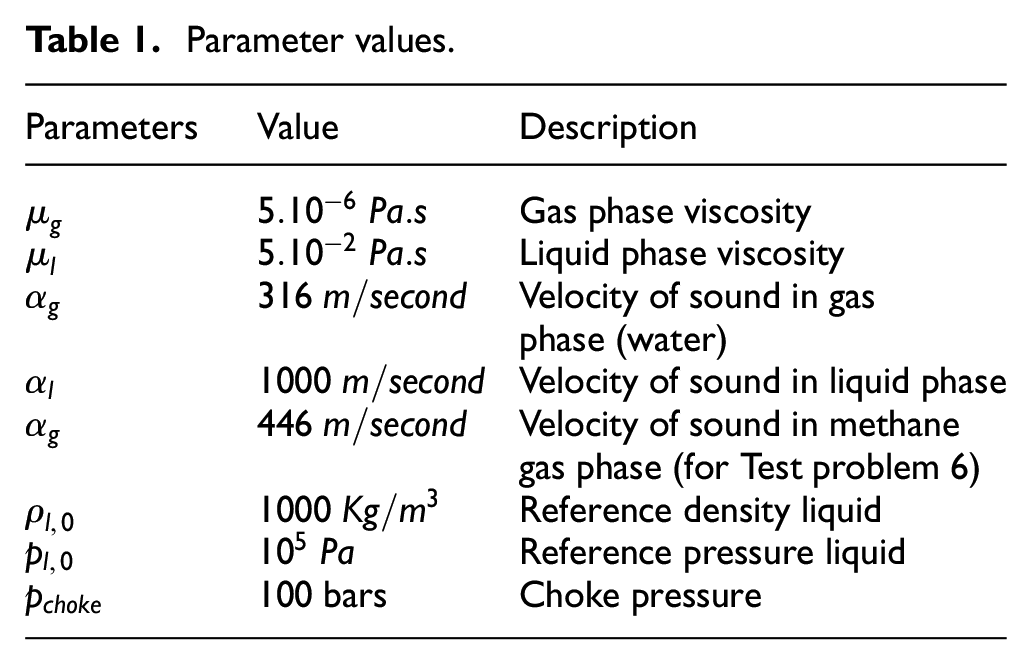
Parameter values.
Eigenvalues calculation
The system of equations (1) are expressed in the compact form, given as

where
with,
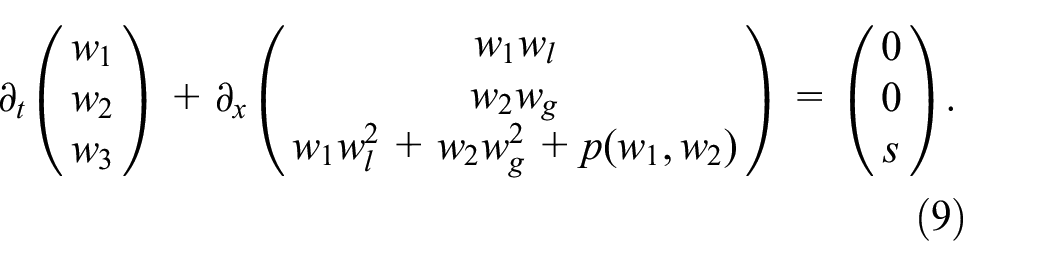
It is observed that the system indicates the flux vector cannot be fully expressed in terms of the conserved variables. As a result, the exact value of the sound velocity cannot be determined. In the articles,6,7 the authors have discussed the full detail for approximating the value of sound velocity. we have omited the expanation of procedure here, but only describe the eigenvalues. Hence, the eigenvalues for the given model is



With

Construction of multi-resolution WENO scheme along with AUSMV numerical flux for the drift flux model
In this part, two-phase drift flux flow model is derived by fifth order multi-resolution WENO scheme along with AUSMV numerical flux. This model are expressed in the compact form, given as

Here

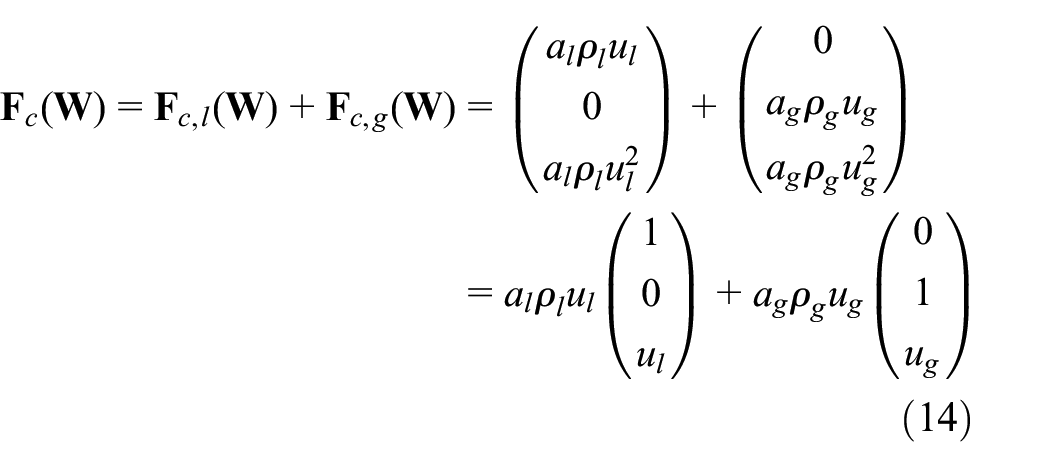
further, the convective flux is also the sum of two fluxes, that is
For the construction of hybrid numerical scheme, firstly, the given domain is discretized into cells, given as

where,
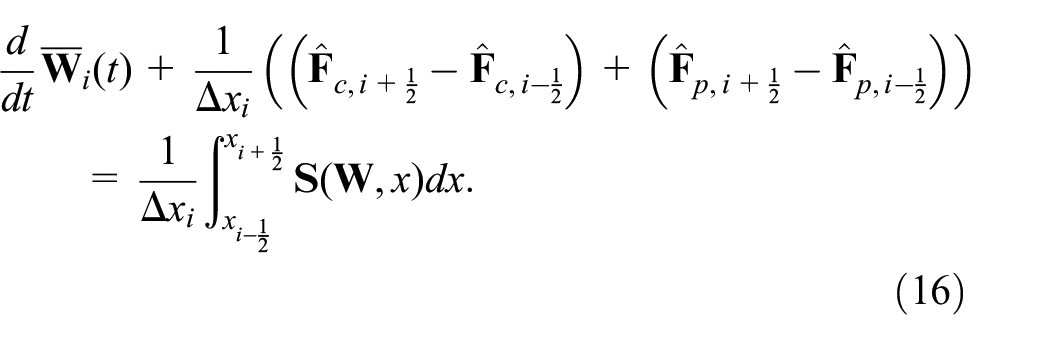
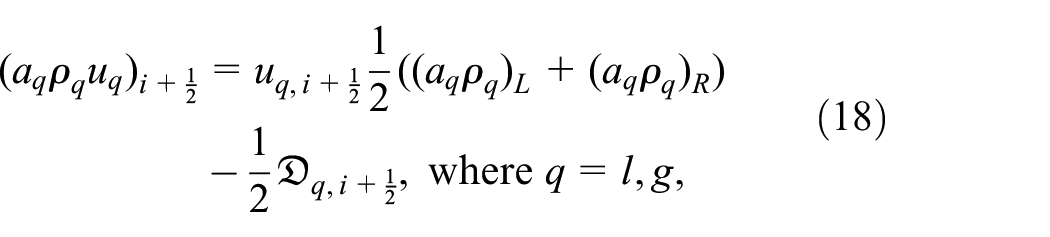
Here, the numerical flux is reprsented by

where,
where

Next,

where, the expressions for

Next, we discretized the pressure term

further, we defined the pressure splitting function,

Finally, the speed of sound in two-phase mixture

and

Parameter


To be more specific, these polynomials are explicitly defined as

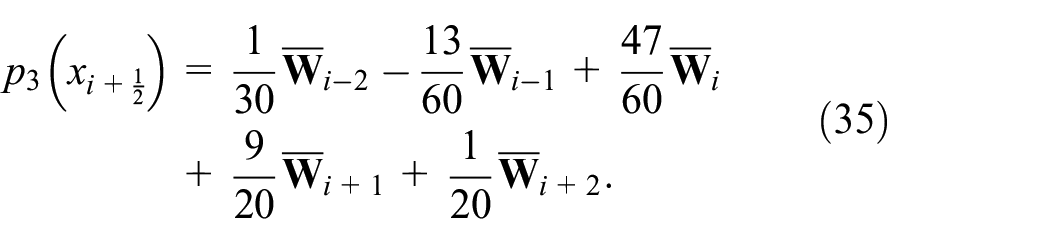
The reconstructed values point-wisely


where


with


Where
While, non linear weights are

Here,

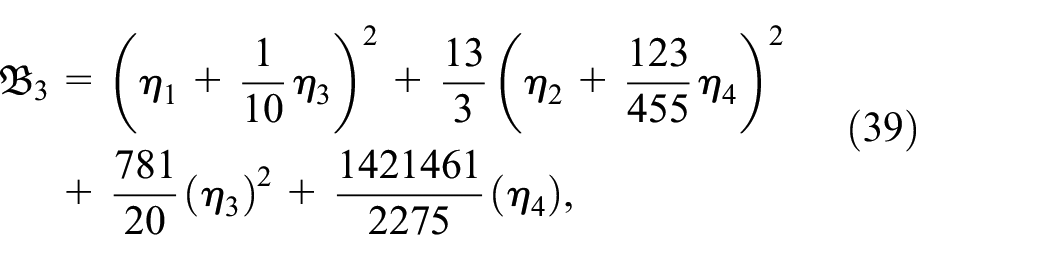
Here, for

where



To resolve the discontinuities efficiently,




In equation (47), To avoid the denominator to become zero

The term

This completes the derivation of WENO technique with AUSMV numerical flux for the two-phase drift flux flow model. Next, we will approximate the source term in equation (8). The approximation of the term

where

the above system can also be rewritten as

Now, the third order TVD RK method 17 is used to compute the system equation (52), as follow

where, by using the relation
Test problems
In this part, we have compared results of high resolution numerical schemes such as improved central upwind 33 with our developed hybrid scheme (MR WENO). Further, we have compared the results of developed scheme and WENO scheme with Lax-Friedrichs numerical flux (WENO) for the second test problem.
Test Problem 1: This test problems is selected from Kuila et al.
34
for measuring the efficiency of developed technique. Here, no-slip condition is used, it means

For test problem 1,

The length of the pipe is considered
Test problem 2: To verify the accuracy and effectiveness of the suggested technique we have selected this problem from Evje and Fjelde.
10
Moreover, a length of


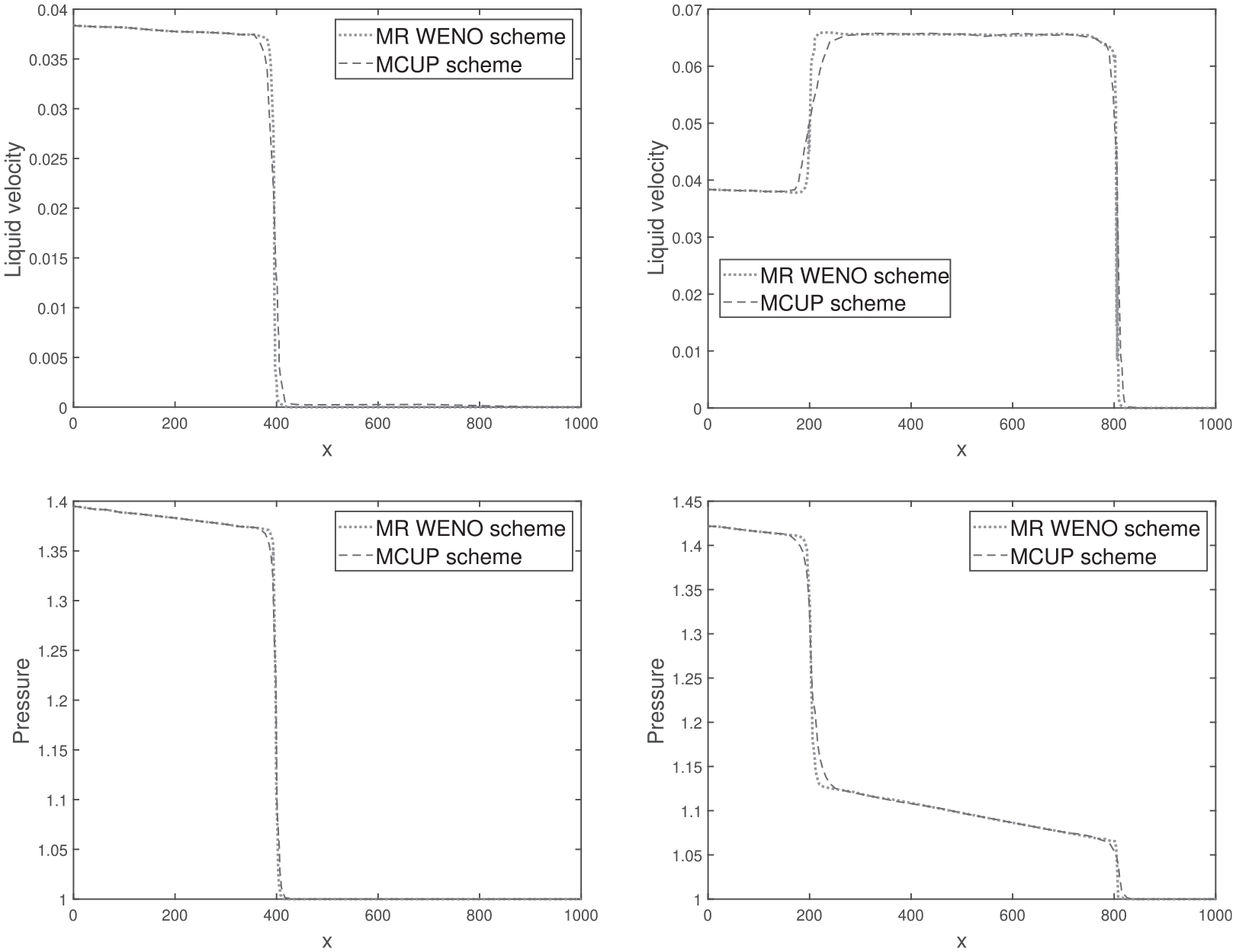
The solution profiles of test problem 1 at
Hybrid numerical scheme (MR WENO) are used to determined the profiled solution for gas velocity, liquid velocity, and pressure volume fraction, simple WENO, and improved central upwind numerical scheme (MCUP) at time
Test problem 3: Domain of the solution consits of two rare-faction waves and one contact wave in this problem. The length of the horizontal pipe, final time, and values of the parameters involved in the gas-slip relation are considered same as given in the previous test problem. The data of the problem is expressed as follows


The solution profiles of test problem 2 at

The profiled solution obtained by MR WENO and MCUP numerical schemes are shown in the Figure 3. Precisely, the profiled solution consist of contact waves and rare-faction. Moreover, the contact discontinuities are resolved by derived numerical scheme (MR WENO) more accurately and efficiently then the high-resolution numerical scheme (MCUP).
Test problem 4: we have taken this problem from the article.
6
This test problem is more challenging for the numerical schemes since this test problem, considered frictional forces (2). Initially, in the horizontal pipe we have considered
Test problem 5: This problem is deemed to be the most difficult challenge for numerical methods taken from Fjelde and Karlsen.
6
The source term in equation (2) and the gas-slip relationship in equation (7) in the the algebraic form are used by taking values of
Test problem 6: Test problem 6 is taken to analyze the two-phase flow in the vertical marine riser of length


The solution profiles of test problem 3 at
The solution profiles of pressure pulse and liquid velocity at different times.
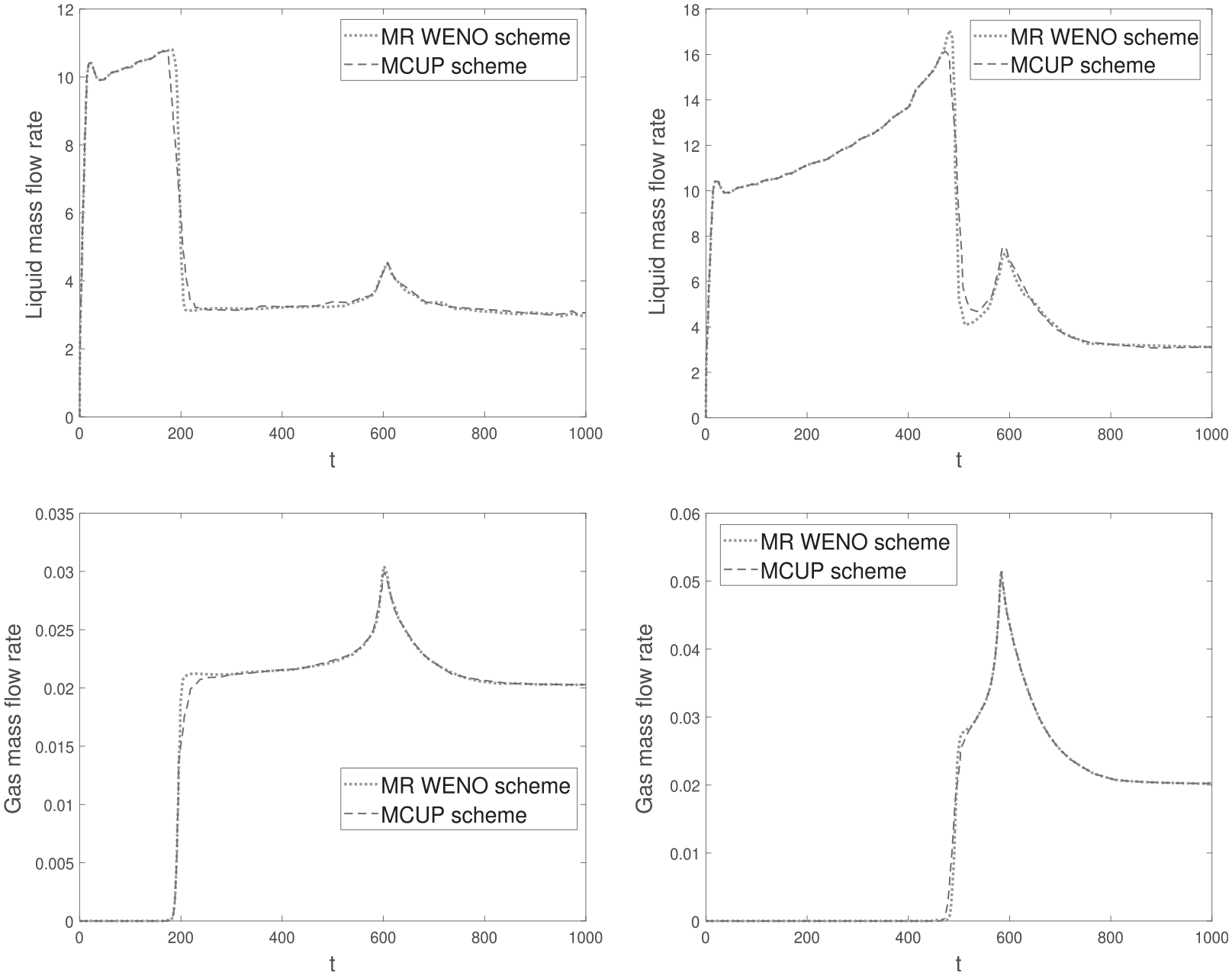
The solution profiles of test problem 5.
This type of drift velocity
35
used for bubble flow in the slug flow. Further, the choke pressure is considered 100 bars. This pressure enforces the pressure gradient in the system, more precisely this pressure helps to prevent dissipation of pressure in the system. The vertical marine riser is discretized into 100 grid points. The solution profiles shown in the Figure 6 are obtained at

Solution profiles obtained at time
Conclusions
In this research, a high order hybrid numerical scheme is developed for simulating the two-phase flow in horizontal and vertical channels, more precisely, a fifth-order multi-resolution WENO is utilized for the spatial reconstruction, and the AUSMV numerical scheme is used to the calculate the fluxes of conserved quantities across the computational cells in a discretized domain. This new hybrid numerical scheme effectively resolves contact discontinuities, conserves the positivity of flow variables, and eliminates spurious oscillations in transition zones or in the vicinity of sharp gradients. A comprehensive set of test cases demonstrates the precision and dependability of the newly developed technique. Additionally, the profiled solution attained by new method are compared to those produced by the improved CUP and WENO with Lax-Friedrichs flux (simple WENO) numerical approaches. The results show that our developed numerical technique is robust, more efficient, and less diffusivity as compared to the improved central upwind and simple WENO numerical methods.
Footnotes
Handling Editor: Chenhui Liang
Declaration of conflicting interests
The author(s) declared no potential conflicts of interest with respect to the research, authorship, and/or publication of this article.
Funding
The author(s) received no financial support for the research, authorship, and/or publication of this article.
