




Abstract
This paper focuses on the influence of road weight captured by vibration on vibratory vibrator energy excitation and the optimization of vibratory vibrator baseplate when there is road instead of direct contact between baseplate and the ground. For this purpose, based on the vibration attenuation formula of the foundation surface, the variation law of the captured road weight is obtained. The excitation dynamics model considering the captured road weight is constructed and verified. The energy excitation effect of vibration system is analyzed. By using topology optimization method, the baseplate is optimized, and the comparative study of vibratory vibrator excitation effect before and after optimization is carried out. In the process of energy transmission of the vibrator, the reaction mass will consume most of the energy, the actual output vibratory wave energy is only 5.5% of the total energy. The octagonal I-steel baseplate can reduce its weight by 442 kg while ensuring its rigidity, and the energy excitation effect is relatively improved by 18.2%. The research will provide a reference for improving the energy excitation effect of vibratory vibrator considering the weight of the captured road.
Introduction
Vibratory vibrator is a kind of oil exploration equipment. The energy excitation effect of vibratory vibrator determines the output vibratory wave energy, which is the key to affect the vibratory exploration effect.1–3 Previously, the working area of vibratory vibrator was flat, and the vibratory vibrator baseplate was directly coupled with the ground during operation. In 1980s, sallas first proposed the vibrator-ground coupling model, and based on it, he proposed to establish the dynamic equation of vibrator-ground coupling by weighting method. 4 Wei and Phillips5,6 used finite element simulation method to study the dynamic characteristics of vibratory vibrator baseplate, and proposed that part of the ground will vibrate along with the baseplate in the vibration process. Zhuang et al. 7 and Jun et al., 8 studied the coupling dynamic model of vibratory vibrator and the ground, and put forward the law of the influence of baseplate and ground material parameters on the dynamic response of vibrator. Li et al.9,10 have studied the coupling between the vibrator baseplate and the ground and the influence of scanning bandwidth on energy transfer. Based on fractal theory, Huang et al.11,12 established the nonlinear contact relationship between the rough surface topography and the baseplate, studied the energy transfer relationship between the rough surface topography and the ground, and proposed that the coupling state between the baseplate and the ground is different, and the energy transfer efficiency is also different. Previous studies have explained the baseplate-ground contact model in more detail, but have not seen the research on the energy excitation effect of vibration system when there is road influence between the baseplate and the ground. Therefore, it is necessary to establish a vibrator baseplate-road-ground vibration dynamic model suitable for the road with an intermediate layer between the baseplate and the ground, and carry out research on the excitation effect of vibratory vibrator energy considering the captured road.
The purpose of this paper is to obtain the relationship between the captured road weight and frequency based on the vibration attenuation formula of the foundation surface. The vibratory vibrator excitation dynamics model considering the captured road weight is constructed and verified. Meanwhile, the energy excitation effect of vibration system considering the captured road is analyzed. The vibratory vibrator baseplate is optimized to improve the vibratory vibrator energy excitation effect.
Establishment and verification of vibratory vibrator excitation model considering captured road
Establishment of vibratory vibrator excitation model
As shown in Figure 1, when the vibratory vibrator works, high-pressure hydraulic oil enters the oil cavity of the reaction mass through the piston rod, which pushes the reaction mass to move. The generated reaction force is transmitted to the baseplate through the piston rod and other structures, and finally the vibration is excited to the ground in the form of vibratory waves through the baseplate. 13 As shown in Figure 2, there is a layer of concrete road under the baseplate, which makes it impossible to directly couple with the ground. At this time, there is no constraint on both sides of the road, and the road is not completely connected with the ground. Therefore, when the vibratory vibrator excites on the concrete road, the road will vibrate with the baseplate. 14 In addition, since the minimum side length of the road pressure surface is larger than the road thickness under the condition of vibratory vibrator excitation, the following assumptions can be made:
The vertical compressive strain and shear strain of concrete road can be ignored when it is compressed;
Concrete road can be regarded as elastic bodies of equal thickness with elastic constants E (elastic modulus) and μ (Poisson’s ratio);
Under the action of load, the contact between the concrete road and the ground is completely continuous.

Geometry of the vibrator.

The vehicle on the road.
A layered vibration model of vibratory vibrator baseplate-road-ground can be established as shown in Figure 3.

Dynamic model of baseplate-road-ground coupling system.
The excitation scanning signal of the vibratory vibrator can be expressed as:

Where: A is the pressure amplitude of the internal hydraulic cavity of the reaction mass, fs is the vibration starting frequency, fe is the vibration ending frequency, t is the current scanning time, and T is the vibration period.
Therefore, as shown in Figure 3, the matrix form of the dynamic equation of the vibratory vibrator baseplate-road-ground vibration model considering the captured road is:

Where mr, mb, and mi are the weight of reaction mass, baseplate, and captured concrete road; c1, c2, and c3 are damping coefficients respectively; k1, k2, and k3 are stiffness coefficients; X1, X2, X3 are displacements of reaction mass, baseplate, and concrete road; Y1, Y2, Y3 are velocity of reaction mass, baseplate, and concrete road; Z1, Z2, Z3 are acceleration of reaction mass, baseplate, and concrete road; Q(t) is the hydraulic force.
Determination of the weight of the captured road
From the equation of the excitation model, it can be seen that the reaction mass, baseplate, and the road participating in vibration will affect the vibration effect of vibratory vibrator. Under the condition that the reaction mass and baseplate is constant, the weight of the road participating in vibration is crucial to the research of the vibration effect.
When the vibrator is excited, the vibration transmitted from the center of the baseplate to the surrounding area will attenuate as the distance from the vibration center increases. Because the attenuation coefficient determined by the area of the baseplate and the energy absorption coefficient determined by the road material are fixed values, the vibration amplitude at different positions of the concrete road is mainly affected by the distance between the point and the vibration center and the vibration frequency. Therefore, the vibration amplitude of the vibrator excited on a concrete road at a distance r from the vibration center can be determined by a vibration attenuation formula, which is expressed as15,16:

Among them:
According to the vibration standard of mass concrete, it can be considered that when the vibration speed is 20 mm/s, the vibration will not have obvious influence on the concrete road. Therefore, the position where the vibration speed is 20 mm/s is defined as the capture boundary, and the distance from the boundary to the vibration center is r (Figure 4).

Captured road cross-sectional area.
Because the length and width of the road involved in vibration are far greater than its thickness, the captured road volume is:

There is a relationship between the thickness and the vibration transmission radius of the lower surface of concrete road:

Because both the model and the experiment used a concrete road width of 3.55 m, the weight mi of concrete road can be simplified and obtained:

Where h is the thickness of road, r is the vibration transmission radius of concrete road surface, and ρ is the density of concrete road.
It can be seen from Figure 5 that the weight of concrete road captured by vibration decreases exponentially with the increase of vibration time. In addition, the increase of the thickness of the concrete road will lead to a significant increase in the weight of the captured road.

Weight of concrete road with different thickness participating.
Dynamic model verification
In order to verify the validity of the dynamic model, the dynamic equation (1) and the vibration attenuation equation (2) are verified by the field vibration data (Figure 6).

Field equipment: (a) vibratory vibrator vehicle and (b) the position of acceleration and speed sensors.
The field test parameters are shown in Table 1:
Vibrator and vibration attenuation parameters.

In order to verify the validity of the dynamic model, the dynamic equation (1) and the vibration attenuation equation (2) are verified by the field vibration data.
It can be seen from Figures 7 and 8 that the maximum error between the numerical and experimental acceleration is 12.8%. The maximum error between the numerical and experimental vibration velocity at different distances from the vibration center is 10.5%, which occurs at 2 m from the vibration center. The farther away from the vibration center, the smaller the velocity error. The numerical results clearly agree with the experimental results.
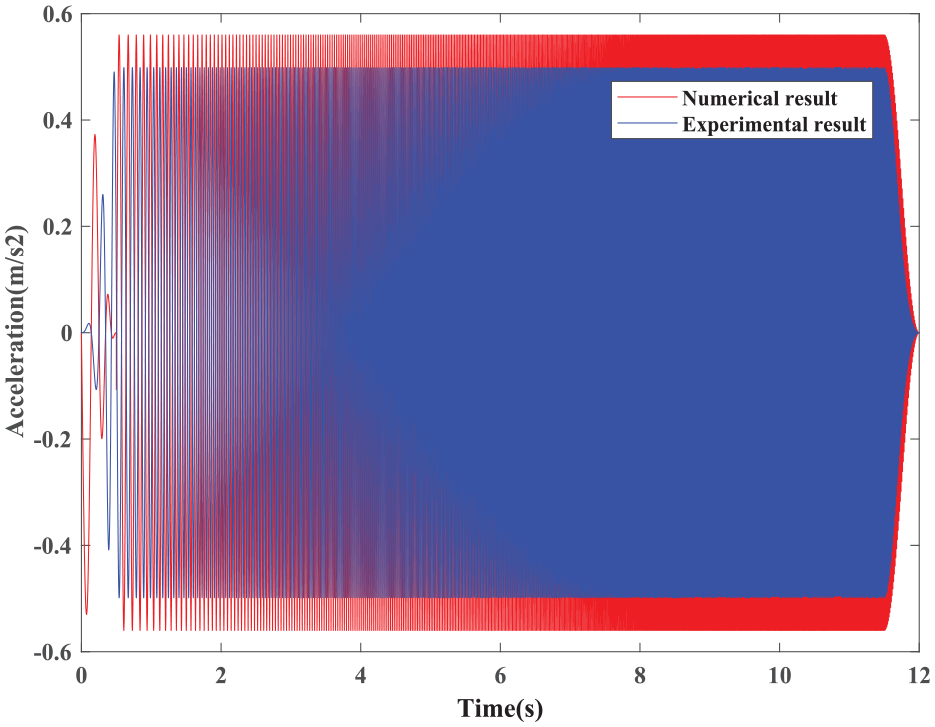
Comparison between the numerical and experimental acceleration.

Vibration speed at different positions.
Although, due to substandard construction techniques and untimely maintenance in the later stages, some concrete roads may not be completely continuous with the ground, and there may be various defects such as holes and cracks. The model proposed in this study didn’t consider the existence of such defects, which has certain limitations. However, the model proposed in this study also provides guidance for considering how the captured road influences the excitation effect of the vibrator.
Analysis of energy excitation effect of vibration system considering captured road
From equation (2), it can be seen that the weight of the reaction mass, the baseplate, and the weight of the captured road will affect the excitation effect of the vibratory vibrator. In order to clarify the influence of the captured road on the energy excitation effect, this paper will carry out the analysis of the energy excitation effect of the vibration system based on the weight change of the captured road.
Analysis of the influence of captured road on vibration system
Without considering the road vibration, the vibratory vibrator baseplate will be in direct contact with the ground, and the contact damping stiffness between the baseplate and the ground is c4, c5, k4, k5. 17 X4, X5 are displacement of reaction mass and baseplate; Y4, Y5 are velocity of reaction mass and baseplate; Z4, Z5 are acceleration of reaction mass and baseplate; the dynamic equation of the vibration system is as follows:

The formula (2), (6), and (7) can be solved.
From Figures 9 and 10, it can be seen that the captured road has little influence on the displacement of reaction mass in the whole working cycle. However, the captured road will greatly affect the displacement of baseplate, and the change of displacement will also affect the energy excitation effect of the vibration system. Therefore, it is of great significance to study the excitation effect of vibratory vibrator system considering the captured road, and it is worth further exploration.

Reaction mass displacement comparison.

Baseplate displacement comparison.
Analysis of vibration system excitation effect considering the captured road
According to the research in Li 17 and Peng, 18 the exciting effect of the vibratory vibrator can be evaluated by the output energy and energy transfer rate.
The output energy of the vibratory vibrator at a certain moment is the energy absorbed by the ground when it is acted by the vibration system. The formula is:

Where: t1, t2 are the time corresponding to the adjacent valleys and peaks, fz is the contact force-displacement relationship between the road and the ground in the vibrator system, zs is the displacement of the road in the static equilibrium position, and T is the working period of the vibrator system. In addition, under the working state of the vibrator system considering road vibration, the reaction mass, the baseplate, and the road will all consume part of energy in the vibration process, which is approximately expressed as the kinetic energy of the reaction, the baseplate, and the road, so the total energy of the vibration system is:

By solving the formula (2), (6), (8), (9), we can get:
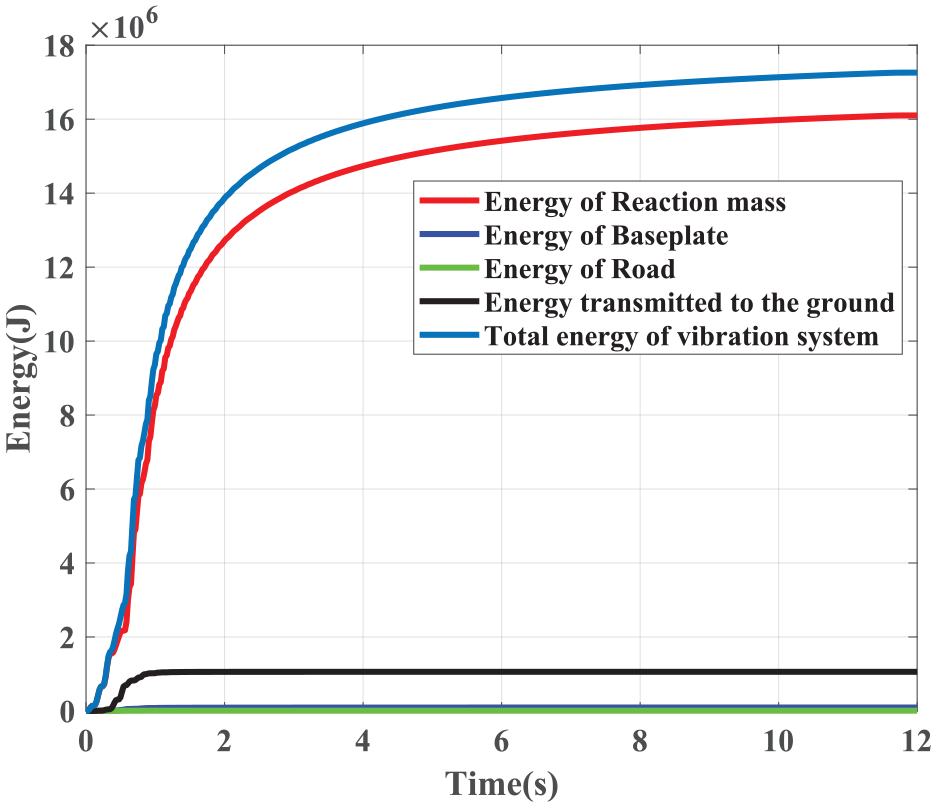
As can be seen from Figures 11 and 12, considering the captured road, the energy received by the ground when the vibratory vibrator system excites is 9.3e5 J, the total energy of the vibration system is 1.69e7 J, and the output energy accounts for 5.5% of the total energy of the vibrator system; However, when the captured road is not considered, the energy received by the ground is 3.1e6 J, and the output energy is 2.17e6 J. Meanwhile, the output energy of the vibration system without the influence of the captured road is obviously better than that of the model considering the road, and the intervention of the road will accelerate the output energy dissipation in the high frequency stage.

Output energy of different models.
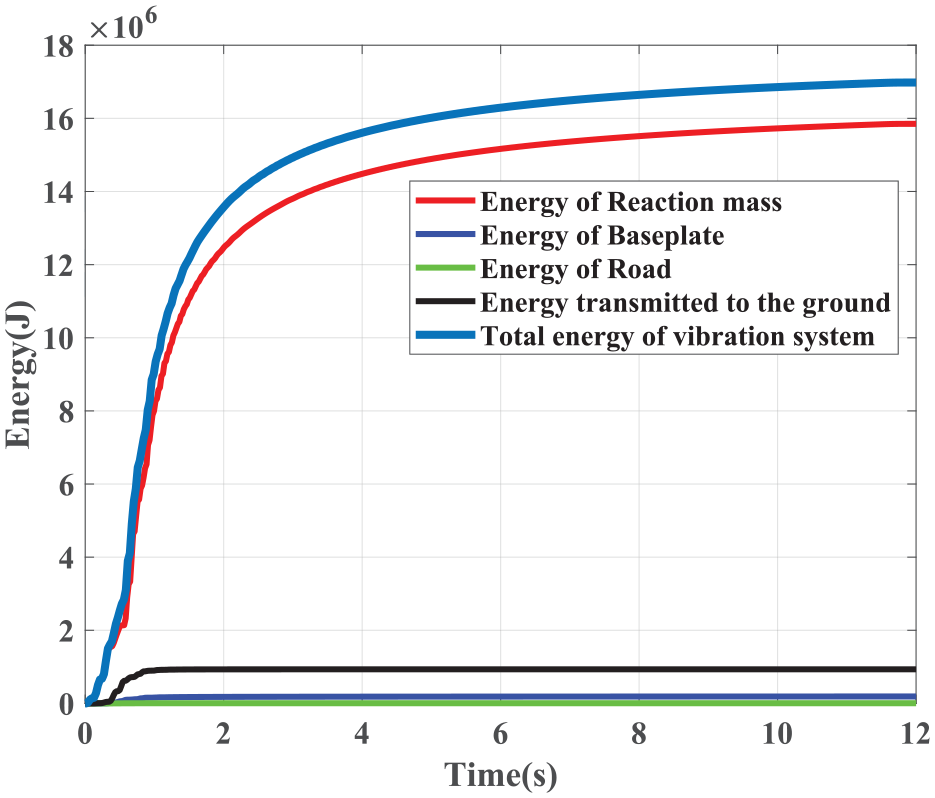
Energy ratio of vibration system.
In addition, the output energy of vibratory vibrator increases rapidly in low frequency band, and the growth rate of output energy decreases rapidly. Through comparison, it can be found that the vibration energy of vibrator’s reaction mass and baseplate is relatively fast at this stage, which indicates that the most downward transmission period of vibration energy is in low frequency excitation stage, while the vibration energy in high frequency band is mostly consumed by the movement of baseplate and reaction mass.
Study on optimization of vibratory vibrator structure
In view of the low output energy and energy transfer rate of vibration system considering captured road reflected in the previous section, this section will optimize the baseplate of vibratory vibrator in order to improve the excitation effect of vibration system.
Research on improvement of vibratory vibrator structure based on topology optimization
Literature Ding 19 found that the energy loss in the vibration process can be effectively reduced and the excitation energy can be improved by reducing the weight of the baseplate and the reaction mass. However, because the reaction mass of vibratory vibrator is the core component of vibrator excitation, changing its structure may affect the excitation of vibration system energy, so the research on optimization of reaction mass structure is generally not carried out. Therefore, this study mainly adopts the solid isotropic material with penalization (SIMP) model of variable density method to carry out structural topology optimization with the stiffness and mass of vibrator baseplate as the target parameters, and its mathematical model is:
Objective function:

Constraints:

Where:
The appropriate objective function can be selected according to the actual situation in topology optimization design. One of the most used objective functions is flexibility, that is, the minimum structural flexibility is used to represent the maximum stiffness. The flexibility objective function of SIMP method is:

Where:
During the working process of the vibrator, the high-pressure hydraulic oil produced by the hydraulic system will alternately enter the upper and lower cavities between the reaction mass and the piston rod, thus driving the reaction mass to move up and down. The reaction force of the hydraulic oil is transmitted to the baseplate through the piston rod, so that the signal produced by the vibrator can be transmitted to the ground. According to the structure and working characteristics of BV500 vibratory vibrator, the model is simplified: (1) Simplify the reaction mass and its accessories, and directly load the reaction mass force, static load, and dynamic load on the model as known loads; (2) Simplify the whole aluminum alloy baseplate; (3) Establish a simplified concrete road and hard ground model, and the specific model parameters are shown in Table 2.
Model material parameters.
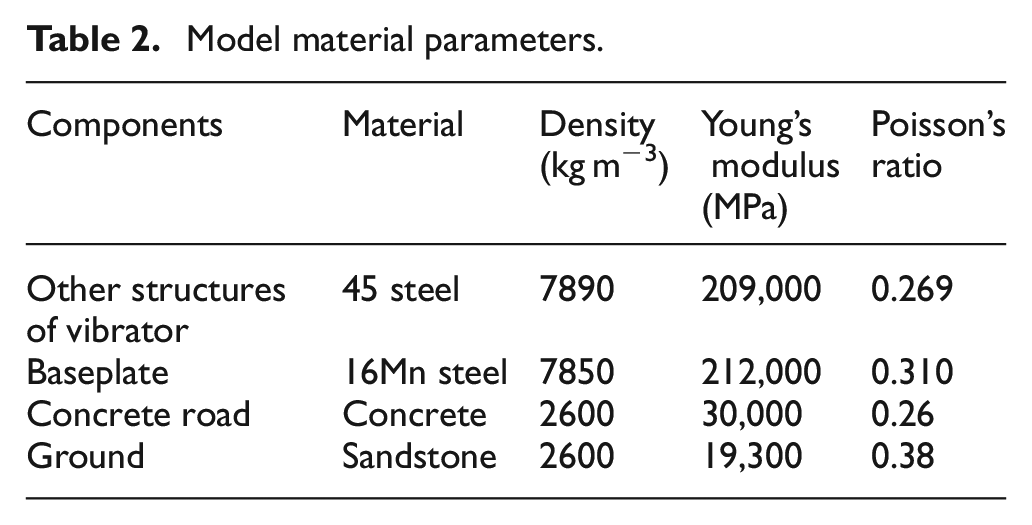
The specific load parameters in this model are as follows:
(1) Dynamic load: The signal frequency is 3–96 Hz, and the peak value of 70% interaction force signal is 154 kN. In the simulation, for the convenience of calculation, the maximum load of sinusoidal load is selected to act on the end face of piston rod to simulate the hydraulic pressure, as shown in Figure 12.
(2) Static load: 190 kN acts on six air springs on the left and right sides of the baseplate, as shown by the red arrow in Figure 13. The weight of reaction mass is 2750 kg, which acts on the upper and lower sides of the vibrator baseplate evenly through two gravity compensation airbags, as shown by the yellow arrow in Figure 14.
(3) Constraint: the contact between the baseplate and the concrete road, the concrete road and the hard ground is set as rough (only static friction occurs, that is, the normal direction can be separated, but the tangential direction can’t slide relatively), and the contact of other parts is set as bonded (there is no tangential relative sliding or normal relative separation between the contact surfaces or contact edges). The lower end of concrete fixed and restrained.
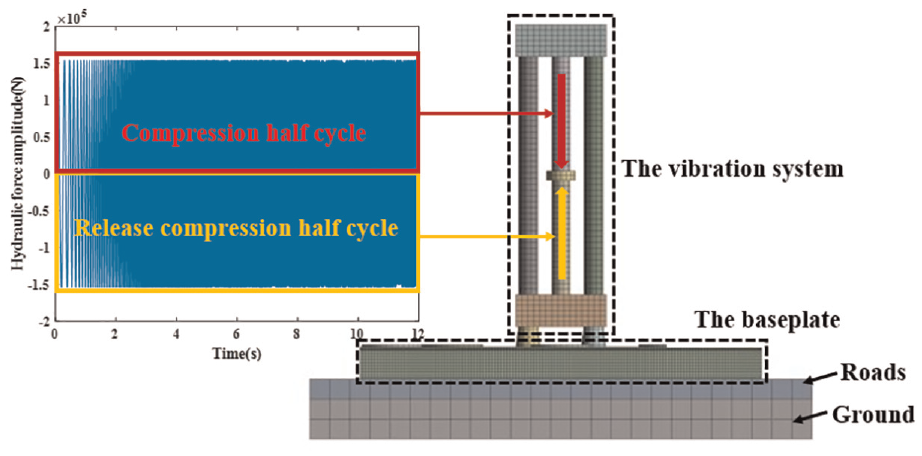
Topology optimization model of I-beam baseplate.

Topology optimization model of I-beam baseplate structure.
Similarly, the deformation of I-beam baseplate, concrete road, and ground is in the elastic deformation stage, so the materials of I-beam baseplate, concrete road, and ground are selected as elastic materials, 16Mn for I-beam baseplate, concrete for road, and sandstone for ground.
(1) optimization region: Define the aluminum alloy baseplate as an optimized region.
(2) objective (constraint target):The maximum stiffness under volume constraint is adopted, that is, the minimum compliance is set to represent the maximum stiffness.
(3) response constraint: Considering the load-bearing area and the middle dynamic load area, in order not to affect the performance of the baseplate and ensure a certain strength of the baseplate, the volume fraction of the constrained optimization area should not be less than 70%.
Topology optimization results and analysis
By solving the topology optimization, the optimization result can be obtained as shown in the Figure 15, in which the transparent part is the removable material part after optimization. The above topology optimized baseplate structure is irregular, which will make the processing process extremely complicated, resulting in poor manufacturability. Considering the manufacturability of plate processing, it is necessary to process the original topology optimized result, and the processing result is shown in Figure 16.

Optimization Results of I-beam Bottom Baseplate Topology.

Baseplate after material removal.
It can be seen from the Table 3 that the overall mass of the optimized baseplate is reduced by 45.3% under the condition of meeting the stiffness requirements, and the optimization results meet the requirements of topology optimization. According to the quality of the optimized model, the baseplate is applied to the vibratory vibrator excitation model, and the solution can be obtained.
Comparison of model parameters before and after optimization.

Comparison of energy consumption can be obtained as shown in the Figure 17 the trend of energy consumption of the baseplate in the low frequency band has not changed, but the growth rate of energy consumption in the high frequency band has slowed down, and the energy consumption in the whole working cycle is 2.18e5 J. After optimization, the energy consumption is only 9.3e4 J, and the energy consumption is reduced by 57.3%, which greatly reduces the energy consumption of the baseplate during vibration. As can be seen from Figure 18, under the condition that the total energy of the vibration system is 1.69e7 J, the energy received by the ground is 1.1e6 J, accounting for 6.5% of the total energy. Compared with 9.3e5 J before optimization, the energy excitation effect is improved by 18.2%.

Comparison of energy consumption.
Energy proportion after optimization.
Conclusion
In this paper, based on the basic vibration attenuation formula, the weight of the road captured by vibration is calculated, and the variation law of the weight of the captured road with frequency is obtained. A vibratory vibrator baseplate-road-ground model is constructed, and the vibratory vibrator energy excitation effect considering the captured road and the topology structure optimization of the baseplate are carried out. The main conclusions are as follows:
(1) The vibratory vibrator baseplate can capture the road between the baseplate and the ground when vibrating, and the weight of the captured road decreases exponentially with the increase of vibratory vibrator vibration frequency, which will have a great impact on the energy excitation effect of vibration system.
(2) From the vibration energy excitation effect of vibratory vibrator, the energy excitation effect of vibratory vibrator is better when it is excited at low frequency, but the vibrator structure will consume most of the energy in both high frequency and low frequency, in which the reaction mass will consume more than 90% of the energy of the vibration system, and the energy actually converted into vibratory waves only accounts for 5.5% of the total energy;
(3) According to the topology optimization theory, it can be concluded that the weight of the baseplate can be reduced by 45.3% and the energy excitation effect of vibratory vibrator can be improved by 18.2% by cutting off the four corners of the baseplate and replacing the whole aluminum alloy block with I-beam.
In the above research, the vibratory vibrator energy excitation effect considering the captured road is analyzed, and the vibratory vibrator baseplate is improved by topology optimization method, which improves the energy received by the ground. The research results will provide a reference for improving the vibratory vibrator energy excitation effect considering the captured road.
Footnotes
Handling Editor: Chenhui Liang
Declaration of conflicting interests
The author(s) declared no potential conflicts of interest with respect to the research, authorship, and/or publication of this article.
Funding
The author(s) disclosed receipt of the following financial support for the research, authorship, and/or publication of this article: This work is supported by National Natural Science Foundation of China (Grant No. 41902326), Science and Technology Program of Sichuan Province (Grant No. 22GJHZ0284), and Nanchong City & Southwest Petroleum University Science and Technology Strategic Cooperation Special Fund (Grant No. SXHZ048), and the Fundamental Research Funds for the Central Universities of Southwest Minzu University (2021NQNCZ05).
