



Abstract
Transmission towers operate in complex engineering environments, such as gravity, strong winds, ice and snow, wire breaking and unbalanced loads. Owing to complicated structural parameters, multiple load cases and multiple constraint conditions, the optimal design plan of the structure is difficult to acquire. Popular intelligent algorithms (Genetic Algorithm, GA; Particle Swarm Optimisation, PSO; and others) need to spend time in structural mechanical computation and search processes. To solve this problem, the commercial FE software ABAQUS was used to build the full parametric analytical and computational sub-procedures (general static, linear buckling and cost computation) for the transmission tower under multiple load cases and constraint conditions. Then, the main algorithm procedure, KSM-GA, was developed based on the GA optimiser and Kriging Surrogate Model (KSM). The KSM-GA could import the design variables (such as cross-section properties and structural dimensions) of the transmission tower into the FE computational sub-procedures and read the results (including stresses, displacements, buckling load and weight). The results show that the KSM-GA can reduce the search time more than 30% compared with the GA, PSO and BO-GP( Bayesian Optimisation with Gaussian Process) while the training precision of the KSM is above 99% accuracy of the FE results.
Keywords
Introduction
The transmission tower is mainly used in the process of electricity transmission, which is a critical safeguard of the electric energy supply. As shown in Figure 1, the entire structure of a transmission tower is commonly assembled using mounts of discrete steel components through welding or bolting connections. It works year-round in a harsh outdoor environment under multiple loads, namely, electric wire, attachment equipment, wind, ice and snow.

The transmission tower in the electricity engineering.
Depending on the type of design variables to be optimised, the aspect of transmission tower optimisation can be divided into shape, size, topological and layout optimisation. Wang and Dong 1 studied the shape optimisation of transmission towers and established a generalised variable optimisation model, which reduced the total weight of 110 V linear towers by 12.73%. Kaveh and Mahjoubi 2 developed an improved version of the spiral optimisation algorithm (SPO) for the shape and size optimisation of a tower truss under multiple frequency constraints. Rahman et al., 3 Hooshmand and Campbell, 4 Asadpoure and Valdevit 5 and Gao et al. 6 investigated the optimal topological structure of discrete towers using external approximation, design synthesis and minimum grid density methods, respectively. Noii et al. 7 used the improved augmented Lagrangian genetic algorithm (ALGA) and quadratic penalty function genetic algorithm (QPGA) to optimise for the topology and size of the 57 pole transmission tower structure. The optimisation results were 29 and 9% lighter than the traditional design values, respectively, and the optimisation effect was significant.
Layout optimisation is a combination of size, shape and topological optimisation. Gholizadeh and Poorhoseini,8,9 Ahari and Atai, 10 Ahrari and Deb 11 and Zhang and Li12,13 used particle swarm optimisation algorithm (PSO), dolphin echo location algorithm, ant colony algorithm or improved ant colony algorithm and evolutionary algorithm, respectively. Their aim was to optimise the layout of the ‘equivalent’ truss structures in truss engineering, especially large truss structures such as 47 the ole transmission tower structure and 582 pole tower structure. Ahari successively proposed the full stress evolution strategy (FSD-ES) and improved the full stress optimisation strategy (FSD-ES-II) for member structures. With the stress of the member elements as the constraint criterion, the adaptive penalty function and covariance were used to provide a global optimisation criterion for layout optimisation. Zhang also compared the results of these four types of optimisation issues. In the overall optimisation design of the transmission line tower structure, after the size optimisation, the cost of the new structure is reduced by approximately 16.5% compared with the original model. After the shape optimisation, it is reduced by 21.3%, and after the topology optimisation, it is reduced by approximately 19.6%. Furthermore, after the layout optimisation, the cost of the new structure is reduced by approximately 23.8%.
The optimal design of a transmission tower can not only decrease the whole structural weight or manufacturing costs but also improve the structural security performance in bearing multiple outer loads. Natarajan and Santhakumar 14 first proposed an optimisation program for transmission towers based on structural reliability and found that the reliability of a 110 kV transmission tower increased with an increase in its structural weight, but there was an extreme value at 3.325 t. Tsavdaridis et al. 15 introduced strong wind and icing load constraints into the topology optimisation of transmission towers. The topology framework of the transmission towers was combined with shape optimisation of the cross-section properties. After layout optimisation, the weight of the structure itself also decreased by 46%, and the resistance performance to wind and ice was significantly improved. Li et al. 16 and Wu et al. 17 studied the anti-buckling mechanism of discrete structure booms and established a Stability Ensured Soft Kill Option (SSKO) based on the soft killing algorithm SKO to ensure the stability of discrete structures, which was effective for the stability optimisation of discrete structures and the light weight of the overall structure.
In addition to the above optimisation methods, several other algorithms have been introduced or developed to solve the optimisation issues of transmission towers. For example, Kaveh18,19 introduced a cascade optimisation algorithm to solve the transmission tower optimisation problem with a high number of design variables, a large size of the search space, and a great number of design constraints. Tort et al. 20 integrated a novel two-phase simulated annealing (SA) algorithm into the commercial PLS-TOWER software. He aimed to optimising the steel lattice towers for minimum weight according to the ASCE 10-97 design specification using both the size and layout design variables. Li et al. 21 introduced the plant growth simulation algorithm PGSA to optimise the manufacturing costs of tower structures. The advantage of the KSM-GA approach developed in this study over previously published algorithms, for example, ordinary GA, particle swarm optimisation (PSO) and simulated annealing (SA) is the decrease in the number of calls for the sub-procedures of the structural security and economic index computations, which would consume too much time in the search process.
The high-precision surrogate model method had been investigated in the engineering optimisations. Meng et al.22,23 introduced three RBMDO (reliability-based multidisciplinary design optimisation) methods with different reliability analysis strategies. Teng et al. 24 summarised the series-parallel and expansion methods, multi-extremum surrogate models and decomposed-coordinated surrogate models for the multi-objective dynamic reliability analysis of complex structures. An UCO (an uncertainties-based collaborative optimisation) strategy using saddlepoint is proposed by Meng et al. and validated to solve multidisciplinary design problems with higher calculation efficiency. Motoyama et al. 25 provided the optimisation tools for PHYSIC based on Bayesian Optimisation. PHYSBO can be used to find better solutions for both single and multi-objective optimisation problems. Luo et al. 26 developed a novel enhanced MCS approach with an advanced machine learning method, namely hybrid enhanced MCS (HEMCS). Compared to the enhanced MCS, the proposed method provides higher flexibility for the prediction of failure probability.
This article describes the optimal shape and size structure of a 110 kV transmission tower marked as ZC27153-63 under multiple load and constraint conditions. Compared with GA, PSO and BO-GP, 25 the search time was significantly shortened. First, a mathematical optimisation model of a 110 kV transmission tower composed of steel components was built with the optimisation objective of minimum structural cost considering the price variance between steel materials Q235 and Q355. The model considered the rigid connections of the components, multiple load cases (including gravity, wind, snow and wire breaking) and constraint conditions (strength, rigidity and buckling stability). Then, a parametric FE model and analytical procedures were created in ABAQUS to compute the structural security performance under multiple loading cases. Finally, the Kriging Surrogate Model (KSM) with Latin Hypercube Sampling (LHS) technology was introduced to train the relationship between the shape and size variables, structural stresses, displacements and buckling factors. The updated GA searching algorithm could call for KSM training models instead of computational procedures, including mechanics index computations and structural costs.
Building mathematic optimisation model
The studied structure of the transmission tower mainly consists of the leg, body-1, body-2, body-3 and double tower booms, as shown in Figure 2, which are all welded using triangular steel components of various sizes. These components are divided into three types according to their functions: chords, diagonal bars and auxiliary bars. The total design height of the transmission tower below the booms is H = 54 m, including the height of leg D4 and the height of tower bodies D5, D6 and D7. The widths of the tower leg and body are D1, D2 and D3, respectively. The cross-section of tower body-3 is prismatic, and the height and width of the head-end booms (position connected with body-3) are both equal to the width of body-3 WS2. The other end of the boom is D8, as shown in Figure 2(b). The invariant geometric parameters, shown in Figure 2, are listed in Table 1.
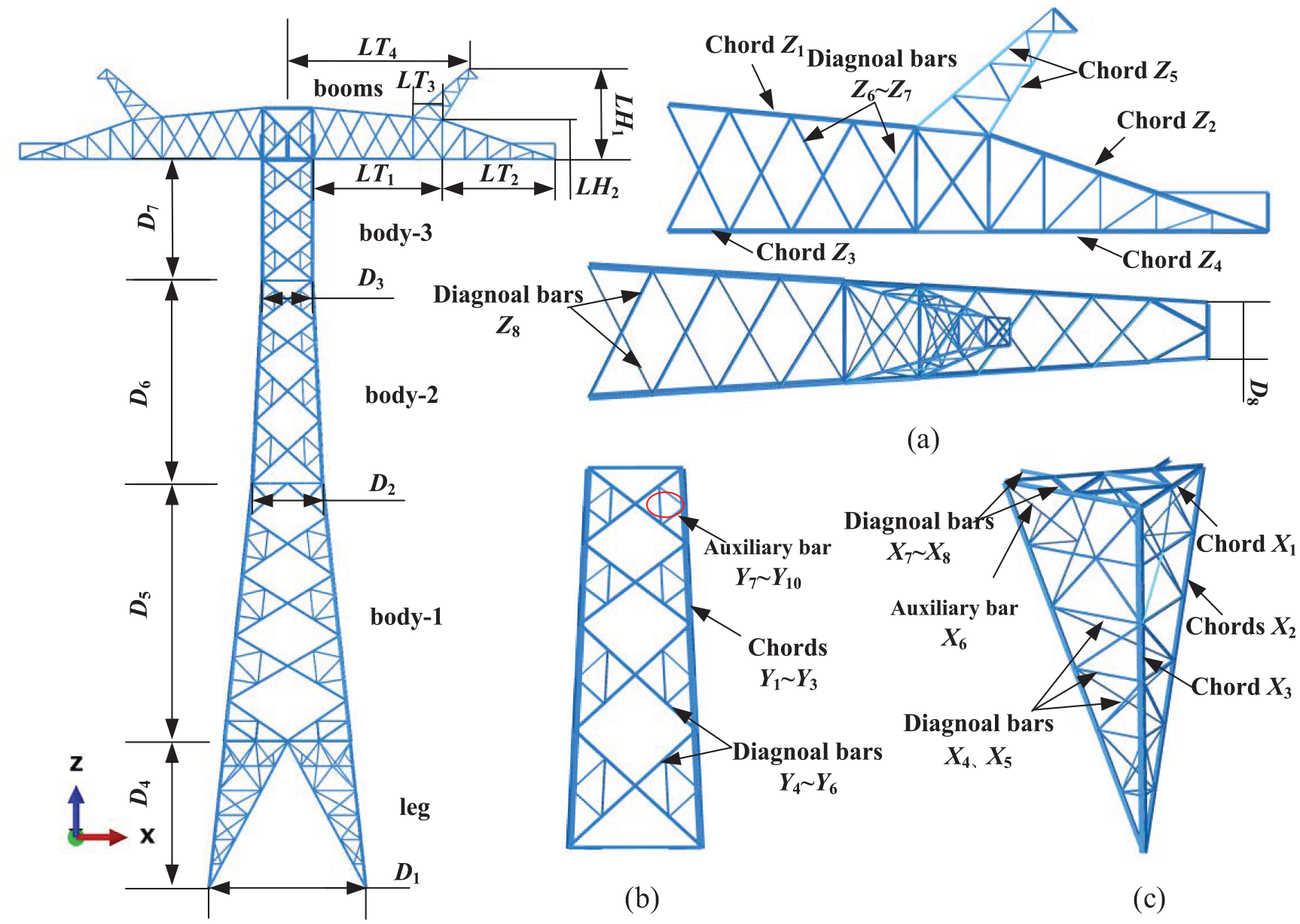
Structural design parameters and design variants in the tower structure: (a) shape and size variants in booms, (b) size variants in bodies and (c) size variants in leg.
Invariant geometric parameters marked in Figure 2.

Design variables
A total of 34 design parameters, shown in Figure 2 were chosen as the design variables in the mathematical optimisation model. These variables consist of size variants representing the cross-sectional properties of the components and shape variants representing the geometric dimensions of the structure.
The size variants are expressed as

The shape variants are expressed as

The alternative domains for size and shape variants are listed in Tables 2 and 3, respectively, where {a, t, M} represents the cross-sectional properties of the triangular steel components, {a, t} is the size of the cross-section of the components, M is the optional material name with different yield strengths of the components. S1, S2 and S3 are alternative domains for the size variants of the chord, diagonal and auxiliary components, respectively. The initial design values of the shape variants are underlined. For the alternative domains in Table 3, the value 11,900 in ‘11,900 ± i × 200; i = 1, 2, 3’ is the initial design value of variant D1.
The size design variables and their alternative domains (unit: mm).

The shape design variables and their alternative domain (unit: mm).

Treatment of the multiple load cases and constraints
The transmission tower is an important infrastructure for electric transmission, working outside under wind, rain and snow weather all the time. Hence, all dangerous loading cases should be calculated and checked to ensure their mechanical performance. Different countries have formulated their own design rules for the security checking of transmission tower structures. According to the Chinese Code GB 50545-2010 for the design of 110–750 kV overhead transmission lines, the loads applied to the transmission tower under dangerous working conditions are classified in the following seven cases, as listed in Table 4. These load cases include the most dangerous combinations of gravity, wind loads, iced loads and wire loads.
The loads applied to the tower structure under the dangerous working conditions.
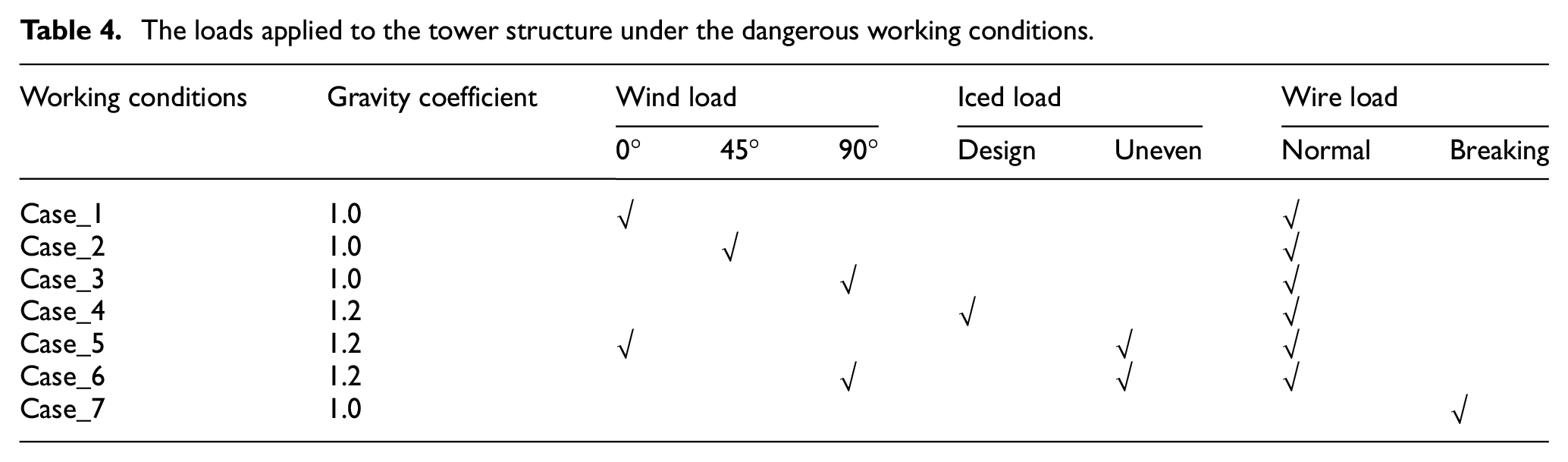
The applied loads are shown in detail in Figure 3. The designed wind speed v = 12 m/s at a standard height of 10 m and three different wind directions with angles of 0°, 45° and 90° were checked. The tensions FC and FG of the conductor wires and ground wires under normal conditions were 199.81 and 37.60 kN, respectively. However, if the transmission tower works in ice and snow weather, the surfaces of the wires and tower are covered with ice and snow. In those cases, FC and FG would become larger with the design values 299.7 and 55.60 kN, respectively. Meanwhile, the computing gravity of the transmission tower also increases by 1.2 times that of the origin. However, if the wires break owing to an unexpected accident, the corresponding tension of the wire drops to zero.

Applied loads on the transmission tower structure.
The mechanical analytical procedure of the general static and linear buckling module under the above conditions Case_1–Case_7 was solved with the secondary development procedures (general static analyses and linear buckling analyses) in the FE software ABAQUS. To ensure safety, the mechanical indices of stresses, displacements and buckling load factors under all working conditions should satisfy GB 50545-2010. This implies that the following constraint conditions should be satisfied:
(1) Constraint for the maximum stresses in the components:
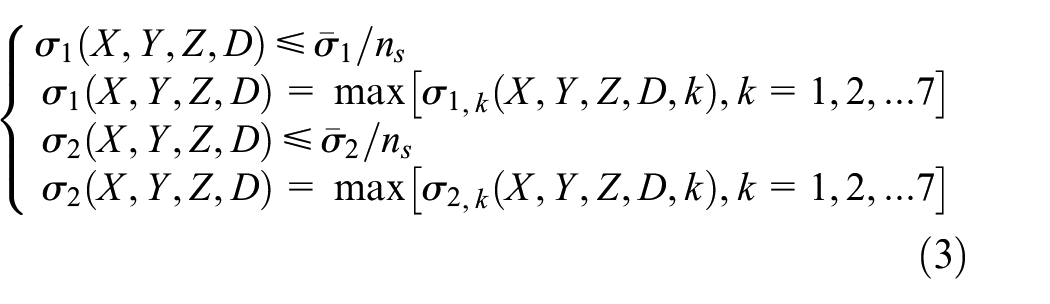
where σ1 and σ2 are the maximum Von Mises stresses of components Q235 and Q355, respectively, which can be extracted directly from FE computations.
(2) Constraint for the maximum Z-direction deflections

where
(3) Constraint for the maximum buckling load factor of the entire structure:

wherein, F0 is the initial loading force. If setting F0 = FG replaces the initial loading forces in the sub-procedure of the linear FE bucking analyses, the extracted buckling load factor λ should be greater than or equal to 1.
Mathematic optimisation model
As mentioned in Section ‘Design variables’, the investigated structure of the transmission tower was made of two different steel materials, Q235 and Q355. The mechanical properties (density ρ1, elastic modulus E1 and Poisson’s ratio υ1) of steel Q235 are ρ1 = 7.24 × 10⁻⁶ kg/mm3, E1 = 2.09 × 10⁵ MPa, υ1 = 0.25, while those of steel Q355 ρ2 = 7.35 × 10⁻⁶ kg/mm3, E2 = 2.10 × 10⁵ MPa, υ2 = 0.30. The prices of steel Q235 and Q355 are p1 = 4200 and p2 = 4500 yuan per ton in Chinese market. The optimisation objective in this study is to minimise the structural costs of the transmission tower marked as ZC27153-63 (Z means intermediate transmission tower, C is the cross type of tower bodies) based on its initial structural design plan.
The total structural costs can be acquired by separately calculating the weights of the Q235 and Q355 components. Based on Sections ‘Design variables’ and ‘Treatment of the multiple load cases and constraints’, the mathematical optimisation model for the minimum structural costs T_C of the transmission tower was established as follows:

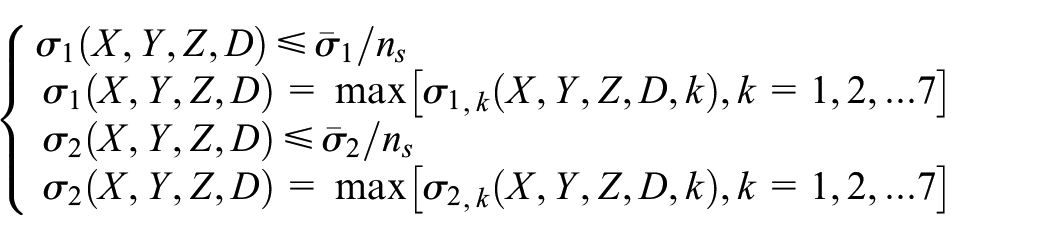
(1) Constraint of the Von Mises stresses
(2) Constraint of the displacements

(3) Constraint of the buckling load factors

the components X1–X3, Y1–Y3 and Z1–Z5∈
Kriging Surrogate Model and its training samples
Kriging modelling method
The Kriging Surrogate Model is a stochastic interpolation algorithm that assumes the Gaussian process to be the model of the input and output variables. Consequently, the output data

where

where n represents the training sampled points of the real output data; R(
If the correlation function is the Gaussian function, then

where p is the dimension of sampled points
The construction of a Kriging Surrogate Model for transmission tower optimisation can be explained as the following. Firstly, a set of sampled points between the input data


The number of shape and size design variables in the article is p = 34, so
From these sampled points, unknown parameters



where
However, before calculating



where
The principle of generating samples points with Latin Hypercube Sampling
The generation of sampled points in the KSM can be stochastic or deterministic. The well-known sampling methods, in principle, include Stratified Sampling, Monte Carlo Simulation and Latin Hypercube Sampling.
The Latin Hypercube Sampling (LHS) method
32
was introduced to increase the efficiency of the model training of KSM, which operates by dividing the subspace of each shape and size variable

where
Optimisation procedure with KSM-GA method
Based on KSM with LHS and GA optimiser, a new training and optimisation method, KSM-GA, was developed in this study to solve the mathematical model built in Section ‘Mathematic optimization model’. The optimisation process is plotted in a schematic flowchart in Figure 4. The main algorithm procedures of the KSM-GA were developed using Pycharm software with Python. The sub-procedures of parametric FE analyses, including general static analysis, linear buckling analyses and structural cost computation, were developed by the secondary development platform using the commercial software ABAQUS.
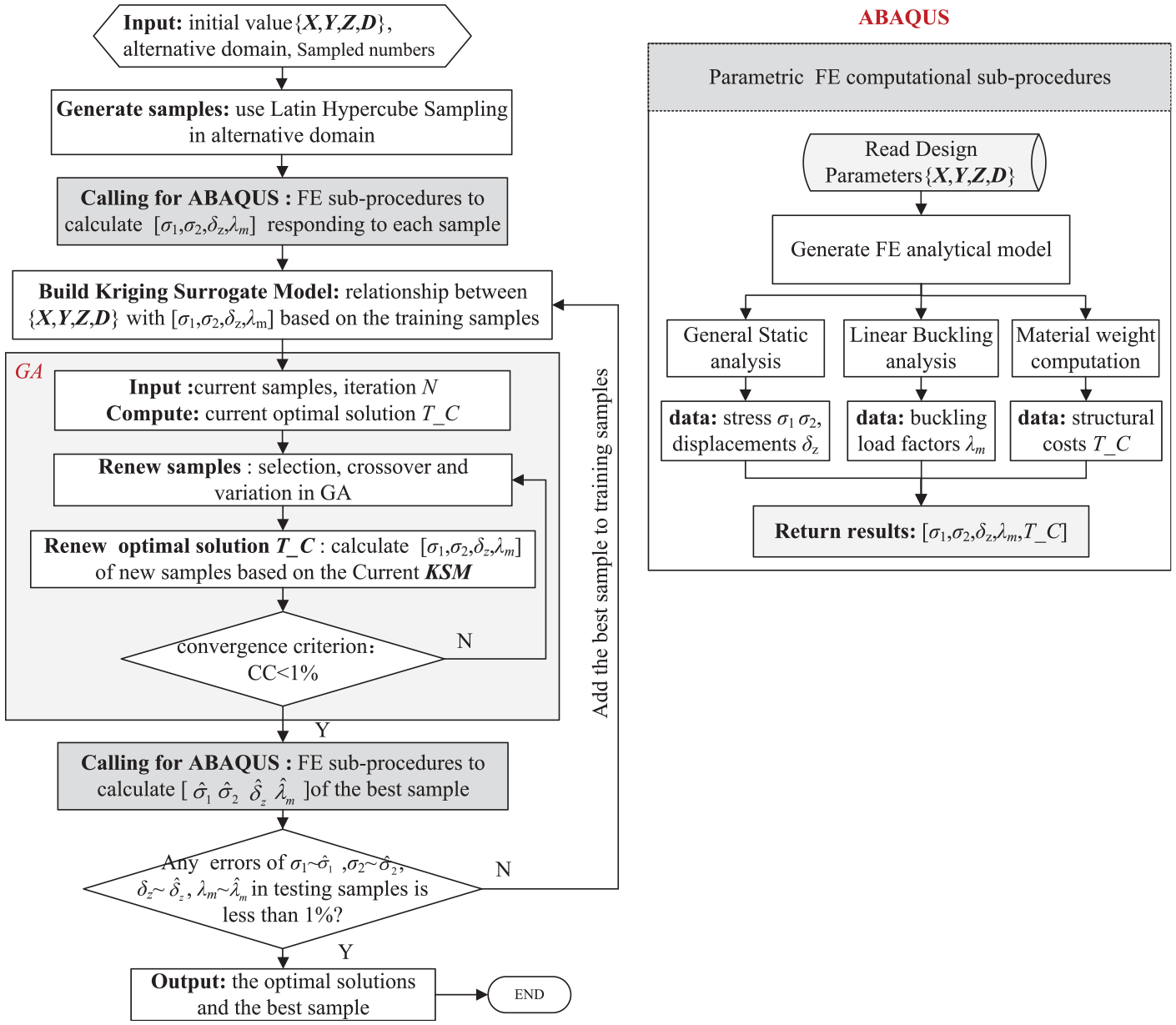
Schematic flowchart of KSM-GA.
The principle of parametric FE analysis sub-procedures is shown in Figure 5. KSM-GA calls for ABAQUS using system command os.open(r’ abaqus cae nogui=’’). They exchanged the design variants and analytical results through the txt files. The parametric script file was developed in the secondary development of ABAQUS with python command, and the developed steps can be concluded in the following.
Geometric modelling: The structural components of the tower crane were modelled by linear elements of type B31 with two nodes. The necessary geometric characteristics are shown in Figure 2.
Assigning materials and section properties to all components: The step included inputting the density, elastic modulus and Poisson’s ratio of materials Q235 and Q355, and then assigning the material and section {
Loads and constraints: Multiple loads were applied to the transmission tower according to the seven working conditions, and then the end of the legs is fixed with all freedoms off.
Meshing: All the components were meshed with five linear elements (type B31).
Solutions: The General Static or Linear Buckling analytical module was implemented in ABAQUS and then the analytical jobs were submitted for the computation.
Obtain the analytical results: The Von Mises stresses, displacements, buckling load factors and structural weights of components Q235 and Q355 were obtained.

The principle of FE parametric calculations in KSM-GA.
The main procedure, KSM-GA, requires the FE sub-procedures to obtain the Von Mises stresses, displacements, buckling load factors and structural costs of the transmission tower. The main steps are as follows:
Input necessary data needed in the procedures, including the initial value of the shape and size variables [
Use LHS in Section ‘The principle of generating samples points with Latin Hypercube Sampling’ to generate n combination vectors about the shape and size variables of the sampling points,
Call for the FE sub-procedures to compute the maximum stress σ1, σ2, maximum displacements δz, minimum buckling load factor λm and structural costs T_C. The stresses, displacements and buckling load factors can be directly extracted from the FE analytical job, but the structural costs must be calculated using equation (9), based on the extracted data of the cross-sectional areas and lengths of the Q235 and Q355 components.
The Kriging Surrogate Model is built based on the sampling points of variable vectors
Introduce the optimiser GA to search for the minimum structural cost T_C and its corresponding variable vector [
Call for the FE sub-procedures again to validate the accuracy of the best sample points of the KSM. If the errors of the predicted data [σ1, σ2, δz, λm] are all less than 1% compared with the FE computing results, the main algorithm procedure KSM-GA is performed, and the minimum structural cost T_C and its corresponding variables vector [
Results and discussions
Optimal design plan with KSM-GA
The optimisation procedures developed in Section ‘Optimization procedure with KSM-GA method’ were performed for the optimal structural costs of the transmission tower. The main algorithm KSM-GA required 25 iterations to determine the optimal structural design plan. The optimisation results are listed in Table 6. It shows that KSM-GA decreases the structural costs by 5.93% from the initial 167,201.47 to 157,292.70 yuan. Meanwhile, the total structural weight declined 6.17% from 38,421.63 to 36,051.49 kg. The optimised plan changed the proportion of steel material Q235 (initial 38.1%; optimal 39.8%) and Q355 (initial 61.9%; optimal 60.2%) in the structural components, which caused different reduction ratios in the structural costs and total weight. The optimised design variables included size variables (such as X1, X3, X4, X7, X8 and Y1) and shape variables (such as D1, D3 and D4). For example, the main chord X1 in the tower leg transfers from the initial
The mechanical performance of the transmission tower before and after optimisation was acquired from the parametric FE computational sub-procedures. Based on the loading cases in Table 4, the constraint indices for the seven working conditions were calculated, and the FE cloud charts of the stresses, displacements and buckling load factors in the worst working conditions are plotted in Figures 6 and 7. Before the optimisation, the worst working condition is Case_5 and the constraint indices of the maximum von Mises stresses (σ1, σ2), displacement δz and the minimum buckling factors λm were 213.02 MPa, 106.28 MPa, 55.59 mm, 3.1577, respectively. After the optimization, the constraint indices σ1, σ2, δz, λm were 216.99 MPa, 113.65 MPa, 62.09 mm and 3.2895. In the mathematical optimisation model, the allowable stresses and equation (3) were 221.88 (Q355) and 146.87 MPa (Q235), respectively. The allowable displacements

FE analytical results of the initial design plan of the transmission tower: (a) maximum stress, (b) maximum displacement and (c) minimum buckling load factor.

FE analytical results of the optimal design plan of transmission tower based on KSM-GA: (a) maximum stress, (b) maximum displacement and (c) minimum buckling load factor.
To validate the accuracy of FE models, some test data for the initial design plan of the tower ZC27153-63 was acquired from China Southern Power Grid Co. The loading case and test points A–E were shown in Table 5. Compared with the structural test, the error of FE calculation was below 15%. And the results from FE calculation are close to theoretical calculations using structural mechanics and design code GB 50545-2010.
The accuracy of FE computing model.

Compared with ordinary GA optimiser
To validate the performance of the KSM-GA, ordinary GA, PSO and BO-GP (Bayesian Optimisation with Gaussian Process surrogate model) methods are introduced in this subsection. The GA main procedure calls for the FE computing sub-procedures in the entire iterative process without the sampling technology and surrogate model training as the KSM-GA. Meanwhile, the optimisation flow of other optimiser PSO and BO-GP was plotted in Figure 8.

The optimisation flow chart of optimiser PSO and BO-GP.
Tables 6 and 7 list the performance data and optimal design plan of the GA, PSO, BO-GP and KSM-GA, respectively. It show the parallel computation from FE procedures have significant effect in the total searching time. These algorithms need spend 13.8 min without parallel computation in calling for ABAQUS to calculate a sample, which is more than twice that of parallel computation off.
Optimisation results of KSM-GA.

The performance of the optimisation methods.

With parallel computation on, the KSM-GA method spends less time about 31.43%, 38.42% and 38.22% than that of ordinary GA (32 h 21 min), PSO (34 h 21 min) and BO-GP (34 h 18 min), respectively. Most of the time cost in running GA and PSO is spent in the FE computing sub-procedures, which needed to be called 286 and 305 times before the final convergence. However, the number of calls was 148 and 113 for the BO-GP and KSM-GA. It proved the high efficiency of the combination of surrogate model with optimisation algorithms
The iterative processes of the total structural costs and component weights are shown in Figure 9(a) and (b), respectively. The optimal structural costs of the transmission tower searched by KSM-GA are 157,292.7 yuan, 0.98% less than that resulted from GA with 158,858.47 yuan. The KSM is also better than PSO and BO-GP method with less iterations and lower structural costs. Conversely, the total structural weight does not always decline in the iterative processes, as the optimisation objective in this study is the minimum structural cost (as seen in the black circle of Figure 9(b)). This indicates the inequality between the lowest structural cost and the lightest structural weight. Because of the different prices of steel Q235 and Q355 with similar densities, the structural costs are determined by both the total weight and proportion of steel Q235/Q355 components.
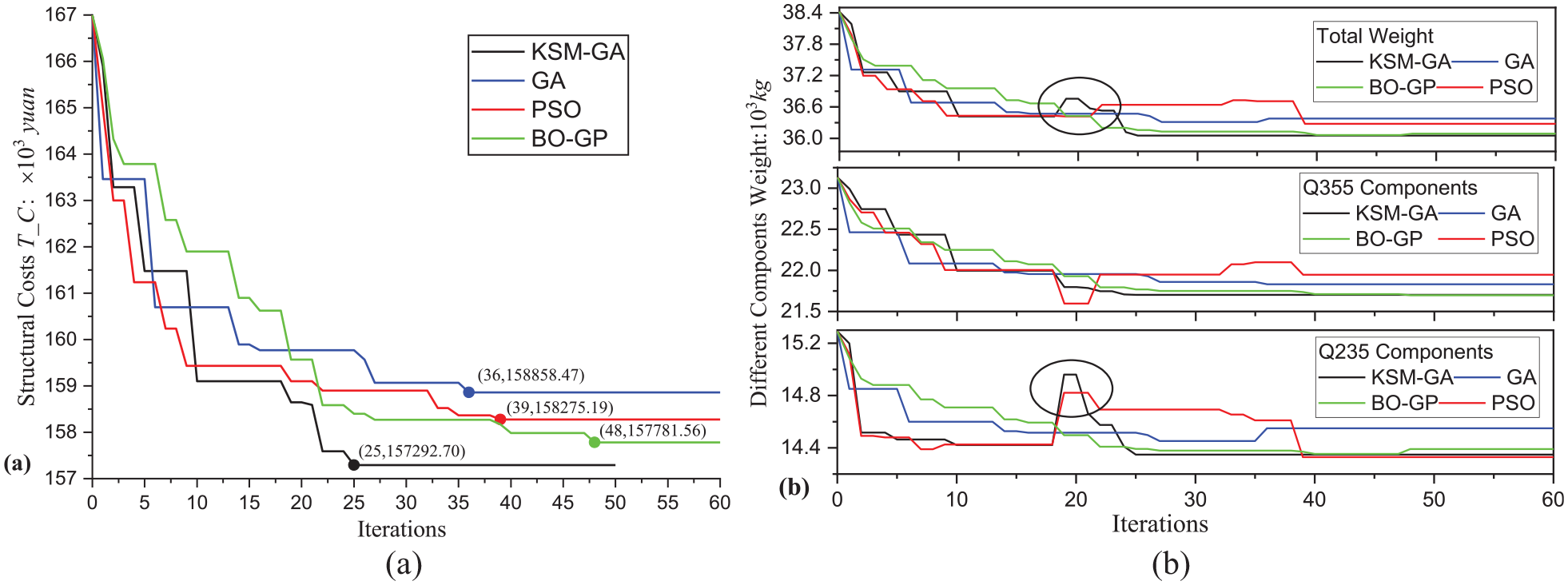
The solution iterative processes of KSM-GA and other optimisation methods: (a) structural costs T_C and (b) different components weight of Q235 and Q355.
Conclusions
In this study, the optimal design of a transmission tower with minimum structural costs was investigated by considering multiple loading cases and mechanical performance constraints. A full parametric mathematical model was established to satisfy the transmission rules of GB 50545-2010. The KSM-GA method was developed and it could call for FE computing sub-procedures (General Static analysis, linear buckling analysis and structural cost computation) in ABAQUS. The advantage of KSM-GA is the reduced number of calls by introducing Latin hypercube sampling technology and the Kriging Surrogate Model method. Based on the optimisation results, the following conclusions can be drawn.
The design plan for the minimum structural costs of a 110 kV transmission tower is presented in this article. Compared to the current plan, the optimal structural cost T_C decreases by 5.93%, and the total weight decreases by 6.17%. The optimal plan also shows that the main optimised positions are located on the size variables (such as X1, X3, X4, X7, X8 and Y1) and shape variables (D1, D3 and D4).
Compared with the ordinary optimiser GA, PSO and BO-GP, the developed KSM-GA method requires less time in all iterative processes by introducing Latin Hypercube sampling technology and Kriging surrogate model training, which significantly reduces the number of calls for the FE computation sub-procedures. The final optimisation results show that the KSM-GA saves more than 30% of the search time. Meanwhile, the parallel computation function from FE procedures has significant effect on the searching time for all the methods.
A significant observation is that the total structural weight does not always decline in the iterative processes when the minimum structural costs are set as the optimisation objective. The weight proportion of the steel Q235/Q355 components is also influential. Hence, researchers should consider structural costs more critically than lighter structural weights when improving the structural economic indicators.
Footnotes
Handling Editor: Chenhui Liang
Declaration of conflicting interests
The author(s) declared no potential conflicts of interest with respect to the research, authorship, and/or publication of this article.
Funding
The author(s) disclosed receipt of the following financial support for the research, authorship, and/or publication of this article: The authors were supported by Post-doctoral Later-stage Foundation Project of Shenzhen Polytechnic [Project No. 6023271002K] and Guangdong Basic and Applied Basic Research Foundation Project No. 2020A1515111024].
Data availability statement
The data that support the findings of this study are available from the corresponding author upon reasonable request.