



Abstract
The study of well-known Darcian fluidic streams and hybrid nanofluids is an essential need of nowadays researchers in regard to their exceptional heat transfer rates and implementations. The significance of hybrid nanofluids in controlling heat transmission cannot be overemphasized. Therefore, this article scrutinizes the Darcy Forchheimer flow of hybrid nanofluid toward a flexible tube. The flow rates near the surface of the cylinder are investigated by applying the Darcy-Forchheimer theory while examining the heat transfer rate, nonlinear convection expressions are used. The analysis also considers thermal radiation and chemical reactions. One of sophisticated numerical approach Runge–Kutta method (RK4) is selected for the proposed problem’s solution. The main novelty of present research is to examine the characteristics of hybrid nanofluids in the context of heat transfer over an extending cylinder for the purposes of enhancement regarding thermal transference and inertial impacts. Results shows that hybrid-based nanofluid provides upsurges in solid volume fraction of nanoparticles accompanied by an enhancement in the heat transfer rate by 4.32%, 5.8%, and 14.46% individually. The outcomes witnessed that hybrid based proposed nanofluids increased thermal transportation processes more effectively than other nanofluids.
Keywords
Introduction
Nanofluids, the evolution of regular fluids, are of interest to researchers of modern time due to their industrial applications. For the very first time, the terminology was introduced by Choi and Eastman
1
for optimal heat transmissions. The fabrication of nanofluids consists of dispersing nano-sized chemicals into fundamental fluids and is based on nanotechnology to subsequently enhance heat transfer rate. These mediums have a wide variety of applications in the transmission of heat, such as engineering, manufacturing, microfluidics, microelectronics, scientific, and micro-based processors. Later, his theory was applied to the creation of hybrid nanofluids by combining different nanoparticles with different chemical properties.
2
Hybrid nanofluids are defined as formulations by adding different nanoparticles with different chemical properties to a base fluid which can be used to retrieve the thermological competence of nanofluids. Gul et al.
3
examined the thermal performance of
Darcy’s extensive and well-known version is the Darcian fluid stream, which is typically used for inertia impacts. With the addition of the square demonstration at the end of speed, inertia is announced and who have consented to Forchheimer’s modification. Rasool et al. 21 studied the radiative Rosseland procedure on reactive Maxwell nanofluid flows to an isothermally heated sheet using the Darcy–Forchheimer model. In the same year, Rasool et al. 22 worked on the entropy generation for Cleveland Z-Staggered Cavity utilizing Darcy-Forchheimer flow of nanofluid. The transport of the Darcy-Forchheimer convective flux using hybrid nanoparticles in force on a rotating disk was considered by Hiremath. 23 Rasool et al. 24 investigated the numerical significance of the Darcy-Forchheimer model for MHD nanofluid flow bounded by a stretching surface. Alshehri and Shah 25 investigated computational observations on the Darcy–Forchheimer nanofluid on a porous medium with a viscous dissipation effect. During their work, Rasool et al. 21 considered Buongiorno’s model in order to investigate the effects of Darcy-Forchheimer space, radiative flux, Brownian diffusion, and thermophoresis on MHD Maxwell nanofluid flow subject to a surface being stretched. Several researchers have defined nanomaterials in order to describe their properties for engineering and industrial applications, see Refs.26–30
In the view of demands for meteoric energy transportations, heat can be transferred at a faster rate by using thermal radiative source. 31 These electromagnetic radiations travel with the help of wavelength and have optimal capability of penetration into media. Thus, they hold vital importance of in any thermodynamic transport system. By taking the linear Rosseland approximation into account, the impacts of thermal radiation on the flow of hybrid-based nanofluids, imposing a modified version of the Buongiorno nanofluid, has been well observed by Wakif et al. 32 Khan et al. 33 Studied the radiation-convective flux of the Casson gold-bloodnanofluid of the non-linear coupled differential system on a rotating surface. The researchers of Reddy et al. 34 analyzed the effects of radiation and chemical reaction on Casson nanofluid on a stretching surface during MHD heat transfer. Further surveys tell us about tremendous industrial and mechanical applications that involve rapid cooling stretching bodies. An initial concept of flow analysis over a stretcher cylinder was provided by Wang 35 and specifically observed the influence of stretching parameter on fluids motion. Later on, the similar idea was employed by Vajravelu et al. 36 when they modified the Wang’s model for investigating the heat transfer rate and impact of drag force. Sarada et al. 37 examined the flow of a water-based ternary hybrid nanofluid containing graphene, CNTs, and silver nanomaterials, bound by a curved sheet, and discussed how stretching, activation energy, and non-Fourier heat flux affected the flow. Likewise, the fluid streams along an extending cylindrical channel were analyzed with various reverberations by many analysts from last decades, such as Refs.38–43
Figure 1 show the preparation of hybrid nanofluids and geometry of the problem. In literature, numerous research works are available on nanofluids with different systematic methodologies and distinct variables. However, in view of the above literature, no one has taken hybrid nanofluids with this kind of flow setup. The main novelty of present research is to examine the characteristics of hybrid nanofluids in the context of heat transfer over an extending cylinder for the purposes of enhancement regarding thermal transference and inertial impacts. Mostly, the researchers strive to deal with the flow phenomena, involving external moving plates, whereas the motivation of the proposed research work is to examine the fluid flow generated by extended cylinder. Therefore, the Darcy-Forchheimer based mathematical model is used with combination of nanoparticles that is, TiO2 and Ag. In addition, thermal radiation and chemically reacting terms are used in the proposed model. For the solution of the proposed model RK-4 methods is utilized.
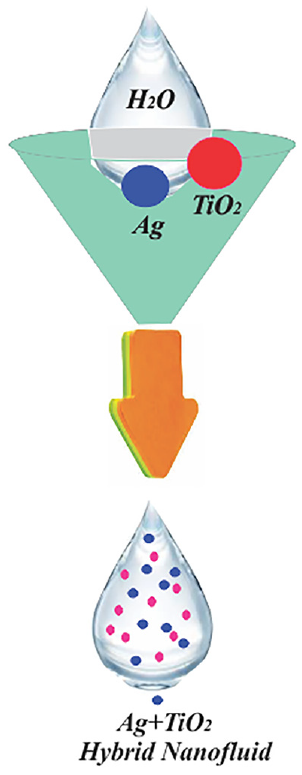
Contemplated hybrid nanofluid containing nanoparticles (Ag + TiO2) and Water (H2O) as base fluid drop showing its constituents.
Formulation
Consider incompressible, laminar and steady boundary layer flow of hybrid nanofluid accompanied by natural convection which is evolved at the external surface of an extending and radiating cylinder. The assumption of steady flow enables the definition of a streamline as the path traced by a fluid particle moving in the flow field, from which it follows that a streamline is a line in the flow that is everywhere tangent to the local velocity field. The incompressible flow means that the density is assumed to be constant which means that the equations containing derivatives of density are zero. The other major simplification is that the number of equations to be solved is reduced. If the density is constant, then there cannot be large variations in temperature, and the temperature may be assumed to be constant as well.
Water


while the necessary Dirichlet conditions are:


Flow geometry.
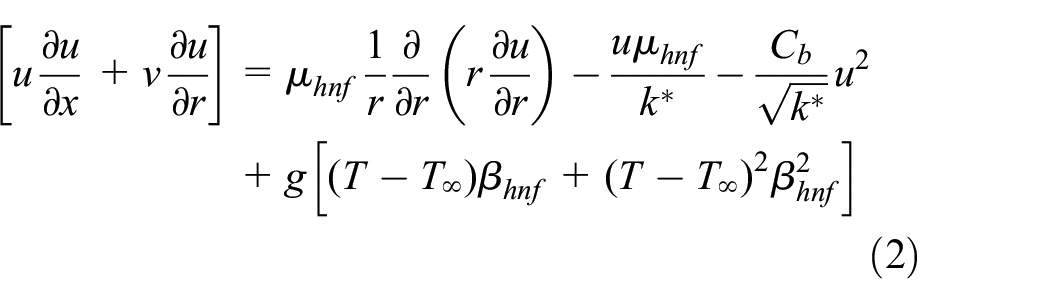
In the governing model; equation (1) is continuity, equation (2) is momentum, equation (3) is energy, and equation (4) are boundary conditions.

In equation (5),
Equations (1)–(4) transforms to dimensionless form as:


and

Further,

Here, the non-dimensional parameters obtained are
Through the assistance of Refs,3,28,29 the related thermal and physical characteristic of hybrid nanofluids relative to base fluids are, hereby, stated in equations (10)–(14) sequentially.


The physical quantities of prime concern are skin friction coefficient

where

where
Solution methodology
In order to better understand the flow phenomena, the non-linear model, consisting of coupled equations (6)–(8) and subjected to substantial constraints in equation (8), is solved numerically. For this purpose, the fourth order Runge–Kutta method (RK4) technique combined with the shooting method is adopted. RK4 is a family of classical Runge–Kutta approaches which are among the most effective and widely used iterative methods (implicit and explicit) for solving the initial value problem (IVP) of ordinary differential equations. One of the most significant advantages of Runge-Kutta formulae is that it requires the function’s values at some specified points. For the ambient boundary, it is necessary to select a suitable finite value such as




Equations (17)–(20) are coded in MATLAB in the form of a matrix to solve numerically. Also, a conversion is made for
Discussion
This section reflects the influences regarding fluxes in dimensionless prospective of velocity
Depiction of velocity profiles
Figures 3 to 7 represent the visible upshots associated with velocity field

Significant impressions of local inertia coefficient

Significant impressions of porosity factor

Significant impressions of Grashof number

Significant impressions of Grashof number
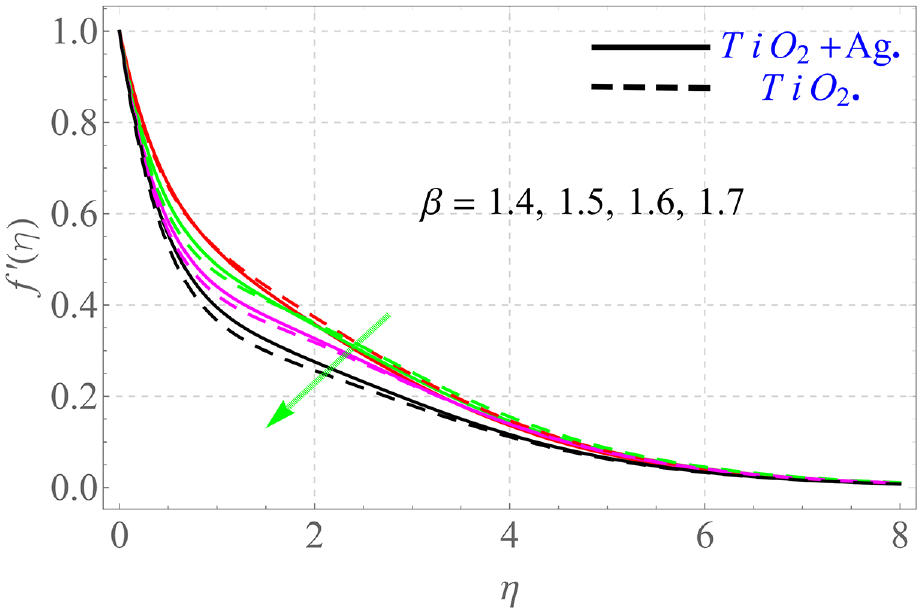
Significant impressions of thermos expansion coefficient
Depiction of temperature profiles
Figures 8 and 9 are the performance of distinguishing fluid parameters on a temperature profile for the suggested flow model. The direct relation of radiation Rd with temperature profile is shown in Figure 8. It has been examined that for larger radiation parameter, temperature of the proposed fluid is raised due to increase in heat of fluid. The solid volume fraction of the aforementioned nanomaterials

Significant impressions of Radian parameter

Significant impressions of solid volume fraction of nanoparticles
Depiction of skin friction coefficient and Nusselt number
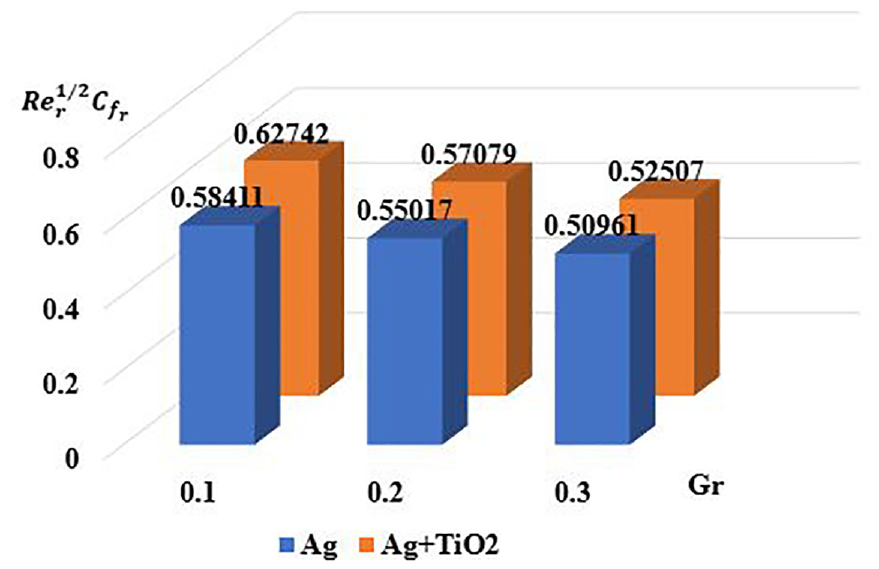
Figures 10 and 11 show skin friction rate in correspondance with different values of thermo-Grashof numbers
Significant impressions of Grashof number

Significant impressions of Grashof number
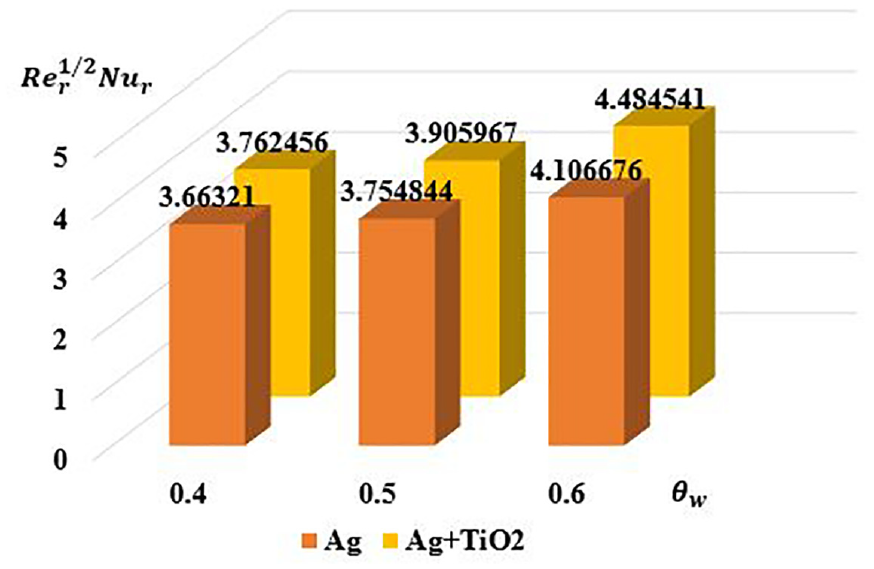
Significant impressions of temperature ratio parameter

Significant impressions of Radiation parameter

Percentage-wise variations in heat transfer rate against solid volume fraction of nanoparticles
The validation of reduced skin friction

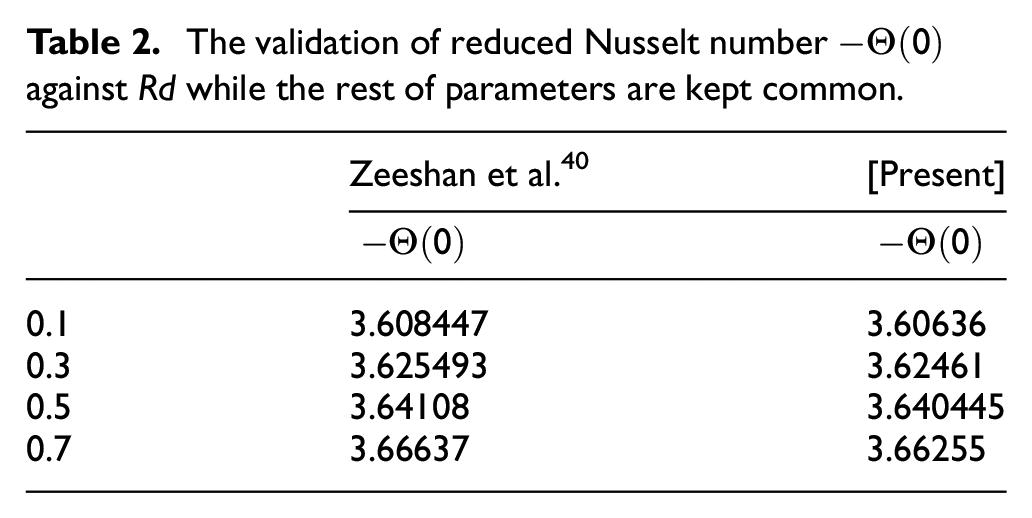
The validation of reduced Nusselt number
Concluding remarks
An area of current research focuses on the Darcy-Forchheimer flow model for impingement normally oriented toward porous extendable tubes with silver and titanium dioxide. On the behalf of above-mentioned discussions and investigations, the conclusions end with the following key considerations:
A negative impact upon the velocity field is recorded due to increased values of local inertia coefficient, porosity parameter, and thermal expansion coefficient. However, the positive effect is achieved for velocity due to the higher number of thermo Grashof numbers, respectively.
The skin friction coefficient boosts up with increasing values of the porosity parameter and local inertia coefficient.
Contrarily, the surface frictional sources are reduced by Grashof numbers while affecting the fluids motion productively.
According to the percentage-wise enhancement in heat transfer rate, hybrid nanofluids are more effective at improving heat transfer mechanisms.
In view of all the discussions, hybrid nanofluids can generate required cooling efficiency of moving pipe conduits in industrial and manufacturing factories.
Moreover, hybrid nanofluid is hoped to have productive selection cooling-efficiency and cost-friendly, and thus can be considered as a best anti-freeze agent for automobiles in the future.
Footnotes
Handling Editor: Chenhui Liang
Declaration of conflicting interests
The author(s) declared no potential conflicts of interest with respect to the research, authorship, and/or publication of this article.
Funding
The author(s) received no financial support for the research, authorship, and/or publication of this article.
