




Abstract
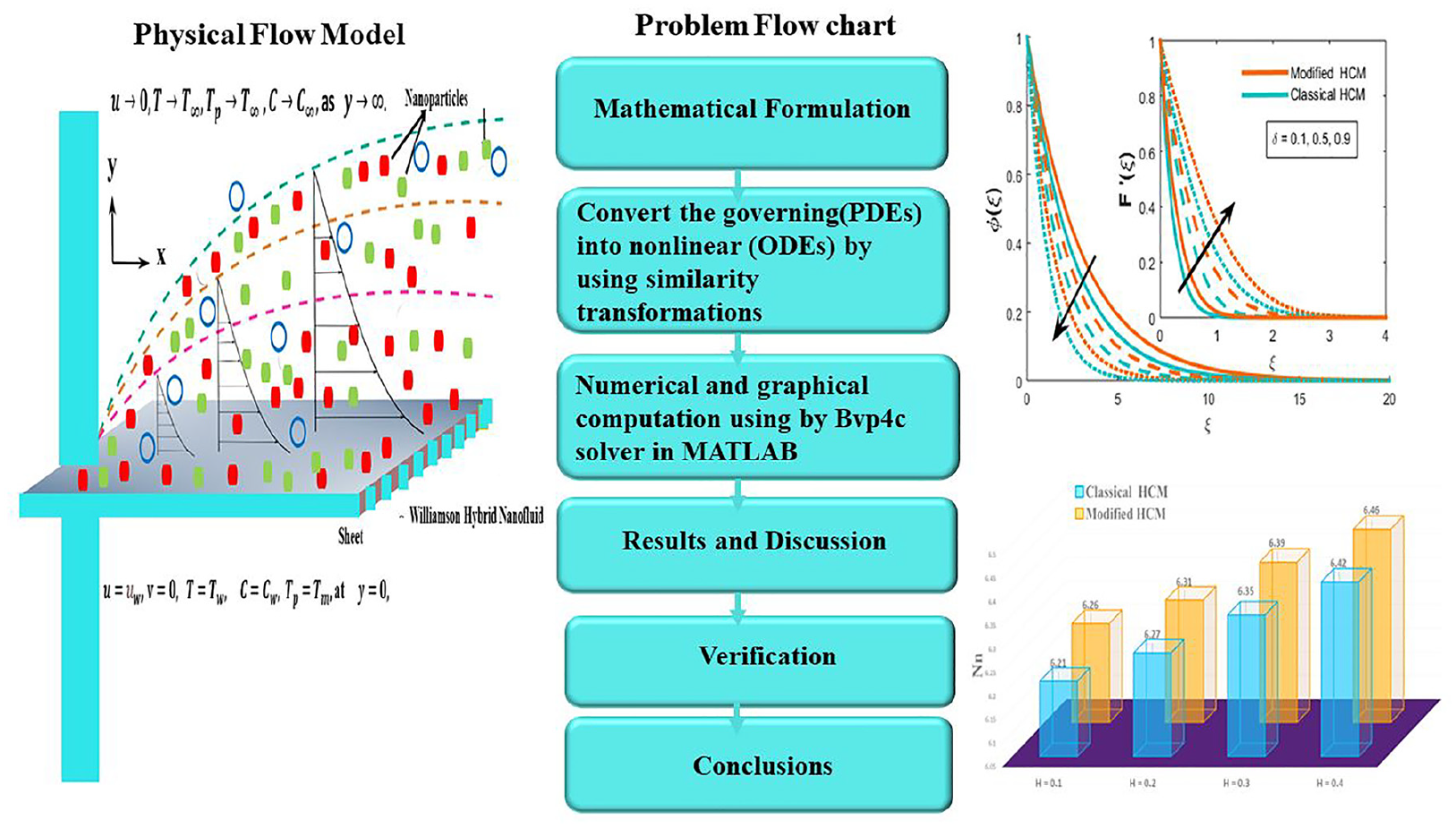
In this investigation, local thermal non-equilibrium, elastic deformation impact on MHD Williamson hybrid nanofluid across a sheet utilizing a permeable media, and viscous dissipation features are examined. The impact of chemical reaction and Cattaneo-Christov heat flux are taken into consideration in the modeling. Mass and heat transfer phenomena were modified from the general Cattaneo-Christov theory, which considers the importance of relaxation times. The local thermal non-equilibrium model is based on energy equations and provides efficient heat transmission for both liquid and solid phases. Therefore, two thermal distributions are used for both the fluid and solid phases. In this specific piece of work. The hybrid nanofluid ( SiC -- Co3O4NAC6H7O6) flow model contains nanoparticles of diamond (ND), Cobalt oxide (Co3O4), and silicon carbide (SiC) dissolved in Sodium alginate (NAC6H7O6). It is essential for the design of sophisticated cooling systems that require precise temperature management, as those found in microelectronics and aircraft. The model can also be applied in biomedical engineering to medication delivery systems based on nanofluids. Furthermore, its application in materials science can improve the heat transfer characteristics of nanocomposites and manufacturing processes, leading to more effective energy systems and better thermal control. The model equation system is theoretically solved using the Bvp4c method once the pertinent similarity variables have been reduced. To illustrate how different physical conditions, affect the involved distributions, the findings are graphed. When the interphase heat transfer parameter is increased, the solid phase’s thermal transport rate rises although the liquid phase’s heat transfer rate decreases.
Keywords
Get full access to this article
View all access options for this article.