This study seeks to examine the impact of convective heat transfer, buoyancy ratios, hall current effect, nonlinear thermal radiation, Schmidt number, Prandtl number and mass flux condition on the temperature profiles, velocity profiles and concentration profiles. The research explores into mass and heat transfer characteristics of a stagnation point flow of a free convective triple diffusion with considerations for convective boundary constraints and nonlinear thermal radiation over a mobile vertical plate. To elucidate the aims and methodology, the study utilizes similarity transformation to convert the governing partial differential equations into a set of nonlinear ordinary differential equations. Numerical solutions are obtained employing a fourth-order Runge-Kutta shooting strategy. The findings, showcased through graphical representations, unravel the intricate interplay of parameters, shedding light on flow distribution, temperature, and velocity profiles. These quantitative results not only enhance our scientific understanding of fluid dynamics but also hold practical implications across diverse sectors. Notably, the acquired insights are poised to benefit fields such as environmental science and engineering, where optimizing heat and mass transfer processes is paramount. This research thus contributes valuable perspectives to both the theoretical framework of fluid dynamics and its real-world applications.
Heat transfer is essential to industry and technology, and it plays a major role in mechanical systems. Heat transfer is involved in many technical and industrial processes, such as lamination operations, refrigeration, the refining industry, small heat pumps, and improved thermal oil.1,2 Base fluids are frequently used as the main energy source by large companies. Nevertheless, a lot of these fluids have low heat conductivity, which makes them inappropriate for use in industrial operations. In a short amount of time, there has been a lot of interest in the study of nanofluids as a potential source of alternative energy. The fascinating and novel thermal dynamics of nanoparticles make the study of nanofluids promising for a range of applications.3,4 Specifically, exothermic reactions, resource efficiency, racing, ejection processes, polymer coating, thin-film solar energy, and oil refining are among the industries that employ nanoparticles. Furthermore, they are employed in air fresheners, car emission controls, and biochemical processes, demonstrating the broad range of applications for which nanofluids may be employed to solve heat transfer problems in many industries. Fundamental phenomena such as mass fluxes and convective heat have numerous applications in a variety of areas.5,6 Comprehending the complexities of these currents is essential for enhancing heat and mass transfer procedures, impacting fields like engineering, environmental research, and industrial uses.
In recent decades, there has been a notable surge in research pertaining to stagnation point flows, particularly due to their relevance in addressing a multitude of challenges in the domain of polymer-based industrial applications. This phenomenon holds significant importance, as it involves intricate interactions between various physical parameters. Understanding the variations in these parameters within the vicinity of the flow is crucial in engineering contexts. It is worth mentioning that the highest degree of heat transfer takes place in the proximity of the flow, coinciding with a reduction in velocity. The findings of this research hold significant importance for various industries, including aerodynamics, hydrodynamics, and electronics, particularly in the context of stagnation point flow. Dzulkifli et al.7 conducted a comprehensive investigation on unsteady stagnation point flow over stretching shrinking permeable sheet involving slip velocity effect. Nadeemet al.8 discussed characteristics of three dimensional stagnation point flow of hybrid fluid. Mahmood and Khan9 studied nano particle aggregation effect on unsteady stagnation point flow of hydrogen oxide based nanofluids. Khan et al.10 presented analysis of heat and mass transfer of stagnation point flow over Riga plates having chemical reactions and radiation effects. In their work, Lok et al.11 examined the micropolar flow fluid with steady stagnation point on vertical surfaces. Yacob et al.12 analyzes the stagnation-point flow of steady boundary layer of a micro polar fluid forthcoming a horizontally extending sheet.
The investigation of triple diffusive flows offers an engrossing look into the complex interaction between several diffusive processes in fluid dynamics. The simultaneous diffusion of mass and heat in double diffusive flows creates complexity that have a substantial influence on a variety of natural and artificial systems. The investigation’s extension to triple diffusive flows introduces a new level of complexity since three separate elements interact to affect phenomena like chemical concentration gradients and temperature stratification. Within fluid dynamics, mixed convection flows are defined by the complex interaction between buoyancy-driven natural convection and externally driven forced convection. This phenomenon is highly relevant to a wide range of research areas, including environmental fluid mechanics and heat exchangers. Krishna Chaitanya and Chatterjee13 discussed mixed convection flow past counter rotating side by side cylinders having low Reynold number. Hansda and Pandit14 took double diffusive mixed convection flow of hybrid fluid for studying the performance of thermosolutal discharge in concave/convex chamber. Ali et al. works on Cattaneo-Christov heat flux theory for mixed convection flow in rotating disk.15 Vinodkumar Reddy et al.16 explored double diffusion mixed convection non Newtonian fluid with Cattaneo-Christov in porous sheet.
The Hall current effect is a fundamental phenomenon in several plasma and fluid systems, affecting the transport characteristics of charged particles and magnetic fields. Moreover, investigating the complex relationship between Hall current effects and mass flux becomes crucial to comprehending and improving a range of technological processes, from space propulsion systems to magnetic confinement fusion devices. Seddeek and Aboeldahab17 explored the effect of radiation on a gray, electrically conducting gas in close symmetry with unsteady convection flow. They also inspected the consequence of a powerful magnetic force field acting perpendicular to the plate, taking into account Hall current. Majeed et al.18 studied impact of hall current effect and viscous dissipation of MHD mixed convective flows. He also described the engineering properties of all these fluid properties. El-Aziz and Afify19 the influence of Hall current on the magnetohydrodynamic (MHD) Casson nanofluid slip flow across a stretched sheet, clarifying the complex interaction between nanofluid dynamics and magnetic effects, with special attention to the mass flux of nanoparticles at the sheet’s surface. Rehman et al.20 examines how Hall current affects a Casson nanofluid’s magnetohydrodynamic (MHD) slip flow across a stretched sheet, highlighting the special case in where the mass flux of nanoparticles at the sheet’s surface is limited to zero. Mahmud et al.21 examines the flow properties of a magnetic shear-thinning nanofluid under the combined impact of zero mass flux and Hall current, giving insight on the delicate interplay between magnetic effects and the rheological behavior of shear-thinning fluids.
In the setting of triple-diffusive mixed convection, the complicated coupling of thermal radiation emerges as a major element, greatly altering heat transfer processes in fluid systems with changing concentration, temperature, and momentum gradients. Comprehending the interaction between thermal radiation and convective processes is crucial in deciphering the intricacies present in triple-diffusive flows. This understanding has ramifications for a variety of applications, encompassing everything from sophisticated heat exchangers to environmental transport phenomena from orbital propulsion systems to refinement fusion devices. Makinde22 conducted a study on the boundary layer of free convection flow involving mass transport and thermal radiation adjacent to a vertical plate. The investigation specifically addressed in situations where the plate experiences alterations within its own plane. Islam et al.23 conducted study by taking into account the complex effects of thermal radiation and differentiating between assisting and opposing flows, the investigation focuses on the double-diffusive stagnation point flow over a vertical surface. This study offers important insights into the behavior of the thermal and concentration boundary layers In order to better understand the thermal properties of these intricate fluid dynamics scenarios, a thorough stability analysis by Bakar et al.24 is carried out to examine the behavior of mixed convection nanofluid flow within a permeable porous medium, taking into account the significant effects of radiation and internal heat generation. Wahid et al.25 investigates the complicated dynamics of mixed convection magnetohydrodynamic (MHD) hybrid nanofluid flow across a permeable inclined plate that is shrinking. It clarifies the effect of thermal radiation and offers important insights into the properties of heat transmission in this delicate fluid-solid interaction. Khan et al.26 study to looks at how nonlinear radiation affects nanofluid flow across a porous wedge when a magnetic field is present. This research provides insights into the complex interactions that occur between thermal radiation, magnetic forces, and porous media in this type of fluid dynamics scenario. Khan et al.10 investigates the associated effects of thermal radiation and binary chemical reaction on heat and mass transport through a mathematical study of the unsteady stagnation point flow of a Riga plate, therefore advancing our knowledge of complicated fluid dynamics and chemical kinetics. Some other studies also explains effect of thermal radiation are.27–29
In order to provide insight on the underlying principles of triple diffusive flows and its implications for applications in a variety of domains, including materials science and oceanography, our research aims to untangle the complex dynamics of these flows. Along, looking at the previously mentioned literature, it appears that, as far as we are aware, no research has been published that explains the mass transfer, flow, and heat properties of the nonlinear radiative heat flux in triple diffusive convection with convective boundary conditions of nano fluid with hall current effect, joule heating and mass flux condition. The work is very relevant to many real-world applications, particularly those where mass and heat transmission are important factors. Its practical use can be in the electronic device cooling system optimization process. The study’s emphasis on mass flux, the Hall effect, and dynamic heat transfer highlights its potential to provide new perspectives on how to better regulate the thermal properties of electronic components, therefore boosting their dependability and performance. The results might direct the creation of electronic system cooling solutions that are more effective, expanding the possibilities of contemporary technology. The goal of this investigation is to numerically answer this problem by utilizing the Newton-Raphson iteration scheme along shooting technique with the fourth-order Runge-Kutta method to determine the missing boundary conditions of the differential equations for mass, heat, and flow. In order to critically examine the present topic, the following research questions are used.
What is the impact of a moving sheet’s dynamic interaction at the stagnation point on the heat transfer of triple-diffusive free convection? How can the fourth-order Runge-Kutta method along shooting technique, and Newton-Raphson iteration scheme be used to solve the studied problem numerically while addressing the boundary conditions in the differential equations for mass, heat, and flow? What role do mass flux and the Hall effect serve in the triple-diffusive free convection process? What effects does the addition of radiative and nonlinear convective heat transfer have on the triple-diffusive free convection enhancement?
Description of the problem
The mathematical model under investigation pertains dynamic study of a movable vertical plate submerged in an electrically conductive, incompressible liquid with nonlinear convective and radiative heat transfer processes. The fluid flow is bounded by a continuous two-dimensional boundary layer that includes the influencing effects of Joule heating and Hall current. The model also takes into consideration a zero-mass flux situation, offering a thorough framework for analyzing the system’s intrinsic thermal and electrical complexity.
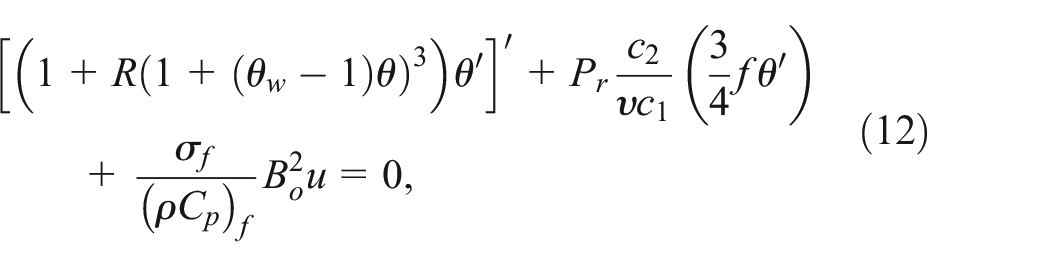
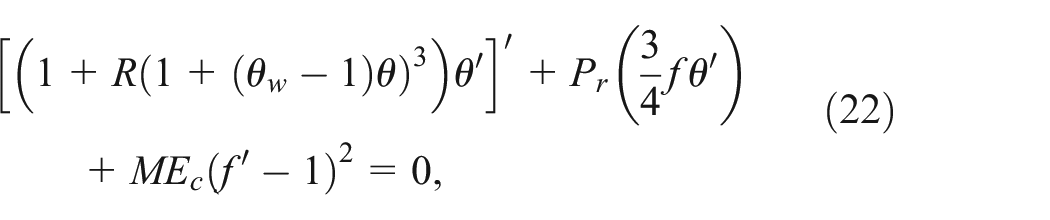
The following are the boundary layer equations that govern:
Under these equations’ boundary conditions, which are
The free stream velocity is , the extended sheet velocity is , where and are constant. And is the temperature, the convection mechanism heats the plate due to a hot fluid of temperature (>).
By employing of Roseland approximation, the radiative thermal flux , is
here is the radiative heat flux, and mean absorption coefficient is denoted by and the Stefan–Boltzmann constant is . This study considers that the temperature varies throughout the stream and the linear combination of temperature causes the introduction of . By omitting the higher-order terms and expanding in a Taylor’s series about , we obtain the following
Since the stream function is defined as , , we present the subsequent similarity transformation:
Where , , and , are positive constants
Along with
here the prime symbolizes variation according to the similarity independent variable. We select
The wall conditions are , and constant in the plate velocity at the distance from coordinate axis namely .
From equation (17), with the given equation, . We find out constant and as to uniquely, which describes
In this manner, the coefficient in equation (9) gives rise to a crucial aspect of the issue, namely, the mixed convection bound
Anticipating that the current problem lacks an inherent length scale, we have the freedom to define our own length unit, denoted as In this context, we define as follows
We derived the Rayleigh number, denoted as , from equation (14) with the following definition
The modified boundary constraints are outlined below
Here, represents the Prandtl number, denotes the radiation factor, the mixed convection parameter, also known as the Richardson parameter (), given by . Here, , a positive indicates assisting flow, a negative indicates opposing flow, is velocity slip parameter and is temperature slip parameter. The expressions for Nusselt number and the shear stress coefficient are provided below
By use of similarity variables (29), we get
Method of solution
Solving the intricate governing Partial Differential Equations proves challenging. Afterward they undergo a conversion process into ODE through similarity transformation, expressed in equations (19) to (21). These equations are further transformed into nine first-order ODEs as outlined below
Moreover, the associated boundary condition (22) is modified to yield the subsequent form
In this context, we select suitable initial values for , , and that fulfill the associated conditions , , and by means of a continuous shooting technique, persisting as long as the targeted results are attained.
Results and discussion
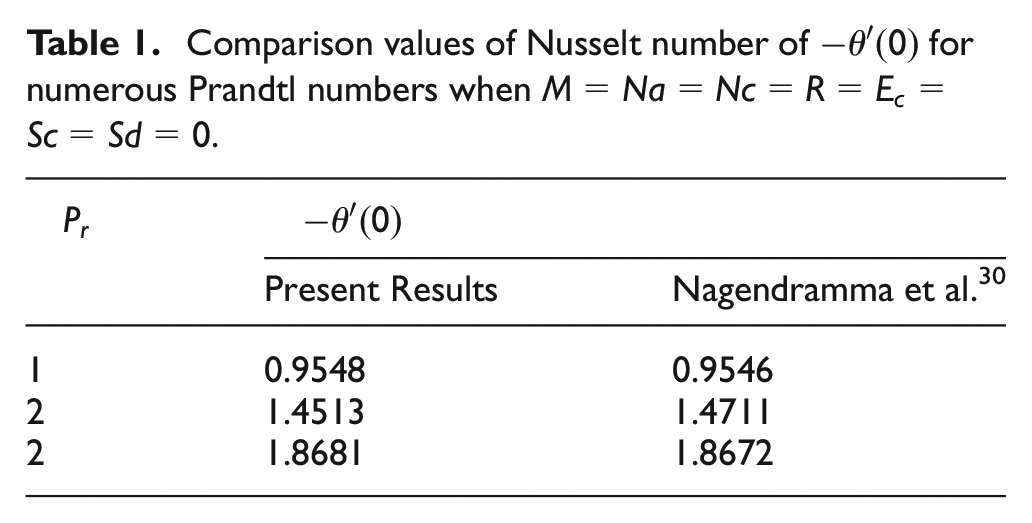
Equations (21)– (24) are transformed in first-order differential equations (Conversion of PDE to IVP) taking the boundary condition equation (25). These equations are then resolved for the specified boundary conditions by means of the Runge–Kutta numerical approach and the most effective strategy. Plotted graphs provide clarification on the results. As Table 1 shows, there is a strong connection between the results of our study and those of Nagendramma et al.30
Comparison values of Nusselt number of for numerous Prandtl numbers when .
The impact of the parameter of nanoparticle concentration on the velocity profile is illustrated in Figure 2. As depicted in the figure, variations in lead to notable enhancements in the velocity profile. This observation suggests that acts a substantial role in influencing the flow dynamics. Higher values of seem to promote more vigorous fluid movement, potentially indicating a stronger convective effect. Conversely, lower values of might imply a relatively subdued flow pattern, potentially indicative of a more dominant forced convection regime. The graph makes reference to the significance of in forming flow patterns, which may have implications for industrial engineering applications. A more thorough investigation of how regulating nanoparticle concentration affects flow dynamics might be useful for industrial engineering applications, resulting in more effective procedures or enhanced system performance. The study reveals a noteworthy trend in the velocity profile w.r.t the magnetic effect parameter . The observed deceleration in the velocity profile with increasing buoyancy ratio , as depicted in Figure 3, is a significant finding in the context of the study. This behavior stands in contrast to the common expectation in buoyancy-driven flows. A higher buoyancy ratio implies a greater effect of buoyancy relative to viscous forces. In many cases, this would lead to an acceleration of the fluid flow. However, the present study’s result suggests a counterintuitive behavior. As illustrated in Figure 4, a rise in the magnetic effect parameter yields to a significant acceleration in the velocity profile. This reflection highlights the substantial influence of magnetic fields on the flow behavior. The magnetic effect parameter M seems to augment the force acting on the fluid, consequently enhancing its velocity. A more skillful examination giving precise numerical data, elucidating the underlying physical principles, and outlining possible industrial engineering applications like magnetic fluid management in pipelines or manufacturing processes are all important aspects of prospective applications in the field of industrial engineering. The observed increase in velocity with a higher Hall parameter in Figure 5 is a significant finding. The Hall effect introduces a magnetic field component perpendicular to the main flow direction, resulting in additional forces acting on the charged particles within the fluid. This, in turn, affects the overall flow behavior. The increase in velocity can be attributed to the Hall effect’s influence on the electromagnetic forces within the system. As the Hall parameter () rises, the magnetic field strength becomes more pronounced, leading to a more pronounced impact on the flow of fluid.
Physical scheme.
Graphical result of nanoparticle concentration impact on velocity profile displays a trend of increasing value for both assisting flow and opposing flow.
Graphical result of buoyancy parameter impact on velocity profile displays a trend of decreasing value for both assisting flow and opposing flow.
Graphical result of magnetic parameter impact on velocity profile displays a trend of increasing value for both assisting flow and opposing flow.
Graphical result of hall current parameter impact on velocity profile displays a trend of decreasing value for both assisting flow and opposing flow.
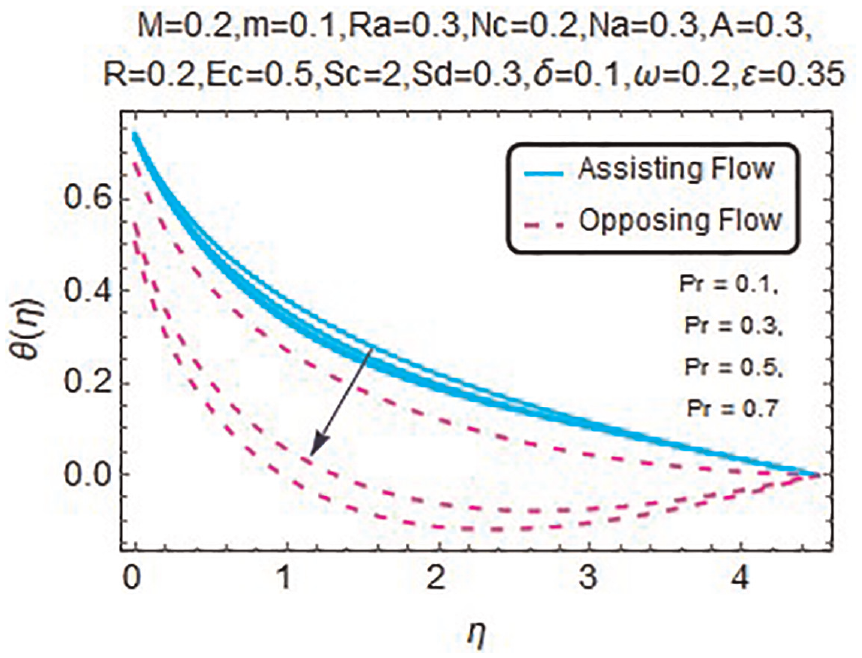
Figure 6 provide the magnetic parameter impact on the temperature profile for both assisting flow and opposing flow condition. For assisting flow, where the buoyancy force aids the flow motion, a growth in the magnetic parameter has a notable consequence on the temperature profile. As rises, the Lorentz force strengthens, exerting a greater influence on the fluid motion. This leads to enhanced mixing and heat transfer, resulting in a more pronounced change in temperature distribution. The temperature near the surface increases, indicating more efficient heat transfer. This behavior is especially relevant in applications where precise control of thermal gradients is essential. Conversely, for opposing flow, where the force of buoyancy opposes the flow motion and magnetic parameter impact is somewhat different. As increases, the Lorentz force acts in a manner that hinders the fluid motion. This leads to a dampening effect on temperature variations. The gradient temperature nearby the surface is decreased, indicating a slower rate of heat transfer. The possession of the parameter of radiation on the temperature profile is given in Figure 7. Also, it is observed that a rise in the value of leads to an enhancement of the temperature profile. As the parameter associated with radiation parameter intensifies, the influence of radiative heat transfer becomes more pronounced. This results in a greater exchange of thermal energy between the fluid and its surroundings, leading to an elevated temperature profile. In the situation involving assisting flow, where the buoyancy force aids the flow motion, an increment in leads to a distinct impact on the temperature profile shown is Figure 8. As rises, the heat generation within the fluid increases. This, in turn, elevates the temperature. The gradient of temperature becomes steeper, indicating enhanced. Conversely, in opposing flow, as soon as the buoyancy force opposes the flow motion, influence of is different. As increases, the heat generation counteracts the buoyancy force. This leads to a dampening result on temperature variations. The temperature gradient is reduced, indicating a slower heat transfer rate. The Prandtl number, depicted in Figure 9, is a dimensionless parameter that signifies the relative significance of momentum diffusivity compared to thermal diffusivity in a fluid. A higher indicates a greater dominance of heat conduction compared to fluid motion. As increases, it signifies that the fluid has a higher thermal diffusivity relative to its momentum diffusivity. For assisting flow, where the buoyancy force aids the flow motion, a decrease in the Prandtl leads to distinct effects on the temperature profile. As decreases, it signifies that the fluid’s thermal diffusivity is higher relative to its momentum diffusivity. This leads to a reduced width of the thermal boundary layer. In the situation of opposing flow, where the buoyancy force opposes the flow motion, the influence of is somewhat different. A lower implies a higher dominance of thermal diffusivity compared to momentum diffusivity. This leads to a more substantial thermal boundary layer, resulting in a lower rate of heat transfer. Figure 10 shows the impact of on temperature profile. In the situation of assisting flow, where buoyancy aids the flow motion, an upsurge in the Eckert number results into distinct effects on the temperature profile. As rises, it indicates that the kinetic energy of the fluid exceeds the thermal energy. This results in a more pronounced cooling effect near the surface. The temperature gradient becomes steeper, indicating more efficient heat extraction. Conversely, in opposing flow, where buoyancy opposes the flow motion, the influence of is somewhat different. An increase in implies a greater dominance of thermal energy relative to kinetic energy. This leads to a dampening effect on temperature variations. The temperature gradient near the surface is reduced, indicating a slower rate of heat extraction.
Graphical result of magnetic parameter on impact on temperature profile displays a trend of increasing value for both assisting flow and opposing flow.
Graphical result of radiation parameter on impact on temperature profile displays a trend of increasing value for both assisting flow and opposing flow.
Graphical result of temperature ratio parameter on impact on temperature profile displays a trend of increasing value for both assisting flow and opposing flow.
Graphical result Prandtl number on impact on temperature profile displays a trend of decreasing value for both assisting flow and opposing flow.
Graphical result Eckert number on impact on temperature profile displays a trend of increasing value for both assisting flow and opposing flow.
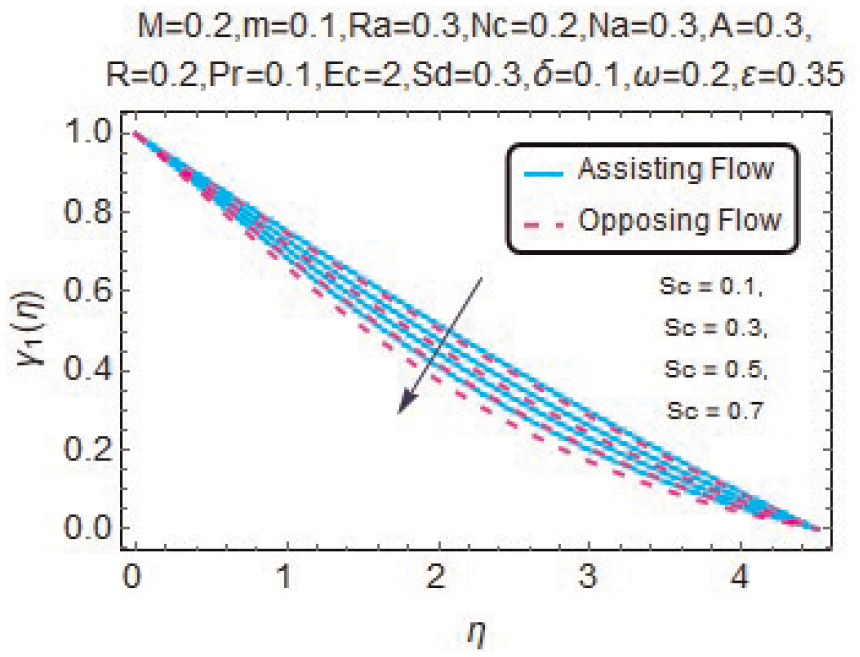
Figure 11 investigates the effect of decreasing the Schmidt number on the concentration profile for both assisting flow and opposing flow conditions. In assisting flow, when buoyancy force aids the flow motion, a reduction in the Schmidt number indicates distinct effects on the concentration profile. As decreases, it indicates that the diffusivity of the solute relative to its kinematic viscosity is higher. This results in a thinner concentration boundary layer. The mass transfer rate across the boundary layer is higher, and the concentration gradient nearby the surface is steeper. A lower implies a higher dominance of diffusivity compared to kinematic viscosity. This leads to a thicker concentration boundary layer, resulting in a slower mass transfer rate. The concentration nearby surface is less steep. The study investigates the impact of decreasing on the concentration profile as shown in Figure 12. A decrease in the implies that the diffusivity of the solute relative to its kinematic viscosity is higher. This leads to a thinner concentration boundary layer. The mass transfer rate across the boundary layer enhances, and the concentration gradient close the surface becomes steeper.
Graphical result Schmidt number on impact on temperature profile displays a trend of decreasing value for both assisting flow and opposing flow.
Graphical result Schmidt number on impact on temperature profile displays a trend of decreasing value for both assisting flow and opposing flow.
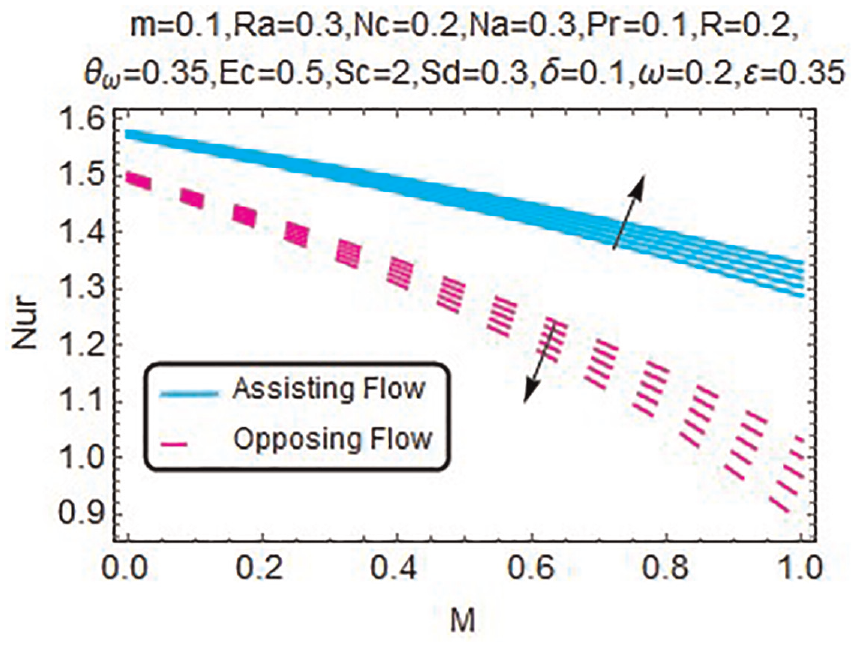
Figure 13 explains the behavior of the Nusselt number as the magnetic parameter is varies for assisting flow case and opposing flow situation. The buoyancy force aids the flow motion in assisting flow, a growth in the magnetic parameter marks an enrichment in the Nusselt number . This behavior is indicative of improved heat transfer characteristics. The occurrence of a magnetic field intensifies the heat transfer process, resulting in a higher Nu. Conversely, in opposing flow, where the buoyancy force hinders the flow motion, a rise in returns a decrease in the Nusselt number. This signifies a reduction in heat transfer efficiency. The heat transfer process hinders due to magnetic field counteracts. Figure 14 explains the occurrence of the Nusselt number as the is varied. For assisting flow, where the buoyancy force aids the flow motion, a growth in the gives an enhancement in the Nusselt number. This indicates improved heat transfer characteristics. A higher implies a higher dominance of thermal diffusion compared to mass diffusion. In opposing flow, where the buoyancy force opposes the flow motion, an increase in results in a decrease in the Nusselt number. This signifies a reduction in heat transfer efficiency. A higher Sc indicates a higher dominance of mass diffusion compared to thermal diffusion. Figure 15 depicts the behavior of the Nusselt number as the Prandtl number is varied. For assisting flow, where buoyancy aids the flow motion, an increase in the Prandtl number yields an enhancement in the Nusselt number. Consequently, indicates improvement in heat transfer characteristics. A higher implies a higher dominance of momentum diffusivity relative to thermal diffusivity. This results in a more sustainable thermal boundary region and near the surface temperature gradient is enhanced. Consequently, more efficient heat transfer occurs, leading to an improved Nusselt number. On the contrary, in opposing flow fluid motion is opposed by the buoyancy force, a rise in results in a decrease in the Nusselt number. This signifies a reduction in heat transfer efficiency. A higher indicates a higher dominance of thermal diffusivity associated to momentum diffusivity. As a result, thermal boundary layer become thinner and a gentler heat transfer rate. Consequently, the Nusselt number decreases. In the case of assisting flow, an increase in the temperature ratio parameter results in an enhancement in the Nusselt number shown in Figure 16. This indicates improved heat transfer characteristics. As the temperature ratio parameter increases, it implies that the temperature difference between the fluid and its surroundings becomes more significant. This intensifies the thermal driving force for heat transfer. Consequently, the Nusselt number rises, reflecting a more efficient heat transfer process. Conversely, for opposing flow, an increment in the temperature ratio parameter results in reduction of the Nusselt number. This signifies a reduction in heat transfer efficiency. As the temperature ratio parameter increases, it implies a stronger resistance to heat transfer due to the counteracting flow. The temperature gradient near the surface is less steep, indicating a slower rate of heat transfer.
Nusselt Number for magnetic parameter showing increasing trend for assisting flow while decreasing trend for opposing flow case.
Nusselt Number for Eckert number showing increasing trend for assisting flow while decreasing trend for opposing flow case.
Nusselt Number for Prandtl number gives increasing trend in assisting flow while decreasing trend in opposing flow.
Nusselt Number for temperature ratio parameter showing increasing trend for assisting flow and decreasing trend for opposing flow case.
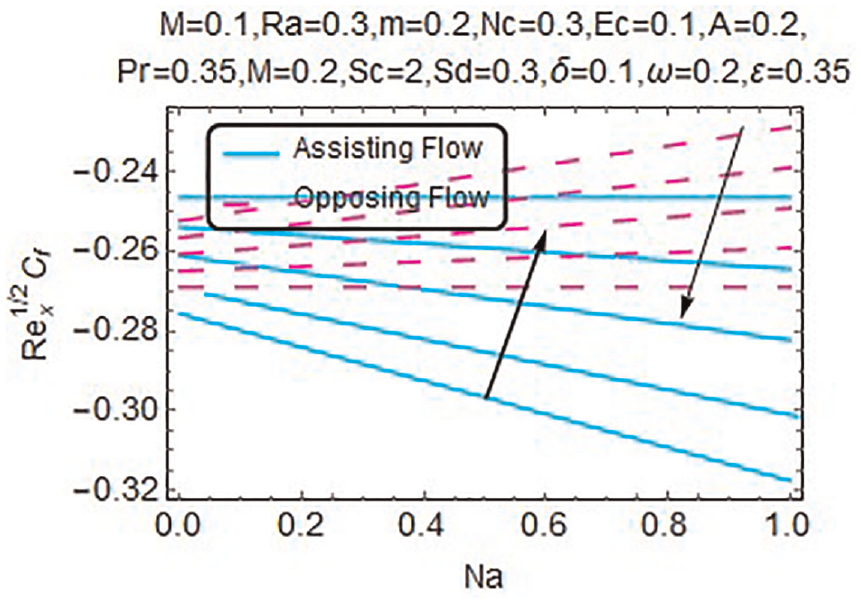
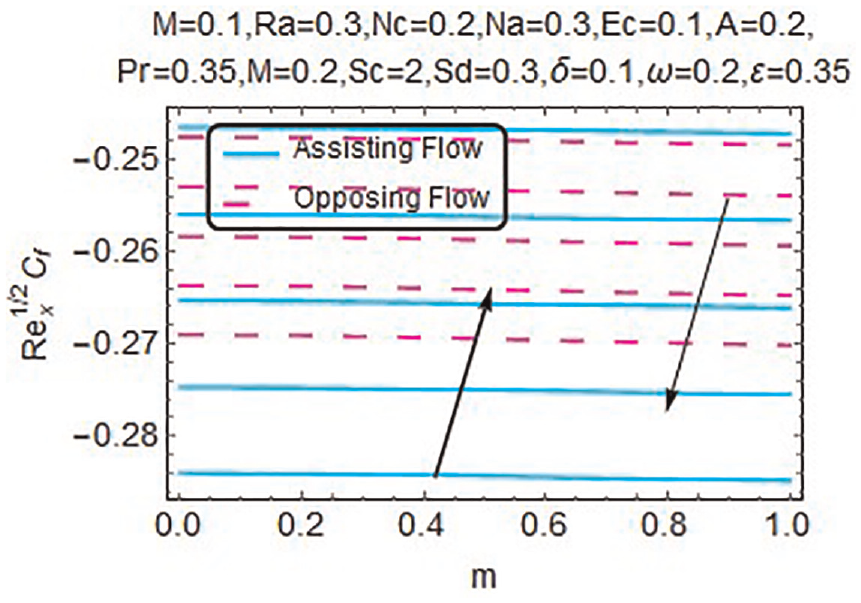
Figure 17 shows the behavior of skin friction as the buoyancy ratio parameter is varied for both assisting and opposing flow conditions. For assisting flow, where the buoyancy force aids the flow motion, a decrease in the buoyancy ratio parameter leads to a reduction in skin friction. This indicates a decrease in the resistance to flow. As decreases, the buoyancy force becomes less influential, allowing the fluid to flow more freely along the surface. Conversely, in opposing flow, where the buoyancy force opposes the flow motion, an increase in results in an increment in skin friction. This indicates that the flow resistance has increased. The buoyant force works against the flow when rises, increasing the fluid’s resistance The behavior of the skin friction is investigated in Figure 18 as the Hall current effect parameter is adjusted. Skin friction decreases when the Hall current effect parameter m increases when opposing flow is taken into account. As a result, there is less barrier to flow. The Hall effect gets stronger as m grows, changing the flow behavior. Frictional resistance along the surface is lowered as a result. This suggests that flow resistance is rising. The fluid experiences more resistance as increases because the hall current effect opposes the flow. The behavior of skin friction under varying is given in Figure 19. The skin friction coefficient is evaluated for variables M against λ. Skin friction coefficient is shown by Figure in (20) which decreases in assisting flows and rises in opposing flow. A decrease in reduces skin friction for assisting flow, where the buoyant force helps the flow motion. This suggests that the flow resistance has decreased. Conversely, a drop in causes a decrease in skin friction in an opposing flow, when the buoyancy force opposes the flow velocity. This indicates that the flow’s resistance has decreased. Figure 19 shows the behavior of skin friction as the buoyancy ratio parameter is varied for both opposing and assisting flow conditions. For opposing flow, where the buoyancy force opposes the flow motion, an increase in the buoyancy ratio parameter leads to an increase in skin friction. This indicates an increase in the resistance to flow. As increases, the buoyancy force acts against the flow, intensifying the resistance experienced by the fluid. Conversely, in assisting flow, where the buoyancy force aids the flow motion, an increase in results in a decrease in skin friction. This signifies a reduction in the resistance to flow. As increases, the buoyancy force becomes more influential, allowing the fluid to flow more freely along the surface. The behavior of the Sherwood number as is varied for both assisting and opposing flow conditions is shown in Figure 21. For assisting flow, where the buoyancy force aids the flow motion, an increase in the leads to an increase in the Sherwood number. This indicates enhanced mass transfer characteristics. As increases, it implies a higher dominance of thermal diffusion to mass diffusion. This results in a thinner concentration boundary layer, a steeper concentration gradient near the surface, and more efficient mass transfer. In opposing flow, where the buoyancy force opposes the flow motion, an increase in results in a decrease in the Sherwood number. This signifies a reduction in mass transfer efficiency. A higher implies a higher dominance of mass diffusion compared to thermal diffusion. This leads to a thicker concentration boundary layer, resulting in a slower rate of mass transfer. The behavior of the Sherwood number as the Schmidt number in Figure 22 varied for both assisting and opposing flow conditions. For assisting flow, where the buoyancy force aids the flow motion, an increase in the Schmidt number leads to an increase in the Sherwood number. This indicates enhanced mass transfer characteristics. A higher implies a higher dominance of momentum diffusivity relative to thermal diffusivity. Conversely, in opposing flow, where the buoyancy force opposes the flow motion, a rise in results in a lessening in the Sherwood number. This signifies a reduction in mass transfer efficiency. A higher indicates a higher dominance of thermal diffusivity compared to momentum diffusivity. This leads to a thinner concentration boundary layer and a slower rate of mass transfer.
Skin friction for nanoparticle concentration parameter against showing increases trend for assisting flow case while decreasing trend for assisting flow case.
Skin friction for hall effect parameter against gives decreasing trend for assisting while increasing trend for opposing flow case.
Skin friction for against gives increases trend for assisting while decreasing trend for opposing flow case.
Skin friction for magnetic parameter against gives increasing trend for assisting while decreasing trend for opposing flow case.
Sherwood number for Schmidt number against gives increasing trend for assisting while decreasing trend for opposing flow case.
Sherwood number for against gives increasing trend for assisting while decreasing trend for opposing flow case.
Conclusion
The study examines the flow, mass transfer and heat transfer characteristics in the existence of nonlinear thermal radiation, joule heating hall current effect along with zero mass flux condition on triple diffusive free convection stagnation point flow along a moving vertical plate. The findings obtained from this investigation are summarized as
The velocity experiences a reduction with increasing buoyancy ratio parameter, while it rises proportionally with higher Rayleigh number values.
The heat transfer undergoes the expansion of the thickness of thermal boundary layer as the value of increases because of thermal radiation. This indicates enhanced thermal energy release within the boundary layer.
Heat transfer and shear stress diminish with a rise in the velocity slip parameter, alongside a concurrent increase in the temperature slip parameter.
The velocity experiences an upswing with an increase in the Hall parameter (m), while conversely, a counter trend is noticed in the cases of temperature and concentration.
The current problem has the potential for extension to both non-Newtonian and Newtonian fluids, considering thermal radiation in non-linear case and incorporating effects of heat source. Such extensions may find broader applications, particularly in industries dealing with polymers.
Footnotes
Appendix
Handling Editor: Chenhui Liang
Declaration of conflicting interests
The author(s) declared no potential conflicts of interest with respect to the research, authorship, and/or publication of this article.
Funding
The author(s) received no financial support for the research, authorship, and/or publication of this article.
Ethical Approval
Not applicable.
ORCID iDs
Zafar Mahmood
Umar Khan
Data availability
“Data will be available on demand.”
References
1.
TurkyilmazogluM. Exact multiple solutions for the slip flow and heat transfer in a converging channel. J Heat Transf2015; 137: 101301.
2.
AsgharSJalilMHussanM, et al. Lie group analysis of flow and heat transfer over a stretching rotating disk. Int J Heat Mass Transf2014; 69: 140–146.
3.
IslamAMahmoodZKhanU. Significance of mixed convective double diffusive MHD stagnation point flow of nanofluid over a vertical surface with heat generation. Proc IMechE, Part N: J Nanomaterials, Nanoengineering and Nanosystems2024. DOI: 10.1177/23977914231210798
4.
MahmoodZAhammadNAAlhazmiSE, et al. Ternary hybrid nanofluid near a stretching/ shrinking sheet with heat generation/ absorption and velocity slip on unsteady stagnation point flow. Int J Mod Phys B2022; 36: 2250209.
5.
Mahmuda MayaMUAlamMNRefaie AliA. Influence of magnetic field on MHD mixed convection in lid-driven cavity with heated wavy bottom surface. Sci Rep2023; 13: 18959.
6.
SaeedAAlgehyneEAAldhabaniMS, et al. Mixed convective flow of a magnetohydrodynamic Casson fluid through a permeable stretching sheet with first-order chemical reaction. PLoS One2022; 17.
7.
DzulkifliNBachokNYacobN, et al. Unsteady stagnation-point flow and heat transfer over a permeable exponential stretching/shrinking sheet in nanofluid with slip velocity effect: A stability analysis. Appl Sci2018; 8: 2172.
8.
NadeemSAbbasNKhanAU. Characteristics of three dimensional stagnation point flow of hybrid nanofluid past a circular cylinder. Results Phys2018; 8: 829–835.
9.
MahmoodZKhanU. Nanoparticles aggregation effects on unsteady stagnation point flow of hydrogen oxide-based nanofluids. Eur Phys J Plus2022; 137: 750.
10.
KhanUMahmoodZEldinSM, et al. Mathematical analysis of heat and mass transfer on unsteady stagnation point flow of Riga plate with binary chemical reaction and thermal radiation effects. Heliyon2023; 9.
11.
LokYYAminNCampeanD, et al. Steady mixed convection flow of a micropolar fluid near the stagnation point on a vertical surface. Int J Numer Methods Heat Fluid Flow2005; 15: 654–670.
12.
YacobNAIshakAPopI. Melting heat transfer in boundary layer stagnation-point flow towards a stretching/shrinking sheet in a micropolar fluid. Comput Fluids2011; 47: 16–21.
13.
Krishna ChaitanyaNVVChatterjeeD. Mixed convective flow past counter-rotating side-by-side cylinders at low Reynolds number. Numer Heat Transf A Appl2023; 83: 141–159.
14.
HansdaSPanditSK. Performance of thermosolutal discharge for double diffusive mixed convection of hybrid nanofluid in a lid driven concave–convex chamber. J Therm Anal Calorim2023; 148: 1109–1131.
15.
AliUIrfanMRehmanKU, et al. On the Cattaneo–Christov heat flux theory for mixed convection flow due to the rotating disk with slip effects. Waves Random Complex Media2022; 1–15–DOI: 10.1080/17455030.2022.2056659
16.
Vinodkumar ReddyMSucharithaGVajraveluK, et al. Convective flow of MHD non-Newtonian nanofluids on a chemically reacting porous sheet with Cattaneo-Christov double diffusion. Waves Random Complex Media2022; 1–20. DOI: 10.1080/17455030.2022.2111478
17.
SeddeekMAAboeldahabEM. Radiation effects on unsteady MHD free convection with Hall current near an infinite vertical porous plate. Int J Math Math Sci2001; 26: 249–255.
18.
MajeedAZeeshanAShaheenA, et al. Hall current and viscous dissipation impact on MHD mixed convection flow towards a porous exponentially surface with its engineering applications. J Magn2022; 27: 223–231.
19.
El-AzizMAAfifyAA. Effect of Hall current on MHD slip flow of Casson nanofluid over a stretching sheet with zero nanoparticle mass flux. Thermophys Aeromechanics2019; 26: 429–443.
20.
RehmanAKhanWBonyahE, et al. Steady three-dimensional MHD mixed convection couple stress flow of hybrid nanofluid with Hall and Ion slip effect. J Adv Civ Eng2022; 2022: 1–11.
21.
MahmudKMehmoodRRanaS, et al. Flow of magnetic shear thinning nano fluid under zero mass flux and hall current. J Mol Liq2022; 352.
22.
MakindeOD. Free convection flow with thermal radiation and mass transfer past a moving vertical porous plate. Int Commun Heat Mass Transf2005; 32: 1411–1419.
23.
IslamAMahmoodZKhanU. Double-diffusive stagnation point flow over a vertical surface with thermal radiation: assisting and opposing flows. Sci Prog2023; 106.
24.
BakarSAArifinNMPopI. Stability analysis on mixed convection nanofluid flow in a permeable porous medium with radiation and internal heat generation. J Adv Res Micro Nano Eng2023; 13: 1–17.
25.
WahidNSArifinNMKhashi’ieNS, et al. Mixed convection MHD hybrid nanofluid over a shrinking permeable inclined plate with thermal radiation effect. Alex Eng J2023; 66: 769–783.
26.
KhanUAhmedNBin-MohsenB, et al. Nonlinear radiation effects on flow of nanofluid over a porous wedge in the presence of magnetic field. Int J Numer Methods Heat Fluid Flow2017; 27: 48–63.
27.
AshrafWKhanIShemseldinMA, et al. Numerical energy storage efficiency of mwcnts-propylene glycol by inducing thermal radiations and combined convection effects in the constitutive model. Front Chem2022; 10: 879276.
28.
AdnanWAbbasMZBani-FwazK, et al. Thermal efficiency of radiated tetra-hybrid nanofluid [(Al2 O3 -CuO-TiO2 -Ag)/water] tetra under permeability effects over vertically aligned cylinder subject to magnetic field and combined convection. Sci Prog2023; 106.
29.
AlharbiKAMNadeemAEldinSM, et al. Heat transport mechanism in glycerin-titania nanofluid over a permeable slanted surface by considering nanoparticles aggregation and Cattaneo Christov thermal flux. Sci Prog2023; 106.
30.
NagendrammaVDurgaprasadPSivakumarN, et al. Dynamics of triple diffusive free convective MHD fluid flow: Lie group transformation. Mathematics2022; 10: 2456.