




Abstract
The nanoliquid concept has variety of applications toward biomedicine, heat exchangers, cooling of electrical devices, foods, and transportation. It is important to add various kinds of solid nanoparticles, such as silica, copper, silver, alumina, graphene, gold, and so on to the base fluids to increase the thermal efficiency of common fluids like engine oil, kerosene oil, water, sodium alginate, etc. This research explores the second-order slip flow of a Cu-Fe3O4/H2O past a bi-directional stretching surface. The current research takes into account the conditions of thermal convection, zero mass flux, and velocity slips. It is important to note that the hybrid nanoliquid flow’s wall mass transfer rate is eliminated by the zero mass flux at the wall. Furthermore, a strong magnetic field, thermophoresis, activation energy, exponential heating, chemical reaction, and Brownian motion are also studied. The mathematical framework of this report is presented in the form of PDEs which are then converted into ODEs via appropriate similarity transformations. A semi-analytical method called HAM, is used in order to solve the transformed ODEs. The convergence of HAM is shown with the help of Table. The impacts of physical parameters on the flow distributions are shown with the help of Tables and Figures. The findings of this study demonstrate that the velocity distributions of the hybrid nanofluid flow are decreased as the magnetic constraint is augmented. The ratio parameter has an inverse relationship to the primary velocity and has direct relationship to the secondary velocity. The energy profile has augmented due to the higher thermal Biot number. The present analysis is validated by comparing the new results with reported results.
Keywords
Introduction
The study of heat transfer (HT) investigates the production, adaptation, and transmission of heat energy across physical models. HT is divided into a variety of devices, including those that transmit dynamism through phase changes, heat radiation, heat conduction, and heat convection. Numerous studies recommend include heat transfer concepts in engineering problems. Heat pipes, heat exchangers, and mass transfer preservation are a few of the applications studied. Further applications include HT in solar collectors, food chilling, energy storage, and non-Newtonian fluids. Additional topics include geothermal HT and HT in buildings.1–4 Nanoparticle HT and fluid flow were the subject of research by Minkowycz et al. 5 Their attention was drawn to disparate needs such as material characteristics, biomedical applications, fluid flow, and energy conversion. Özisik and Orlande 6 recently published a pioneering research on HT and its use. Dawar et al. 7 evaluated the heat transmission of the magnetohydrodynamic (MHD) stagnation point flow of a hybrid nanofluid flow over a non-isothermal flat surface. They showed the increasing nanoparticles volume fractions have amplified the temperature, while declined the velocity of the hybrid nanofluid flow. Ramzan et al. 8 inspected the slip flow of a mixed convective MHD hybrid nanofluid flow past an extending sheet. Wakif et al. 9 analyzed the copper oxide-alumina/water nanofluids flow by using Buongiorno’s nanofluid model. Their results showed that the hybrid nanofluidic medium is significantly stabilized by the partial replacement of the Al2O3 nanoparticles in combination with CuO nanomaterials. Acharya et al.10,11 investigated the hybrid nanofluids flow past a different extending surfaces with magnetic and solar energy applications. Shafiq et al. 12 addressed the Forchheimer Casson water/glycerine-based nanofluid flow over a rotating surface with mangetic field effect.
Due to its huge variety of relevance in biomedicine, double windowpane, heat exchangers, food, transportation, cooling of electrical devices and other areas, the concept of nanoliquid has grown in importance for researchers in recent times. It is necessary to add various kinds of solid nanoparticles, such as silica, copper, silver, alumina, graphene, gold, and so on to the base fluids to upsurge the thermal efficiency of common fluids like engine oil, kerosene oil, water, sodium alginate, etc. A review of the literature showed a significant number of research publications that discuss improving base fluids, thermal conductivity.13–18 Sheremet et al. 19 scrutinized the flow of nanoliquid in a square cavity with radiation effect. They originated that the higher radiation enhanced the heat transmission rate and energy of the Al2O3-H2O nanofluid. Bondarenko et al. 20 investigated the Al2O3-H2O nanoliquid flow in an enclosure. They reported that the raising solid volume fraction of the nanofluid flow increased the heat transmission rate. Dogonchi et al. 21 examined the copper-water nanofluid flow between two rectangular cylinders with an inclined magnetic field impact. They discovered that the increasing magnetic field and nanoparticles have reduced the skin friction, while increased the heat transmission rate. Bondarenko et al. 22 addressed the natural convective flow of an alumina-water nanoliquid over a cold vertical walls with energy conduction and generation source. They observed that the cooling process is intensified by the addition of nanoparticles when heating the cold vertical wall. Hashim et al. 23 surveyed the natural convective flow of an Al2O3-H2O nanofluid in a wavy cavity with an iso-thermal conditions. It was resulted that adding the nanoparticles and choosing an ideal number of oscillations improve the heat transmission inside the cavity.
A unique class of fluids known as hybrid nanoliquid has a higher thermal efficiency than base fluids. In comparison to nanoliquid, hybrid nanoliquid has comparable types of applications. Due to its improved performance, hybrid nanoliquid is projected to have a higher thermal efficiency. Two distinct kinds of nanomaterials are dispersed in fluid to create hybrid nanoliquid. Ahmadi et al. 24 reported the nanofluid flow over a linear flat plate. They determined that the rising values of unsteadiness factor augmented the velocity of the nanofluid. Furthermore, the heightening solid volume fraction enhanced the thermal transmission rate and energy of the hybrid nanoliquid flow. Qasim et al. 25 inspected the energy transmission of a time-dependent thin film flow past an extending surface. They established that the energy transference rate of the nanoliquid is reduced with the increasing Eckert number. A theoretical analysis of nanoliquids flow across an extended sheet was provided by Dawar et al. 26 They came to the conclusion that under no-slip conditions, the increasing behavior in the nanofluids velocity is much greater. Shah et al. 27 reported the impacts of embedded factors on the flow distributions. They determined that the growing ratio parameter affects the velocity distribution in two different ways. Acharya et al. 28 analyzed the ferrofluid flow with Hall effects. They concluded that the higher Hall parameter has reduced the surface drag along transverse direction while increased along radial direction. Bhatti et al. 29 investigated the effects of electric and magnetic fields on the flow of a hybrid nanofluid manufactured of sodium alginate between two vertical parallel plates. They discovered that the hybrid nanofluid’s improved thermal conductivity greatly increases the flow’s rate of heat transfer. Yarmand et al. 30 offered an experimental examination on the functionalized graphene nanoplatelets (GNP-Ag) which are decorated with silver and also focuses on the creation of nanofluids. Animasaun et al. 31 investigated the 36 and 47 nm sized Al2O3-water nanofluids flow past an upper horizontal surface with magnetic field impact.
Viewing the above literature survey, the authors are confident that there is less study based on the second-order slip-flow of a Cu-Fe3O4/H2O past a bi-directional stretching surface. Thus, the authors have presented a semi-analytical analysis on the flow of a Cu-Fe3O4/H2O across a stretching surface. In addition, the hybrid nanofluid flow’s wall mass transfer rate is eliminated by adopting the zero mass flux condition. Furthermore, a strong magnetic field, thermophoresis, Brownian motion, activation energy, space dependent heat source, and chemical reaction are evaluated. In view of the above assumptions taken in the flow model, the authors have to answer the following research questions:
(1) What effect does the thermal Biot number have on the temperature of Cu-Fe3O4/H2O as it moves across a stretching surface?
(2) How do the slip conditions affect the velocity of Cu-Fe3O4/H2O across a stretching surface?
(3) How does the zero mass flux condition affect the concentration of the Cu-Fe3O4/H2O across a stretching surface?
(4) How do the magnetic flux, ratio parameter, space-dependent heat source, Brownian motion, activation energy, and thermophoresis factors affect the flow profiles?
To address the above research questions, the authors have presented a semi-analytical analysis on the flow of a Cu-Fe3O4/H2O across a stretching surface. In addition, the hybrid nanofluid flow’s wall mass transfer rate is eliminated by adopting the zero mass flux conditions. The mathematical framework of this report is presented in the form of PDEs which are then transformed into ODEs via appropriate similarity transformations. The effects of physical entities are shown with the help of Figures and Tables. Further assumptions are explained in the problem formulation section, which is offered in Section “Problem statement.” Section “Homotopy analysis method” shows the homotopic solution of the present analysis. Section “Results and discussion” contains the results and discussion. And finally, the closing observations are listed in Section “Conclusion.”
Problem statement
Assume the three-dimensional flow of a hybrid nanoliquid past a bi-directional stretching surface. The hybrid nanoliquid flow is composed of
Second-order velocity slips
Thermal convective and zero-mass flux conditions
Space-dependent heat source
Activation energy
Chemical reaction

3D flow geometry.
Based on the aforementioned suppositions, the leading equations are: 32


The consistent boundary conditions are defined as33–36:

Furthermore,
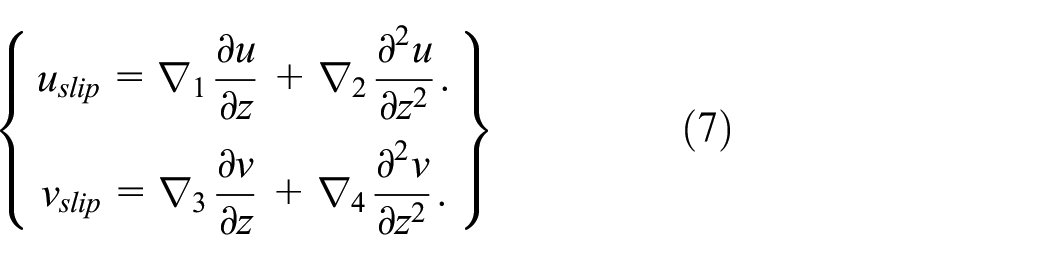
where
The suitable similarity transformations are defined as:

Using equation (8), the leading equations are transformed as:


In the above equations,
Thermophysical properties
Thermophysical properties of the hybrid nanoliquid are defined in Table 1.
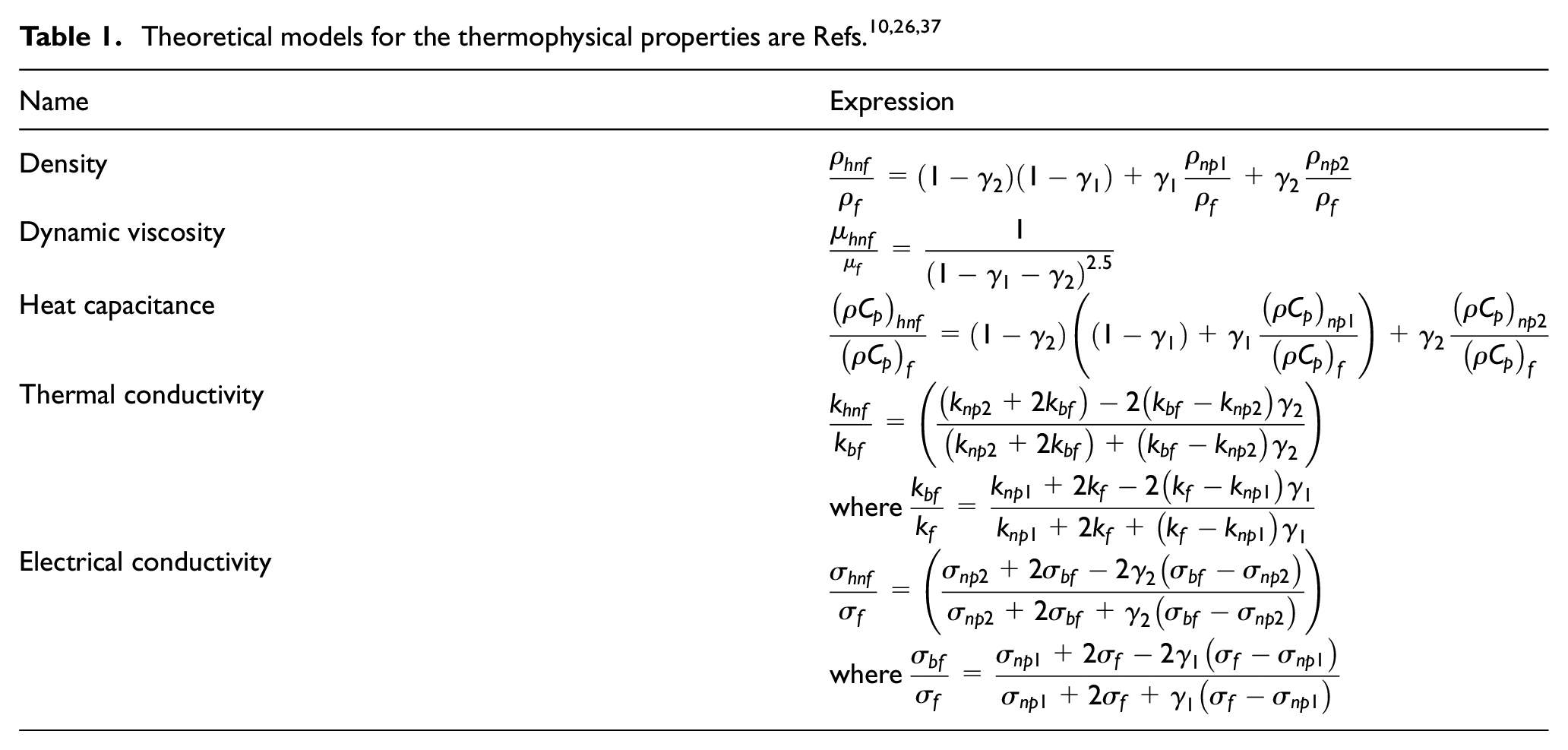
In the above Table,

Quantities of interests
The skin friction coefficients and Nusselt number are mathematically defined as:

where

It is important to note that, as described in Tripathi et al., 43 Seth et al., 44 and Wakif et al., 45 the wall mass transmission rate has simply vanished in the condition of zero mass flux. The following reduced forms are obtained by utilizing the suggested similarity transformations:

where
Homotopy analysis method
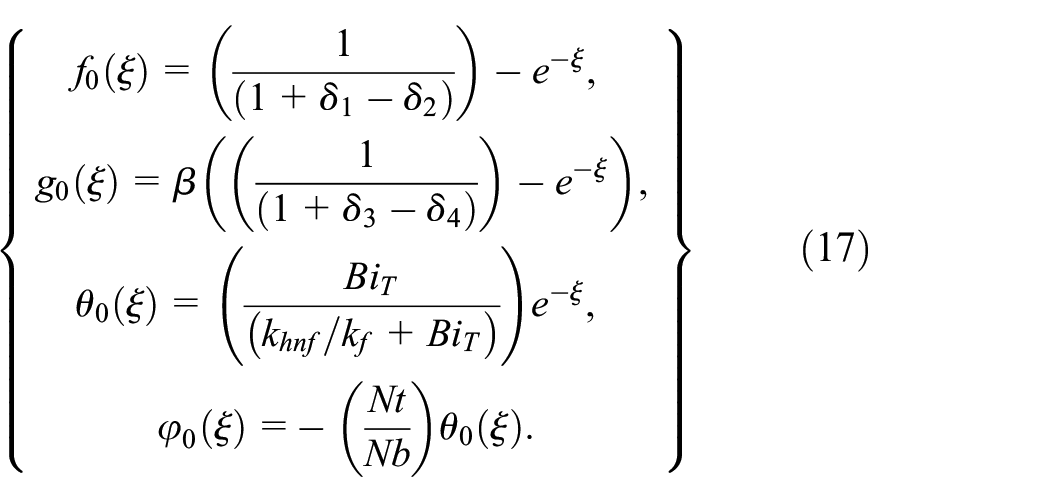
The initial guesses and linear operators, for the homotopy analysis method (HAM) framework, are defined as:
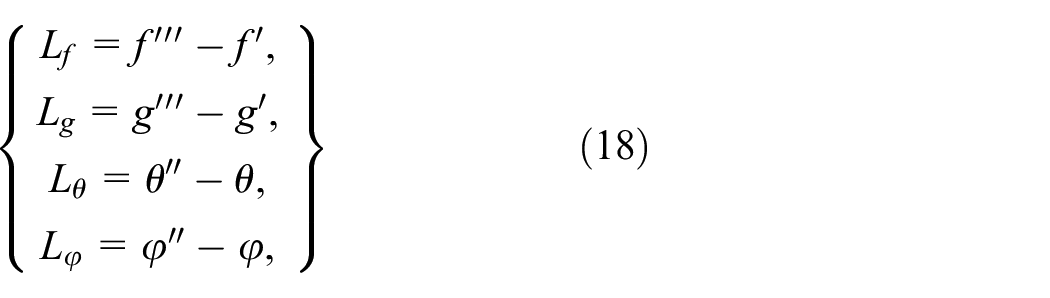
with properties:

where
Results and discussion
This section shows the impressions of entrenched factors on the velocities, thermal, and concentration profiles, Nusselt number and skin friction are presented with the help of Tables and of Figures. Figures 2 and 3 describe the impression of

Influence of

Influence of

Influence of

Influence of

Influence of

Influence of
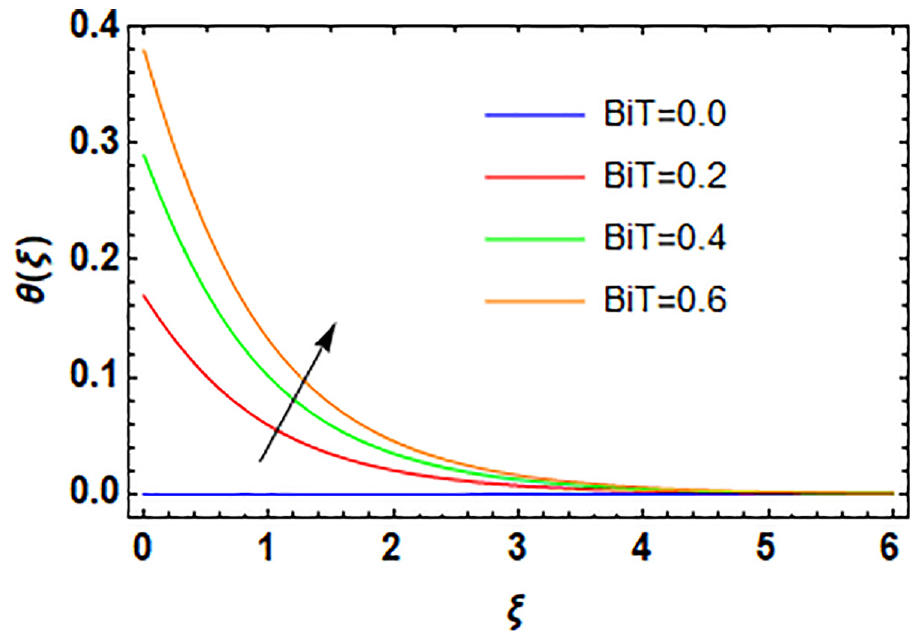
Influence of
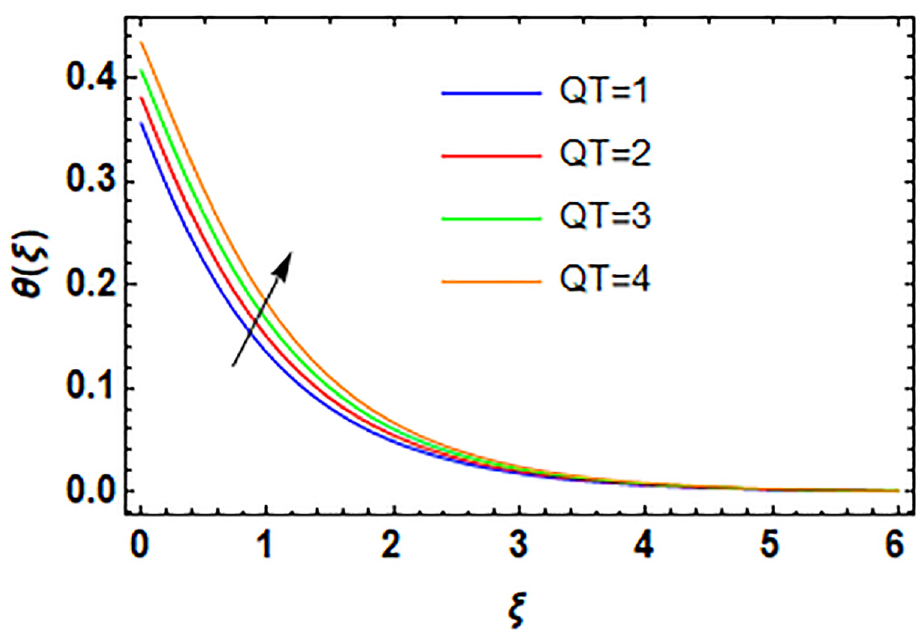
Influence of

Influence of

Influence of

Influence of

Influence of
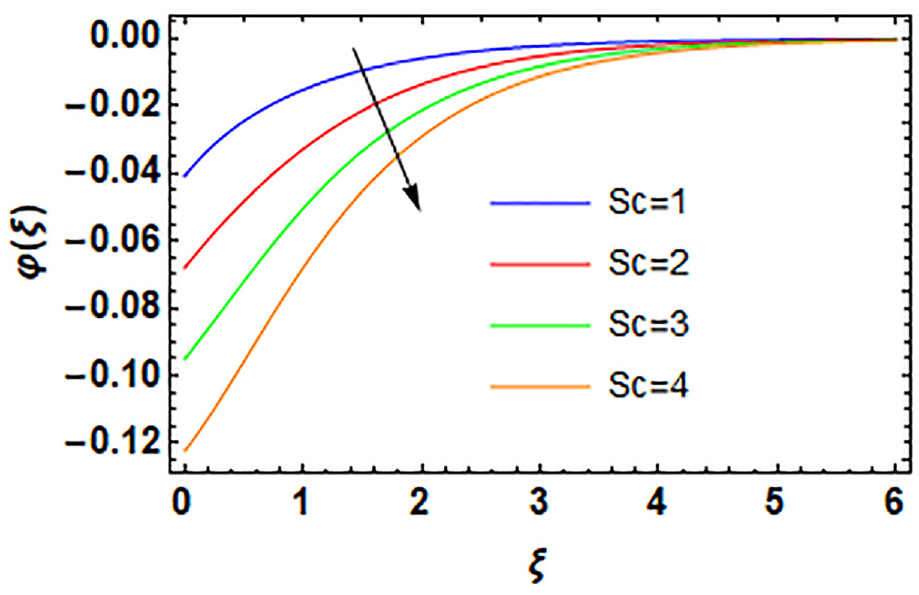
Influence of
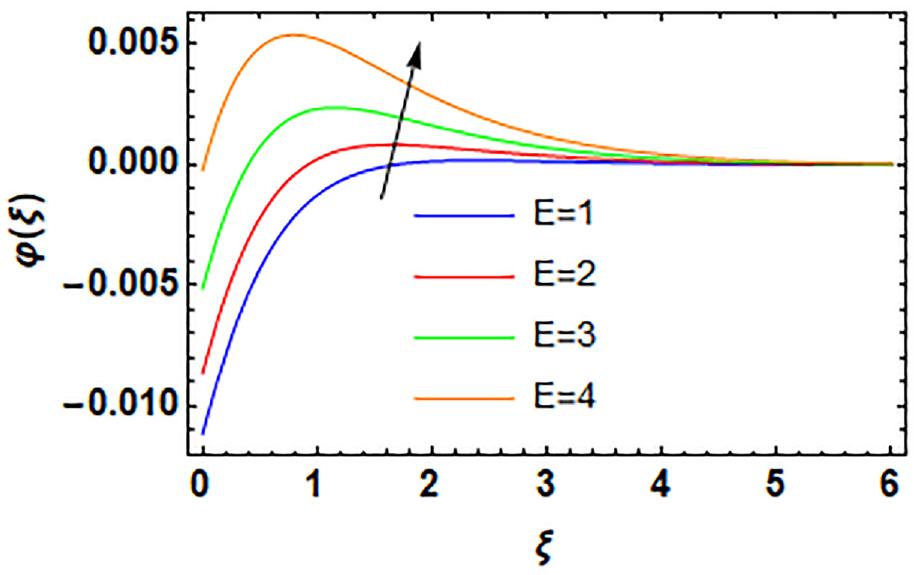
Influence of

Combined effects of
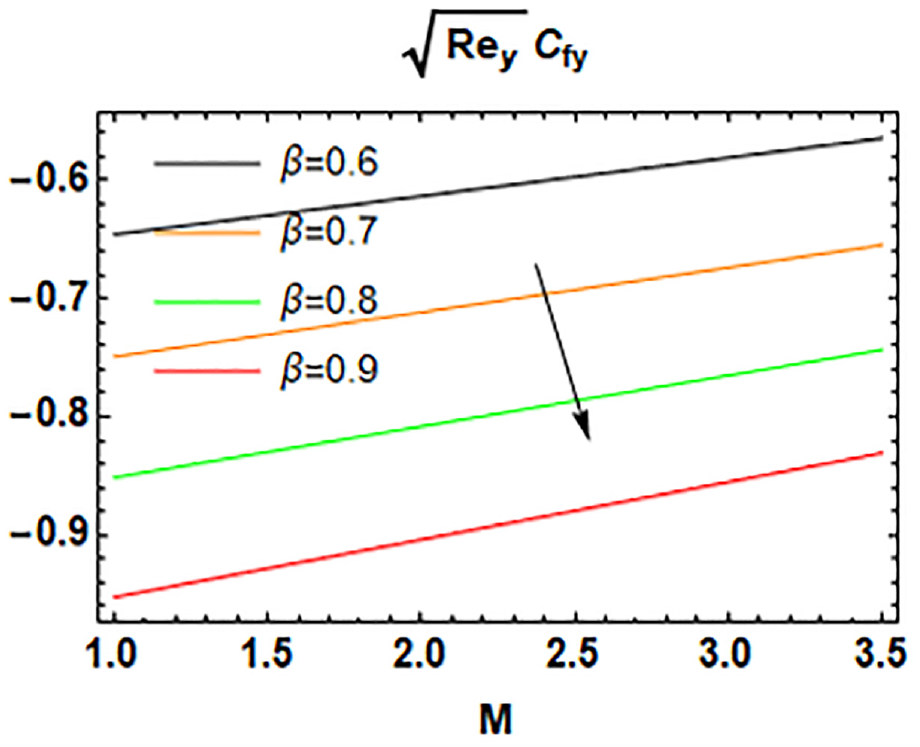
Combined effects of
Convergence of HAM.

Comparisons of

Impacts of

Conclusion
The slip flow of a water-based hybrid nanoliquid including nanoparticles across a bi-directional stretching surface is investigated in this paper. It is assumed that the three-dimensional flow is laminar, steady, and incompressible. The present research includes velocity slips, zero mass flux, and thermal convection conditions. It is essential to notice that the hybrid nanoliquid flow’s wall mass transfer rate vanishes at zero mass flux at the wall. The mathematical framework of this report is presented in the form of PDEs which are then converted into ODEs via appropriate similarity transformations. A semi-analytical method called HAM, is used in order to solve the transformed ODEs. The significant points of this report are recorded as:
(1) The impression of the magnetic flux on the velocity distribution of the hybrid nanofluid is observed to be declining due to the higher resistive force near the sheet surface.
(2) The hybrid nanofluid’s velocity profile along
(3) The hybrid nanofluid’s velocity has decreased in both directions due to the second-order slip parameters.
(4) The higher Bio number has concentrated the thermal resistance which enhanced the temperature profile.
(5) The greater space-dependent heat source, Brownian motion, and thermophoresis factors have significantly increased the temperature profiles.
(6) The concentration profiles have improved with higher thermophoresis and activation energy parameters, whereas they have decreased with the augmenting Schmidt number and Brownian motion factor.
(7) It is discovered that while the rate of heat transmission is increased by thermal Biot numbers and Brownian motion factors, it is decreased by the growing thermophoresis factor. When comparing the thermophoresis factor between water and hybrid nanofluid flows, the latter has an 8% larger impact. Similar to water, hybrid nanofluid exhibits effects of thermal Biot number and Brownian motion factor that are 8% and 9% larger respectively.
(8) At this point, it is necessary to note the significance of fluid flow with slip in microelectromechanical systems. The microscale size of these devices lead the flow in these systems to significantly diverge from the conventional no-slip flow. Microscale devices and low-pressure settings frequently include concentrated gas flows with slip condition.
(9) The present analysis is validated by the comparing the new results with reported results.
Footnotes
Appendix
Notations

| Name | Symbol |
|---|---|
| Coordinates | , , |
| Components of velocity | , , |
| Temperature | |
| Temperature at the surface | |
| Reference temperature | |
| Temperature at infinity | |
| Concentration | |
| Ambient concentration | |
| Dynamic viscosity | |
| Electrical conductivity | |
| Density | |
| Thermal conductivity | |
| Specific heat | |
| Brownian diffusion coefficient | |
| Thermophoretic coefficient | |
| Space-dependent heat coefficient | |
| Stretching velocity along axis | |
| Slip velocity along axis | |
| Stretching velocity along axis | |
| Slip velocity along axis | |
| Nondimensional velocity distribution along axis | |
| Nondimensional velocity distribution along axis | |
| Nondimensional temperature distribution | |
| Nondimensional concentration distribution | |
| Similarity variable | |
| Magnetic factor | |
| Prandtl number | |
| Thermophoretic factor | |
| Brownian motion | |
| Space-dependent heat factor | |
| First-order slip factor for | |
| Second-order slip factor for | |
| First-order slip factor for | |
| Second-order slip factor for | |
| Thermal Biot number | |
| Ratio factor | |
| Temperature difference factor | |
| Schmidt number | |
| Activation energy factor | |
| Chemical reaction factor |
Handling Editor: Chenhui Liang
Declaration of conflicting interests
The author(s) declared no potential conflicts of interest with respect to the research, authorship, and/or publication of this article.
Funding
The author(s) received no financial support for the research, authorship, and/or publication of this article.
