



Abstract
Although organic Rankine cycles (ORCs) have cornered the small-scale energy harvesting market, the generation capacities produced by sCO2 cycles far exceed those of ORCs, reaching higher powers and efficiencies. This paper analyzes the results of the field tests performed in 2022 at the Grupo Dragón, Nayarit, Mexico, facilities, in which the objective was to validate the operation of the ORC IDEA-10 system with a capacity of up to 10 kWe. The thermodynamic states reached during the test time lapses in which there was full operational stability and with direct loads are analyzed. The results obtained together with proposals for improvement led to compare the performance of ORCs with sCO2 systems for low temperature geothermal sources. The efficiencies of simple sCO2 cycles (5.32%) turned out to be lower than that of ORC at the same temperatures (9.7%), however, the efficiency of the sCO2 cycle improved notably in a regenerative configuration, given the properties of CO2 near its critical point, reaching efficiencies above 25% even at low temperatures compared to conventional ORCs with efficiencies below 10%. Finally, the basis for the implementation of sCO2 in low enthalpy geothermal applications was established, designing an experimental circuit with results obtained in the literature.
Introduction
The use of geothermal resources as a heat source is an area of opportunity that promotes the change toward a more environmentally responsible energy consumption.
Organic Rankine cycles (ORC) are energy systems that use low boiling temperature and high molecular mass organic fluids for use in low and medium temperature heat sources, 1 such as surface geothermal sources.
These systems are mainly made up of four elements which are an evaporator, a condenser, a pump, and an expander. The expander is an important component within the ORC since it is the element that transforms the thermal energy of the working fluid into mechanical energy for its subsequent conversion into electrical energy by coupling an electrical generator to the expander shaft. The isentropic efficiency of the expander directly affects the overall efficiency of the system so it is necessary to identify the correct type of expander for your application. Expanders are divided into two main categories according to their principle of operation. One type is the volumetric expander, which generally obtains the enthalpy drop and pressure ratio by changing the inner volume of the working chamber, examples of this type are the screw expander, the piston expander, and the scroll expander. The second type are turboexpanders, among which are axial, radial, and centrifugal flow turbines. Radial flow turbines are characterized by their ability to cope with large enthalpy drops at low periphery, low manufacturing cost, and compact structure. 2
Many publications postulate that, for small power or small mass flow rates, volumetric expanders are advantageous in terms of efficiency, rotational speed, size, and cost for power systems with power ratings below 10 kWe. However, in works such as Weiß et al., 3 the differences between turbines and volumetric expanders were analyzed in detail, reaching the conclusion that small turbines may be superior to volumetric expanders since they allow high volumetric flow ratios, a small installation size is needed, there is no wear, lubrication may not be necessary, and they can be customized to a large extent. The main disadvantage is the high rotational speed and requiring a custom high-speed electrical generator for coupling.
Another disadvantage is found in the mechanical efficiency of the turbines for low power ORC systems, ORC turbine efficiencies of 52%−82% have been reported in the literature, while the efficiency of gas turbines can easily reach 90%. 4 Currently, high energy density systems capable of working with supercritical fluids are known to satisfactorily increase the performance of their turbines. The proposed improvement and implementation of CO2 in supercritical state as a working fluid in low temperature energy systems is the objective of this work. The following is a description of the case study carried out in the field with an ORC system and the main observations obtained from the tests performed.
This project arises from the collaboration of the Engineering Institute of the National Autonomous University of Mexico (UNAM) with the company ETU i+D in the development of a modular organic Rankine cycle (ORC) IDEA-10 for applications in low enthalpy geothermal sources. The IDEA-10 ORC system is a commercial design, licensed for replication, which produces up to 10 kWe of electrical power using R245fa as the working fluid. It consists of a storage tank, two flat plate heat exchangers, a metering pump, and two parallel-connected radial outflow turbines (ROT) of two expansion stages each and coupled to a brushless electric generator with a maximum capacity of 5 kWe each. The system operates with a R245fa refrigerant flow rate of 3600 kg/h, at turbine inlet conditions of 14.8 bar and 150°C. In 2022, several field operational tests were conducted to analyze the performance of the ORC IDEA-10 unit. The system was moved to the Domo de San Pedro geothermal field in Nayarit, Mexico, to operate with a flow of steam remaining from the field’s electrical generation process as a heat source. The energy source consisted of geothermal brine at conditions of 8.5 bar and 170°C, while the cooling system included a 380 kWt wet cooling tower capable of providing water at 25°C at 1.5 bar required for condensation of the coolant 5 (Figure 1).

IDEA-10 in the Domo de San Pedro geothermoelectric field.
The purpose of this work is to analyze the behavior of the ORC IDEA-10 system under in situ conditions and based on the results obtained and the field experience developed with the ORCs, to identify and propose improvements to these energy conversion systems for direct geothermal sources (low temperature) through the use of CO2 in supercritical state as working fluid.
Thermodynamic design analysis
ORC systems are Rankine cycles that operate under the following ideal processes like Brayton cycles starting with an isentropic compression (1–2), followed by isobaric heat addition (2–3), for an isentropic expansion in the turbine (3–4) and finally an isobaric heat extraction (4–1). Implementing the laws of conservation of mass and energy in the main elements of the system yields the following equations for the pump (1, 2), evaporator (3), turbine (4, 5), and condenser (6). Where






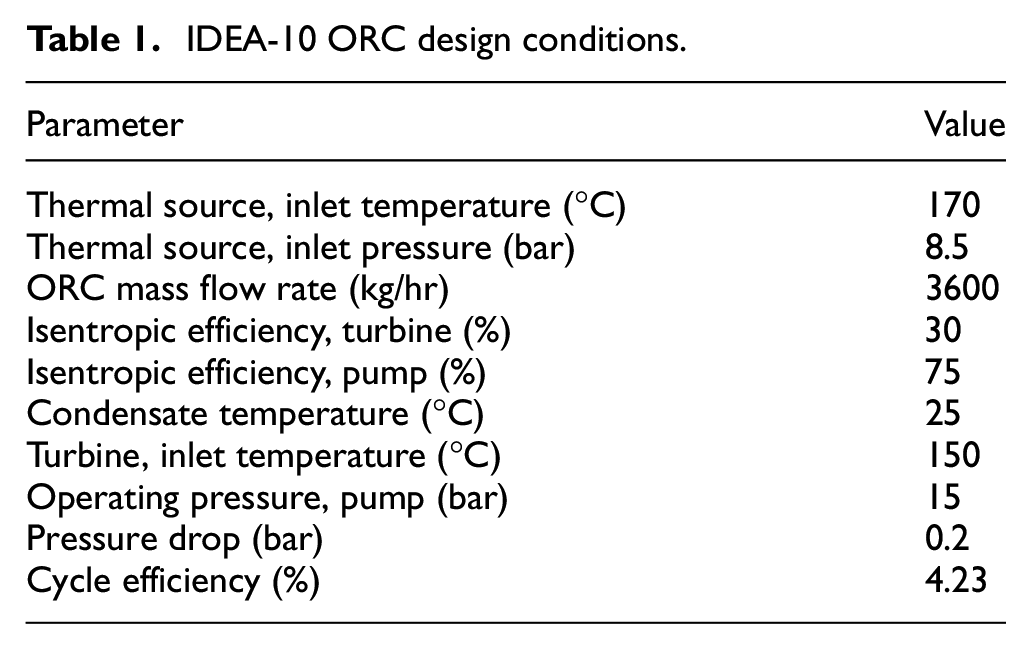
Table 1 shows the design conditions of the ORC IDEA-10 and Figures 2 and 3 show the thermodynamic states and the T-s diagram of its process.
IDEA-10 ORC design conditions.

Thermodynamic states at design conditions IDEA-10.

ORC IDEA-10 T-s diagram.
IDEA-10 field operational tests
The operational tests in the San Pedro Dome geothermoelectric field were developed during the years of 2018 and 2022. Although in the year 2018 some preliminary results were obtained, it was not possible to obtain certain conclusions of the behavior of the system due to the limitation in data collection. 5 This led to the fact that in 2022 the ORC IDEA-10 system was improved, designing and installing an instrumentation and data acquisition system capable of continuous recording, with the objective of better analyzing the behavior and stability of the cycle in an active operating state. Pressure and temperature sensors were incorporated in the four main thermodynamic states of the cycle, together with two data acquisition cards DAQ-4718 for thermocouples and DAQ-4704 for pressure sensors. All the data generated were collected in real time using a graphical interface developed in LABVIEW. Figure 4 shows the main elements present in the ORC system together with its sensors and data acquisition module. An FDT-21 ultrasonic flow meter was used to measure the mass flow of R245fa inside the ORC.

ORC IDEA-10 system main components.
The operation tests of the ORC IDEA-10 were carried out in 1 week, where two cases of interest were analyzed. The first one was an operation of the ORC in thermodynamic stability for a minimum time of 45 min, extending to a maximum of 10 h. The output of the electrical generators of the turbines was connected to an inverter cabinet with a capacity of 6 kWe. In this test, four 12 V batteries connected in series were charged to power an array of twelve 500 W luminaires (Figure 5).

ORC IDEA-10 in 10-h test, San Pedro Dome.
Figure 6 shows the values detected by the data acquisition system for the 10 h test, where state 1 for pressure and temperature is located at the inlet of the turbines, state 2 at the outlet of the turbines, and state 3 at the inlet of the dosing pump. Figure 7 shows the thermodynamic states of the ORC for average values of the test, the average R245fa mass flow rate measured was 1584 kg/h and an efficiency of 0.7% in the cycle. Figure 8 shows the active power reported for the 10 h test against the demand of the luminaires for the electric generators, identifying N171003 as turbine 1 and N171004 as the second one. In this case it was only possible to use a demand of 3000 W, corresponding to six luminaires before the batteries were fully discharged. However, the ORC system was able to operate at stability without problems for the 10 h that were contemplated, the maximum total power reported was 450 W.

Pressures and temperatures recorded in the DAQ 10 h test.

Thermodynamic states of IDEA-10 in 10 h test.

Electric generators behavior to load demand by luminaires.
A measurement error analysis was performed and a standard deviation for the N171003 turbine measurements of 11.37 W and for the N171004 turbine of 17.23 W was obtained. The graphs are shown in the Figure 8 along with the total performance of both turbines and their deviation.
The second case of interest was the operation of the generators in direct load with a bank of 6.3 kW, 60 V resistors (Figure 9). The bank was composed of 21 deltas with three resistors of 100 W each, of which 6 deltas were finned tube resistors and 15 deltas, immersion resistors.

Test with direct loads of ORC IDEA-10, San Pedro Dome.
As in the previous case, the thermodynamic parameters were recorded in real time with the DAQ (Figure 10) and for the missing states, analog instrumentation and manual measurements were used to complement the analysis of the system behavior (Figure 11). The total time of this test was 13 min where loads of 300 W were gradually applied until the total demand of 6300 W was reached. The behavior of the generators is shown in Figure 12, where a maximum total power of 330 W was reported. The reported mass flow rate was 1584 kg/h and an efficiency of 1.79% in this case. The same for this case, the standard deviations for the turbines were measured, with a value of 35.92 W for N171003 and 27.33 W for N171004. The total performance is shown in the Figure 12.

Pressures and temperatures in DAQ direct loads test.

Thermodynamic states of IDEA-10 in direct loads test.

Electric generators behavior in direct loads test.
Results analysis and field experience
From the results obtained in the two field tests, it can be compared with the expected behavior according to the design parameters for the ORC IDEA-10 system with the help of the sensitivity study for the turbines Figure 13 that for a mass flow of 1584 kg/h registered in the ultrasonic flow meter, an estimated power of 3 kW would be expected, however, for the results obtained Figures 8 and 12 these values turn out to be much lower. One aspect that was significantly affected was a large pressure drop in the heat exchangers that was not contemplated in the design parameters. Site temperature was also a variable that was not considered and affected the cycle performance, overheating in the evaporation in the cooling tower resulted in a lower level than required for operation and led to cooling line pump failures.

Sensitivity curves, power versus mass flow at different turbine inlet pressures.
This had an impact on the cycle efficiency in the long time tests, comparing with the data obtained by Fatigati et al. 6 for an ORC of the same scale (efficiencies of 2.4%–4%) those obtained through the design parameters resemble (4.23%) and for the tests with direct loads (1.79%), however, these performances are potentially improvable.
One way to increase the power of the system is to increase the mass flow or increase the temperature of the source as shown in Figure 14, however, the increase in mass flow in the system would result in an increase in dimensions which would lead to a higher installation cost.

Sensitivity curves for turbines, power versus mass flow at different source temperatures.
The temperature increase would have to be studied in detail since some refrigerants have low degradation temperature where their thermodynamic properties are affected. Among these issues and technical aspects to improve during field performance tests ORC IDEA-10 system, the possibility of increasing the power and efficiency substantially changing the working fluid by carbon dioxide (CO2) arises.
System improvement strategies
ORC system performance depends significantly on cycle parameters, working fluid, and component performance. 7 The benefits achievable by ORC systems have led to increasingly efficient systems. Thus, three methods of optimizing ORC systems stand out: the selection of a suitable working fluid, the use of an efficient thermodynamic cycle configuration, and the improvement in turbomachinery design. 8 To improve process efficiency, various configurations have been developed that adopt steam reheat stages to obtain a higher energy jump, reduce the pressure drop on the steam side, and more efficiently exploit the heat provided by the thermal source. The installation of a regenerator will depend on the selection of the working fluid and the optimum configuration of the cycle. 11 Another aspect of ORC systems of great interest is their sensitivity to the properties of the working fluid due to the effect it has on operating conditions, performance, and equipment selection.
Although ORCs with organic fluids generate moderate power with low enthalpy sources, it is possible to transfer large amounts of energy in compact package sizes by taking advantage of certain compounds. Some researchers even suggest working certain fluids under supercritical conditions. 9
The selection of the working fluid for an ORC system is of vital importance for the efficiency of the system. It also represents the first step in the design and consideration should be given to the use of working fluids with low global warming potential (GWP) and ozone depletion potential (ODP). 10 Given the increasing requirements to control emissions from energy systems, the use of CO2 as a working fluid is attractive as it is non-toxic, non-flammable, and has a low GWP compared to other refrigerants, in addition, the use of CO2 as a working fluid can reduce the emission of the same by combining it in CO2 sequestration systems for direct implementation.
ORC to SCO2 cycle repowering
The development of supercritical carbon dioxide (sCO2) power cycles is a new technology that explores the possibility of making better use of today’s energy resources. Although ORCs have cornered the market in small-scale energy harvesting, the generation capacities produced by sCO2 cycles far exceed those of ORCs, reaching higher power and higher efficiencies. In addition, sCO2 cycles operate at high pressures throughout the system, resulting in an energy-dense working fluid that promotes the development of compact systems with a low plant footprint. 12
However, a change of fluid and handling of supercritical conditions implies compatibility and capacity reviews of thermal and mechanical equipment, as well as a more precise process control, so it is necessary to analyze the operating conditions and select the equipment and instrumentation to take advantage of this technological improvement.
A supercritical fluid is a substance that is above its critical point for CO2 this condition is reached at 30.98°C and 7.37 MPa. Above this value, CO2 acquires both liquid and gas properties that allow it to develop low compressive work and high energy transfers. 12
One aspect to highlight is the different thermodynamic configurations, while the R245fa operates in a Rankine cycle, the CO2 operates in a Brayton cycle, usually both closed. Crespi et al. 13 performs an exhaustive review of all sCO2 cycle configurations reported to date, where efficiencies for closed Brayton cycles from simple to reheated with recompression are highlighted in ranges of 27%−40% and above 60% in the case of combined cycles with mainly nuclear and concentrated solar power (CSP) applications. However, given the low enthalpy geothermal application of this work, the comparison will be made with sCO2 systems smaller than 250 kWe.
Although they do not operate in the same cycle or region, it is possible to compare the efficiency of Rankine and Brayton sCO2 cycles under the same source heat power conditions. Figure 15 shows a comparison between the Rankine cycle with R245fa, CO2 in a simple Brayton cycle and CO2 in regenerative Brayton under the same heat source power condition varying its temperature. The black curve represents R245fa in an ORC where it can be seen how this fluid reaches its maximum efficiency (9.6%) above 110°C, decreasing as the source temperature increases. On the other hand, the red curve represents CO2 in a simple Brayton cycle, where the advantage of R245fa at temperatures below 350°C is clear. At first glance it could be said that R245fa is a better choice of working fluid for systems operating with low temperature heat sources and that CO2 is better as the source temperature increases. However, the maximum efficiencies of both cases are below 10%. The blue curve represents CO2 in a regenerative Brayton cycle, where the superiority of this fluid using its heat transfer properties is perfectly illustrated.

Comparison of efficiencies with respect to source temperature between fluids and cycle configuration.
By coupling an extra heat exchanger and allowing reheating in the system, the efficiency of the cycle is greatly benefited. Despite working with the same fluid; sCO2, the heat supplied decreases, allowing to reach better efficiency values than R245fa even at low temperatures and improving as the temperature increases. The main disadvantage of using sCO2 systems in low temperature sources would be found in the need to implement more complicated configurations such as regenerative which also leads to an increase in cost. However, if this difficulty is overcome, we will have a cycle that provides more than twice the efficiency of a conventional ORC, reaching efficiencies above 25%.
This work provides the basis for the scaling up of sCO2 systems to geothermal applications with the aid of a turbomachinery development bench for the detailed study of the fluid characteristics within the supercritical zone. The following is a summary of the most prominent work worldwide on the development of experimental circuits with sCO2. Although there are systems under development for large powers
Table 2 describes the capabilities at Sandia National Laboratories (SNL), Bechtel Marine Propulsion Corporation (BMPC), both in the United States, the Tokyo Institute of Technology (TIT) in Japan and the Korea Institute of Energy Research (KIER) in South Korea.16–19 The recurring configurations in these systems are Brayton cycles with recompression and reheating (BRCRC) and Brayton with reheating (BRC). Table 2 shows compression efficiencies ranging from 48% to 70% and expansion efficiencies ranging from 51% to 87% and pressure ratios from 1.44 to 1.80. In addition, having temperatures and inlet pressures in the compressor near the critical point, which is where most benefit is obtained from the properties of CO2. As for the mass flows are observed values between 4320 and 20,772 kg/h for heat sources ranging from 160 to 834.90 kWt and cycle efficiencies of 1.73%–32.05%.
sCO2 experimental banks comparison in the world.

Based on the general behavior of the Brayton sCO2 cycle and taking as reference the data in Table 2, the thermodynamic parameters of the development bench are defined. Boiler power and temperature limit values are established as 199 kWt and 180°C, taking as a technical consideration a thermal approximation in the heat exchanger of 15°C, estimating a turbine inlet temperature of 165°C, according to experience with its operation. Knowing that the thermodynamic properties of CO2 near its critical point favor the performance of the compressor, it was decided to set the compressor inlet pressure and temperature at 75 bar and 31°C. Table 3 shows the summary of the thermodynamic input design data, Figure 16 the thermodynamic states of the sCO2, and Figure 17 T-s diagram of the Brayton cycle.
Brayton sCO2 design conditions.

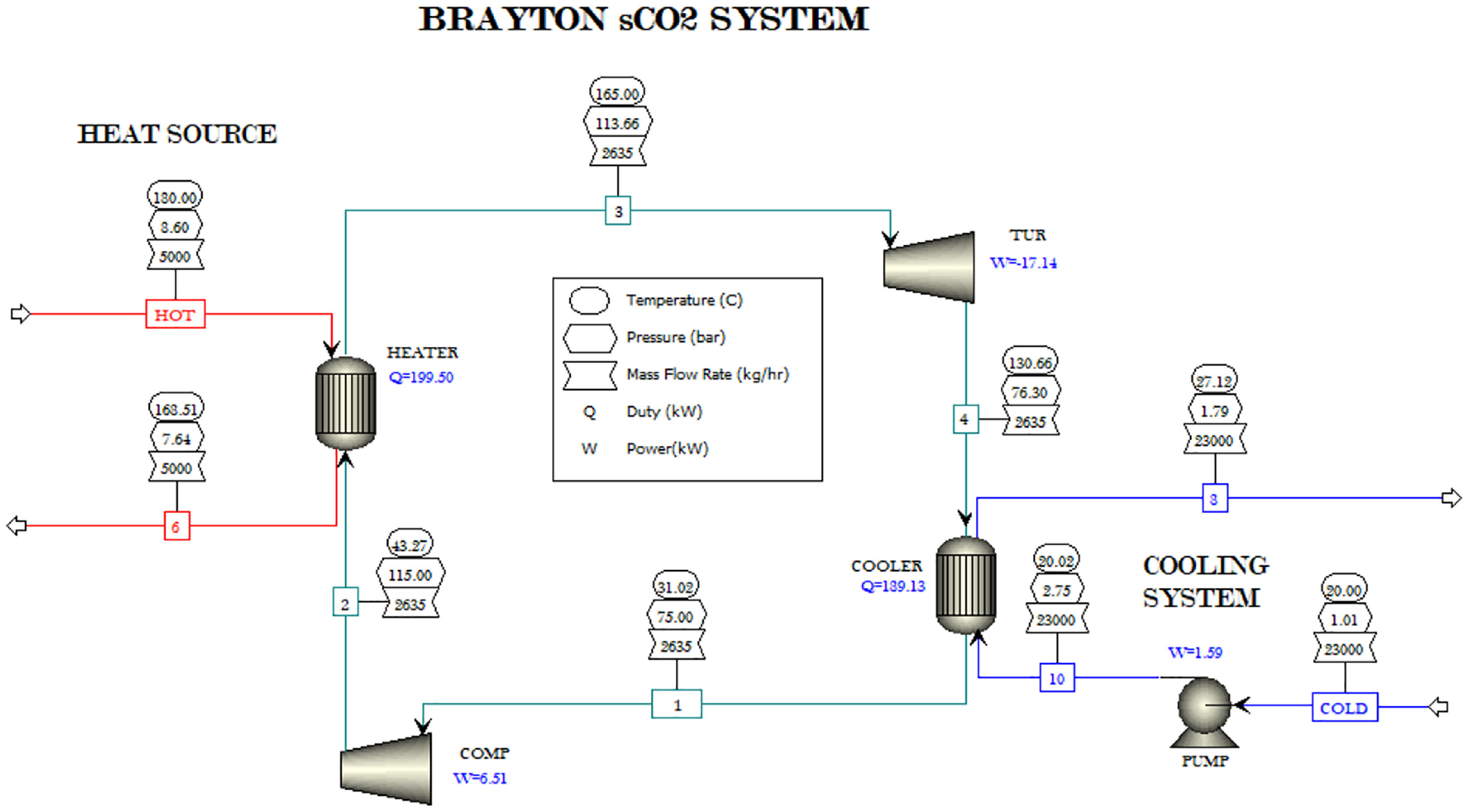
Thermodynamic states of the Brayton cycle sCO2.

T-s of thermodynamic states of the development bank sCO2.
The power obtained in the bench design (10.1 kWe) with the proposed input conditions was very similar to that obtained by the TIT 18 (10 kWe) with an efficiency 6.25%, due to having a similar heat source power, with a mass flow of 2635 kg/h. The overall efficiency of the cycle (5.32%) was as expected for simple Brayton sCO2 systems (less than 10%) at not very high temperatures, as predicted in the Figure 15.
Discussion
In relation to the field tests developed with the ORC system, the turbines worked well below the operation requirements and almost all the tests were regulated by the inverter and the battery set. For the 10-h test the measured R245fa mass flow rate was 1584 kg/h and a cycle efficiency of 0.7% was obtained. Figure 8 showed the active power reported for the test against the luminaire demand for the electrical generators. Although a demand of 3000 W, corresponding to six luminaires, could be used before the batteries were fully discharged, the ORC system was only able to produce 450 W of peak power, however, it operated stably without problems during the 10 h contemplated.
For the test with direct loads, the resistor bank made no demands on the turbines and at no time was there a change involving substantial regulation of the control valve. The total time for this test was 13 min where loads of 300 W were gradually applied until the total demand of 6300 W was reached. The behavior of the generators was shown in Figure 12, where a maximum total power of 330 W was reported with a mass flow of 1584 kg/h and an efficiency of 1.79% in this case. The implementation of a flow regulator for the cycle is evident for the correct regulation of the loads when the turbines require it, although in these tests it was possible to regulate the flow manually through a needle valve, the demand of the resistor bank was not enough for the turbines to require more flow and this improvement is considered for future updates of the cycle.
The site temperature was an unconsidered variable that affected the cycle operation, overheating in the evaporation in the cooling tower resulted in a lower level than required for its operation and led to failures in the cooling line pump. The computer equipment was also affected by the high temperatures, interrupting data capture at certain times. All these external environmental factors, added to the large pressure drops in the heat exchangers, had repercussions on the cycle efficiency in the long time tests. Comparing with the data obtained by Fatigati et al. 6 for an ORC of the same scale (efficiencies of 2.4%–4%), those obtained for the tests with direct loads were 1.79% and for the 10-h test 0.7%, values well below those reported in the literature.
The sCO2 cycles that have been developed in recent years and the theoretical and experimental powers and efficiencies reported by several authors, together with the areas of improvement found in on-site tests with the ORC system, led to the idea of improving the ORC IDEA-10 cycle and implementing CO2 as the working fluid in a new configuration.
Although ORC and sCO2 systems do not work with the same cycle or thermodynamic region, it is possible to compare the efficiency of Rankine and Brayton sCO2 cycles under the same heat source power conditions. Figure 15 compared between Rankine cycle with R245fa, CO2 in a simple Brayton cycle and CO2 in a regenerative Brayton cycle under the same heat source power condition varying its temperature. The results of the graph showed that R245fa in an ORC reaches maximum efficiency (9.7%) above 110°C, decreasing as the source temperature increases. CO2 in a simple Brayton cycle obtains better efficiencies than R245fa at temperatures above 350°C, however, the maximum efficiencies of both cases are less than 10%. On the other hand, with sCO2 in a regenerative Brayton cycle, by coupling an extra heat exchanger and allowing reheating, the system benefits by greatly increasing the efficiency of the cycle. Despite working with the same sCO2 fluid, the heat supplied decreases, allowing better efficiency values than R245fa to be achieved even at low temperatures and improving as the temperature increases. The main disadvantage of using sCO2 systems in low temperature sources would be found in the need to implement more complicated configurations such as regenerative which also leads to an increase in cost. However, if this difficulty is overcome, we will have a cycle that provides more than twice the efficiency of a conventional ORC, reaching efficiencies above 25%.
For the design proposal implementing sCO2 as the working fluid under conditions similar to those in which the ORC IDEA-10 system would operate (low temperatures), a design power of 10.1 kWe was obtained, very similar to that obtained by the TIT (10 kWe) with an efficiency 6.25%, due to the fact that it had a similar power in heat source, with a mass flow of 2635 kg/h. The total efficiency of the cycle (5.32%) was as expected for simple Brayton sCO2 systems (less than 10%) at not very high temperatures, as predicted in Figure 15.
Conclusions
The importance of this work lies in the fact that based on the results obtained and the field experience developed, the improvement of the current energy conversion systems for direct geothermal sources (low temperatures) through the use of sCO2 as working fluid was identified, contributing to sustainable development and the production of cleaner and greener energy with the main attraction of improvements in efficiency and power on a smaller scale.
Although further development is still required for this new technology and its application in geothermal sources for sCO2 systems under development, it is advisable to select components and design configurations that offer the greatest amount of control and reliability of operation, even though overall cycle performance may be reduced. Once it has been demonstrated that sCO2 systems meet efficiency expectations and exhibit reliability, progress will be made in improving system performance. With this in mind, the development of the experimental sCO2 bench will be done by analyzing designs already worked on by other institutions and thoroughly understanding their behavior, without focusing on overall system performance. Once the performance is understood in detail and the effectiveness of the turbomachine in small-scale sCO2 systems is demonstrated, the system will be scaled up and improved.
As future work, it is planned to start with the detailed engineering for the fabrication, assembly, and commissioning for laboratory tests, for subsequent implementation in field tests with low enthalpy geothermal sources.
Footnotes
Handling Editor: Chenhui Liang
Declaration of conflicting interests
The author(s) declared no potential conflicts of interest with respect to the research, authorship, and/or publication of this article.
Funding
The author(s) disclosed receipt of the following financial support for the research, authorship, and/or publication of this article: The authors would like to thank CeMIE-Geo project P08/1125, the IIDEA group of the UNAM Engineering Institute, Dragón group and ETU i+D S.A. de C.V.
Permissions
The authors directly grant all permissions for any previously published content, including figures and tables that may have influenced the development of this work.
