




Abstract
An initial study has been carried out to determine the most suitable system for recovering power from engineered geothermal systems. When using a binary power plant, account has been taken of the relatively rapid temperature decline of such resources. A simplified idealised analysis shows that the total recoverable power is more or less independent of the type of power plant used but a system that maximises the heat recovery from the brine, in its passage through the primary heat exchanger will yield a much higher initial power output and a much quicker return on the capital invested, than one which is designed to maximise the power plant cycle efficiency.
Introduction
Geothermal Energy, potentially offers several advantages over other types of renewable sources, for the generation of electric power. Apart from being largely non-polluting and carbon neutral, it is available as a continuous source of heat, which does not have to be associated with storage systems, in order to produce an uninterrupted supply of electricity. However, geothermal resources suitable for exploitation as sources of heat for thermal power plant are limited to areas, where there are natural aquifers, such as the California geysers, or pressurised hot water sources, that can be reached by drilling. These are found almost exclusively in areas of volcanic activity, near the junction of the tectonic plates, largely located along the so called Pacific Ring of Fire. Therefore, they are not widely available in industrialised countries, where the demand for electricity is greatest.
Since the mid 1970s, resulting from the discovery of local areas of land, where the thermal gradients associated with drilling were found to be unusually high, investigations have been proceeding to recover heat from dry rock by creating two deep drillings into the ground and joining them by fracturing the rock between them, as is done in the oil and gas industry. Water can then be pumped at high pressure through one borehole, which is heated in its passage through the fractured rock and recovered from the second borehole. The hot pressurised water can then be passed through a heat exchanger, acting as a heat source for a thermal power plant, following which, it is recirculated. This is shown schematically in Figure 1. Such a heat source has been described as Hot Dry Rock (HDR) or, more recently, as an engineered geothermal system (EGS)
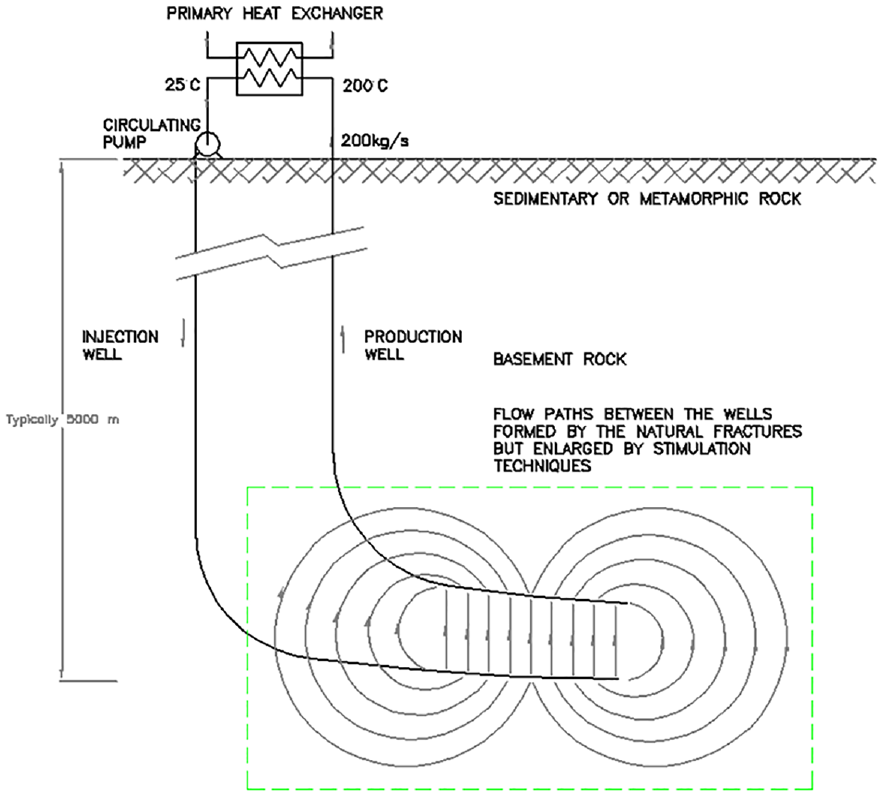
The EGS concept.
Problems associated with creating a large enough artificial reservoir and obtaining a sufficient flow rate of injected water through the flow paths created by the fracking process have not, as yet been fully resolved and, at the time of writing the author is unaware of a successful demonstration of this mode of power generation. However, development work continues in a number of sites and should these lead to success, then this method of power generation has enormous potential and could be widely utilised.
Heat transfer from recirculated geothermal brines, acting as a heat source for a thermal power plant is a common means of generating power. However, in the case of EGS, there is an important difference.
Natural geothermal resources, recover heat from the earth’s inner core, where the available heat is abundant. Consequently, although prolonged heat recovery from it leads to some decline in the recoverable resource temperature, it is a good approximation, to design the power plant on the assumption that this decline will be small over the lifetime of the plant and, if necessary, can be partially recovered by additional drillings.
There is no natural water supply to an EGS and heat is recovered only by conduction from the rock surrounding the fracture paths. The thermal conductivity of rock is relatively low and hence, with time, the circulated water temperature is likely to decline far more rapidly than when it comes directly from a natural geothermal resource.
Methods of recovering power from reinjected geothermal brines are well established. These all involve heat transfer from the brine to some form of Rankine cycle power plant. The general layout of which is shown in Figure 2.
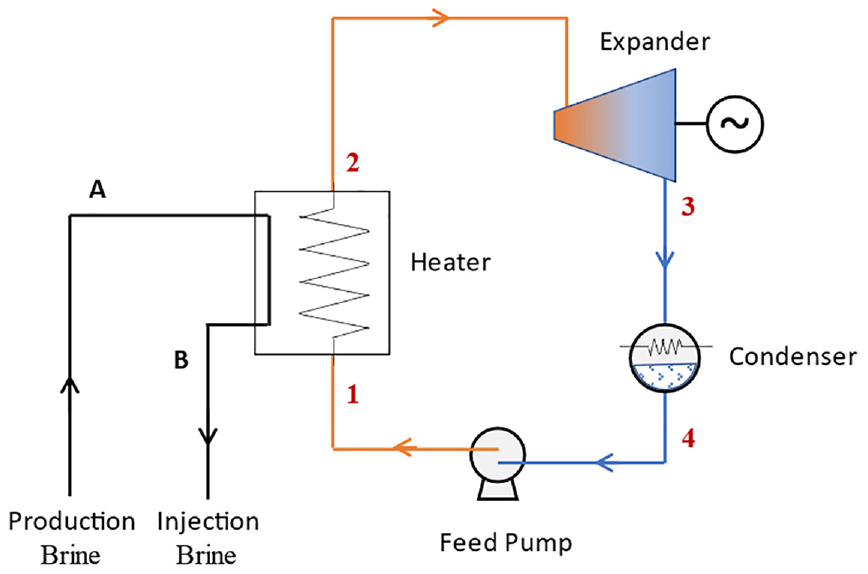
Binary system power plant essential features.
Some variations in the form of the cycle are possible, depending on the choice of an organic working fluid and the resource temperature, as described in Smith et al. 1 These are shown on Temperature-Entropy coordinates in Figure 3. These are known as organic Rankine cycles (ORC’s), and that most commonly used is the first of these, based on the expansion of just saturated vapour.
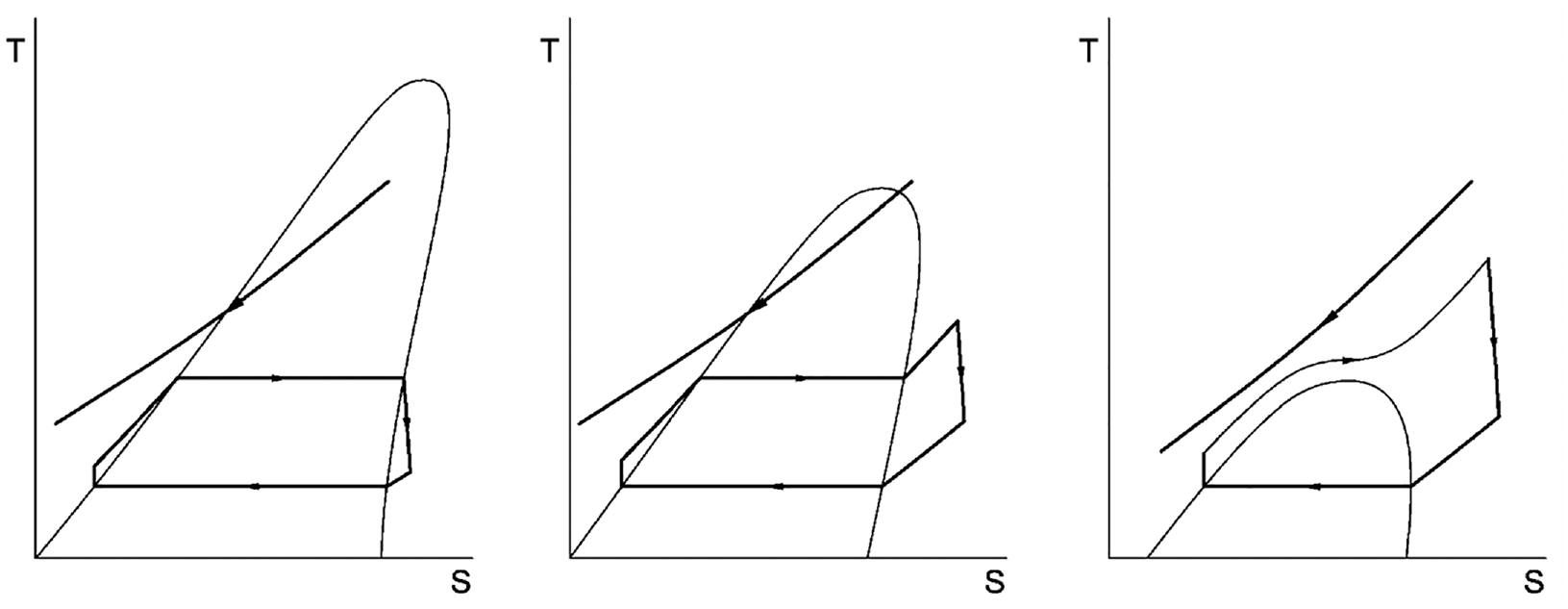
Types of organic Rankine cycles for power recovery from geothermal heat sources.
An alternative form, that has been proposed, eliminates evaporative heat transfer and expands the working fluid as a wet vapour is shown in Figure 4 and has been described as a Trilateral Flash Cycle (TFC).1,2
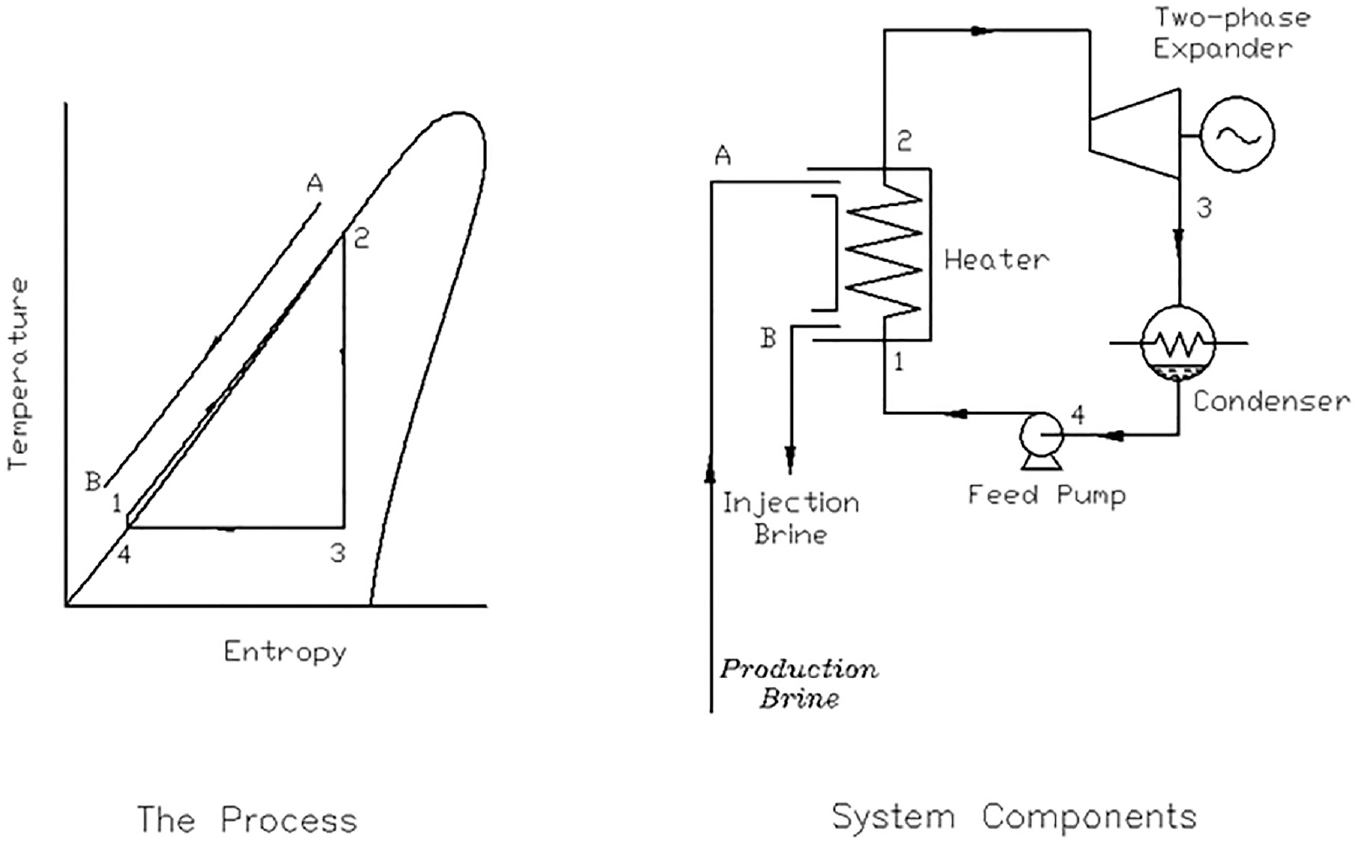
Trilateral flash cycle (TFC) system.
This study was to carry out a basic analysis to determine how the decline of resource temperature with time might affect the choice of power plant for an EGS. In this case, the assumption has been made that due to the low thermal conductivity of rock, the rate of recovery of heat, to the material immediately in contact with the fractures, from the larger surrounding rock, is so low that it is a good approximation to consider the system to be effectively isolated.
Thermodynamic considerations
Independent of any working fluid, or type of heat source, ideal considerations of maximum power recovery, when heat is recovered from an infinite heat source and rejected to an infinite heat sink, lead to the well-known Carnot Cycle, where:

Where: source temperature =
However, nearly all heat sources are flowing fluids, such as combustion products, hot liquids and gases, are finite, and, as heat is withdrawn from them, their temperature falls.
If an ideal power plant, based on a Carnot cycle, is used to recover heat from such a source, then a compromise has to be made, between a maximum cycle temperature of T1, when the cycle efficiency would be a maximum, but the recoverable heat and hence the power output would be zero and a minimum temperature of T0 when the recoverable heat would be a maximum, but the cycle efficiency and hence the power output would be zero. This can be better appreciated, as shown in Figure 5.
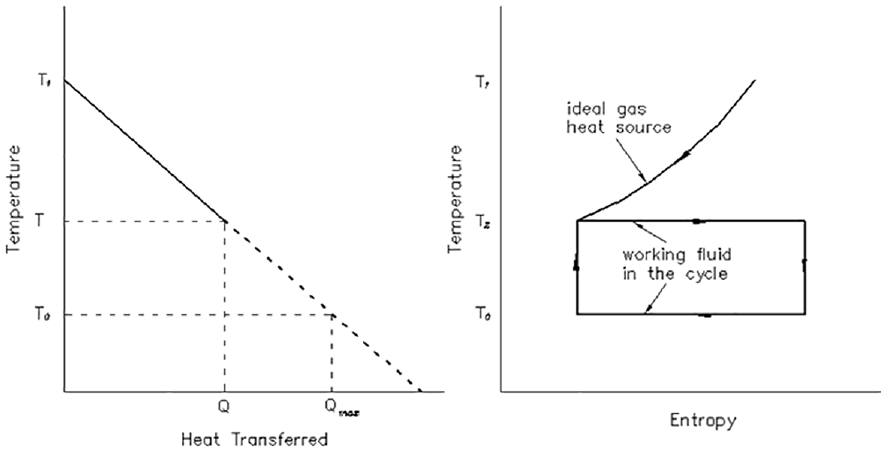
A Carnot cycle system recovering heat from a cooling flowing fluid.
As shown in the left hand diagram, heat transfer to the system is only possible from the inlet temperature T1 down to the maximum power plant temperature T. It follows that the heat transferred

However, as can be seen, if
Hence the heat recovery efficiency:

Now the cycle efficiency,

Define the overall conversion efficiency of any system

For maximum recovery of power


Hence, as shown3,4 the solution for this shows that the conversion efficiency will be a maximum when the maximum temperature of the Carnot cycle system =
It follows from equation (4) that the maximum cycle efficiency of such a system with an initial heat source temperature T1, will then be

However, when the heat source is finite and its temperature falls as heat is withdrawn, the ideal cycle for power recovery would be a succession of infinitesimal Carnot cycles each operating over a progressively falling source temperature, which, when integrated, form an ideal trilateral cycle as shown in Figure 6.
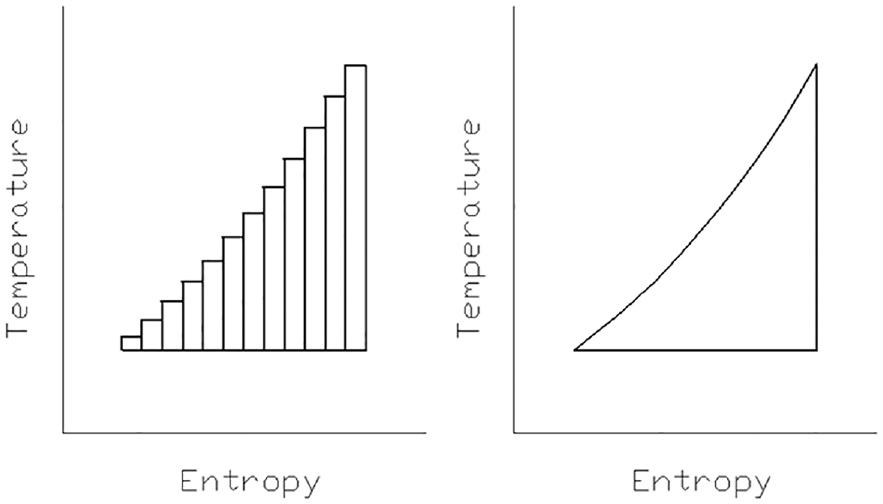
Derivation of the ideal trilateral cycle.
Consider any one of the infinitesimal cycles in which a hot fluid stream, initially at temperature T1, supplies heat to an ideal heat engine, which, in turn, rejects heat to an infinite heat sink at temperature T0. Any heat transfer from the hot stream must be associated with a decrease in its temperature. Thus, per unit mass flow rate of fluid, at any temperature T:

For the receipt of heat dq, the engine does work dw, where:

For an ideal infinitesimal heat engine, as shown in Figure 7, according to the Second Law:
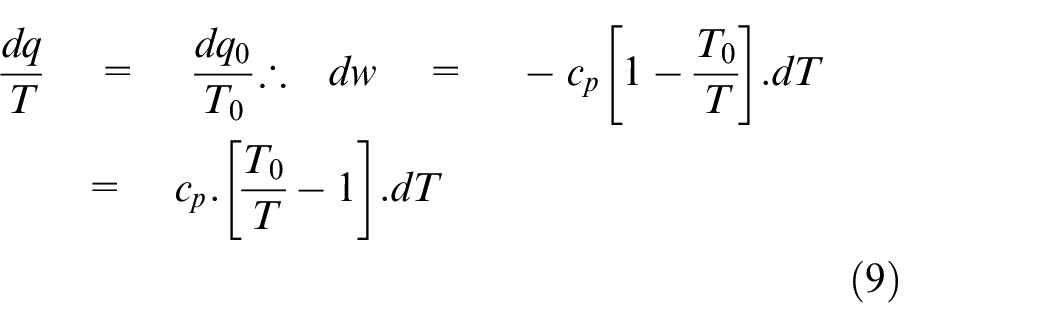
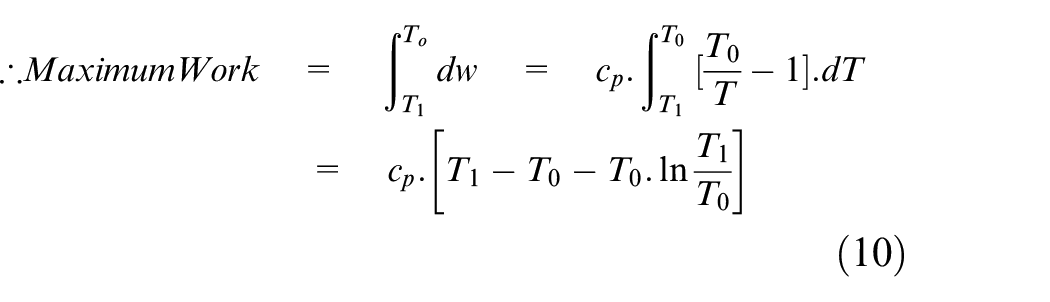
Since the heat transferred is then a maximum, per unit mass

Hence, as shown in refs,1,3 the ideal efficiency for the integrated system then becomes:

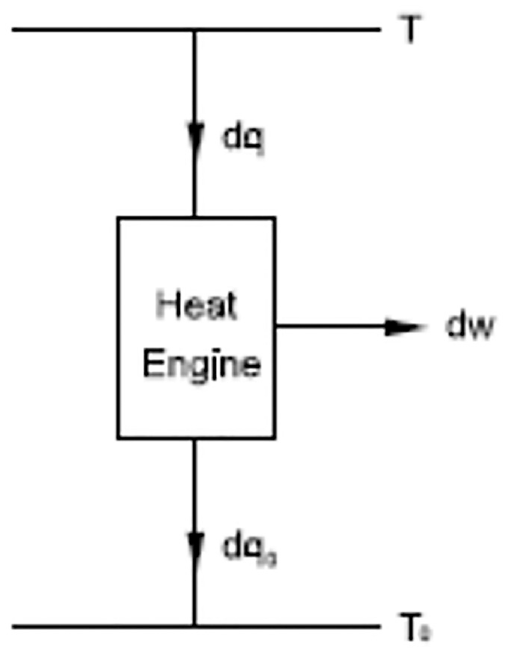
Infinitesimal heat engine.
Analysis
Assuming an idealised system, comprising a finite heat source with a total mass of M and a specific thermal capacity of Cp, through which a steady flow of fluid is recirculated and from which heat is extracted during the circulating process, then regardless of the power plant cycle from which the heat contained in the fluid is extracted, the total recoverable heat from it can be expressed as:

Then assuming equations (8) for the optimised Carnot cycle and equation (12) for the ideal trilateral cycle, the circulating fluid will be returned to the source at a temperature of
Expressions for both the maximum total work recoverable and the rate at which power can be obtained, per unit thermal capacity from each of them can then be derived as follows:
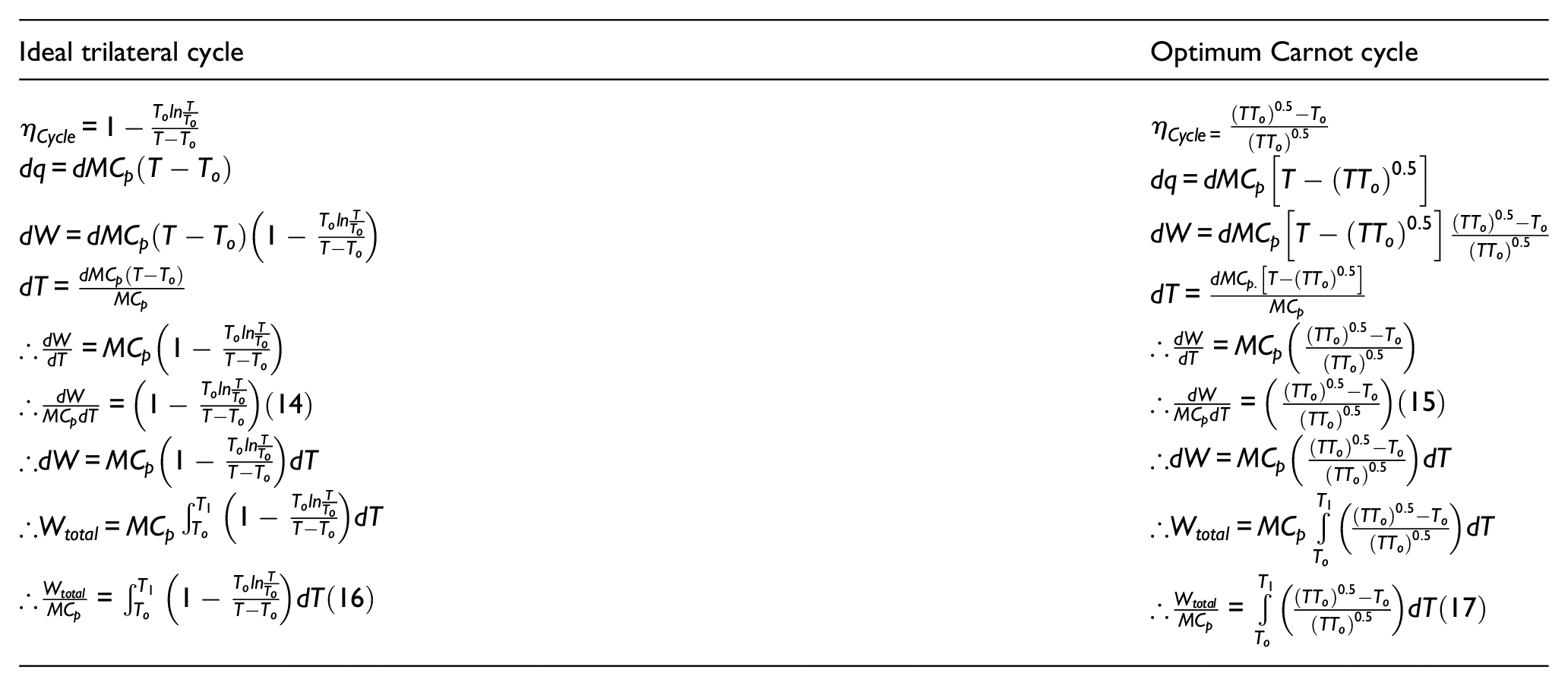
Equations (14) to (17) cannot be solved analytically, in closed form. However, when considering a finite resource with an initial temperature of up to 200°C and an ambient temperature of 15°C, if the right hand sides of equations (14) and (15) are plotted against resource temperature, as it falls from its initial temperature to its final value, as shown graphically in Figure 8, then the area beneath each curve is equal to the total work produced by each type of power plant, from the heat extractable from the resource, per unit thermal capacity of the resource.
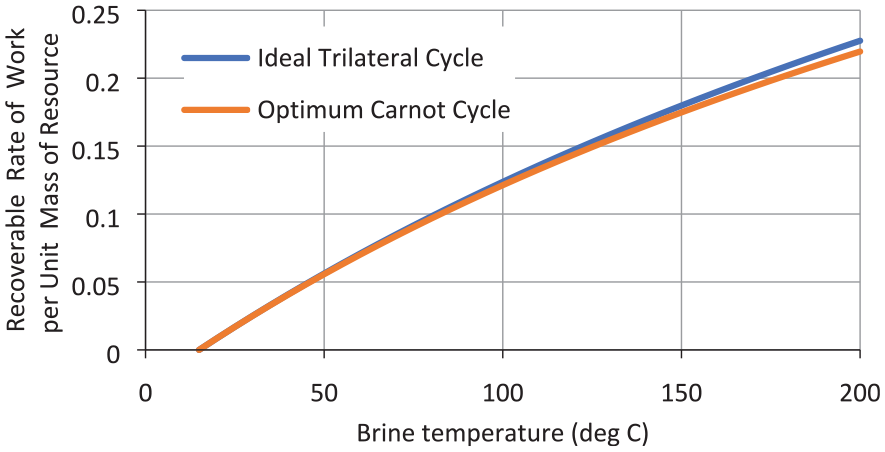
Recoverable work per unit mass of resource from ideal trilateral and optimum Carnot cycles.
Similarly, plotting the right hand sides of equations (16) and (17), plotted against resource temperature, as it falls from its initial temperature to its final value, as shown, graphically, in Figure 9, shows how the rate of power output, per unit thermal capacity of the resource varies as the resource temperature decreases.
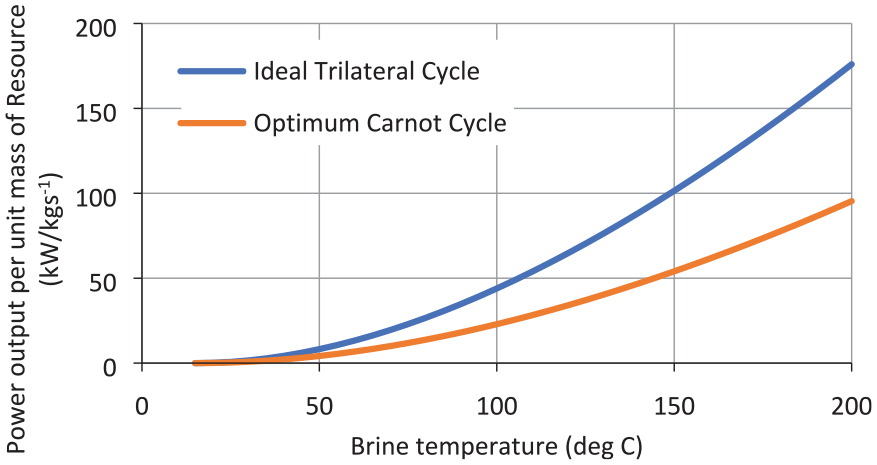
Power output per unit mass of resource from ideal trilateral and optimum Carnot cycles.
Discussion
Bearing in mind that the analysis is based on ideal cycle systems, there are no internal irreversibilities in the power plant. However, the two systems differ in that, as can be seen in Figure 5, the heat transfer to the Carnot cycle system is highly irreversible, due to the large initial, but declining, temperature difference between the circulating fluid and the power plant working fluid. However, as can be seen in Figure 6, the heat transfer to the ideal trilateral system is reversible.
On the other hand, the heat rejected from the circulating brine back to the resource, from the optimised Carnot cycle system, is at the highest possible temperature
The interesting feature of the results is, therefore that, as shown in Figure 8, the ideal total recoverable work from a finite heat resource, is virtually independent of the type of power plant employed. However, as shown in Figure 9, the ideal trilateral cycle system recovers power at nearly twice the rate possible from the ideal Carnot cycle system.
The closest practical implementation of an ideal trilateral cycle system would be a supercritical ORC, or a TFC system, while a saturated Rankine cycle system, which is most commonly used for geothermal power plant, where the main portion of the heat input, is used to evaporate the working fluid, would be the nearest to that of an ideal Carnot cycle system.
In practice, additional irreversibilities occur in both cases, due to component efficiencies, the lower work ratio of a practical trilateral cycle system, compared to that of a Rankine cycle, and additional irreversiblities in the heat exchange processes. It should also be noted that the trilateral cycle system would be more expensive due to the need for larger heat exchangers and a bigger, more powerful, expander.
However, it should be borne in mind that the drilling costs for any EGS resource will be larger than that for a conventional geothermal system recovering heat from a natural aquifer.
Further and more detailed studies may be needed, but the much higher return rate, on the capital invested, possible from a system with a higher rate of power recovery, favours a practical power plant based on a cycle which approximates more closely to the trilateral ideal.
Conclusion
When considering the most suitable power plant for an EGS resource, it appears from a preliminary evaluation, which includes consideration of the resource temperature decay with time, that the total work recovery possible from it is more or less independent of the type of system used, but that a power plant which maximises the heat recovery rate from the brine flow is preferable to one which maximises the power plant efficiency, since it generates a higher power output over a shorter period. This will yield a better return on the capital invested. Thus a supercritical ORC, or a TFC system, may be preferable to an ORC system in which there is a significant amount of heat supplied by evaporation.
Footnotes
Appendix
Declaration of conflicting interests
The author declared no potential conflicts of interest with respect to the research, authorship, and/or publication of this article.
Funding
The author received no financial support for the research, authorship, and/or publication of this article.