



Abstract
A mathematically created model that represents the flow of blood by a stenotic blood vessel is used in the current investigation. The stenotic malady is arising due to the abnormal contraction of the flow passage in the arteries of human body. This contracting produces severe health problems and may minimize the flow of blood in arteries. The study of such mathematically constructed model facilitates us to examine such issues. The circular cylinder is taken with 0.3 m radius and 1.5 m length on the x-axis. The blood is passing through the intertwined stenosis artery. The developed model is assumed to be Newtonian. The segregated solver is applied on the developed model to solve the mass and momentum equations, which is based on the finite difference discretization. The findings indicate that, in comparison to all other regions of the vessel, the maximum narrowing regions of the stenosis eventuate most frequently, directly affecting the wall shear stress. The influence of narrowness on pressure and velocity are displayed in graphs. The pressure distribution of blood on the wall of the artery is also shown. Streamline for the velocity field is also examined.
Introduction
The inspection of the flow of blood in a stenotic affected arteries has great importance in the medical field because a lot of diseases directly related to the physical properties of the wall of artery and blood flowing in it. The mathematically developed models facilitate us to avert such kind of health risk by inspecting the irregular flow of blood by the stenotic affected artery.
The different numerical and theoretical models designed at a practical description of the vessel flow have been conducted. The blood is assumed to be Newtonian, which is possible for medium and large arteries.1–3 A detailed analysis of few mathematical models taken in the recent era for blood vessel modeling are explained in this article. Ali et al. 4 studied the pulsatile blood by the inflexible stenosed channel. For various originating parameters, the axial and radial velocities, the shear stress of wall and resistance strife were explored. Nadeem et al. 5 explored the power law model for the flow of blood by the tapered stenotic artery. Ijaz et al. 6 examined the flow of blood by overlap stenotic medium along with variable viscosity and nano-particles. Zaman et al. 7 studied the unsteady flow of blood along with nano-particles through the stenotic affected artery.
Very recently, Ali et al. 8 explored the parametric and mathematical review of the flow of blood in a stenotic affected vessel. Nadeem and Ijaz 9 probed the analysis of the flow of blood by the catheterized stenotic affected artery along with nano-particles. Mortazavinia et al. 10 established that the stenotic affected artery has an influence on displacement of the vessel wall and wall shear stress. Furthermore, they determined the brief parametric study and built comparison among the stenosed and healthy artery. Padma et al. 11 proposed the numerical model for the pulsatile flow of blood in an inflexible vein along with minor narrowness. They assumed the blood to be non-Newtonian, electrically directed liquid which consolidates magnetic nano-particles. Rabby et al. 12 developed the mathematical model to explore the non-Newtonian pulsatile flow hold by a finite volume part in the interior of stenosis. Misra et al. 13 considered the blood flow by porous artery along with multiple stenosis damaged by the magnetic field. They assumed the flow by the tube to be Newtonian. Berntsson et al. 14 mathematically constructed the 1D model that describes the flow of blood by stenotic affected artery. Iasiello et al. 15 numerically investigated the blood flow in bifurcated region. Kaazempur-Mofrad et al. 17 developed the model simulation for axisymmetric and asymmetric stenotic arteries.
A lot of research has been performed in associate to the evolution of sclerosis, the bulk of research considered the configuration of the stenosis is either asymmetric or symmetric. However, it is presumed that the stenosis can be multiple or grow in an erratic manner. Furthermore, stenosis can be composite or overlapping in the human body. Haldar 16 probed the power law model to examine the effect of different shape of stenosis. Srivastava et al. 18 described the influences of the catheter on the flow of blood by an overlapping stenotic affected artery. They assumed the macroscopic two-phase model. Riahi et al. 19 also studied the flow of blood by stenosed affected artery. Daniel and his team examined the constriction and hematocrit influence on the shear stress and impedance at the boundary wall. There is no ambiguity that stenotic arteries are most important in the artery system of mammalian and the evolution of stenosis on the wall might change the behavior of flow in large manner. The knowledge of the influence of stenotic artery on flow dynamics will be most important in the construction of artificial surgical parts of blood arteries which has surgical benefits. Mekheimer and El Kot 20,21 and Mandal 22 examined the stenotic effects in their research. Razavi et al. 23 examined the numerical simulation of pulsatile blood flow in stenotic affected artery along with different models.
In this inquiry, a model is produced for the blood flow through a cylinder with an unconventional wall when several stenosis is overlapped at multiple positions along the axis of symmetry. In literature, the overlapping of two stenosis is discussed by many researchers. The novelty of the paper is that stenosis is overlapped at multiple position along the x-axis. Here blood is assumed as Newtonian. The wall of the arterial segment is treated to be deformable as well as rigid. The length of the stenotic artery is taken to large enough as in comparison with radius, therefore the special, entry, and end wall influences can be ignored.
Problem formulation
A Newtonian type of flow model is constructed and blood is flowing inside the stenosed artery. The system of cylindrical coordinate

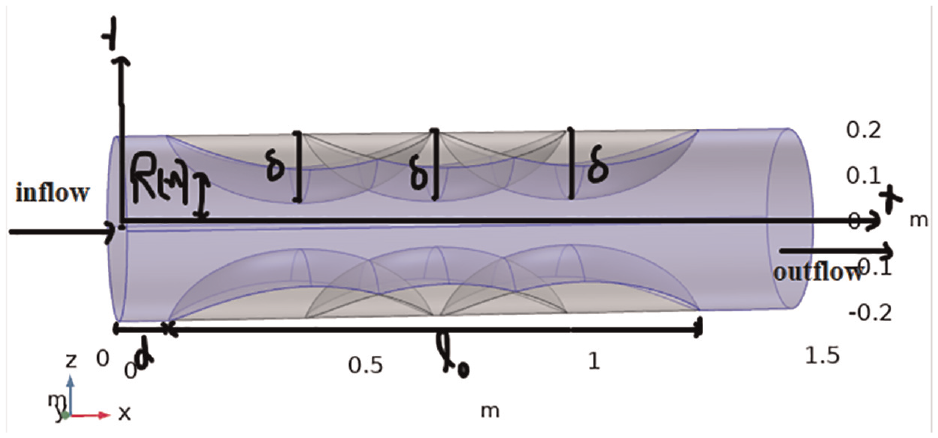
Geometry of stenotic artery with overlapping at multiple positions.
Where
The stenotic segment of the artery is assumed the cylindrical axisymmetric vessel of radius 0.2 m. The flow of blood is taken as viscous, unsteady, and incompressible liquid with density
Figure 1 shows the stenotic affected segment of the artery that contains the overlapping at multiple positions. The velocity components

where

The compact equations (1) and (2) for the chosen velocity vector field


Since

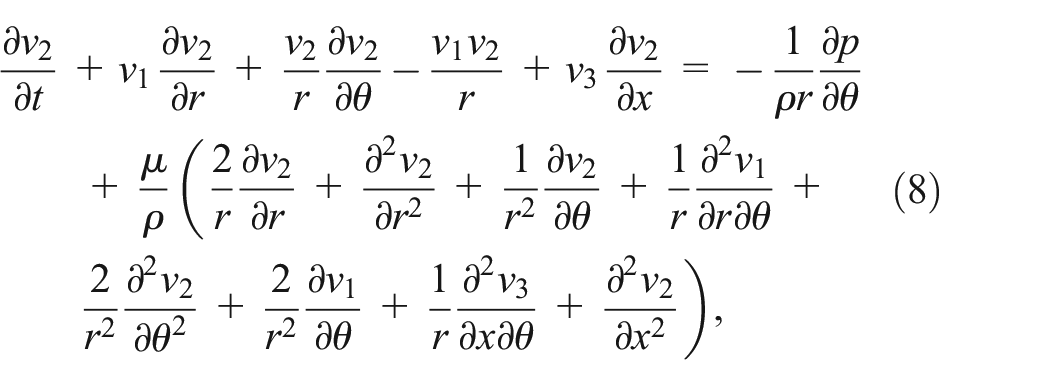

According to the situation of taken flow problem, the circumferential velocity component



The used initial conditions are:

The boundary condition included the wall, inlet and outlet. There is no slip on the wall, that is, velocity must be zero with the wall. Furthermore, the length of the artery is taken as

The boundary condition for the suppress backflow at the outlet is
Procedure of numerical solution
The physics-controlled sequence type is taken and the normal element size of mesh is built to get the results as in Figure 2. The skewness quality measure is adopted. The partial mesh contains 12,337 mesh vertices. The mesh elements 42, 568, 160, 5490, 10,056, and 34,881 are the vertex elements, edge elements, quads, triangles, prisms, and tetrahedron respectively. The largest and smallest element size is 0.0596 and 0.0178 respectively. Domain element statistics consist of mesh volume, the element volume ratio, the average quality of elements, the minimum element quality, and the number of elements. The mesh volume and the element volume ratio are 0.1283

Mesh of overlapping Stenosis.
Discussion and outcomes
The aim of this portray is to examine the variation in blood flow sequence and approximate the changes in wall shear stress and resistance in a stenotic artery, in which the multiple stenosis is simultaneously overlapping. The effects of this simultaneous overlapping on the flow of blood are examined. Figure 3(a) and (b) expressed the velocity cut planes for

Cut planes for blood velocity and pressure at
The velocity and pressure cut planes for

Cut planes for blood velocity and pressure at
Figure 5(a) and (b) display the velocity cut planes for
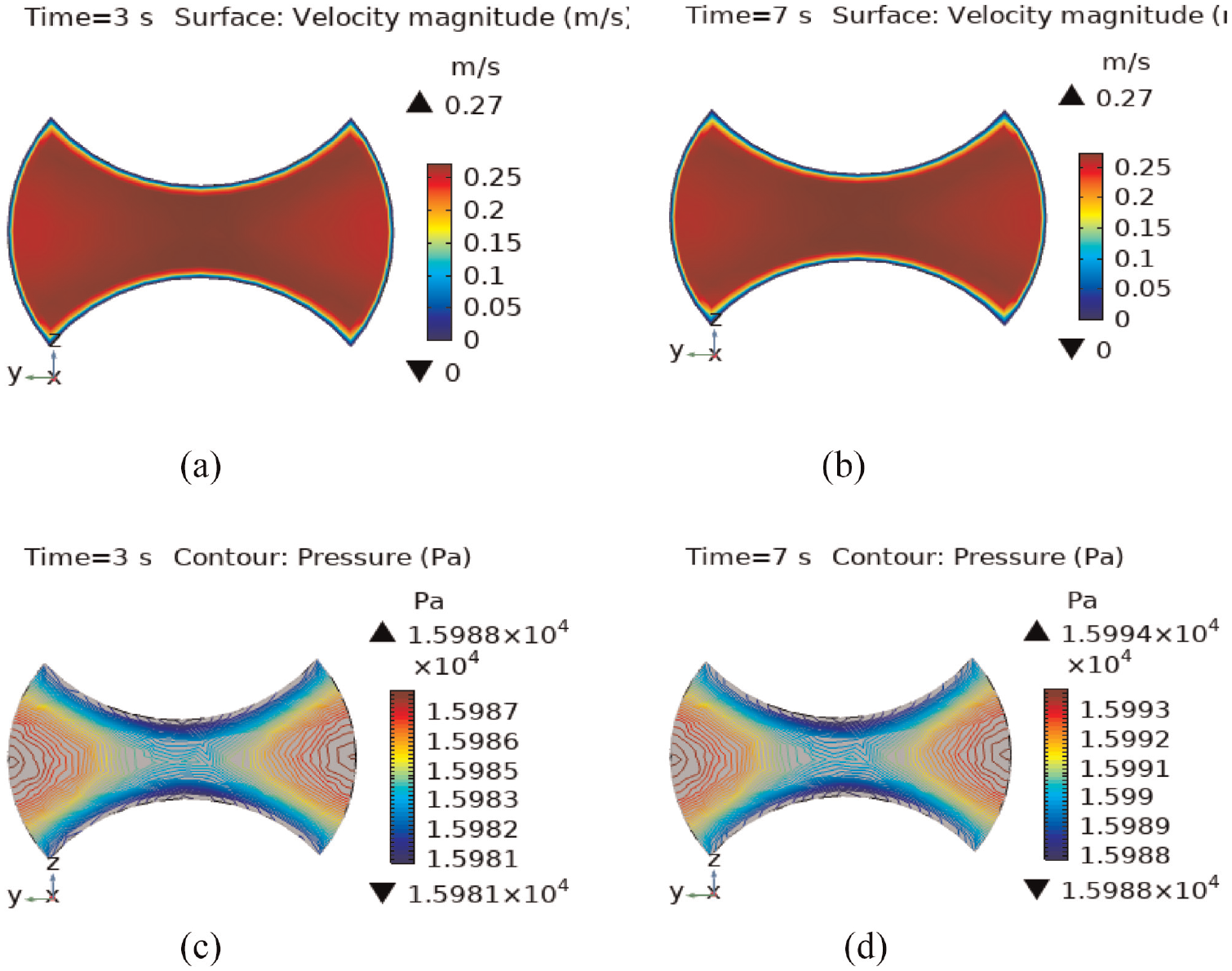
Cut planes for blood velocity and pressure at
The velocity and pressure cut planes for

Cut planes for blood velocity and pressure at
Figure 7(a) and (b) display the velocity cut planes for

Cut planes for blood velocity and pressure at
The velocity cut planes for
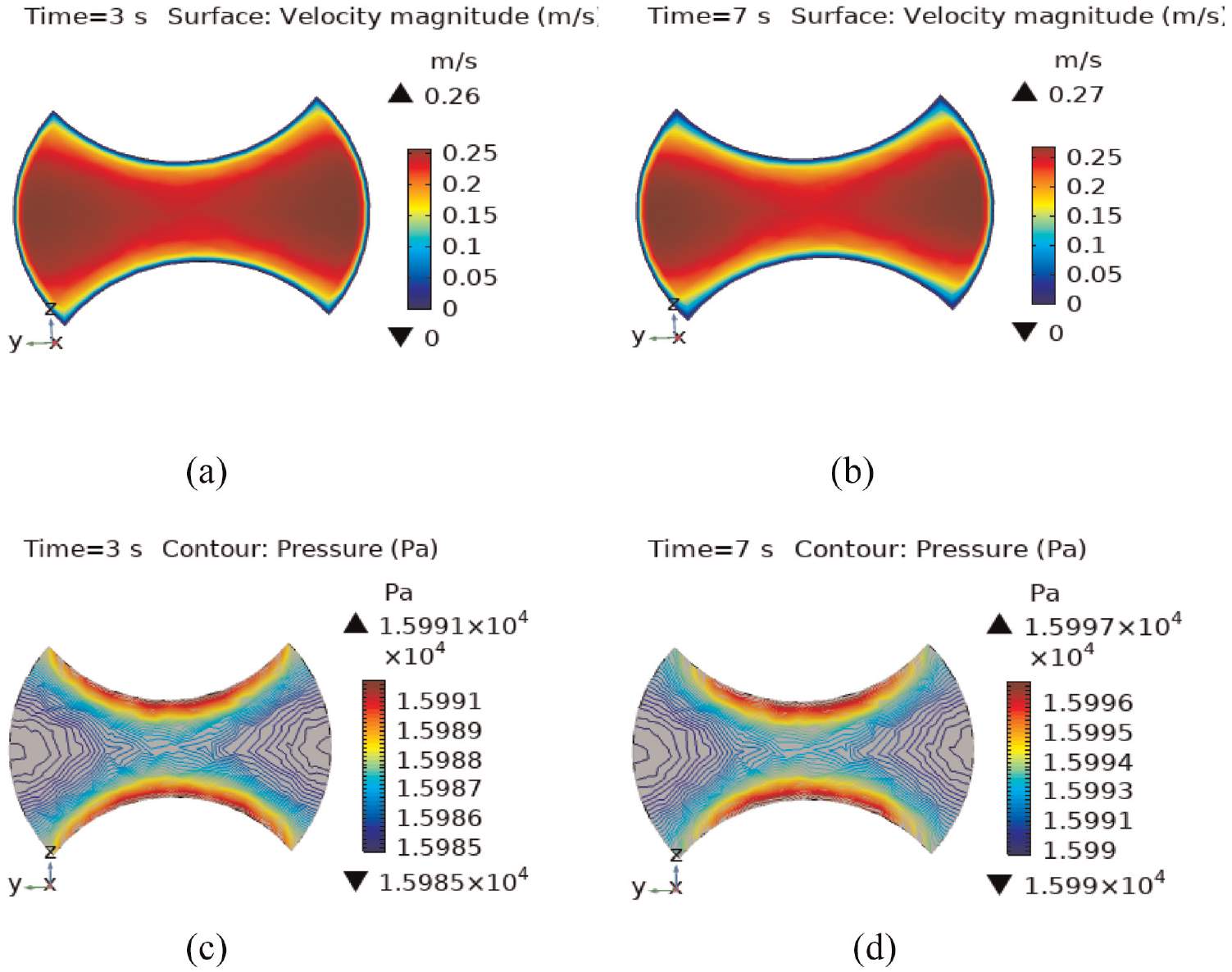
Cut planes for blood velocity and pressure at
Figure 9(a) and (b) shows the cut planes for velocity profiles at

Cut planes for blood velocity and pressure at
The velocity and pressure cut planes for

Cut planes for blood velocity and pressure at
Figure 11(a) to (d) display the velocity and pressure cut planes

Cut planes for blood velocity and pressure at
The longitudinal velocity and pressure cut planes are shown in Figure 12(a) to (c) for

Longitudinal cut planes for blood velocity and pressure at

Pressure of blood on wall of overlapped stenosed artery for

Pressure of blood on wall of overlapped stenosed artery for

Streamline of velocity field for

Streamline of velocity field for
Conclusion
In current study, a numerical computation of unsteady incompressible flow of blood by a simultaneously overlapping multiple stenosis modeled artery is developed. The wall of artery is assumed to be rigid and there is no slip on the boundary. By examining the solution derived in this research, it can be noted that
The velocity is increasing along the horizontal axis till the first maximum height of the stenosis. Then decreasing from the first maximum height to the first overlapping point of the stenosis and again increasing from the first overlapping point to the second maximum height. It decreases from the second maximum height to the second overlapping point. After increasing the second overlapping point to the third maximum height, it is decreasing.
The velocity does not change with respect to time up to the first maximum height. After that, it increases with time continuously at each point except the second maximum height where it is constant.
The pressure is decreasing from the start of stenosis to the first maximum height along the horizontal axis. It increasing from the first maximum height of stenosis to the first overlapping point and decreasing from first overlapping to the second maximum height. The pressure is again increasing from the second maximum height of stenosis to the second overlapping point of stenosis. After decreasing from the second overlapping point to the third maximum height of stenosis it is again increasing.
The pressure is continuously increasing with respect to time from the start of multiple overlapping stenosis to its end.
The current paper will be expanded in a subsequent paper to include cases of overlapping stenosis and irregular arterial flow brought on by the existence of nanoparticles, for which calculations are found to be dependent on the results of the current paper. Another important extension of the present study could involve the development of medically realistic finite systems with cases conforming to the biologically produced data in order to determine the components of vascular blood circulation maladies that can enhance the health of the relating patients.
Footnotes
Handling Editor: Chenhui Liang
Declaration of conflicting interests
The author(s) declared no potential conflicts of interest with respect to the research, authorship, and/or publication of this article.
Funding
The author(s) received no financial support for the research, authorship, and/or publication of this article.
