



Abstract
It is looked into how fractional MHD and viscous fluid naturally flow across a vertical plate that oscillates with a steady heat flux in a porous medium. The analytical solution for non-dimensional momentum was generated using the Laplace transform and the Boussinesq approximation. Comparisons are presented between Fourier’s law-described classical thermal transport and Prabhakar-like fractional time free convection flows in terms of temperature and velocity. By using fractional viscous fluid, we were able to produce conventional viscous fluid solutions and complete their objective. Finally, diagrams are used to show how different parameters such as Prandtl number, fractional parameters, Grashof number, effective permeability, time on temperature and velocity, and graphically recovered the solution available in the literature.
Introduction
Natural convection flows of a viscous, incompressible and unsteady fluid across a vertical and infinite plate have received much study due to its a variety of engineering and environmental applications processes. They tend to be very interested in manufacturing technologies such bulk food goods, filtration procedures, insulation of fiber and granular, nuclear reactors, design of spaceship, geothermal systems etc. Given different temperature conditions at the boundary, several scholars are analyzing the unsteady free convection flow across a sliding vertical plate. Oreyeni et al. 1 have explored the significance of exponential space-based heat generation and variable thermophysical properties on the dynamics of Casson fluid over a stratified surface with nonuniform thickness. In a vertical, circular cylinder, Ahmed et al. 2 explored natural convection with damped thermal flux. Chukwuneke et al. 3 investigated the dynamics of solid items falling from such a viscous fluid. They noticed that the analytical solution provided a decent approximation of the forces controlling the motion and some indicators that fluid viscosity plays a crucial role in preventing the mobility of the solid matrix in a viscous fluid. Using a high-order isogeometric analytic approach, Liu et al. 4 sought to solve the Reynolds equation of the lubricating problem in hybrid bearing surfaces. Shah et al. 5 investigate an analytical study of the unsteady nonlinear convection flow of nanofluids in an infinitely rectangular channel. According to Salubi et al., 6 accurate modeling of the kinetic theory and hydraulic systems of such axially or helical movement of non-Newtonian liquid hydrocarbons in the enclosures is essential for the measurement and efficient implementation of subsurface pressure while drilling operations. They have observed that the hydrodynamic characteristics of the axial and helical thermodynamic flow of Newtonian as well as non-Newtonian fluid through into the annuli was investigated and evaluated using an analytical and numerical technique.
Engineering issues like plasma imprisonment, cooling nuclear reactors with molten material, and electromagnetic manufacturing are all connected to MHD. A magnetohydrodynamic driven, often known as a MHD confer, is a technique for moving seagoing vessels utilizing only magnetic and electric fields and no mechanical parts. A magnetic field can be used to guide the electrified propulsion (gas or water), which can then propel the vehicles in the reverse way. Although there are several functional prototypes, MHD drives are still not feasible. By using a complete slip model, Mahabaleshwar et al. 7 examined the non-Newtonian MHD heat and flow transport of a copper-alumina/water hybrid nanofluid caused by a transparent shrinking/stretching surface. They observed that the temperature profile and thermally boundary layer also rose with increasing magnetic parameter. Akyildiz and Alshammari 8 presented a high-order precise numerical method for the couple dimensional paired hyperbolic as well as parabolic partial differential effectiveness of implementing in the unsteady and magnetohydrodynamics (MHD) flow of outer Maxwell fluid. Suresh Babu et al. 9 computed the numerical solution of the MHD type natural convective Jeffrey viscoelastic fluid with chemical process and heat source using the Mathematica software. Shah et al. 10 investigated a generalized Fourier’s law model for the impacts of fractional derivative and heat source/sink on free convection flow of nanofluids under the impacts of MHD in a hollow tube. In the case of a chemical reacts and a connected magnetic field, Raghunath and Mohanaramana 11 examined the influences of Hall current, movement, and Sort impacts on MHD and an unsteady free convection type flow of mass and heat transfer of an incompressible, viscous, and electrically conducting fluid well beyond a slanted plate enclosed in a porous medium. They applied the perturbation approach yields an accurate analytical solution to the governing equations for fluid temperature, velocity, and component concentration given to suitable initial as well as boundary conditions. Arulmozhi et al. 12 analyzed the comparison of a nanofluid that is (Cu-H2O) and water (a pure fluid) across a moving vertical plate covered by a porous surface. They used the Perturbation technique to calculate the most wonderful, suited solution to the oscillating structure of boundary layer problems for such governing flow. Fetecau et al. 13 successfully resolved the issue of hydromagnetic free convection flowing above a movable infinitely vertical plate having Newtonian heating, viscous dissipation, and chemical processes in the influence of a heat source. The impact of MHD flow field heat transfer employing CNTs with radiant heat and a heat sink/source over a shrinking/stretching sheet was studied by Mahabaleshwar et al. 14 Díaz Palencia et al. 15 looked at the flow through an Eyring-Powell characterization in order to represent various non-Newtonian fluid-related circumstances. Senel 16 studied a fully developed, flowing Magnetohydrodynamic (MHD) flow among slipping-wall cylinders. They discovered that when the Ha increases, the magnetic flux isolines are forced to close in on themselves, slowing the flow and the flow is accelerated by the wall slide, and the boundary layers close to the sliding walls are reduced.
The study of fluid flow across porous medium has become a separate topic of research due to its widespread interest. Poromechanics is the study of more widespread behaviors of porous medium including distortion of the solid frame. Technology for disposing of nuclear waste and material jetting are two examples of where the notion of porous flows is used. Flow pattern in porous medium is influenced by a variety of variables, but its primary purpose is to use energy to make fluid via the drilling. Numerous factors affect the flow arrangement in porous medium, but its main objective is to employ energy to create fluid by drilling. Darcy’s law is the most basic principle that governs this link Bear. 17 Verma et al. 18 provided the analytical solution to the problem of the radius influence of nanoparticles on unsteady free convective copper-water nanofluid flow across an expanded sheet in porous medium. Rom and Müller 19 solved several sets of governing equations in the realms of gas flow and porous medium, coupling the two domains by placing boundary conditions at the interfaces. A high-thermal-conductivity porous media has been shown by Huo et al. 20 to significantly boost the heat transfer frequency of the solid-liquid change of state in thermal energy storage systems by hence improving the utilization efficiency of sustainable energy. The application of a fan-shaped porous medium to speed up the rate of heat transmission of phase-change materials in storage of thermal energy was studied, as was how the porous medium’s angle, porosity, and Rayleigh number influenced the process of solidification and melting. The hybrid type nanofluid flow over a non-axisymmetric stagnation-point flow region on a flat board in a porous medium was taken into consideration by Waini et al. 21 The results also demonstrate that the skin friction rises when the parameters of the porous medium and hybrid nanomaterials rise. Ashraf et al. 22 conducted the absorbed flow and heat transfer along on the thermally and electrically insulating cone implanted in porous medium while encountering the varied surface temperature. The key discovery of the key implications is that decreasing the mainstream liberal velocity and temperature field and observing an opposing attitude in the magnetic profile are necessary for increasing the changeable surface temperature parameter. For the upright borehole of a deep geothermal heat pump in a solvent porous medium, which is a heated cylinder with dimensions of diameter D and length Lb multi-dimensional free convection and melded convection have been statistically investigated by Ravi Shanker and Homan. 23 In a fluid- inflamed and collapsible porous medium with thermal radiation non-equilibrium (LTNE) circumstances, Li et al. 24 presented a fully coupled thermo hydro mechanical (THM) system and carried out the related calculation. The results of this study help us to understand the THM completely coupling process and LTNE influence in a fluid-saturated porous material in greater detail. In order to account for the influence of the form of the nanoparticles, Hemalatha et al. 25 showed the mixed free convection of carbon nanotubes and Nanofluid containing clay nanoparticles in a porous non-Darcy medium. Meena et al. 26 discussed the effect of two-fold dispersing on mixed convection flow through a vertical cone of a viscous incompressible fluid saturating in a porous medium. The heat and mass transfer in friction factor interactions for slipped gaseous fluid flow in constrained porous medium were provided by Tariq and Liu 27 using pore-scale LBM modeling. The homogenization method was used by Li and Dimitrienko 28 to focus on the mathematical modeling for the filtration of a modified Newtonian fluid in porous medium.
A fractional derivative in applied mathematical theory and analysis is a derivative about any arbitrary order, complex or real. Gottfried Wilhelm Leibniz first mentions it in a letter to Guillaume de L’Hospital that he wrote in 1695. 29 In a letter to one of the Bernoulli brothers written around the same time, Leibniz discussed the relationship between both the binomial theorem as well as the Leibniz principle for the fractional order derivative of a mixture of two functions. All the components of fractional calculus may be found in a paper from Abel’s, 30 early, which introduced it: understanding that non-integer order differentiation as well as integration can be thought of as an identical generalized operation, the concept of non-integer order integration as well as differentiation, the consensually inverse relationship in both them, and even the homogeneous notation for the differentiation and integration of any arbitrarily defined real order. Over the course of the 19th and 20th centuries, the theoretical and implementations of fractional calculus significantly developed, and a large number of authors contributed definitions of fractional integral and derivatives. Through the use of fractional calculus, incredible differential equations, also referred to as fractional derivative, are a modification of differential equations. For a prominent class of optimal control issues governed by fractional order Fredholm integral equations including delays in both the input and the output signals, Marzban 31 devised a direct transcription method. In order to create the unique discrete non-integer order SEIR model of COVID-19 and investigate its dynamic properties, Abbes et al. 32 studied to generalize the discrete non-integer order SEIR model. The unsteady natural convection flow due to fractional thermal transport and symmetric heat source/sink was studied by Vieru et al. 33 The outcomes show that the suggested approach is systematic and appropriate for addressing stochastic fractional issues that arise in technology, engineering and physics in perspective of the ABC nonlinear fractional. The effects of the Atangana-Baleanu (AB) time-fractional integral on a second-grade fluid having ternary nanoparticles suspended along an infinitely wide vertical plate were investigated by Shah et al. 34 Linear basic differential equations with arbitrary precision that are either integrable or continuous functions, with fractional order differential equation of any such Riemann-Liouville or Caputo kinds, were explored and solved by Fernandez et al. 35 A set of time-fractional diffusing equations with generalized fractional differential equations have been studied numerically by Alikhanov and Huang. 36 Applications of non-integer Caputo time fractional derivatives to natural convection flow subject to arbitrary velocity and Newtonian heating was covered by Imran et al. 37 In order to tackle the issue, they used the Laplace transform as well as Stehfest’s numerical approach and found that the heat transfer rate decreases with rising values of the fractional parameter, reaching a lowest value for the classical model. Di Matteo et al. 38 investigated of the Wiener path integral-based theory of stochastic respond prediction of nonlinear harmonics with fractional derivative parts.
In order to create a fractional Bloch-Torrey equation in three dimensions (3D), Zhang et al. 39 looked into whether a fractional Laplacian was appropriate.
In this study, we investigate free convection MHD flows of fractionally viscous fluid with Prabhakar-like characteristics in a porous medium. The enlarged fractional derivative constitutive equations regarding heat flux serve as the foundation for such mathematical model. We established time-fractional Prabhakar derivatives in this study using generalized memory impacts. Utilizing the integral transform technique, the dimensionless velocity as well as temperature fields’ analytical solutions are computed. It also compares the velocity and heat transfer for conventional viscous fluid with generalized heat conduction, with ordinary viscoelastic fluid using classical Fourier thermal flux, and with Prabhakar-like non-integer ordered viscous fluid with generalized thermal convection. A good technique to select an appropriate mathematical model that would improve the consistency between theoretical and experimental findings may be to use Prabhakar operators having specified fractional factors.
Mathematical formulation of the problem
Assume that there are incompressible, free-convection MHD viscous fluid in a porous medium. Both the fluid as well as plate are at rest with a constant temperature


The governing regarding fluid and thermal transport in light of the foregoing premises and the usual Boussinesq’s approximation.40,41
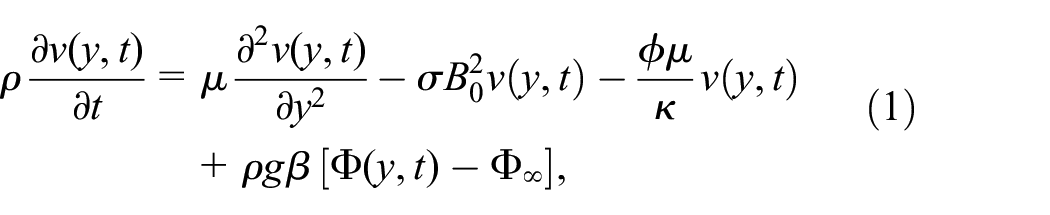
The momentum equation
The energy balance equation

The Fourier’s law for thermal flux

where,
We take into account the initial as well as boundary conditions for equations (1)−(3)



where
To create the non-dimensional equations, add the following non-dimensional components.

Where,


where
Initial and boundary conditions are described in a dimensionless form.



In this article, we provide a brand-new mathematical framework that accounts for the effects of generalized thermally memory. In order to accomplish that, we present a generalized Fourier’s law based on Prabhakar’s fractional derivative:

Where Elnaqeeb et al. 43 describes the regularized Prabhakar derivative.

in above equation,
The Laplace transform of equation (15), is
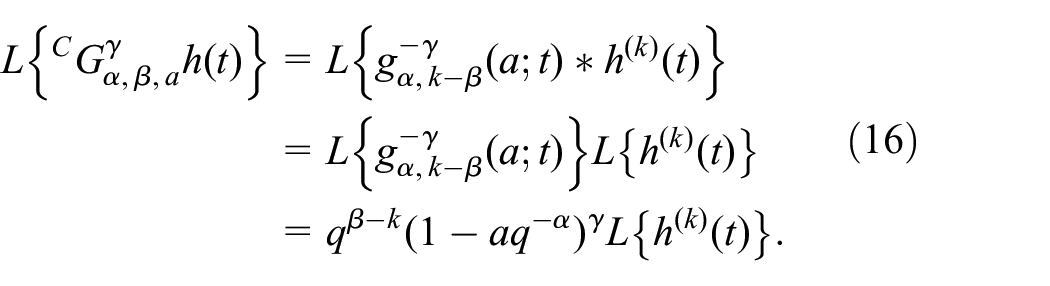
The Prabhakar kernel of such regularized Prabhakar derivatives is known as
Formulation of the problem
Temperature solution
For
Equations (9), (14), (12)2, and (13)2, take the following form after applying Laplace



where
Put equation (18) into (17) yields the following differential equation.

Given by is the answer to equation (20), which also fulfills the boundary conditions in equation (19).

where

Using the exponential function’s series formula, equation (21) adopts the following alternative form.

Following Laplace transformation, equation (22) gets the following form.

Case: Classical Fourier’s law
By putting

which can be written as

applying Laplace transformation, equation (25) gets the following form.

Fluid velocity solution
After applying the Laplace transform and the initial condition for velocity (12)1, the modified problem for velocity field is equations (8), (13)1.


using equation (21) in equation (27), we obtain
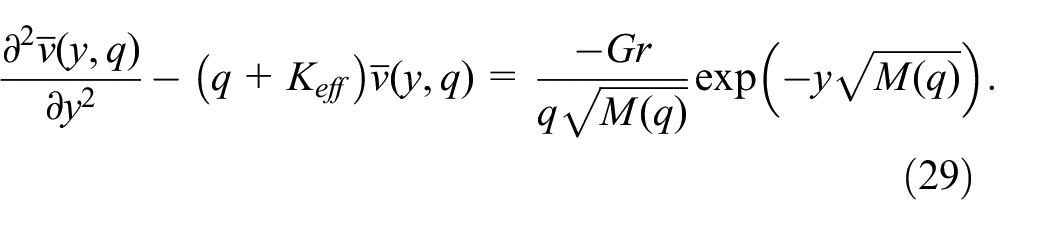
With the use of equation (28), the solution to equation (29) is
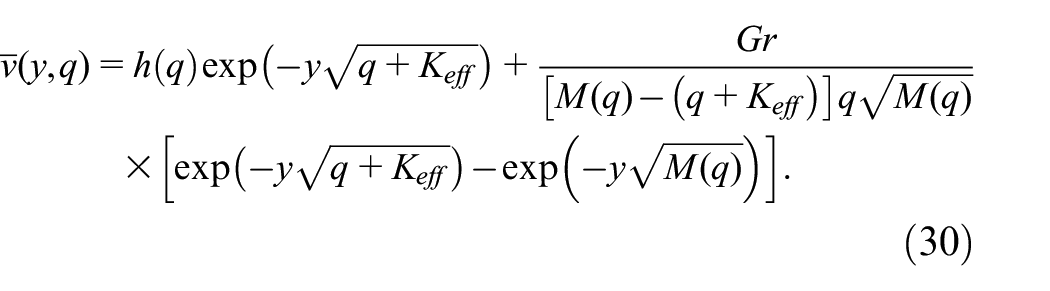
The simplest form of equation (30), is
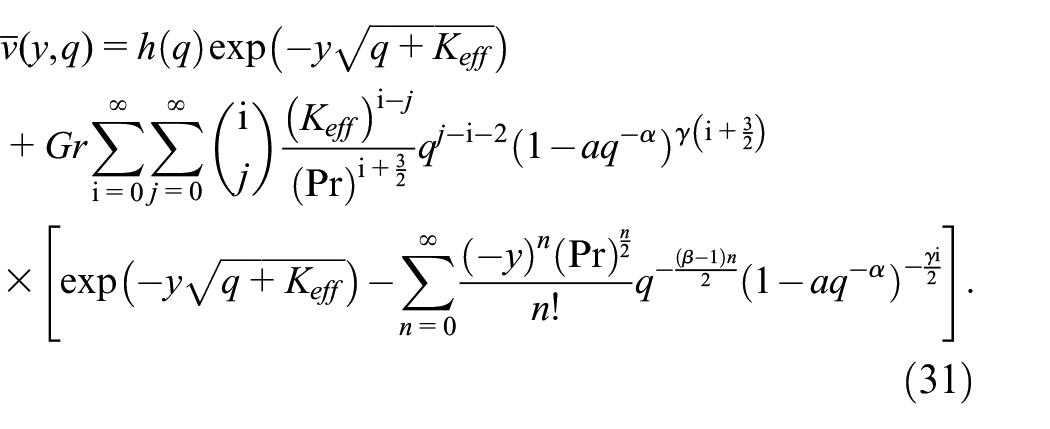
Applying inverse Laplace transformation, equation (31) gets the following form.

Case: Ordinary viscous fluid with classical Fourier law
By putting

The simplest form of equation (33), is

where
Equation (34), becomes after Laplace inverse

Case: Fractional viscous fluid when Keff=0
By putting

Equation (36), takes the following equivalent form

Applying inverse Laplace transformation, equation (37) gets the following form.

Case: Classical viscous fluid when Keff=0
By putting

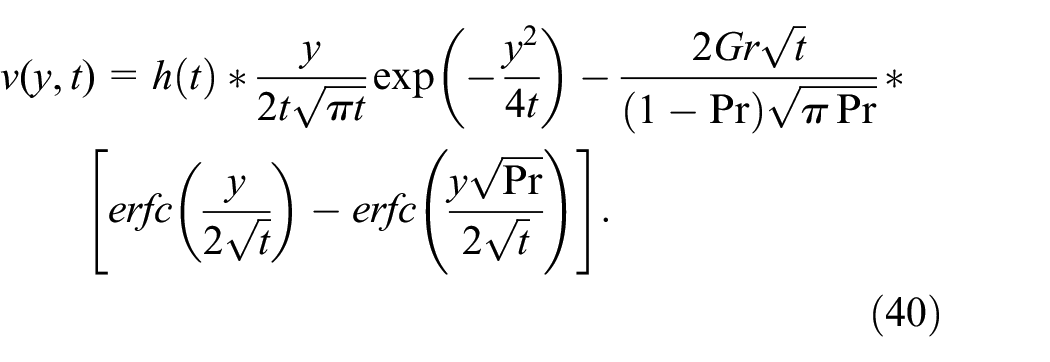
Applying inverse Laplace transformation, equation (39) gets the following form.
Discussion, conclusions and graphical results
A theoretical analysis of the flow of uniformly heated, incompressible, viscous fluid in a porous medium on an infinitely movable plate is established. Inside this constitutive equation, Prabhakar fractional order derivative has been utilized to account for the generalized memory impacts. The typical Laplace transform method has been used to solve the non - dimensional partial differential equation. Temperature and velocity have appropriate solutions that can be expressed in terms of such an exponential function. This satisfies all the requirements, including the initial and boundary conditions, and in specific cases, reduces to a well-known solution from the literature.
Numerical calculations are made for temperature as well as velocity for appropriate parameters such fractional order parameters
In order to gather information on the thermal transport system with Prabhakar’s memory impairment, numerical results from temperature expressions (23), were shown in Figures 1 to 7. These graphs show comparisons involving thermal transport using the conventional Fourier law of thermal flux and generalized non-integer thermal flux having Prabhakar-like derivative.

Flow geometry.

Profile of temperature at
Profile of temperature at

Profile of temperature at

Profile of temperature at

Profile of temperature at

Profile of temperature at
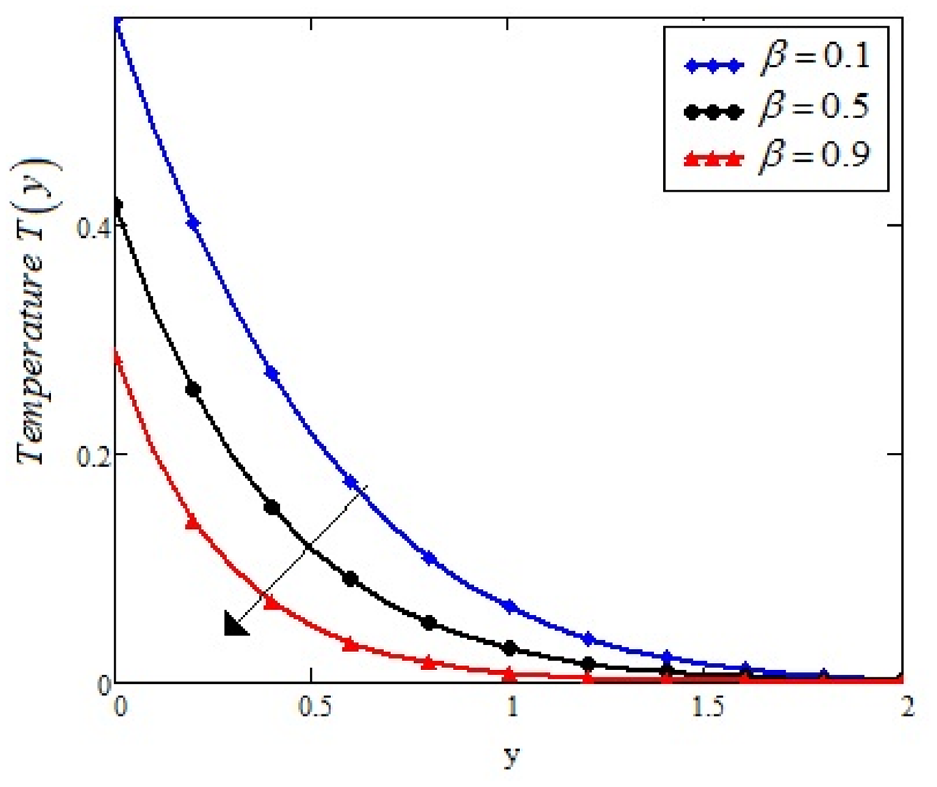
In Figure 2, the influence of parameter
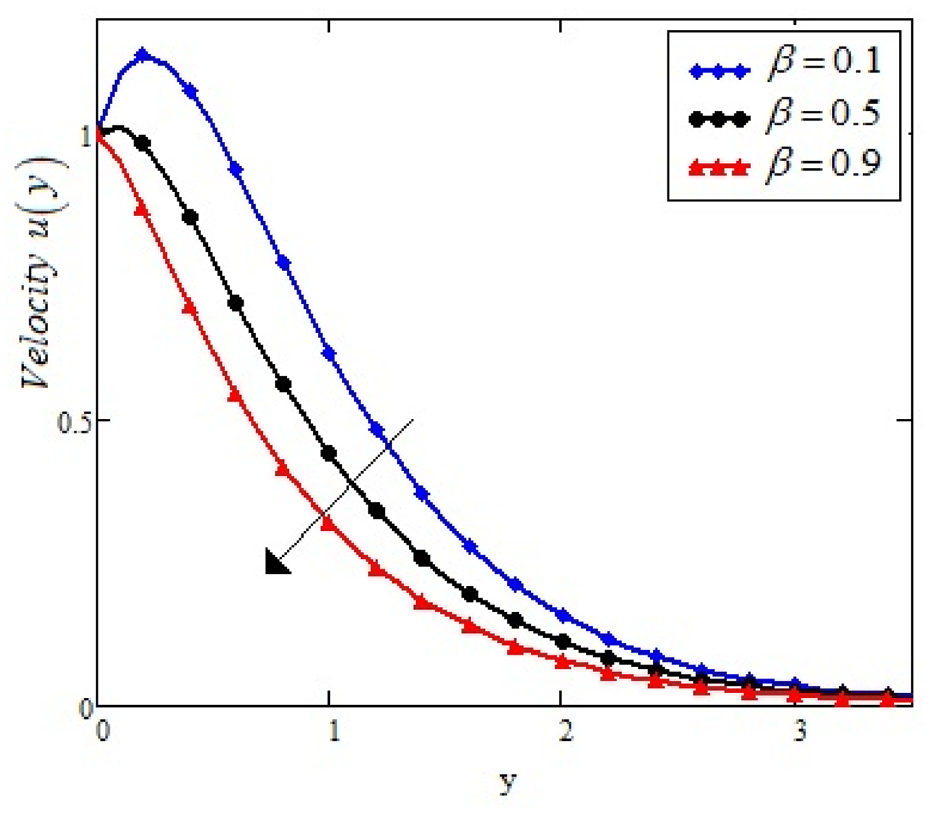
In Figure 8, the influence of parameter

Profile of velocity at
Profile of velocity at

Profile of velocity at

Profile of velocity at

Profile of velocity at

Profile of velocity at

Profile of velocity at

Profile of velocity at

Comparison representation of velocity for the ordinary viscous and fractional viscous fluid at
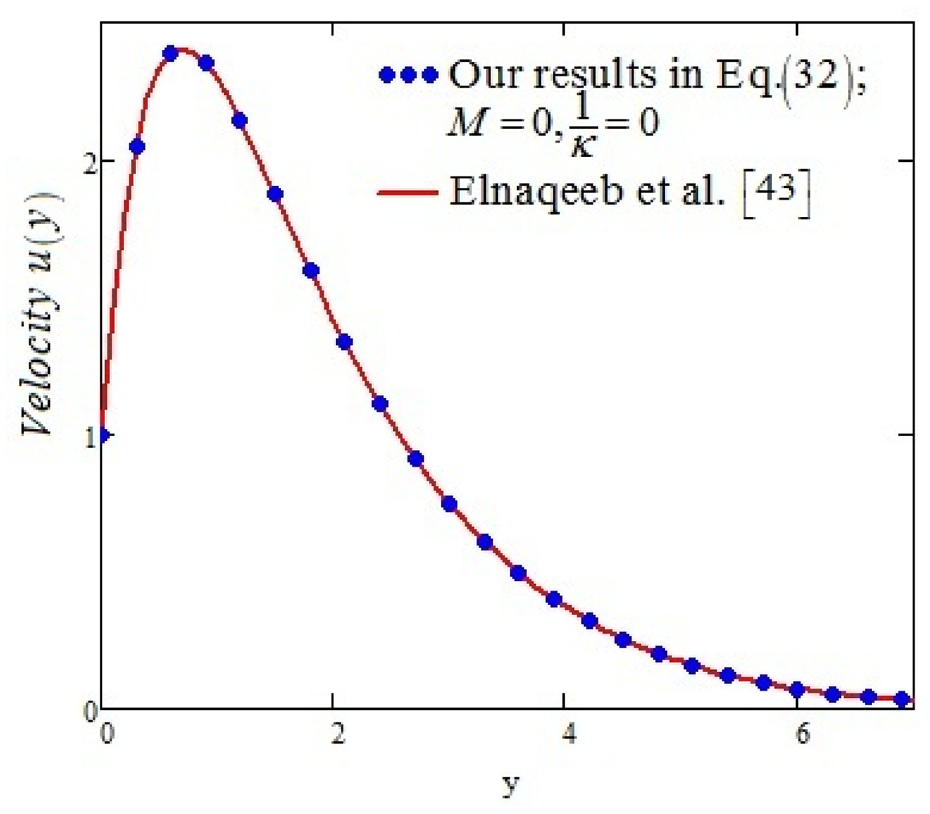
Validation profile for present solution (32) and Elnaqeeb et al. 43
Conclusions
Over an infinitely vertical isothermal plate with homogeneous heat flux, free convection flows of Prabhakar-like fractional MHD viscous fluid in a porous medium have been studied. The shear stress as well as thermal flux generalized fractional constitutive equations are the basis for the mathematical model. It is considered how the generalized memory effects are characterized by the time-fractional Prabhakar derivatives. The analytical solution for the dimensionless velocity as well as temperature components are found by using Laplace transform. As compared to a typical MHD viscous fluid passing from a porous medium with generalized heat transfer and frequent viscoelastic fluid as for classical Fourier thermal flux, Prabhakar-like fractional MHD viscous fluid in a porous medium with generalized thermal transport has a higher velocity and transfers heat more efficiently. Using the Prabhakar operators using specific values of the fractional factors may be an effective method to select a suitable mathematical model that produced results that were well in agreement with both theory and experiment. The following points have been identified after a careful examination of the work.
The velocity decreases as the fractional parameters
The temperature and velocity are an increasing function of time parameter t.
When the plate is cooling, the Grashof number Gr causes the fluid velocity to increase. When the plate is heated, the opposite reaction is seen.
The velocity and temperature both drop as Pr values are raised.
Fluid velocity decreases as effective permeability are increased.
Footnotes
Appendix
Handling Editor: Chenhui Liang
Declaration of conflicting interests
The author(s) declared no potential conflicts of interest with respect to the research, authorship, and/or publication of this article.
Funding
The author(s) received no financial support for the research, authorship, and/or publication of this article.
