



Abstract
Cilia motion is commonly located in mammalian cells of living organisms which continually grow and feature conspicuously. The ciliary apparatus is associated with cell cycle movement and proliferation, and cilia play a dynamic part in human and animal growth and everyday life. The motivation of these applications, a theoretical model is presented to examine the viscous dissipation effects on the ciliary flow of micropolar fluid through a two- two-dimensional channel under slip constraints. The flow is controlled by the metachronal wave propagation generated by cilia beating on the inner walls of the channel. The model comprises the motivational aspects of radiative flux and predicts the parametric ranges for excellent heat transfer results. The normalized equations are simplified by the lubrication hypothesis and analytical outcomes are attained by integration technique. Graphical illustrations have been utilized to explore the impressions of the derived physical parameters on the flow configurations to give each parameter a physical interpretation. Special attention is given to investigating the pumping and trapping characteristics of the micropolar fluid due to ciliary metachronism. The major outcomes disclosed that the fluid velocity upsurges for enhancing values of coupling number and micropolar parameter. The pressure gradient increased with the slip parameter, providing insights into flow control, particularly where minimizing or enhancing shear is critical. The fluid temperature is enhanced by enhancing the Brickman number however temperature is decreased by increasing the thermal radiation parameter.
Keywords
Introduction
Cilia are microscopic hair-like structures found on the surface of various mammalian cells, including those in the kidneys, lungs, esophagus, and respiratory tract. These structures play crucial roles in essential physiological functions, exhibiting rhythmic beating movements. In the kidneys, cilia act as sensory devices, conveying information from the surrounding fluid to prepare cells for urine transport. In the respiratory tract, cilia facilitate the inhalation of fresh oxygen by keeping air pathways free of excess particles. The fluid flow resulting from the wavy motion of cilia closely resembles peristaltic tube flow. The motility of cilia contributes significantly to various physiological mechanisms, such as locomotion, respiration, and alimentation. Ciliary-driven pumping is integral to numerous biological processes, including biomedicine, nuclear reactors, and physiology. The role of cilia is particularly essential in phenomena involving circulation, locomotion, and the movement of food in the digestive region. 1 Blake 2 conducted a study on cilia-operated flows in a tube, revealing the occurrence of reflux near the cilia walls, indicating an antiepileptic chronological error. The study also found that the largest flow rates occurred for cilia lengths of 0.3–0.6 of the tube radius. The consequences of ciliary activity on the propulsion of micropolar fluid through a two-dimensional channel under lubrication approximation theory were reported by Farooq et al. 3 Ramesh et al. 4 investigated the magnetohydrodynamic pumping of electro-conductive couple stress physiological liquids through a two-dimensional ciliated channel and observed that the axial velocity is enhanced in the core region with greater wave number whereas it is suppressed markedly with increasing cilia length, couple stress, and magnetic parameters, with significant flattening of profiles with the latter two parameters. The cilia-driven flow of viscoelastic fluid through a complex divergent channel under curvature and porosity effects was inspected by Javid et al. 5 who concluded that the boundary layer phenomena in the velocity profile are noticed under more significant porosity and time relaxation effects. Abbas et al. 6 inspected the thermally radiative ciliary flow of an electrically conducting Carreau–Yasuda fluid through a curved channel taking into account the effects of viscous dissipation. The findings of this study have practical applications, including the control of bleeding in severe injuries. The numerical study for heat generation and electro-osmotic effects of the Carreau model of a fluid in an unsteady channel under the lubrication hypothesis was explored by Salahuddin et al. 7 Some dynamic contributions of the cilia-driven flow of numerous liquids through different geometries can be seen through.8–12
Nowadays, the study of non-Newtonian fluids has gained great interest due to its medical, industrial, and biological applications.13–18 The flow of non-Newtonian fluids plays an important role in manufacturing polymer, boiling, plastic foam processing, bubbles absorption, etc. The relation between shear stress and shear strain is nonlinear in this type of fluid. For this reason, the non-Newtonian fluid models are proposed and many of the models are either semi-empirical or empirical. Micropolar fluids are also non-Newtonian fluids having microstructures exhibiting non-symmetrical stress tensors. Eringen 19 was the first to introduce the concept of simple micropolar fluids. In the theory of micropolar fluids, rigid particles are contained in microelements. Micropolar fluids are considered to be rigid and exhibit micro inertial and micro rotational effects. The best example of a micropolar fluid is human blood. Blood is a suspension of white cells, red cells, and platelets. Some other examples of micropolar fluids include ferrofluids, liquid crystals, bubbly liquids, etc. The impacts of entropy generation and thermal radiation on the peristaltic blood flow of a Magneto-micropolar fluid in a tapered channel were studied by Asha and Deepa. 20 The peristaltic transport of micropolar fluid through an asymmetric channel under the lubrication approximation hypothesis was discussed by Mahmood et al. 21 In this study, authors observed that Pressure rise increases in the pumping region on increasing the lubrication impacts and coupling number while decreasing due to an increase in micro-rotation effects, phase difference, and channel width. The thermally radiative flow of peristaltic transport on the micropolar-Casson fluid through a channel having sinusoidal walls was inspected by Abbas and Rafiq. 22 The performance of effective heat transfer rate considering the flow of radiating micropolar nanofluid through a permeable expanding sheet embedding within a permeable medium was analyzed by Panda et al. 23 and concluded that the thermal energy due to the enhanced thermal radiation accelerates the heat transmission rate for both the case of suction/injection. The study of micropolar fluid for different flow features was reported in Abou-Zeid, 24 Khaliq et al., 25 and Imran et al. 26
Cilia movement with heat transfer has several applications in biomedical sciences and industry such as tissue engineering, drug delivery systems, and techniques like in vitro fertilization, treatment of respiratory disorders, and thermal regulation. The bio-inspired approach of cilia flow with heat transfer provides insights into nature’s efficient female reproductive tract. While this heat transfer primarily maintains the appropriate temperature for egg maturation, it can also influence the motility and survival of sperm. For instance, Akbar and Butt 27 presented a mathematical model of the flow of a Jeffrey fluid in a tube of finite length is considered due to the metachronal wave of cilia motion. The fully developed mixed convective flow of a Newtonian fluid takes place through a 2D vertical ciliated channel in the presence of an external magnetic field acting in the direction normal to the flow was investigated by Ahmad Farooq et al. 28 The pumping of an electrically conducting particle-fluid suspension due to metachronal wave propulsion of beating cilia in a two-dimensional channel with heat and mass transfer under a transverse magnetic field was investigated by Abdelsalam et al. 29 The flow and heat transfer characteristics of magnetohydrodynamic Carreau fluid in the fallopian tube with a metachronal wave of cilia were reported by Tanveer et al. 30 Huang et al. 31 explored the flow properties with mass and heat transfer of multilayered flow of two immiscible fluids (Phan-Thien-Tanner and Jeffrey fluid models) flowing due to ciliary beating in a channel, which is beneficial in different applications related to bioengineering, biomedical sciences, and medical equipment. Some important studies of heat transfer can be seen in the References32–38.
As far as the authors’ knowledge is concerned no analysis has ever been carried out considering the thermally radiative flow of micropolar fluid through a two- two-dimensional channel under velocity slip constraints. The role of cilia is essential in processes such as circulation, respiration, locomotion, and food movement in the digestive tract, and almost all animal kingdoms have cilia. Further, it is found that the model of a micropolar fluid may be more appropriate for biofluids like blood, used in examining fluid flow in the brain, liquid crystals, exotic lubricants, the flow of colloidal suspensions, animal blood, etc. So the present article aims to investigate the ciliary blood flow of a micropolar fluid model under the influence of viscous dissipation and thermal radiation. To study the mechanism of blood flow it is necessary to introduce the fluid models which behave like a suspension of fluid. The Newtonian model is considered to be one of the simplest models among the various models describing biofluids. However, Newton’s law of viscosity does not describe the behavior of many biofluids (e.g. blood). It is realized that the micropolar fluid model is an appropriate model for blood. Further, the modeling of blood by a micropolar fluid plays an indispensable role in peristalsis because blood behaves like a non-Newtonian fluid in microcirculation. The problem is first modeled and then analyzed by the low Reynolds number and long wavelength approximations. Due to metachronal waves generated due to row-wise beating cilia, authors have employed constraints like large wave number so that the uniform pressure can be assumed over the cross-section and the low Reynolds number to neglect the inertial forces. The influences of different physical parameters are visualized and revealed in detail to demonstrate the significant features of various flow fields.
Mathematical formulation
Consider the cilia-driven flow of a micropolar fluid inside a uniform channel of infinite length. The inner walls of the channel are covered with a ciliated carpet. The flow is produced due to the periodic beating of cilia which generates a metachronal wave traveling with a constant speed c to the right side of the channel (see Figure 1). We choose a reference frame (X, Y), where the X-axis is lying along the centerline of the channel and the Y-axis is in the normal direction. It is supposed that the lower and upper walls of the channel are maintained with temperatures

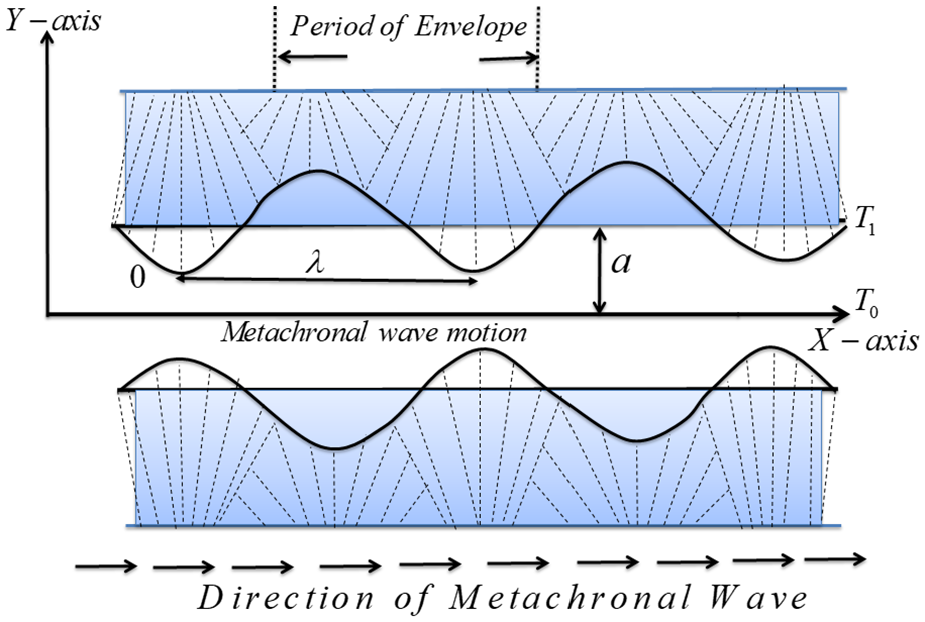
Geometry of the problem.
Sleigh 39 observed that cilia tips move in elliptical paths. In line with this approach, the vertical position of the cilia tips can be written as:

where


The fundamental equations for an incompressible liquid are given by 3 :




Where

The flow is unsteady in the fixed frame

For a two-dimensional steady flow, the velocity field, the microrotation vector, and the pressure will take the following forms:

The radiative thermal heat flux is expressed as 20

Defining the following dimensionless quantities:

Using the above dimensionless variables along with equations (10)–(12), we obtain the system of governing equations in the nondimensional form as (after dropping “*”):


In the above equations,

Now applying the principles of lubrication theory (i.e.





The flow is symmetric about the centerline of the channel

Solution of the problem
Equation (21) shows that

Upon integrating with respect to

Now use of equation (27) in (23), we get:

where

Using the value of

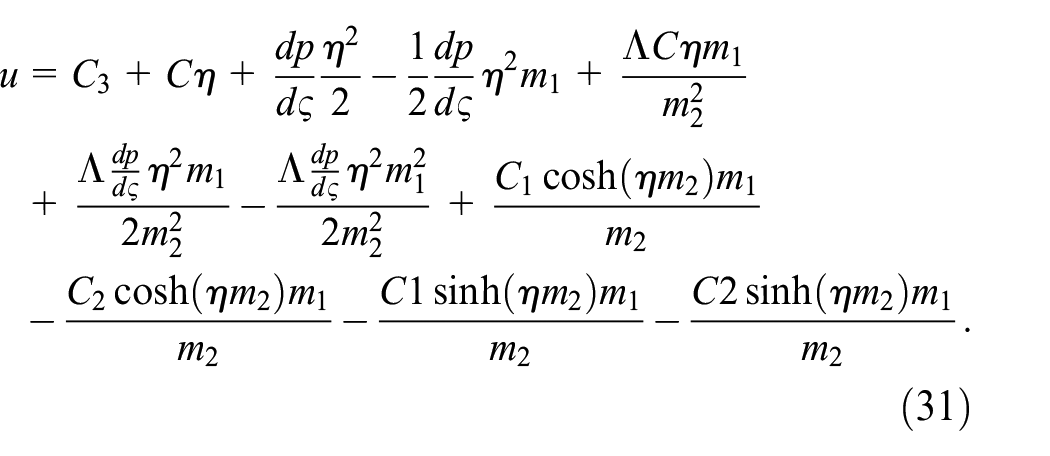
The solution of equation (30) subject to constraints is given as:
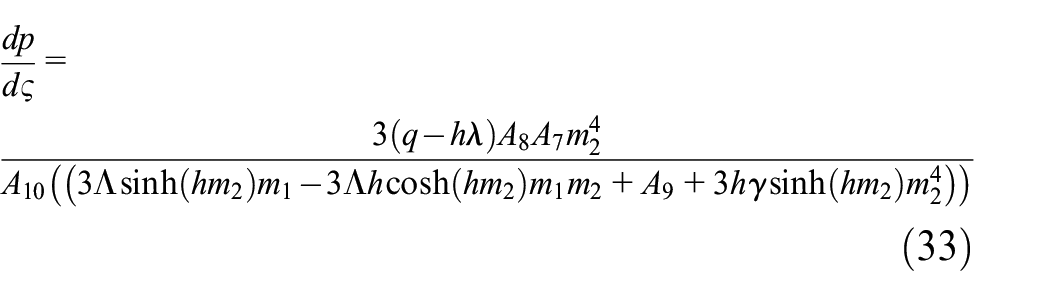
The pressure gradient is determined by employing the expression for volumetric flow rate

By substituting the value of into the integral and solving for
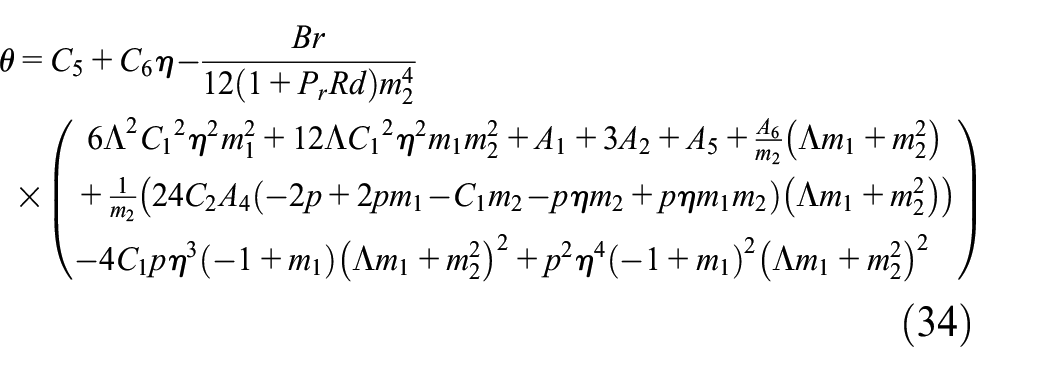
The expression for temperature is
The pressure rise

Discussion of the outcomes
In this section, we have presented distributions of pressure rise, pressure gradient, velocity, temperature, and streamlines for the coupling number

Comparison of the limiting case of the present study with the results of Farooq et al. 3
Figure 3(a) is graphed to depict the deviations in the velocity profile for various values of the coupling number

Variation of velocity profile
Figure 4(a) to (d) illustrates the effect of various parameters like coupling number, micropolar parameter, eccentricity parameter, and slip parameter on pressure rise
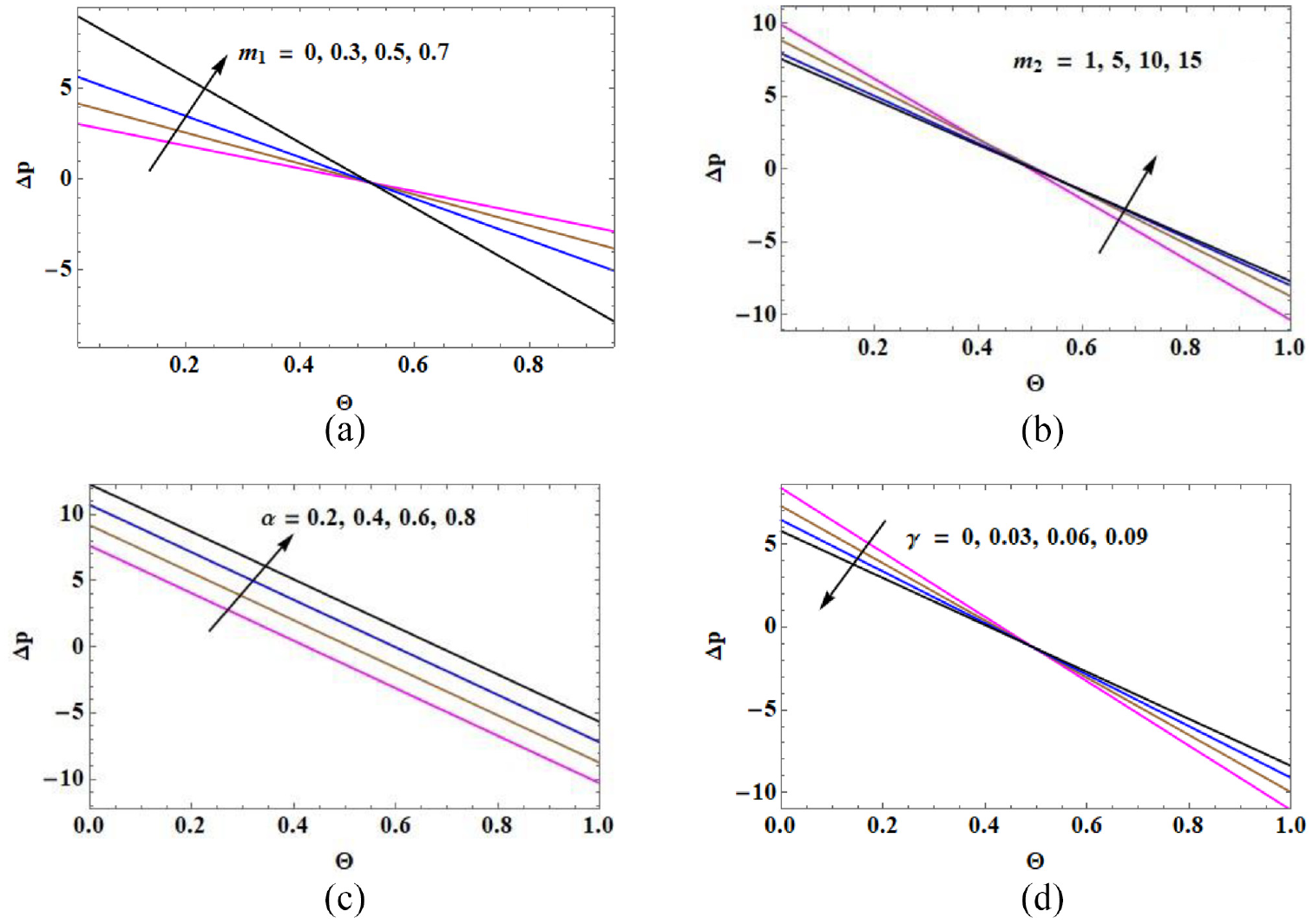
Variation of pressure rise
Figure 5(a) to (d) reveals the deviation in the axial pressure gradient for various physical parameters. Figure 5(a) portrays the changes in

Variation of pressure gradient
The impacts of various important parameters such as physical consequences of coupling number

Variation of temperature profile
The impact of the Brinkman number
Split streamlines, which happen at high flow rates and significant occlusions, enclose a bolus of fluid particles flowing along closed streamlines in the wave frame.
10
Consequently, it is found that some fluid is trapped throughout the wave’s propagation and is traveling forward with it. This physical event can be explained by the blood clot that forms and the food bolus that travels through the digestive tract. Figure 7(a) and (b) indicates that the size as well as the number of trapping boluses increase by increasing the values of the coupling number

Contours for (a)

Contours for (a)

Contours for (a)
Conclusions
This study analyzed the effects of viscous dissipation on radiative micropolar fluid flow in a ciliated channel, incorporating slip constraints. By applying the lubrication approximation and integration methods, several significant findings emerged. The motivation of this study is to understand the mechanisms underlying the transport of human semen through ductile efferents. This investigation indicates that the micropolar fluid may describe the behavior of seminal material more realistically as compared to the Newtonian fluid. The key aspects are outlined below.
The fluid velocity upsurges for enhancing values of coupling number and micropolar parameter.
The magnitude of the pressure rise increases as the coupling number and micropolar parameter increase.
The pressure gradient increased with the slip parameter, providing insights into flow control, particularly where minimizing or enhancing shear is critical.
The fluid temperature is enhanced by enhancing the Brickman number however temperature is decreased by increasing the thermal radiation parameter. The temperature control insights from coupling viscous dissipation and radiation are valuable for cooling applications, such as in electronic devices and biomedical implants.
Increasing cilia length led to a rise in both the size and number of trapped boluses, offering the potential for targeted drug delivery in biomedical applications.
Footnotes
Appendix
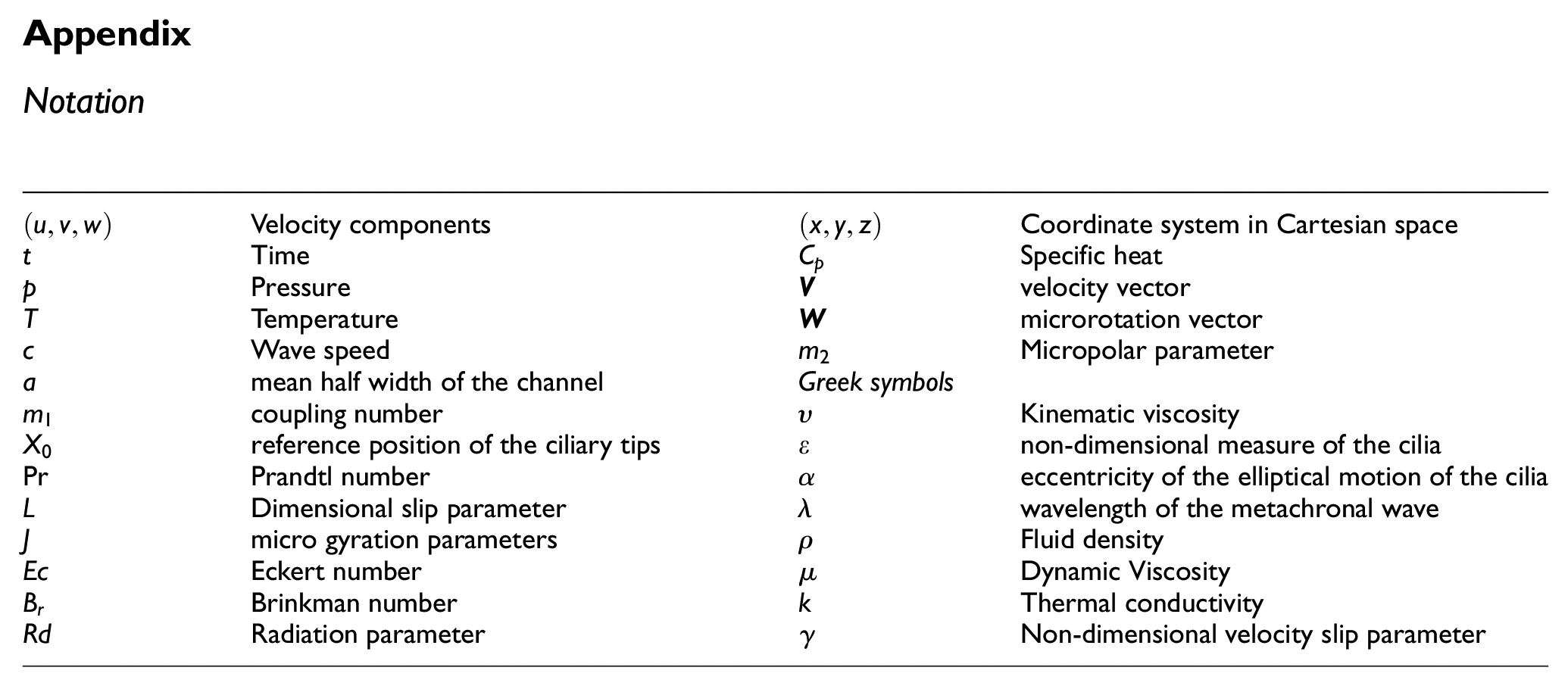
Notation
| Velocity components | Coordinate system in Cartesian space | ||
| Time | Specific heat | ||
| Pressure | velocity vector | ||
| Temperature | microrotation vector | ||
| Wave speed | Micropolar parameter | ||
| mean half width of the channel | Greek symbols | ||
| coupling number | Kinematic viscosity | ||
| reference position of the ciliary tips | non-dimensional measure of the cilia | ||
| Prandtl number | eccentricity of the elliptical motion of the cilia | ||
| Dimensional slip parameter | wavelength of the metachronal wave | ||
| micro gyration parameters | Fluid density | ||
| Eckert number | Dynamic Viscosity | ||
| Brinkman number | Thermal conductivity | ||
| Radiation parameter | Non-dimensional velocity slip parameter | ||
Acknowledgements
We are thankful to the reviewers for their encouraging comments and constructive suggestions to improve the quality of the manuscript.
Handling Editor: Sharmili Pandian
Declaration of conflicting interests
The author(s) declared no potential conflicts of interest with respect to the research, authorship, and/or publication of this article.
Funding
The author(s) received no financial support for the research, authorship, and/or publication of this article.
