




Abstract
In this article, the influence of a magnetic field is studied on a generalized viscous fluid model with double convection, due to simultaneous effects of heat and mass transfer induced by temperature and concentration gradients. The fluid is considered over an exponentially accelerated vertical plate with time-dependent boundary conditions. Additional effects of heat generation and chemical reaction are also considered. A generalized viscous fluid model consists of three partial differential equations of momentum, heat, and mass transfer with corresponding initial and boundary condition. The idea of non-integer order Caputo time-fractional derivatives is used, and exact solutions for velocity, temperature, and concentration in terms of Wright function and function of Lorenzo–Hartley are developed for ordinary cases. Graphical analysis of flow and fractional parameters is made by using computational software MathCad, and discussed. The results obtained are also in good agreement with the published results from the literature. As a result, it is found that temperature and fluid velocity can be enhanced for smaller values of fractional parameters.
Keywords
Introduction
Over the last few years, different publications on exact solutions of Newtonian and non-Newtonian fluids via fractional derivatives approach have been published. Khan et al. 1 introduced Caputo time-fractional derivative in the constitutive model of a generalized Casson fluid past an infinite flat plate oscillating in its own plane. Furthermore, they particularized their results for ordinary Casson fluid, viscous fluid with fractional derivative, and ordinary viscous fluid. Khan and Zaman 2 used the idea of fractional derivatives and solved the viscoelastic second grade fluid problem over an impulsive plate in the presence of a uniform magnetic field and porous medium. Rasheed et al. 3 avoided complex math calculi and used a numerical approach, namely, finite difference-finite element technique for solving fractional model of Oldroyd-B fluid in a closed channel. Few other important attempts among them are those made by Qi and Jin, 4 Qi and Xu, 5 Wang and Zhao, 6 Wang et al., 7 Mahmood et al., 8 Fetecau et al.,9,10 Jamil et al.,11,12 Khan et al., 13 and Kamran et al. 14
However, quite recently, an increasing interest has been evinced in the generalization of these problems to the flow situation with heat transfer or heat and mass transfers together. It is because in many engineering and industrial problems, the phenomenon of momentum transfer does not occur alone and is accompanied by heat transfer or heat and mass transfers. The numerical or approximate solutions for such problems are abundance in the literature, since such solutions do not require complicated math calculi. However, exact solutions of the generalized fluid problems (fractional fluid models) with combine heat and mass transfers require quite complicated calculus to solve and to understand; therefore, very few results to date have been published in the literature. Cattani et al., 15 in his recent book, discussed several physical situations on fractional derivatives including heat conduction problems. For convection problems, the idea of fractional derivatives is recently introduced, and so far, only few articles are published.
Among the recently published articles, Vieru et al. 16 studied time-fractional free convection flow of an incompressible viscous fluid near a vertical plate with Newtonian heating and constant mass diffusion at the bounding plate and in the presence of first-order chemical reaction. They used Laplace transform and obtained exact solutions for temperature, mass concentration, and velocity fields, in terms of Robotnov–Hartley and Wright functions. Further, they evaluated rates of heat and mass transfer together with shear stress at the bounding plate.
Shahid 17 analyzed radiative heat and mass transfer for generalized model of magnetohydrodynamic (MHD) viscous fluid flow over an infinite oscillating plate. Laplace transform technique was used, and the exact expressions for temperature, mass concentration, and velocity were presented in the forms of Fox-H function, General Wright function, and in the form of integral solutions using generalized function, respectively. Shakeel et al. 18 Obtained exact solutions in terms of Wright functions for convection flow over a heated vertical plate via time fractional derivative approach. In addition, they computed numerical results using the subroutines of the software package Mathcad, and found that both exact and numerical solutions are in good agreement. Zhao et al. 19 had investigated transient electro-osmotic flow of Oldroyd-B fluids in a straight pipe of circular cross section. They have seen the effects of relaxation and retardation time on velocity profiles are analyzed numerically. Chen et al. 20 used the idea of time–space-dependent fractional derivative to MHD viscoelastic fluid flow and analyzed the heat transfer over an accelerating plate with slip boundary condition. Ali et al. 21 extended the idea of time-fractional free convection flow from viscous fluid to non-Newtonian fluid of Brinkman-type. More exactly, they studied combined effects of heat and mass transfers of Brinkman-type fluid, also known as generalized Brinkman-type fluid, over an oscillating plate in the presence of first-order chemical reaction. Same as in the above problems, they used Laplace transform technique and obtained exact solutions for temperature, concentration, and velocity fields and presented them in terms of special functions such as Wright function, Fox-H function, Mittag-Leffler and general Wright functions.
This article aims to study the effects heat generation and chemical reaction on unsteady MHD flow of viscous incompressible fluid past an exponentially accelerated infinite vertical plate with variable temperature and variable mass diffusion. First of all, a generalized model in terms of partial differential equations with time-fractional derivatives under the imposed initial and boundary conditions has been developed. Then, by using the idea of Caputo time-fractional derivatives, the dimensionless system of equations has been solved using the Laplace transform technique. Exact solutions for velocity, temperature, and concentration are established in terms of Wright function and
Mathematical formulation of the problem
The unsteady MHD flow of viscous incompressible fluid past an exponentially accelerated isothermal infinite vertical plate with variable temperature with variable mass diffusion in the presence of heat absorption and variable temperature has been studied. Initially, the plate and the fluid are at the same temperature
We made the following assumptions:
All the fluid physical properties are considered to be constant except the influence of the body force term.
Applied transverse magnetic field of uniform strength
The fluid’s conducting property is supposed to be slight and hence the magnetic Reynolds number is lesser than unity and the induced magnetic field is small in comparison with the transverse magnetic field.
It is further supposed that there is no applied voltage, as the electric field is absent.
Viscous dissipation and Joule heating in energy equation are neglected.
Electric field is neglected.
According to Boussinesq’s approximation, the unsteady flow is governed by the following set of equations:
Linear momentum equation
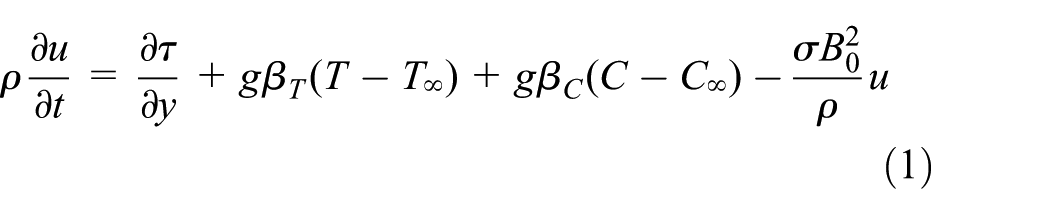
where

Thermal balance equation

where q is the thermal flux, its constitutive equation is obtained by Fourier’s law

Diffusion balance equation is

where

Initial and boundary conditions are



Introducing the following dimensionless variables and parameters

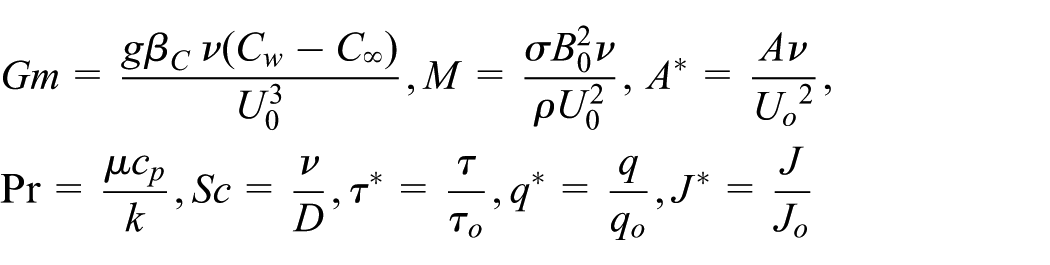
into equations (1)–(9) and dropping the star notation, we have the following initial-boundary problem



with dimensionless initial and boundary conditions



where

Fractional model
The basic fractional model is developed by generalizing the constitutive equations, that is, shear stress equation proposed by Scott-Blair and Caffyn 22

The constitutive thermal flux equation generalized by Fourier’s law proposed by Hristov 23 and Povstenko 24

The constitutive equation for diffusion given by Fick’s law

Substituting equation (20) into equation (11), equation (21) into equation (13) and equation (22) into equation (15), we get


Apply inverse left operators to equations (23), (24) and (25), we get


where

It is worth pointing that equations (26)–(28) are obtained by generalizing the constitutive equations and not by just replacing the time derivative by fractional derivative. 25
Solution of the problem
Calculation for temperature
Applying Laplace transform to equations (26), (18)2, (19)2 and using initial condition with


The solution of the partial differential equation (30) by using conditions in equation (31) is

Inverse Laplace transform of equation (32), will be obtained numerically by apply Stehfest’s and Tzou’s algorithms.26,27
The Nusselt number

Heat transfer rate in terms of Nusselt number by using equation (32)

The inverse Laplace transform of equation (34) will be calculated numerically.
Temperature field for the ordinary case
By taking

with inverse Laplace transform

The Nusselt number

where
Calculation for concentration
It is observed that the initial-boundary value problem for concentration

Calculation for velocity
Applying Laplace transform to equations (26), (18)1, (19)1 and using initial condition, we obtain


where
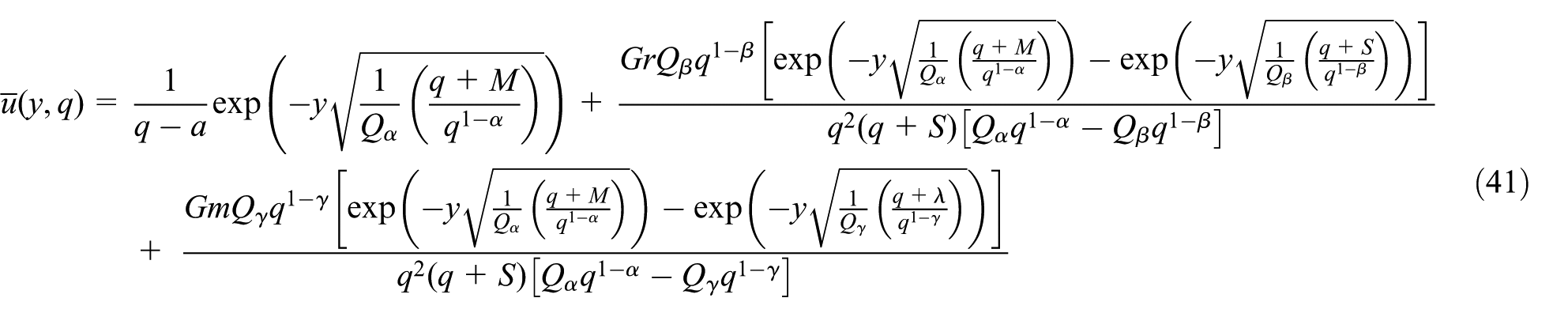
The expression obtained in equation (41) is a complex, its analytical results cannot be found; therefore, solution of equation (41) will be found numerically.26,27
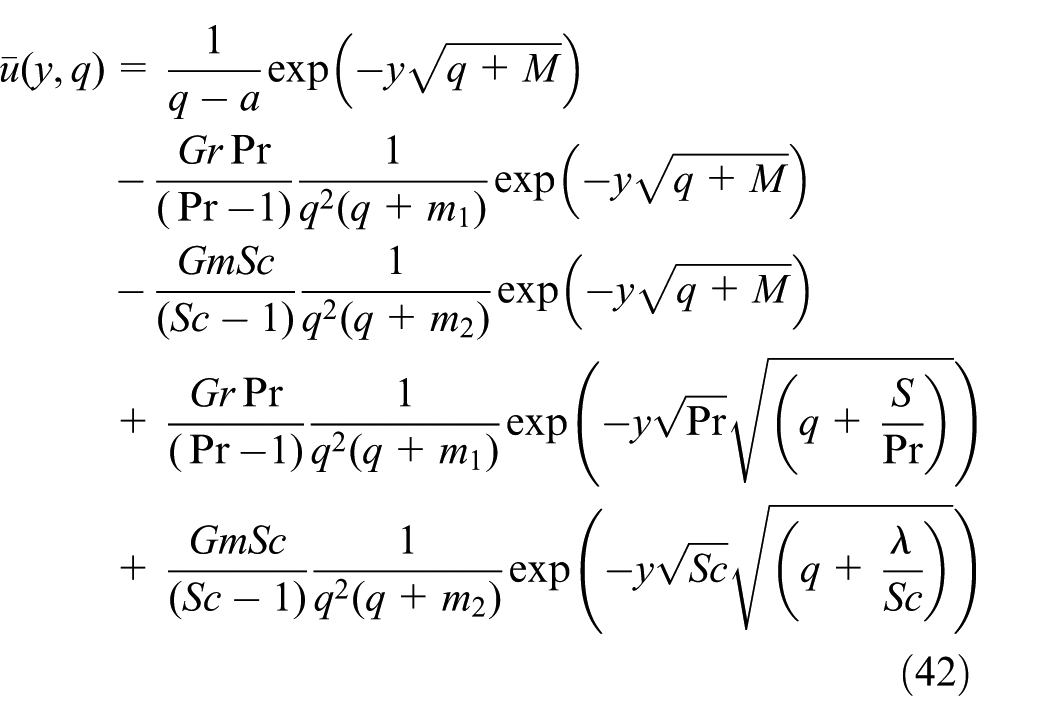
Velocity field for ordinary case
By taking
with inverse Laplace transform

where * represents convolution product and
Numerical results and discussions
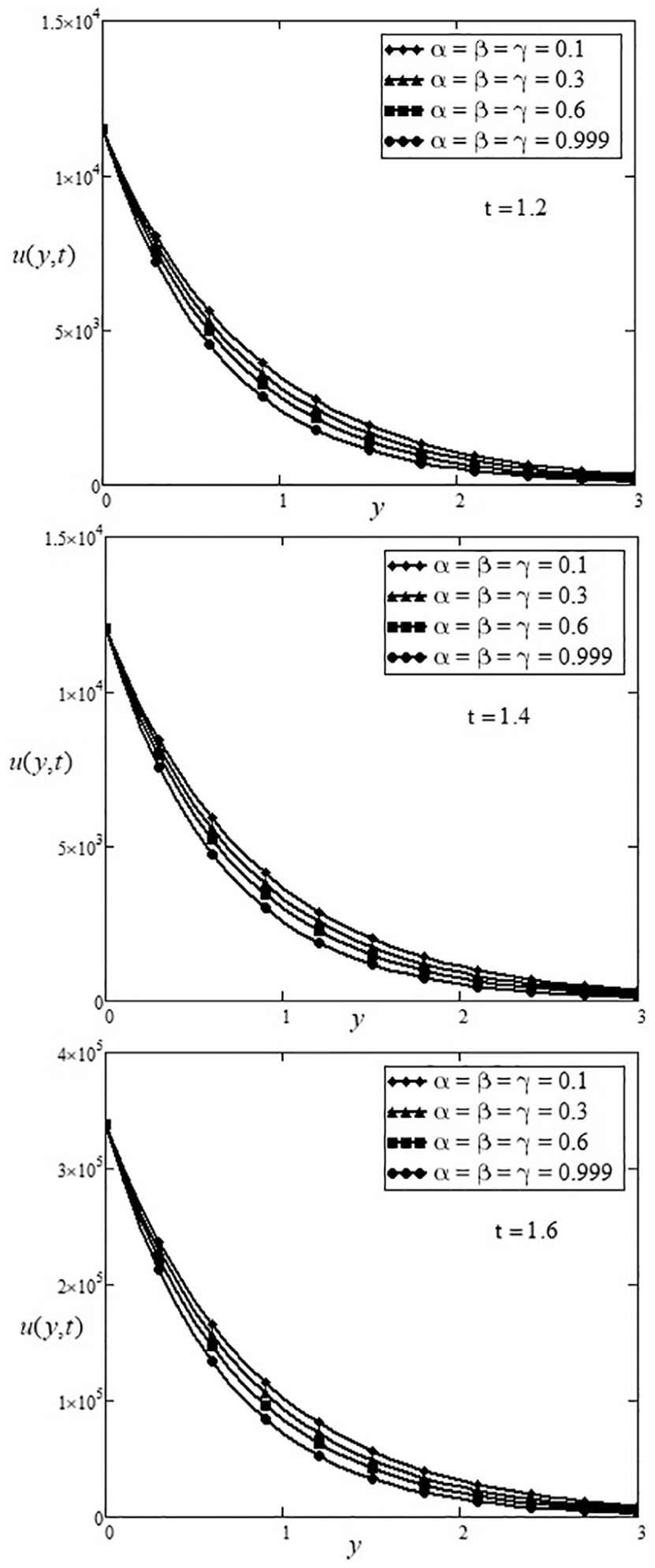
The effects of fractional parameter on temperature and velocity profiles are presented in Figures 1 and 2. It indicates that by increasing the value of fractional parameter, the temperature as well as the fluid velocity decreases. Further we also note that, for larger values of time t, the velocity and temperature are both increasing functions while thermal and momentum boundary layer thickness reduced. But the difference between the temperature and velocities is decreased.
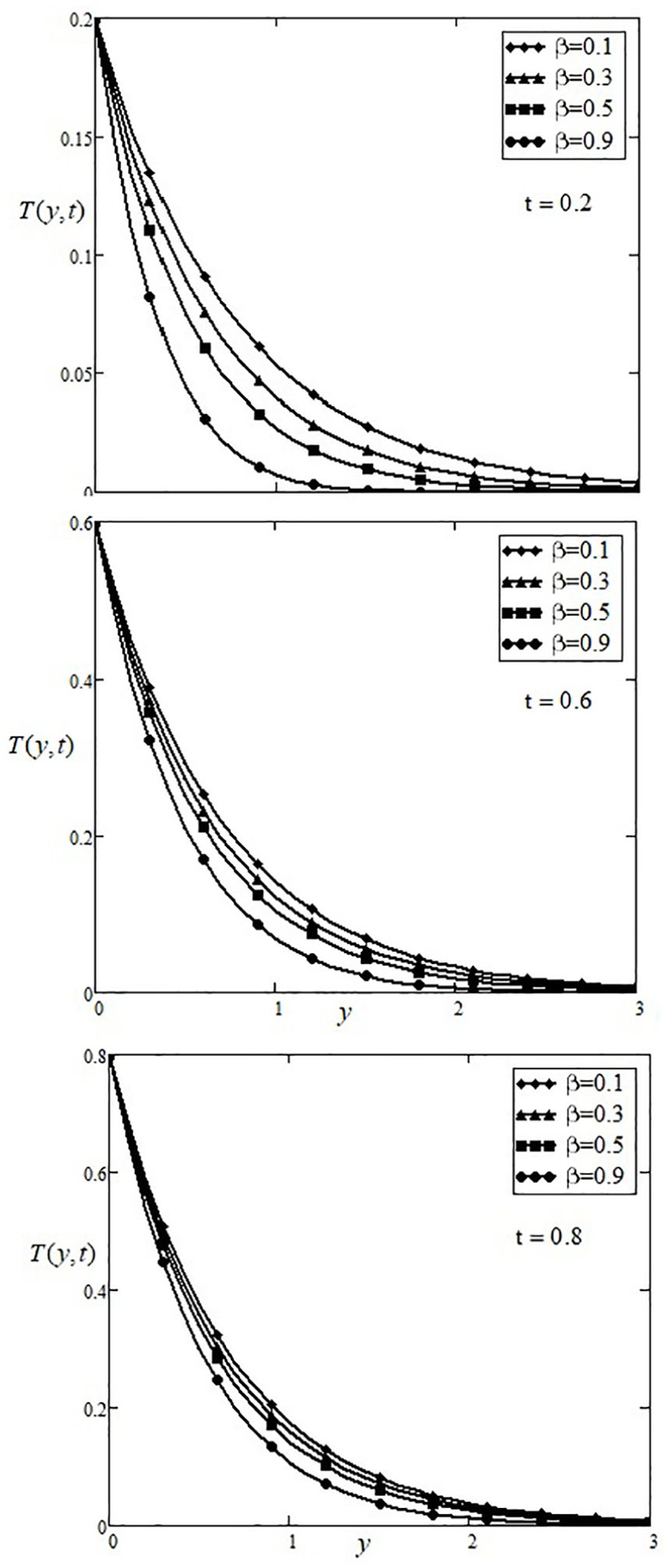
Profile of temperature for

Profile of velocity for
The influence of the Prandtl number
Profile of temperature for Pr variation and
The influence of Grashof number
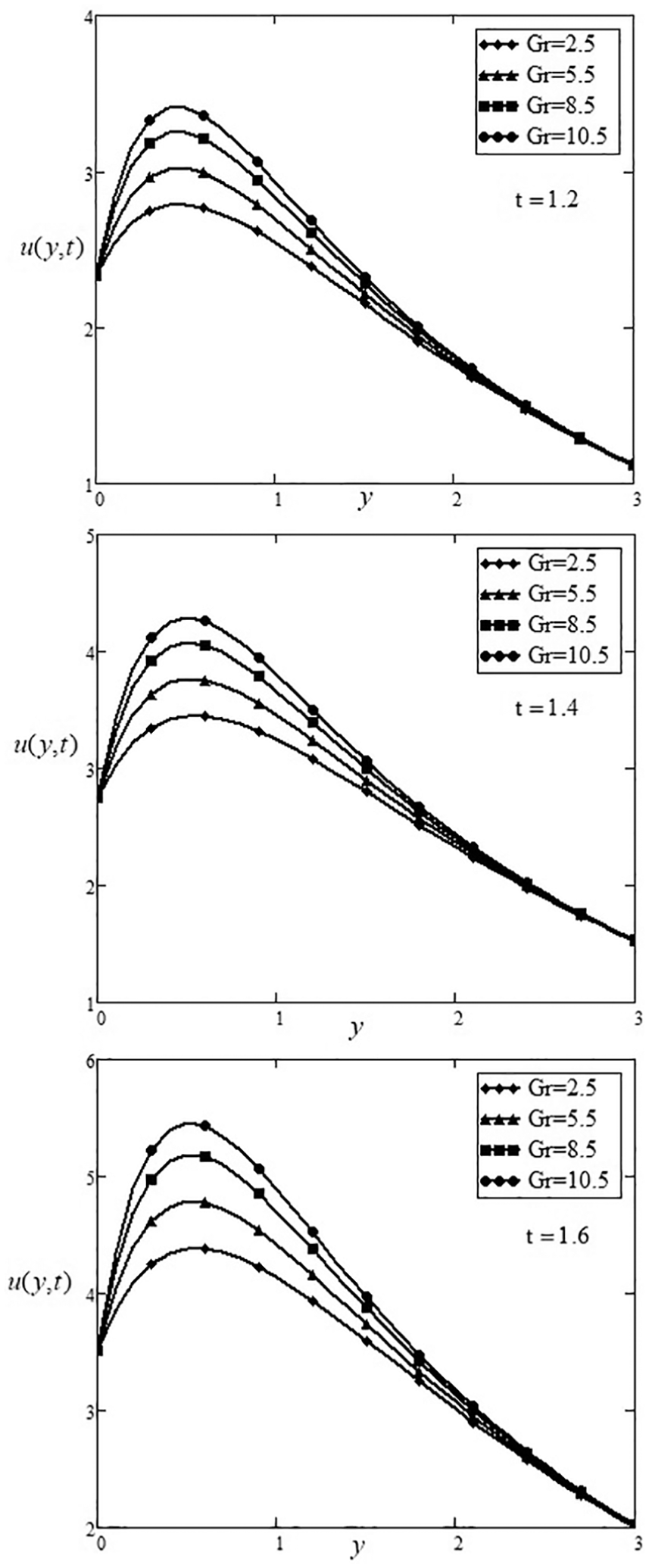
Profile of velocity for
The influence of Grashof number for mass transfer
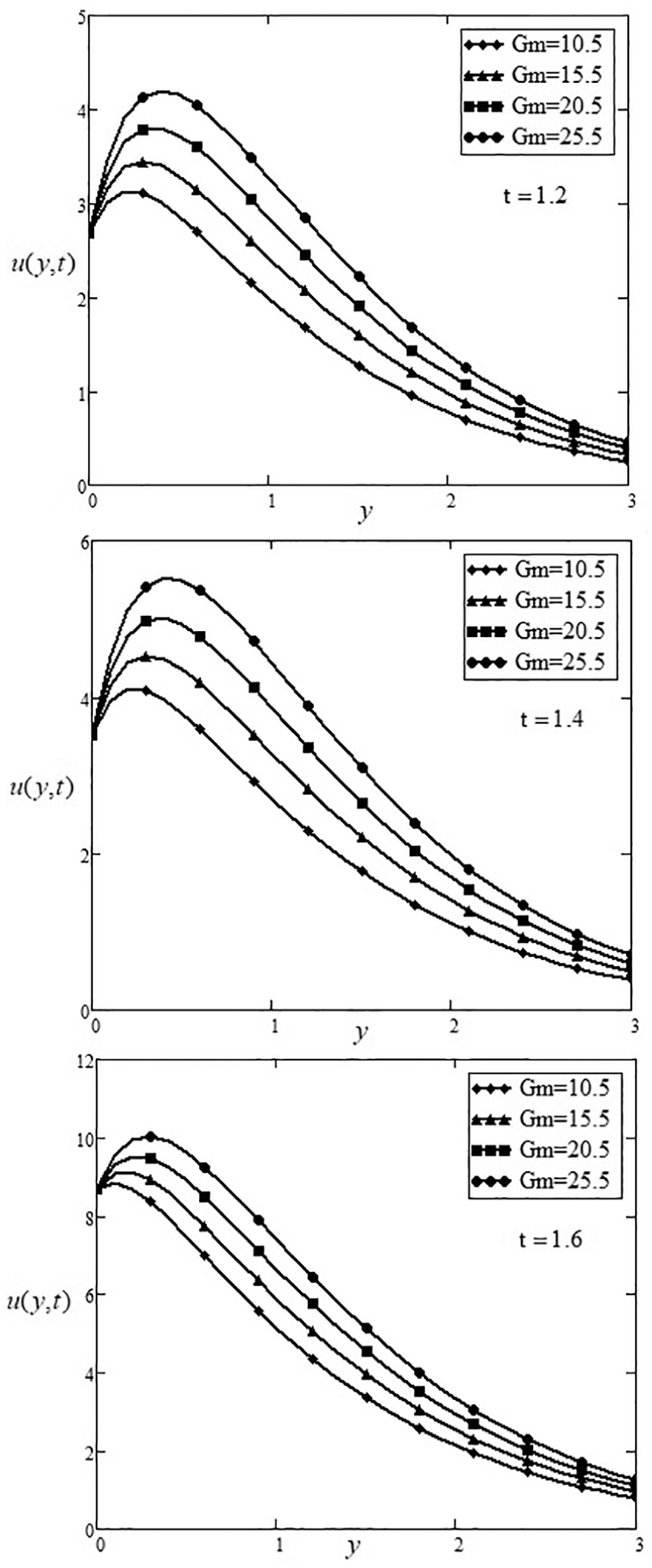
Profile of velocity for
In Figure 6, the effect of the magnetic field strength on the momentum boundary layer thickness is studied. It is noted that the magnetic field presents an effect on the velocity field by creating drag force that opposes the fluid motion, causing the velocity to decrease. However, in this case, an increase in the M only slightly slows down the motion of the fluid away from the moving vertical plate surface towards the free stream velocity, while the fluid velocity near the moving vertical plate surface decreases. This phenomenon is in excellent agreement with the physical fact that the Lorentz force generated in the present flow model due to interaction of the transverse magnetic field and the fluid velocity acts as a resistive force to the fluid flow which serves to decelerate the flow. Figure 7(a) and (b) is plotted to see the validity of our obtained results. We have compared our velocity results with the results from the studies by Imran et al.
28
and Khan et al.
29
and found that they are in good agreement with each other. Further, to check the correctness of inversion algorithms, namely, Stehfest’s and Tzou’s, a graphical comparison has been made, which is presented in Figure 8. In Figure 9, our obtained results are compared with the results of Nazar et al.
30
by taking
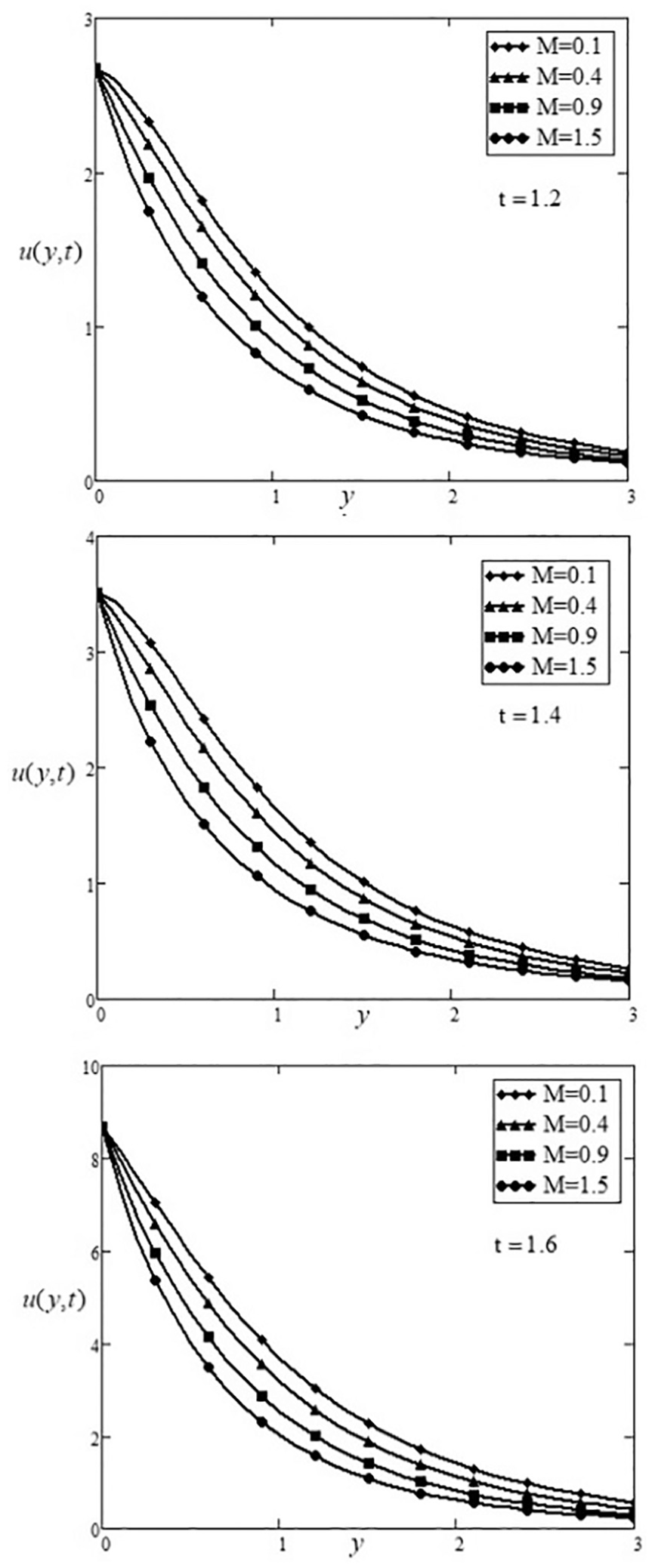
Profile of velocity for

(a) Velocity comparison graph when
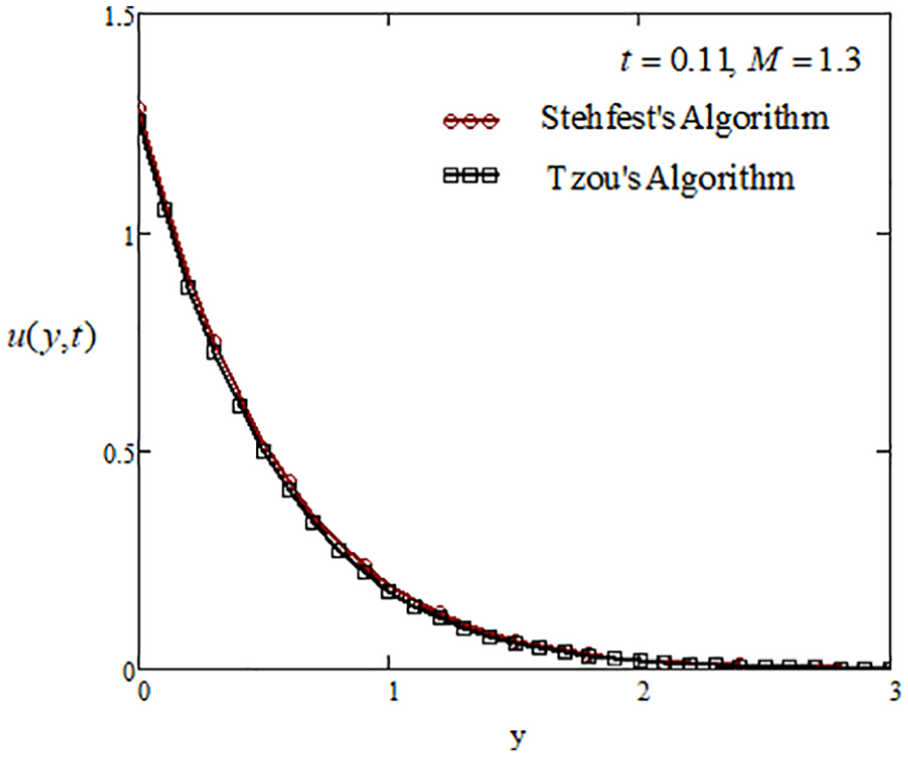
Velocity comparison graph when

Velocity comparison graph when
Conclusion
Magnetic field effect is studied on fractional model of viscous fluid with double convection due to simultaneous effects of heat and mass transfer. This convection was induced by temperature and concentration gradients. The infinite vertical plate was moved with exponentially accelerated motion of a vertical plate with variable heat and mass at the boundary. Moreover, additional effects of heat generation and chemical reaction were also considered. A generalized model of viscous fluid was developed and solved via fractional Laplace transform method introduced by Caputo. Exact solutions for velocity, temperature, and concentration were developed in terms of special functions, namely, Wright function and function of Lorenzo–Hartley. Some comparisons have been drawn and they are in good agreement with the results published in Imran et al., 28 Khan et al., 29 and Nazar et al. 30 The results were plotted and discussed with the following key points.
Increasing the value of fractional parameters, the temperature and velocity were increased for smaller values and decreased for larger values.
Increasing the Prandtl number
Velocity is maximum near the plate and found more distinctive peak values in the stream region and then decreased away from the plate.
Magnetic field was responsible for drag force and reduced fluid velocity.
Footnotes
Appendix 1
Appendix 2
Handling Editor: Dean Vučinić
Declaration of conflicting interests
The author(s) declared no potential conflicts of interest with respect to the research, authorship, and/or publication of this article.
Funding
The author(s) received no financial support for the research, authorship, and/or publication of this article.
